Three hybrids named {(tepb)[Ag4Br8]}(1), {(tepb)[Cu2(SCN)6]}(2) and {(tepb)[Ag4Br6(SCN)2]}n(3) [tepb4+ = 1, 2, 4, 5-tetrapyradyl benzene] were encountered by cation-templated self-assembly with metal thiocyanates in solution. Crystal data analysis revealed that these compounds were composed of discrete organic cations and inorganic anions by electrostatic and hydrogen bond interactions. 1 is a tetranuclear oligomer, 2 is a dimer and 3 possesses a 2D polyrotaxane layer structure. All compounds were further characterized with elemental analysis, IR spectra and thermal analysis.
The rational design and synthesis of template-oriented organic-inorganic hybrid materials has attracted considerable interest in the last few years not only from a structural point, but also due to their potential applications in different areas such as catalysis, medicine, molecular absorption, electromagnetism, sensors, ion exchange, and photochemistry applications [1–7]. One synthetic strategy for design of organic-inorganic hybrid materials was to combine suitable inorganic building blocks with organic templates with structure-directing functionality. Among the numerous families of organic-inorganic hybrid materials, the family directed by organic cations with azotic heterocycles has occupied a crucial position in chemical engineering and molecular science [8]. To date, many heterocyclic nitrogen-containing organic cations have been widely used to construct compounds with interesting structures and novel properties [9–11]. Monocationic or dicationic species have dominated the templated synthetic strategies to construct organic-inorganic hybrid frameworks by metal–ligand coordination, π-π stacking interactions, hydrogen bonding and solvophobic effects [2–18]. However, relatively few hybrid frameworks have employed multivalent polycations (greater than divalent) to direct self-assembly.
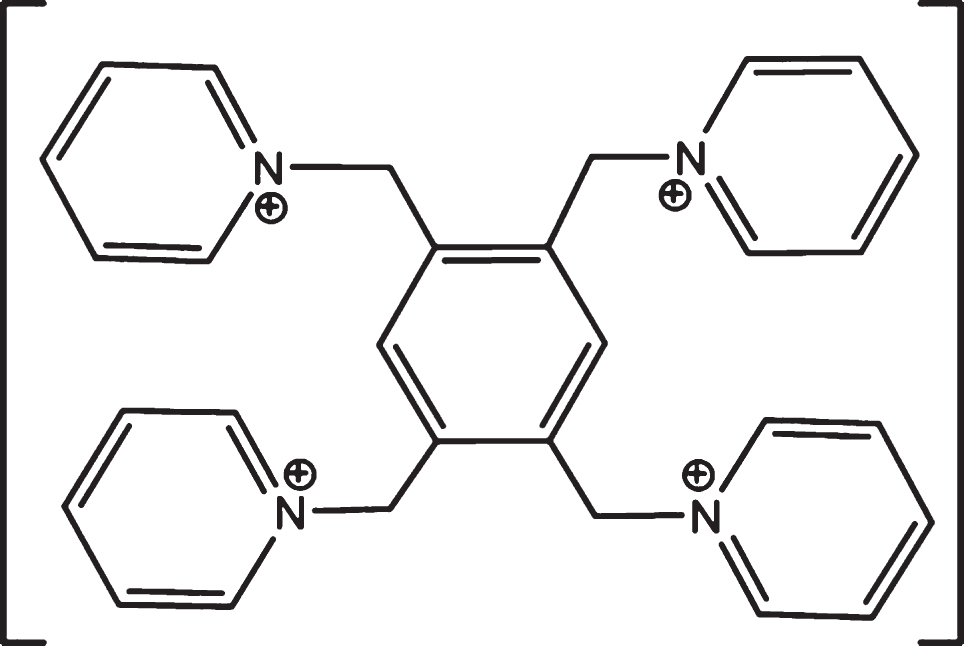
In this article, we reported the syntheses, crystal structures and thermal stability of three novel metal thiocyanate polymers: {(tepb)[Ag4Br8]}(1), {(tepb)[Cu2(SCN)6]}(2) and {(tepb)[Ag4Br6(SCN)2]}n(3) induced by tetracation template as depicted in Scheme 1.These compounds exhibit interesting oligomer, dimer or 2D polyrotaxane structures.
The tetracation used in this study.
Experimental
Materials and methods
tepb4+ = 1, 2, 4, 5-tetra (N-pyridiniummethyl) bezene tetrabromide (tepb·4Br) was prepared from refluxing reaction of 1, 2, 4, 5-tetra(bromomethyl)benzene with excessive pyridinium in toluene under 110°C, similar to a literature approach [19]. Other chemicals and solvents were obtained from commercial sources and used as received without further purification. The IR spectrum was recorded on a Shimadzu IR435 spectrometer as KBr disk (0–400cm-1). Elemental analysis for C, H, and N was performed on a Perkin–Elmer 240 elemental analyzer. A model NETZSCHTG209 thermal analyzer was used to record simultaneous TG curves in the flowing air atmosphere of 20 mL min-1 at a heating rate of 5°C min-1 in the temperature range from room temperature to 800°C using aluminum crucibles.
Preparation of {(tepb)[Ag4Br8]}(1)
A solution of tepb·4Br (0.1 mmol) in DMF was added to a stirring solution of AgSCN (0.1 mmol) dissolved in 10 mL DMF in the presence of excess KSCN (0.4 mmol). The resulting mixture was stirred for 5 min and filtered. Then the solution was slowly evaporated in a vial at room temperature. The light brown crystals of {(tepb)[Ag4Br8]} suitable for X-ray analysis were obtained after two weeks in about 30% yield. The product was not soluble in common solvents. IR(KBr): 3118.62(m), 3066.76(m), 3046.51(s), 2956.77(m), 2077.64(w), 1630.66(s), 1576.98(w), 1528.24(w), 1483.36(vs), 1438.34(w), 1303.07(w), 1140.98(vs), 953.62(w), 886.06(w), 865.55(w), 823.29(w), 807.21(w), 765.66(w), 680.31(m), 618.30(m), 470.10(w), 438.92(w) cm-1.Anal calcd for C30H30N4Ag4Br8: H,1.99; C,23.75; N,3.69. Found: H, 1.94; C, 23.83; N, 3.62.
Preparation of {(tepb)[Cu2(SCN)6]}(2)
The procedure was similar to the synthesis of 1, except that AgSCN was replaced by CuSCN (0.1 mmol) and tepb·4BF4 was used instead of tepb·4Br. Red crystals of {(tepb)[Cu2(SCN)6]} suitable for X-ray analysis were obtained about 83% yield. IR(KBr): 3115.67(m), 3055.27(s), 2967.97(m), 2079.25(vs), 2065.04(vs), 1625.90(s), 1481.12(s), 1144.44(m), 757.83(s), 674.38(s),605.61(w), 461.47(w) cm-1.Anal calcd for C36H30Cu2N10S6: H, 3.28; C, 46.89; N, 15.19. Found: H, 3.24; C, 46.82; N, 15.25.
Preparation of {(tepb)[Ag4Br6(SCN)2]}n(3)
The procedure was similar to the synthesis of 1, except that more AgSCN (0.2 mmol) + KSCN (0.8 mmol) were used. Dark brown crystals of {(tepb)[Ag4Br6(SCN)2]} suitable for X-ray analysis were obtained about 40% yield. IR(KBr): 3449.69(vs), 3120.48(m), 3057.57(s), 2948.49(m), 2102.78(vs), 1705.20(w), 1630.30(s), 1578.11(w), 1496.84(m), 1480.76(s), 1461.88(m), 1371.00(w), 1258.71(w), 1212.82(w), 1145.91(s), 930.59(w), 790.04(w), 755.42(m), 711.16(w), 672.23(m), 618.22(m), 466.97(w), 435.86(w) cm-1. Anal calcd for C32H34Ag4Br6N6O2S2: H, 2.27; C, 25.46; N, 5.57. Found: H, 2.23; C, 25.51; N, 5.62.
X-ray structure data collections
Crystallographic data for the title three compounds were collected at 100(2) K on a Bruker APEX-II area-detector diffractometer equipped with graphite- monochromatized Mo-Kα radiation (λ= 0.71073Å). Their structures were solved by direct methods and expanded using Fourier techniques. The non-hydrogen atoms were refined with anisotropic thermal parameters. The hydrogen atoms were assigned with common isotropic displacement factors and included in the final refinement by using geometrical constraints. The structures were refined with full-matrix least-squares techniques on F2 using the SHELXTL-97 program package [20, 21]. Crystal data are summarized in detail in Table 1.
Crystallographic data
Compound
1
2
3
Formula
C30H30Ag4Br8N4
C36H30Cu2N10S6
C32H34Ag4Br6N6O2S2
Formula weight
1517.34
922.14
1509.71
Crystal system
monoclinic
monoclinic
orthorhombic
Space group
P21/c
P21/c
Acam
a/Å
8.4586(3)
13.820(10)
12.7982(5)
b/Å
20.2847(8)
8.928(6)
20.8021(7)
c/Å
11.5117(4)
15.971(12)
16.1772(6)
a()
90.00
90.00
90.00
b()
94.057(3)
91.43(2)
90.00
g()
90.00
90.00
90.00
V/Å3
1970.22(12)
1970(3)
4306.8(3)
Z
2
2
4
ρ/Mg cm-3
2.558
1.555
2.328
μ/mm-1
25.440
1.440
7.493
F(000)
1412.0
940
2856.0
Crystal size/mm3
0.13×0.13×0.1
0.5×0.4×0.1
0.16×0.15×0.12
T/K
291.15
293(2)
291.15
Reflections collected
7312
12330
5808
data/restrains/parameters
3509/0/208
3467/3/244
2278/14/148
GOF on F2
1.050
1.054
1.018
Final R indices [I > 2σ (I)]
R1 = 0.0583, wR2 = 0.1549
R1 = 0.0381, wR2 = 0.0956
R1 = 0.0481, wR2 = 0.1026
R indices (all data)
R1 = 0.0699, wR2 = 0.1704
R1 = 0.0434, wR2 = 0.0434
R1 = 0.0792, wR2 = 0.1160
Largest diff. peak
1.85
0.628
1.44
hole(e Å-3)
–0.90
–0.549
–1.01
Results and discussion
Structure description of {(tepb)[Ag4Br8]}(1)
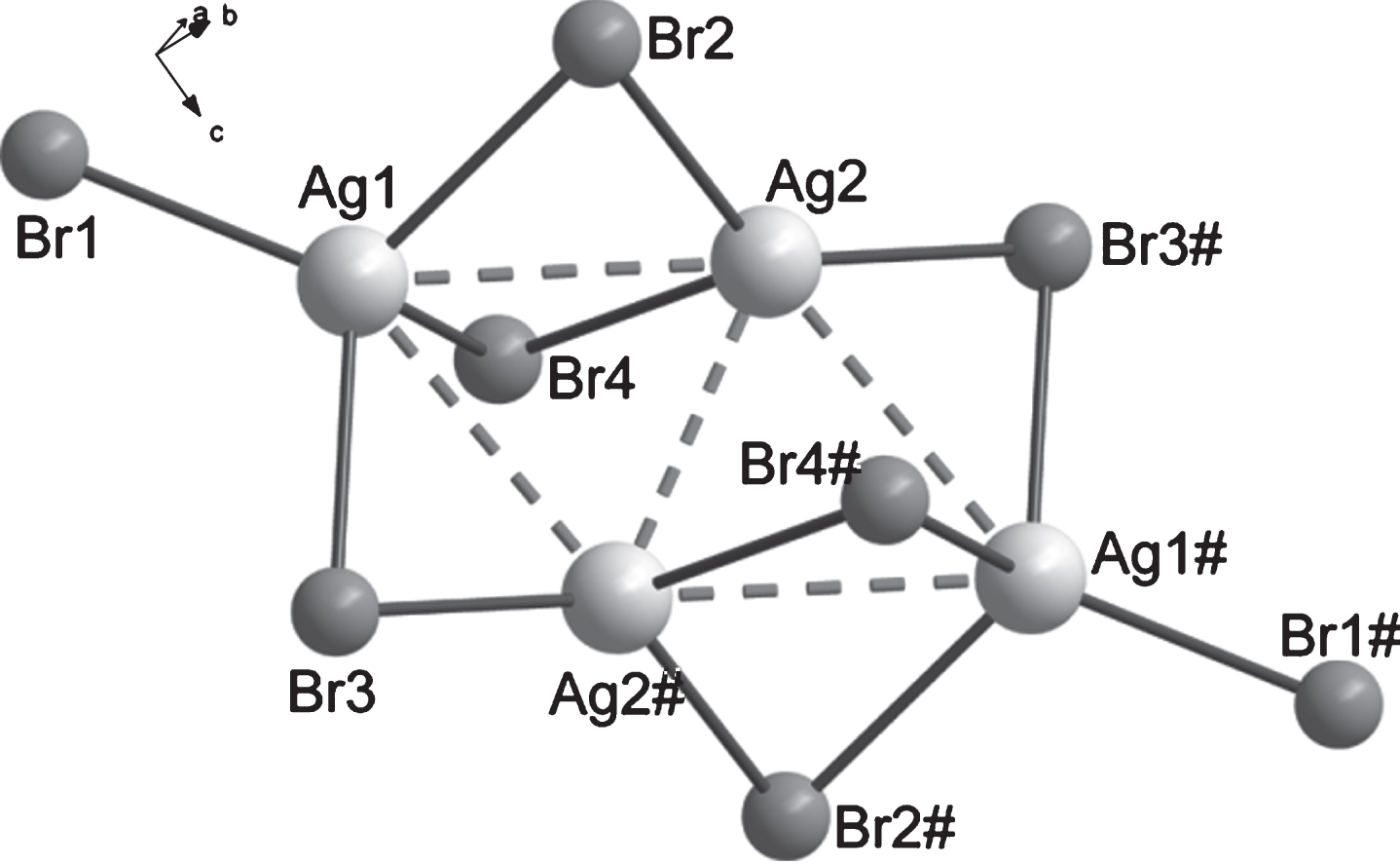
Bromine atoms preferentially coordinate the silver atoms, so SCN- groups do not participate in the coordination in 1. Compound 1 crystallizes in the monoclinic space group P21/n with its asymmetric unit including one tetrameric inorganic anion [Ag4(μ2-Br)6(t-Br)2]4- and tetracation tebp4+. In the structure each Ag(1) coordinates to three μ2-Br and one t-Br (Fig. 1). In contrast, Ag(2) is coordinated by three μ2-Br. All the Ag-μ2-Br distances vary from 2.634 Å to 2.937 Å and the bond length of Ag(1)-t-Br is 2.590 Å. The distance of Ag(1)···Ag(2) (3.295 Å), Ag(1)···Ag(2)# (3.213 Å), or Ag(2)···Ag(2)# (2.852 Å), has been proved shorter than double Van der Waals radius of Ag atom (3.44 Å), indicating the existence of metal-metal interactions. The tetracations take trans-configuration and it is the C-H···Br hydrogen bonds and electrostatic interaction that hold positive and negative ions together.
The Ag-Br unit in compound 1.
Structure Description of {(tepb)[Cu2(SCN)6]} (2)
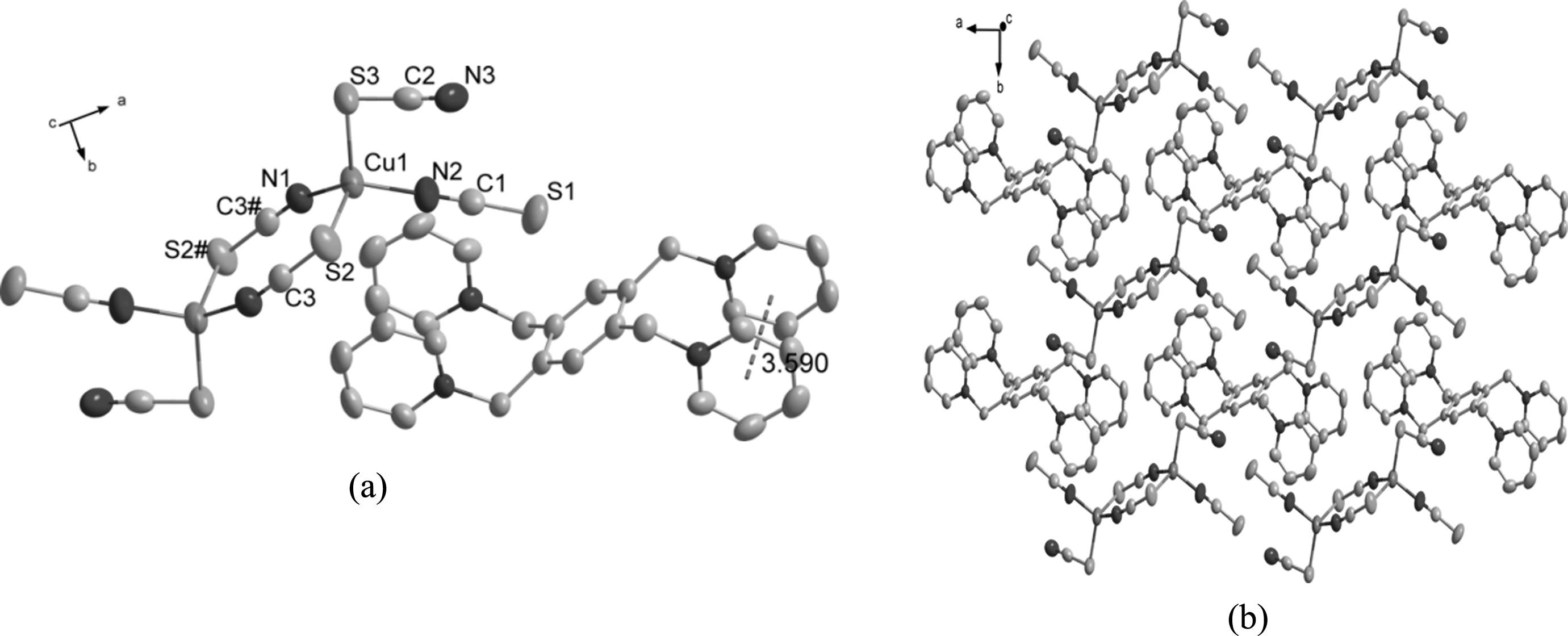
Compound 2 features a centrosymmetric dimeric inorganic phase and disperses four-charged cations as illustrated in Fig. 2a. Each cuprous center adopts the different circumstance of 2N2S with Cu-N(1) = 1.957 Å, Cu-N(2) = 1.957 Å, Cu-S(2) = 2.505 Å and Cu-S(3) = 2.364 Å. The bond angles of Cu-N(1)-C(3)# and Cu-N(2)-C(1) are 158.19° and 171.08°. The angles of Cu-S(2)-C(3) and Cu-S(3)-C(2) are 98.64° and 95.57°.
The structural unit (a) and the monolayer (b) of compound 2.
The distance of two pairs of pyridinium rings in one polycation is 3.590 Å, meaning a weak π-π stacking caused by high polarized ambient. Delicate perception tells two kinds of similar but different orientations of the structural unit, of which the angle is approximately 74.13°. Each orientation extends into independent layers along ab-plane as shown in Fig. 2b. It is the alternative arrangement of the two orientated layers in space that piles the layers up into three-dimensional arrangement along c-axle.
Structure Description of {(tepb)[Ag4Br6(SCN)2]}n(3)
3 crystallizes in orthorhombic space group Acam. It features tebp4+ threaded in the two dimensional inorganic network and water molecular distributed between layers. X-ray crystallographic analysis reveals only one independent Ag+ center in the inorganic moiety: Ag(1) is four-coordinated by three μ2-Br and one end-on S-μ2-SCN-. The bond lengths of Ag-Br vary from 2.623 Å to 2.777 Å and Ag-S is as long as 2.592 Å. The distance of Ag(1)···Ag(1)# is 3.373 Å, indicating a week metal-metal interaction. As shown in Fig. 3a, the SCN- groups act as the connecter bridging two [Ag2Br2] by coordinating to silver ions. Due to the flexibility caused by Br(1), hexagonal rings compose each inorganic layer viewing along b-direction, as shown in Fig. 3b. From Fig. 3c we know that the tetracations(tebp4+) take a classical trans-configuration in 3. It is made up of infinite 2D inorganic networks with the corresponding tetracations trapped inside to form a penetrating model. Polyrotaxane architecture consisting of a 2D inorganic network perforated with organic molecules was few reported. From this point of view, 3 can be regarded as the rare representative example of 2D polypseudorotaxane polymers. The topological diagram is shown in Fig. 3d.
The diagram of inorganic unit (a), hexagonal ring in each inorganic layer (b), transfixion model (c), topological diagram (d) of compound 3.
Thermogravimetric analyses
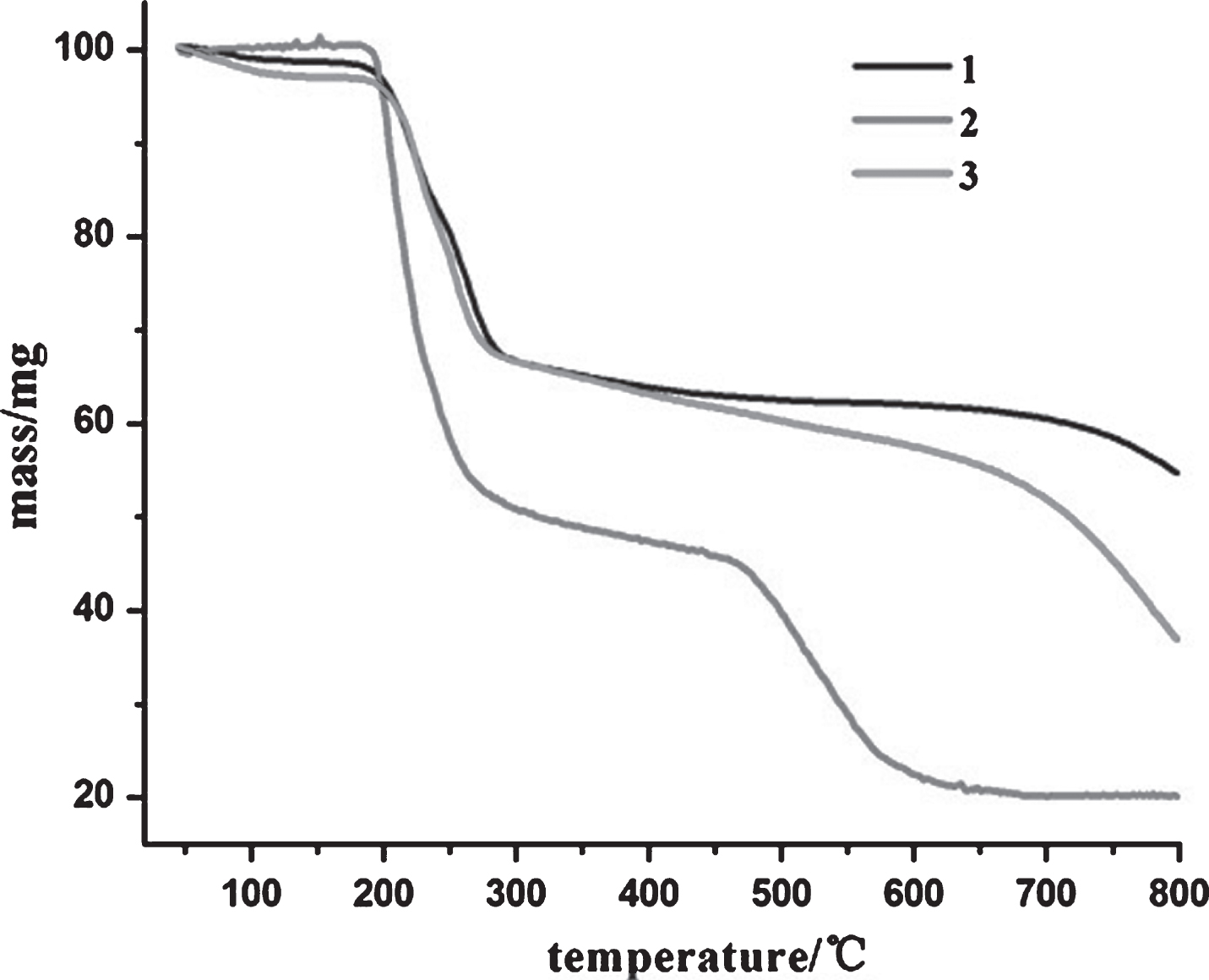
To estimate the stability of 1, 2 and 3, the TGA experiments were carried out up to 800° in flowing air atmosphere and the TG curves of three compounds are shown in Fig. 4. Results show the organic moieties were largely lost at around 190°C, which is approximately equal to that of honeycomb-like hybrids, meaning a similar protection imposed on the interior organic cations by the inorganic moieties. This is ascribable to the analogous threading and exposure of inner cations through the annulus of inorganic macrocycles [22].
The TG curves of compounds 1-3.
Conclusions
In conclusion, we have presented the template effect of tetracationic tepb4+ by the preparation of three organic-inorganic hybrids 1-3 with tetranuclear, dinuclear and 2D structures. In three compounds, the organic moiety acts as structural directing agents. Its properties, such as geometry and relative orientation play the important roles in dictating the formation of inorganic polymer framework. Further work is in progress to extend this facile method to other metal pseudohalides and evaluate the influences of cations structure and different anions on the resulting supramolecular structures.
Supplementary data
Supporting information: Important bond distances and angles for 1-3; CCDC reference numbers: 918704 (1), 926180 (2), and 918703 (3). These data can be obtained free of charge via http://www.ccdc.cam.ac.uk/conts/retrieving.html, or from the Cambridge Crystallographic Data Centre, 12 Union Road, Cambridge CB2 1EZ, UK; Fax: t44 1223 336 033 or Email: deposit@ccdc.cam.ac.uk.
Footnotes
Acknowledgments
Research efforts in the Niu group are supported by the National Science Foundation of China (No. 21671177).
References
1.
StuppS.I. and BraunP.V., Molecular Manipulation of Microstructures: Biomaterials, Ceramics, and Semiconductors, Science277 (1997), 1242.
2.
MüllerA., ShahS.Q.N., BöggeH. and SchmidtmannM., Molecular growth from a Mo176 to a Mo248 cluster, Nature397 (1999), 48.
3.
ZaworotkoM.J., From Disymmetric Molecules to Chiral Polymers: A New Twist for Supramolecular Synthesis, Angew Chem Int Ed37 (1998), 1211.
4.
HillC.L., RhuleJ.T. and JuddD.A., Polyoxometalates in Medicine, Chem Rev98 (1998), 327.
5.
CheethamA.K., FereyG. and LoiscauT., Open-Framework Inorganic Materials, Angew Chem Int Ed38 (1999), 3268.
6.
WangC.H., SongL.S., NiuY.Y. and LiangY., Synthesis, structures and properties of twonovel supramolecular polymers of Cu(I) with 1,1′-Bis (isoquinoline)-1,4-Phenyldimethylenyl, Main Group Chemistry14 (2015), 71.
7.
ChenY., YangZ., GuoC.X., NiC.Y., RenZ.G., LiH.X. and LangJ.P., Iodine-induced solvothermal formation of viologen iodobismuthates, Eur J Inorg Chem33 (2010), 5326.
8.
DesirajuG.R., Supramolecular Synthons in Crystal Engineering-A New Organic Synthesis, Angew Chem Int Ed Engl34 (1995), 2311.
9.
LeongW.L. and VittalJ.J., One-Dimensional Coordination Polymers: Complexity and Diversity in Structures, Properties, and Applications, Chem Rev111 (2011), 688.
10.
JiaQ.X., WangY.Q., YueQ., WangQ.L. and GaoE.Q., Isomorphous CoII and MnII materials of tetrazolate-5-carboxylate with an unprecedented self-penetrating net and distinct magnetic behaviours, Chem Commun40 (2008), 4894.
11.
LiW., JiaH.P., JuZ.F. and ZhangJ., A series of manganese-carboxylate coordination polymersexhibiting diverse magnetic properties, Dalton Trans39 (2008), 5350.
LiL., YueJ.M., QiaoY.Z., NiuY.Y. and HouH.W., The side chain template effect in viologen on the formation of poly- pseudorotaxane architecture: Six novel metal coordination polymers and their properties, CrystEngComm15 (2013), 3835.
14.
YueJ.M., NiuY.Y., ZhangB., NgS.W. and HouH.W., Four novel metal coordination polymers directed by 1,1′-dibutyl-4,4′-bipyridinium dibromide (BBP) and their framework dependent luminescent properties, CrystEngComm13 (2011), 2571.
15.
XuG., GuoG.C., WangM.S., ZhangZ.J., ChenW.T. and HuangJ.S., Photochromism of a Methyl Viologen Bismuth(III) Chloride: Structural Variation Before and After UV Irradiation, Chem Int Ed46 (2007), 3249.
16.
QiaoY.Z., YueJ.M., LiuX.C. and NiuY.Y., Three novel cation-templated metal thiocyanates with 1-2D polypseudorotaxane frameworks, CrystEngComm13 (2011), 6885.
17.
LvX.R., ZhaoF.K., GuoX.L., NiuY.Y., XuN., HouH.W., FanY.T., SunD. and ZhuY., Hydrothermal synthesis, structure and fluorescent property of a novel cuprous thiocyanate inorganic polymer directed by 1,5-bis(pyridinium) pentane cation, Inorg Chem Commun12 (2009), 653.
18.
JiangX.M., ZhangM.J., ZengH.Y., GuoG.C. and HuangJ.S., Inorganic Supramolecular Compounds with 3D Chiral Frameworks Show Potential as Both Mid-IR Second-Order Nonlinear Optical and Piezoelectric Materials, J Am Chem Soc133 (2011), 3410.
19.
LiL., ZhuL., YueZ.C., ZhangW.L., ZhangB., NiuY.Y. and HouH.W., Three unprecedent polycational templated cuprous thiocyanate networks: Synthesis, structure and Properties, CrystEngComm15 (2013), 8395.
20.
SheldrickG.M., SHELX97. Program for crystal structure solution and refinement, University of Gottingen, Germany, 1997. .
21.
Stoe and Cie, X-STEP32, Version 1.07b: Crystallographic package. (GmbH: Darmstadt, Germany, 2000).
22.
ValderreyV., Escudero-AdanE.C. and BallesterP., Polyatomic Anion Assistance in the Assembly of [2]Pseudorotaxanes, J Am Chem Soc134 (2012), 10733.