



Abstract
A novel supramolecular compound {(L1) [CdI4]} (L1 = 1-(3-(((1 s,3R,5S)-1,3,5,7,tetraazaadamantan-1-ium-1-yl)methyl)benzyl)-1,3,5,7,-tetraazaadamantan-1-ium) was synthesized from CdI2 and L1 by self-assembly reaction in solution. Its structure was analyzed by X-ray diffraction, and X-ray crystallography showed that the crystal was mononuclear. The compound was characterized by UV, TG, photocatalysis and adsorption.
Introduction
Over the past 20 years, the research on organic-inorganic supramolecular compounds has been deepening. A supramolecular compound is a compound in which a plurality of particles are bonded together by a non-covalent bond such as hydrogen bonding, van der Waals force, host-guest chemistry, and electrostatic interaction [1–5]. But supramolecular compounds are not a simple combination of components, they produce some new properties that are different from the original components. Due to the crystal topological diversity and magnetic properties of supramolecular compounds, the application prospect of supramolecular compounds in photocatalysis, selective adsorption, and magnetic field is also increasing [6]. Supramolecular chemistry also intersects with many fields, such as biochemistry, environmental science, and information science [7–9]. Nitrogen-containing heterocyclic supramolecular compounds are an important branch of supramolecular compounds. Nitrogen-containing heterocycles are easy to modify, and people introduce various functional groups into them. The compounds after the introduction of functional groups have excellent properties in terms of adsorption and photocatalysis [10]. The crystal synthesized in this paper is a supramolecular compound containing nitrogen heterocyclic organic cations. In addition, we also characterize its structural properties.
Experimental
Materials and methods
According to the method reported in the literature, the organic cationic template L1 was synthesized (Scheme 1). All other reagents are of A. R. grade (≥99%) reagents obtained from commercial sources without further purification. Distilled water was used for all procedures. The UV-vis diffuse reflection spectra was recorded with the Cary 5000 UV-Vis-NIR. The purity of the synthesized bulk microcrystalline materials was measured by powder X-ray diffraction. A model NETZSCHTG209 thermal analyzer was used to record the synchronous TG curve with in the flowing air with a temperature range of 20–900°C, a heating rate of 5°C and a temperature range of 20 mL·min–1.
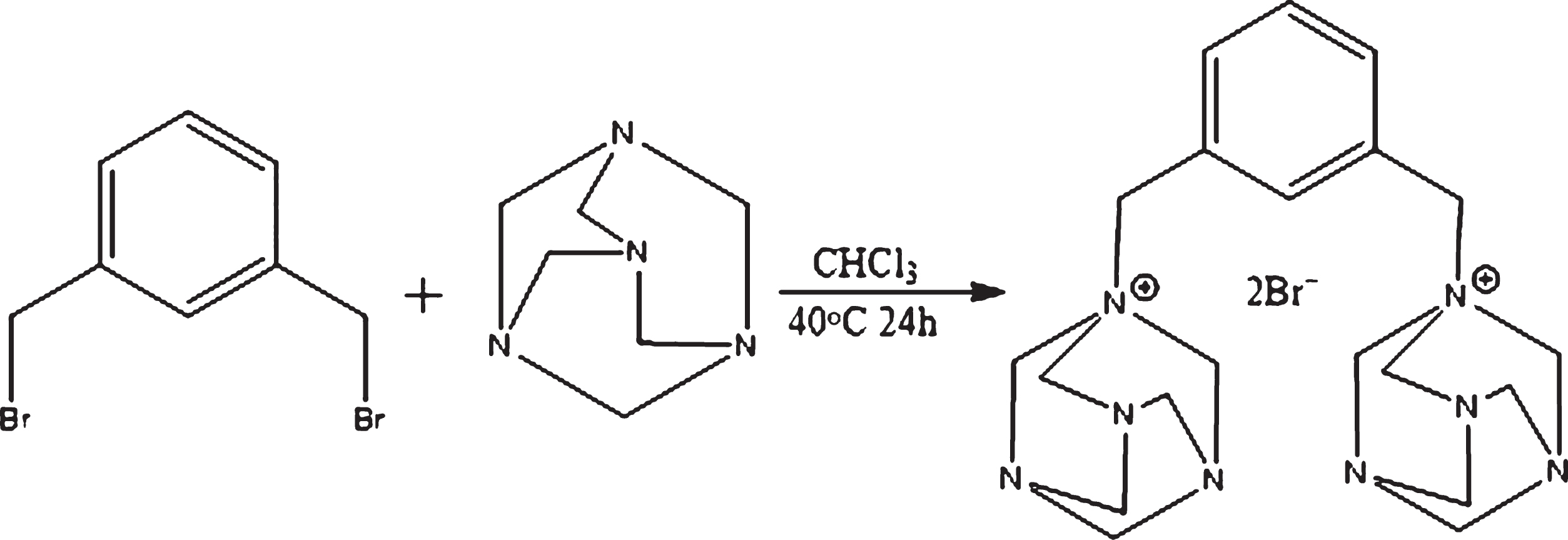
Chemical reaction of synthetic ligand.
HMT (0.1794 g, 1.28 mmol) was added to 45 ml of a chloroform solution until the HMT was completely dissolved. Then m-dibenzyl bromide (0.1689 g, 0.64 mmol) dissolved in 30 mL chloroform solution was added dropwise. The mixture was stirred at 40°C for 24 h to give a white solid. It was washed with chloroform and naturally dried at room temperature to obtain a ligand L1 having a yield of more than 80% [11]. The reaction diagram is as follows:
A acetonitrile solution of L1 (0.054 g, 0.1 mmol) was added to a stirred acetonitrile solution of CdI2 (0.037 g, 0.1 mmol) dissolved in water. The resulting mixture was stirred for 5 minutes and filtered. The solution was then slowly evaporated in a vial at room temperature. A rod-shaped colorless crystal was obtained after 3 days.
X-ray crystallography study
Single crystal X-ray diffraction data of the compound 1 are recorded in Brucker SMART CCD diffraction graphite - monochromated Cu - K alpha radiation at 293 K (lambda = 0.71073). Data reduction and absorption correction is done using the SADABS package. After absorption correction, packages such as shelxtl-97 and olex-2 were used for analysis. In addition to disordered atoms, hydrogen atoms are designated as a common isotropic substitution factor and are finally refined by using geometric constraints. Table 1 summarizes key crystallographic information. A compound most similar to
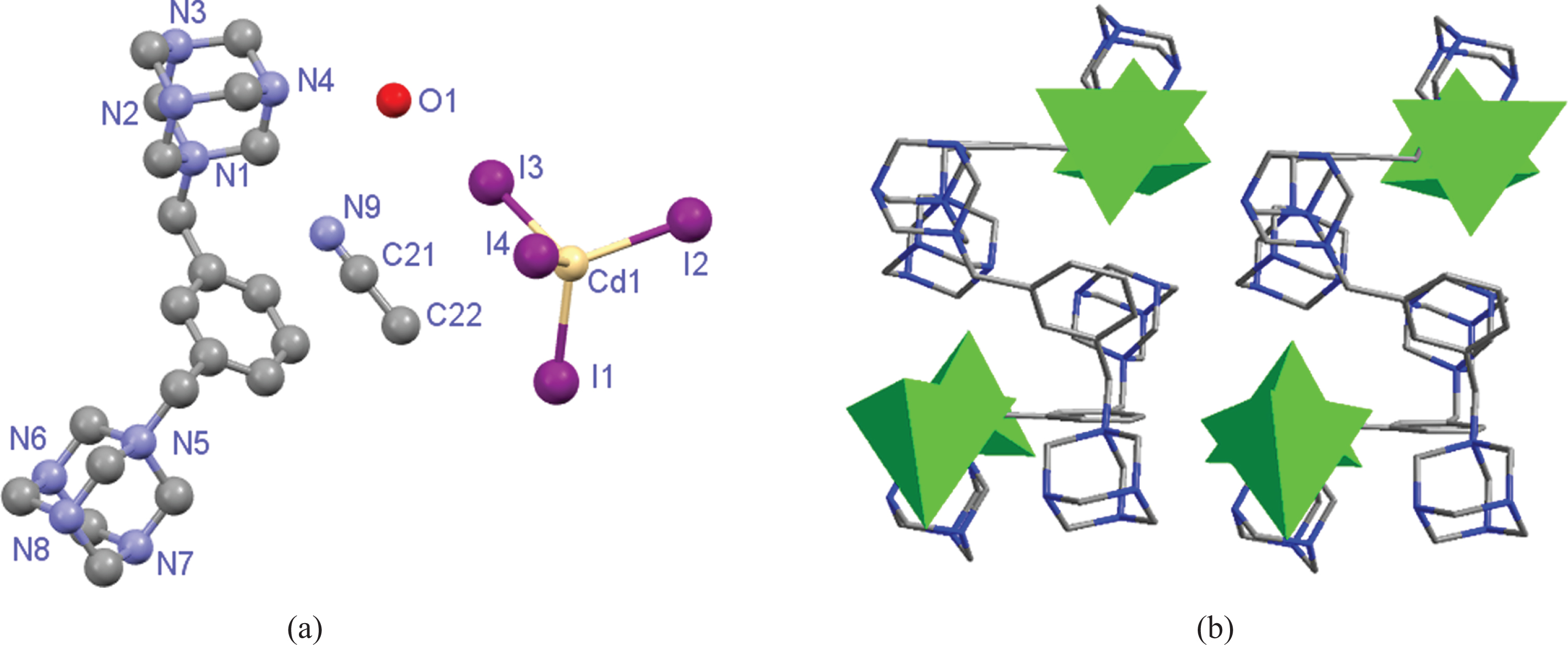
(a) The hydrogen atoms are omitted for clarity. (b) The figure is also seen from the c-axis.
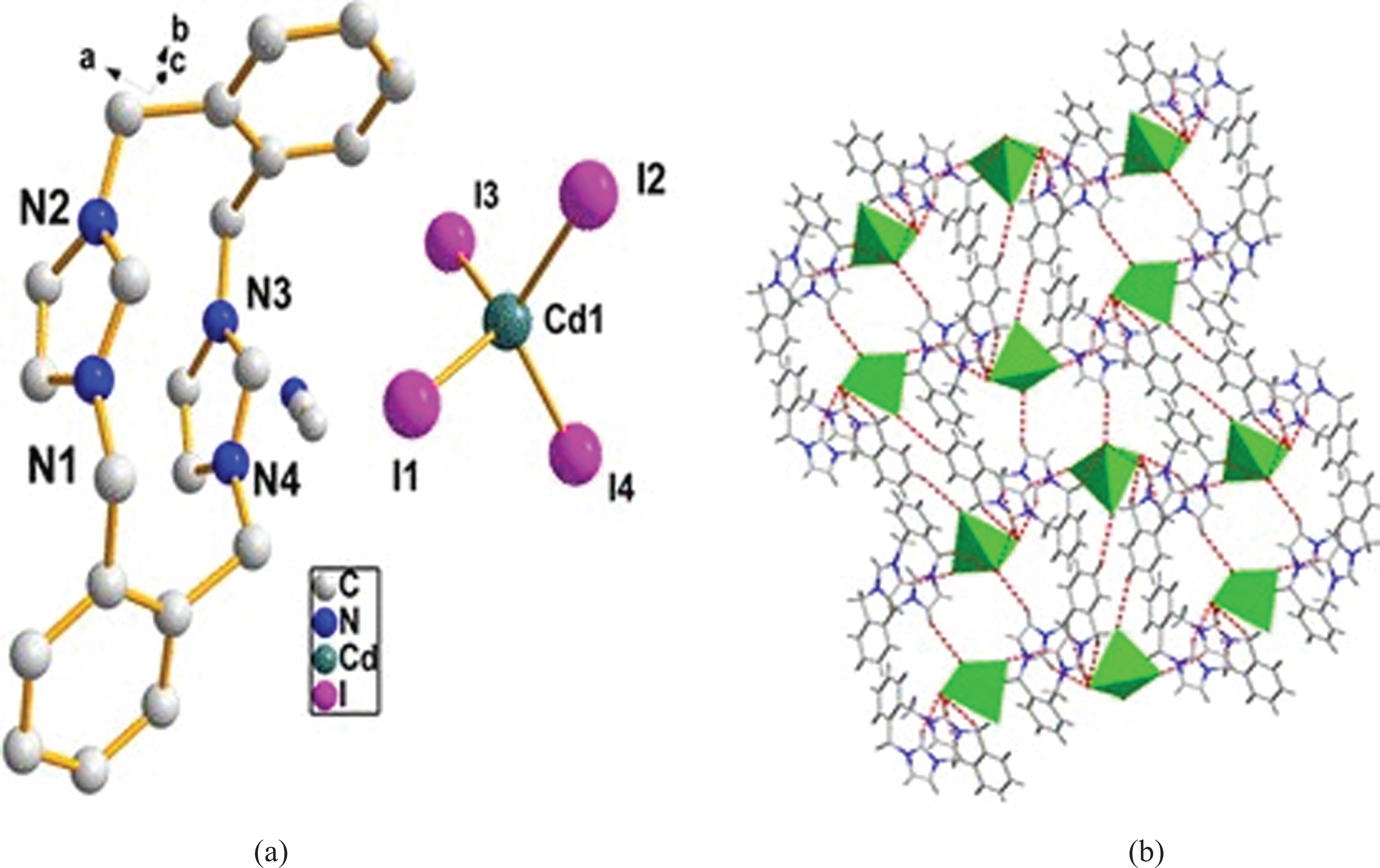
(a) The monomer diagram of a compound similar to the reported compound. (b) The accumulation diagram. The hydrogen atoms are omitted for clarity.
Crystal data and structure refinement for 1
Bond lengths (Å) and bond angles (°) for compounds
Comparison of some important parameters of compounds
Structural description
The crystal belongs to monoclinic system with P21/c Space group, and the compound is composed of ligand cationicL1, [CdI4], free H2O and solvent molecule CH3CN (Fig. 1. (a)). In the mononuclear anion structure, a cadmium and four iodine coordination, forming a tetrahedral structure, where Cd-I (1) = 2.7524, Cd-I (2) = 2.7898, Cd-I (3) = 2.7758, Cd-I (4) = 2.7793.The key angles of I-Cd-I range from 103.94 to 112.87. Cadmium tetraiodide and acetonitrile are uniformly distributed around the ligand cation (Fig. 1 (b)).
X-ray diffraction (XRD)
To ensure the purity of the sample, we carried out X-ray diffraction. The fitting degree of experimental data and simulation data is very high (Fig. 3), indicating that the sample purity meets the requirements.

X-ray Diffraction of the compound 1.
Solid state UV spectra of the compound 1
The solid UV-vis absorption spectrum of the compound is shown in Fig. 4. The compound has absorption peak at 200–300 nm, which may be due to the charge transfer of ligand cation to metal. And 300–500 nm has a strong absorption peak, probably because of the π-π* transition between organic cations.
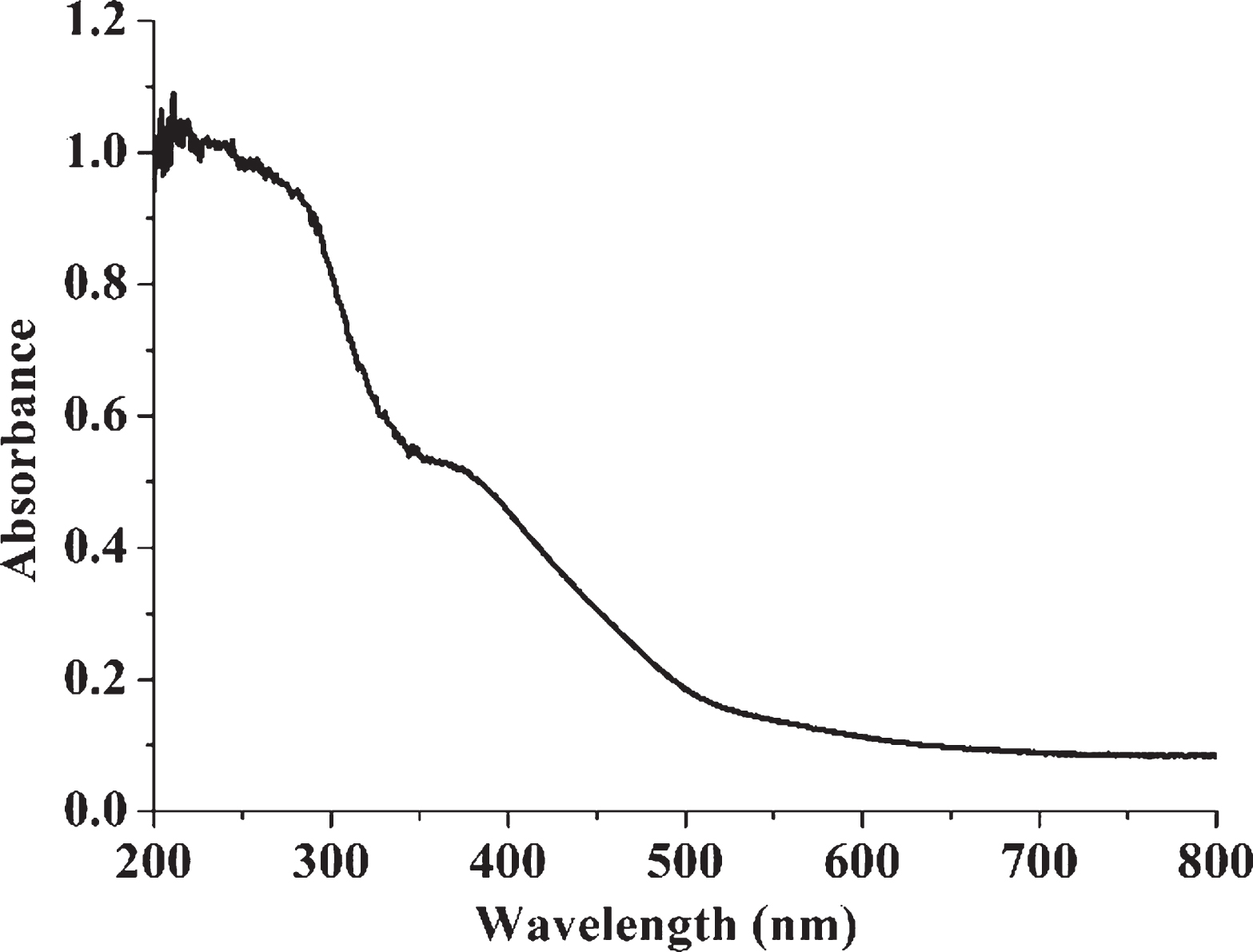
The solid UV-vis absorption spectrum of the compound.
Now, the problem of water pollution is a very serious problem in the world. Methylene blue (MB) was used as a simulated pollutant to investigate the adsorption and decontamination capacity of the compound. Specific experimental methods are as follows:
50 ml of 4 ppm MB solution was prepared in a volumetric flask and 20 mg of the compound was added to it as an adsorbent and stirred under dark conditions.3 ml solution was absorbed every 20 min for centrifugation and UV absorption spectra were determined (Fig. 5).
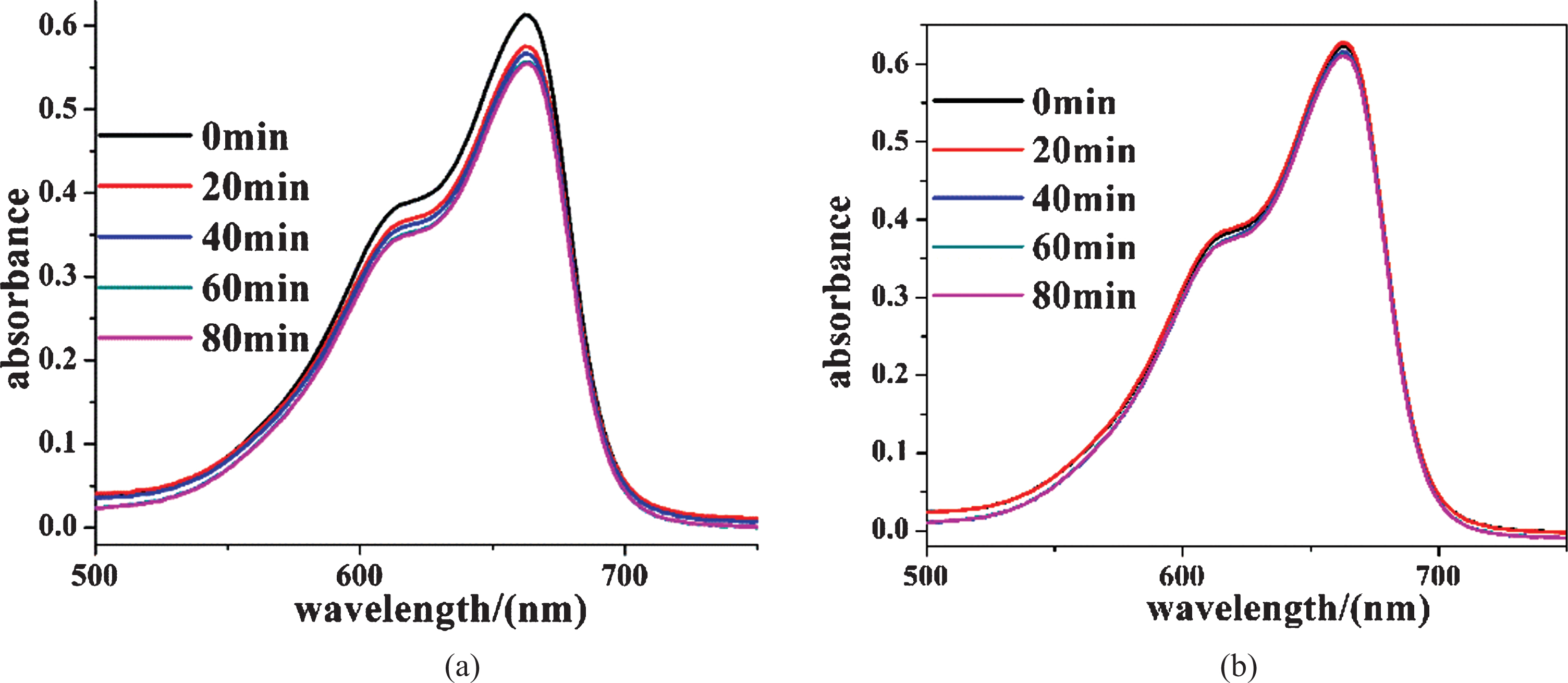
This figure shows the results of adsorption methylene blue of the corresponding solution at different times. (a) was experimental group, (b) was blank group.
It can be seen from the Fig. 5 the absorbance of methylene blue solution gradually decreased with the extension of time, indicating that the compound had a certain adsorption effect on methylene blue.
We have studied the degradation of methylene blue under xenon lamp irradiation. Specific operation steps are as follows:
First, prepare 20 ml, 1×10 mol/L methylene blue solution, then add 10 mg of the compound to it, and stir for 1 h. Then a small amount of suspension was centrifuged every 40 min and the UV absorption spectrum curve of the supernatant was measured (Fig. 6) (Under the light source of 500 W xenon lamp then irradiated). It can be seen from the above figure that the compound has a certain photodegradation effect on methylene blue. As time goes on, the absorbance at different wavelengths decreases.
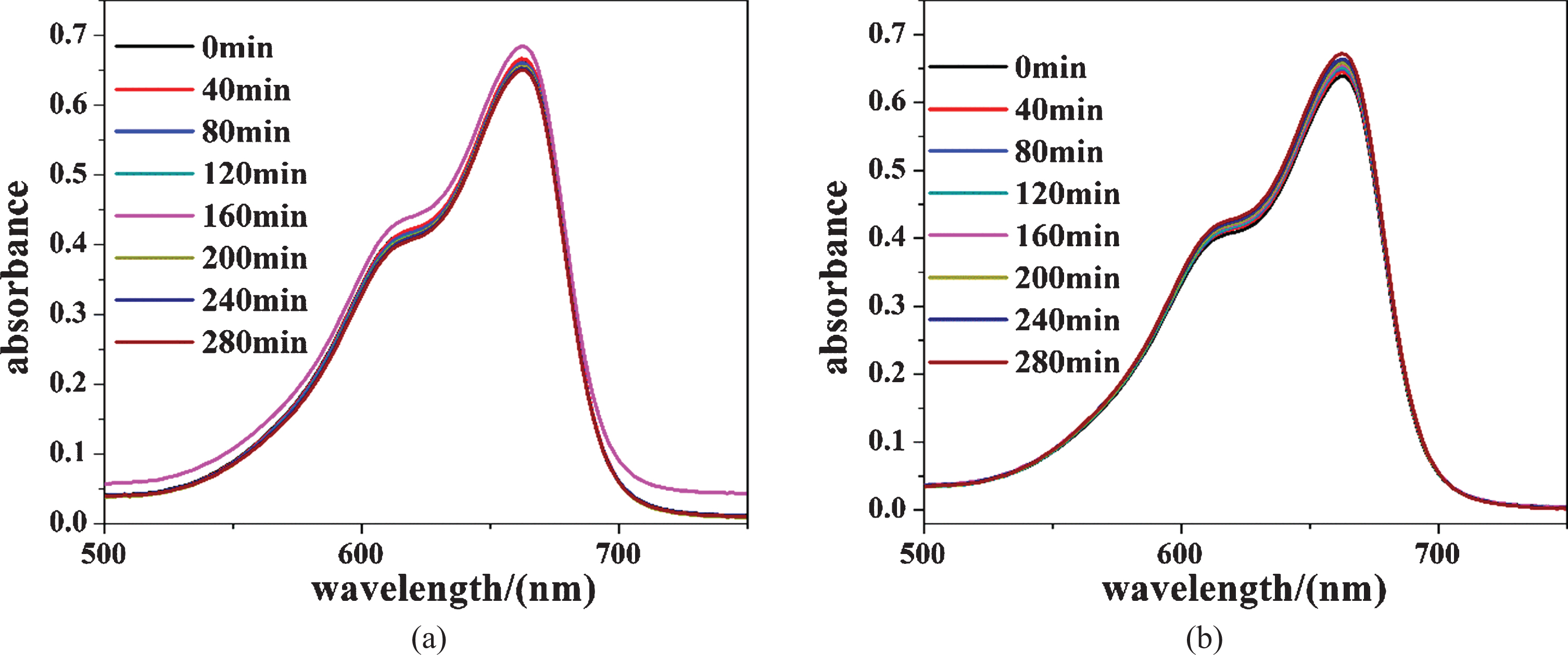
This figure shows the photodegradation of methylene blue in the presence or absence of compounds. (a) experimental group, (b) blank group.
In order to study the thermal stability of the compound, thermogravimetric experiments up to 900°C were carried out in flowing N2. The gas flow rate was 30 cm/min, and the heating rate was 5 K/min. The temperature range of the experiment was 20–900°C.TG diagram (Fig. 7) clearly shows with the weight loss of the compound below 200°C the solvent molecular water and acetonitrile are lost; The decomposition of organic cations from 200°C to 600°C is the decomposition of organic cations, in which the organic cations from 200°C to 300°C lose the part of hexamethylene tetramine to m-xylene, while the organic cations from 300°C to 600°C are the remaining part of hexamethylene tetramine. Above 600°C is the decomposition of inorganic anion.

The percentage of the compound that remains as the temperature increases.
This paper mainly reported the synthesis of crystal {(L1) [CdI4]} obtained by solvent evaporation at room temperature, and it was synthesized by self-assembly reaction in solution. Its structure was described and its properties were explored. The crystal belongs to monoclinic system. We characterized it by X-ray diffraction and UV-vis absorption spectrum. Photocatalysis and adsorption were also studied.
Footnotes
Acknowledgments
The research are supported by the NSFC (No. 21671177).