



Abstract
Interactions of H+, Li+, Na+, and K+ cations with five isomers of cytosine were studied employing B3LYP and MP2 methods using 6-311++G(d,p) basis set. The cation-cytosine interactions affected the relative stability of the isomers, however, in the all complexes, the keto structure was the most stable isomer. Cation-cytosine interactions influenced the energy barriers of intramolecular proton transfers so that in some cases the cations catalyze the proton transfer and in others they increase the activation energies. The observed difference was attributed to the change in the acidity and basicities of the proton donor and acceptor sites and a linear correlation was obtained between acidity and activation energy.
Introduction
Cytosine along with other primary nucleobases such as guanine, adenine, thymine and uracil are the building block of RNA or DNA. These nucleobases can exist in different tautomers due to their intramolecular proton transfers [1–5]. Hydration affects the stability of the nucleobase tautomers and catalyzes tautomerism by lowering the energy barriers of the intramolecular proton transfers [6–10]. Proton and cation transfers are involved in many biological functions of DNA. The proton transfers and intermolecular hydrogen bonds between the pair bases may be affected by the interaction of the nucleobases with ionic and neutral species. Interaction of the nucleobases with alkali and heavy metal cations, proton and other species such as carbon nanotube have been studied [11–15]. Tehrani et al. [16] studied interactions of alkali metal cations (Li+, Na+, K+) with cytidine and showed that the alkali metal cation coordination changes the acidity of the cytosine nucleoside. Also, interactions of the metal cations can stabilize the unstable isomers of the nucleobases and affect their tautomerisms [17]. Rincon et al. [18] studied effect of Ni+2, Cu+2 and Zn+2 on the stability of thymine isomers and reported that the metal cation complexation lowers the energy barriers of the keto-enol tautomersim. Protonation and ionization also affect the energy barriers of single and double proton transfers in the base-pairs [19, 20]. Stabilizing effect of the metal cations has been attributed to oxidation of the nucleobases due to the cation-base interaction [21, 22]. The catalysis effect of metal cations on the proton transfer may be interpreted basis on Lowdin’s hypothesis: metal cations introduce positive charge facilitating the proton transfer from the more positively charged site to another site [19].
In this work, interactions of alkali metal cations (X+) with the most stable isomers of cytosine are studied and their effect on the energy barriers of intramolecular proton transfers in the cytosine-X+ complexes are investigated. The change in the energy barriers is interpreted basis on the change in the acidity and basicity of the proton donor and proton acceptor sites due to complexation.
Computational details
The structures of the molecules, adduct ions, and transition state (TS) complexes were fully optimized employing B3LYP and MP2 methods using 6-311++G(d,p) basis set. B97D, Grimme’s functional including dispersion was also used for calculations on the relative stability of the cytosine isomers [23]. The frequency calculations were performed on the optimized structures by the same method to obtain the thermodynamic parameters at 298.15 K. The structures were also optimized in water solvent with dielectric constant of 78.35 using Tomasi’s Polarized Continuum Model (PCM) [24]. The transition state structures were optimized using the keyword OPT = TS and calculation was carried out on an initial structure very close to the real structure of TS. An intrinsic reaction coordinate (IRC) [25] calculation was performed on the optimized TS geometry to confirm the accuracy of the TS structure. The vibrational frequencies of the TS structures were also checked to sure that they have only one imaginary frequency. The calculations were performed by Gaussian 09 software [26].
Cation affinity of a molecule (M) toward a cation (X+) is defined as a negative value of ΔH for the following reaction in gas phase
The cation basicity of M is calculated as – ΔG value for the reaction (1).
Figure 1 shows the structures of 10 isomers of cytosine optimized in gas phase. Important geometry parameters (bond lengths and angles) of the cytosine isomers are shown in Fig. 1. The structures
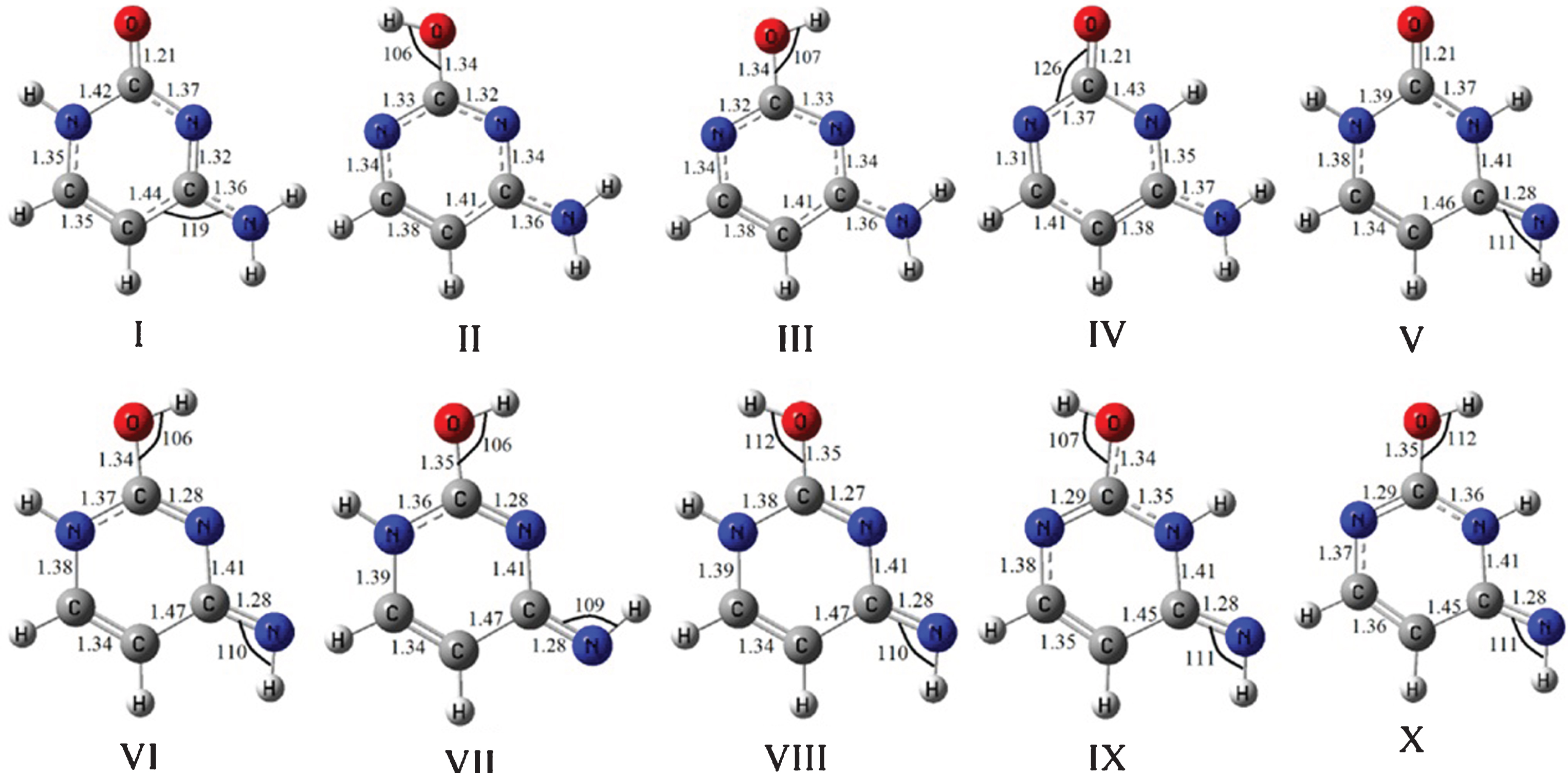
The structures of 10 isomers of cytosine optimized by B3LYP/6-311++G(d,p) method in gas phase with bond lengths (ringA) and angles (deg).
The relative energies (ΔE), and Gibbs free energies (ΔG) of the cytosine isomers calculated by the B3LYP, MP2, and B97D methods. The values in the parenthesis are the ZPE-corrected energies
The comparison of the relative energies calculated by B3LYP method shows that the isomer
Figure 2 shows the different isomers of protonated and alkali metal cationized cytosine optimized by the B3LYP method in gas phase. Also, the main angles and bond lengths are shown in degree and ringA, respectively. Some of these isomers were not obtained by the MP2 method so that they converted to other isomers during optimization. Therefore, the MP2-energies of these isomers have not been reported in Tables 2, 3, and 4. Cytosine has different proton acceptor sites (N and O atom), therefore, protonation from these sites results in different protonated isomers. The alkali metal cation-cytosine interactions are almost ion-dipole electrostatic interactions [27, 28] so that Li+, Na+, and K+ can interact with two adjacent sites, simultaneously.

The structures of different isomers of the protonated and alkali metal cationized cytosine, optimized by B3LYP/6-311++G(d,p) method in gas phase with bond lengths (ringA) and angles (deg).
The relative energies (ΔE) and free energies (ΔG) for the different isomers of the protonated and cationized cytosine. The ΔEZPE and ΔGZPE are the ZPE-corrected energies and free energies, respectively
The cation affinities and cation basicities of the cytosine isomers calculated by the B3LYP and MP2 methods. (CA: cation affinity and CB: cation basicity)
Comparison of the calculated activation energies (Ea), free energies (ΔG#) and entropies (ΔS#) of proton transfers in the isolated, protonated and cation adduct ions of cytosine. The ΔHacid is the enthalpy of deprotonation in gas phase. Δ(ΔHacid) is defined in equation 3. The energies are in kJ/mol and entropies are in J/K.mol. PDS: proton donor site; PAS: proton acceptor site
Table 2 summarizes the relative energies of the cytosine adduct ions. In addition, the calculated cation affinities (CA) and cation basicities (CB) of different sites of cytosine have been tabulated in Table 3. The protonation and cation interactions change the stability trend of the cytosine isomers, however, the isomer
Interactions of the Li+, Na+ and K+ cations with the cytosine isomers change the stability trend so that the interactions increase the stability of the isomer
Figure 3 shows the transition state (TS) structures for intramolecular proton transfers in isolated, protonated and alkali metal cationized cytosine optimized by the B3LYP/6-311++G(d,p) method. The important bond lengths and angles of the TS structures have been shown in angstrom (ringA) and degree, respectively. In the TS structures of the proton transfers

The transition state (TS) structures for intramolecular proton transfers in isolated, protonated and alkali metal cationized cytosine optimized by B3LYP/6-311++G(d,p) method with bond lengths (ringA) and angles (deg).
Table 4 compares the calculated activation energies (Ea), free energies (ΔG#) and entropies (ΔS#) of proton transfers in the isolated, protonated and cation adduct ions of cytosine. The MP2-calculated values of Ea and ΔG# were also included in Table 4. Since there is a good agreement between the B3LYP and MP2 calculated activation energies, only the B3LYP results are discussed. The calculated Ea values of
We assume that the change in the energy barriers of the proton transfers is due to the change in the acidities and basicities of the proton donor and acceptor sites of cytosine after their interactions with the cations. Therefore, the acidity of these sites were calculated in the absence and in the presence of the cations (X+) according to reaction (2)
The Δ(ΔHacid) values calculated by the B3LYP method are summarized in Table 4. In the case of cation-catalyzed proton transfers, the Δ(ΔHacid) values are more positive than the corresponding value of isolated cytosine. The large negative values of Δ(ΔHacid) in the presence of the cations indicate the increase in the energy barriers. Figure 4 shows the correlation between the Δ(ΔHacid) values and the Ea. For Δ(ΔHacid)≈0.0, the Ea is about 160 kJ/mol, and as the Δ(ΔHacid) increases the activation energy decreases.
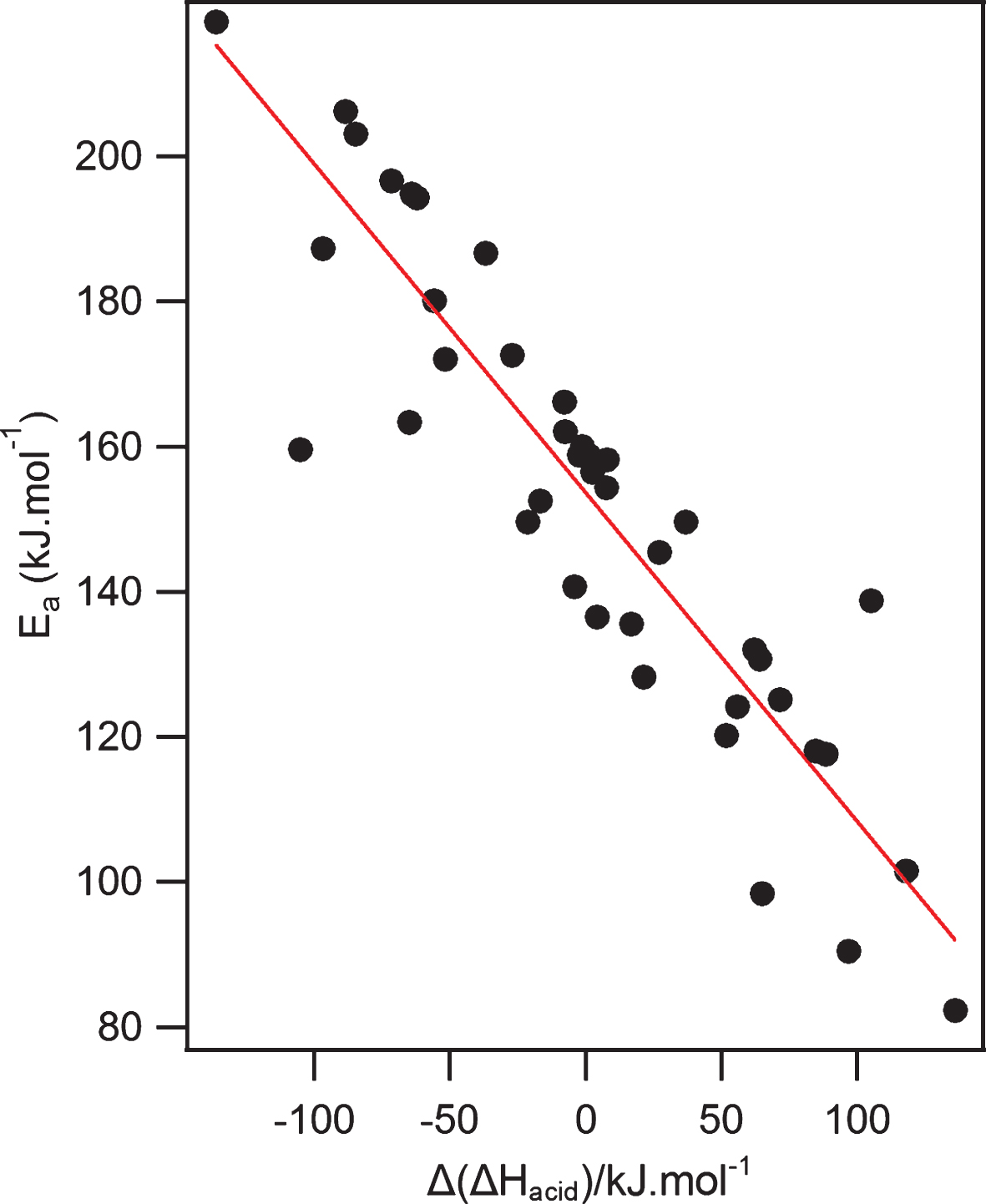
Linear relationship between the activation energies, Ea, of intramolecular proton transfers in cytosine and difference in the acidity of the proton donor and proton acceptor sites, Δ(ΔHacid).
Cytosine has different isomers, however, in this work only five of the most stable isomers with considerable relative abundances were considered. Interactions of H+, Li+, Na+ and K+ with the cytosine isomers were studied using B3LYP and MP2 methods. The cation-cytosine interactions influenced the stability trend of the cytosine isomers, however, the keto structure (isomer
Footnotes
Acknowledgments
The author wishes to express his thanks to the Science and Research Branch of Islamic Azad University in Tehran.