



Abstract
Density functional theory (DFT) calculations were performed to stabilize a representative C16Mg8O8 nanocage derived from C32 and Mg16O16 counterparts for selective adsorption of carbon monoxide (CO) and nitrogen monoxide (NO) gaseous molecules. After obtaining optimized structures, molecular features were evaluated for describing the model systems. Diagrams of density of states (DOS) revealed that the energy differences between frontier molecular orbital levels of the highest occupied and the lowest unoccupied molecular orbitals (HOMO and LUMO) of the stabilized C16Mg8O8 nanocage could provide a more proper semiconductor in comparison with each of the original C32 and Mg16O16 cages. To explore the advantage of such C16Mg8O8 nanocage for CO and NO gases adsorption, molecular descriptors such as energies, geometries, and electronic structures were characterized for all possible adsorption configurations of bimolecular formation of gas . . . nanocage. Significant changes of HOMO and LUMO levels besides the values of corresponding energy gaps of C16Mg8O8 nanocage in singular and bimolecular systems could help to recognize adsorption of each of CO and NO gaseous molecules. Furthermore, more variations of energy gaps in the process of gas . . . nanocage bimolecular formation could lead to more sensitivity of nanocage for detection of adsorbed gases. As a consequence, the investigated C16Mg8O8 nanocage was introduced for differential recognition of CO and NO gases regarding several environmental health issues.
Keywords
Introduction
Considerable efforts have been always dedicated to develop methods and technologies for detection and removal of pollutants especially from those environments of industrial regions and modern cities because of dangerous exhaust gases deathful impacts for human life systems [1–5]. However, no certain solution has been completely approved yet for the problem of pollutants and the investigations have been still under developments in this issue [6–10]. There are several types of pollutant in all phases of solid, liquid and gas, in which carbon monoxide (CO) and nitrogen monoxide (NO) are those extremely toxic gaseous pollutants with deathful impacts for harmful impact on human life. Therefore, exploring novel procedures for detection and removal of such gaseous pollutants are important to save human life [11, 12]. Effective methods for capturing each of CO and NO gases have been reported by earlier works, but the methods have not been still finalized for such purposes and further innovations are required for overcoming this issue [13, 14]. It is important to mention that the pollutants have also serious harmful impacts such as corrosion on environmental systems other than human life [15]. In this regard, developing sensor materials and devices could help for the purpose of detection and removal of such external pollutant substances [16]. To this aim, developing “Gas-Sensor” devices have been seen very much important for detection of hazardous gases even for their removal from environment with characteristic features of sensitivity, specificity, low power consumption and fast response time [17]. Utilizing nanostructure-based devices has been seen among the most versatile procedures of gas sensor manufacturing for developing novel procedures of gas detection and removal using the benefits of nanostructures such as high surface/volume ratio, quantum confinement effects, and very sensitive electronic features [18–22].
The pioneering work of nanotechnology innovation has raised numerous efforts of researchers to explore characteristic capabilities and features of nano-based systems for applications in various specified fields [23–30]. In this case, cage-like fullerene hollow-spheres have been seen useful to utilize specified applications for unique purposes among other types of nanostructures such as nanoparticles, nanotubes and graphene [31–35]. The first introduced nanostructures were carbon-based materials, in which the existence of non-carbon-based nanostructures have been also recognized through simulation and synthesis of (XY)n systems such as (BN)n, (BP)n, (AlN)n, (AlP)n, (MgO)n, (ZnO)n, etc. [36–47]. Moreover, metal oxide-based (XY)n nanostructures, especially magnesium oxide (MgO) known as a metal-oxide semi-conductor, are current significant research catalyst targets for industry, nano-ball bearings, gas sensors, biosensors, nanotechnology and biotechnology even for detection of toxic and combustible gases [48–51]. Based on the already introduced Cn and (MgO)n fullerene materials, a new combination of heterogeneous CnMgnOn nanocage was investigated for selective CO and NO pollutant adsorption. Examining formations of heterogeneous nanostructures could help researchers for recognizing new features for innovating novel materials and applications for the specified purposes, in which the impure (defected or hybridized) nanostructures might work better than pure ones especially for formation of interacting complexes with other substances [52–54]. To show such characteristic features, the obtained results of proposed C16Mg8O8 nanocage were compared with those of reference C32 and Mg16O16 parent nanocages. Hence, the main goal of this work was to investigate a more efficient heterogeneous nanocage C16Mg8O8 combination to interact properly with each of CO and NO gaseous air pollutants. Based on chemistry aspects, each of CO and NO could work as isocarbonyl and isonitrosyl ligands for participating in complex formations with other substances especially those metals with vacant orbitals in specified chemical environments. However, their molecular and atomic features were investigated in this work for their interacting as representative molecules with the proposed C16Mg8O8 nanocage. To achieve such purpose, quantum-chemical calculations were performed to carefully recognize the investigated systems at the lowest molecular and atomic scales as benefits of employing computer-based works for investigating complicated nanosystems [55–57].
Computational details
Density functional theory (DFT) calculations were performed on molecular systems for obtaining geometry optimizations, analyzing density of states (DOS) diagrams [58], evaluating molecular electrostatic potential (MEP) surfaces [59] and natural bond orbital (NBO) charges analyses [60]. The model systems were reference C32 and Mg8O8 parent nanocages and the targeted C16Mg8O8 nanocage for adsorption of one CO or NO molecule for formation of CO . . . C16Mg8O8 and NO . . . C16Mg8O8 complexes. To obtain precise results, proper levels of theory including the M06-2x exchange-correlation functional and the 6-311G** large size basis set were employed as implemented in the GAMESS program [61, 62]. The obtained DOS diagrams were visualized by the GaussSum program [63]. The values of adsorption energies (Eads) of gas . . . nanocage complex formations were evaluated using eq. (1), in which the negative value of Eads could correspond to exothermic adsorption process.
The main goal of this work was to investigate a heterogeneous C16Mg8O8 nanocage for efficient detection of CO and NO gases. Besides, the reference models of C32 and Mg16O16 parent nanocages were also investigated for comparing the results of study. Each model system was optimized first to achieve the minimum-energy structures for further evaluating the molecular and atomic features. Structures of all three nanocages (Fig. 1) were composed of six 4-membered (4MR), six 6-membered (6MR) and two 8-membered (8MR) rings. Further examining the structures showed that C32 and Mg16O16 nanocages were symmetric regarding the electric charge distributions with zero-value of dipole moment whereas the heterogeneous C16Mg8O8 nanocage represented asymmetric behavior of electric charge distributions with a large dipole moment ∼14 Debye. The analyses of NBO population charges [64] demonstrated an overall net charge of positive and negative electrons on the atoms of C–C bonds of C32, atoms of Mg–O bonds of Mg16O16, and atoms of Mg–O, Mg–C, O–C, and C–C bonds of the heterogeneous C16Mg8O8nanocage surface indicating different ionic natures for the investigated models. Indeed, energies of such bond formations are expected to be at least slightly different the nature of participating atoms in chemical bonds. The point was important for the existence of impurities in nanosystems to modify their own electronic properties for developing further applications of different purposes. For the targeted C16Mg8O8 nanocage of this work, such features were observed in comparison with the reference C32 and Mg16O16 parent molecules to consider the concept of cages that bear a more proper nanosurface for interacting with gas molecules. Additionally, frontier molecular orbitals of HOMO and LUMO of the investigated systems could show variations of conductivity of the targeted heterogeneous C16Mg8O8 nanocage in comparison with the reference models. In this case, reducing value of HOMO-LUMO energy gap (Eg) could cause an obvious change in the corresponding electrical conductivity as provided by eq. (2), in which σ is the electrical conductivity and k is the Boltzmann′s constant.
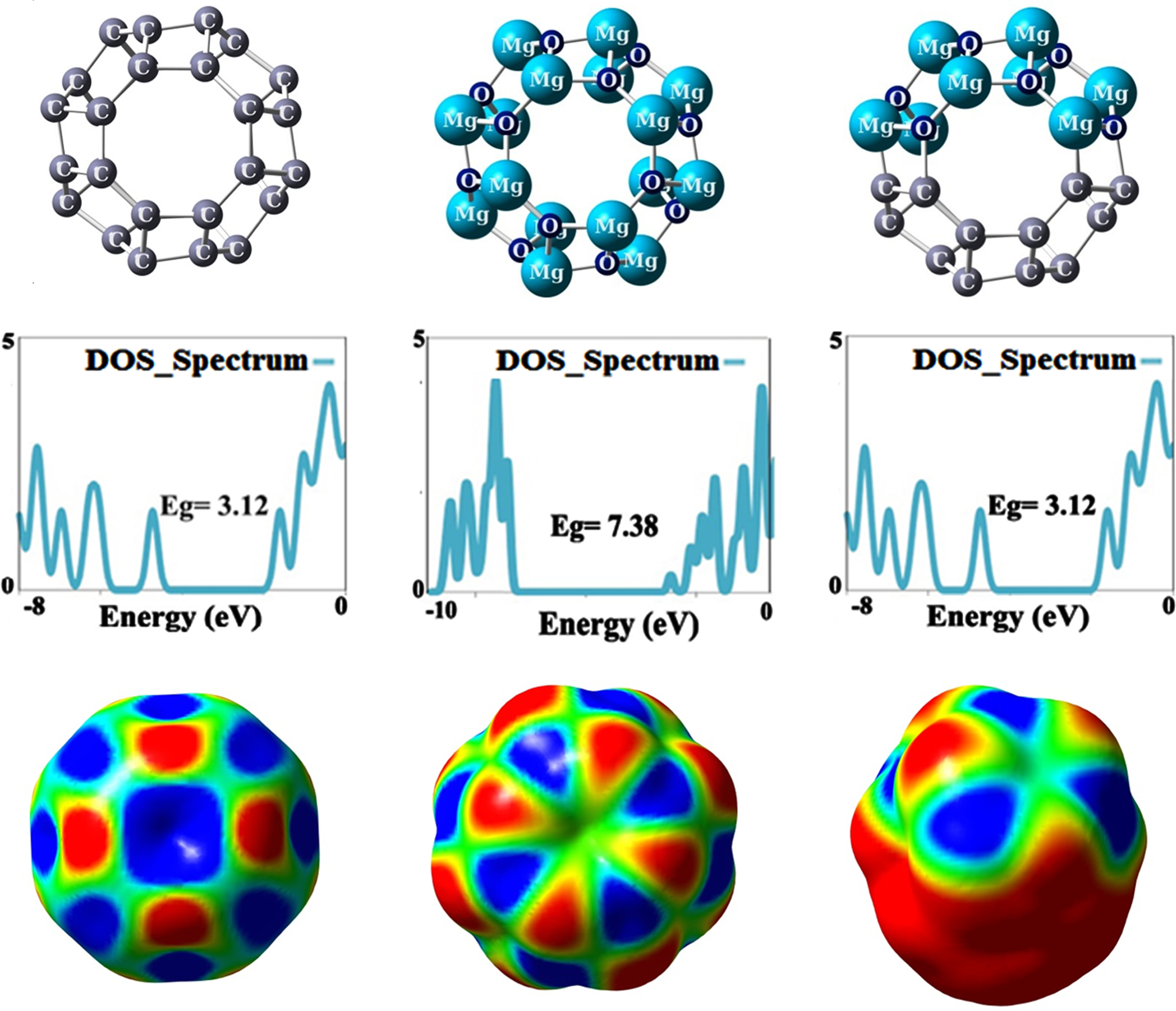
The optimized structure of C32, Mg16O16 and heterogeneous C16Mg8O8 nanocages (Top), their DOS plots (Middle) and the MEP analysis of a net charge of positive and negative electrons in all over the nanocage surfaces (Bottom).
According to eq. (2), a smaller value of Eg at a given temperature could lead to a higher electrical conductivity. The obtained value of Eg of heterogeneous C16Mg8O8 nanocage was smaller than those of C32 and Mg16O16 parent nanocages yielding a higher electrical conductivity for the targeted nanocage as a more proper semiconductor. By providing such desirable C16Mg8O8 nanocage semiconductor, the adsorption processes of CO and NO molecules were examined. To carefully determine such interacting system possibilities, various configurations of bimolecular complex formations were considered for performing optimizations by the initial positioning of CO or NO molecules towards Mg, O and C atomic sites of the nanocage in different orientations. As a consequence of performing full structural relaxation during optimization processes without any constraint, the most stable obtained configurations of bimolecular complex formations are illustrated in Fig. 2; R configuration represented the oxygen head of CO orientated toward the Mg atom on the lateral MgO surface of the nanocage with a distance of 2.23 Å, and S configuration represented the interaction between the C atom of molecule and two carbon atoms of the nanocage, with distances of 2.26 and 2.27 Å. After reviewing both adsorption sites, it was clear that the O head of CO molecule was located close to the Mg atom with positive charge of the nanocage whereas the C head of CO molecule was located close to the C atom with negative charge of the nanocage.
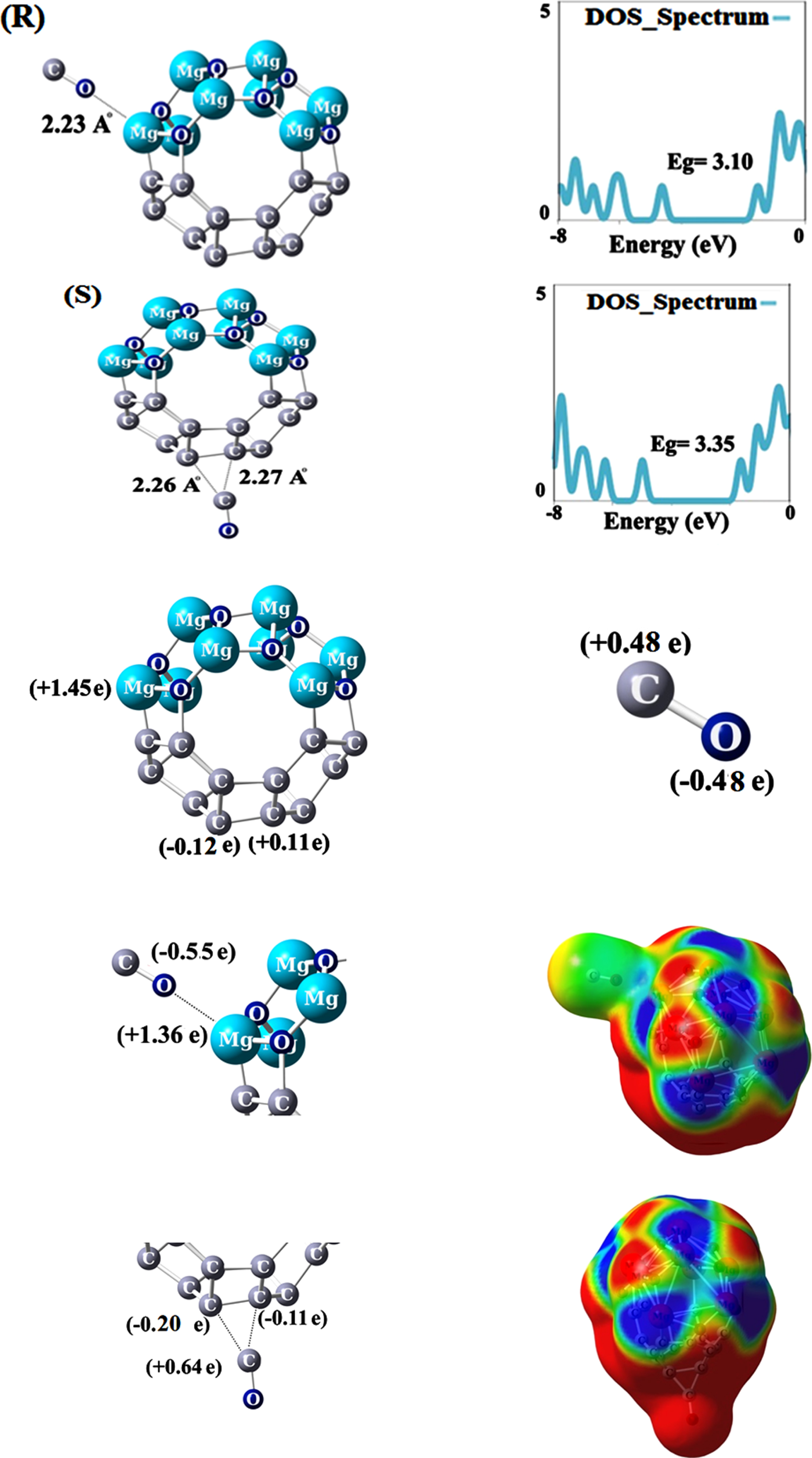
Model for the stable configurations of CO on the heterogeneous C16Mg8O8 nano cage surface, their DOSs, NBO analysis for CO molecule, pristine nanocage, and CO adsorption processes on the surface of heterogeneous C16Mg8O8 nanocage, and calculated molecular electrostatic potential surfaces of the CO adsorbed on the MgO surface of the nanocage and CO adsorbed on the C surface of the nanocage. Color ranges, in a.u.: blue, more positive than 0.050; red, more negative than –0.050. The interactions are physical and the dashed lines show symbols of interactions and distances.
In Fig. 3; the R configuration represented that the N head of NO molecule was located toward the Mg atom on the lateral MgO surface of the nanocage with a distance of 2.31 Å and S configuration showed the interaction with the C surface atom at a distance of 3.08 Å. Based on the NBO charge analysis, it was found that the charge of Mg atom in MgO surface and two C atoms in C surface of the C16Mg8O8 nanocage were +1.45, –0.12, and +0.11 |e|, respectively. The NBO charges of CO molecule were –0.48 and +0.48 |e| for O and C atoms. Simultaneously with approaching CO molecule toward the Mg atom of C16Mg8O8 nanocage from its O head, the NBO charge of Mg associated with CO was +1.36 |e| and for O head of CO was –0.55 |e|, on the other hand, the NBO charge of NO molecule was –0.18 and +0.18 |e| for O and N atoms. Simultaneously with approaching the NO molecule toward the Mg atom of C16Mg8O8 nanocages from its N head, the NBO charge of Mg associated with NO was +1.72 |e| and that of N head of NO was +0.10 |e|. Therefore, a charge transfer became apparent from the nanocage to the CO molecule. In contrast, in the approaching process of CO from its C head to two C atoms of the nanocage, the NBO charges of connected C atoms to CO were –0.20 and –0.11 |e| and that of C head of CO was +0.64 |e| revealing charge transferring from CO to the nanocage. As shown in Table 1, the transferred charges between CO and the nanocage in the adsorption processes were about 0.07 and 0.17 |e|, respectively, and a charge transfer from the nanocage to the CO molecule. In contrast, in the approaching process of NO from its N head to two C atoms of the nanocage, the NBO charges of connected C atoms to NO were –0.14 and +0.08 |e| and that of N head of NO was +0.18 |e| revealing charge transferring from NO to the nanocage. As shown in Table 1, the charge transfers between NO and the nanocage in the adsorption processes were almost negligible. The calculated values of Eads for these configurations were in the range of –0.33 and –0.37 eV, respectively, for the CO molecule and –0.43 and –0.12 eV for NO molecule (Table 1). The obtained values of Eads from these calculations were dependent on the orientation of location of CO and NO molecules outside the targeted C16Mg8O8 nanocage. The values of Eg of C16Mg8O8 nanocage for the R and S configurations were calculated to be about 3.12, 3.10 and 3.35 eV respectively, for the CO molecule and 2.35 and 3.02 eV for the NO molecule. Detailed information including values of Eads, NBO charge transfers, Eg, and ΔEg are all listed in Table 1. It is here important to mention that the obtained values of Eads indicated physical interactions between each of CO and NO and nanocage and the dashed lines of figures only showed symbol of such physical interactions and distances.
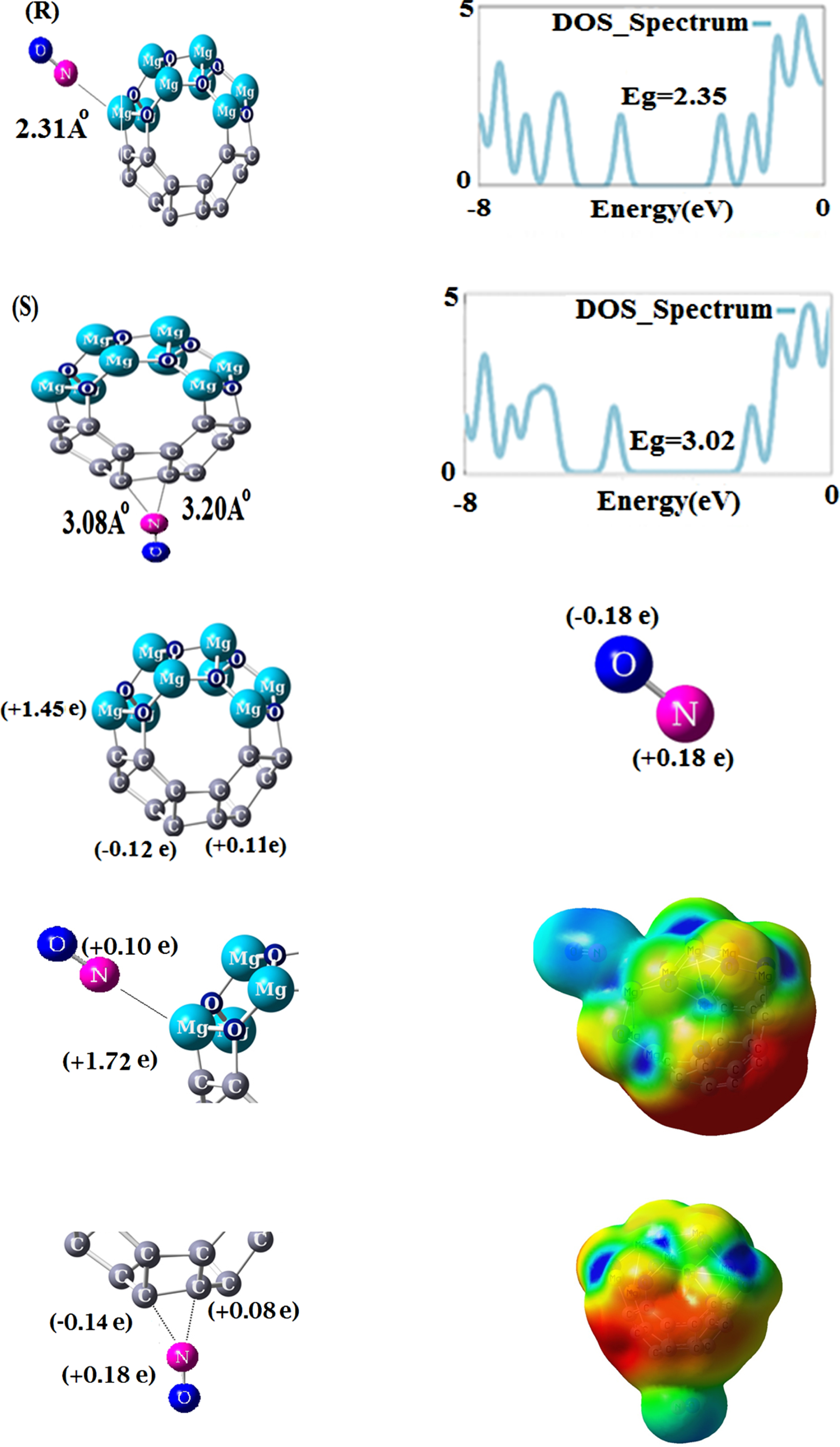
Model for the stable configurations of NO on the heterogeneous C16Mg8O8 nano cage surface, their DOSs, NBO analysis for NO molecule, pristine nanocage, and NO adsorption processes on the surface of heterogeneous C16Mg8O8 nanocage, and calculated molecular electrostatic potential surfaces of the NO adsorbed on the MgO surface of the cluster and NO adsorbed on the C surface of the nanocage.. Color ranges, in a.u.: blue, more positive than 0.050; red, more negative than –0.050. The interactions are physical and the dashed lines show symbols of interactions and distances.
The adsorption energy (Eads) of CO and NO molecules on nanocage, Transfer charge between molecules and nanocage (QT) and the HOMO-LUMO energy gaps (Eg) and the change of nanocage HOMO -LUMO gap upon the adsorption processes
The evaluated DOS diagram of C16Mg8O8 nanocage in Fig. 1 indicated that the value of Eg was about 3.12 eV referring to a semiconductor substance. The obtained DOS diagrams of both chemisorption configurations (R and S) for CO and NO molecules demonstrated a new impurity state in comparison with the C16Mg8O8 nano cage (Fig. 2 3). The value of Eg for CO was decreased from 3.12 to 3.10 eV for the R configuration whereas it showed an increase from 3.10 to 3.35 eV in the S configuration. The value of Eg for NO was decreased from 3.12 to 2.35 eV for the R configuration whereas it showed an increase from 3.10 to 3.02 eV in the S configuration. The value of ΔEg of CO molecule for both configurations were about 0.02 and –0.23 eV, respectively, and those of the NO molecule were 0.77 and 0.10 eV, respectively (Table 1). Since, the changes of values of Eg during the adsorption process could be related to the sensitivity of the sorbent for the particular adsorbate, variations of Eg of the nanocage could be expected to bring about the obvious change in the corresponding electrical conductivity. The trend could transform the presence of intended adsorbate precisely into an optical signal. Therefore, the heterogeneous C16Mg8O8 nanocage could be potentially proposed for applications as bidirectional nanosensor for toxic NO detection.
In order to interpret the adsorption interaction between each of CO and NO molecules and heterogeneous C16Mg8O8 nanocage, MEP surfaces were presented to explain the charge distributions at the molecular scale surfaces. The stabilized adsorbed configurations of CO and NO molecules at the C16Mg8O8 nanocage surface were investigated for performing the MEP analyses as defined by eq. (3). Within this equation, the charge on nucleus A was designated by ZA located at RA and V(r) demonstrated the effects of nuclei or electrons prevailing at any point.
As shown in Fig. 1 for the assumptions of MEP analyses, it could be concluded that the Mg atoms were positively charged (blue colors) whereas the C, N and O atoms of complex were negatively charged (red colors). The MEP surface represented the charge transfer from Mg atoms to each of C, N and O atoms of the system revealing the existence of ionic bonds at the nanocage surface. Based on such achievements, strong interactions were formed between each of the CO and NO molecules and the nanocage leading to charge transfers from the molecules to the nanocage through chemisorption interactions. However, interaction between the CO and nanocage in S site led to a charge transfer from the nanocage to the CO molecule. All such details were very well represented in Figs. 2 3.
In this work, DFT calculations were performed to optimize a representative heterogeneous C16Mg8O8 nanocage derived from C32 and Mg16O16 single-standing nanocages to propose a novel nanosurface for adsorbing toxic CO and NO gases. The model systems were stabilized to evaluate further features for achieving the aim of this work. Analyses of DOS diagrams demonstrated desirable conductivity of the investigated heterogeneous C16Mg8O8 nanocage confirming successful simulation of a strong semiconductor. Subsequently, adsorption processes of each of CO and NO gases were examined at the surface of C16Mg8O8 nanocage. The results showed that such processes could change the electronic properties of nanocage by variations of HOMO and LUMO levels in addition to values of Eg. Such frontier molecular orbitals changes could be converted to an electrical signal for NO detection even in the presence of CO molecule. As a consequence, selective adsorption of CO and NO gases could be expected to work employing the heterogeneous C16Mg8O8 nanocage. Such research achievements could help for performing further investigations on nanostructures for application in the fields of gas detections for environmental health issues.
Footnotes
Acknowledgments
S.A. gratefully thanks helpful comments of Dr. Milad Nouraliei during evaluation of this work.