



Abstract
Quantum chemical density functional theory (DFT) calculations were performed to investigate the adsorption of arsine (AsH3) gaseous substance at the surface of representative models of boron nitride (B16N16), aluminum nitride (Al16N16), and silicon carbide (Si16C16) fullerene-like nanocages. The results indicated that the adsorption processes of AsH3 could be taken place by each of B16N16, Al16N16, and Si16C16 nanocages. Moreover, the electronic molecular orbital properties indicated that the electrical conductivity of nanocages were changed after the adsorption processes enabling them to be used for sensor applications. To analyze the strength of interacting models, the quantum theory of atoms in molecules (QTAIM) was employed. As a typical achievement of this work, it could be mentioned that the investigated Si16C16 fullerene-like nanocage could work as a suitable adsorbent for the AsH3 gaseous substance proposing gas-sensor role for the Si16C16 fullerene-like nanocage.
Introduction
During last decades, several applications of carbon-based nanostructures have been introduced for various fields from industries to living systems such as energy storages, gas separations, drug carriers, and so on [1–3]. The feature of high surface to volume ratio made the nanostructures a suitable material for involving in interacting with other molecular and atomic substances [4–6]. To this time, various types of carbon-based nanostructures; including fullerene, nanotube, nanoparticle, nanocone, and grapehene, have been innovated through computations and experiments [7–9]. The spherical shape of fullerene and fullerene-like nanostructures could make them as an appropriate candidate for employing in adsorption applications [10–12]. In this case, formations of other non-carbon-based nanostructures have been also innovated, in which combinations of boron and nitrogen atoms as boron nitride (BN), aluminum and nitrogen atoms as aluminum nitride (AlN), and silicon and carbon atoms as silicon carbide (SiC) are among typical examples of such heteroatomic nanostructures [13–15]. Indeed, the non-carbon-based nanostructures have been seen even better that the carbon-based nanostructures in many cases, in which the polarity could be increased by composition of heteroatoms enabling the nanostructure for better dispersing in water media [16–18]. Moreover, different values of electronegativity of heteroatoms could provide an activated surface for involvement of the nanostructure in interactions with other substances [19–21]. In this regard, considerable efforts shave been dedicated to recognize the features of heteroatomic nanostructures, in which characteristic features have been evaluated for each of BN, AlN, and SiC nanostructures [22–24]. Indeed, electronic features such as electron affinity, ionization potential, band gap, and other related ones could make such heteroatomic nanostructures appropriate for employing in various applications [25–27].
Within this work, fullerene-like BN, AlN, and SiC heteroatomic nanostructures have been investigated for adsorbing the arsine (AsH3) gaseous substance through performing quantum chemical calculations. Earlier works indicated that the combination of sixteen of each atom yielding a fullerene-like nanocage structure with thirty-two atoms, could be energetically more stable than other models of atomic combinations [28–30]. To this aim, B16N16, Al16N16, and Si16C16 were investigated in this work for adsorbing the AsH3 substance, which is a toxic gas threatening the human health life system [31–33]. To this point, it should be detected and removed from those environments related to the exhausting AsH3 gas [34–36]. Accordingly, this work was performed for examining capability of such heteroatomic fullerene-like nanocages for adsorption of AsH3 gaseous substance regarding the detection and removal roles. To achieve this purpose, geometries optimizations and properties evaluations were done to provide required information for solving the problem using advantageous computational approaches. Briefly, the major problem of this work was to explore the adsorption mechanism of AsH3 by each of the BN, AlN, and SiC fullerene-like nanocages in addition to examining benefit of each nanocage for approaching such purpose. It is worth to mention that the fullerene-like nanocage materials could be employed for various fields of applications [37–39]. For both of biological and industrial applications, modifications of nanostructures could help to provide materials for more specified applications [40–42]. Not only the nanocages, but also other geometrical configurations of nanostructures could be investigated for such purposes [43–45]. Electronic and structural features of the nano-based materials are almost dominant for approaching the goals of their specified applications [46–48]. To this aim, several efforts have been always dedicating to investigations of such novel materials for various types of applications from biology to industry [49–51]. Accordingly, this work was performed to show such advantages of heteroatomic fullerene nanocages for sensor applications towards the AsH3 gaseous substance.
Materials and methods
Density functional theory (DFT) calculations were performed to obtain the stabilized structures of singular B16N16, Al16N16, and Si16C16 fullerene-like heteroatomic nanocages in addition to the AsH3 molecule. To this aim, the three-dimensional models of these singular structures were initiated in the optimization calculations up to reaching the minimized energy geometrical structures. Next, combinations of AsH3 with each nanocage were stabilized again to obtain the optimum configuration of AsH3 molecule at the surface of nanocage as show in Fig. 1. In this step, the best configurationally relaxed modes of AsH3 molecule at the surface of each nanocage was investigated. By preparing the optimized structures in both of singular and complex forms, the required information for interpreting the investigated systems including the adsorption energy (EAds), Fermi energy (EF), and energy gap (EG) were evaluated and they were listed in Table 1. Such molecular descriptors features could help to interpret the models based on the stabilities of structures and their related features of electronic systems. For such purpose, the visualized diagrams of density of states (DOS) and molecular electrostatic potential (MEP) surfaces for the investigated systems were shown in Figs. 2 3. To achieve the mentioned structures and properties, the M06-2X/6-31G* level of DFT calculations were performed using the GAMESS program [52]. Moreover, further insights about interactions were evaluated by employing the quantum theory of atoms in molecules (QTAIM) to show the nature of interactions between AsH3 and each nanocage using the Multiwfn package [53]. The results of QTAIM features were summarized Table 2 and Fig. 4. Indeed, this is an advantage of performing the QTAIM analysis for the interacting systems to show natures of occurred interactions between the substances and detecting the atomic sites of interactions for complex formations [53]. It is worth to mention that performing such computational works could provide insightful details for developing various applications of original nanostructures avoiding the existence of experimental complexity [54–56]. In this mode of study, the molecular and atomic features could be detected very well for reaching a brighter interpretation of the investigated models systems. To this aim, the current research work was done by employing such computational approach tools to investigate the sensor function of fullerene nanocages for AsH3 detection and removal. The evaluated results of this work were summarized in Tables 1 2 and Figs. 1–4 to interpret the investigated models systems.
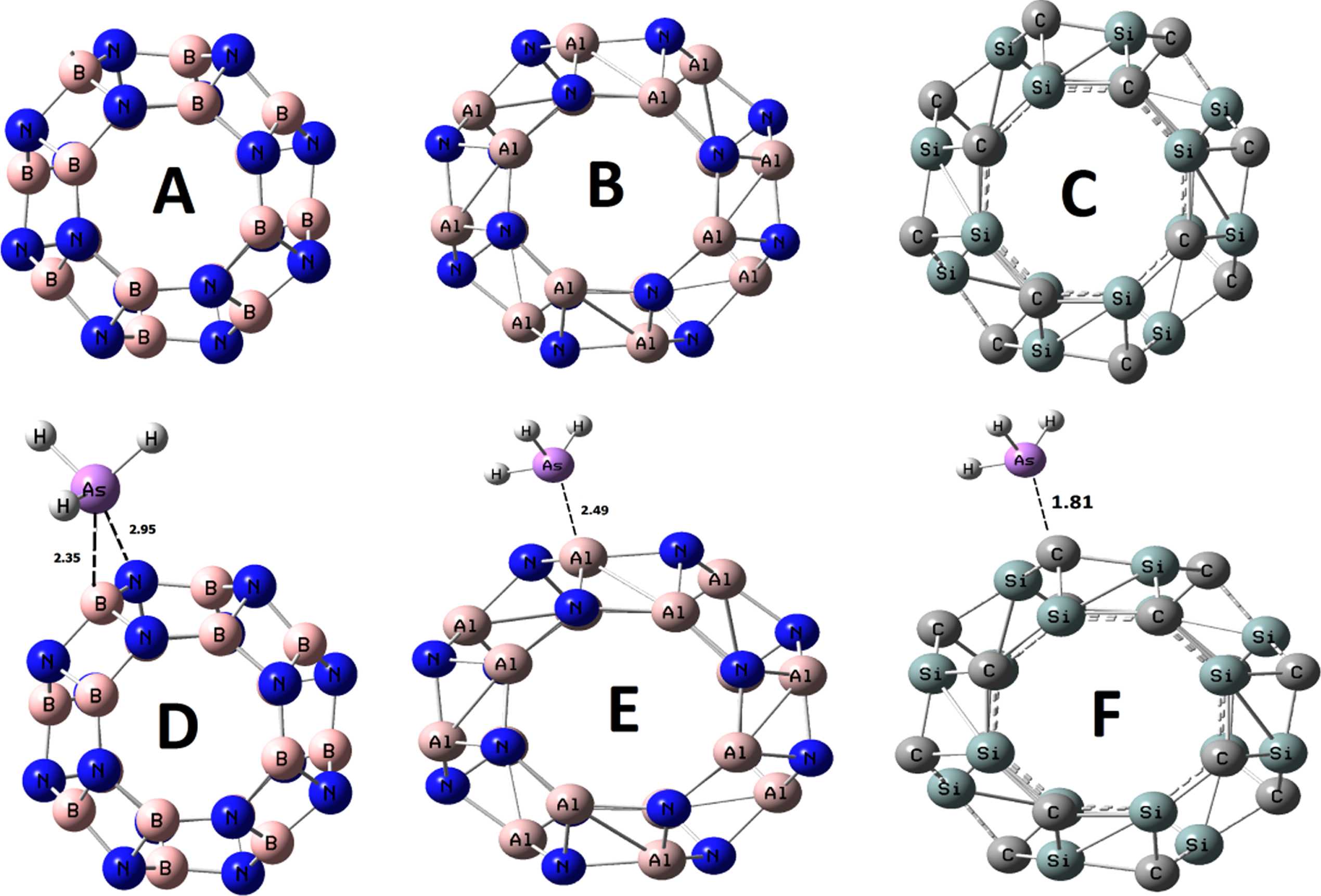
Optimized structures for singular B16N16, Al16N16, and Si16C16 nanocages (A, B, and C) and their corresponding AsH3-adsorbed models including AsH3@B16N16, AsH3@Al16N16, and AsH3@Si16C16 complexes (D, E, and F). Interaction distances are shown in Å.
Molecular descriptors for the optimized models
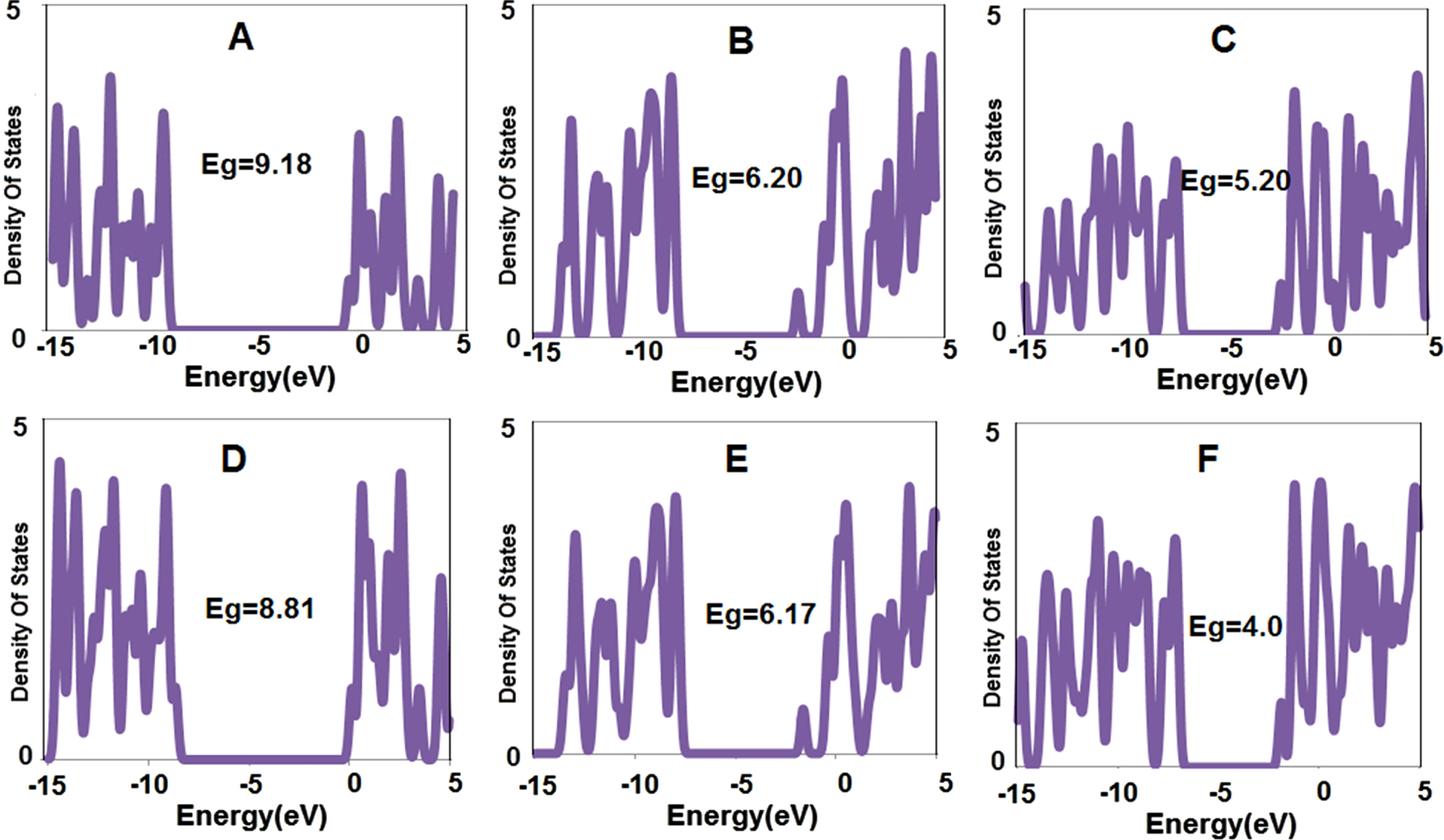
Evaluated DOS diagrams for singular B16N16, Al16N16, and Si16C16 nanocages (A, B, and C) and their corresponding AsH3-adsorbed models including AsH3@B16N16, AsH3@Al16N16, and AsH3@Si16C16 complexes (D, E, and F). Energy values are shown in eV.

Evaluated MEP surfaces for singular B16N16, Al16N16, and Si16C16 nanocages (A, B, and C) and their corresponding AsH3-adsorbed models including AsH3@B16N16, AsH3@Al16N16, and AsH3@Si16C16 complexes (D, E, and F). The surfaces are defined by the 0.0004 electrons/b3 contour of the electronic density with blue color for more positive region and red color with more negative region.
QTAIM descriptors for the optimized models

QTAIM molecular graphs of (A) AsH3@B16N16, (B) AsH3@Al16N16, and (C) AsH3@Si16C16 complexes.
The major goal of this work was to investigate the AsH3 gaseous substance adsorption by means of each of B16N16, Al16N16, and Si16C16 fullerene-like nanocages. The models of nanocages were composed of two types of four-member and eight-member rings, in which the optimized models were shown in Fig. 1. The obtained geometries indicated two lengths of BN with 1.49 Å for four-member rings and 1.45 Å for eight-member rings, two lengths of AlN bonds with 1.86 Å for four-member rings and 1.77 Å for eight-member rings, and two lengths of SiC bonds with 1.83 Å for four-member rings and 1.76 Å for eight-member rings. It was shown that larger rings were in shorter bond distances in comparison with smaller rings. Evaluating the corresponding molecular orbital features for the optimized models indicated that energy levels of the highest occupied and the lowest unoccupied molecular orbitals (HOMO and LUMO) detected the effects of atomic types variations in the investigated models yielding different values of EG, as the energy distance between HOMO and LUMO. As listed in Table 1, the values of EG were obtained 9.18, 6.20, and 5.20 eV for each of singular B16N16 and Al16N16 and Si16C16 nanocages, respectively. Moreover, the values of EG were significantly changes after AsH3 adsorption revealing the possible role of nanocage for working as a sensor of such gas adsorption process. In this regard, the values of EG were reduced in the AsH3-adsorbed models revealing the role of interaction energy between the nanocage and gaseous substance to provide some of energy gap between of HOMO and LUMO levels of the nanocages. As a consequence, such adsorption process could be affirmed regarding the changes of such electronic molecular orbital features. Accordingly, the Fermi levels were also changed because of atomic types variations in the singular models and AsH3 adsorption in the complex models. To show details of such molecular orbital variations, examining the evaluated DOS diagrams could help to achieve the purpose (Fig. 2).
Examining the exhibited results of DOS diagrams in Fig. 2 could demonstrate effects of atomic types variations in the singular models and AsH3 adsorption in the complex models. Not only between HOMO and LUMO levels, changes of molecular orbitals features were seen before and after such levels. In this regard, the expectation of sensor application of such nanocages could be affirmed, in which the electrical conductivity could be increased for the models with smaller values of EG. Additionally, variations of MEP surfaces (Fig. 3) could show the features of investigated models in singular and complex forms, in which the models could show different properties as indicated earlier by the measured energy distance between HOMO and LUMO and the evaluated DOS diagrams.
To analyze the strength of interactions of AsH3@nanocage complex models, QTAIM analyses were performed for the optimized structures to achieve this purpose. To this point, bond critical points (BCP) between interacting substances were obtained to examine the existence of interactions and strengths. Moreover, values of charge density (ρc) and Laplacian of charge density (∇2 ρc) were evaluated with the aim of deciding on the nature of interactions. In this regard, the negative values could imply for stronger interactions than the positive values. Additionally, positive and negative values of electron energy density (Hc) could imply for weak and strong interactions. As shown in Fig. 4 and Table 2, the performed QTAIM analyses indicated that the models were in interactions in terms of weak and strong ones. More precisely, the results indicated that the models were categorized for stronger interaction for AsH3@Si16C16 model in comparison with other two models, in which AsH3@Al16N16 was seen stronger than AsH3@B16N16 model. In this regard, formations of complex models were achieved and their interacting strengths were recognized. Comparing these results with those ones mentioned above showed that all results were all in agreement with each other for proposing the investigated nanocages as appropriate materials for adsorbing AsH3 gaseous substance, in which the investigated Si16C16 nanocage was seen as the most appropriate one to approach the purpose.
Conclusion
In the current research work, DFT calculations were performed to investigate the adsorption processes of AsH3 gaseous substance at the surface of each of representative B16N16, Al16N16, and Si16C16 fullerene-like nanocages. The optimized structures were obtained and the adsorption energies indicated that the most appropriate interacting sites are between the As atom of AsH3 and each of B, Al, and C atoms of B16N16, Al16N16, and Si16C16 nanocages, respectively. The most stable complex structure was obtained for AsH3@Si16C16 and each of AsH3@Al16N16 and AsH3@B16N16 was placed in the next level of stability. Moreover, electronic molecular orbital features approved that the energy distances between HOMO and LUMO could very well detect the interactions, in which the existed energy gap would be reduced by provided energy from the interaction process. Moreover, the evaluated diagrams of DOS and MEP surfaces showed variations of electronic patterns for the investigated models from singular to complex forms. In this regard, the electrical conductivity was assumed to be increased for the AsH3-adsorbed models of nanocages indicating possible sensor role of the investigated nanocages. As a concluding remark, it could be mentioned that each of B16N16, Al16N16, and Si16C16 nanocages could work properly for adsorbing AsH3 gas with higher working efficiency for the Si16C16 nanocage.