



Abstract
Examination of a promising iron-doped graphene (FG) sensor for the sulfur oxide (SO2) toxic gas was done in this work at the molecular and atomic scales of density functional theory (DFT). The models were stabilized by performing optimization calculations and their electronic features were evaluated. Two models were obtained by relaxing each of the O or S atoms towards the Fe-doped region of surface. Energy values indicated higher strength for formation of the O@FG model in comparison with the S@FG model. The evaluated quantities and qualities of electronic molecular orbitals indicated the effects of occurrence of adsorption processes on the electronic conductivity property of FG as a required feature of a sensor material. As a consequence, the idea of proposing the investigated FG as a promising sensor of the hazardous SO2 gas was affirmed in this work based on the obtained structural and electronic features.
Introduction
Graphene is a honeycomb monolayer of carbon atoms, which has been already recognized as a single standing layer of graphite through experiments [1–3]. After the remarkable innovation of graphene, considerable efforts have been dedicated to explore features of this carbon monolayer for employing in various applications from industry up to biology [4–9]. To this time, the surface of graphene has been always interesting for adsorbing other substances or catalyzing the reactions [10–12]. In this regard, attempts of researchers showed benefit of employing such surface for gaseous substance adsorptions for protecting environmental issues [13–15]. The exhausted gases from industries are the serious wastes with harmful impacts on environment and human life systems; therefore, sensing and removing such gases are indeed a must especially for those modern cities [16–20]. To this aim, several efforts have been done to innovate sensor materials for sensing or even removing such hazardous gases up to now, but the work is still under development [21–23]. Moreover, energy storages and battery applications were also investigated for the garpehene-based structures [24–26]. Sulfur dioxide (SO2) is a known toxic gas as a byproduct of burning fossil fuels, in which its existence in environment is really hazardous for the human health system [27]. Therefore, several works have been carried to innovate sensors for detection of such toxic SO2 gas even at the lowest concentrations [28–30]. For sure, benefits of nanostructures have been shown by earlier works to make nanosensors for detection of SO2 gas besides approaching the purpose of gas removal [31–34]. To this aim, the idea of employing an iron-doped model of graphene (FG) for working as a sensor of SO2 gas has been studied in this work by performing structural characterizations based on the achievements of quantum calculations.
Earlier works indicated that coronene (C24H12) could represent the molecular scale of graphene for being involved in the molecular and atomic quantum calculations [35–38]. As a consequence, such coronene model was employed to represent the molecular scale graphene layer of this work, in which one carbon atom has been substituted by one iron atom to yield the FG model for sensing the SO2 gaseous substance as shown in Fig. 1. The role of hydrogen atoms is to saturate the edges of monolayer avoiding the occurrence of any dangling effects because of lack of shared electron in valance shells [39–41]. As shown in Fig. 2, combinations of SO2 and FG were analyzed by details based on performing various types of quantum calculations. The evaluated energy features were also listed in Table 1. Hence, the required materials and methods were all available to produce insightful information for introducing a promising FG sensor for SO2 Gas. Indeed, the importance of such topic has been very well affirmed by earlier works on SO2 gas sensor developments, in which the story has not reached to the end up to now [42–44].

Molecular models.
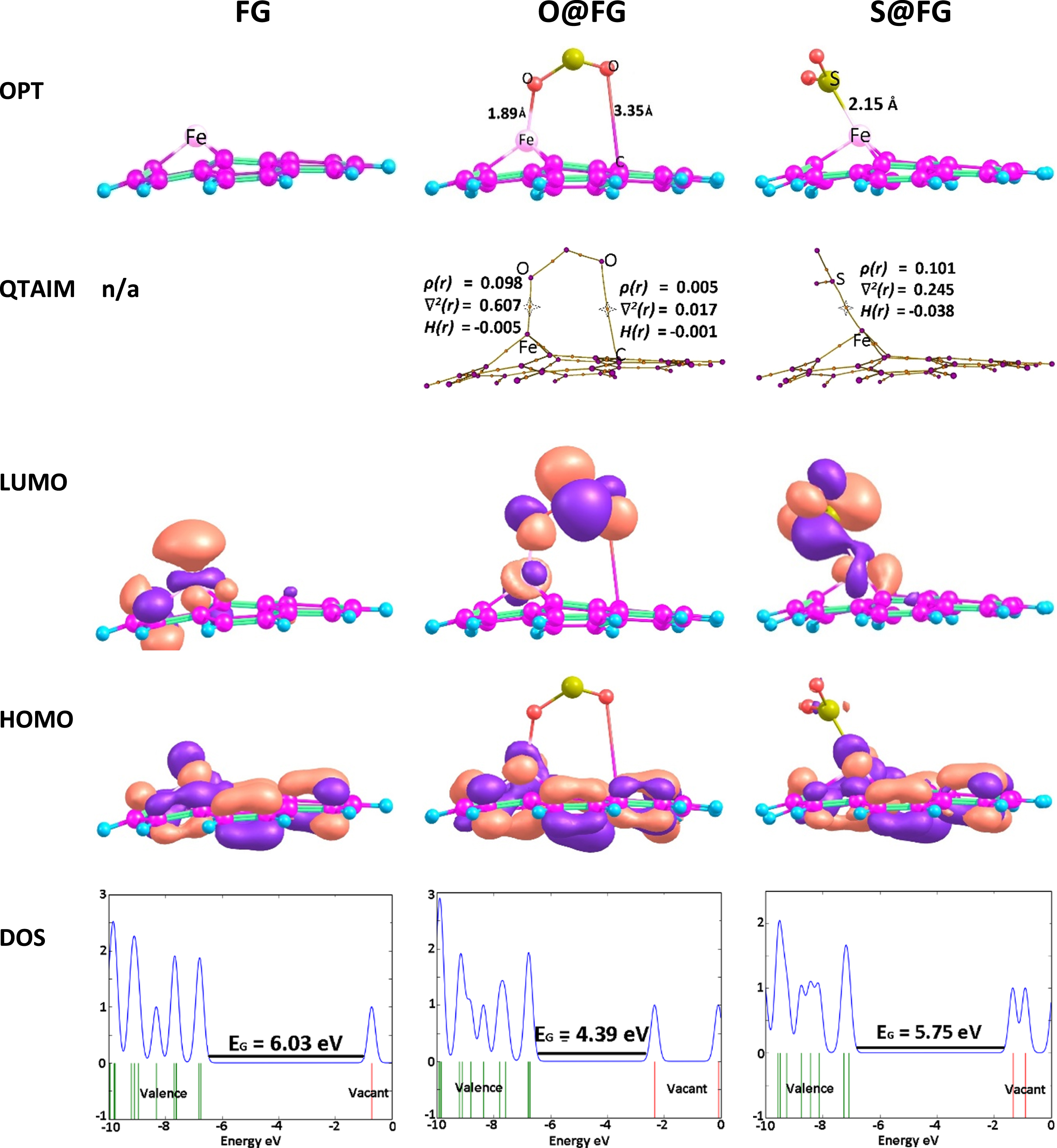
Optimized models and molecular orbital features.
Molecular energy features
The essential materials of this work are singular molecular models of FG and SO2 as shown in Fig. 1. Both models were optimized to obtain their energetic stabilized geometries for providing the interacting substances to approach the goal of the current work. Combinations of SO2 and FG were examined for several times by performing optimization calculations based on different initiating configurations of two molecules towards each other. The results yielded two models with the direct orientation of O atoms towards the Fe-doped atom indicated by O@FG and the direct orientation of S atom towards the Fe-doped atom indicated by S@FG. The obtained optimized models and their molecular orbital features were all visualized in Fig. 2. To exhibit the occurrence of such adsorption processes, the interaction distances of optimized configurations, the quantum theory of atoms in molecules (QTAIM) features, the electronic molecular orbital patterns of the lowest unoccupied molecular orbital (LUMO) and the highest occupied molecular orbital (HOMO), and the diagrams of density of states (DOS) were all shown in Fig. 2. Moreover, the quantities of adsorption energy (EADS), energy levels of LUMO and HOMO (EL and EH), energy gap (EG), and Fermi energy (EF) were listed in Table 1 for the optimized configurations of the investigated models. All the quantum calculations of this work were performed at the wB97XD/6-31G(d) level of density functional theory (DFT) as implemented in the Gaussian program [45]. The benefit of employing computational approaches to solve the scientific and industrial problems has been vastly affirmed by the achievements of earlier works [46–48]. Therefore, such methodological benefit has been employed to approach the goal of this work by exhibiting the obtained results in Table 1 and Fig. 2.
Results and discussion
By the importance of innovating novel sensors for the hazardous gases, a promising FG sensor for the SO2 gas was investigated in this work. The optimized models were prepared by means of performing DFT calculations, in which the Fe-doped atom was moved to upper level of planar monolayer to provide an interacting site with other substances. As shown in Fig. 2, the homoatomic composition of carbon monolayer was doped by an iron atom to yield the FG model for working as a surface for adsorbing the SO2 gaseous substance. As a consequence, the relaxed configurations of SO2 the FG surfaces were obtained.
Two optimized configurations of SO2@FG models were obtained by performing the optimization calculations on biomolecular models. The energy converging results indicated that two possibilities were available for adsorbing the SO2 gas in two directions through occurrence of interactions between O and Fe atoms to create the O@FG model and between S and Fe atoms to create the S@FG model. The results of adsorption energy of Table 1 indicated the values of –1.25 and –0.66 eV for the EADS quantity of O@FG and S@FG models, respectively. The negative sign of EADS quantity could affirm the possibility of exothermic formation of such bimolecular systems with reasonable magnitudes of adsorption strength. Return to Fig. 2 could exhibit that the O@FG model was created by occurrence of two interactions whereas the S@FG model was created by occurrence of one interaction between the SO2 gas and FG surface. This achievement was very well analyzed by means of the evaluated QTAIM features, in which the mentioned numbers of interactions ad their strengths were recognized for the integrating models.
The values of density of electron (ρ(r)) and Laplacian of electron density (∇2(r)), and energy density (H(r)) were all in reasonable ranges of physical interactions between the atomic sites of substances [49]. If all three values were positive, the strength of interaction was weak whereas in the case of all negative values, the strength of interaction was high at the order of covalent bonds. In the current work, the strength of interaction was in medium level designing occurrence of physical interactions. Moreover, the adsorbed SO2 molecule kept its own shape and it was not dissociated at the adsorbent surface. More details based on such results indicated that O-Fe was the strongest interaction and each of S-Fe and O-C were placed at the next steps of interaction strengths. The interaction distances were also in this order O-Fe < S-Fe < O-C in agreement with the obtained energetic features. Accordingly, the occurrence of O-C interaction helped the SO2 model for involving in better adsorption process by the FG surface for the O@FG model, in which the strength of O@FG model was seen higher than that of S@FG model. This achievement could very well affirm the importance of performing molecular scales calculations to show details of interacting systems for proposing the materials to be employed for such adsorbent applications. Indeed, the role of Fe-doped atom was dominant in the structural composition of FG, which provided an interacting atomic zone for adsorbing other substances. Of course, earlier works showed advantages of doped nanostructures for employing in various applications even better than their pure structures [50–52].
Further analyses of the results were based on the obtained electronic molecular orbitals features as shown in Fig. 2 besides their corresponding quantities of Table 1. One major feature of a material for employing in sensor applications is its electronic sensitivity to any external perturbation, in which the energy distance of LUMO and HOMO levels could indicate such feature besides the single standing energy levels of LUMO as the vacant orbitals and HOMO as the occupied valence orbitals. In this regard, patterns of LUMO and HOMO for the parent FG model exhibited the localization of LUMO at the Fe-doped atom of FG and that of HOMO at the whole structure. As a consequence, the Fe-doped atom could work as an adsorbing atomic site for the SO2 substance, which has plenty of lone pairs of electrons at both of the O and S atomic sites. The results of adsorbed models also approved such achievement, in which the models were obtained by relaxing the SO2 substance towards the Fe-doped atomic region. Variations of LUMO and HOMO were occurred in each of O@FG and S@FG models reminding the feature of electronic sensitivity to existence of any external perturbation. As a consequence, the models were stabilized and their electronic molecular orbitals distribution patterns indicated the electronic sensitivity to adsorption of the SO2 gaseous substance. Moreover, analysis of quantities of Table 1 could show that the single standing energy levels of LUMO and HOMO (EL and EH) were in closer distance in each of O@FG and S@FG models in comparison with the parent FG model. Accordingly, smaller values of EG for each of @FG and S@FG models in comparison with the parent FG model could reveal the occurrence of easier electric conductivity for bimolecular models as a required feature for a sensor material. Energies of Fermi level (EF) were also showed such importance for the adsorbed models. To visualize these features, the evaluated diagrams of DOS could show both of energy distances between the LUMO and HOMO levels in addition to occurrence of variations in such electronic molecular orbital levels. As a consequence, the investigated FG model could be introduced as a promising sensor for the hazardous SO2 gas. Comparing the results of this work with other parallel works also affirms such achievement for the investigated model of the current work [53–55]. It is worth to mention that the works on adsorption processes are not only limited to the gaseous substances but so many other substances are always the subjects of involving in the adsorption processes [56–59]. But those of gaseous adsorbents are indeed in a vital importance for protecting the living systems from gaseous poisoning.
Conclusion
Innovating a promising FG sensor for the SO2 gas was investigated in this work. The results indicated that the existence of Fe-doped atom in the composition of carbon monolayer could provide an interacting atomic site at the surface, in which it could be indeed an electron acceptor region. On the other hand, two configuration were obtained for relaxation of SO2 at the surface including O@FG and S@FG models with higher energy strength of formation for the first model. Furthermore, the results of QTAIM features indicated the highest strength of interaction for O-Fe interaction in comparison with those two other ones including S-Fe and O-C interactions. Variations of LUMO and HOMO features in booth f quantities and qualities levels indicated that the electronic features pf FG model could be sensitive by the existence of SO2 substance, in which such feature could help the model for working as a sensor. Moreover, the evaluated diagrams of DOS affirmed such achievement. As a consequence, the investigated FG model could be proposed a promising sensor for the SO2 gas.