




Abstract
A model of heterogeneous carbon-boron-nitrogen (C-B-N) nanocage was investigated in this work for adsorbing H2O and H2S substances. To achieve this goal, quantum chemical calculations were performed to obtain optimized configurations of substances towards the surface of nanocage. The calculations yielded three possible configurations for relaxing each of substances towards the surface. Formation of acid-base interactions between vacant orbitals of boron atom and full orbitals of each of oxygen and sulfur atoms yielded the strongest complexes of substance-nanocage in comparison with orientation of substances through their hydrogen atoms towards the surface of nanocage. As a consequence, formations of interacting H2O@C-B-N and H2S@C-B-N complexes were achievable, in which mechanism of action showed different strengths for the obtained complexes. Variations of molecular orbital features and corresponding energy gap and Fermi energy for the models before/after adsorption could help for detection of adsorbed substance through a sensor function. And finally, such C-B-N nanocage showed benefit of providing activated surface for efficient adsorption of each of H2O and H2S substance with possibility of differential adsorption regarding the strength of complex formations.
Introduction
Gas adsorption has been always an important topic for researchers to find efficient adsorbents for approaching this goal [1–3]. By innovation of nanotechnology, considerable efforts have been dedicated to explore benefits of employing nano-related structures for adsorbing gases from environment [4–6]. Several features of applications have been developed for various application in all phases of matters and conditions [7–9]. Nanostructures have been typically known for their wide surface area ratio to occupied volume making them suitable for participating in interactions with other substances [10–12]. Based on such benefit, capability of nanostructures have been examined by several research works to show mechanism of action and characteristic features for involving in adsorption processes [13–15]. In this case, both of living systems and industrial system have been significantly examined to reach the purpose [16–18]. The first introduced nanostructures were almost composed by carbon atoms, in which fullerenes and carbon nanotubes were the famous ones in this category [19, 20]. However, further investigations introduced non-carbon based nanostructures with varieties of atomic compositions for constructing the desired structures [21–24]. Among the proposed structures, combinations of boron and nitrogen atoms (BN) have been seen as an appropriate composition for constructing novel nanostructures instead of carbon ones with similarity of electronic numbers of BN atoms and those of two carbon (C) atoms. Indeed, BN nanostructures have been introduced as single-standing nanostructures very soon after innovation of C nanostructures, in which combinations of C-B-N have been seen achievable as a heterogeneous nanostructure [25–29]. It is important to mention that existence of impurities in nanostructures, in the form of doped models, is an advantage for exploring novel applications for these materials especially for electronic related processes and adsorption [30–32]. In this case, such impure nanostructures could provide activated surfaces for adsorbing other substances by assistance of different atomic sites of surface area [33–36]. Such idea of formation of a heterogeneous nanostructure for adsorbing H2O and H2S substances was investigated in this work by performing quantum chemical calculations. Earlier works indicated importance of investigating the current topic of this work to explore an efficient mechanism for H2O and H2S substances by assistance of nanostructures [37–39].
A model of C-B-N nanocage was proposed in this work for doing adsorption of H2O and H2S substances (Figs. 1 2). As noted by earlier works, H2S is a harmful substance available in the averments of industrial cities or plants [40–42]. Availability of humidity could increase harmful effects of H2S, in which adsorption of both of H2O and H2S from environment could help for increasing the safety level for avoiding poisoning situation [43–45]. To this point, the idea of H2O and H2S adsorption was investigated in this work to explore efficiency of a proposed heterogeneous nanostructure for working as an adsorbent of mentioned substances. The results were summarized in Table 1 and Figs. 1–3 for providing required information for discussing the goal of this work.
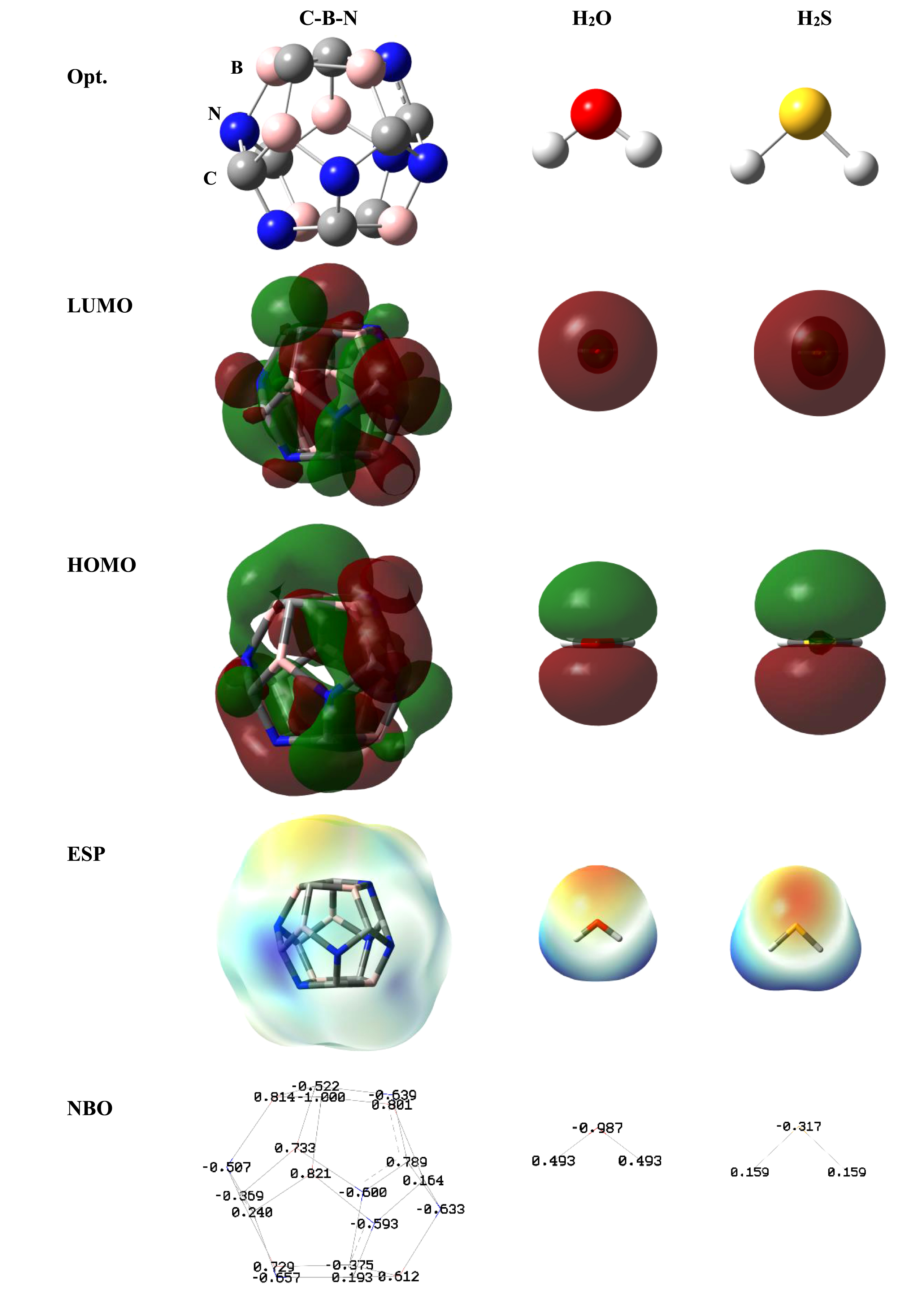
Individual models of C-B-N, H2O, and H2S; optimized configurations, HOMO/LUMO distribution patterns, ESP surfaces, and NBO atomic charges.

Complex models of H2O@C-B-N; optimized configurations, HOMO/LUMO distribution patterns, ESP surfaces, and NBO atomic charges.
Descriptors of the optimized models
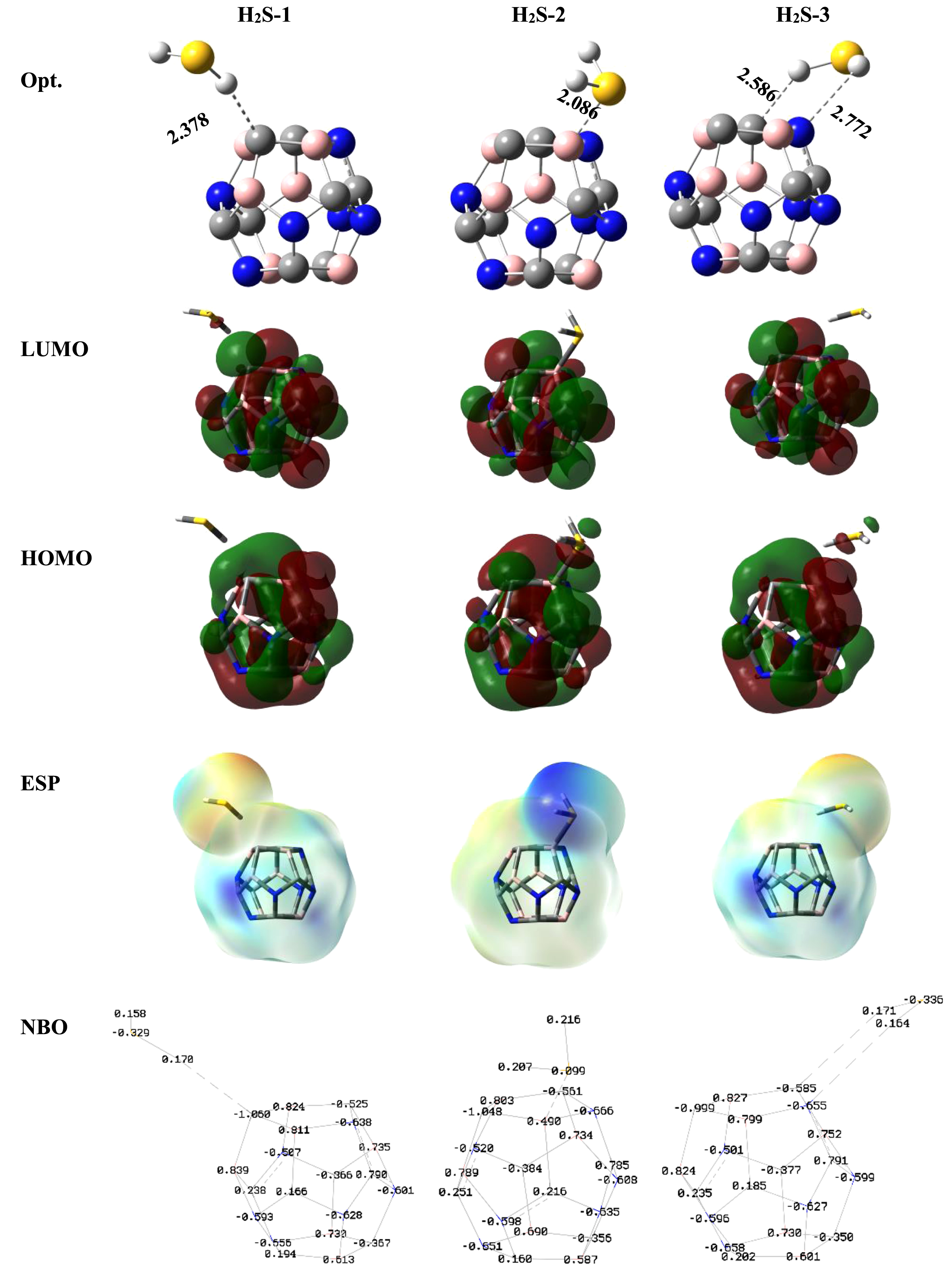
Complex models of H2S@C-B-N; optimized configurations, HOMO/LUMO distribution patterns, ESP surfaces, and NBO atomic charges.
A representative model of heterogeneous C-B-N nanocage with stoichiometry of C8B6N6 was investigated in this work for adsorbing H2O and H2S substances (Fig. 1). To this aim, quantum chemical based density functional theory (DFT) calculations were performed to prepare the optimized structures for evaluating their corresponding descriptors. After obtaining singular models, adsorption processes of each of H2O and H2S substances at the surface of C-B-N nanocage were examined through performing additional optimization calculations. As a consequence, various configurations of adsorbed substances at the nanocage were obtained (Figs. 2 3). In this regard, the models were prepared for evaluating descriptors including adsorption energies (EAds), energies of the highest occupied molecular orbitals (HOMO) and the lowest unoccupied molecular orbitals (LUMO), differences of HOMO and LUMO energies as energy gap (EG), Fermi energies (EF), and dipole moments (DM), all listed in Table 1. Moreover, graphical representations of the optimized models and evaluated bond distances of interacting sites were shown in Figs. 1–3 in addition to representations of HOMO and LUMO distribution patterns, electrostatic potential (ESP) surfaces, and natural bond orbital (NBO) atomic charges. This work was performed by benefit of employing computational approaches for solving research problems, in which the investigated models were carefully analyzed by means of evaluated molecular and atomic scales descriptors [46–49]. All calculations were performed employing the wB97XD/6-31 + G* method and basis set as implemented in the Gaussian program [50].
Results and discussion
As shown in Fig. 1, a model of heterogeneous C-B-N nanocage was investigated in this work for adsorbing each of H2O and H2S substances. Similarities of structural shapes of these two substances in addition to location of both of O and S atoms in group six of elements, may always make a mixture of conflictions for adsorbing these two substances. Therefore, a model of nanocage was hypothesized here for possible adsorbing each of H2O and H2S substances, in which quantum chemical calculations were performed to achieve the goal of this work. Fist the individual models were optimized to obtain structural configurations at the minimum energy level. Next, combinations of each of H2O and H2S substances and C-B-N nanocage were examined for occurrence of adsorption processes (Figs. 2 3). The results of individual models indicated that the models could be stabilized by performing DFT calculations, in which spherical shape of C-B-N nanocage was reasonable in the optimized mode. Further results of molecular orbital features of Fig. 1 sowed that the heterogeneous surface of C-B-N nanocage provided a variety of choices for participating in adsorption processes with various localizations of HOMO and LUMO patterns at all surfaces of nanocage. Indeed, this is an important achievement for employing C-B-N nanocage for their activated surfaces for participating in adsorption processes. Examining ESP representations could also affirm the idea to employ such nanocage for adsorptions with varieties of colors from mostly blue of nanocage (positive side) and mostly red of H2O/H2S substances (negative side). In this case, these models could be involved in interacting modes based on opposite charges of such molecular sides. To this aim, the NBO atomic charges were exhibited for the optimized models to show variations of atomic charges of models before/after occurrence of adsorption processes. The results of Table 1 could show that formation of almost all adsorbed complexes could be achievable with more or less strength in comparison with each other. As could be seen in Figs. 2 3, three configurations were found for adsorption of each of H2O/H2S substances at the surface of C-B-N nanocage, in which their magnitudes of EAds were almost different.
Figure 2 represents optimized configurations of interacting H2O@C-B-N complexes, in which different orientations of H2O were relaxed towards the C-B-N surface. Hydrogen atoms were involved in interactions in H2O-1 and H2O-3 complexes whereas oxygen atom was involved in interaction in H2O-2 complex. Boron atom has lack of electrons in the atomic valence shell and on the other hand, oxygen atom has lone pairs of electrons in the atomic valance shell; therefore, a strong interaction could be expected for H2O-2 model by formation of interactions between oxygen and boron atoms. Examining the results of Table 1 could affirm this expectation that the H2O-2 complex model yielded the largest magnitude of EAds for highest possibility of formation. Other two complex models were in lower stabilities than H2O-2 with the order of H2O-3 > H2O-1. For H2O-3 complex model, both hydrogen atoms of H2O were involved in interactions; however, only one hydrogen atom was involved in integration in H2O-1 complex. As a consequence, better results of adsorption process were found for H2O-3 complex model in comparison with H2O-1 complex. H2O molecule is almost a small flexible molecule and occurrence of all configurations could be expected to be achieved. The important point is that all three configurations could be considered as achievable complexes for the interacting models of H2O substance and C-B-N nanocage. Analyzing other results of molecular orbital features could show significant impacts of occurrence of such molecular interactions on each of HOMO and LUMO magnitudes and distribution patterns. Interestingly, HOMO and LUMO patterns were localized at the C-B-N counterpart meaning that the adsorbed substance could not participate in further interactions. This achievement could be re-mentioned by stable adsorption mechanism of H2O at the surface of C-B-N nanocage, in which adsorbed H2O molecule is almost a neutral substance not applicable for involving in further interactions. One of the functions of adsorbents is their ability for keeping the adsorbed substance, in which such function could be proposed by such HOMO and LUMO localization a the C-B-N surface. Moreover, ESP surfaces could show existence of H2O@C-B-N complexes by their continuous surface features and the corresponding NBO atomic charges could help to find+/- atomic regions. Analyzing values of HOMO and LUMO and their related EG and EF features could show possibility for recognition of adsorbed substance y changes of conductivity features between the occupied/unoccupied molecular orbitals levels. In addition to changes of each level of HOMO and LUMO for the models, their distances were also changed as shown by different obtained values of EG. Moreover, changes of Fermi level could help very well for detection of adsorbed substance with a sensor function. Changes of electric charges at the surfaces of molecular systems could be seen by values of DM. As a consequence, the investigated C-B-N was seen as a suitable surface for adsorption of H2O substance, in which mechanism of such adsorption could be varied by different orientations of relaxed H2O towards the C-B-N surface. Indeed, occurrence of acid-base interactions through the vacant orbitals of boron atom and full orbitals of oxygen atom could yield a remarkably strong H2O@C-B-N complex.
Figure 3 represents complexes of adsorbed H2S substance at the surface of C-B-N nanocage, in which three models were obtained through performing optimization process. Here it could be mentioned that the occurrence of adsorption process is one story and knowing the mechanism of adsorption is another story. By benefits of performing computer-based works, both points of adsorption and mechanism could be achieved. In this case, three configurations were obtained for adsorbed H2S substance at the surface of nanocage, in which orientations of H2S substance towards the surface could determine the stability of resulted complex model. As shown in Fig. 3, H2S-1 and H2S-3 were involved in interactions with the nanocage through hydrogen atomic sites whereas H2S-2 was involved in interaction through sulfur atomic site. Based on EAds contents of Table 1, it could be mentioned that H2S-2 complex formation was almost the most suitable one in comparison with formations of other H2S-1 and H2S-3 complex models, in which the energy ranking of stability could be categorized in this way: H2S-2 > H2S-3 > H2S-2. This achievement is almost in agreement with parallel results of last section for H2O adsorption processes. To this point, formations of H2S@C-B-N complex models were achievable, but with different levels of stabilities and configurations relaxations. Formation of acid-base interactions was also the winner of this part, in which H2S-2 models was seen as the most stable complex model. Changes of HOMO and LUMO features in both of magnitudes and distributed patterns were notable, in which a way of detection of adsorbed substance could be provided through variations of EG and EF of adsorbed complexes in comparison with the original models. Additionally, variations of HOMO and LUMO distribution patterns, ESP surfaces, and NBO atomic charges could clearly describe the magnitudes of effects of bimolecular complex formations of the interacting substances. As a consequence, the investigated C-B-N nanocage could be proposed for working as an adsorbent for H2S substance in addition to doing a sensor function, which could be expected for applications in the environmental related issues.
Conclusion
This work was performed to examine benefit of employing a heterogeneous C-B-N nanocage for adsorption of each of H2O and H2S substances. Comparing the results for two sets of interacting complex models could show benefit of employing heterogeneous nanocage surface for adsorbing each of H2O and H2S substances. However, strengths of complexes were higher for the H2O related complexes in comparison with the H2S related ones. Therefore, it could be expected that a differential mode of adsorption could be occurred for H2O and H2S adsorption processes by the investigated C-B-N nanocage. Additionally, variations of HOMO and LUMO levels and their related EG and EF features could make possible detection of adsorbed substances through doing a sensor function.