



Abstract
Two novel quinone derivatives (NN3 and NN4) were synthesized in this work and they were characterized to be used as small organic semiconductor molecules in different types of photovoltaic applications. To make accessible compounds, three simple steps were followed to prepare NN3 and NN4 compounds. Furthermore, energy levels of the highest occupied molecular orbital (HOMO) and the lowest unoccupied molecular orbital (LUMO) were determined for the computationally optimized models of the investigated compounds. The obtained optical and electrochemical results of this work indicated that NN3 and NN4 compounds were good candidates for application in the fields of bulk heterojunction (BHJ) and perovskite solar cells. Indeed, investigating new energy resources has been seen an important topic of research for producing clean energies and portable storage systems.
Introduction
The field of semiconductor has been seen very interesting because of the importance of energy absorption and storing devices, in which the organic semiconductors have been grown rapidly in this case [1–3]. Benefits of organic semiconductors are their lightweight, flexibility, and low cost in comparison with the inorganic semiconductors [4–6]. These properties leaded to the advantages of organic semiconductors for applications in photovoltaic devices such as organic photodetectors, organic sensors, and organic solar cells [7–9]. Several works have been reported using small organic molecules as photovoltaic devices for optical-based applications [10–14]. The photovoltaic systems represent one of the most efficient way of generating clean energy without exhausting the hydrocarbon pollutions [15–17]. However, high price of producing the optical devices is a real banner of solar panels developments [18–20]. To overcome such issue, the innovation of organic semiconductors helped to construct cheaper energy devices such as solar with small amounts of the organic dyes as an active layer of energy generation [21–23]. Among many types of used organic dyes in production of highly efficient dyes of third-generation solar cells, quinone derivatives have been the most attractive organic compounds for approaching the goals of this fields [24, 25]. Benzoquinone is a known electron acceptor with a highly conjugated system to be applied as a solid-state semiconducting molecule in many fields related to the active layers of organic solar cells, organic field-effect transistor, organic dyes in dye synthesized solar cells, luminescent spectral concentrators, and fluorescent sensors [26–32]. It could be mentioned here that the topic of energy absorption and storage is very important for supplying the new energy needs of different industries [33–35]. Several material compounds have been developed in this case to provide the required devices of energy related systems [36–38]. Such materials have been also activated for adsorbing other substances, in which such models could be investigate for further developments of energy devices [39–41]. In the case of photovoltaic energy devices, there are many in-trusting quinone derivatives such as 2,3-dichloro-5,6-dicyano-1,4-benzoquinone (DDQ) to be used as an additive to bulk heterojunction (BHJ) systems [42]. Additionally, benzoquinone has been used as an additive into the perovskite films to improve efficiency and air stability enhancement [43]. Within this work, two organic benzoquinone derivatives (NN3 and NN4) were synthesized and they were characterized by employing various techniques such as NMR spectroscopy, mass spectroscopy, UV-Visible, and cyclic voltammetry. To provide more information at the molecular scales, density functional theory (DFT) calculations were performed to prepare the optimized molecular geometries and energy levels of the highest occupied molecular orbital (HOMO) and the lowest unoccupied molecular orbital (LUMO) of the investigated models. The calculations were performed by benefits of employing computational approaches to investigate the materials at the smallest scales to explore their electronic structures and features [44–46].
Experimental details
Synthesis of Compound

The molecular model of compound
Synthesis of Compound

The molecular model of compound
Synthesis of Compound

The molecular model of compound
Computations: The B3LYP/6-311G(d,p) DFT calculations were performed to obtain the optimized geometries and the corresponding features for the optimized models systems. The calculations were performed using the Gaussian 09 program [48]. By performing these types of computations, more insightful information could be provided for analyzing the molecular models systems [49–52].
Synthesis of compounds
In two steps, a Suzuki coupling reaction followed by a reduction reaction were used to prepare two quinone derivative compounds (NN3 and NN4) precursors for photovoltaic devices. The reaction steps of prepared compounds were shown in Fig. 4. In these reactions, compound

The presentation of synthesis of compounds
The UV-visible absorption spectra of compounds NN3 and NN4 were calculated at room temperature by using DCM, at a concentration of 10-5 M. Fig. 5 and Table 1 illustrate the optical properties for compounds NN3 and NN4. Compound NN3 has possessed two narrow absorption bands in the ultraviolet region with maximum absorbance at 374 nm. Moreover, the same compound was displayed a broad absorption peak in the visible region between 400–700 nm. On the other hand, compounds NN4 displayed only two narrow absorption bands in the ultraviolet region with a maximum of 369 nm [53]. These first absorbance bands in the ultraviolet region for both compounds (NN3 and NN4) are probably due to the n-π* transition of quinone or may be due to the π-π* transition of the aromatic moieties. Furthermore, the absorbance band for compound NN4 in the visible region could have corresponded to the intramolecular charge transfer (ICT). Based on the obtained optical data, compounds NN3 and NN4 are good candidates to be used as a small organic semiconductor for bulk-heterojunction and perovskite solar cells respectively. Compound NN3 has a broad absorption peak in the visible region which is the most important requirement for organic semiconductors to be used as a donor layer in bulk-heterojunction solar cells [54]. Likewise, compound NN4 has an absorption band in the ultraviolet region only, and this fact is essential for the organic compound to be used as a hole transport layer in perovskite solar cells.

The UV-vis spectra for compounds
The UV-vis absorbance data for compounds NN3 and NN4
The electrochemical properties were calculated using a cyclic voltammetry (Fig. 6, A) and a square wave voltammetry (Fig. 6, B) in a solution of DCM (10–3 M) at the room temperature. The estimated ionization potential (HOMO level), electron affinity (LUMO level), and fundamental energy gap for compounds NN3 and NN4 were recorded. 1.6 mm diameter platinum was used as working electrode, Pt wire as the counter electrode, and silver wire as a reference electrode. Additionally, tetra-n-butyl ammonium hexafluorophosphate (TBA.PF6) (0.1 M) was used as a supporting electrolyte. The following equations were used to calculate the values of ionization potential (IP), electron affinity (EA), and EGAP.
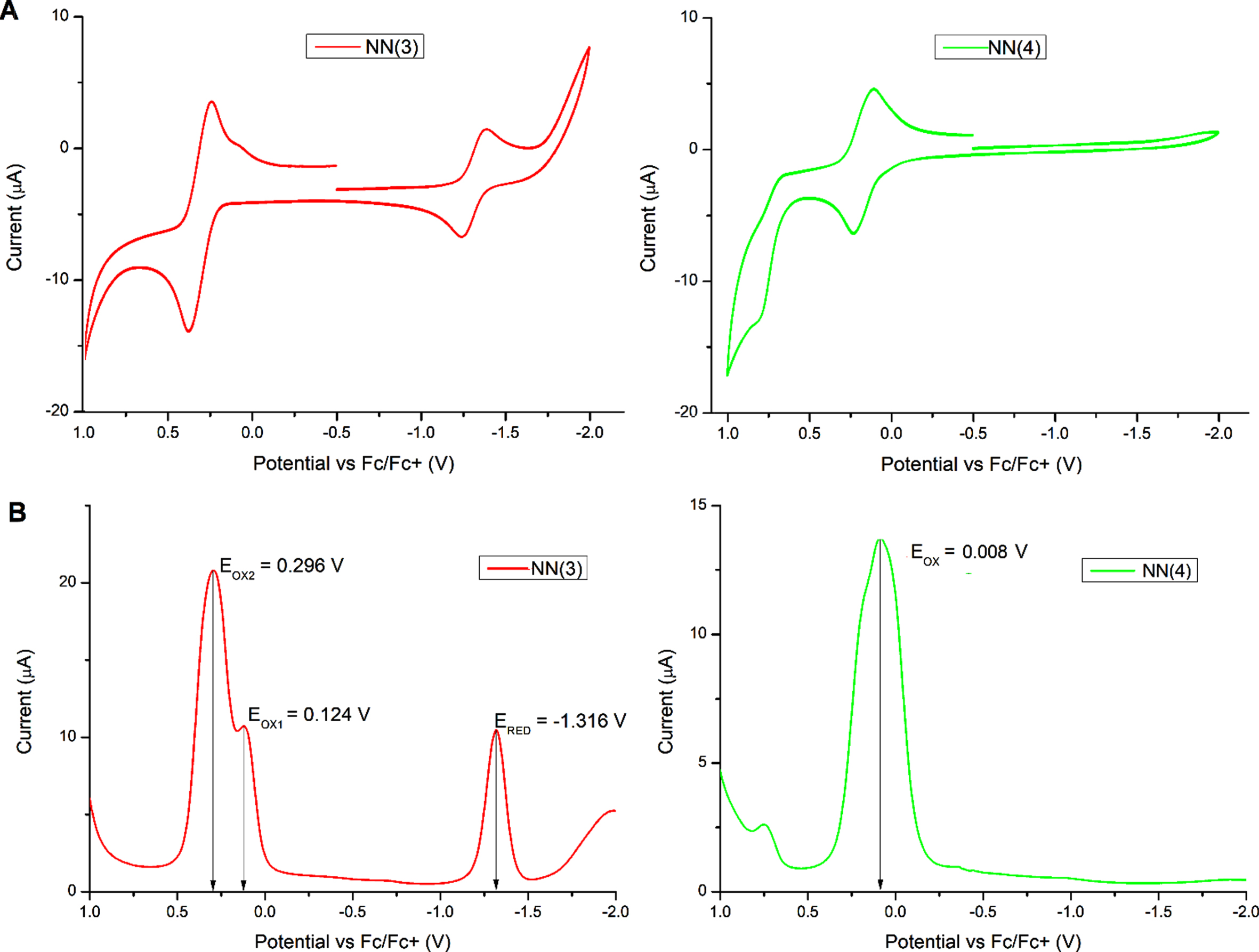
The performed A- cyclic voltammetry and B- square wave voltammetry for compounds
As shown in Fig. 6, compound NN3 displayed two oxidations and one reduction wave. On the other hand, no reduction peak but only one oxidation peak was observed with compound NN4 and Table 2 was shown the summary of electrochemical properties of the dyes. Based on the data, the values of IP for compounds NN3 and NN4 were found to be 5.096 eV and 4.888 eV, respectively. However, the value of EA for compound NN3 was calculated to be -3.484 eV. Furthermore, the energy gap of compound NN3 was calculated to be 1.612 eV. Compound NN3 was shown one reversible reduction and one oxidation peak which means that compound NN3 can be accepted and donate one electron. Nevertheless, compound NN4 displayed only one reversible oxidation peak. The data obtained from cyclic voltammetry was in good agreement with the square wave voltammetry.
The summary of electrochemical data for compounds NN3 and NN4
The models of NN3 and NN4 were optimized to obtain the minimized energy structures. The results showed existence of a dihedral angle ∼142° for NN3 and ∼154° for NN4 between benzoquinone and the appended phenyl group for triphenylamine (Fig. 7). The twisted angle could lead to appearance of negative effects on the conjugation of molecular structure. On the other hand, the dihedral angle could increase the solubility of the compound by preventing π-stacks among the molecules. The electron distribution of HOMO for two compounds was delocalized in the two sides of the molecules (triphenylamine) whereas the electron distribution of LUMO was delocalized on the molecular center (benzoquinone) meaning these compounds are ideal as a hole transport materials. As shown in Table 3, the estimated values of energy gab for compounds NN3 and NN4 are 1.874 eV and 2.886 eV, respectively. For many optoelectronic applications, the acceptable values of HOMO and LUMO levels could assist to improve the donor-acceptor electron migrations leading to an increase in the efficiency of the device. Based on the obtained values form both of computation and experiments, the HOMO and LUMO of NN3 and NN4 were located in suitable positions to be used as donor layers in BHJ solar cells and as a hole transport layer in perovskite solar cells, respectively.
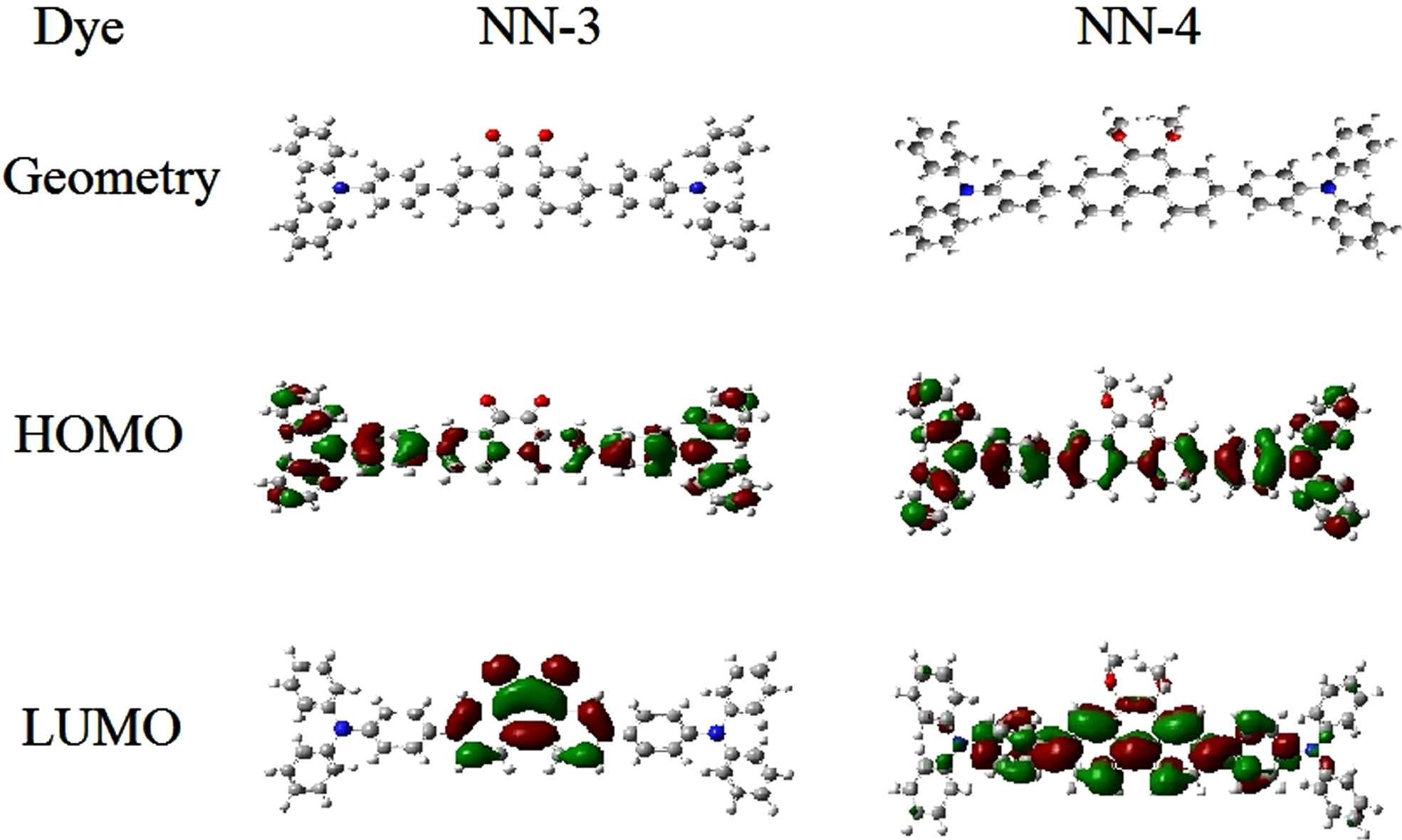
The ground state optimized geometry and electron density distribution for compounds
The computed energy levels of NN3 and NN4 based on DFT calculations
In summary, two novel quinone derivative compounds, NN3 and NN4, were successfully synthesized via two simple steps. These compounds were fully characterized by spectroscopic measurements such as 1H NMR, 13C NMR, mass spectrometry, UV-Visible, and electrochemical methods studies (Cyclic and square wave voltammetry), in which the experimental results were supported by the computations. This study aimed to use these compounds for different solar cells applications. Importantly, the optical and electrochemical result showed that the molecules could be proposed as good candidates for application in the fields of BHJ and perovskite solar cells.
Footnotes
Acknowledgments
The authors gratefully acknowledge the Ministry of Higher Education of Iraq, Kirkuk University – college of education / Al-Hawija and college of science, Baghdad University–department of chemistry, Market research, and consumer protection cancer. The Al-Karkh University of Science–Faculty of Remote Sensing and Geophysics, for their kind support in this work.