



Abstract
The selectivity of biocatalysts based on enzymes, eco-friendly reaction systems, and strong catalyst performance is exceptionally compelling. For improving enzyme recyclability and stability, a good option that has been proved is immobilization. For enzyme immobilization, hydrogel sodium polyacrylate combined with nanoparticles is an interesting class of support matrices as compared to others. This study synthesizes and uses the cross-linked hydrogel sodium polyacrylate-decorated gold or silver nanoparticles (HSP/AuNPs or AgNPs) as immobilized support for peroxidase and FTIR characterizes it. The novel supports immobilized system properties enhanced biocompatibility. They have attained a greater immobilization yield (91% with HSP/AuNPs and 84% with HSP/AgNPs). The rest of the immobilized peroxidase activity, after 10 recurring cycles of HSP/AuNPs was 61% and HSP/AgNPs was 54%. The remaining activity of the immobilized enzyme onto HSP/AgNPs, after storing at 4°C for 6 weeks, was 73% and HSP/AuNPs was 75% of its initial activity. It was revealed that the optimum temperature for the free enzyme and the immobilized enzyme was 50°C and 50–60°C, respectively. For the immobilized enzyme, the optimum pH is 7–7.5, as compared to the optimum pH of free enzyme pH 6.5.
Introduction
Immobilized enzymes have several advantages over dissolved enzymes. Soluble enzymes are flawed in a variety of ways, including reusability, stability, recovery, complexity, costly production processes, restricted pH ranges, and temperature sensitivity. As a result, combining enzyme immobilization with solid media has shown to be a successful strategy to overcome their application limitations [1–3]. The employment of various biocatalysts not only creates target products and eliminates side effects, but also increases selectivity and activity. Enzyme-based biocatalysts are attractive because of their excellent catalytic performance, environmentally acceptable catalysts, and selectivity [4]. Furthermore, the enzyme immobilization causes excellent storage and operating reliability, and fast reaction times. Peroxidase was used as a model enzyme in this study. it is often used as antioxidants, food processing markers [5], performing material synthesis [6], and bioelectrodes [7]. Notwithstanding their significance, peroxidases’ use as biocatalysts in manufacturing processes and commercial applications are constrained because they are impaired in the presence of high concentrations of hydrogen peroxide [8] and have poor stability under operating conditions. The enhancement of peroxidase properties leads to the use of these enzymes in industrial applications.
Designing the carrier and choosing the support matrix are critical steps in enzyme immobilization. Recently, nanostructures have seen widespread use as an enzyme immobilization matrix. Amongst the various nanostructures (metal nanoparticles, carbon nanotubes, silica, and others), the silver and the gold nanoparticles seem particularly appealing for use as hosting matrixes. They’re spherical, with diameters ranging around tens of nanometers, and are similar to massive biomolecules including enzymes, receptors, and antibodies. Such nanoparticles, which are a thousand times smaller than a cell, have a variety of biomedical uses, including cancer detection [9], gene and drug delivery [10], radiotherapy [11], suppressing and regulating bacterial growth [12], and biosensors and sensors [13]. Good electronic properties and a big surface area Au and Ag nanoparticles can provide a stabilized exterior for enzyme immobilization. They may also function like conveyance centers, promoting electron transfer. ‘Redox enzymes’ immobilization using colloidal silver/gold is assumed to either allow directing channels amidst silver/gold surface [14] and the prosthetic groups or to assist the protein assume a more favorable direction. Gold and silver nanoparticles were used as a framework of enzyme immobilization in which the enzymes’ activity is preserved since the silver and gold surfaces allow protein molecules to be absorbed [15]. Enzymes immobilization on stable supports such as Ag and Au nanoparticles is accomplished by using isolated enzymes or entire cells of glucose oxidase [16], lysozyme [17], alcohol dehydrogenase [18], and aminopeptidase [15]. With all these advantages, the present study focuses on the use of sodium polyacrylate spheres incorporated by silver and gold nanoparticles as a novel support for the peroxidase enzyme. the morphological characters, reusability, and storage stability of the immobilized enzyme were investigated.
Materials and methods
Purchasing of Sodium poly(acrylate) hydrogel, Sodium tetrachloroaurate (NaAuCl4), Silver nitrate (AgNO3), and Sodium citrate (NaCit) were done from Sigma-Aldrich. Every other reagent employed was of analytical grade and used as it is. Peroxidase was previously purified from Commiphora gileadensis [19].
Preparation of support
The Turkevich method was applied for synthesizing Gold (AuNPs) and silver (AgNPs) nanoparticles, employing sodium citrate (NaCit) [20]. The sodium polyacrylate sphere was immersed in different concentrations of NaAuCl4 (1–15 mM) and 5 mM NaCit, by heating at 90°C for 20 min, the expected aqueous AuNPs colloids were formed. In the same manner, AgNPs were synthesized using different concentrations of AgNO3 (20–80 mM) and 5 mM NaCit. The swelling hydrogel sodium polyacrylate incorporated with AuNPs (HSP/AuNPs) or AgNPs (HSP/AgNPs) were removed and cleansed using distilled water for removing excess of NaAuCl4 or AgNO3. To perform the enzyme immobilization process, the peroxidase enzyme (100 units) was mixed end-over-end with HSP/AuNPs or HSP/AgNPs at 110 rpm, in Tris–HCl (pH 7.0 or 8.0) and 20 mM sodium acetate buffer (pH 6.0). At room temperature, the immobilization reaction proceeded overnight. Removal of aliquots of the supernatant was done and drying of the HSP/AuNPs or HSP/AgNPs at room temperature, and investigation of the degree of immobilization was done. The following formula was used for calculating the immobilized efficiency:
For evaluation of peroxidase activity, the method of Yuan and Jiang was employed [21]. 50 mM Tris–HCl buffer pH 7.0, 40 mM guaiacol, and 8 mM H2O2 was present in a 1 ml aliquot of the reaction mixture, with the least amount of enzyme preparation. Every minute, there was a variation observed in absorbance because of guaiacol oxidation. The amount of enzyme that can raise the OD to 1.0/min is known as the activity per unit of the substance. Under standard assay conditions, the experiment was performed.
Protein determination
The Bradford method was employed for quantifying the protein [22] with the help of bovine serum albumin as a standard.
FTIR analysis
FT-IR (Fourier-transform infrared spectroscopy, Thermo Scientific) was employed for examining the chemical composition of sodium polyacrylate hydrogels along with AgNPs or AuNPs before and after the process of immobilization.
Storage stability and reusability
In the reusability studies, the evaluation of immobilized enzyme activity was done as described above. Removal of immobilized enzyme was carried out and cleansed multiple times using 50 mM Tris–HCI buffer pH 7.2 in the following operating cycle, and an addition of a fresh substrate took place. The reaction was carried out repeatedly, at particular intervals, for 10 cycles of use. The evaluation of the storage stability of the immobilized and free enzyme was carried out, at fixed intervals, by measuring the activities of the enzymes at 4°C for 6 weeks.
Effect of temperature and pH
Two kinds of buffers i.e. Tris-HCl buffer (pH 6.5–9.0) and 50 mM of sodium acetate buffer (pH 4–6.0), were employed for the evaluation of the impact of pH on the immobilized and free peroxidase activity. By carrying out the reaction at a temperature between 30 and 80°C, the impact of temperature on the immobilized and free peroxidase activity was evaluated. In every set, a value of 100% was assigned to the highest activity of an enzyme.
Results and discussion
The impact of sodium tetrachloroaurate and silver nitrate concentrations on the activity of the enzyme at the time of the experiment was inspected. Within the optimum conditions, the final sodium etrachloroaurate concentrations were 1, 5, 10, and 15 mM while the final silver nitrate concentrations were 20, 40, 60, and 80 mM. The best concentration as evident from Table 1, an increase in the immobilized enzyme activity was found with the increase in sodium etrachloroaurate concentration at the start and attained the greatest value at 10 mM at pH 7, and then, correspondingly a decrease was observed in the enzyme activity when sodium etrachloroaurate concentration was increased again. Similarly, an increase in the activity of the immobilized enzyme was observed with the increase of silver nitrate concentration at the start and attained the greatest value at 40 mM at pH 7, and then, there was a decrease in enzyme activity. The optimum immobilization efficiency (IE%) for HSP/AuNPs or HSP/AgNPs was 91% and 84%, respectively. From these results, HSP/AuNPs is suitable to support for peroxidase enzyme with high IE%. In literatures, gold nanoparticle incorporated with cellulose nanocrystal was used as support for cyclodextrin glycosyltransferase and the immobilization efficiency was 70% [23]. Khan et al., reported that α-amylase was immobilized on silver nanoparticles/Polyaniline-assisted with retained 83% of the original activity [24].
Effect of Sodium tetrachloroaurate and silver nitrate concentrations on the immobilization efficiency
Effect of Sodium tetrachloroaurate and silver nitrate concentrations on the immobilization efficiency
The FTIR spectra of hydrogel sodium polyacrylate (HSP), hydrogel sodium polyacrylate-decorated gold nanoparticles (HSP/AuNPs) before and after immobilization, and hydrogel sodium polyacrylate-decorated silver nanoparticles (HSP/AgNPs) before and after immobilization were shown in Fig. 1. The stretching vibrations of the –OH bonds for acrylate are shown by peaks at 3326 cm–1. The distinctive band at 1539 cm–1 is because of C = O asymmetric stretching in the carboxylate anion, which is corroborated by another high peak at 1319 cm–1 that is connected to the carboxylate anion’s symmetric stretching mode. The amide group is responsible for the absorption band at 1654 cm–1. AuNPs and AgNPs were capped by the FTIR spectra of the citrate. It was observed that the peak for symmetric stretching (COO–) from sodium citrate was 1445 cm–1 carboxylate asymmetric stretching (COO–) at 1553 cm–1. The carboxylate asymmetric stretching peak for citrate on the AuNPs appeared to be greatly a high-frequency deviation from the actual peak position. For citrate on AgNPs, however, the carboxylate asymmetric stretching appeared to be a somewhat low-frequency deviation. The carboxylate symmetric stretching on both, the AgNPs and AuNPs are low-frequency deviations to 1314 cm–1, but the peak intensity of carboxylate symmetric stretching on the AgNPs is substantially higher as compared to the AuNPs. Interestingly, upon peroxidase immobilization onto the HSP/AuNPs/or HSP/AgNPs samples, a change in the FTIR was observed that revealed new peaks along with the emergence of strong, wide peaks because of NH2, OH groups, and amide contained in the peroxidase, strong amide bands, and reappearance of C–O–C peaks, verifying that the of peroxidase enzyme immobilization was a success.

FTIR spectra of HSP, HSP/AuNPs, HSP/AgNPs, HSP/AuNPs with enzyme, and HSP/AgNPs with enzyme.
The impact of various pH values (4.0 to 9.0) was assessed for free and immobilized peroxidase. Figure 2 presents the results. For free peroxidase, the optimum activity was at pH 6.5. For the immobilized peroxidase on HSP/AuNPs/or HSP/AgNPs, the optimum activity was observed at a wide pH ranging from 7.0 to 7.5. The comparison of the outcomes of the immobilized and free peroxidase reveals that the immobilized peroxidase activity was higher at a range of pH values (4.0–9.0). it was revealed that the pH deviated from 7 for free peroxidase to 7.5 for the immobilized enzyme in other studies [5, 25–27]. The optimum pH level for immobilized HRP was 7.0 and free HRP was 6.5 in another study [28]. This change could have been caused by ionization of the microenvironment around the active site in the acidic and basic amino acid chain due to the newly developed interactions of basic residues of the enzyme with HSP/AuNPs/or HSP/AgNPs.
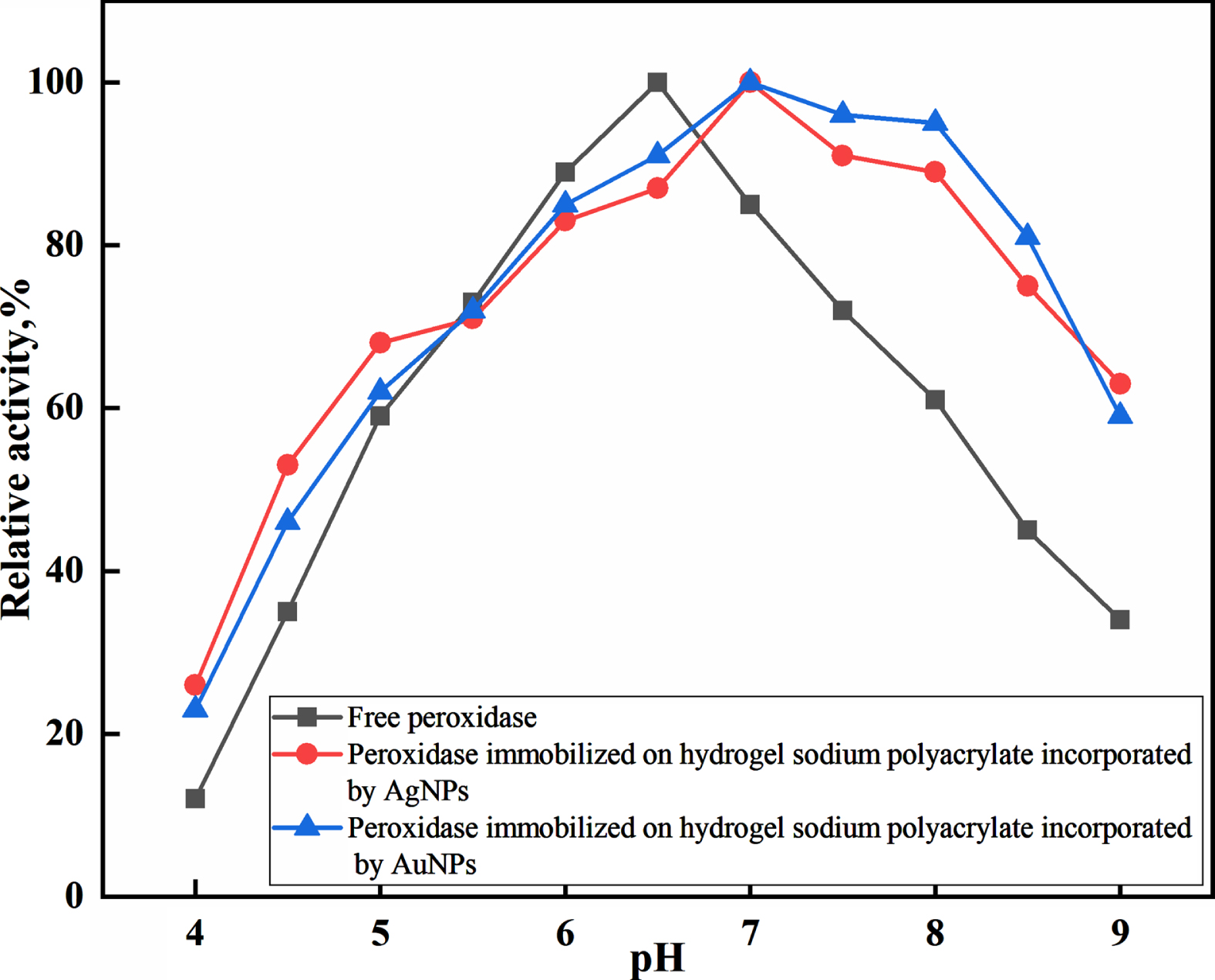
Effect of pH on the free and immobilized enzyme.
The impact of temperature on the immobilized and free peroxidase activity is presented in Fig. 3. The optimum free peroxidase relative activity was observed at 50°C. Immobilized peroxidase, however, had a wide highest relative activity ranging from 50 to 60°C. The immobilized enzyme activity was found to be less temperature sensitive as compared to the free peroxidase at 50 to 80°C. Protein 3D structure unfolds because of the high temperature that influences the free enzyme in contrast to the immobilized form [29]. The reason for immobilized enzyme stability at higher temperatures in the process of immobilization was the decrease in enzyme configuration flexibility. [30, 31]. Changes in the immobilized peroxidase’ optimum temperature have been observed in studies when employing various carrier supports, such as Temoçin et al. [32], revealed that the highest activity was observed at 50°C, when HRP immobilized on electrospun poly (vinyl alcohol) blend nanofibres, in contrast to its soluble equivalent (45°C). Reusability is the most important characteristic of immobilized enzymes in terms of industrial and economic applications. Under optimal conditions, the reusability study was performed, and the activity of the enzyme was evaluated for 10 reuses. Evident in Fig. 4, the immobilized enzyme on HSP/AuNPs and HSP/AgNPs retained 61% and 54% of its actual activity after 10 cycles. The results demonstrated significant improvement in peroxidase reusability. This reusability is enabled for two reasons: hydrogen bond creation and ionic interactions between the enzyme and the carrier. Based on the results, it was evident that the immobilized peroxidase had excellent recyclability properties. The enzyme activity decreased after repeated cycles, which is attributed to interactions of the active substrate layer of the immobilized enzyme. This is followed by the formation of weak bonds between the immobilized peroxidase and matrix, which leads to the phenomenon of leaching in the enzyme. In reusability experiments, the enzyme’s leaching leads to decreased activity [33, 34].
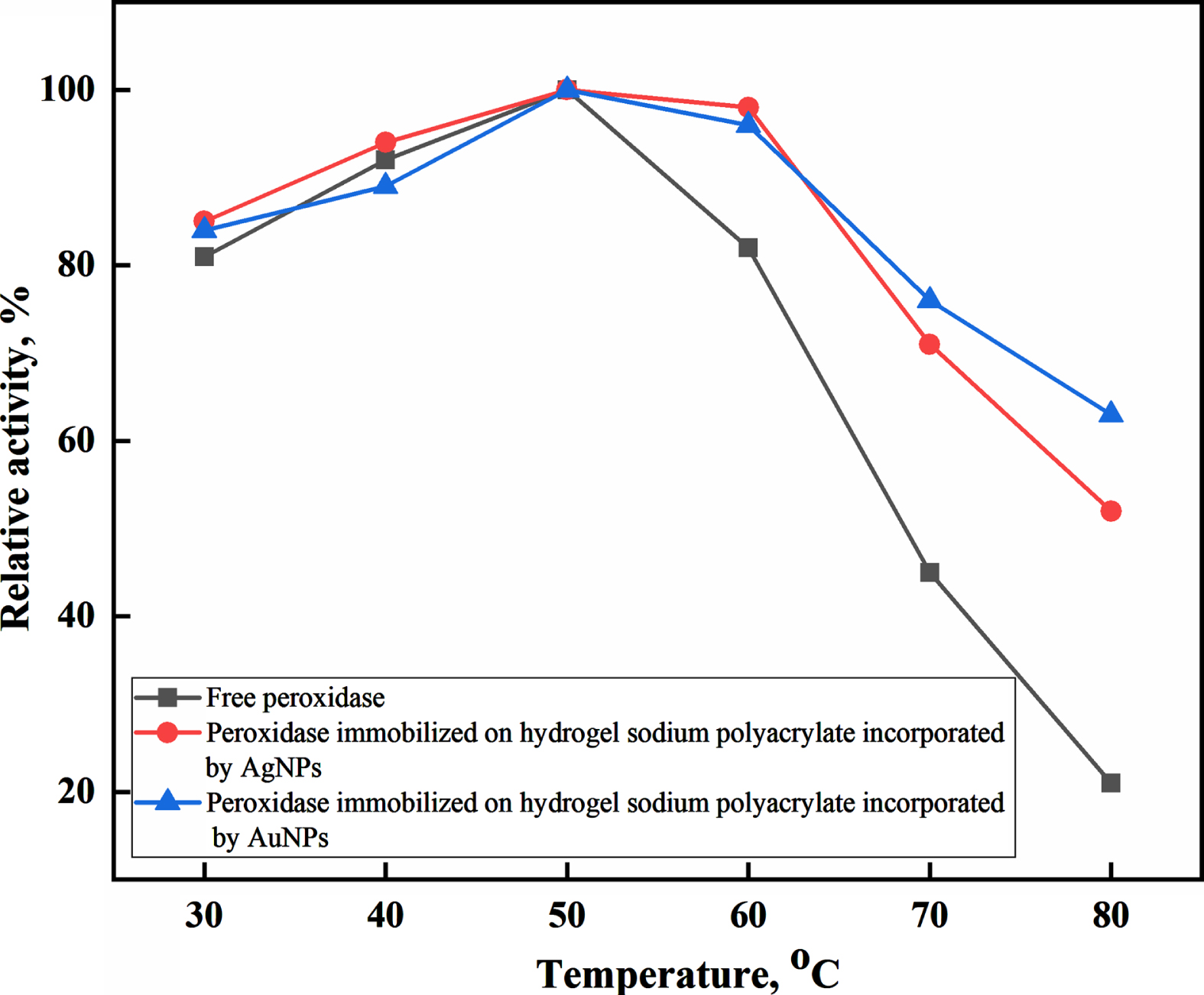
Effect of temperature on the free and immobilized enzyme.
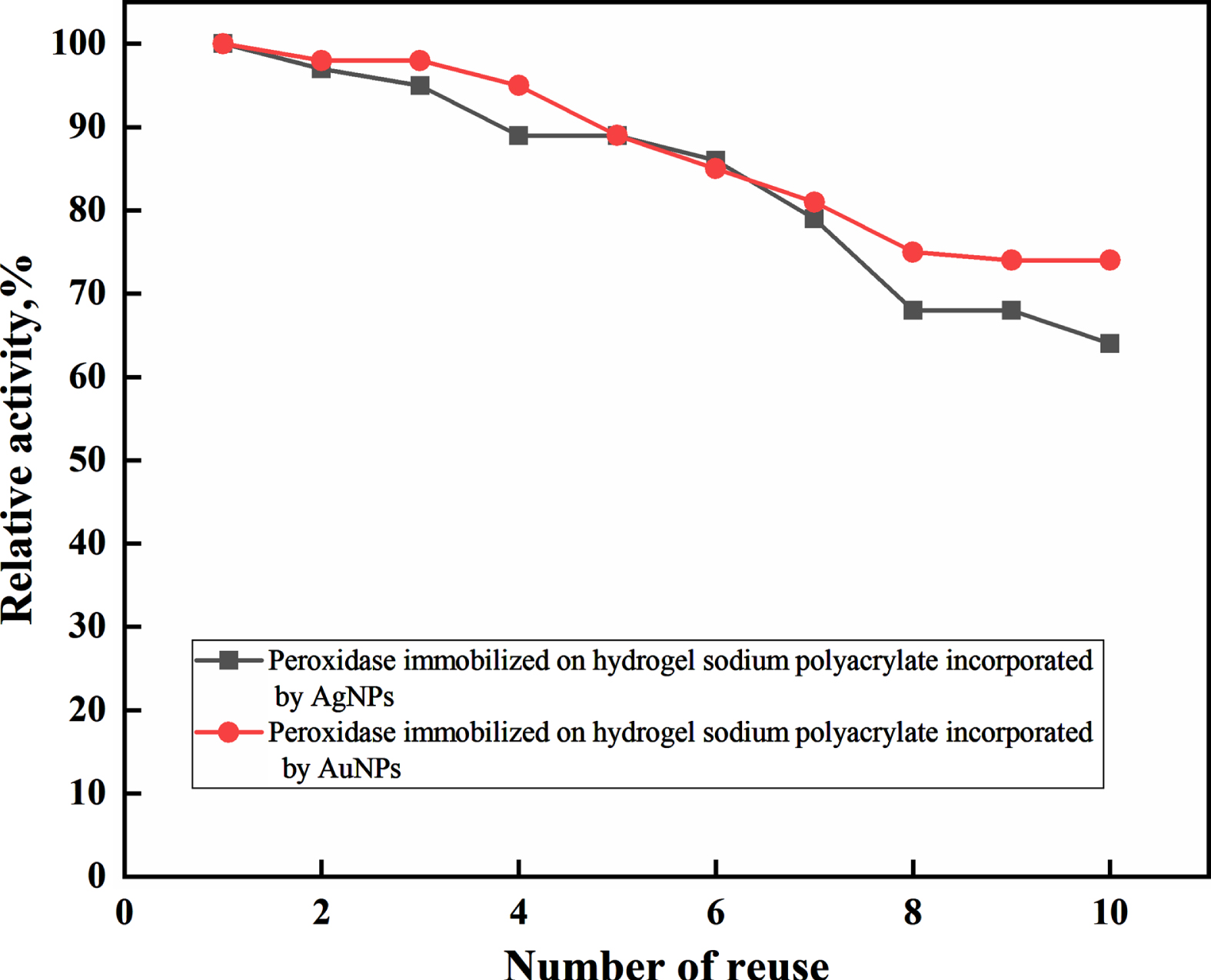
Reuse of immobilized enzyme.
A crucial factor that has been found when for large-scale and long-term commercial usage is enzyme storage stability. Storage of both immobilized enzymes was done at 4°C for understanding their storage capability. Their activity was observed for 6 weeks. The investigation of the remaining activity was done every week under standard conditions. Evident in Fig. 5, after storing for 6 weeks, the immobilized enzyme activity on HSP/AuNPs retained 75% of its activity, and on the other hand, the immobilized enzyme on HSP/AgNPs retained 73% of its activity, while the soluble enzyme retained 51% of its original activity after storing for 6 weeks. These results clearly show that immobilization is responsible for retaining enzyme activity and helps to improve its storage stability. The storage stability of an immobilized enzyme has been identified as an essential driver for analyzing the efficiency of immobilization [35].
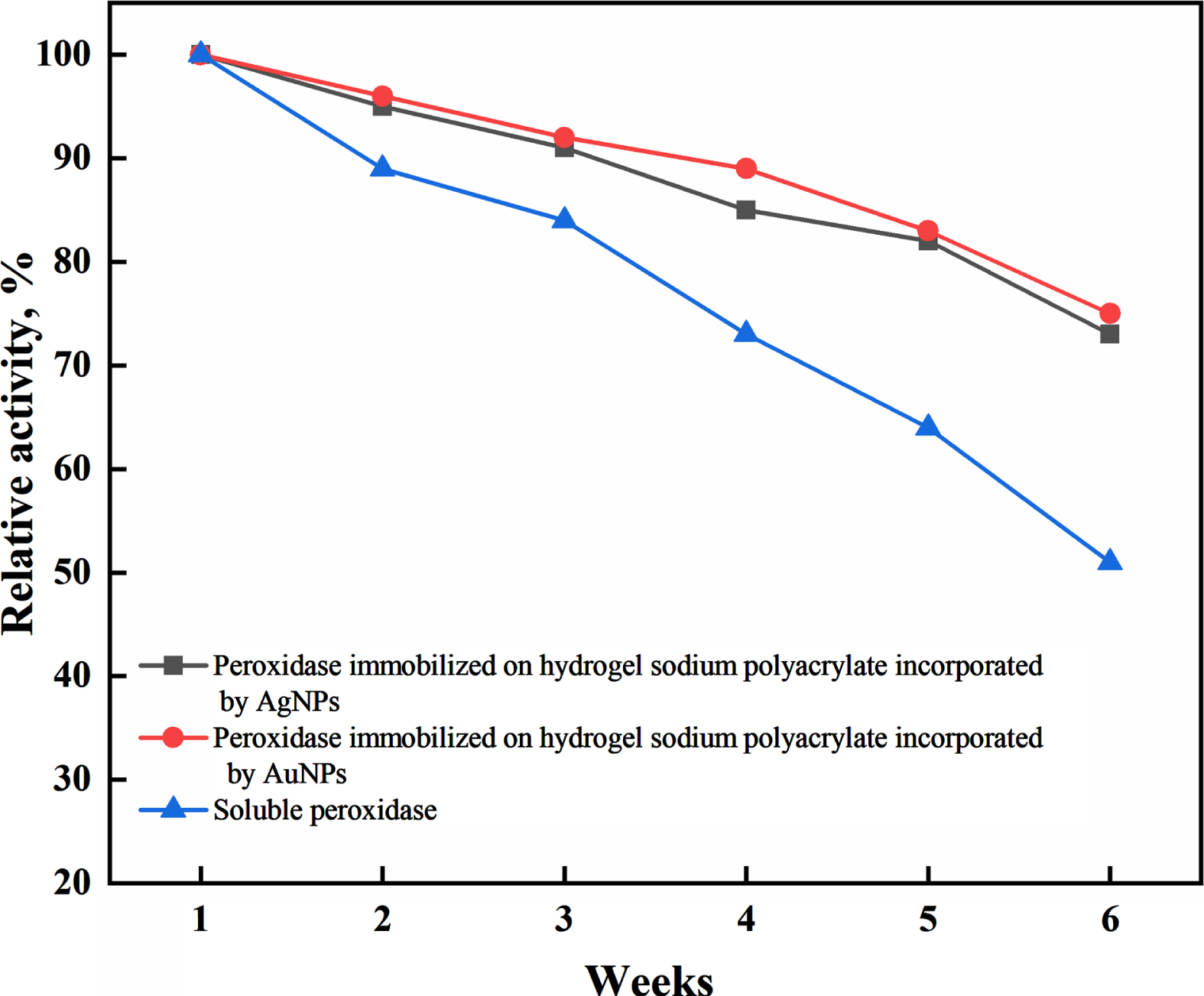
Storage stability of the free and immobilized enzyme.
The results demonstrate that immobilizing peroxidase on HSP/AuNPs or HSP/AgNPs at pH 7 is an exceptionally productive method since the biocatalyst was way more stable i.e. reused ten times with 61% and 54% of its activity, respectively. Moreover, it was revealed in a study of the enzyme-support reaction the best temperature was 50–60°C and that the best pH was 7–7.5. Based on the obtained results, the HSP/AuNPs system is very favorable support for peroxidase immobilization, leading to exceptional stabilization.
Footnotes
Acknowledgments
The work was funded by the University of Jeddah, Saudi Arabia, under grant No. (UJ-21-DR-6). The authors, therefore, acknowledge with thanks the university of Jeddah technical and financial support.