



Abstract
In general, MIMO upgrades the radio communication with improved capacity and reliability. As there is a presence of multiple antennas at transmitter and receiver side, the proper Transmit Antenna Selection (TAS) for attaining effective performance is still a challenging point. This paper intends to introduce a TAS algorithm in LTE system using Self-Adaptive Grey Wolf Optimization (SAGWO) for improving the system performance. It introduces self-adaptiveness in the Grey Wolf Optimization (GWO) by determining the capacity improvement accomplished by each candidate solution for the TAS problem followed by updating the candidate solution based on the improvement. The simulation model considers both Rayleigh channel and Rician channel, for four antenna configurations like 2
Keywords
Introduction
In general, MIMO is a wireless technology that can aid wireless products with 802.11n. It comprises of numerous antennas (probably termed as an array of antennas) [11] at both the transmitter and receiver parts. Here, Adaptive output feedback [9, 10, 35] can control the FTC problem in the MIMO system. The effective transmission in MIMO technology is made possible by the support of STBC, and it also makes use of OSTBC. In fact, MIMO mostly depends on Antenna Diversity schemes. Moreover, the similar performance as the hardened massive MIMO channel can be achieved by the OFDM and single-carrier transmission system [10]. OFDM is used for attaining both efficient communication and channel equalization in the frequency domain. More diversity at the receiver side and high robustness can make available by the MIMO channel, where the entire details regarding the signals are given in the channel matrix. In addition, antenna spacing element is acquired based on the principles of diffraction limited optics, so that the throughput and reliability of the system can be enhanced [12].
The output system of MIMO de-multiplexes the source data stream into multiple independent channel streams. One of the fundamental benefits of MIMO channel is the achievement of high redundancy and improved channel capacity. Moreover, PPBT can estimate the singular vectors of the channel matrix [13] and Random matrix theory can analyze the performance of the precoder [14]. In some cases, OFDM with the bit-loading algorithm is adopted to attain better free space transmission [15]. On the contrary, pilot sequences can be used for downlink transmission purposes [16], and Gradient Search [17] method can be used for the recognition of signals [17]. In MIMO channel, Delayed Feedback in the Relay can improve the performance on Degree of Freedom. Similarly, Cognitive Radio Networks [19] can obtain the secrecy outage performance of TAS. However, the MIMO system suffers from the main drawbacks such as high complexity and more expensive antenna elements [36, 39]. These limitations have motivated to develop the effective antenna selection process, which has taken the fundamental role in MIMO system [37, 38].
Antenna selection, in general, is utilized for enhancing the performance of the non-selective fading channel. When all the antennas are used for spatial multiplexing, then it can be termed as “H-S/MIMO” and when the entire antennas are used for various purposes, then it can be termed as “H-S/MRC”, or “generalized selection combining”. Since the optimum selection algorithm seems to be complex, fast selection algorithms are used as it has less complexity. There is a necessity of feedback path for promoting effective TAS. In most of the TAS algorithms, sum rate analysis for all the optimal AS scheme matches the numerical results [20, 21]. Even more, Downlink Correlated channel [22] can improve the channel capacity, where the Massive MIMO systems can enhance the system performance and channel capacity [23]. The system performance can also be improved by the adoption of Joint Antenna Selection method, and two-way relay networks [24, 26] and Joint Precoding [25] method can improve the throughput of the system. The delayed channel capacity can access the beamforming strategy [27]. Basically, the effective data transmission is accomplished by selecting the antenna with higher transmit power [28]. Furthermore, physical layer security [29] is provided by the proper antenna selection process, which can be improved by Dual antenna selection methods [30].
This paper contributes a TAS algorithm in LTE system using SAGWO for improving the system performance. The SAGWO is exploited for solving the TAS model, where the ergodic capacity of Rayleigh channel is considered. The channel model is extended to Rician channel and the simulation is observed for four antenna configurations. Further, the performance of the proposed SAGWO is compared with conventional EDB-TAS, ECB-TAS, and ABC-TAS, GA-TAS, FF-TAS, PSO-TAS and GWO-TAS models. The rest of paper is organized as follows. Section 2 describes the literature review with related works and problem definition. Section 3 illustrates the TAS model in LTE system. Section 4 portrays the optimized rank based TAS. Section 5 illustrates the simulation results and Section 6 concludes the paper.
Literature review
In 2016, Jang et al. [1] have accomplished the near optimal sum rate performance in MIMO system using an advanced antenna selection approach. At first, they have analyzed the average sum rate of the optimal selection method and best antenna set solution. Further, the experimental results have validated the effective performance of the proposed algorithms, as it has 15% of performance gain.
In 2015, Jung and Kim [2] have developed the correlated D-MIMO systems with less complexity using an effective near-optimal antenna selection algorithm. They have attained utmost channel gain, with reasonable antenna support. In addition, the adopted optimal selection algorithm has provided high capacity with low cost and less complexity. The performance gain was seemed to be efficient with high energy efficiency when a small count of antennas was used.
In 2013, Lari et al. [3] have studied two different cases of MIMO system. In the first case, when CSI was not available and when CSI is available whereas in the second case when CSI was not available, TAS is difficult and so RAS is done. During this process, one antenna at the receiver may have maximum instantaneous Signal to Noise Ratio. On the contrary, TAS scheme was executed for the condition of not having CSI in the transmitter part. Further, they have analyzed the optimal power adaptation and powerful capabilities of the proposed model.
In 2015, Le et al. [4] had dealt the energy efficient algorithm for promoting valuable antenna selection in MIMO system. The received bits per unit of energy consumption were evaluated to validate the energy efficient algorithm. In some cases, error was occurred as the main drawback. Thus the optimal values of the transmitted symbols were gained, which has improved the performance of energy efficient algorithm.
In 2016, Le et al. [5] have maintained the energy efficient antenna selection method. In fact, EE-SE has faced the significant loss in energy efficiency. Furthermore, the proposed method has used the exhaustive search technique in the case of small count of antennas. Here, the Greedy algorithm was developed to complete near optimal performance with complexity compared to the optimal search method.
In 2016, Tiwari et al. [6] have analyzed the performance level of MIMO system over Weibull-Gamma fading channel. They have evaluated the error rate performance by exploiting the CSIT. Here, antenna selection method was used to accomplish CSIT. Thus AS was adopted in the OSTBC to enhance the performance of MIMO system.
Furthermore, in 2013, Hu and Luo [7] have developed a competent antenna-pair selection scheme, for a non-regenerative dual-hop amplify and forward MIMO systems. They have also diminished the hardware complexity with the proposed method without affecting the symbol error rate. In 2016, Amadori and Masouros [8] have executed the antenna selection at low complexity using an advanced antenna selection scheme. With this technique, they have attained the ability to match the constructive interference among diverse users. The linkage of simple matched filter precoder in the transmitter part has enhanced the performance of the system. Thus, maximum power savings and reduced complexity were made possible through this method. Table 1 represents the state of the art of the TAS algorithm.
State-of-the-art of TAS algorithms
State-of-the-art of TAS algorithms
The distinctive TAS method proceeds by exhaustive search, choosing the optimal probable subset of the full set of antennas [33]. Although the performance of the exhaustive search can be optimized, its complexity still increases linearly with the total number of antennas, as well as the number of antennas to be chosen. As a result, much research on TAS schemes has been performed, in an effort to attain lesser complexity than that of exhaustive search methods [34, 35]. In [1], the greedy search method was proposed for that purpose. Moreover, the simplest approach is to choose the transmitting antenna by means of computing the norm of the thermal vector of the entire channel. Nevertheless, in place of simply minimizing the complexity, this also minimizes the user’s attainable rate of transmission.
This paper intends to introduce a TAS algorithm for enhancing the system performance. The proposed TAS is on the basis of the advanced meta-heuristic search approach termed as GWO, which is inspired based on the hunting behaviour grey wolves. Firstly, the channel capacity is estimated through the channel model and it is defined as the objective model for the TAS problem. The selected objective model defines the Ergodic capacity of the system in Rayleigh fading channel, for that accurate channel estimate will be adopted. Secondly, a self-adaptive GWO proposes to solve the TAS model. The self-adaptiveness in the GWO is introduced by determining the capacity improvement accomplished by each candidate solution for the TAS problem followed by updating the candidate solution based on the improvement.
TAS model
The architecture of MIMO-OSTBC model shown in Fig. 1 is related to the feedback for the TAS case. Further, it is applied to the M-ary PSK modulator, and the OSTBC encoder encodes the modulated output. In fact, the current experiment is carried out for an individual TAS and hence, a single transmission link is considered. Here,
Architecture of TAS model.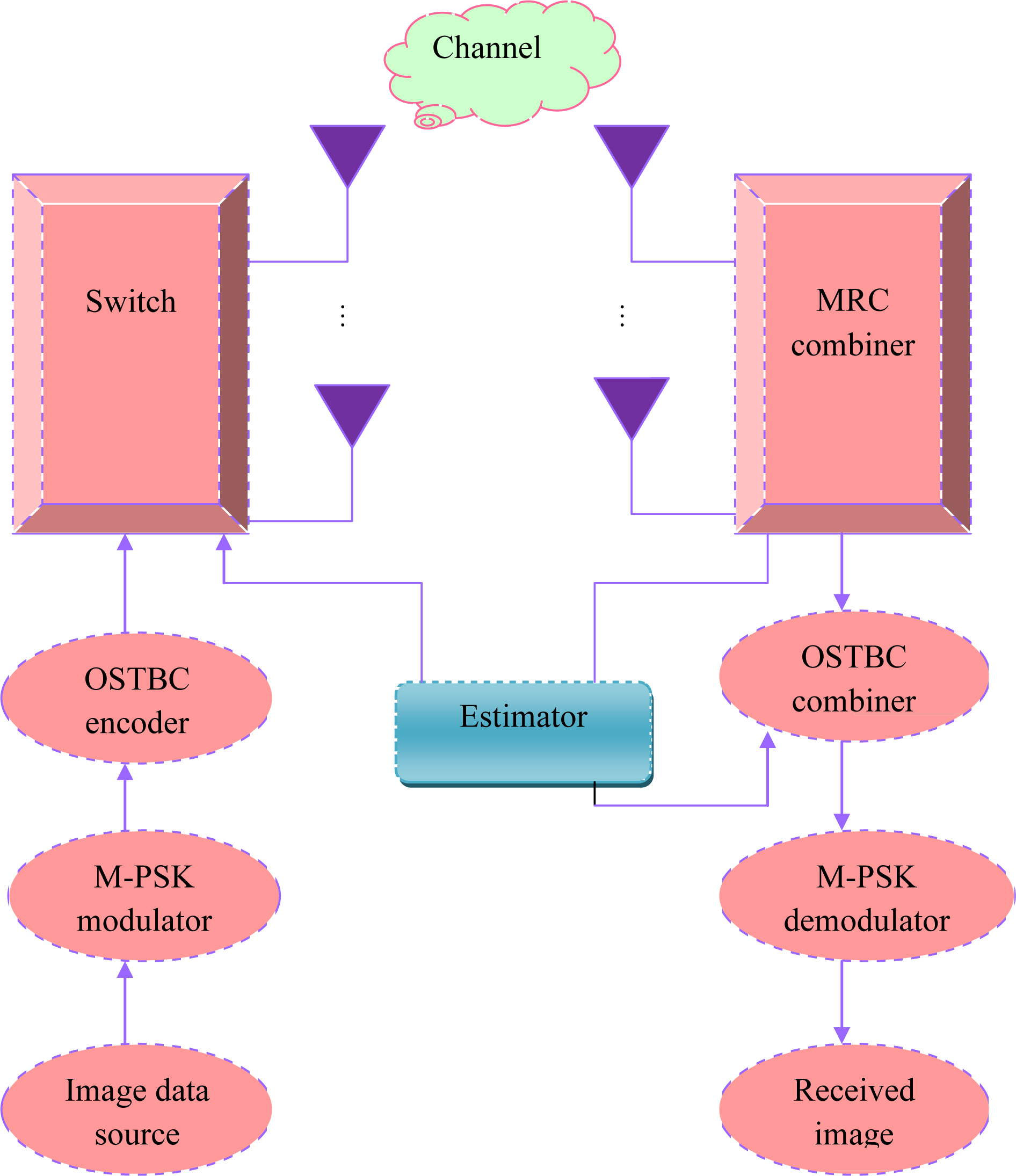
Let
Equation (1) represents the model of received signal vector
To measure the channel capacity, it is essential to transmit the pilot signal from every transmit antennas
Consider an equal power is allotted for every channel in the model (based on Rayleigh fading channel) so that the covariance matrix is equal to the identity matrix as
As shown in Eq. (3), it is essential to focus only the single subset for the computation of channel capacity for every transmit antennas. The channel capacity is generally a random variable
Since the system model is based on Rayleigh fading channel, Eq. (4) represents the PDF of the Rayleigh distribution. In the respective equation,
Likewise, Eq. (5) expresses the (CDF) for Rayleigh distribution, where
The current paper considers only the selection of transmit antennas. The system can be termed as
Objective model
The proposed TAS model uses an implicit procedure of selecting optimal transmit antenna configuration. According to the procedure, two objective models are used. The primary objective model is an implicit model but selects the antenna configuration that holds minimal average as given in Eq. (6). Here,
Rank definition:
The secondary objective model is the explicit objective model that plays a key role in allocating ranks for antenna configuration based on the error rate of the transmitted and received data. The secondary objective model is given in Eq. (9) where
In this section, the optimal allocation of rank is done by the GWO algorithm [31]. GWO is a newly introduced meta-heuristic algorithm that operates based on the hunting behavior of wolves. There are mostly three wolves responsible for hunting, those are
As mentioned earlier, the component
The mathematical model of hunting action is expressed in Eqs (15) to (20).
The final update formula of GWO (attained objective) is given in Eq. (21) that is subjective to Eq. (9). The pseudo code of GWO-based Rank optimization is depicted in Algorithm 1.
The description of Algorithm 1 is depicted as follows.
The population of grey wolf is initialized as Then the components, The search agents For a particular iteration, the position of the current search agent is updated using Eq. (21). Further, the component Then the fitness function of the entire search agents is computed. The search agents The process is repeated until the completion of maximum iteration.
Flowchart of SAPSO.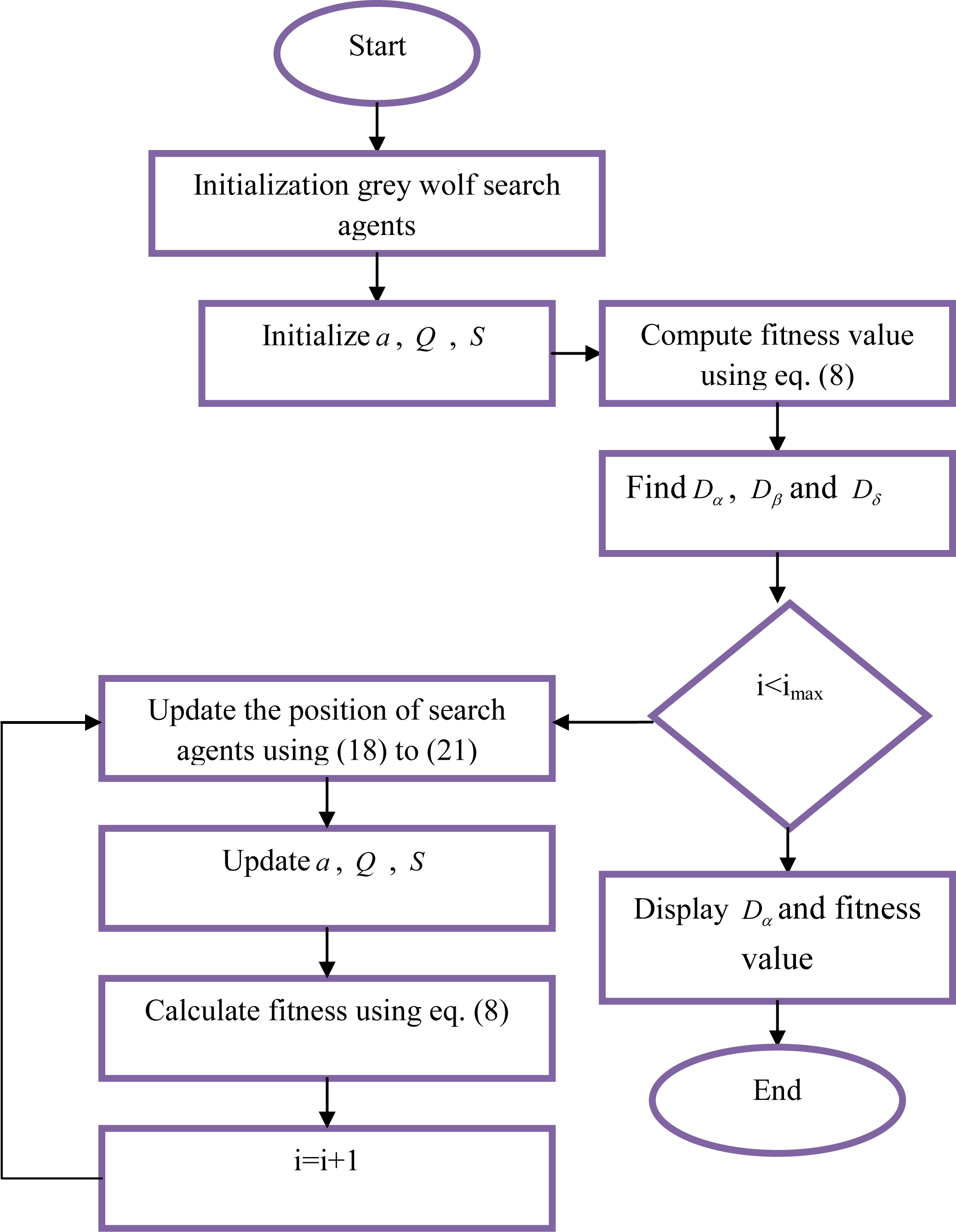
Figure 2 shows the flowchart of the proposed SAGWO.
Selected antenna configurations of optimal TAS model for Rayleigh channel
Mean BER of proposed and conventional TAS model for Rayleigh channel
BER analysis of TAS on four antenna configurations like (a) x, (b) 3 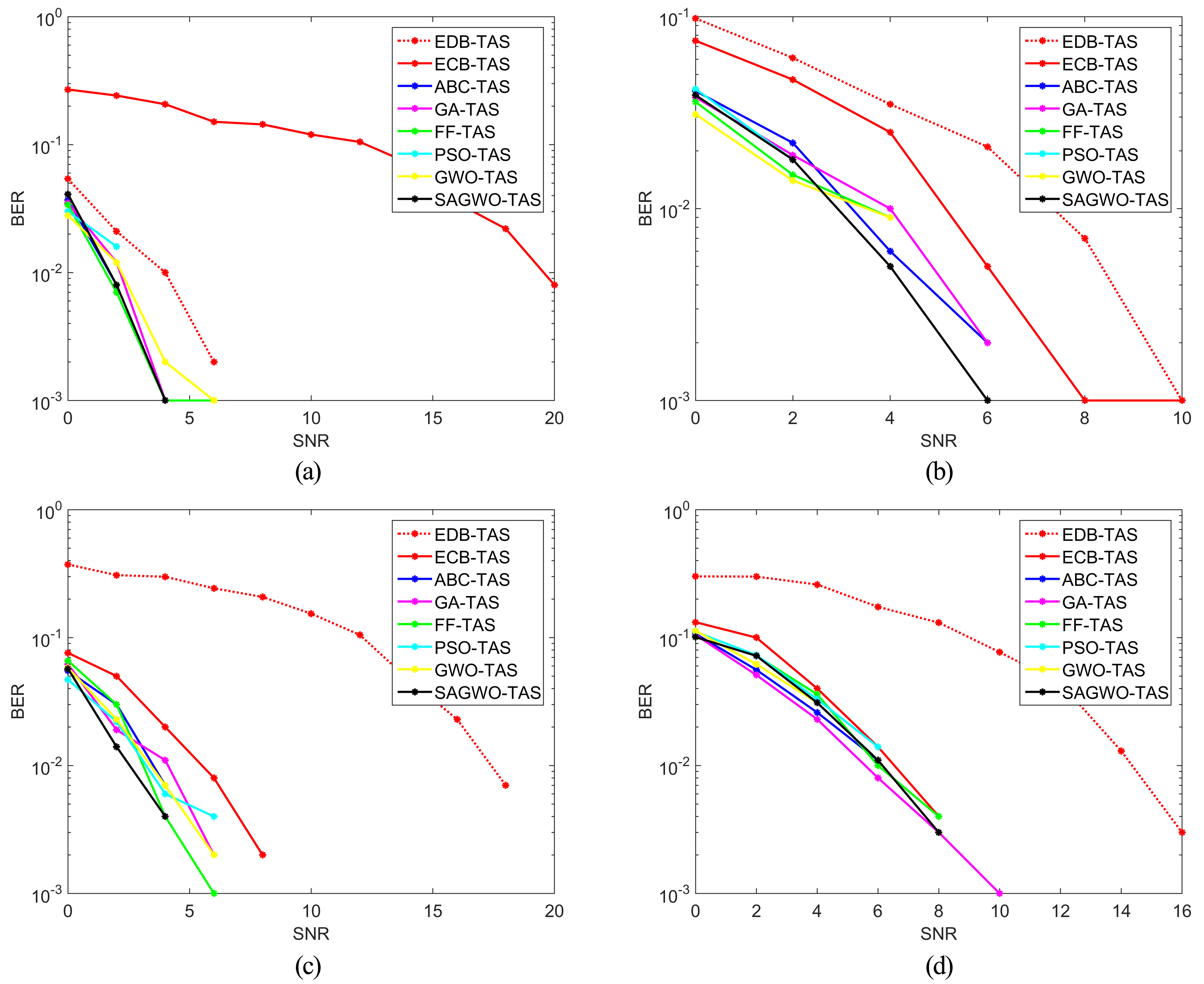
Procedure
The TAS scheme in LTE system using proposed SAGWO is simulated in MATLAB, and the results are observed. The particular process is carried out in both Rayleigh and Rician channels, and it concerns four antenna configurations like 2
Rayleigh channel
Figure 3 shows the BER analysis of TAS on four antenna configurations for Rayleigh channel. As shown in Fig. 3a, the BER of the proposed SAGWO model for antenna configuration 2
The selected antenna configuration of the proposed and conventional TAS model for Rayleigh channel is shown in Table 2. Here, the antenna is selected for four configurations. For ABC-TAS model, antenna 1 and 2 is selected for configuration 2
Selected antenna configurations of optimal TAS model for Rician channel
Selected antenna configurations of optimal TAS model for Rician channel
BER analysis of TAS on four antenna configurations like (a) 2 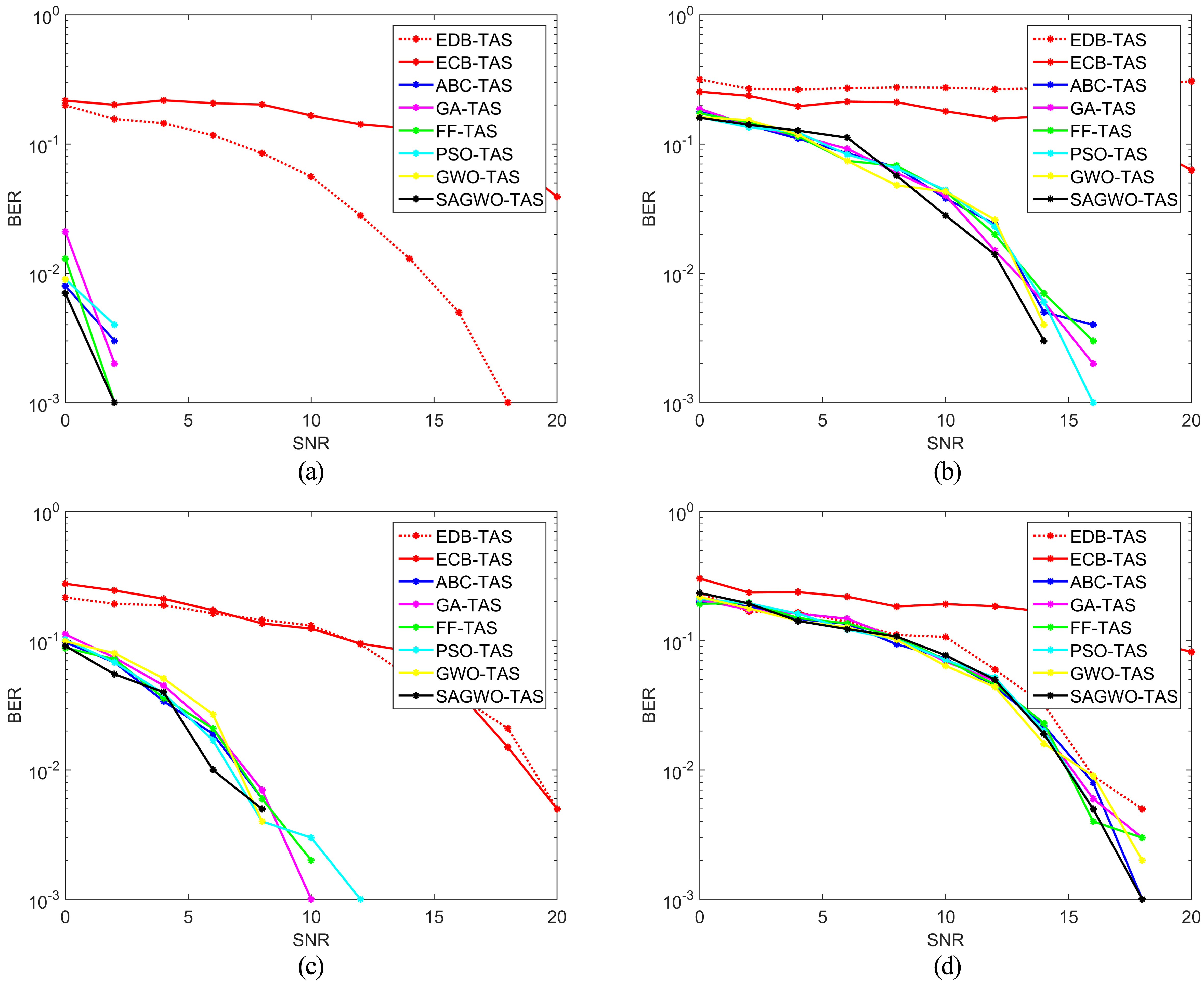
BER analysis of TAS on four antenna configurations for Rician channel is shown in Fig. 4. Here, BER of the proposed SAGWO at SNR value of 3.5 is 99.20% better than EDB-TAS, 99.36% better than ECB-TAS, 74.35% better than ABC-TAS, 80% better than PSO-TAS and same as FF-TAS model for antenna configuration 2
Table 4 depicts selected antenna configuration of optimal TAS model for the Rician channel. Here for the proposed SAGWO-TAS model, antenna 1 and 2 is selected for configuration 2
Mean BER of proposed and conventional TAS model for Rician channel
Mean BER of proposed and conventional TAS model for Rician channel
This paper has presented an optimal TAS algorithm for improving the LTE system performance using SAGWO algorithm. In fact, the self-adaptiveness in the GWO algorithm has introduced by determining the capacity improvement accomplished by each candidate solution for the TAS problem followed by updating the candidate solution based on the improvement. The simulation model has considered both Rayleigh channel and Rician channel, for four antenna configurations like 2
Footnotes
Abbreviations and acronyms
Authors’ Bios