



Abstract
Education is developing very fast with the advancement of technology and the process of the smart era. One can store all educational certificates and credentials in the form of an electronic wallet or a folder. By using this electronic transformation of certificates, users can transfer the certificates from one place to another very easily. The “data island” phenomenon, central data storing, confidentiality, reduced security, and integrity are common problems of electronic data transfer. This study presents a safe sharing of digital documents which uses blockchain technology and an attributed-based cryptosystem to offer a creative solution to the abovementioned issues. The proposed scheme uses Ethereum smart contracts and achieves fine-grain access control by using attribute-based encryption. Finally, we verified our model using the test network and compared the performance with some existing state-of-arts. The results of proposed scheme generated by simulations are more feasible and effective in challenging environments.
Introduction
Documents or certificates in physical form provide a variety of challenges as they are cumbersome to exchange and have a chance of being destroyed and misplaced. With the progression of technology and the expansion of the smart era, more and more people are using electronic wallets to store their educational certificates. The main benefit of keeping certificates electronically is the ease of accessing, storing, and using them anywhere, anytime, without the burden of carrying them manually [1, 2]. Nowadays, it is gaining popularity day by day because of the use of digital educational certificates and other certificates such as registration certificates of vehicles, PAN Cards, etc., making people’s lives more convenient and easy [1, 3]. It is also getting support from the government. But with various advantages, it has some problems also.
The digital documents are stored as normal electronic data bits and bytes. When the data is transmitted from one place to another or stored on the cloud or any other storage, then data security, authenticity, and data integrity are difficult to maintain. This kind of information is easily hacked by hackers or accessible by unauthorized users.
Generally, the storage used for these documents is centralized. The main problem with this type of storage is the central point of failure.
Nowadays, most of the digital document databases are centered on organizations or different regions. This can create a “data island” phenomenon, which creates less security and reliability channelization between different databases.
The cost of investment will be high if the data center is created within the organization.
Access to digital documents is quite easy using the public key of the original user. This can happen due to the lack of a secure and reliable access control system.
By seeing all the above issues the privacy becomes the most important issue for sharing of digital document on cloud platform. In latest years, most of the organizations are interested to use blockchain technology other than the financial field [3, 4]. The main reason for attraction towards blockchain and smart contracts is distributed storage and its immutable nature [5]. Blockchain was hypothesized in 2008 and the main implementation of it was used to enable a financial system in the form of crypto currency called as Bitcoin. Blockchain authorizes different untrusted parties to come together and create a lasting, consistent and apparent record of exchange [5, 6, 7]. The parties can process these records without relying on any centralized authority. The blockchain’s security is improved by the use of the hashing algorithm and the consensus mechanism called as proof of work. Additionally, it is a type of distributed network that needs at least 50% of peers to agree before accepting even a modest modification in data [8, 9].
In the year 2018, Zhu et al., proposed an access control model [8]. In the model author’s proposed various type of transactions design, such as registration of object, grant or access request, etc. In the year 2019, Paillisse et al., used blockchain in to provide distributed access control by applying multi-administrative domain concept [9]. Some policies defined group-based and blockchain has been utilized to store them by transactions. In addition to blockchain, a variety of techniques used for access control can be employed to restrict the access to data or information stored in the cloud [10, 11, 39, 46]. In the year 2018, Wang et al., introduced a model based on blockchain, Ethereum smart contracts and ABE for data sharing [12]. The scheme was able to eliminate the problems of key hacking or modification, and also ensures the privacy of data. In the year 2019, Eltayieb et al., proposed a model for secure sharing of data over cloud using ABE signcryption protocol and blockchain [13]. Eltayieb et al., used the smart contracts to give a solution for the problem of wrong result generation of conventional cloud system. Interplanetary File System (IPFS) is a peer-to-peer distributed file system, which is another intriguing concept in addition to blockchain [14]. It offers a content-addressed block storage model and incorporates a number of previously successful solutions. The goal of IPFS is to enhance HTTP, one of the most popular file-distributed systems in use today. [15, 16] suggested a reliable and scalable mechanism for file sharing. It offers a scalable key management system and makes use of yet another re-encryption method to facilitate the accessibility of numerous users. The encryption key is kept in a dispersed manner that can withstand attempts at collusion by users with access restrictions. The encryption key’s single subkey is supplied to the authorized user, increasing the security concerns because the user must control the key.
To improvise all the inefficiencies and limitations, the study proposes a novel model based on blockchain for securely sharing digital documents in the cloud. The model also uses the ABE scheme for providing fully secure access control. The main advantages of the proposed model will be secure access of data; traceability of data; fine-grained access control and data integrity. Also, the proposed model offers confidentiality, collision attack resistance, and self-auditability of data. We summarize our main contribution to this work as follows.
This paper proposed secure digital certificates sharing system based on blockchain and IPFS.
The documents are encrypted by searchable encrypted keyword schema for access control in sharing digital documents for fine-grained access control.
The centralized authority will obtain the key by using the attributes of the owner certificates, i.e., (students, employees, etc.), which is further used for the encryption of data and setting of access policies. Further, the owner of the certificate can obtain a key for decryption by using its specified attributes.
The scheme uses a storage platform called the InterPlanetary File System (IPFS). The problem of single-point failure, authentication, and data integrity are reduced by using blockchain technology.
The scheme uses the Ethereum smart contracts to realize the search for encryption keys of the certificates.
The remaining paper is organized as follows. The related work ABE and blockchain is described in Section 2. Section 3 outlines preliminaries concepts required to understand the proposed model. Section 4 proposes the model and smart contracts. Section 5 illustrates and simulation, results received after simulation, and the performance comparison of the proposed model with some existing work. Security analysis on the basis of confidentiality, collision attack and auditability is done in Section 6. Finally, Section 7 presents the conclusion of the work.
Abbreviations used throughout the manuscript:
Literature review
Attribute-based encryption (ABE)
The ABE considered as special type of encryption technique, which comes under the category of public key cryptosystem. The techniques take user attribute as a public key. The ABE embedded the encryption technique called as identity-based, proposed by Shamir in 1984 [17]. The reason behind is the identity information of the user can be considered as attributes in maximum cases, such as fingerprint, PAN number, etc. Boneh et al., had introduced IBE scheme considered as first scheme based on the concept of signature scheme [18]. Their scheme considered the bilinear maps as a base concept. On the guidelines of identity based encryption several studies have been carried out by various researchers’ likes Waters, Lew ko etc. [19, 20, 21]. After introduction of IBE concept in 2005, Sahai et al., proposed threshold based IBE [11]. The concept proposed by Sahai et al., was considered as the base for ABE technique. ABE access control is the most effective and proven encryption technique [10, 11]. During the current decade various researchers published their work on ABE [22, 23, 24, 25]. The attribute-based encryption technique can be explored based on the keyword search technique over the encrypted data. Various models for this searchable ABE were presented in literature [26, 27, 28, 29, 30]. Utilizing encrypted keywords, the provided model accesses the data over the cloud using the ABE with searchable encryption. In the year 2014, Sun et al., proposed a secure ABE scheme by using non-monotonic access policy [27]. On the same guidelines of ABE (Attribute-Based Encryption) in year 2014, Yamada et al., had proposed searchable ABE scheme based on keyword search technique for cloud environment [31]. They have also implemented two re-encryption techniques in the model – lazy re-encryption and proxy re-encryption. The only problem with the scheme was the decentralization of rights and integrity of data. Also, the scheme uses the 3
Blockchain technology
When sensitive data such as financial data, credential data in the form of digital documents, or health care data is transferred over the network, there is always a trust issue. In the year 2008, Nakamoto et al., presented two novel models based on peer-to-peer electronic cash systems. One is called Bitcoin, which is also considered the first virtual currency, and the second is called Blockchain. The blockchain technology uses the TCP/IP protocol as the base platform to work over the Internet [4]. A distributed ledger is referred to as a decentralized network that is used to store and exchange all kinds of information in a distributed manner. These ledgers are immutable, secure, not hackable, and easily auditable whenever it is required [4, 5]. This feature of blockchain gives a massive level of transparency in comparison to the traditional system. Each block in the blockchain is recognized by its cryptographic signature using a secure hash algorithm, called as SHA 256. SHA 256 algorithm produces a message digest of 256 bits using a block size of 512 bit [6]. Figure 1 shows the simple blockchain structure. According to the architectural view, the blockchain presents an ordered list. Every block in the blockchain is connected with the previous block of the chain. Currently, the blockchain is used by various researchers in versatile fields of research such as IoT, cloud computing, e-voting, health care, transferring of digital documents, etc. [31, 32, 33, 34, 35]. In the year 2018, Elisa et al., developed a model which was based on blockchain and used for handling the government affairs system [33]. The key objective of the proposed scheme was to overcome the trust defiance in the organizations that come under the category of the public sector by enhancing security. Wang et al. proposed a cloud-based model for electronic health records (EHR) [34]. Their proposed model worked on ABE and blockchain. However, the major issue with that model is that it did not consider smart contracts. Hence, it was not fully automated. In the year 2019, Mahore et al., proposed an EHR management system [35]. The model uses the concept of a permissioned blockchain and proxy re-encryption technique. The issue with that model when it was implemented on the cloud, it could not follow the proper access control rules. If any user wishes to access data, he/she could be accessed by using a key. In the year 2020, Sun et al., proposed a scheme based on blockchain technology for storing EHR records. Also, Sun et al., have used the Interplanetary File System (IPFS) to solve the problem of centralized storage [36]. In the year 2019, Wang et al., proposed a cloud storage model based on blockchain technology to provide more security and data integrity [37]. In the scheme, the valid access time can be set by the data owner (DO) to access the information smoothly from storage. Also, the Ethereum-based smart contracts are used to store the cypher text.
Features and challenges in related work
Table 1 presents the summary of some preexisting work in a related domain. The major components are various features, proposed methodology, and challenges.
Features and challenges in related work
Features and challenges in related work
Blockchain.
Bilinear maps
Let us
We agree to use (‘
Let us consider a bilinear map
Let
So,
So,
Since,
So
Secret Sharing Scheme (SSS)
The SSS was introduced by Shamir [34]. It is used as a base for ABE schemes. The SSS has two main processes, one is the share and the other is recovery. When the owner wants to share
Smart contracts
Smart contracts are like traditional contracts, but the only difference is that they are in the form of a digital form of a program. An Ethereum smart contract is a program that is a collection of functions and states (data) present on the blockchain and a specific address. The whole code or part of the code runs automatically for some agreement. For example, the transfer of funds from one party to another. The main benefit of using smart contracts is that it removes the requirement of a 3rd party. However, it is stored in the blockchain, so everything is completely distributed. It is not controlled by a single user and is also immutable [40, 41].
IPFS
The distributed storage protocol is called IPFS. IPFS is designed to handle all kinds of unnecessary file redundancy. It generates a hash value that is unique for each file stored in the system. The required file of the user can be found by using the respective hash address. Since IPFS is distributed, therefore, it avoids the problem of centralized failure in the storage system, also called single-point failure [36, 16].
System model
The model is split into two sections: document storage and document search. The model contains five different kinds of entities. The document owner (DO), the document user (DU), the key generation center (KGC), the document authority (DA), and the blockchain. The Fig. 2 represents the system architecture diagram. In the model, public key of DO is used to encrypt all the digital documents and the encrypted documents will be stored on an IPFS storage device. All the key creations will be handled by the KGC. The DA will be treated as a gateway between all the entities to establish communication and security. The metadata (transaction details) of the digital documents will be stored on the blockchain with the help of smart contracts for handling storing and searching of data and maintaining tamper-resistant features. The digital documents can be accessed only by DO and DU.
Workflow of the proposed model
KGC – It will deploy the smart contract and create system parameters. Additionally, it gives the DA permission and assigns attribute keys to the DOU. It will be the KGC’s responsibility to send the required secret keys for the DOU and DOC.
It chooses
Mater Key –
In Eq. (1)
System architecture.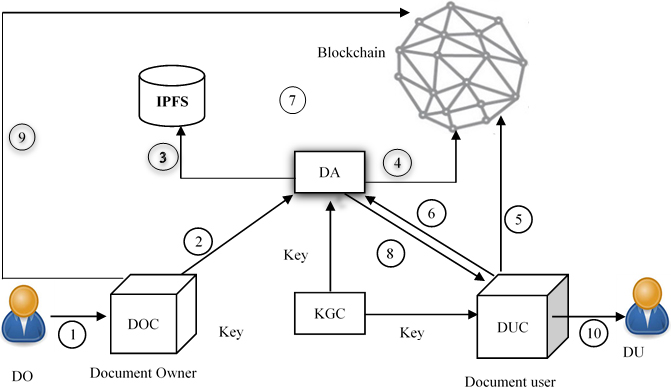
The labeling of the system architecture in Fig. 2 is presented as below.
DO sends documents and other information through DOC. DA retrieves encrypted documents and associated information. DA sends encrypted documents to IPFS. Metadata (transaction data) will stored in Blockchain using smart contract. DU searches metadata using tokens in blockchain. If tokens are valid and found then DUC request to DA for data. DA retrieves data from IPFS. DA sends requested encrypted data to DUC. DUC sends data to DU Any time DO can verify logs on blockchain through DOC.
DOC – DOC does the encryption and creates the cypher text (CT) using plain text M, parameters, public key, an attribute access tree, etc. DOC will choose a polynomial
DA – The index of smart contracts must be uploaded by DA. To confirm the validity of the data, it uploads the transactions and stores ciphertext in the cloud. The DA chooses some keywords from the certificate data (such as – Roll_No, data of birth, etc.), produces the DOC’s key
Keyword search – Once the transaction ID and index have been transferred to the cloud, the DO and DU can use keyword search to look for certificates. The DA selects
Every time a token is passed from a CU or CO to a smart contract, and as a return value the location and ID of the satisfied set will be received.
Decryption of document – Two entities, DOC and DUC, are capable of decrypting the document’s data. The DOC and DUC can get the decrypted document in accordance with the access rules, and each DUC has its own private attribute key. Decryption will be the reverse of encryption, i.e., it will be done in a bottom-up manner. The decrypted document ‘M’ is presented in the expression (4) with consideration of expressions (1) and (2) as follows.
Validation of tempering of data – The DUC or DOC locates the (
For creating the smart contracts Ethereum is used as the platform. The smart contract includes adduser, deleteuser, addindex, and searchindex. The
Experiment results and discussions
All simulations are carried out using an Intel(R) Core(TM) CPU i7-8750H and 16 GB of RAM to calculate the performance of our suggested strategy. Ethereum is operated on a virtual machine that is running Ubuntu 14.04 LTS.
Performance evaluation
For the purpose of building a smart contract, we used the Ethereum test network and the Solidity programming language. Gas had a starting price of 9Gwei (1Gwei is equal to 10-9 ether (ETH)). We used our certificate data for the trial for testing purposes. We’ve just used single threads in all of our investigations. On the TestRpc Ethereum blockchain environment, which offers a local simulated environment, we implemented the system model. Five distinct files, each measuring in kilobits, were used to create the encrypted index. The total gas consumed in creating the contract was 908608. The total gas consumed for the addition of the encrypted index has increased linearly as per the number of tasks added. For adding one index, the cost was 80416, for adding five indexes, the cost increased to 422130, for adding 10 indexes, the cost increased to 844052, etc. The overhead in the computation has been compared with some other schemes [27, 31, 34] concerning the time taken in key generation and the time taken for index generation. The computation cost for key generation is depicted in Fig. 3. The plot clearly shows that the scheme takes quite less time for key generation in comparison to other schemes. The performance of the scheme proposed by Sun et al. is very close to our proposed scheme [27]. Figure 4 illustrates the computational time required for index generation. The plot clearly indicates that proposed scheme has better performance than the schemes proposed by Sun et al., and Yamada [27, 31]. Further, we have done a comparison concerning the throughput of search operations with the schemes proposed by Mahore et al., and Sun et al. [35, 36]. The total number of transactions that are modified in the ledger in one second is referred to as throughput. Figure 5 shows the comparison plot for the throughput of the search operation. The performance of our scheme is quite improved in comparison to other state-of-arts proposed by Mahore et al., and Sun et al. [35, 36].
Plot of key generation time.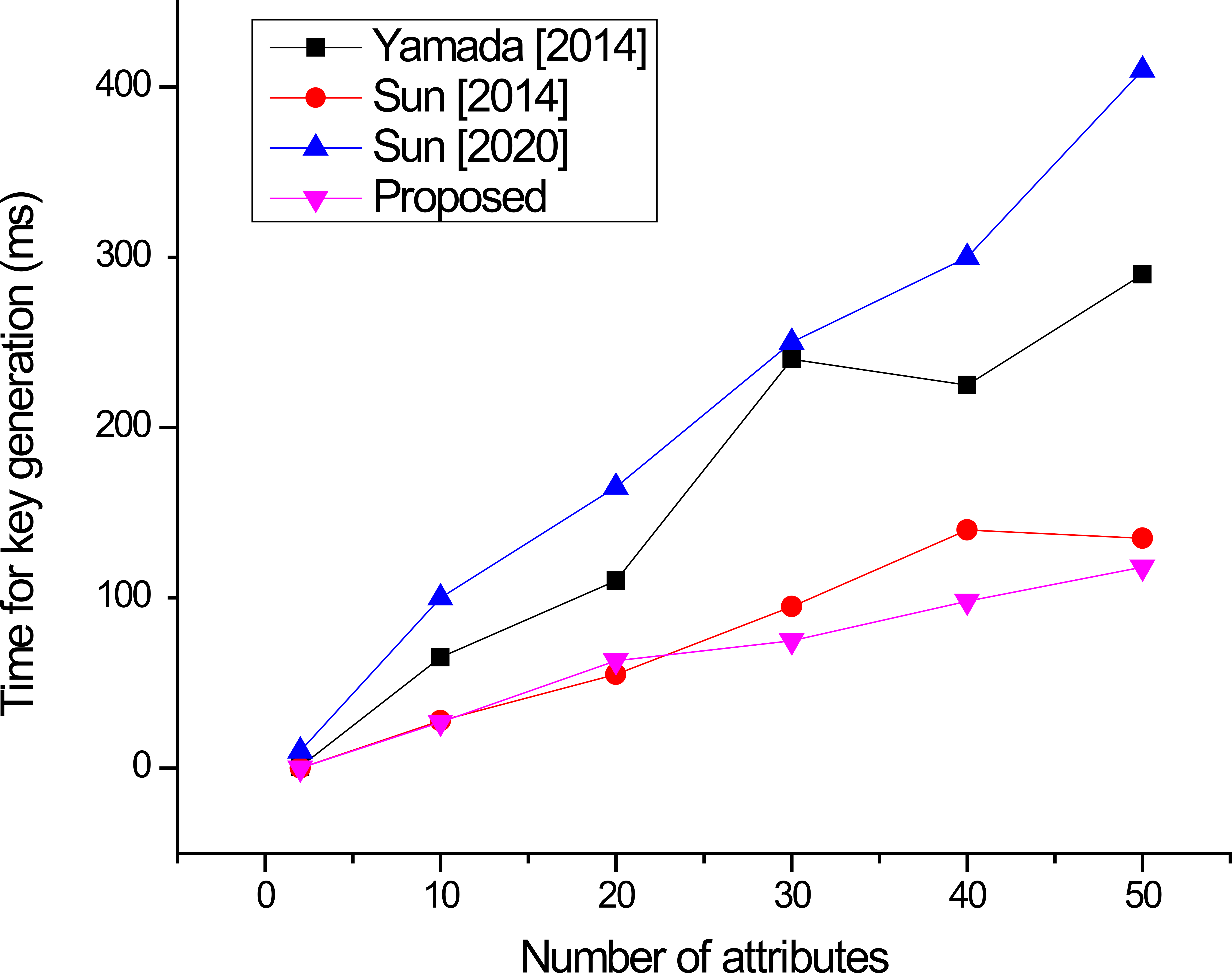
Plot of index generation time.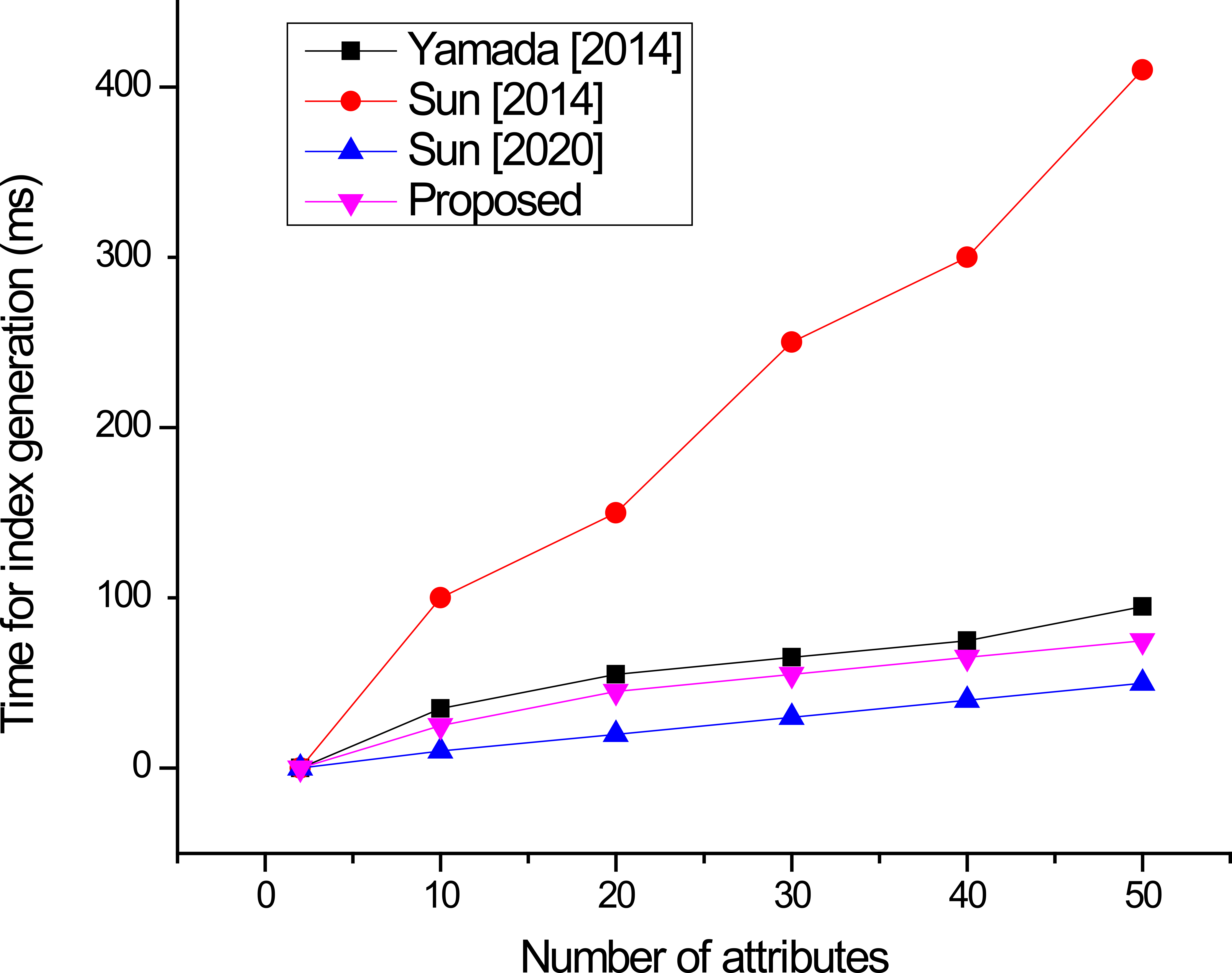
Plot of throughput for search operation.
This section describes the performance of our scheme in terms of the computational cost. We compared the computational costs evolved at various stages of the schemes to those found in the literature [27, 31, 36]. The comparison is shown in Table 2, where upper bond of the cost for exponential operation is represented by
Comparison of computational cost
Comparison of computational cost
In our system, secure transactions are carried out using the full grain access control method. After completing the registration process, the owners and users who wish to participate in the secure file sharing system are recognized as trustworthy. The Blockchain and IPFS servers, however, are untrustworthy since anyone with internet connection can view their data. Although data on the IPFS server and Blockchain can be accessed by unauthorized users, encrypted files downloaded from the IPFS server cannot be decoded without the group key. The suggested model offers collision attack resistance, auditability, and confidentiality. Additionally, the CSP attack can be detected because to auditability. This section talks about our blockchain-based model’s security analysis. The security analysis of the proposed model is analyzed on the basis of the following questions: by taking the assumption that the servers used in the proposed model are semi-trusted and assuming the following procedure is defined in the model, sometimes it can be tried to know the data [42, 43, 44, 45, 46, 47, 48, 49, 50, 51]. Further, the following questioners require to be addressed.
Does the proposed model provide confidentiality or not? Does the proposed model resist the collision attack or not? Does the proposed model provide auditability of data or not?
In this paper, we have proposed a secure framework for digital document sharing using blockchain and the ABE cryptosystem. The framework proposes the use of blockchain for digital document management. It provides secure download (searching) and storage of digital documents using IPFS, Ethereum smart contracts, and searchable ABE algorithms. The key advantage of employing the ABE cryptography technology is that only users whose attributes meet the specified conditions of the access policy are able to access documents. When storing and accessing data, the implementation of blockchain assures security, traceability, and non-tempering qualities. Using smart contracts eliminates the need for a third party to record transactions and establish consensus. With this plan, document sharing may be accomplished affordably and securely. In the future, we’ll test the model using a public dataset. The model can be used by educational institutes and government organizations to create a digital wallet for storing all the education certificates of students.
Footnotes
Declaration of statement
We confirm that this manuscript has not been published elsewhere and is not under review or consideration by another journal.
Author’s Bios