



Abstract
OBJECTIVE:
The objective was to assess stress in fathers of preterm infants and use of “Kangaroo Father Care (KFC)” to mitigate it.
STUDY DESIGN:
Stress levels of 30 fathers of preterm infants admitted in the NICU were assessed using the parental stressor scale: neonatal intensive care unit (PSS: NICU) before and after three sessions of KFC. The data was analysed using Wilcoxon signed rank sum test.
RESULT:
There was a statistically significant reduction in stress levels after KFC (p = 0.006). Amongst all the four subscales, stress levels were found to be reduced in ‘staff behaviour and communication’ (p = 0.001) domain and ‘baby looks and behaves’ domain (p = 0.05).
CONCLUSION:
Fathers of preterm infants admitted in the NICU experience a lot of stress, which can adversely affect their mental health. Kangaroo care is very effective in reducing this paternal stress levels.
Abbreviations
Kangaroo care
Kangaroo mother care
Kangaroo father care
Neonatal intensive care unit
Parental stressor scale
Introduction
Kangaroo mother care (KMC) has been defined as skin to skin contact between mother and her infant, frequent and exclusive or nearly exclusive breast feeding and attempts at early discharge from the hospital [1]. In preterm and low birth weight infants, kangaroo care (KC) has already proven to reduce mortality, illness severity, infection and duration of hospital stay [2]. It may also reduce apneic episodes, promotes weight gain and leads to higher exclusive breastfeeding rates [3]. Cardio respiratory stability, thermoregulation, sleep organization, duration of quiet sleep and pain modulatory responses appear to be improved in preterm infants who have received KC [4]. The experience of having a sick infant hospitalized in the neonatal intensive care unit is highly stressful for parents. Stressful nature of the Neonatal Intensive Care Unit (NICU) environment for parents is well documented in literature [5–7]. They experience high stress associated with anxiety and uncertainty [8–10]. These stress related symptoms may affect parents’ ability to handle their parenthood and thus affect the infants’ development. It has been shown that providing KMC promotes bonding and relieves stress in mothers and their infants alike [8]. Studies also indicate that KMC can lower the risk for postnatal depression [10–12]. However, fathers are often ‘left out’ of such care provision and continue to remain stressed [9]. On similar lines, Kangaroo Father Care (KFC) may promote fathers bonding with the infant and make them feel less stressed. It can also provide much needed relief to the mothers who may be exhausted postnatally. There is dearth of literature for assessing the effect of KC in reducing the stress levels in fathers in NICU. Hence the objective of the present study was to study the reduction in stress levels in fathers after initiation of KC.
Materials and methods
The ethical approval for the study was obtained from the Institutional Review Board (IRB). This was a pilot study to assess the stress reduction in fathers after “Kangaroo Care”. After discussing with the IRB, it was decided to enrol 30 subjects. Fathers of infants with a gestational age at birth 28–35 weeks and birth weight <1500 grams were included. We excluded fathers whose infants were on assisted ventilation and those having major congenital anomalies. Fathers with major medical and surgical illnesses were also excluded. An informed consent was sought from the eligible fathers before the commencement of the study.
This was a prospective observational before-after study done for a period of 6 months from January 2018 to June 2018 consecutively enrolling 30 eligible fathers in a tertiary level neonatal unit. After recruitment, demographic details of fathers (age, education, occupation, income) and hospitalization details of infants (gestation, birth weight, birth order, sex) were noted.
The primary outcome of interest of the present study was to study reduction in paternal stress levels after initiation of KFC. Paternal stress levels were assessed using the parental stressor scale: neonatal intensive care unit (PSS NICU) [13, 14]. It is a validated questionnaire in English and Hindi languages to measure parental stress. The PSS NICU is a 45item scale that measures parental stress related to 4 dimensions of NICU environment. The scale consists of four subscales that measures stress related to (a) the sights and sounds in the unit (5 items), (b) the appearance and behaviour of the infant (19 items), (c) the impact on the parents’ role and their relationship with their infant (10 items), and (d) the staff behaviour and communication (11 items). Before the first KC session, the fathers were asked to rate each item on a five-point Likert type scale from not experienced (0) or not stressful (1) to extremely stressful(5). Fathers were then sensitized about the benefits of KC. Fathers were taught how to administer KFC by a senior registrar who was already trained. KC was provided by the fathers for duration of 90 minutes. After 3 such sessions of KC done on 3 consecutive days, the stress levels in fathers were assessed again using the PSS: NICU scale. A study flow diagram has been depicted in Fig. 1.
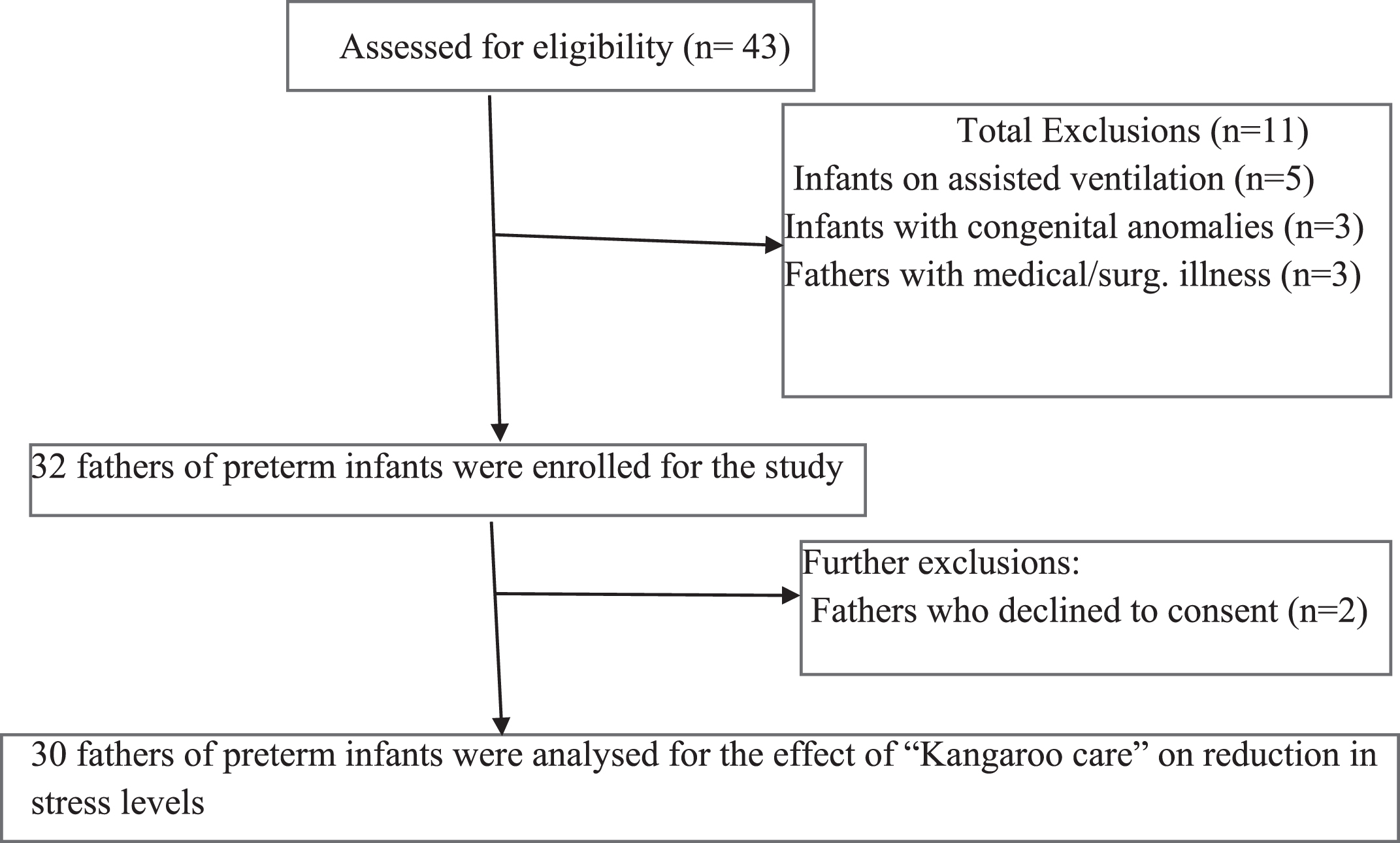
Study population flow diagram.
It was done in SPSS software version 16. As the data was not normally distributed and was ordinal in nature, Wilcoxon signed rank sum test was used to analyse the results. A p value <0.05 was considered significant.
Results
The baseline characteristics of the study population are depicted in Table 1. For the 30 fathers enrolled, demographic data showed that the mean gestational age of the preterm infants was 30.53 weeks and the mean age of the fathers was 28.5 years. Majority (63.2%) of the fathers belonged to lower middle socioeconomic status. The overall stress scores and the sub scores in each of the four domains before and after KFC are shown in Table 2. Amongst all the 4 subscales, stress levels were found to be reduced in “staff behaviour and communication” with a statistically significant p value <0.05. The stress score in the ‘baby looks and behaves’ domain was tending towards significance with a p value of 0.052. The total stress score was statistically significantly lower after KFC (p = 0.006).
Baseline characteristics of the study population
Baseline characteristics of the study population
Comparison of overall stress score of fathers across subscale and total scale before and after KFC
*- tending towards statistical significance. **- statistically significant.
Parents are under tremendous stress when their sick neonates are undergoing treatment in NICU. The NICU environment may be far from being family-centric. In the present study, parental stressor scale was used to quantify the amount of stress in fathers. KFC was used for reduction of stress levels in fathers. We found that overall stress scores before KFC were median (IQR) 112.5(91.25–156.3) and after were 98.5(72–133.8) and this was significantly lower after KFC (p = 0.0063).
The PSS: NICU questionnaire assesses stress in 4 domains. In the present study, it was found that the level of stress for fathers was most for the domain of ‘baby looks and behaves’. This could be due to the fact that premature and low birth weight infants are physiologically immature and show a blunted response to their surroundings as compared to their mature counterparts [5, 15]. This finding is consistent with the study done by Shields-Poe and Pinelli et al who found this same domain to cause the greatest stress [15]. However, in a similar study done by Miles et al and Agrawal et al, the authors found that the most stressful aspect of having a neonate in NICU was the domain of ‘parental role and relationship with their baby’ [13, 14]. The domain which was found to be least stressful for fathers in this study was the ‘NICU sights and sounds’. This is similar to observations made by [14–16]. These lower stress levels reflect that the fathers consider the NICU environment conducive for their infants’ well being and is a part of the necessary comprehensive care.
In the present study, we found that the ‘staff behaviours and communication’ domain was stressful for the fathers 18(11.75–37.25) and that this stress was reduced after KFC 11(3.5–26.25) with the stress reduction being statistically significant (p = 0.0013). It is likely that after starting KC, there was better communication with the staff; with more time being spent in the NICU, the fathers appreciated the work and efforts of the staff towards the care of their sick infant [17, 18]. The present study has a few merits like its prospective nature. The fathers provided KC uniformly to these preterm infants on 3 consecutive days for the same time period of 90 minutes. This led to more active participation and promotion of KFC in the unit. There are few limitations in the study. Firstly, the stress reduction was studied after 3 sessions of Kangaroo care lasting 90 minutes. The reduction in stress levels could have been more with longer and more sessions of KFC. Secondly, the present study did not consider other reasons for paternal stress such as financial, social and physical health. These factors could have influenced the stress levels in fathers providing KFC. In a study done by Dutta et al, they found that financial aspect was the most important factor for paternal stress [19]. Thirdly, this was a single centre study enrolling 30 fathers. More studies with a larger sample size are needed to validate the above findings.
Overall, the present study showed that KC leads to a reduction in stress levels of fathers whose infants are admitted in the NICU. KFC has number of other benefits. Firstly, it helps in allowing the stressed mothers of these fragile infants to get some necessary relief. Similar findings were also echoed in the study done by Morelius et al. [20]. Secondly, KFC is equally efficacious as KMC in reducing the stress levels in the preterm infants as studied by Srinath et al. [21]. Future studies with a larger sample size and in multiple centres are warranted to validate the study findings. Future studies involving longer duration of KFC and with consideration of other factors for paternal stress are also encouraged.
Conclusions
Fathers of preterm infants admitted in NICU experience a lot of stress which can adversely affect their mental health. KC which has been proven to reduce the maternal stress levels, is very effective in reducing the paternal stress levels as well.
Conflict of interest
The authors have no conflicts of interest to disclose.
Funding source
No funding was secured for this study.
Financial disclosure
The authors have no financial relationships relevant to this article to disclose.
Footnotes
Parental stressor scale (PSS): NICU
We are interested in how the environment and experience in the neonatal intensive care unit affects parents. The neonatal intensive care unit is the room where your baby is receiving care. Sometimes we call this room the NICU for short. We would like to know about your experience as a parent whose child is presently in the NICU.
This questionnaire lists various experiences other parents have reported as stressful when their baby was in the NICU. By stressful, we mean that the experience has caused you to feel anxious, aspect or tense. Please place an X in the NA box, if you have not experienced this.
Below is a list of the various sights and sounds (5 points) commonly experienced in anthe NICU. We are interested in knowing about your view of how stressful these sights and sounds are you.
Below is a list of items that might describe the way your
We want to ask you is how you feel about your own
We are interested in whether you experienced any stress related to
Using the same rating scale, indicate how stressful in general, the experience of having your baby hospitalised in the NICU has been for you (Total of 45 points)
Modified Kuppuswamy scale for socio-economic status: