



Abstract
BACKGROUND:
The immune system significantly participates in the development of the successful delivery process. The roles played by cytokine molecules in the induction of term delivery are yet to be clarified. The aim of this project was to explore the serum levels of interleukin-10 (IL-10), IL-17A, and IL-23 in the mothers with term and prolonged pregnancy and their infants.
MATERIALS AND METHODS:
In this study, 60 samples were collected from either mothers with term and prolonged pregnancy or their infants, collectively 240 samples. Serum levels of IL-10, IL-17A and IL-23 were explored using enzyme linked immunosorbent assay (ELISA) technique.
RESULTS:
IL-10 serum levels significantly decreased in the neonates with prolonged pregnancy when compared to their mothers. Serum levels of IL-23 were increased either in term or prolonged pregnancy neonates when compared to their corresponded mothers. Serum levels of IL-10 and IL-23 significantly decreased and increased, respectively, in the female in comparison to male in the prolonged pregnancy neonates. IL-10 also significantly decreased in the term mothers who had higher gravidity.
CONCLUSION:
Although, IL-17A does not play a key role in the delivery mechanism, IL-10 and IL-23 may be considered as potential factors in the modulation of term delivery.
Introduction
Cytokines are the small and unstable molecules, which significantly direct the immune system responses against infectious diseases [1, 2], tumors [3, 4], autoimmunity [5, 6], and placenta physiological/pathological functions [7, 8]. It has been reported that the molecules may play a role in the fetus development and are produced either following immune cell responses to the placenta/fetus alloantigen or modulation of immune responses to the fetus [9–11]. Thus, it appears that cytokines may be considered as the regulators of a term delivery [12]. Cytokines play several roles in the human cell systems from both induction and inhibition of inflammation to angiogenesis and angiostasis [13]. It has been hypothesized that pro/anti-inflammatory cytokines may induce a balance in the mother immune responses to the fetus antigens and also in the induction of an appropriate term delivery. However, the main cytokines involved in the induction of term delivery are yet to be clarified. Interleukin-10 (IL-10) is the main anti-inflammatory cytokine, which is produced by several cells, such as macrophages, Th2 and T regulatory lymphocytes and significantly participates in the immune response homeostasis and inhibition of autoimmunity [14, 15]. Additionally, previous investigations demonstrated that IL-17 and IL-23 are the main cytokines, which not only participate in the induction and stimulation of inflammation, they are the plausible factors play some roles in the pathogenesis of autoimmune and pro-inflammatory based diseases [15–17]. Thus, it may be hypothesized that IL-10, as anti-inflammatory cytokine, IL-17A and IL-23, as the pro-inflammatory cytokines, may participate in the progression of a physiological delivery. Therefore, this study was aimed to investigate IL-10, IL-17A, and IL-23 serum levels in the mothers with term and prolonged pregnancy, and their corresponded neonates.
Material and methods
Subject
In this cross-sectional study, 240 samples, including cord bloods from term (60 samples) and prolonged pregnancy (60 samples) neonates and serum samples from term (60 samples) and prolonged pregnancy (60 samples) mothers were obtained at Rafsanjan Maternity Hospital of Nick-Nafs. The procedures of blood sampling and evaluation of the mother’s clinical status were under supervision of a gynecologist. Accordingly, term (the time of labor between 38 to 40 weeks) and prolonged pregnancy (the time of labor after 40 weeks) was approved by the gynecologist based on the two categories including first day of last menstruation and a reliable ultrasound biometry between 8–12 weeks. Due to the plausible effects of parity, gravidity, and age on the serum levels of cytokines, two mother groups (prolonged and term pregnancy) were matched regarding the variables. Additionally, the participants who suffered from blood pressure, pre-eclampsia, infection, diabetes (type 1 and 2), cesarean delivery, vaginal bleeding, irregular menstruation, allergies, smoking, and opium consumption cases were excluded from the study. Prior to the entrance to the study, the participants completed the informed consent form. Rafsanjan University of Medical Sciences Ethical Committee approved the protocols of the current project by IR.RUMS.REC.1397.034 code.
Detection of the serum cytokine levels
The serum and cord blood levels of IL-10, IL-17A, and IL-23 were measured using commercial kits from Karmania Pars Gene Company, Kerman, Iran, based on the enzyme linked immunosorbent assay (ELISA) technique.
Statistical analysis
Based on the normality of the data distribution regarding the serum levels of the evaluated cytokines and also the variables such as age, gravidity, and weight, parametric tests were used to determine the differences among the groups. Accordingly, one-way ANOVA was used to determine the differences among the groups (mothers with term and prolonged pregnancy, and their neonates) regarding the serum levels of the cytokines, age, gravidity, and weight. The differences among the mothers with various gravidities were evaluated using one-way ANOVA. However, the differences of IL-10, IL-17A, and IL-23 serum levels between male and female in each term and pest-term neonates were calculated using independent samples t test. The correlations among IL-10, IL-17A, and IL-23 serum levels, maternal age, neonate weight, and neonate head circumference were determined using Pearson correlation test under SPSS software (Version 18). P values lower than 0.05 were considered significant.
Results
Results showed that serum levels of IL-10 (p = 0.004) and IL-23 (p < 0.001), but not IL-17A (p = 0.288), were significantly different among the groups (Fig. 1). Accordingly, serum levels of IL-10 were 5.37±0.33 pg/mL in the term mothers, 4.49±1.98 pg/mL in the term neonates, 5.05±0.34 pg/mL in the prolonged pregnancy mothers and 3.95±0.21 pg/mL in the prolonged pregnancy neonates (Fig. 1). Tukey Post-Hoc test showed that the differences between prolonged pregnancy mothers and their neonates (p = 0.050), but not between term mothers and their neonates (p = 0.112), were significant. IL-23 serum levels also were 1591.29±161.64 pg/mL in the term mothers, 4763.24±566.43 pg/mL in the term neonates, 1768.36±239.11 pg/mL in the prolonged pregnancy mothers and 5252.99±879.77 pg/mL in the prolonged pregnancy neonates (Fig. 1). Tukey Post-Hoc test demonstrated that both term (p < 0.001) and prolonged pregnancy (p < 0.001) mothers had significantly lower serum levels of IL-23 when compared to their corresponded neonates.
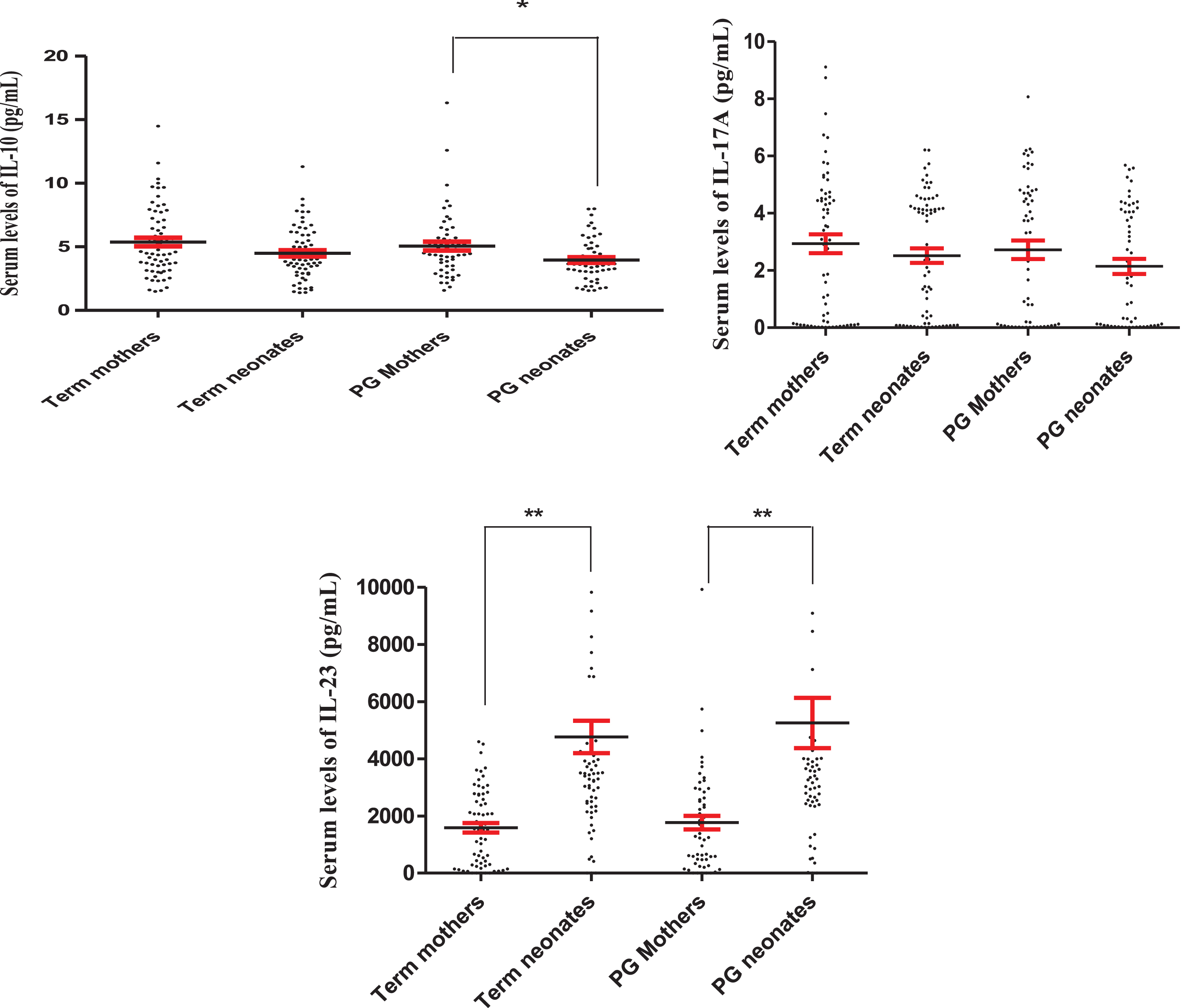
IL-10, IL-17A and IL-23 serum levels in the term and prolonged pregnancy mothers and their corresponded neonates. The figure illustrates that IL-10 and IL-23 serum levels were significantly lower and higher in the term and prolonged pregnancy mothers, respectively, when compared to their corresponded neonates. IL-17A serum levels did not alter among the participants. PG: Prolonged pregnancy. *p = 0.050, **p < 0.001
Data analysis demonstrated that IL-10 (p = 0.891), IL-17A (p = 0.830) and IL-23 (p = 0.866) serum levels were not significantly different between male and female term neonates (Fig. 2). However, serum levels of IL-10 (p = 0.049) and IL-23 (p = 0.015) significantly increased and decreased in the male prolonged pregnancy neonates in comparison to female prolonged pregnancy neonates, respectively (Fig. 3).
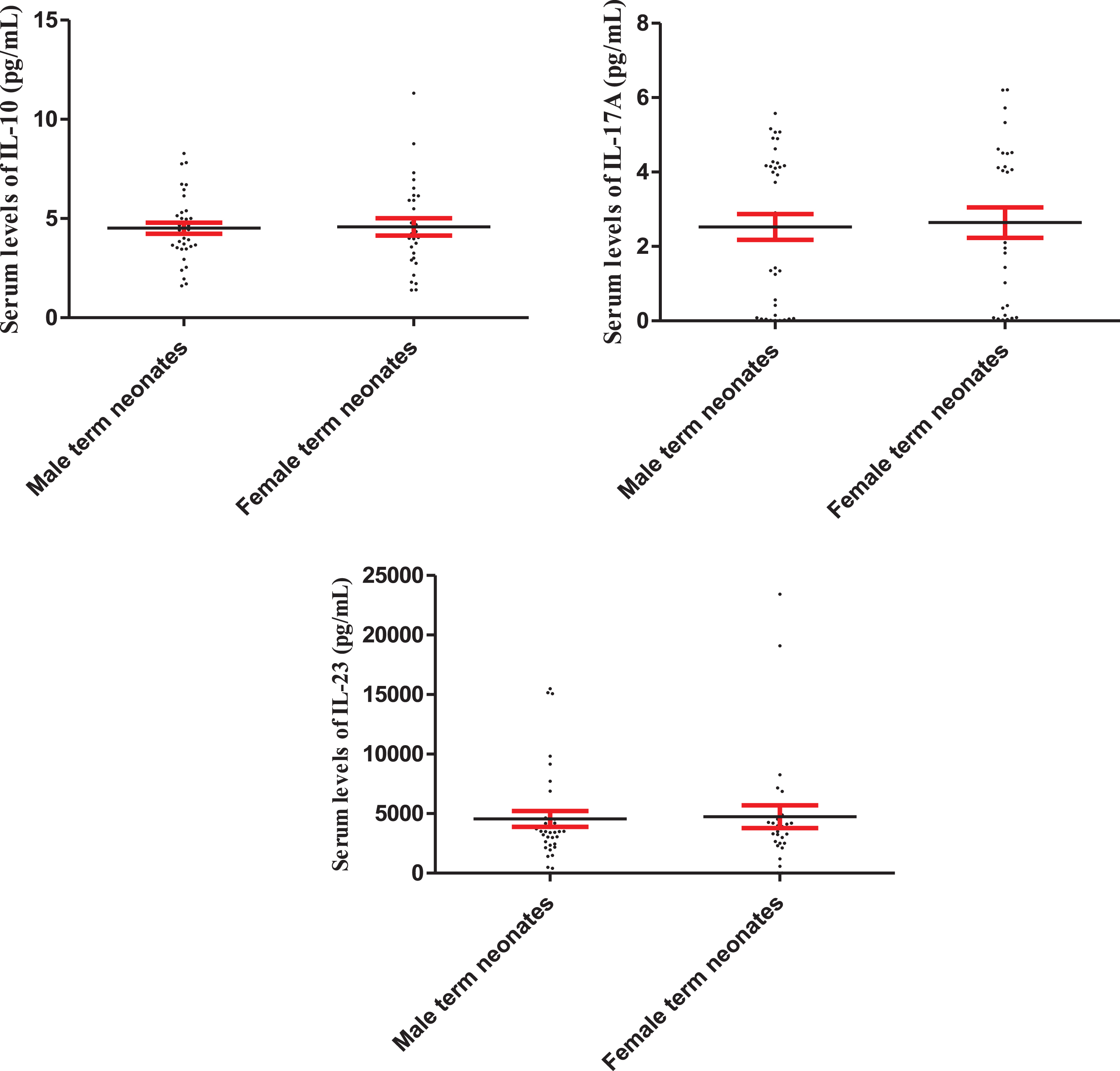
Serum levels of IL-10, IL-17 and IL-23 in the male and female term neonates. Serum levels of IL-10 (p = 0.891), IL-17A (p = 0.830) and IL-23 (p = 0.866) serum levels were not significantly different between the male and female term neonates.
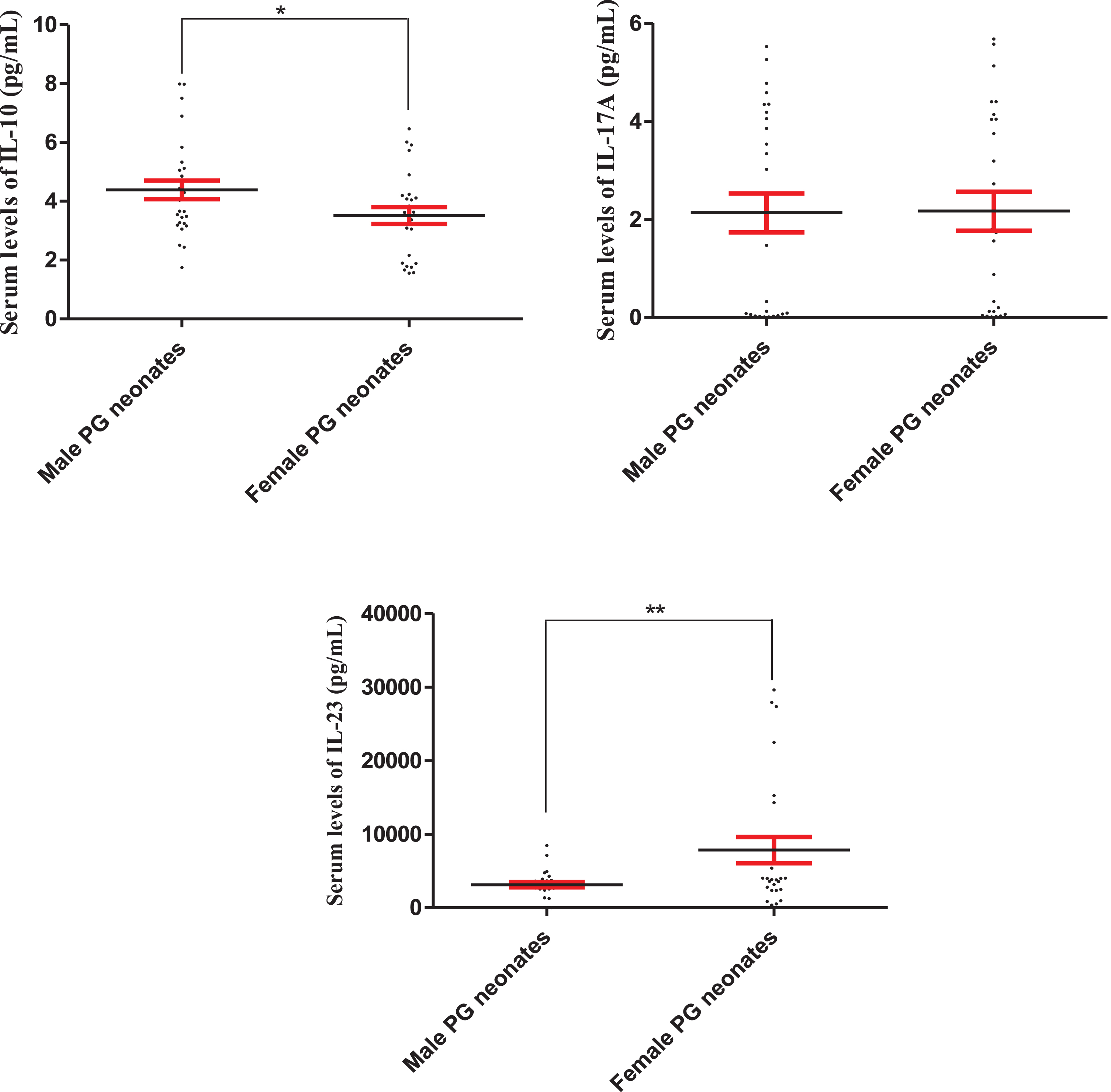
IL-10, IL-17A and IL-23 serum levels in the male and female post-term neonates.< /b>IL-10 significantly increased and IL-23 significantly decreased in the male post-term neonates in comparison to the female post-term neonates. IL-17A serum levels did not change between the groups. PG: Prolonged pregnancy. *p = 0.049, **p = 0.015.
Statistical analysis also revealed significant (p = 0.007) differences regarding IL-10 serum levels among term mothers with various gravidities (Fig. 4). Accordingly, IL-10 serum levels were higher and lower in the mothers with 1 and 5 gravidities, respectively. IL-17A (p = 0.131) and IL-23 (p = 0.867) serum levels did not alter among the groups (Fig. 4). IL-10 (p = 0.498), IL-17A (p = 0.808), and IL-23 (p = 0.566) serum levels did not significantly change among the prolonged pregnancy mothers with various gravidities (Fig. 5).

Serum levels of IL-10, IL-17A and IL-23 in the term mothers with various pregnancies (Gravidity). Serum levels of IL-10 (p = 0.007) were significantly higher and lower in the mothers with first and fifth pregnancies.
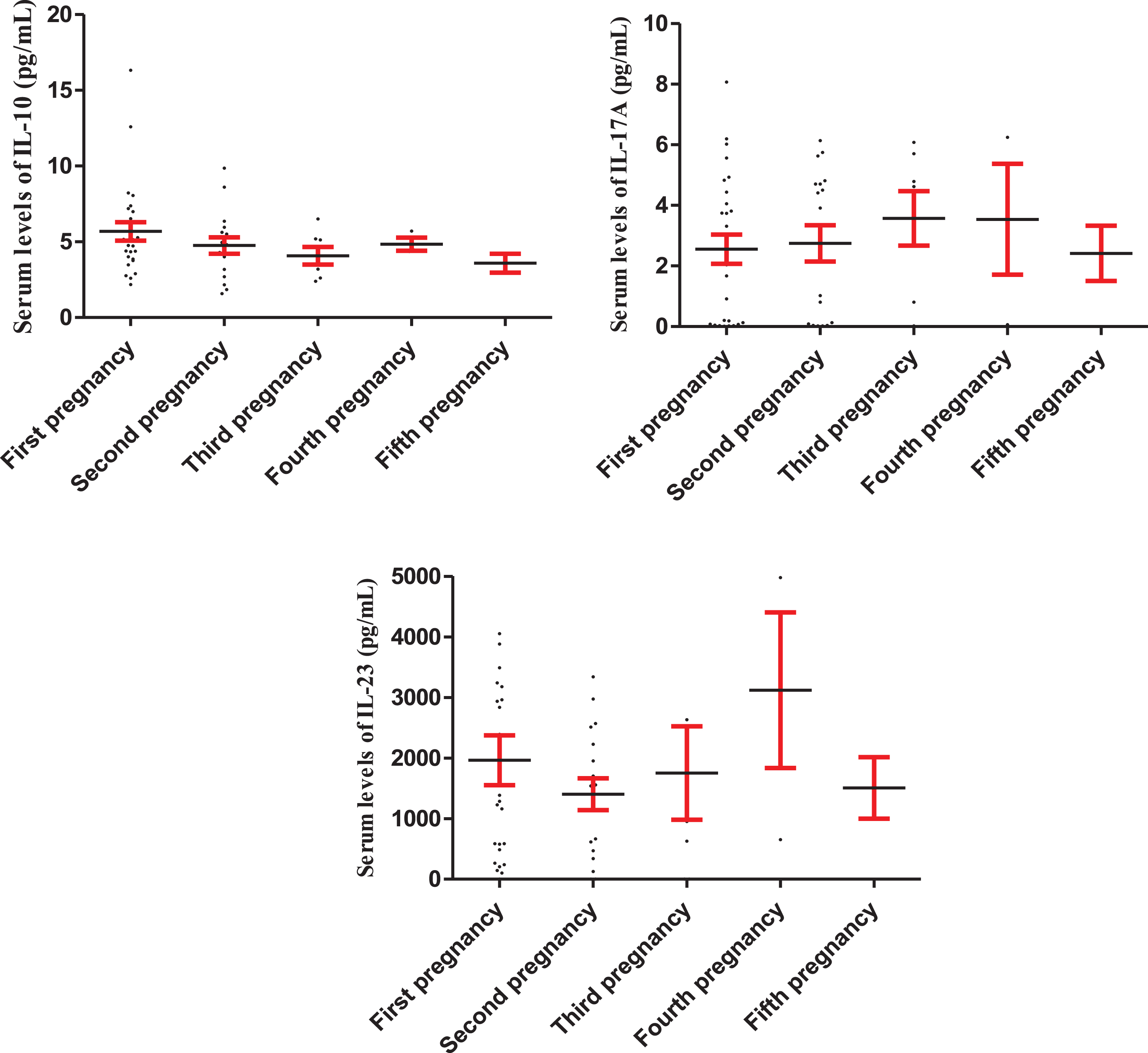
Serum levels of IL-10, IL-17A and IL-23 in the prolonged pregnancy (PG) mothers with various pregnancies (Gravidities).< /b>Serum levels of IL-10 (p = 0.498), IL-17A (p = 0.808) and IL-23 (p = 0.566) did not significantly change among the groups with various gravidities.
Pearson correlation test showed that, there were poor negative correlations between age and IL-10 serum levels in the term mothers and also between weight and IL-23 serum levels as well as head circumference and serum levels of IL-23 in the prolonged pregnancy neonates. Also, there were moderate and poor positive correlations between head circumference and weight of prolonged pregnancy neonates with IL-10 serum levels, respectively (Table 1).
Correlation between head circumference and weight of neonates, age of mothers and serum levels of cytokines in the term (A) and prolonged pregnancy (B) mothers as well as term (C) and prolonged pregnancy (D) neonates
The table shows that there were poor negative correlations between age and IL-10 serum levels in the term mothers and also between weight, IL-23 serum levels and head circumference and serum levels of IL-23 in the prolonged pregnancy neonates. There were also moderate and poor positive correlations between head circumference and weight of the prolonged pregnancy neonates with IL-10 serum levels, respectively.
The results showed that IL-23 cord blood levels significantly increased in both term and prolonged pregnancy neonates when compared to their mothers. Due to the pro-inflammatory properties of IL-23, it may be concluded that delivery is a pro-inflammatory based phenomenon and immune system, including cytokines, plays a key role in the induction of delivery. However, the statistic analysis revealed that IL-10 cord blood levels significantly decreased in the prolonged pregnancy neonates, but not in the term neonates, when compared to their mothers. IL-10 is a potential anti-inflammatory cytokine and significantly decreases immune cell responses to the alloantigens, the antigens which are presented by the fetus. Therefore, based on the results it may be hypothesized that down-regulation of IL-10 in the prolonged pregnancy neonates may be associated with increased inflammation in the prolonged pregnancy neonates, which in turn may be related to delayed delivery and consequently increased inflammatory responses to the alloantigens. In another word, it appears that decreased IL-10 in the prolonged pregnancy neonates may be associated with elevated inflammation in the neonates to induce delivery. It has been reported that IL-10 plays critical roles in the inhibition of pre-term delivery through induction of tolerogenic dendritic cells (DCs) and, then development of T regulatory lymphocytes, activation of the anti-inflammatory intracellular signaling, such as Janus Kinase-1 (JAK1)/signal transducer and activator of transcription 3 (STAT3) pathway, and down-regulation of pro-inflammatory molecules, including cyclo-oxygenase-2 (COX-2) [18, 19]. Thus, it may be hypothesized that prolonged exposure of alloantigens to the maternal immune cells in the prolonged pregnancy neonates results in activation of some immune responses and hence, may be associated with decreased in either functions of tolerogenic DCs and T regulatory lymphocytes or production of pro-inflammatory molecules, such as COX-2. To the best of our knowledge, there are not previous investigations regarding the roles played by IL-10, IL-17A, and IL-23 in the prolonged pregnancy and this is the first study demonstrated that IL-10 and IL-23, but not IL-17A, play plausible roles in the prolonged pregnancy pathogenesis. However, previous investigations proved the significant roles played by IL-10 [20–22], IL-17A [8, 24], and IL-23 [25, 26] in the normal pregnancy. Based on the fact that IL-23 serum levels were significantly increased in the neonates in comparison to their mothers, it seems that the neonate immune responses significantly participate in the modulation of delivery too.
The results also revealed that IL-10 and IL-23 cord blood levels significantly decreased and increased, respectively, in the female in comparison to the male prolonged pregnancy neonates. These values were not different between female and male term neonates. Thus, it may be hypothesized that gender may be a critical factor to modulate expression of cytokines in the prolonged pregnancy neonates. So, it appears that more investigations regarding the roles played by the gender on the immune responses of prolonged pregnancy neonates needs to be designed. Additionally, the results in the term mothers showed that IL-10 serum levels decreased in association with increased gravidity. Due to the fact that IL-10 serum levels also decreased in the prolonged pregnancy neonates in comparison to their mothers, but not in term neonates, it may be hypothesized that increased gravidity may increase the risk of prolonged pregnancy. However, the molecular mechanisms of this hypothesis need to be explored by further investigations.
To confirm the critical roles played by IL-10 in the prolonged pregnancy, the results demonstrated that there is a moderate positive correlation between IL-10 cord blood levels and head circumference, which is a criterion for health of neonates. Again, it seems that IL-10 may be considered as a main target for more investigations regarding its roles in the prolonged pregnancy.
Declaration of interest
The Authors have no conflicts of interest.
Footnotes
Acknowledgments
This project was granted (Code: d/p/20/196) by the Rafsanjan University of Medical Sciences.