



Abstract
Radio frequency identification (RFID) has been viewed as a promising technology for quite some time. Initially developed a couple of decades ago, the technology has been accompanied by predictions of imminent widespread adoption since its beginnings. A majority of retailers and other users are now using or planning to use the technology. This paper employs a combination of the technology-organization-environment (TOE) model and the 3-S (substitution, scale, structural) model to analyze the long journey of RFID adoption in retail. Top retail executives in the US and Europe were interviewed to investigate RFID adoption patterns based on differences in technological, organizational, and environmental circumstances. As the retail industry is moving into a post-adoption era, these results demonstrate the current stage of retail RFID adoption, identify factors playing important roles over time as motivators or impediments, and provide some insight into the slow pace of adoption.
Keywords
Introduction
Interest in RFID began around the turn of the century as its capabilities were found to have potential synergies with newly installed enterprise resource planning (ERP), supply chain management (SCM), and store management systems as well as other applications collecting and sharing data throughout organizations (Akkermans et al., 2003; Delen et al., 2007). RFID technology uses small electromagnetic tags (also named transponders) attached to objects, tickets and merchandise. These tags are able to identify and transmit information over short distances without a line of sight. The tags can also be linked with external databases, allowing tag readers to call up additional information on the object. What this allows, as opposed to barcodes representing a product class, is identification of pallets, cases, or even individual items or people. The result allows objects to be uniquely identified and tracked, increasing efficiency while reducing costs through greater process transparency.
The most obvious applications for RFID are in inventory management, as shown in its early connections to ERP and SCM systems (Chappell et al., 2002; Kambil, 2002). Every time a tagged object passes by a RFID reader, its location is recorded. More labor-intensive, line-of-sight barcode scanning could be reduced, especially as RFID readers could handle larger quantities, such as entire pallets, all at one time. With better real-time information on inventory levels, less safety stock might be necessary, stockouts could be reduced, and items were more likely to be in the right place at the right time. As a result, operational efficiently increase∖ed (DeHoratius & Raman, 2008; De Marco et al., 2012).
As things developed, however, operational advantages from tagging people also became apparent. Customers could then be followed and identified like physical inventory, allowing a better idea of supply and demand for facilities, both in real time and on a historical basis. There was always a case to be made for an ability to combine RFID data with customer data. The more that individually identified products could be associated with individually identified consumers, the greater the possibilities for understanding customers and their preferences. More recently, interest has grown in omnichannel applications, particularly in cross-channel fulfillment (locating an item physically, regardless of channel, when demanded by a customer) (Kumar & Ting, 2019).
The range of applications is vast, including physical inventory for manufacturing and service operations, inventory in a retail stores, tracking customers/users, and following items after the sale to helping manage after-sale service (Kasiri et al., 2012). But more specifically, just about all of these advantages of RFID technology apply particularly to retail operations. Physical inventory management, from supply chains to operations (including omnichannel) to post-sale use, is critical to retail success. Matching product information with customer information (through loyalty programs, apps, or other means) is also increasingly important. Enabling better customer communication and relationships, both inside and outside retail environments, has become a key competitive capability. RFID has the potential to substantially improve all of these. Much of this potential was recognized nearly twenty years ago. Predictions were that the technology would be rapidly adopted as tag costs dropped, standardization occurred, and user companies, including retailers, demonstrated bottom-line success attributable to RFID installations. Early high-profile adoptions such as Walmart mandating RFID for its top suppliers in 2003, the US Department of Defense requiring the technology for thousands of its suppliers in 2004 (Asif, 2005), and Metro Group Future Store Initiatives in Germany (Ton et al., 2005) built apparent momentum for rapid adoption of the innovation. The pace slowed a few years later, however, and RFID was viewed less positively by potential users (Roberti, 2018). A slower installation rate was apparent, especially in retail, once the hottest sector (Bunduchi et al., 2011). RFID appeared to have entered the trough of disillusionment period predicted by the Gartner Hype Cycle (Gartner, 2018).
In another reversal, the technology has shown signs of recovery in recent years. In one survey only 43%of retailers had adopted or intended to adopt in 2014 vs. 73%in 2016 (Unger & Sain, 2016). The same study projected a 22%growth rate in spending on the technology for 2015 to 2018. High-profile adoptions have also picked back up, including major retailers such as Target. Another study by Sain and Wong (2018) shows 92%of retailers in North America were progressing toward the adoption of RFID, a 25%increase from the 2016 results.
The important question for retail is why such a promising technology, with the potential to revolutionize the entire industry, has taken so long to show signs of more widespread implementation in the retail sector. This paper investigates the long journey of RFID adoption in the retail sector over the last two decades. This study solicited global experts’ opinions and uses Information Systems (IS) theoretical models to explain the important factors that have influenced the adoption decisions of this technology. The goal is to develop an IS hybrid model demonstrating the adoption process of RFID in retail. The findings of this research can help facilitate future adoption of new technology in industries.
In the next section, the theoretical foundations from the IS literature are developed, followed by section 3 explaining the research methodology. Section 4 presents the findings of the study, and section 5 provides discussion of the results in the context of previous studies, limitations, and future directions. Section 6 includes concluding remarks.
Theoretical foundations
Numerous theories seek to explain the adoption of information technology (Davis, 1989; Tornatzky & Fleischer, 1990; Rogers, 1995). The technology acceptance model (TAM) is one of the most widely used technology adoption theories (Davis, 1989). Perceived usefulness and perceived ease of use are the major factors in the theory initially developed to explain individual user adoption. TAM was later expanded to include more constructs to explain the adoption of technology at organizational level (Venkatesh, 2000; King & He, 2006; Wu, 2011).
Technology-organization-environment (TOE) is another longstanding framework concerning technology and innovation adoption (Tornatzky & Fleischer, 1990) by organizations. The TOE framework focuses on technology adoption at the firm-level, classifying different factors into three categories: technology-level factors such as technological complexity, organization-level factors such as organizational size and priorities, and environment-related factors such as industry competition and customer behavior issues.
Roger’s diffusion of innovation (DOI) process (1995) and Malone and Rockart’s 3-S (substitution, scale, structural) model (1991) can also help explain stages of information technology adoption in general and RFID retail adoption in particular (Zhu et al., 2006a; Zhu et al., 2006b; Lee, 2007; Lin et al., 2014; Lee, 2018). Rogers’s model describes 5 stages (knowledge, persuasion, decision, implementation, confirmation) to show the steps an organization goes through in the innovation adoption process. Bhattacharya (2015) used Roger’s model to specifically explain the early stages of RFID retail adoption. Similarly, Malone and Rockart (1991) categorized the stages of technology diffusion as substitution, scale, and structure. To illustrate, the technology is tested as a substitute for current tools, gains enough acceptance to enable scale-up (with related cost savings) until it eventually becomes the dominant technology itself, and a new infrastructure grows to support it. Lee (2007) used Malone and Rockart’s (1991) framework as his theoretical basis for studying RFID adoption stages. He described substitution as RFID replacing bar code systems in retail, a build to scale as RFID expanding to uses such as inventory management to customer service and handling returns, and then creation of a supporting infrastructure as retail processes discovered new ways to innovate related to the RFID installations. His view, in 2007, was contemporary with RFID’s struggle to move through the scaling phase of the model.
Other studies of innovation adoption also applied specifically to RFID and help to focus the question. Huber et al. (2007) looked at retail adoption in Australia, identifying the issues of cost, lack of awareness and education on RFID technology, perceptions of the technology being too immature, and some practical perspectives such as tagging level. Schmitt et al. (2007), though specifically studying the auto industry, compiled adoption models that might be usefully applied to RFID more widely, as did Jeyaraj et al. (2006) utilizing not only the Rogers’ adoption/diffusion model and versions of the TAM but other well-known approaches such as the Theory of Planned Behavior (Fishbein & Asjen, 1975) and Theory of Reasoned Action (Venkatesh et al., 2003). Also included is Dipietro et al. (1990) emphasizing variables surrounding the technology itself, the organization, and the environment. Importantly, these reviews highlight models more focused on decision-making in firms.
These theoretical lenses mesh well with what can be observed concerning real-world RFID adoption. The most obvious issues have been cost and privacy, essentially whether the benefits of the technology were worth the costs, both monetary and with the surrender of private consumer data. The early concerns about costs had to do simply with the per chip price, just a question of when that number would go from over ten cents a chip down to a more affordable couple of cents (Kasiri and Sharda, 2013). Research suggested that while a number of cost aspects were pertinent to adoption decisions (manufacturing, customization, infrastructure, installed base), the critical ones had to do with the cost of the chip itself, including the lack of a standardized option (Wu et al., 2008). The volume found in a standard chip, of course, would drive down manufacturing costs through a learning curve, economies of scale, and less uncertainty.
A number of efforts were made to create common standards for RFID transponders. These were complicated early on by competing technologies (e.g. radio wave frequencies used) and jurisdictions (Dew, 2006; Wu et al., 2006). But international standards organizations helped to consolidate inputs into generally accepted agreements, especially through EPCglobal and the ISO (Bunduchi et al., 2011). Although differences still exist, especially across some international borders, the standard technology is advanced enough to handle most technological challenges without costly customization. There is certainly enough agreement to have allowed forward movement with major adoptions among some key industry players (Bunduchi et al., 2011). So costs have continued to come down, even if not at a pace predicted a decade ago. And now they are, at least, predictable. What is still unpredictable are the benefits from RFID adoption (Kasiri et al., 2012). Although very clear in theory, attaching numbers to them is more problematic and the traditional innovation adoption issue of immediate costs vs. long-term benefits has become more prominent today. Indeed, the costs of installation are clear and material. Exactly where the business savings enter into the picture, and their level or degree, is more problematic and less predictable. Although information and knowledge sharing increase with effective RFID installations, the concrete business impact remains fuzzy. Studies suggest that operational performance improvements in general and in specific areas such as inventory management, TQM, or JIT may be possible (Zelbst et al., 2014; Ngai et al., 2008) but the dollar impact is again hard to pin down. In those situations, making the case for investment becomes more difficult.
Beyond cost and cost/benefit questions, privacy concerns have continued to play a part in RFID adoption decisions. Although not really relevant in many supply chain and operational environments (inventory doesn’t require privacy), privacy does matter in retail, when consumers possess tagged items, and in services where consumers themselves may be tagged. In the early days of RFID, records of consumer purchases and their specific locations were a new concern (Kelly & Erickson, 2005; Garfinkel et al., 2005). With the advent of smart phones, such data are now a matter of everyday life, something many individuals turn over to companies on a regular basis. Technological options such as post-purchase RFID disablers and blockers have also become available. In some ways, the privacy concerns have declined but in other ways, as RFID systems data are used in other areas (e.g., Internet of Things) or combined with other ever-larger databases, privacy is even more of an issue (Chen, 2019).
Other issues have been noted such as continuing technological questions (e.g. co-location of chips and the difficulties of readers separating them), infrastructure (cost of new vs. the existing installed base), and whether a technological leap might have rendered the technology less attractive (Wu et al., 2006; Bunduchi et al., 2011).
Today, retail RFID is more rapidly being rolled out or is even in place on a larger scale. The goal of this paper is to demonstrate the various factors that have played key roles in the pace of adoption of the technology while also determining how those factors continue to influence retail RFID. An integrative explanatory framework is developed by combining the TOE and 3-S models (Fig. 1) to illustrate the big picture, the journey of RFID, an industry-changing technology, over the past two decades. The results provide lessons for the fast-changing environment of technology adoption in retail.
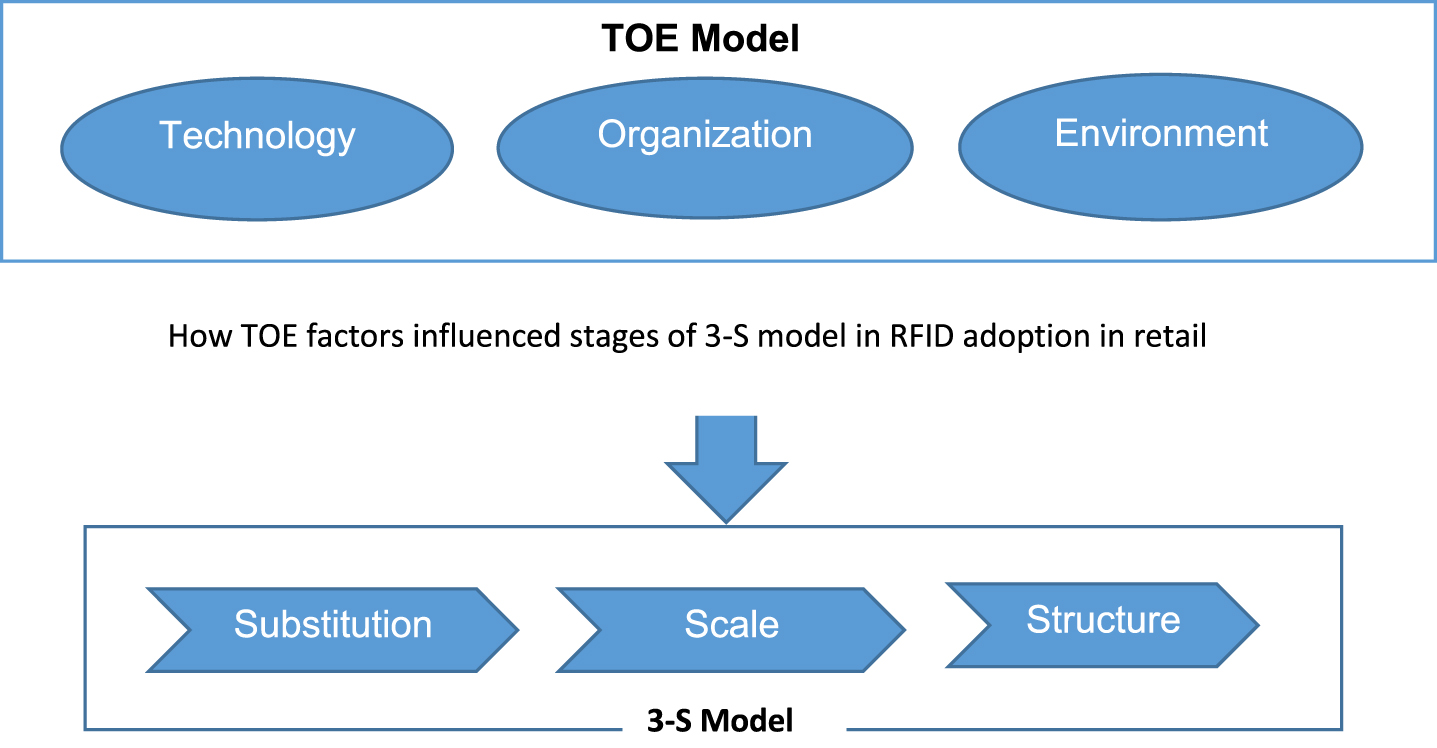
Integrative Model of TOE and 3-S for Retail RFID Adoption.
As the retail industry now moves toward an RFID post-adoption period, top retail executives making these decisions were interviewed about the longer-than-expected adoption timespan. More specifically, semi-structured interviews were conducted with fourteen leading retail executives, seven in Europe and seven in the US. All were RFID experts who have been extensively involved with RFID implementation at some point during their careers. They were able to share their experiences about technological, organizational, and environmental factors affecting adoption. Purposefully, half of the executives came from the Europe and half from the US so that their opinions on environmental factors gave us a broader perspective as well. The sample included well-known executives in this field who were contacted by the researchers and their wider networks (modified snowball) throughout the two regions (Atkinson & Flint, 2001). The mix of executives from Europe and the US also represented the different conditions, perspectives, and adoption rates across borders (Park et al., 2010).
The depth interviews took about an hour and were conducted face-to-face or by telephone over a period of nine months in Germany, Italy and the US. Prior to the interviews, interviewees were provided an overview of the research, the interview questionnaire, and an informed consent form acknowledging their understanding of the study’s purpose and their anonymous participation. The open-ended questionnaire aimed at their perceptions of the current state of the technology and explored the factors influencing technology adoption as broadly and deeply as possible. The questions were open-ended by design, so they were not directive and did not limit the executives’ opinions. The questionnaire consisted of general questions that were constructed from validated items noted in an extensive literature review on TOE and 3-S frameworks as well as RFID studies in the retail sector (Tornatzky & Fleischer, 1990; Rogers, 1995; Lee, 2007; Bunduchi et al., 2011; De Marco et al., 2012; Kasiri et al., 2012; Unger & Sain, 2016). The questionnaire started by asking interviewees about the adoption stages of RFID technology in retail in general and their companies since 2000. The answers to this question were coded with respect to the 3-S (substitution, scale, structural) model (Lee, 2007). The rest of the questionnaire asked the experts to identify the factors that have influenced retailers in their RFID adoption decisions. The answers to these questions were coded based on the TOE model and were grouped as technological (complexity and standardizations of the technology), organizational (cost/benefit of technology implementation, organizational characteristics), and environmental (general costs, regulations, privacy concerns, etc.) factors (Rogers, 1995).
Results
As noted, the executives’ opinions were solicited with respect to any important factor that played a role in the adoption process of RFID over the last two decades; technological, organizational, and environmental variables as drivers or barriers of adoption of technology in general and RFID in particular (Tornatzky & Fleischer, 1990; Lee & Ozer, 2007; Wang et al., 2010). The executives identified ten factors as major variables within TOE framework, as shown in Table 1.
Key Technological, Organizational and Environmental Factors Reported by Executives
Key Technological, Organizational and Environmental Factors Reported by Executives
The executives also explained how these factors have influenced the adoption process positively and negatively over time.
Existing RFID technology and general-purpose tags have been further improved over the last several years. A new generation of chips has been developed, enabling tags to be more sensitive and require significantly less energy for chip activation. Furthermore, they offer more programmability and radio-technical features. Transponder performance and intelligence have improved as well. Tags are becoming more powerful, able to store more data and provide sensory information about temperature, humidity and more. Solutions are now on the market that positively exploit how tags behave differently under diverse physical conditions, such as heat and humidity. In addition, the supply of tags for technically difficult applications has increased. For example, on-metal (OM) tags with a thickness of only 0.6 mm are now hardly distinguishable from labels. Table 2 describes different type of available tags with their applications in retail.
RFID Technology Types
RFID Technology Types
A related issue has been the compatibility of technology throughout a retailer’s extended network. While a firm the size of Walmart can mandate what its suppliers adopt, others are at the mercy of existing systems (Allen et al., 2000). As noted, tag standards have only recently converged, and the systems around the tags, including IT systems may or may not be compatible with other firms. As a retailer brings on a new supplier, it might have in place an easily integrated RFID platform and associated enterprise systems and core business processes. But it may not. And RFID platforms generate considerable amounts of data, so firms need big data and business analytics capabilities to fully utilize the systems. Consequently, the technology of systems surrounding the tags continues to pose issues as well.
Sometimes innovation is a priority in a retailer. An interviewee noted “Zara and Inditex Group in Spain started investing in RFID even before the benefits of the technology was fully realized and proved by business cases. Believing in this technology as an innovative tool convinced their executives to go ahead with their investment.”
In addition, all parts of an organization are not necessarily on the same page. Different levels of knowledge about RFID systems and different priorities, once again, may result in some individuals and some groups having pro-RFID attitude while others are more non-committal. Loss-prevention groups, for example, are often very well-informed about RFID and its potential but may face challenges in convincing others within the firm.
A related aspect noted by the interviewees was organizational culture. In the US, the national culture is often recognized as more willing to take risks, a tendency that shows up in corporate cultures as well. The result can be more flexibility and a greater willingness to innovate. Alternatively, more risk-averse cultures found in Germany and Italy can leave their firms less willing to take the plunge on RFID investment. That being said, firms do exist that are less obviously influenced by national culture, including innovators like Inditex/Zara.
In addition, vertical integration in supply chains helps retailers in the adoption of the technology. Most European retailers such as C&A, Adler, Gerry Weber, and Zara that implemented RFID have benefitted considerably from improvements to their supply chains.
The other difference noted by the experts was geographical dispersion of distribution centers. Europe’s dense population requires less distribution centers than does the US. Less distribution centers leads to lower costs of adoption. Even within the more geographically dispersed US, however, retailers often put a higher priority on efficient inventory management and reducing shrinkage, no single factor is necessarily dominant in every situation.
RFID entered the retail market in the late 1980s, primarily for tracking inventory. Early on, RFID hardware and tags were cost-prohibitive for the mainstream with a price of $1 per tag or higher plus antennae and sensors. In 2015, the RFID market was valued at $26 billion, and innovations within the Internet of Things (IoT) were on the rise. But costs have dropped as the technology matured. RFID tags are getting both smaller and cheaper over time, resulting in a multiplicative corresponding reduction in tag cost. In addition, RFID tag yields are improving, further compounding the effect of these trends on cost reduction. Engineering and manufacturing tolerances for RFID chips are much larger than for high-end chips (e.g., RFID chips can operate at low clock speeds, extreme miniaturization is not a prominent problem in RFID production, etc.). Moreover, the manufacturing equipment for RFID tags does not have to be cutting-edge, reducing cost pressures when constructing tag fabrication facilities. Rapidly increasing demand for RFID, along with cheaper manufacturing techniques and improving yields, brings the cost of RFID tags into the sub-penny levels, making tags ever more affordable. In short, tags are economically viable, with costs continuing to fall over time.
In addition, some infrastructure support tools have been replaced by cloud-based services, and retailers have better learned how to utilize these less-expensive options, allowing a cost-optimal mix of on-site and off-site installations. To illustrate, C&A in Germany reinvented its RFID adoption by eliminating middleware, fixed antennas and readers, lowering the implementation cost to a level justifying the new investment.
Costs are similar across continents, with no substantive differences in tag or implementation costs. The interviews did reveal that geographic spread may make a difference in total adoption cost, so the continent-wide distribution requirements of US retailers often led to a bigger investment than that required of more concentrated EU retailers.
Environmental factors
The experts believed that gaining a competitive advantage, especially as first adopter can be a key strategic goal for retailers, enabling them to make a business case to shareholders for RFID adoption. Competition can be a force driving RFID adoption forward. “When Walmart announced its plan over a decade ago, Albertson followed as well. When Walmart stopped, Albertson stopped too.” In addition, some experts expressed that a higher rate of retail use could be driven by adoptions by identifiable pioneers and industry leaders. The lack of first adopters during the early years after RFID’s introduction was an important reason for slow growth. That may have changed. “Adler Modemärkte and C&A in Europe and Macy’s and Target in the US are now examples that can lead their genre retailers toward the adoption of the technology”.
Interviewees did note differing conditions between the US and Europe. In the former, competitive concerns were considerable and industry leadership was a strong motivator for adoption. In the EU, the environment was more variable as different countries had different competitive conditions. In Germany, for example, retail competition is aggressive, leading to a quicker adoption rate than in some calmer environments.
In 2006, the European Commission (EC) launched the largest-ever policy-related public consultation with a series of workshops for RFID stakeholders to identify major issues such as necessary standardizations and RFID policy (EC, 2006). Following the conference, the EC funded many initiatives such as CE RFID (CORDIS, 2008) and BRIDGE (CORDIS, 2009), smoothing the path for RFID adoption. CE RFID (Coordinating European efforts for promoting the European RFID value chain) ran from 2006 to 2008 and was one of the first large initiatives to develop guidelines for larger implementation, including in retail. Coordinated by MGI Metro Group (Loebbecke & Wolfram, 2004), the project established a comprehensive framework for Europe, including all pertinent RFID considerations such as regulations, standardization, and applications (Wolfram et al., 2008).
In a parallel effort, the BRIDGE (Building Radio frequency Identification solutions for the Global Environment in Europe) initiative ran from 2006 to 2009. “The objective of the BRIDGE project was to research, develop and implement tools to enable the deployment of EPC Global applications in Europe.” BRIDGE was coordinated by GS1 to prepare industry and provide recommendations for adoption.
In another initiative, RACE Network RFID (Raising Awareness and Competitiveness on RFID in Europe), a network of stakeholders in Europe was formed to help small and medium enterprises (SMEs) with the development and use of the technology across Europe (EC, 2012). RFID in Europe established a not-for-profit organization in 2012 to promote the technology as an extension of RACE (RFID in Europe, 2012).
Some European national government initiatives also encouraged the adoption of RFID. In Germany, the Next-Generation Media program included 11 projects and 70 participating companies and research institutes promoting and supporting the establishment of industry standards. One project, KO-RFID (Collaboration and RFID) helped Gerry Weber, a major European fashion retailer based in Germany, to adopt RFID in its operations (Edwards, 2012). While most of the experts believed that having a centralized authority promoting and planning initiatives helps the adoption of the technology to move forward faster when a technology is introduced, there has been no similar efforts in the US beyond intermittent Federal Trade Commission attention and GS1’s initiatives noted earlier.
The picture in the US has always been much fuzzier. One interviewee noted “in the US, privacy policies can change from state to state with no central organization setting the expectations.” Another noted that privately funded consortium groups might set their own standards and penalties. For example, financial institutions set their own privacy policy for credit cards. Walmart’s mandate to suppliers had a similar effect but was again company-specific, without legal standing. Although privacy concerns are considerable in both the US and Europe, the experts believed the EU’s willingness to centrally set privacy policies and standards helps the “consistency of the processes” and establishes minimum requirements that can be extended by individual EU members, if needed. The murkier privacy environment in the US makes potential RFID adopters more hesitant.
A number of other environmental factors were noted by the experts. These included one-offs such as the 2008 and 2010 patent suits from Round Rock Research that created some uncertainty over ownership of a key technology. More ongoing details such as the short-term focus of some US executives were also noted as potential barriers to adoption.
Discussion
These results can be better understood in the context of the 3-S and TOE theoretical models discussed earlier. The executives’ comments provide a general picture but can be enhanced if properly framed by existing literature and previous learnings.
In this case, the 3-S framework from Lee (2007) provides the most relevant foundation. Lee identified progressive stages of adoption in industries, specifically substitution, scale, and structure, as technology acceptance gained momentum. Briefly, the substitution stage includes individual companies adopting the technology and experimenting with its capabilities. As more firms do this, the technology scales and becomes more attractive to more players across the industry until, finally, structural changes are also evident, supporting and enabling more universal adoption of the technology. Application of the framework to this study is summarized in Table 3.
An Integrative TOE-3S Model: TOE Adoption Factors Influence on the Stage of Adoption (3S)
An Integrative TOE-3S Model: TOE Adoption Factors Influence on the Stage of Adoption (3S)
As indicated in the table, when organizational circumstances are right, firms will tend to unilaterally experiment with the technology. They will substitute the new technology for their own older methods without necessarily waiting for an industry standard or a company-wide adoption, though that may come with time. According to these interviews, the key variables are improved processes, organizational priorities, and operational size. And these may be interrelated.
When the organizational priority is competition based on efficiency, broad and deep merchandise selection, and rapid inventory turnover, improved processes would be a top priority. So cost-based retailers would certainly look to a new technology such as RFID as would those in fast fashion. Similarly, those with a substantial number of SKU’s such as discounters or category killers would also likely show interest though the interviews suggest that when a Home Depot or Lowe’s has an organizational priority more related to shopper experience, the efficiency potential would have less emphasis. Finally, those retailers with different organizational priorities such as brand image and/or experiential retailing (such as the Gucci illustration in the interviews) would be less likely to be first to adopt or substitute an efficiency-oriented technology such as RFID.
Organizational size would make a difference in terms of the scale and scope of the firm, with a more complex supply chain and operational footprint, potentially making efficiency more of an organizational priority. Although the interviewee panel was most familiar with larger retailers, it’s also not surprising that many of the names thrown out as early adopters included those with substantial scope (Zara, Walmart, Target, etc.). So larger size and an organizational priorities biased toward efficiency and better inventory management would be positive variables in terms of early RFID adoption.
In relation to technological and environmental variables, some of these would also favor technology substitution by some firms. As shown in Table 3, complexity and competition may influence earlier adoption such as substitution by select firms. A complex technology, difficult to execute and support, may generally discourage adoption but competitive conditions and the prospect of unique, defensible advantage or maintaining competitiveness may accelerate it. As noted in the interviews, if a major competitor (Walmart) experiments with the new technology, a firm (Albertson’s) may follow suit and substitute it as well. Similarly, as the complexity drops, as it did with RFID in 2009/2010, adoptions should pick up with follow-on competitors.
Which illustrates how complexity and competition may also provide the segue to the second stage of the conceptual framework. Scale starts to evolve as more competitors adopt a technology (providing even more pressure on remaining non-adopters) while an ecosystem reducing perceived complexity can also encourage more acceptance. Indeed, the comment on decreasing complexity in more recent years bodes well for even further increases in adoption rates.
Decreased costs and consumer acceptance are also variables that would allow the technology to scale within the retail sector. The basic economics of the learning curve suggest that as costs go down, volume and adoption go up. And the interviews provided examples such as C&A where the individual company was able to find cost savings by re-engineering its own system. When incremental improvements to the technology start to pop up, that will spread, encouraging wider adoption and scaling the usage. Similarly, as downstream parties such as end consumers accept the presence of tags in their purchases, that also allows the technology to spread more rapidly. In this case, the acceptance of diminished privacy in online shopping bodes well for wider acceptance of RFID tags with relatively less intrusive privacy concerns.
The remaining variables are external to retail firms. While the industry may scale on its own, once regulatory and related outside entities settle on a reliable environment for the technology, adopters are more willing to bet on bigger investments in the now more established technologies. The key to RFID is that it generally has not reached this stage yet, although closer in Europe than in the US. As pointed out the interviews, some standards have been adopted even though operational differences remain. And though steps have been taken toward establishing industry-wide regulations, including for consumer privacy, there is still work to do. But, once again, Europe provides a more secure environment (Dinev et al., 2006), especially with the recent General Data Privacy Regulation though the California Consumer Privacy Act illustrates movement now occurring in the US as well.
RFID currently appears to be in the scaling stage of the framework. While implementation continues, scale-up is now taking place and the industry is moving toward establishing standards and a structure on which retailers might depend. While adoption continues to move forward, the lack of scaling and standards in the past provides some of the explanation for why adoption moved slowly and why it might currently be further along in the more settled European environment. The findings provide some guidance for both retailers and regulators.
The findings of this study are limited to the opinions of the 14 executives who participated in this research. Further investigation of these findings will be possible with an empirical study in which a larger number of retailers participate in a survey. A statistical analysis of the survey can confirm the significance of the relationships between the TOE factors and the substitution, scale, structural stages of 3-S model.
In this paper, an integrative model was developed by combining two well-known technology adoption theories of TOE and 3-S to frame new insights into retailers’ RFID adoption processes. The paper contributes to the literature in a number of ways. Developing a hybrid model of IS based on established information science theory is always a desirable research outcome. A combination of the TOE and 3-S models, as developed in this study, has not been used to explain technology adoption in general and RFID adoption in particular. Most earlier studies on RFID have been based on the potential impact of the technology derived from pilot studies and analytical models. As some retailers are moving into the post-adoption era, however, deeper analysis is helpful. Through a series of interviews with high-level retail executives in the US and the EU, this study was able to focus on the real issues experienced by decision makers. This study uncovered factors acting as motivators or barriers during the two-decade journey to fuller RFID adoption. In addition, the global perspective provided by retail executives’ opinions from two continents enables study of broader contextual and environmental contexts. Attached to relevant theories, the results improve understanding of what the process accelerators and decelerators look like.
In particular, many issues involved with firm-by-firm adoption, substituting the new technology for previous inventory-tracking systems, appear to have been solved within retail. When improved processes are an organizational priority in large enough firms, they are more and more frequently taking the plunge. When individual situations include an ability to deal with the complexity of the technology and/or matching competitor adoptions, the process speeds up even further. However, on a more industry-wide level, the move through scaling the technology for lower costs and easier implementation has advanced significantly. Costs are coming down and consumers, in an age of decreased privacy, seem more receptive. Both trends though are somewhat recent and so wide-spread adoption is still going on. The lack of standards, predictable regulatory environments, and set privacy standards slowed down the development of an inviting structure for RFID investment for several years. But adoptions are now rolling out at an increased pace.
The increasing popularity of omnichannel retail is leading to widespread implementation of RFID while structural changes are unavoidable. Retail RFID may be at an inflection point where there is increasing scale and a more inviting structural environment, allowing the rate of adoption to increase markedly in the near future.
Footnotes
Acknowledgments
The authors would like to thank the Fullbright Foundation for partially funding this research.