



Abstract
Research concerning heat-resistant steels for the application in fossil-fired power plants has progressed remarkably during the past 60 years. This has resulted in improvements in the electrical efficiency of fossil-fired power plants. Currently, there are plans and programs to develop ultra-supercritical plants designed to operate at steam temperature and pressure conditions of 600/650 °C and 32 MPa. The W-added 9%Cr ferritic heat-resistant steel, that is, ASME grade P92, has been developed as a boiler material for this ultra-supercritical plant. Boiler materials, whose performance is critical for ultra-supercritical plant, are required to possess high creep resistant properties. In addition, these materials are exposed to fatigue induced by thermal stresses, that is, they are operated under creep-fatigue interacting conditions. In this study, mechanical tests under the condition of high temperature creep-fatigue interaction were conducted for P92 steel under stress-controlled and various load frequency conditions using the in-situ observational creep-fatigue testing machine to observe the damage formation behavior around a notch tip composed of voids in mesoscale. On the basis of these results, the effects of damage formation behavior on crack growth life were clarified. Furthermore, for the case of creep deformation, the numerical analyses of vacancy diffusion and concentration around a notch tip were conducted using our proposed numerical method of local stress-induced vacancy diffusion behavior, which is a nanoscale phenomenon to relate these behaviors to the damage formation behavior in mesoscale (μm scale).
Keywords
Introduction
The research concerning heat-resistant steels for the application of fossil-fired power plants has progressed remarkably during the past 60 years. This has resulted in improvements in the electrical efficiency of these plants. Currently, there are plans and programs to develop ultra-supercritical plants aimed to operate at steam temperature conditions of 600/650 °C. The W-added 9%Cr ferritic heat-resistant steel, ASME grade P92, has been developed as a boiler material for this ultra-supercritical plant [5,9]. Boiler materials, whose performance is critical for ultra-supercritical plants, are required to possess high creep resistant properties. In addition, because they are exposed to fatigue induced by thermal stresses owing to start-up and shut-down, they operate under creep-fatigue interaction conditions.
Many studies have been conducted to establish the laws of failure under strain-controlled creep-fatigue conditions for a smooth specimen of 9Cr steel [4,10,11,15,18] and the test methods were standardized [1,2,6]. However, for application to the prediction of failure life of thermal power plants, research using notched specimens is also important, because crack initiation occurs at the sites of stress concentration. In particular, the clarification of the effect of creep and fatigue interaction under high-temperature conditions on the characteristics of damage formation around a notch tip and crack growth behavior is crucial for predicting the life of crack growth. As a method of clarification of these phenomena, an in situ observational creep-fatigue testing system was designed to enable automatic observation of the mechanical behavior of crack growth and damage progression around a notch tip during fatigue and creep loading and certain results were obtained under stress-controlled conditions [19,21,22]. Results of damage formation behavior observed using this observational system are useful for establishing a mechanical model for the establishment of a failure law under creep and creep-fatigue conditions [19,21,22,27]. Furthermore, it is also important to relate this behavior to macroscopic damage mechanics and fracture mechanics for creep crack growth [3,8,12,14].
In this study, using our proposed in-situ observational system and a notched specimen, high-temperature creep and fatigue tests were conducted under stress-controlled and various load frequency conditions for the W-added 9%Cr ferritic heat-resistant steel P92. Consequently, the behavior of damage formation around a notch tip, deformation and crack growth were clarified. Furthermore, because high temperature creep damage consisting of voids, is considered to be caused by vacancy diffusion [21,25], numerical analysis of the diffusion and concentration of vacancy around a notch tip was conducted based on our proposed method [23,25].
Materials and specimen
The materials used for this research were W-added 9Cr ferritic heat-resistant steel P92, and matching weld metal, both developed as boiler tube materials. Furthermore, Cr-Mo-V steel was used as a reference creep ductile material.
The chemical composition and mechanical properties are shown in Tables 1, 2, and 3, 4 respectively. Welding condition of the weld joint is shown in Table 5. The specimen used is a double-edge notched specimen (DEN) as shown in Figs 1 and 2 for the base metal and the weld joint respectively with thickness of 1 mm.
Chemical composition of W-added 9Cr ferritic heat-resistant steel, ASME grade P92 in mass%
Chemical composition of W-added 9Cr ferritic heat-resistant steel, ASME grade P92 in mass%
Chemical composition of Cr-Mo-V steel in mass%
Mechanical properties of W-added 9Cr ferritic heat-resistant steel, ASME grade P92
Mechanical properties of Cr-Mo-V steel
GTA weld condition

Geometry and size of a DEN specimen.
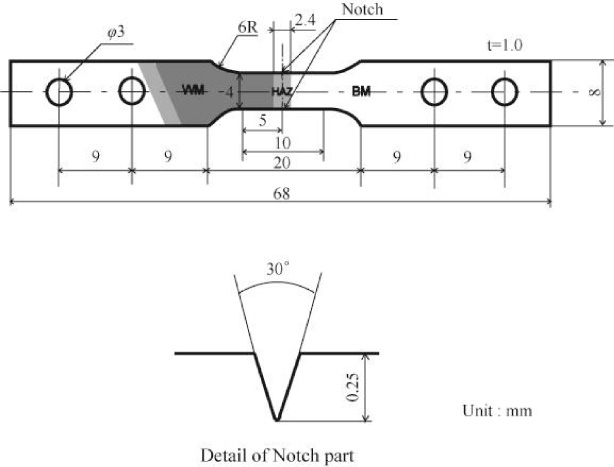
Geometry and size of a DEN specimen of weld joint.
Testing conditions
The machine system was designed and developed to enable automatic real-time observational experiments using a CCD microscope [22]. Using this apparatus, in situ observation of creep damage progression was conducted and the images of the damage region were quantified using a PC. The tests were conducted under high temperature vacuum conditions of 10−3 Pa and under applied load conditions, as described in Table 6. The creep damage region around the notch tip was found to be a dark region, composed of voids and micro-cracks originating along grain boundaries, as shown in previous results for SUS304 stainless steel [22,30]. The dark region is defined as a creep damage region owing to the following reasons.
The specimens were heated using Infrared (IR) rays under vacuum conditions, as shown in Fig. 3. Creep damage is caused by micro-cracking along a grain boundary, which is composed of voids at the grain boundary [22,30] that are considered to be caused by vacancy diffusion [21,27]. In the damage region, a specimen surface becomes irregular due to micro-cracking along a grain boundary. In this region, diffused reflection of light by xenon lamp was caused and it shows as the dark region. Under creep-fatigue conditions, when the effect of fatigue on crack growth increases, creep damage diminishes and fatigue cracks and plastic zone near the fatigue crack originate and they also can be observed by this testing system [22].
As a measure of deformation for a notched specimen, the concept of the Relative Notch Opening Displacement (RNOD, a representative value of deformation of a DEN specimen) [30] given by Eq. (1) was used.
The flowchart of the analysis is shown in Fig. 4. The detailed analysis procedure has been described in previous research [13,23,25]. The area of elastic plastic stress analysis by finite element method (FEM) and that of vacancy diffusion analysis by finite difference method (FDM), respectively are shown in Fig. 5. FDM analysis focused on the localized region around the notch tip. A two-dimensional elastic-plastic FEM analysis was conducted for a model of a DEN specimen, and the distribution of the hydrostatic stress, 𝜎 P , which is the driving force of vacancy diffusion, was obtained. Then, the values of hydrostatic stress calculated by the two-dimensional FEM analysis are interpolated to the grid for FDM analysis, and ∇𝜎 P and ∇2𝜎 P were obtained [13,25]. Finally, the vacancy diffusion and concentration analysis was conducted by FDM.
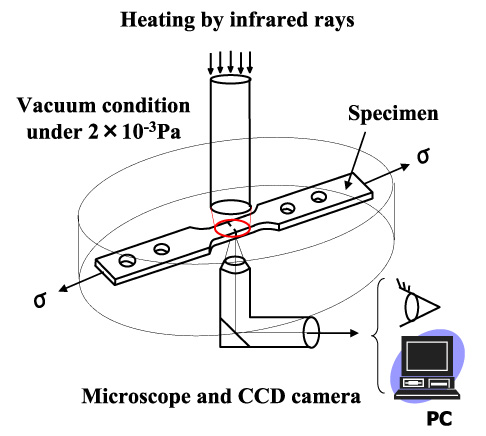
In situ observational creep and fatigue testing machine [22].

Flow of combined elastic plastic stress analysis with local stress induced vacancy diffusion.

Area of analysis by FEM and FDM.
The boundary conditions for conducting this analysis are shown in Fig. 6. The emission area of vacancies was set in the direction of 𝜃 = 45° at the notch tip as shown in Fig. 6, which corresponds to the experimental result of in situ observation [21,22].
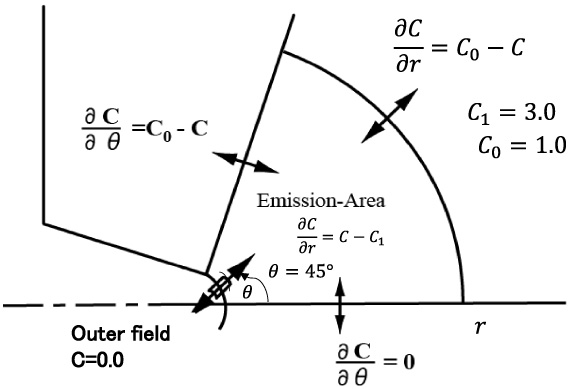
Boundary conditions of the numerical analysis of vacancy diffusion around a notch tip.
Hooke’s law was used to conduct the analysis in the elastic region given by Eq. (2). The characteristics of the work hardening of plastic deformation were approximated using Eq. (3), that is, the linear work-hardening constitutive equation
Based on 𝛼 multiplication concept [23,25], the basic equation of vacancy diffusion is given by Eq. (4)
In this analysis, the values of 𝛼1, 𝛼2, and 𝛼3 were set as 𝛼1 = 0.0025, 𝛼2 = 1.0, and 𝛼3 = 0.5, for the case of 600 °C, that is, the effect of the second term on the vacancy concentration was magnified, and 𝛼1 = 0.001, 𝛼2 = 0.1, and 𝛼3 = 0.05 was set for the case of 615 °C, that is, the second term on the vacancy concentration was diminished owing to the increase in temperature from 600 °C to 615 °C [21]. The physical meaning of 𝛼 i has been described in previous studies [24,25].
Equation (4) was converted into a non-dimensional equation using the non-dimensional values given by Eqs (5a) to (5c).
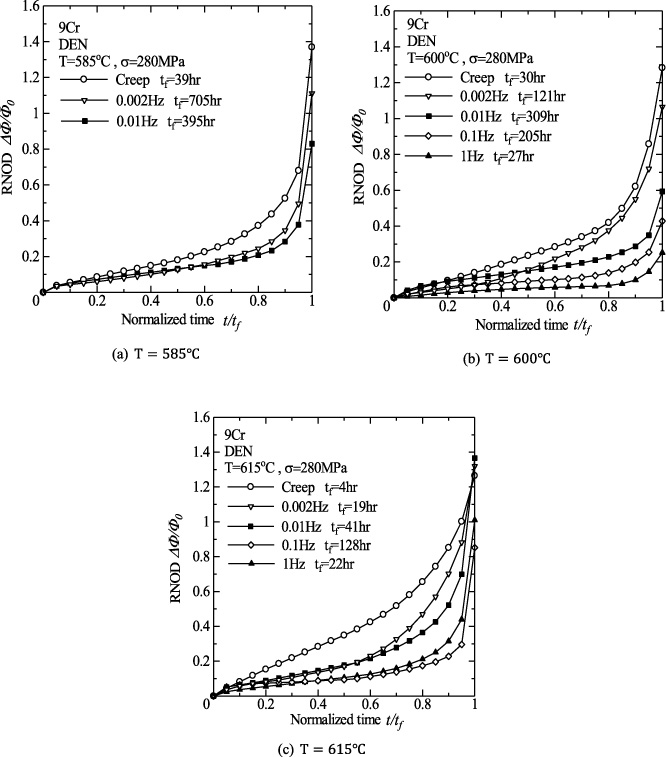
The relationship between RNOD and non-dimensional time for W-added 9Cr ferritic heat-resistant steel (P92 steel) under creep and fatigue conditions.
Substituting Eqs (5a)–(5c) into Eq. (4), the non-dimensional equation of vacancy migration is given by Eq. (6).
Deformation behavior under creep and fatigue conditions for the heat-resistant steel P92
The effects of the load frequency and temperature on the non-dimensional time sequential characteristics of the RNOD under creep and fatigue conditions are shown in Figs 7(a), (b), and (c). These results show that RNOD decreased with an increase in the load frequency. Therefore, RNOD was found to be suppressed under high-load frequency conditions. The effect of temperature on the non-dimensional time sequential characteristics of RNOD under the conditions of creep and fatigue (0.01 Hz) are shown in Figs 8(a) and (b). These results show that RNOD increased with an increase in temperature under creep and fatigue conditions.
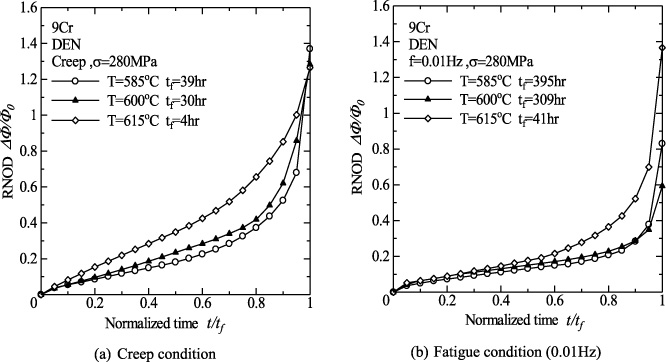
The effect of temperature on RNOD under creep and fatigue conditions. (0.01 Hz) for W-added 9Cr ferritic heat-resistant steel (P92 steel).
The time sequential behavior of damage progression around a notch tip and crack growth observed by the in situ observational testing machine under creep and fatigue conditions with a temperature of 615 °C is shown in Figs 9 and 10. These results show that damage under fatigue condition (1 Hz) localized around a notch tip compared to that under creep conditions as shown in these figures. Furthermore, under the fatigue condition (1 Hz), a crack originated from the upper notch and linked with that of the lower notch and propagated in the damaged region, which is in contrast to that under creep conditions.

The time sequential behavior of damage formation around a notch tip under creep condition of 615 °C and 280 MPa for W-added 9Cr ferritic heat-resistant steel P92.
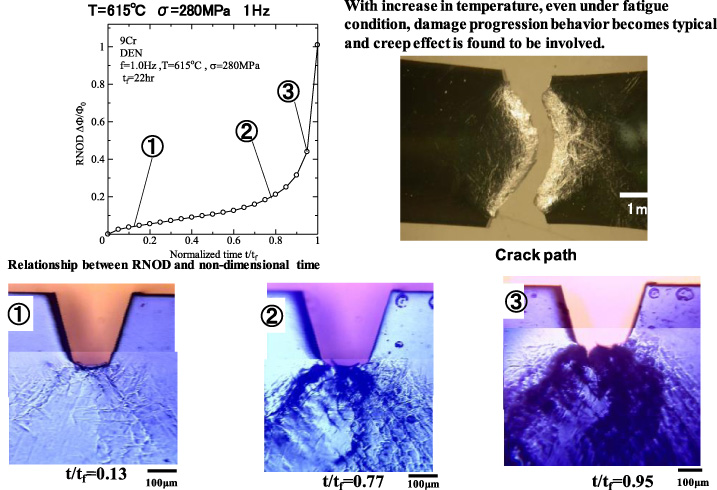
The time sequential behavior of damage formation around a notch tip under fatigue condition of 615 °C, 1 Hz and 280 MPa for W-added 9Cr ferritic heat-resistant steel P92.
The effect of load frequency on the time sequential behavior of damage progression around a notch tip is shown in Figs 11, 12 and 13 under the temperature condition of 600 °C. These results show that with an increase in load frequency under fatigue conditions, the damage localized around the crack tip, and damage formation behavior was suppressed. Furthermore, a straight brittle crack originated form the notch tip and was linked to both the upper and lower notches. This behavior is more pronounced with a decrease in temperature, as shown in Figs 10 and 13.
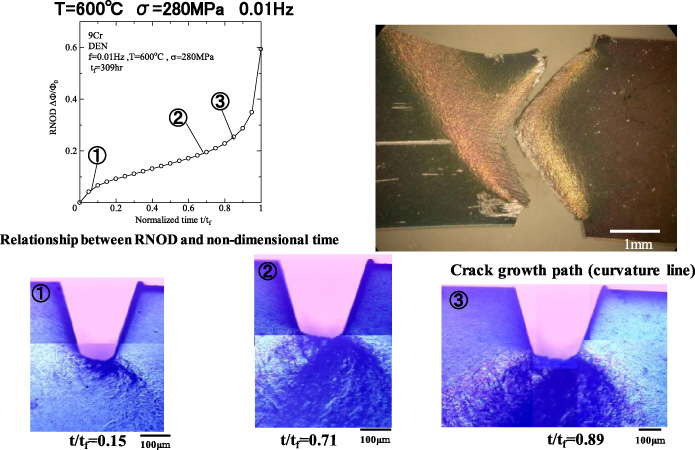
The time sequential behavior of damage formation around a notch tip under fatigue condition of 600 °C, 0.01 Hz and 280 MPa for W-added 9Cr ferritic heat-resistant steel (P92 steel).

The time sequential behavior of damage formation around a notch tip under fatigue condition of 600 °C, 0.1 Hz and 280 MPa for W-added 9Cr ferritic heat-resistant steel (P92 steel).
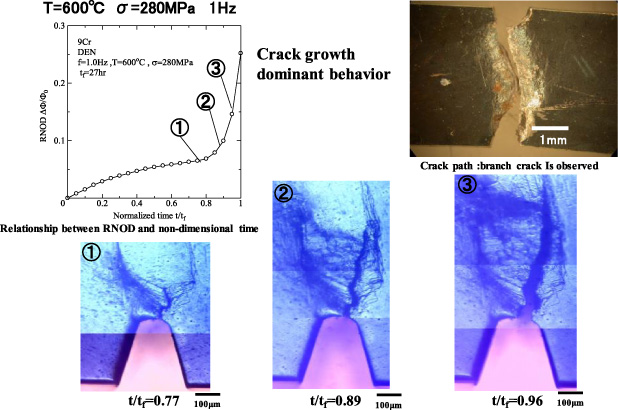
The time sequential behavior of damage formation around a notch tip under fatigue condition of 600 °C, 1 Hz and 280 MPa for W-added 9Cr ferritic heat-resistant steel (P92 steel).
The effect of load frequency and temperature on damage progression behavior
As mentioned in the section on the experimental method, in the damage region, micro-cracks and voids originated under creep or fatigue under low-frequency conditions. The plastic region originated under fatigue under high-frequency conditions, which resulted in a convexo-concave surface in both cases. In such cases, diffused reflection of light by the heater is caused, which results in the dark region forming as a damage region [22,30]. This behavior was also observed for this material, and they were quantitatively measured as damage areas as shown in Fig. 14. On the basis of this method, the time sequential characteristics of the damage progression area under creep and fatigue conditions were quantitatively measured and compared with those of the RNOD.
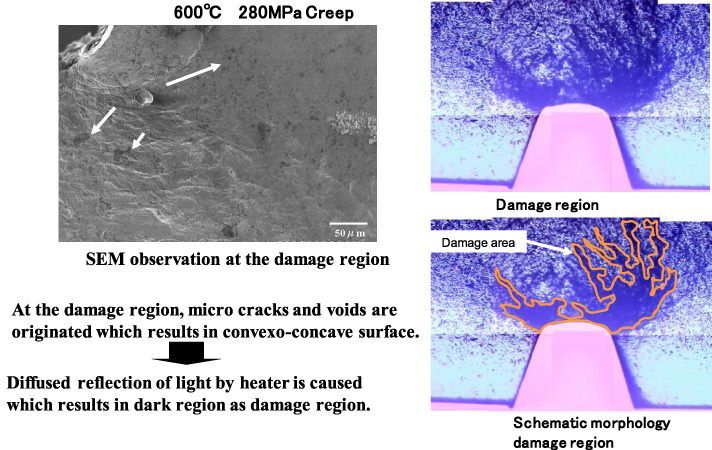
Quantitative estimation method of damage area originated around a notch tip.
The effect of load frequency on the time sequential characteristics of damage progression behavior originating around the notch tip is shown in Figs 15(a), (b), and (c) under creep and fatigue conditions at temperatures of 585, 600 and 615 °C, respectively. These results indicate that under high load frequency conditions, damage formation behavior was suppressed compared to that under creep conditions. Furthermore, with a decrease in temperature, damage formation behavior under creep was found to typically decrease compared to that under fatigue conditions.

The relationship between damage progression area and non-dimensional time for under various load frequency and creep for P92 steel.
The effect of temperature on the time sequential characteristics of damage progression behavior originating around the notch tip is shown in Figs 16(a) and (b) under creep and fatigue conditions, respectively. These results show that with an increase in temperature, the damage progression behavior becomes typical under both creep and fatigue conditions. Moreover, this behavior is qualitatively similar to that of the RNOD as shown in Fig. 8.
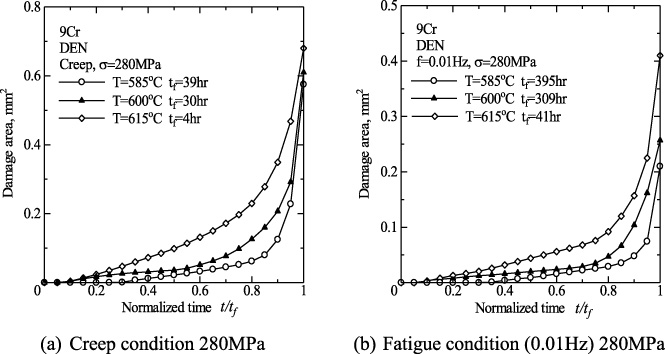
The relationship between damage progression area and non-dimensional time for P92 steel.
The effect of load frequency including creep on the relationship between the damage progression area and the RNOD are shown in Figs 17 (a), (b), and (c) under creep and fatigue conditions at temperatures of 585 °C, 600 °C and 615 °C, respectively.
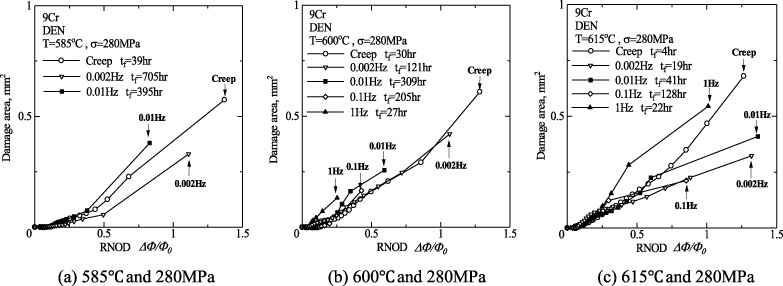
The relationship between damage progression area and the RNOD (creep deformation) for P92 steel.
As evident, linear correlations between the damage progression area and the RNOD were observed under the temperature conditions of 585 °C and 600 °C, in contrast, minimal data scattering was observed at 615 °C.
Thus, from these results, the progression behavior of damage area was found to correlate well with the RNOD. This result show that the RNOD is a representative indicator of the accumulation of plastic deformation and damage arising due to both fatigue and creep.
The time sequential behavior of damage progression around a notch tip under creep conditions for the case of the weld joint is shown in Fig. 18. These results showed that creep damage was suppressed compared to that for base metal and the fracture path linked with both the upper and lower notches in contrast to that for base metals, as shown in Figs 9 and 18. The comparison of the time sequential behavior of the damage progression area and that of RNOD of the base metal with that of the weld joint is shown in Figs 19(a) and (b), respectively. Furthermore, the relationship between the damage progression area and RNOD is shown in Fig. 20 for the base metal and the weld joint. From these results, the damage progression behavior was found to be typically suppressed for the weld joint compared to that for the base metal, however a good correlation exists between the damage progression area and the RNOD.
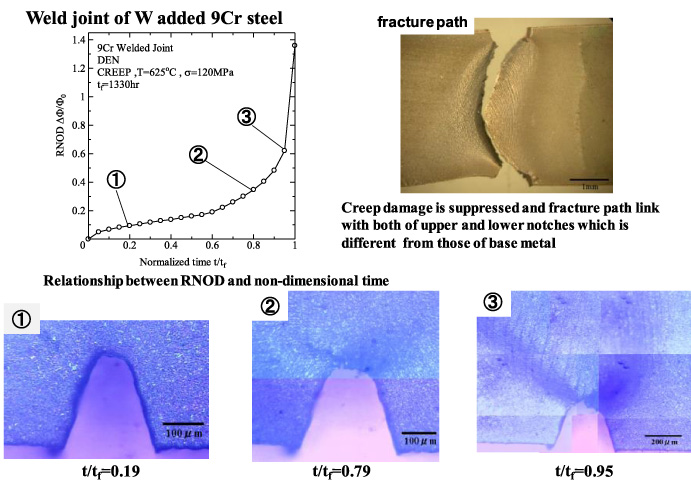
The time sequential behavior of damage progression around a notch tip under creep condition for the case of weld joint.
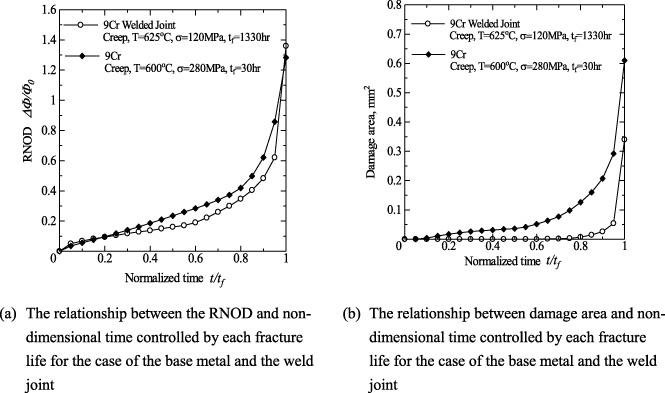
The comparison of the time sequential behavior of damage progression area and that of the RNOD of the base metal with those for the weld joint respectively.

The relationship between damage progression area and the RNOD of the base metal and the weld joint for P92 steel.
The time sequential behavior of damage progression around a notch tip under creep conditions for Cr-Mo-V steel is shown in Fig. 21. These results show that creep damage originated and progressed in the direction of the maximum shearing stress. A crack growth occurred in this damage region was linked to both the upper and lower notches.
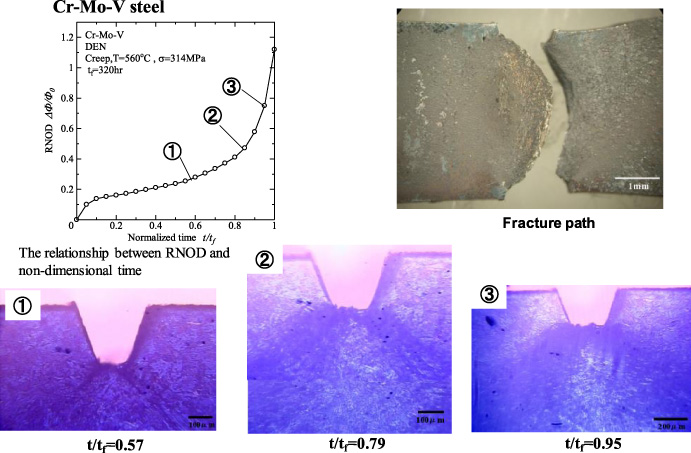
The time sequential behavior of damage progression around a notch tip under creep condition for Cr-Mo-V steel.
A comparison of the time sequential behavior of the damage progression area and that of RNOD for Cr-Mo-V steel with that for 9Cr ferritic heat-resistant steel (P92 steel) is shown in Figs 22(a) and (b), respectively. Furthermore, the relationship between the damage progression area and RNOD is shown in Fig. 23 for these materials. From these results, the damage areas of the last half of the creep life for Cr-Mo-V steel were found to be larger than that for 9Cr ferritic heat-resistant steel P92, as shown in Figs 22(a) and (b). However, a good correlation of the damage area with RNOD exists for both of these materials, the damage area for Cr-Mo-V steel was found to be larger than that of ferritic heat-resistant steel P92, as shown in Figs 23, which resulted in a creep ductile material.
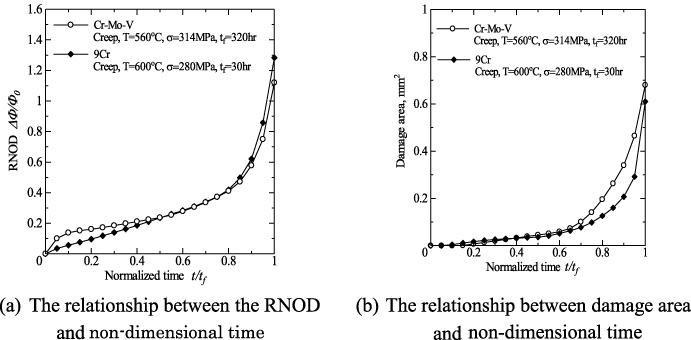
The comparison of the time sequential behavior of damage progression area and that of the RNOD for Cr-Mo-V steel with those for 9Cr ferritic heat-resistant steel (P92 steel).
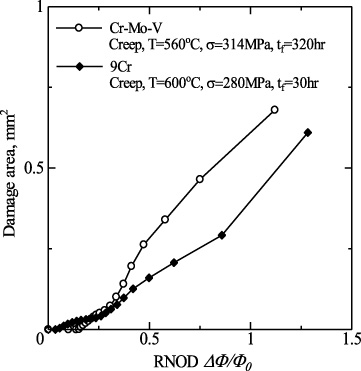
The relationship between damage area and the RNOD.
Deformation and damage progression behavior under creep and fatigue conditions
As mentioned in Sections 5.1 and 5.2, with a decrease in temperature and an increase in load frequency, RNOD, which is the representative indicator of the accumulation of plastic deformation and damage arising due to both fatigue and creep around a notch tip, was suppressed. In particular, damage area was localized, and crack growth became dominant. This implies that the transition from the creep-dominant to the fatigue- dominant mechanisms was found to occur with a decrease in temperature and an increase in load frequency.
Previously, concerning the characteristics of the load frequency of crack growth life under creep and fatigue conditions, with an increase in load frequency, nonlinear transition behavior from creep-dominant to fatigue-dominant mechanism was found to be caused [26,29]. Moreover, in this study, the results of quantitative estimation of the time sequential characteristics of damage progression indicated a good correlation between the damage progression area around a notch tip and RNOD under creep and fatigue conditions, which is closely related to the fracture life. Thus, the results indicate that the damage progression behavior originating around a notch tip can be considered to be closely related to the crack growth life under creep and fatigue conditions.
The effect of temperature on creep damage progression behavior
With a decrease in temperature, damage formation behavior under creep was found to typically decrease compared with that under fatigue conditions, as mentioned in Section 5.3.1. The dominating factor in creep damage is considered to be vacancy diffusion mechanism [21]. Therefore, it is considered to be sensitive to the temperature compared to the mechanism of plastic deformation, which dominates fatigue failure. The effect of temperature on vacancy diffusion around a notch tip is discussed in Section 7 to make sure whether this vacancy diffusion mechanism dominates creep fracture for P92 steel under the creep condition.
Quantitative estimation of the time sequential characteristics of damage progression
From the quantitative estimation of the time sequential characteristics of damage progression around a notch tip, the progression behavior of damage area was found to correlate well with RNOD, that is, the representative indicator of the accumulation of plastic deformation and damage arising due to both fatigue and creep. These results showed that damage progression under creep and fatigue conditions, which is mesoscale behavior, was closely connected with deformation, which is a macroscale behavior.
Damage progression and crack growth behavior under creep and fatigue conditions for the case of weld joint of W-added 9Cr steel P92
Creep damage for a weld joint specimen was found to be suppressed as compared to that for the base metal, as shown in Section 5.4.. The reason for the suppression of damage progression for the weld joint will be the high local stress multi-axiality of a weld joint,
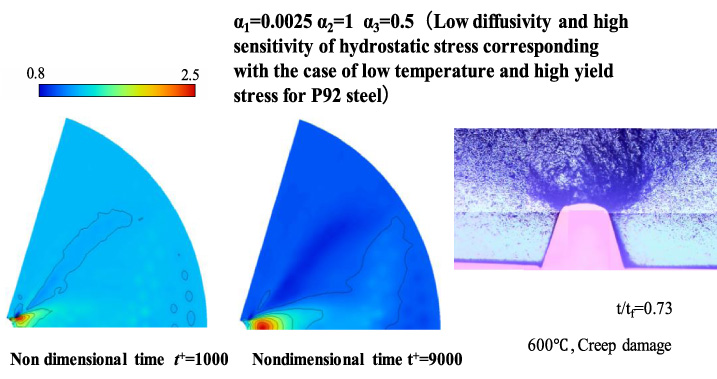
Distribution of vacancy concentration behavior around a notch tip for the case of low diffusivity and high sensitivity of hydrostatic stress for vacancy.
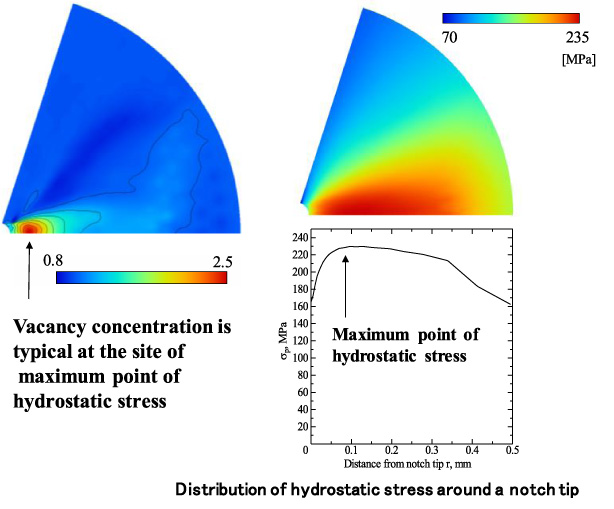
Distribution of vacancy concentration and hydrostatic stress.
On the basis of the method of analysis described in Section 4, analyses of vacancy diffusion behavior around a notch tip were conducted. The distribution of vacancy concentration around a notch tip for the case of low diffusivity and high sensitivity of hydrostatic stress of vacancy is shown in Fig. 24, which corresponds to the case of low temperature and high yield stress for P92 steel. This indicates that vacancy concentration behavior is typically in the notch tip direction owing to the effect of the hydrostatic stress gradient magnified by 𝛼2. In other words, the vacancies localize at the site of maximum hydrostatic stress as shown in Fig. 25. Furthermore, creep damage observed experimentally was also found to correlate well with the localized region of the vacancy concentration. In contrast, the distribution of vacancy concentration around a notch tip for the case of high diffusivity and low sensitivity of the hydrostatic stress of the vacancy shown in Fig. 26 corresponds to the case of high temperature and low yield stress for P92 steel.
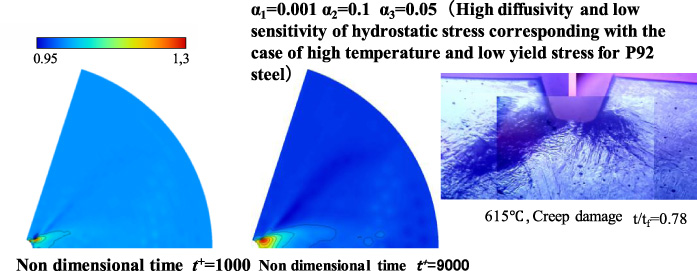
Distribution of vacancy concentration behavior around a notch tip for the case of high diffusivity and low sensitivity of hydrostatic stress for vacancy.
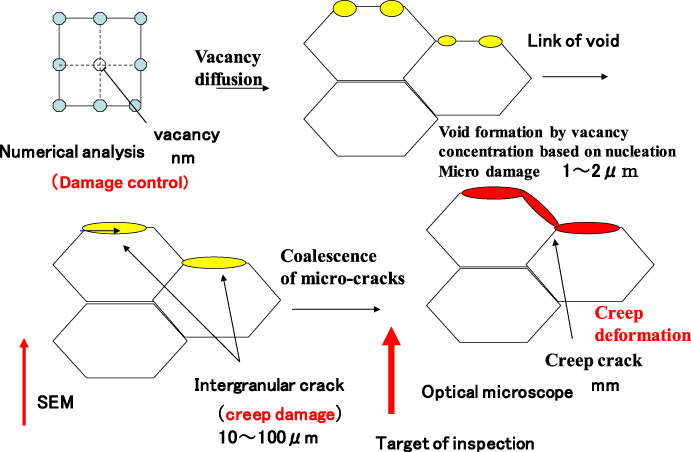
Relationship among creep damage on various scales.
Thus these results indicate that vacancy diffusion in the direction of shearing stress from the notch tip is caused by the effect of the decrease in the hydrostatic stress gradient diminished by 𝛼2 and magnified by 𝛼1 and vacancies do not localize around the notch tip. In addition, the creep damage observed experimentally was also found not to localize around the notch tip but rather disperse, which is in good agreement with the vacancy diffusion behavior obtained by this analysis. Therefore, vacancy diffusion and concentration behavior at the nanoscale was found to be closely linked with creep damage composed of voids and micro-cracks at a grain boundary with mesoscale, which results in creep deformation at the macroscale. These processes are summarized in Fig. 27 [20].
Using a notched specimen of W-added 9Cr steel, creep and fatigue tests were conducted, and the relationship between the damage progression behavior and relative notch displacement (RNOD) was investigated. Furthermore, the analysis of local stress-induced vacancy diffusion around a notch tip was conducted, and the results obtained were related to the creep damage progression behavior around the notch tip.
The following conclusions were obtained: Damage progression behavior under creep and fatigue conditions such as void formation, grain boundary micro-crack origination, plastic region, and a crack were found to correlate well with macroscopic deformation i.e. RNOD (relative notch opening displacement). It was dominated by the load frequency, temperature, and local stress multi-axiality. Moreover, under high-load frequency conditions, the linear crack growth mechanism becomes dominant. Consequently, RNOD is considered to be a representative indicator of the accumulation of plastic deformation and damage arising due to both fatigue and creep. From the viewpoint of damage progression behavior, a clear transition from the creep-dominant to the fatigue-dominant mechanism was found to occur with a decrease in temperature and an increase in load frequency, which dominates crack growth life. Vacancy diffusion and concentration behavior around a notch tip was found to be a dominant factor in the origination of creep damage composed of voids and micro grain boundary cracks. Furthermore, creep damage is a dominant factor in creep deformation. Therefore, vacancy diffusion and concentration behavior at the nanoscale was found to be closely linked with creep damage composed of voids and micro-cracks at a grain boundary at the mesoscale, which resulted in creep deformation at the macroscale.
Footnotes
Acknowledgement
Parts of this work were supported by the Council for Science, Technology and Innovation (CSTI), Cross-ministerial Strategic Innovation Promotion Program (SIP), “Materials Integration for revolutionary design system of structural materials” (Funding agency: JST).
Conflict of interest
None to report.