



Abstract
INTRODUCTION:
Hearing impaired people are prone to preventable health problems due to communication barriers that hinder their access to healthcare services and education. ICTs become educational tools that, implemented in prevention and health promotion programs for this population, improve their access to information.
OBJECTIVE:
To determine the level of knowledge on social hand hygiene before and after the implementation of a virtual learning object in 14 hearing impaired students of a school in Bogotá.
METHODS:
A quasi-experimental, pretest-posttest study was conducted on an intervention performed using a social hand hygiene virtual learning object (VLO).
RESULTS:
A significant difference was observed when comparing the pretest-posttest results, being that, in the post-application test of the VLO, the population learned the importance of hand hygiene to avoid preventable infectious diseases.
CONCLUSIONS:
The implementation of a VLO for social hand hygiene in the population with hearing impairment allowed the learning of the subject, which improved the daily practices of hand hygiene and reduced the risk of contracting preventable diseases, compared with the pretest.
Keywords
Introduction
Disability refers to the limitations that hinder the execution of daily life actions and tasks, which are reflected in body function and limit the interaction with the social environment [1]. One of the most common types of disability is hearing loss, which, according to Colombian law, involves a person who does not have sufficient hearing and in some cases cannot sustain natural communication and socialization. This law classifies this type of population into: deaf, deaf signer, deaf speaker, semi-lingual deaf, monolingual deaf and bilingual deaf [2]; it also establishes sign language as the natural language of this community, which has grammar, syntax and vocabulary like any other oral language, and can be represented in a visual, gestural and spatial way [2, 3].
According to a WHO World Report on Disability [4], people with hearing impairment are more prone to develop preventable health problems such as acute diarrheal diseases, pneumonia, skin diseases, eye diseases and intestinal parasitism due to communication barriers to access health and education services, their socioeconomic level, lack of access to drinking water, limited access to basic hygiene elements and educational programs that promote self-care attitudes [4, 5, 6]. Thus, identifying the sociodemographic characteristics of deaf people, as well as their life cycle is fundamental, particularly in the case of children, preadolescents, adolescents and young people who, regardless of their age and considering their special disability characteristics, require family and social support that gives them equal opportunities and inclusion to society in a natural way [4].
Thinking about the population previously described, it was necessary to design a computer tool based on ICTs that allowed transmitting health education on hand hygiene; this has been used worldwide as a high-impact, economic and simple strategy for the prevention of communicable diseases and for improving people’s quality of life. The tool was implemented in four moments: after going to the bathroom, when handling and preparing food, before eating and after being in contact with contaminated elements or handling garbage or other waste objects [7, 8]. It should be mentioned that this goes hand in hand with access to drinking water, adequate sanitation systems and other components linked to basic sanitation services [9].
Taking into account that the topic of hand hygiene is part of health prevention and promotion programs, health professionals should have knowledge about the subject in order to promote it among patients. In this way, the researchers generated this initiative thanks to their training as surgical assistants or operating room nurses [10], who receive at university training on the management and leadership of aseptic techniques and biosecurity in surgical procedures, and in the promote health guidelines to the community. For this reason the researchers designed a virtual learning object (VLO) for social hand hygiene for the deaf population; this is a tangible and broad solution to access this type of population with a promotion and prevention program on hand hygiene, as it had special teaching and learning characteristics that allowed the transmission of information, facilitated the learning process and allowed the cognitive assessment of students with hearing impairment who were enrolled in a school of the city of Bogotá.
Materials and methods
Design
A quasi-experimental study was carried out using a pretest-posttest design, in order to obtain measures before and after an intervention performed with a VLO on social hand hygiene. The study was made in high-school students with hearing impairment who were enrolled in a specialized school for this type of population in Bogotá. Participants previously knew and authorized their inclusion in the project.
Population
The population participating in the study included 14 people, 50% males (
Instruments
A pretest and posttest questionnaire, which consisted of 14 questions, was designed to assess the knowledge of the study population on social hand hygiene.
Assessment of pretest and posttest knowledge on hand washing. Source: Own elaboration.
Pretest
A questionnaire was designed and applied to the 14 participants, in order to make a prior diagnosis of their knowledge level on social hand hygiene. After the application of the questionnaire, the students were directly observed while they washed their hands in the way they already knew.
Intervention
A VLO was applied to the 14 participants of a school for hearing impaired. This VLO was designed with the support of a virtualization unit of the Fundación Universitaria de Ciencias de la Salud (FUCS), which was based on the ADDI model (Analysis, Design, Development, Implementation). The VLO consisted of four modules built and theoretically based on the international guidelines established by the WHO on social hand hygiene. Prior to its application, three experts validated the VLO in terms of relevance, theoretical content and applicability of the object. The first expert was a designer who validated the design of the VLO; the second was a surgical assistant who evaluated the subject and the content; and the third was a Colombian sign language interpreter, authorized by the National Federation of the Deaf of Colombia (FENASCOL), who evaluated the interpretation of sign language.
Posttest
The same pretest questionnaire was applied to the 14 participants, in order to determine the appropriation of the topic of hand hygiene from the implementation of the VLO.
Ethical considerations
This study does not present any conflict of interest neither by the authors nor by the institution where it was carried out. The human research ethics committee of Hospital de San José-FUCS determined that it was not necessary to include an informed consent, since this was a hand hygiene promotion and disease prevention campaign.
Sociodemographic characteristics of the study population
Sociodemographic characteristics of the study population
*SD: Standard deviation; Sources: Own elaboration.
Pretest and posttest perception of the hand hygiene infrastructure of the school. Source: Own elaboration.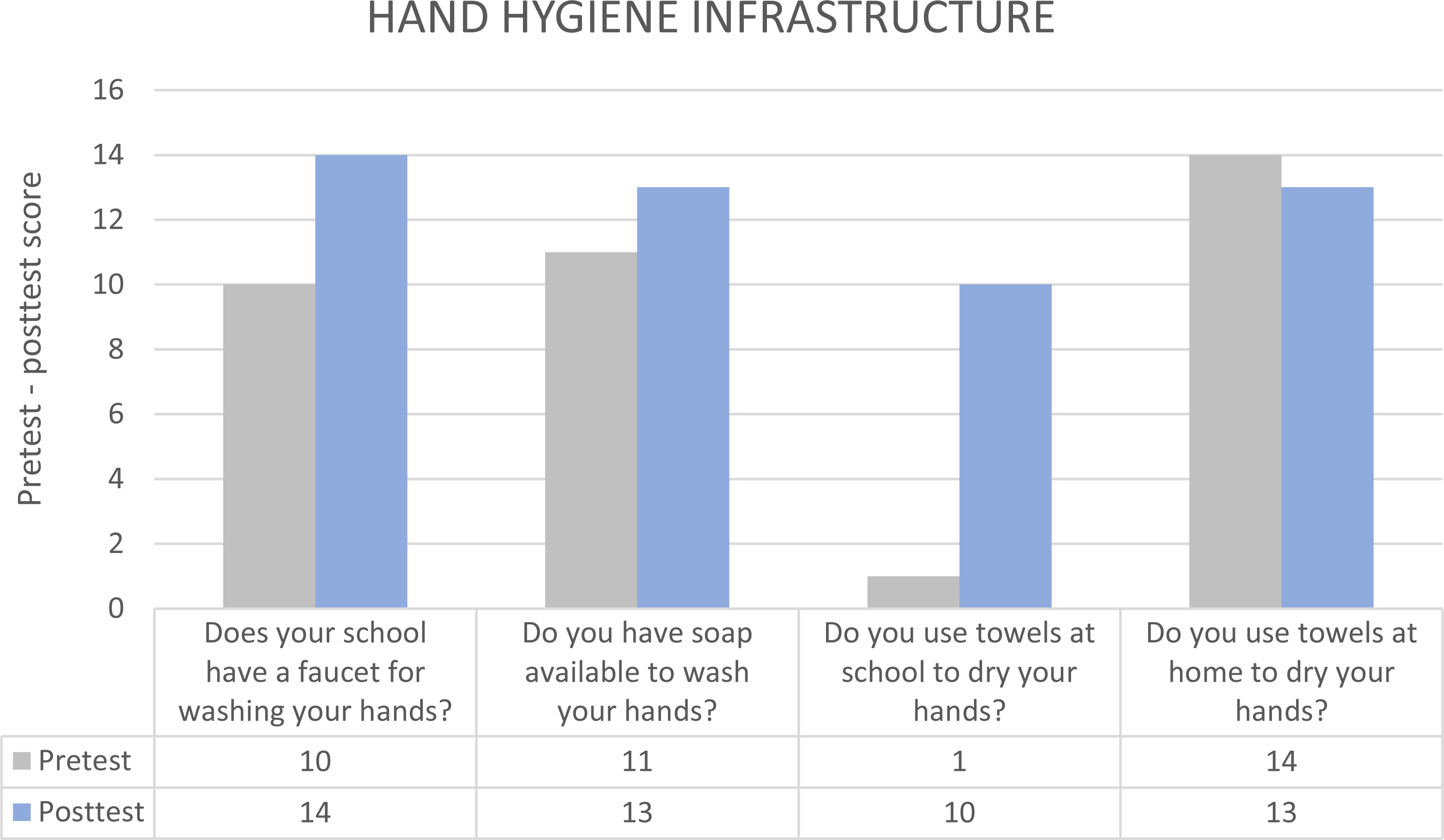
Pre-test and post-test hygiene and health behaviors assessment. Source: Own elaboration.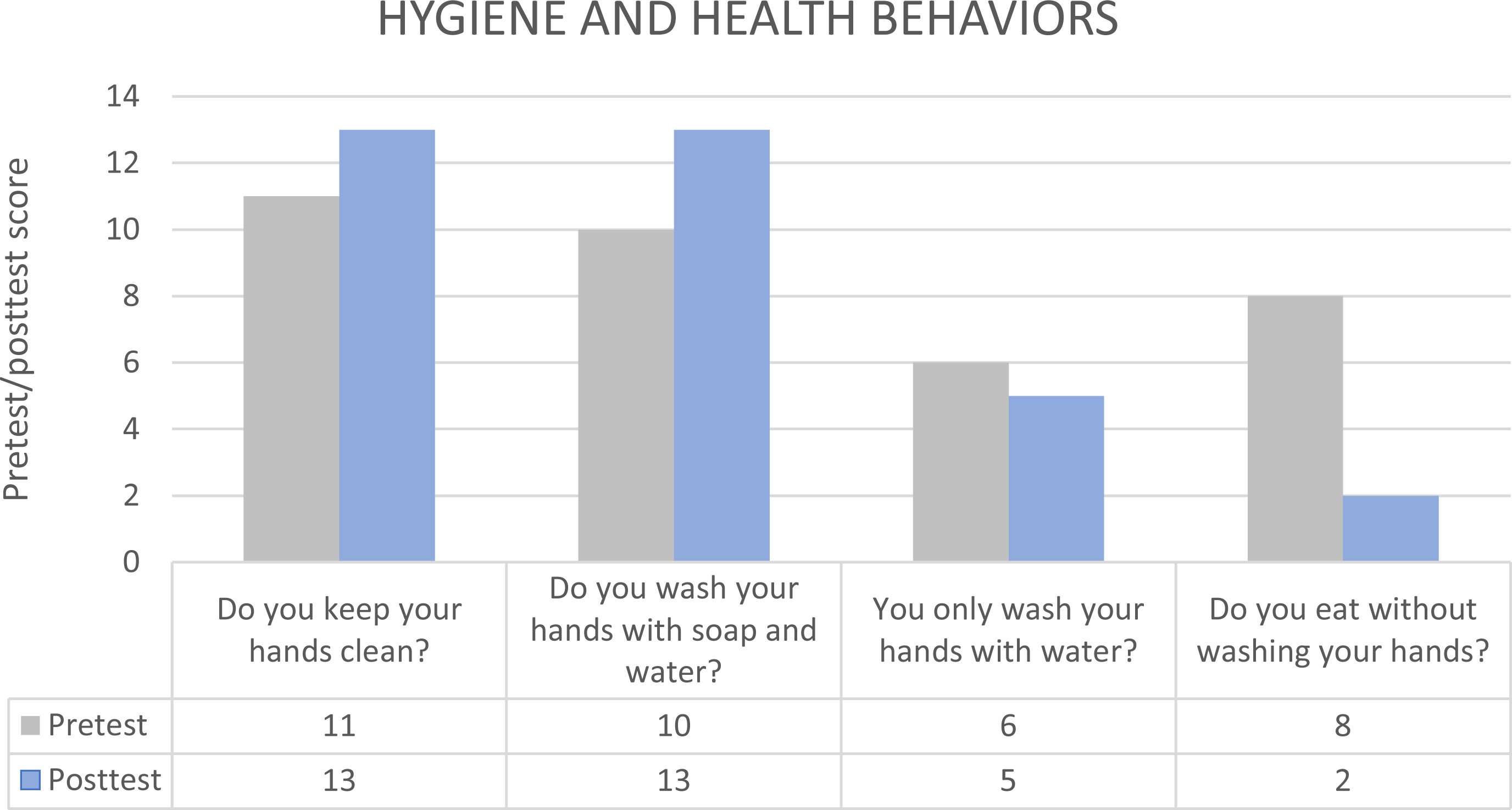
The sociodemographic description of the participants of this study, indicates that most people are from the lowest socioeconomic levels, with 42.8% (
Regarding the knowledge on hand hygiene evaluated in the study population before and after the implementation of the VLO, a significant difference of the posttest with respect to the pretest was found, since the population with hearing disability was able to consolidate the knowledge and understand the importance of hand washing to prevent diseases after knowing the steps, time and moments when hand hygiene should be performed, as shown in Fig. 1.
With regard to hand hygiene infrastructure, in the pretest, the school where the VLO was applied did not have the minimum infrastructure to perform adequate hand washing, therefore, the researchers provided implements, such as soap and towels, to carry out the practical with the participants; in this way, improved the perception of the population studied in the posttest, as shown in Fig. 2.
When evaluating participants’ hygiene and health behaviors, an improvement was observed in the post-test, as shown in Fig. 3.
Discussion
This is consistent with the reports of the Colombian Ministry of Health [11], where morbidity of ear pathologies, hearing and communication disorders are related to low socioeconomic and educational levels countrywide, since these conditions are related to social determinants that generate barriers to access healthcare services, from pregnancy to early childhood, and education services, thus leading to unhealthy lifestyles.
Regarding the type of disability, 71.4% (
When evaluating knowledge on hand washing in the pretest and posttest, an improvement of post-intervention knowledge was identified. This is in line with Díaz and Gallego [13, 14, 15, 16, 17], who state that information and communication technologies implemented in the education of hearing impaired populations facilitate communication and interaction by stimulating visual, oral and written expressions, which leads to an improvement of the quality of life and teaching-learning processes in this population. Similarly, Molano [18] and Samaniego [19] express that promoting the use of ICTs in the population with disabilities promotes access to information and educational, labor and social inclusion. On the other hand, there are studies that indicate the importance of identifying the type of disability to design the VLO according to the needs of the population [20, 21, 22, 23]. In agreement with said study, the researchers took into account not only the results of the pretest but also the characteristics of the disability of the study population to design the intervention with a hand hygiene VLO.
With respect to the results of the infrastructure that the school had, in terms of the basic elements to perform hand washing, the necessary resources for the population to develop this activity were not available. However, a change in students’ perception of the infrastructure was observed, since the researchers provided the necessary materials to perform the hand washing practice. A hand hygiene VLO was designed based on the characteristics of the population that was intervened, obtaining a significant difference in the posttest versus the pretest values regarding the behaviors and daily practices of social hand washing. According to Molina and Cuevas [24], ICTs designed for the learning process of people with disabilities have accessibility, reusability, content and teaching characteristics and become a tool for learning and inclusion in health education in this population.
Conclusion
The implementation of a VLO facilitates the presentation of a specific topic to a specific population; therefore, the project sought to conduct an experimental, pretest-posttest study of an intervention based on a hand hygiene VLO designed for a population with hearing impairment. For this reason, the understanding of the concepts was easier for the participants, since it had different tools designed to transmit the information in a pedagogical and direct way. The VLO generated a significant change in the posttest with respect to the pretest in the student population with hearing impairment of a school in Bogotá, as it improved their daily practices of hand hygiene.
By identifying that the infrastructure of the school where the project was developed did not have basic elements of hygiene, it is possible to expose the difficulties that this type of institution has in offering the essential conditions for implementing good hand hygiene practices that would improve the health of this population. Accordingly, the socialization of these results is the starting point for government agencies or other instances to support low income institutions and improve the conditions for the hearing impaired population to acquire better hand hygiene habits.
It is recommended that these results are taken into account in order to recognize the vulnerable populations in which a health education contribution can be made using ICTs, designed according to the characteristics of each social group. It is also suggested to expand the study with a greater number of people with hearing impairment or other disabilities, in order to disseminate social hand hygiene practices within the inclusive training of these individuals.
Footnotes
Acknowledgments
This study was conducted by the Research Division and the Surgical Assistant School of the Fundación Universitaria de Ciencias de la Salud. The authors would like to thank the school staff for approving the study and to the interpreter for facilitating communication with the study population.
Conflict of interest
None to report.