



Abstract
BACKGROUND:
Falls when using wheelchairs can have serious consequences for users.
OBJECTIVE:
The aim of this study was to investigate wheelchair types, daily movement and environmental factors associated with concerns about falls among wheelchair users.
METHODS:
Fifty-two wheelchair users (36 male and 16 female, mean age of 44.3
RESULTS:
It was found that the highest levels of concern about falling when using wheelchairs were associated with the use of rigid frame wheelchairs; and with activities such as moving on sidewalks and ramps. Half of the sample reported that they did not receive training on wheelchair usage and had concerns about performing wheelie maneuvers. Reported falls caused by wheelchair failure were associated with increased concerns about falls.
CONCLUSIONS:
The findings of this study suggest that wheelchair type, daily movements and environments all influence wheelchair users’ concerns about falls.
Introduction
By analyzing data about falls in different countries it is possible to argue that it is a public health issue. Falls are a frequent event among the elderly in Brazil [1]. Between 1996 and 2012, the mortality rates of the elderly due to falls increased in all regions of the country. This data points to the importance of monitoring these accidents to assist the planning of technological and human resources to prevent falls [2]. In Canada, falls cost 2 billion dollars per year [3]. Most injuries in Canada occur among the elderly, who are a growing population in the country [3]. Falls can cause complications for public health as a result of injuries [3].
There may be a relationship between the prevalence of falls and the need for assistance for locomotion among the elderly [1]. Falls from wheelchairs are recognized as a concern factor for individuals’ health [4]. Falls during wheelchair use may be influenced by the characteristics of users [7, 4, 8], wheelchair stability [9, 8, 10, 11] and environmental accessibility issues [12, 13, 11]. Chen [9] found that 87.8% of the daily accidents involving wheelchair users (WUs) in three years of study were tumbles or falls. Some causal actions of falls from wheelchairs are moving up or down a slope, transfers, propulsion, front wheel breakage, rocks, potholes, wheel component breakage, fainting and loss of balance [14].
Kittel [5] investigated factors associated with wheel-chair abandonment and dissatisfaction and identified some of them as being lack of experience in use and selection of wheelchairs, and limitations in wheelchair design (inappropriate size and weight). These factors were related to limitations in wheelchair use in daily activities [5]. Medola et al. [6] found low level of satisfaction with the aspects of comfort, mobility, access outside the home and appearance of wheelchairs. The authors pointed out that satisfaction may be influenced by the environment: indoor home environments were associated with higher level of satisfaction than outdoor ones [6].
More effective solutions to improve wheelchair design require the collaboration of users, clinicians, designers and other professionals [16]. Some assistive technologies available in the market are still perceived to be ineffective, especially in supporting transfers between the wheelchair and other surfaces [16]. Transfers are one of the most challenging tasks for WUs [16] and this movement often results in accidents [8, 11, 12]. To be independent in transfer maneuvers is important as it affects the personal, social, and self-image of the WU [16].
A fall can have varied physical and psychosocial factors and consequences. It is important to understand the contexts of falls, beyond hospitalization data. Understanding factors involved in the concern about falls can help provide more confidence for WUs during their daily mobility. The assistive device used, the daily movements, routines and users’ perceptions of this context should also be considered.
Fall experiences are still common in the daily lives of WUs and cause injuries. However, little is known about how wheelchair type, daily movements and environment influence users’ concerns about falls.
The aim of this study was to discuss the relationship between users’ concerns about falls and wheelchair type, daily movements and environmental factors. This knowledge can improve interventions – from an interdisciplinary perspective – to reduce falls and improve WUs’ confidence in using their wheelchairs. Future interventions based on this study can involve rehabilitation, wheelchair design and environments.
Materials and methods
Participants
This study had a convenience sample with 52 participants, from different Brazilian regions, users of manual or powered wheelchairs. The inclusion criteria were: individuals over 18 years of age, literate, that make use of a manual or powered wheelchair as their main means of mobility, with no cognitive impairment and being able to answer the questionnaire by phone call. The criteria were verified by verbal questioning. Exclusion criteria were temporary use of a wheelchair, not having access to the online tools necessary for the study procedures and the phone call.
Data collection
An interview-based approach was applied in this investigation, with questions addressing the users’ concern of falling during the use of their wheelchairs in daily routine, based on theoretical background [11, 19, 20]. The questions addressed three main factors associated with the falls: wheelchair characteristics, users’ movements environment factors. We asked participants about their concerns about falls while using the wheelchair they use most during a typical day. We also asked whether the user had a single fall or more than one in all their years of using a wheelchair. For those who responded that they already had one or more fall, we asked to describe one memorable fall and the perceived consequences of it.
The participants were contacted individually by phone call. We started data collection with WUs volunteers, some of whom had already participated in previous studies at The Ergonomics and Interfaces Laboratory (LEI) and Specialized Rehabilitation Center (CER) at São Paulo State University (UNESP). The snowball method was used to find more participants. This method is recommended to collect a sample of a population where access is difficult [18]. We asked each participant if they knew someone who also fit our inclusion criteria and would be interested in participating.
General description of the sample (
52)
General description of the sample (
The interviews were conducted between November and December 2021 by phone call, due to the ongoing COVID-19 pandemic. The responses were recorded and archived by the researcher. Participants were also asked to take and send pictures of their own wheelchairs, to allow the researchers to check the wheelchair type and characteristics.
The independent variables were: wheelchair type (rigid frame, foldable frame and powered). These variables were subjected to descriptive analysis considering the values of mean and standard deviation. The dependent variables were concern about falls related to the wheelchair, movement and the environment (in Likert scale). Users’ perceptions about their most memorable fall and the main causal factor were also a dependent variable. The main factor involved in the fall could be: 1) a failure, breakage or unsuitability of the wheelchair; 2) an unwanted/unexpected interaction with the environment – ramp, uneven floor or obstacle); 3) the user’s own movement, such as transferring or doing a wheelie.
When analyzing different movements during daily routine and their concerns about falls, the movements were considered as repeated measures, as they form part of the collection of the same sample unit, but in different situations, characterizing the application of an ANOVA of repeated measures. For two unpaired variables, such as the wheelchair type and a nominal qualitative variable, as in the case of falling direction, a chi-square test was applied. Statistical analysis was carried out with JASP (0.16). The level of statistical significance used was
Results
Users’ and wheelchair characteristics
From the total sample (
Main characteristics of respondents according to their wheelchair type
Main characteristics of respondents according to their wheelchair type
Percentage of users who perform daily movements and who are concerned about falls.
When it comes to the wheelchair type, the majority (75%) of the participants used manual devices (28.9% foldable frame and 46.2% rigid frame), while 25% used a powered wheelchair as the main means of mobility. It was verified that there were differences between the types of wheelchairs used, such as WUs mass. Powered WU had the lowest average weight (67 kg
The proportions of wheelchair type differed statistically in relation to the diagnosis of users, X
Most (78.9%) of the participants said they had more than one fall since they started using a wheelchair, with the majority (86.9%) of falls reported for manual wheelchairs (45.7% with rigid frame, 36.9% with foldable frame and 4.4% other type) and 13% for powered wheelchairs. The most common direction of a fall was backward (43.5%), then forwards (34.8%) and laterally (21.7%).
Of all of the possible factors affecting a memorable fall, when verifying the relationship between the wheelchair type and these factors, falls from powered and rigid frame wheelchairs were most related to a failure, breakage or unsuitability of the wheelchair. We found a difference between the wheelchair types and the most commonly reported direction of fall. Most falls while using rigid frame wheelchairs were backward (52.4%), while in foldable frame and powered wheelchairs they were forwards (41.2% and 50%).
When asked if they made changes and adjustments in their wheelchair after the described fall, 32.6% of respondents answered yes. The main changes made were: the position of the seat, backrest or rear axle (26.7%), substituting the rear wheels (13.3%), a change to the armrest (13.3%), changed to a new wheelchair (13.3%) and installed an anti-tip wheel (13.3%).
There was a significant effect of the type of movement performed on users’ concerns about falls (F (6.198)
Levels of concern associated with different movements in wheelchairs.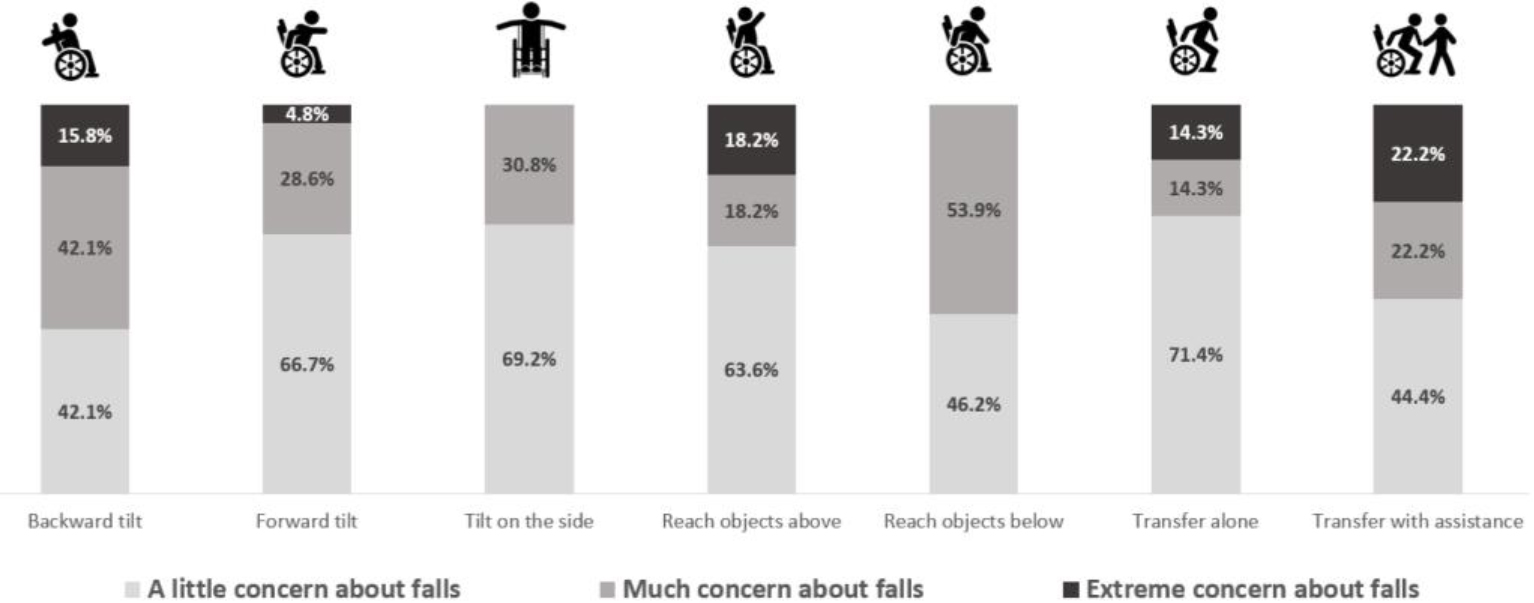
A repeated measures ANOVA was applied to compare concerns about falls when leaning and the respondent’s wheelchair type. It was verified that there was a statistically significant difference between these factors (F (2, 4)
Likewise, it was found that there was a significant difference between concerns about falls relating to different daily movements (reaching high and low objects, transfer when alone, and assisted transfer) and the wheelchair type (F (2, 6)
The main factors reported by users as causing the fall were factors related to the device (43.5%), such as failure or breakage of components or inadequate adjustment of the wheelchair. The data showed that concerns about falls increased most after falls due to wheelchair failure. Such falls were also the ones that most resulted in a need to make changes to the device (55%).
Half (50%) of the participants indicated they did not receive training by a specialized professional on how to use a wheelchair, and 51.9% reported not performing wheelie maneuver due to concerns about falls, functional limitations or because of the use of a powered wheelchair. Of the total number of participants who said they were able to do wheelie movement, 68% used a rigid frame wheelchair, 20% used a foldable frame wheelchair and 12% a powered wheelchair (these respondents also reported using manual wheelchairs).
Not all participants reported that they were able to perform all the movements that were investigated (tilts, reaching and transfers when alone). Inability to do these movements was because of physical (such as a lack of trunk control) or emotional (such as concerns) limitations. The only movement that was performed by all participants was assisted transfer. The relationship between performing movements/maneuvers and having concerns about falls is shown in Fig. 1. The movements reported by users as most associated with concerns about falls were transferring with the help of other people (51.9%), leaning forward (43.8%) and leaning backward (38.8%).
Presence of concerns about falls associated with different types of wheelchairs.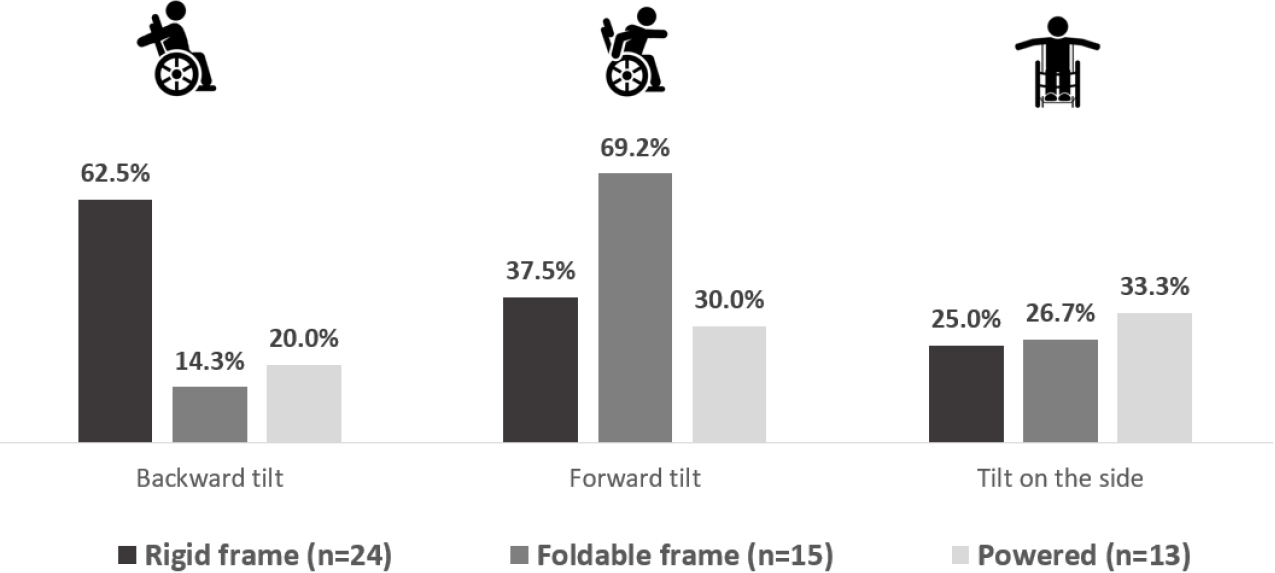
An extreme level of concern was most frequently reported when performing transfers with assistance (22.2%), reaching high objects (18.2%) and leaning back (16.8%). Movements with no extreme levels of concern reported were lateral inclinations and reaching for low objects. The levels of concerns according to daily movements are represented in Fig. 2.
Of the total number of participants who reported their most memorable fall or a single fall they had experienced, 73.9% reported that an injury resulted from these events, with 64.7% being minor injuries, while 20.6% needed medical attention, 5.9% were hospitalized and 2.9% needed a surgical procedure. The bodily regions most affected by injuries were the head, face and neck (35.3%), knee and leg (23.5%) and shoulder, arm, elbow and forearm (20.6%).
Although the injuries were not serious and in low quantity, the fall seemed to affect the confidence in carrying out movements and activities. Of those who described a fall, 69.6% stated that this moment resulted in an increase in their concerns about falls. 39.1% reported having interrupted some activity they like to do or would like to do after the event.
The majority of the participants indicated that they use their wheelchair mostly in a domestic environment (86.5%) and for leisure (86.5%), with fewer respondents using it for work (34.7%) and sports (28.9%). Most (78.9%) of the sample indicated some level of concern about falling when doing some routine activity. Among the most mentioned activities were: having their wheelchair pushed by someone else (65.9%), making transfers (46.3%) and wheelies (39%). The factor least associated with users’ concerns about falls was actions or movement (17%), such as reaching something or transferring.
The environments most associated with concerns about falls while transferring were: bathrooms (57.6%), cars (33.3%) and beds (30.3%). The majority of the sample reported being concerned about falling in the places they use their wheelchair (92.3%). Outdoor environments that were most frequently associated with concerns about falls were sidewalks (95.8%), streets (66.7%), open environments such as squares and parks (41.7%) and public transport (41.7%). Concerns about falls were also reported in relation to different terrains (92.3%), with the most commonly reported being irregular ramps on the descent (83.3%), ascent (81.2%) and irregular flat terrain (72%).
The one most memorable fall were most often reported as happening in indoor non-domestic places (23.9%), such as shops and public transport, followed by backyards (17.3%), sidewalks (17.4%) and streets (13%). The second-most commonly cited factor reported by users as causing the most memorable fall was environmental factors (33%), such as an obstacle on the ground, uneven terrain and collisions with objects.
After experiencing that most memorable fall, some participants said they stopped doing some activities, such as moving on sidewalks, going to the place where the fall happened or nearby, performing the movement or maneuver that caused the fall (such as wheelie or leaning), using public transport, leaving the house on rainy days and carrying out transfers without assistance.
Discussion
This study found that falls are events experienced by most of our sample of WU, and also a factor of concern during daily wheelchair use. Concerns about falls can be influenced by various factors. The consequences of a fall for the user seem to be more psychological than physical, as few serious physical injuries were reported, but concerns about falls increased. The consequences of injuries after falls corroborate the finding by Xiang [17] and Chen [9] that most falls and imbalances in wheelchair operation result in some type of injury.
A fall also seems to affect the future involvement of the individual in activities, as many of the sampled WUs reported feeling insecure about carrying out movements with the type of wheelchair related to the fall and going to places where the fall happened, such as public transport or shops. The results suggest that wheelchair type may have an effect on concerns about falls. The use of a rigid frame wheelchair was associated with higher levels of concerns about falls, mainly when leaning backward. It is possible that this is related to the characteristic of this wheelchair type, which is usually lighter, more compact and more agile.
Also, more than half of the sample reported that they do not perform the wheelie maneuver, which is an important skill for daily activities [23] and user stability [24]. This maneuver was more commonly reported by WUs with a rigid frame wheelchair, due to users of such wheelchairs seems to be more independent. Conversely, rigid frame wheelchairs were more associated with users’ concerns about falls. Thus, it seems that even for users with skills in conducting complex movements, such as wheelies, concerns about falls were still reported when using this type of wheelchair.
An interesting finding is the lack of specialized training on the use of a wheelchair reported by most of the users, as well as that they do not perform the wheelie maneuver. Training on wheelchair skills is important to allow users to gain independence in a variety of mobility situations and environmental/accessibility conditions, but also, for manual WUs, to be able to learn optimal propulsion techniques, taking into account push efficiency and biomechanical loads. In our study, half of the sample reported that they had not received training, which corroborates the study of Kirby [23].
A lack of wheelchair skills has been reported in some studies [25]. A lack of specific training for wheelchair use can generate a worsening of users’ physical condition and autonomy and independence [26]. It also might result in abandonment of the wheelchair [27]. Wheelchair design and rehabilitation interventions should be combined to provide adequate training to users, to improve their confidence in maneuvering their wheelchair [28].
As expected, there is also an influence of the characteristics of WUs on the concern about falls and on fall occurrence. Most of the participants reported using their wheelchair for around 5 to 10 hours in a typical day, and being totally independent. Regardless of users’ experiences with wheelchairs, we found that falls and concerns about falls were frequent, because a large part of the sample reported one or more falls throughout their time using a wheelchair. Indeed, even experienced WUs experience repeated falls during transfers and daily movements [21].
Common environments (sidewalks, streets, squares, and parks, among others) were associated with concerns about falls for most of the participants in this study. Architectural accessibility is still a problem in many urban spaces in Brazil. For this reason, it is common to find irregular sidewalks, squares and establishments with physical barriers that result in difficult access in different environments [22]. Barriers such as lack of accessibility impact perceptions of danger and, consequently, can cause a reduction in social participation. In the current study, even active and experienced users frequently reported concerns about falls and experiencing memorable falls in non-domestic environments.
Other studies also point to the influence of environmental aspects on falls among wheelchair users. In the study of Xiang [17] injuries in adult WUs were more frequent at home and in hospitals and institutions. Forslund [13] found that most of the falls occurred indoors, while the study of Rice [11] found that falls were more frequently reported on sidewalks, surfaces with debris or uneven surfaces, and it was corroborated by Singh [21] that most participants had at least one fall every six months due to uneven surfaces. The literature points out that transfers, especially when there are also environmental restrictions [16], can result in falls [8, 11, 13, 12]. Environment restrictions can be large gaps in height and width, lack of space to safely position the wheelchair and instability of transferring surfaces [16].
In the present study, most participants reported an increase in concerns about falls after the fall described. Concerns about falls may be associated with reduced activity and limited community participation, reduced quality of life, and negative impacts in the domains of physical health, psychological health, and the environment [33]. Indeed, some participants reported that they stopped performing some activities because of a fall, suggesting that there are psychosocial consequences of falls, such as feelings of fear, embarrassment and frustration, in addition to the possible reduction in participation in daily activities, as also reported by Khan [4].
We also found that wheelchair failure or breakage was common in the users’ daily routine, with wheelchair failure being the main factor related to falls. Not every incident of breakage or failure of the wheelchair caused a fall, but the number of falls due to this type of incident was high.
Mobility in non-domestic environments and performing transfers were most associated with reports of WUs’ concerns about falls. The ability to perform transfers independently seems to affect individuals’ perceptions of safety, since transfers with the help of another person were more related to reports of concerns about falls than performing transfers alone. Barbareschi and Holloway [16] state that this movement is extremely important, and affects the individual’s personal, social, and self-image.
The risk of falling increases when the occupant tends to lean forward. Of our sample of wheelchair users who were concerned about falling, the leaning direction most associated with concerns about falls was forward, although this is not the direction in which falls occurred most often.
There was a higher prevalence of concerns about backward falls among rigid frame WUs. In the study of Silva [29] participants pointed to backward propulsion in rigid frame wheelchairs as a generator of perceptions of instability and insecurity, both in users and non-users [29]. In the current study, the concern about falls differed according to the wheelchair type. The front and rear load distribution and inertial properties differ between wheelchair types [30], which can affect the user’s perception of balance.
Stability is more affected by the position of the rear axle [31], the position of the castors [32] and the weight distribution [6]. A shorter length of a wheelchair was a predictor of falls in the study of Nelson [7]. The influence of the position of the rear axle on stability leads to a need to develop dynamically adjustable axles [10]. In the current study, the main change in the wheelchair after a fall was made in the axis, corroborating these studies.
The high number of respondents who had experienced at least one fall corroborates Berg [15], Forslund [13] and Khan [4], who reported that falls are a recurrent event for WUs, and also that serious injuries from falls are uncommon. However, Chen [9] pointed out that any injury has the potential to impact the individual’s social and health function. Indeed, our findings show that falls can increase users’ concern and make them stop doing some activities.
The differences observed between the factors related to falls were also raised by the study of Silveira [14]. There are different predictors and recurrent factors for falls [13, 11, 8]. In Sung [33], powered wheelchair users were six times more likely to have concerns about falls compared to users of manual wheelchairs. Conversely, in the present study, manual WUs reported more concerns about falls than powered WUs.
The study of Chen [9] found that injuries from falls were more frequently located in the upper and lower extremities, while in the present study the head and neck were the body areas most frequently reported as receiving injuries. This finding may be related to the fact that the participants were asked to consider the most important fall, therefore it is possible that the potential for serious injuries in these body areas influenced their reporting on falls.
Limitations of the study
Due to the diversity of the study population, the sample was not homogeneous in terms of demographic data, such as age and height. It was also not possible to achieve a numerically equal sample in the wheelchair categories. It is believed that a larger sample of WUs using power wheelchairs would be important for achieving a more accurate comparison. It is also important to evaluate the influence of the type and intensity of training received on concerns about falls among in these individuals.
Participants reflected on their lifetime wheelchair use, which can affect their ability to recollect falls and injuries clearly, so it is possible that details about falls, such as direction and situation, may not be accurate. It could be that patients’ perspectives regarding not being trained to use their wheelchair arise because some have had a wheelchair for a long time.
Conclusions
This study found that the characteristics of the wheelchair influence the concerns about falls, alongside with interaction with the environment and the activities and movements performed in daily routine. It is important to consider that the influences are mainly related to wheelchair type (rigid frame, foldable frame or powered), due to the characteristics of the WU, the environment and the specific conditions in which falls occur.
The present study also found a need for evaluation and improvement of training on wheelchair skills, due to the high levels of concern users had when performing backward and forward tilting movements. Additionally, we did not find a high percentage of users who had undergone training. Public places must provide a safe environment for WUs’ to perform their mobility activities, thus promoting better means for their independence and social participation.
Funding
This work was supported by the Coordination for the Improvement of Higher Education Personnel (CAPES) #1 under Grant 88887.597667/2021-00.
Author contributions
CONCEPTION: Paula Conceição Rocha de Oliveira.
PERFORMANCE OF WORK: Paula Conceição Rocha de Oliveira, Fausto Orsi Medola and Luciana Ramos Baleotti.
INTERPRETATION OR ANALYSIS OF DATA: Paula Conceição Rocha de Oliveira and Fausto Orsi Medola.
PREPARATION OF THE MANUSCRIPT: Paula Conceição Rocha de Oliveira, Luciana Ramos Baleotti, Gustavo Christofoletti and Fausto Orsi Medola.
REVISION FOR IMPORTANT INTELLECTUAL CONTENT: Paula Conceição Rocha de Oliveira, Luciana Ramos Baleotti, Gustavo Christofoletti and Fausto Orsi Medola.
SUPERVISION: Fausto Orsi Medola.
Ethical considerations
The research methods were submitted and approved by the Research Ethics Committee of the School of Philosophy and Sciences of São Paulo State University – Campus of Marília – FFC/UNESP/SP – Brazil, Technical Appraisal: (Technical Appraisal 3.550.293). Participants were informed about the objectives and procedures and, after accepting to voluntarily participate, read an Informed Consent Form and indicated their acceptance in an online form.
Footnotes
Conflict of interest
The authors have no conflicts of interest to report.