



Abstract
BACKGROUND:
Core stabilization plays an important role in the regulation of postural stability. To overcome shortcomings associated with pain and severe core instability during conventional core stabilization tests, we recently developed the dynamic neuromuscular stabilization-based heel sliding (DNS-HS) test.
OBJECTIVE:
The purpose of this study was to establish the criterion validity and test-retest reliability of the novel DNS-HS test.
METHOD:
Twenty young adults with core instability completed both the bilateral straight leg lowering test (BSLLT) and DNS-HS test for the criterion validity study and repeated the DNS-HS test for the test-retest reliability study. Criterion validity was determined by comparing hip joint angle data that were obtained from BSLLT and DNS-HS measures. The test-retest reliability was determined by comparing hip joint angle data.
RESULTS:
Criterion validity was (ICC
CONCLUSIONS:
Criterion validity data demonstrated a good relationship between the gold standard BSLLT and DNS-HS core stability measures. Test-retest reliability data suggests that DNS-HS core stability was a reliable test for core stability. Clinically, the DNS-HS test is useful to objectively quantify core instability and allow early detection and evaluation.
Keywords
Background
Core stabilization plays an important role in the regulation of postural stability, which is required for coordinated dynamic movement. Core stability is achieved by coordinated co-activation of the transverse abdomen (TrA), internal obliques, external obliques, rectus abdomens, pelvic floor muscles, multifidus, and diaphragm. Unconscious or subconscious activation of these muscles generates intra-abdominal pressure or tension in conjunction with breathing, this results in stabilized and upright neutralized spinal posture during dynamic movement [1]. Impaired core stabilization may result in low back pain (LBP) or other musculoskeletal spinal injuries during dynamic lifting movements. Empirical evidence suggests that in the absence or lack of core stabilization, neuromuscular stabilizing forces are unbalanced, resulting in unevenly distributed spinal loads [1]. This results in LBP and spinal alignment deformities (i.e., lordosis, scoliosis, and kyphosis), and may explain why individuals with core instability are prone to spinal pathology. A valid and reliable core stabilization test that accurately and consistently quantifies core instability is necessary.
Core instability is conventionally measured by various methods, including the bilateral straight leg lowering test (BSLLT), formal test [3], and global muscular endurance test (GMET) [4]. BSLLT is widely used to measure abdominal muscle strength. The test involves gradually extending straight legs from 90
To overcome shortcomings associated with pain and severe core instability during conventional core stabilization tests, we recently developed the dynamic neuromuscular stabilization-based heel sliding (DNS-HS) test. The DNS-HS test is conceptually derived from the DNS technique, which involves subconscious co-activation of the diaphragm, TrA, and multifidus with other superficial core muscles to provide upright stability of the lumbopelvic system in a supine position [1].
While the conventional BSLLT or GMET tests were purported to measure abdominal muscle strength and core endurance, the DNS-HS test is designed to assess the coordinated function of core stability. Hence, it may be more appropriate for individuals with acute LBP and associated core instability. However, the validity and reliability of these core stability testing methods have not been demonstrated. The present study intended to establish criterion validity and intra-rater test-retest reliability of the DNS-HS test by comparing conventional BSLLT measurements using Simi kinematic and ultrasound measurements. We hypothesized that the DNS-HS test would be a valid and reliable measure of core stability in individuals with core instability.
Methods
Participants
Twenty young adults with core instability (18 men, 19 women) participated in the experimental test, which was approved by a major university Human Studies Committee (2013-03). All participants provided informed consent prior to participation. Those participants who were unable to perform the BSLLT while maintaining target pressure level (40
Experimental procedure
All subjects underwent a physical health screening and BSLLT to check for core instability [5, 6, 7]. A procedural checklist and standardized verbal instructions were followed to ensure consistent experimental procedures. All measurement systems were calibrated for each participant before data acquisition.
Ultrasound (The SonoAce 6000, Medison Co., Ltd, Korea) in M-mode with a 3.5 MHz curved transducer (HC2-5) was used to measure diaphragm movement. A pressure biofeedback unit (PBU, Chattanooga Group, Hixon, TN, USA) containing a 3-chamber pressure bag connected to a pressure gauge and inflation device was used to detect core instability [12]. 3D motion capture system (Simi Reality Motion Systems, SRMS, Simi Aktisys GmbH, Unterschleissheim, Germany) was used to determine the hip joint angle during core stability tests. The core stabilization tests included BSLLT and DNS-HS. BSLLT is considered a gold standard measurement against which the new DNS-HS measurement was validated (Fig. 2).
Criterion validity
Criterion validity was determined by comparing hip joint angle data that were sequentially assessed by BSLLT and DNS-HS methods. The hip joint angle during BSLLT was determined first. For BSLLT, a participant was initially positioned in the supine position with hip 90
Prior to data collection, all subjects underwent approximately 10 practical sessions 5 minutes per each session, 5 minutes rest) to become familiarized with both BSLLT and DNS-HS methods. Those participants who successfully performed the tests were included in data collection. A PBU was placed under the 5
Hip joint angle data were obtained during each BSLLT and DNS-HS measurement. Specifically, a participant was instructed to lower or slide their legs toward the plinth while maintaining neutral lumbopelvic alignment. A test was terminated whenever the PBU pressure decreased, and the hip joint angle was then measured with the Simi Aktisys. Hip joint angle kinematics were determined by Simi motion analysis in which three passive markers were placed on the lateral abdominal wall at the L3 level, the greater trochanter, and the lateral femoral epicondyle. A Basler acA640 camera (Basler Ahrensburg, Germany) with a sampling rate of 60 Hz was set a perpendicular distance of 1 m away from the participant (Fig. 1). Three hip joint angle measurements during each BSLLT and DNS-HS test were averaged for further statistical analysis.
DNS-HS test.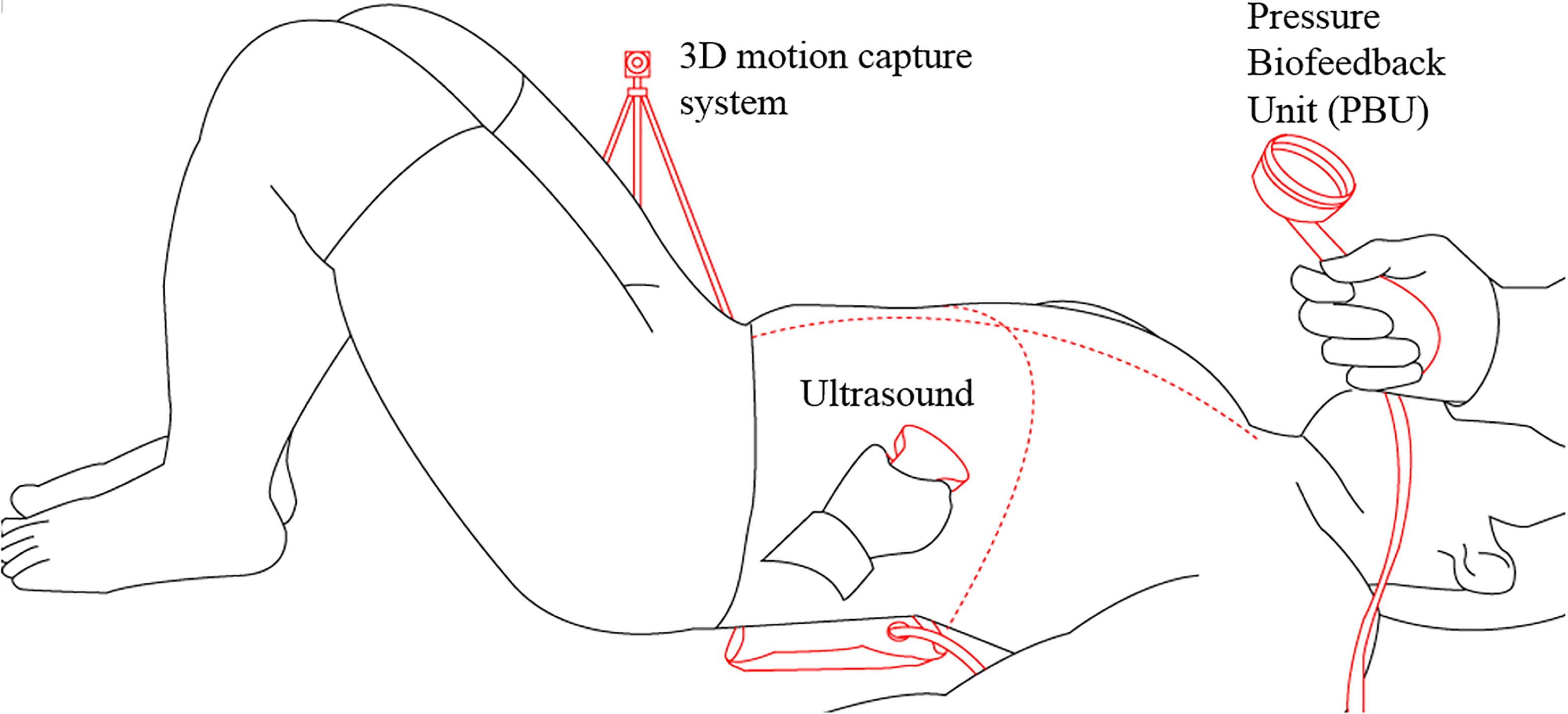
Flow chart of validity and reliability of test.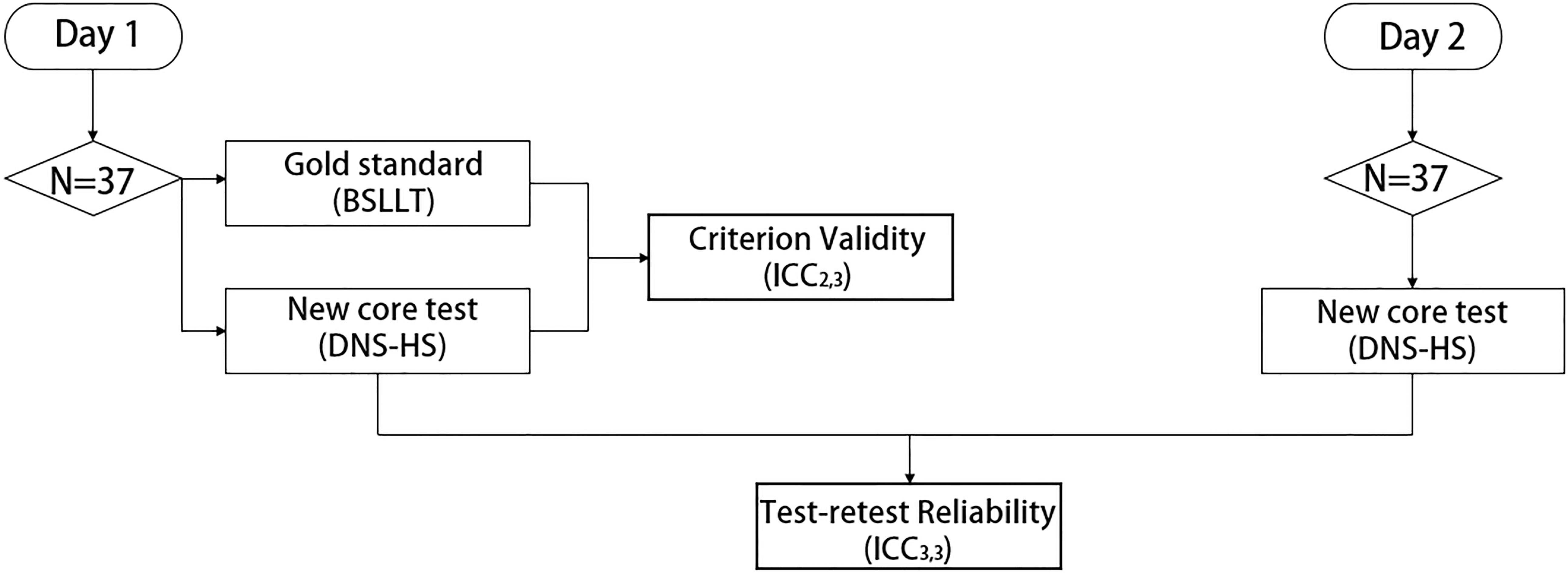
Test-retest reliability was established by determining intra-rater DNS-HS measurement consistency. The reliability test was performed on two separate occasions, approximately 24 hours apart. All testing conditions were maintained as consistently as possible, with the same investigators, experimental procedures (i.e., consistent instruction, calibration, testing sequence, established hook-lying positions), time of day, interval, and testing environment (lighting, temperature). All participants in this study underwent practice trials to get familiarized with the repeated test measurements. Data were only collected after participants showed understanding of the experimental tests. Independent sets of hip joint angle measurements from the same participants were recorded for data analysis.
Statistical design and analysis
SPSS Statistics ver. 21.0 software (SPSS, Inc., Chicago, IL, USA) was used for all statistical analyses. Descriptive statistics including means and standard deviations were computed. The criterion validity and intra-rater test-retest reliability were determined using intraclass correlation coefficients, (ICC
Results
Table 1 presents the demographic characteristics of participants. The validity of the DNS-HS test was determined by comparing hip joint angle data between conventional BSLLT and DNS-HS measurements. Criterion validity was found to be (ICC
Represents demographic characteristics of asymptomatic participants who demonstrated core instability (
37)
Represents demographic characteristics of asymptomatic participants who demonstrated core instability (
Validity obtained by comparing BSLLT and DNS-HS measurement data
Additionally, mean hip angle data showed a significant difference between the BSLLT (74.27
The present study established criterion validity and test-retest reliability of a novel core stability test. There is a dearth of clinical evidence regarding the established validity and test-retest reliability of core stability measurements. Core instability is one of the most perplexing and clinically challenging neuromusculoskeletal conditions because multiple attributes involve core stabilization, strength, power, endurance, flexibility, motor control, and function. Furthermore, core instability lacks a universal definition. Currently, there is no gold standard assessment of core stability with established evidence for its validity and reliability. This makes it difficult to correlate the validity and reliability data of the DNS-HS test with any other core stability measurement.
Test-retest reliability of DNS-HS measurement
Test-retest reliability of DNS-HS measurement
The present criterion validity study compared the DNS-HS core stability test with gold standard BSLLT and demonstrated a good relationship between the two measures (ICC
Based on extensive literature review, only one validity study related to core stability exists to date [20]. Gilleard and Brown developed an abdominal muscle strength test (AMT) and first established its validity by correlating the AMT level of difficulty and electromyographical (EMG) activity in 22 subjects. EMG data collected from the upper and lower rectus abdominis and external and internal oblique muscles were used to validate with four AMT levels of difficulty. The EMG activity results showed increased muscle amplitudes from Levels 1 to 3 whereas at Level 4, the external and internal oblique muscles had relatively increased muscle amplitudes [20]. This indicates that the AMT is a valid measure of discerning abdominal muscle strength in Levels 1 to 3. A different abdominal muscle was utilized in Level 4, which better reflected oblique muscle strength, warranting a different muscle test measurement. However, the validity of AMT has not been fully determined yet. It remains unclear if the abdominal muscle strength recorded by AMT truly represents core stability.
Test-retest data in the present study revealed ICC
Similarly, Smidt et al. [10] assessed the validity of the DLL, sit-up, and prone trunk extension clinical tests in normal adults and adults with a history of LBP. Although the DLL test was superior to other tests, only global abdominal strength was estimated, not core stability function. The majority of subjects were unable to complete the Grade III-IV levels test. Hence, these tests might not be appropriate for individuals with acute or subacute LBP. For these reasons, the DLL test has been challenged as a valid or reliable measure of core instability that is applicable for most clinical populations with LBP [10, 11, 17, 18, 22].
Additionally, mean hip angle data differed between the BSLLT (74.27
Taken together, our collective findings suggest that the DNS-HS measurement may be useful to differentiate original source(s) of spinal pathology resulting from either pain mediated inhibition of core muscles or core instability itself because it may be more conducive and sensitive to individuals with acute or severe low back pain associated with core instability. Nevertheless, this hypothesis should be validated in future research in individuals with acute or subacute low back pain.
Several research limitations should be taken into consideration for future studies. First, the present study included individuals with core instability and a previous history of low back pain. Hence, it is difficult to generalize our results to pathological populations with acute or subacute LBP. Second, the initial starting position differed for the BSLLT (90
The present study established the validity and excellent test-retest reliability of a novel DNS-HS core stability test. Clinically, the DNS-HS test is useful to objectively quantify core stability and aid in early detection. It is also useful for evaluation and monitoring of even minute progress after spinal rehabilitation in individuals with low back pain and core instability.
Conflict of interest
None to report.
Footnotes
Acknowledgments
This research was in part supported by a Brain Korea 21 PLUS Project grant (NO. 2016-51-0009) of Korean Research Foundation awarded to the Department of Physical Therapy of the Graduate School, Yonsei University.