



Abstract
BACKGROUND:
Cognitive biases are mostly automatic processes that result in individuals giving increased attention to threatening stimuli, with the difficulties in disengaging from these stimuli. Recent reviews have reported the presence for attention bias in several psychiatric conditions and provided evidence that such biases could be subjected to modification. Web-based and mobile based bias modification have mixed efficacy and gamification techniques proposed as a solution. There remains a gap in knowledge pertaining to the gamified applications for bias modification that are commercially available.
OBJECTIVE:
An analysis of their gamification approach will help in identification of common gaming elements adopted for use.
METHODS:
To identify commercial applications, a manual cross-sectional search was conducted between 1 and 11 November 2017 on the Google Play store. The following search terminologies were used: “Attention bias” and “Cognitive bias”. The classification of the gamification technique for both the published applications and commercial applications were based on the six approaches described by Wouter et al. [17] and the 17 gamification techniques described by Hoffman et al. [18].
RESULTS:
A total of nine applications were included in the current review. Five out of the nine applications involved the addition of gaming elements to an evidence-based task, and three involved the usage of intrinsic integration while leaving the evidence-based task intact. Other common gamification strategies used are that of the inclusion of digital rewards (
CONCLUSIONS:
Even though most commercial applications appear to have their basis on a validated gamification approach for the delivery of attention bias modification, there remains a need for further research in evaluating these applications clinically.
Introduction
The advances in experimental psychology has led to an increased recognition of cognitive biases. Cognitive biases refer to automatic processes such as automatic attentional or interpretational tendencies towards stimuli, that are of high salience [1]. For example, individuals with addictive disorders tend to be naturally drawn towards substance-related stimuli, whilst individuals with anxiety disorders tend to be naturally drawn towards threatening stimuli. Recent research has demonstrated that attention biases are present in a variety of disorders, ranging from that of addictive disorders to affective conditions, and these automatic biases could be subjected to modification. The Stroop task or the visual probe task are routinely used to assess for the presence of attention bias, and these tasks could also, in turn, be used as a mean for bias modification [2]. In the conventional visual probe task, the probe is associated with the threatening stimuli only 50% of the time, thus enabling a determination of the attention bias towards the threatening stimuli. When the task is adapted as an intervention, the probe is associated with the non-threatening stimuli 100% of the time, thus shifting the attention focus away from the threatening stimuli towards that of the neutral stimuli. By doing so, attention biases are being retrained. Prior meta-analysis has reported the efficacy of attention bias modification on attention biases in samples of individuals with either tobacco or alcohol use disorders [3]. More recently, a review of meta-analysis has similarly reported the evidence for attention bias in a myriad of psychiatric conditions [1]. There have also been published protocols seeking to evaluate the combined efficacy of conventional psychological therapy with attention bias modification [4]. While not much is known with regards to the later about the added effectiveness, the evidence to date highlights that there is a role to consider the modification of such biases, potentially as part of routine psychological treatment for various disorders.
The advances in technologies in the last decade have transformed various aspects of healthcare, including that of the delivery of cognitive bias modification interventions. Web-based attention bias modification has already been investigated for a variety of conditions, including that of addictive disorders [5, 6], depressive disorders [7, 8], social anxiety disorders [9, 10] and obsessive-compulsive disorder [11, 12]. M-health, or mobile health technologies, have also been utilised in the delivery of attention bias modification intervention. The main advantage of using M-health technologies relates to the mobility and portability of the intervention. M-health attention bias modification interventions have also been investigated for disorders ranging from that of insomnia [13] to that of anxiety disorders [14, 15] and that of tobacco use disorders [16]. The evidence arising from either web-based or mobile-based studies appears to be mixed, with some studies reporting the intervention to be effective and others not. Jones and Sharpe [1] in their review have examined the impact of training locations, and have reported that laboratory administered interventions are more efficacious, given that administration of such interventions in the laboratory allows for greater supervision and control, as compared to remote administration. It is critical to recognise that cognitive bias modification tasks are highly repetitive and hence, there is an inherently high propensity for individuals to drop out, or not remain motivated to continue with the intervention [17].
Gamification has been proposed as a method that could help address the lack of motivation in the completion of such repetitive training tasks [17]. The integration of gamification technologies could potentially help in reducing the attrition rates from cognitive bias modification interventions. Gamification refers to the use of game-related elements in a non-game context, as an attempt to make the intervention more engaging. In their prior review, Boendermaker et al. [17] reported how six different gamification approaches could be used in enhancing the effectiveness of cognitive bias modification tasks. The approaches include the addition of gamification elements to existing conventional bias modification tasks; the transformation of the conventional task into a serious game; identification of an underlying theory of an intervention and developing a game out of it; the addition of a full gaming approach to a conventional task; intrinsic and extrinsic combination and lastly, OTS (Over the shelf entertainment games). While Boendermaker et al. [17] have proposed several gamification approaches for bias modification tasks, other researchers have proposed a taxonomy of 17 common gamification approaches [18] and have examined common commercial stress management applications, to determine if they include elements of this approach. The most common approach applied in stress modification applications was that of the provision of feedback. Both the classification systems would be of value in the future analysis of smartphone applications which contains gamification elements.
The previous review [17] has highlighted several publications involving gamified versions of attention bias modification interventions delivered either using the Web or using a mobile device. For example, Boendermaker et al. [19]’s gamified version of a visual probe task (known as evaluating the shots) was reported to be effective in reducing alcohol-related attention biases, but not the overall alcohol consumption or the alcohol binges. Based on Boendermaker et al. [17]’s gamification classification, Boendermaker et al. [19] gamified task was based on the approach of “intrinsic integration with evidence-based task” as a basis. However, as highlighted in the prior content analysis for smoking cessation applications [20], there is a disproportion in the numbers of applications available commercially, as compared to that in the published literature. There is thus a likelihood that there are currently more commercial applications for attention bias modification on the commercial stores, with their basis on various gaming approaches. An understanding of the common gamification approaches that have been adopted in commercial applications, which are potentially widely used by the public, is pertinent, especially if researchers seek to co-create a new gamified cognitive bias modification intervention. Researchers need to be cognizant of gaming techniques that could potentially make the app more appealing for individuals in the public.
The main objective of this review is to identify the gamification approaches adopted in commercial cognitive bias gaming applications. Such an analysis would also help us in the determination if commercial applications are evidence-based and have based their gamification approaches on what has been previously evaluated in the literature. Our current review will help inform future work involving gamification for cognitive bias modification applications.
Methods
To identify commercial applications, a manual cross-sectional search was conducted between 1 and 11 November 2017 on the Google Play store. Only the Google Play store has been evaluated in the current review, as previous content analysis has also looked as just this store, given that the Android operating system currently holds the largest market share globally [21]. Moreover, the prior content analysis has also reported that for addiction related applications, similar applications are found in both the Google Play and Apple stores [21]. The following search terminologies were used, namely that of “Attention bias” and “Cognitive bias”. We have selected these two terminologies to look for cognitive bias relevant applications on the store, as these two terminologies were also used in the previous meta-analysis by Cristea et al. [3], that examined the effectiveness of cognitive bias modification for substance use disorders. As it is expected that there will be a diversity of attention or cognitive bias applications identified using the above search terminologies, the application description of each application was examined, along with the screenshots of the applications. Basically, we followed the approach of Ubhi et al. [22] in their comparative analysis of smoking cessation applications, whereby in their initial screening, the decision to retain applications were made based on description and images of the screenshots. Applications were included for the current review only if it was stated explicitly in the application description that the application was a gaming application. If both a free and paid version of the same application were available, only the paid version would be examined, as it is believed that the paid version of the application would offer the full range of functionalities. All the identified applications were downloaded and further evaluated by two reviewers on an Android Device (Xiaomi Note 4) running Android 7.0 operating system.
The classification of the gamification technique for both the published applications and commercial applications were based on the six approaches described by Boendermaker et al. [17] and the 17 gamification techniques described by Hoffman et al. [18]. Table 1 provides an overview of the gamification techniques described in the prior literature.
Gamification techniques
Gamification techniques
Following the identification of the applications, the following information was extracted from each application, that of a) application name; b) description of the application; c) Total number of downloads, d) Total ratings of application, e) developer or author details and organisation affiliation and f) gamification approach. The first author MWBZ and co-author YJB were involved in the extraction of the above information and the coding of the applications based on the above taxonomy of gamification techniques. If there were any disagreements among the authors, it was resolved with discussion. Inter-rater reliability was assessed by the Kappa statistic, whereby
The search based on the keywords identified a total of 62 applications from the Google Play store. After the exclusion of duplicates, 58 applications were further screened, and 15 applications were downloaded for further evaluation. Out of the 15 applications, six were excluded as they were not classified as games, based on their application description. Eventually, a total of nine applications were included in the current review.
Flowchart of the selection of applications from the Google Play store.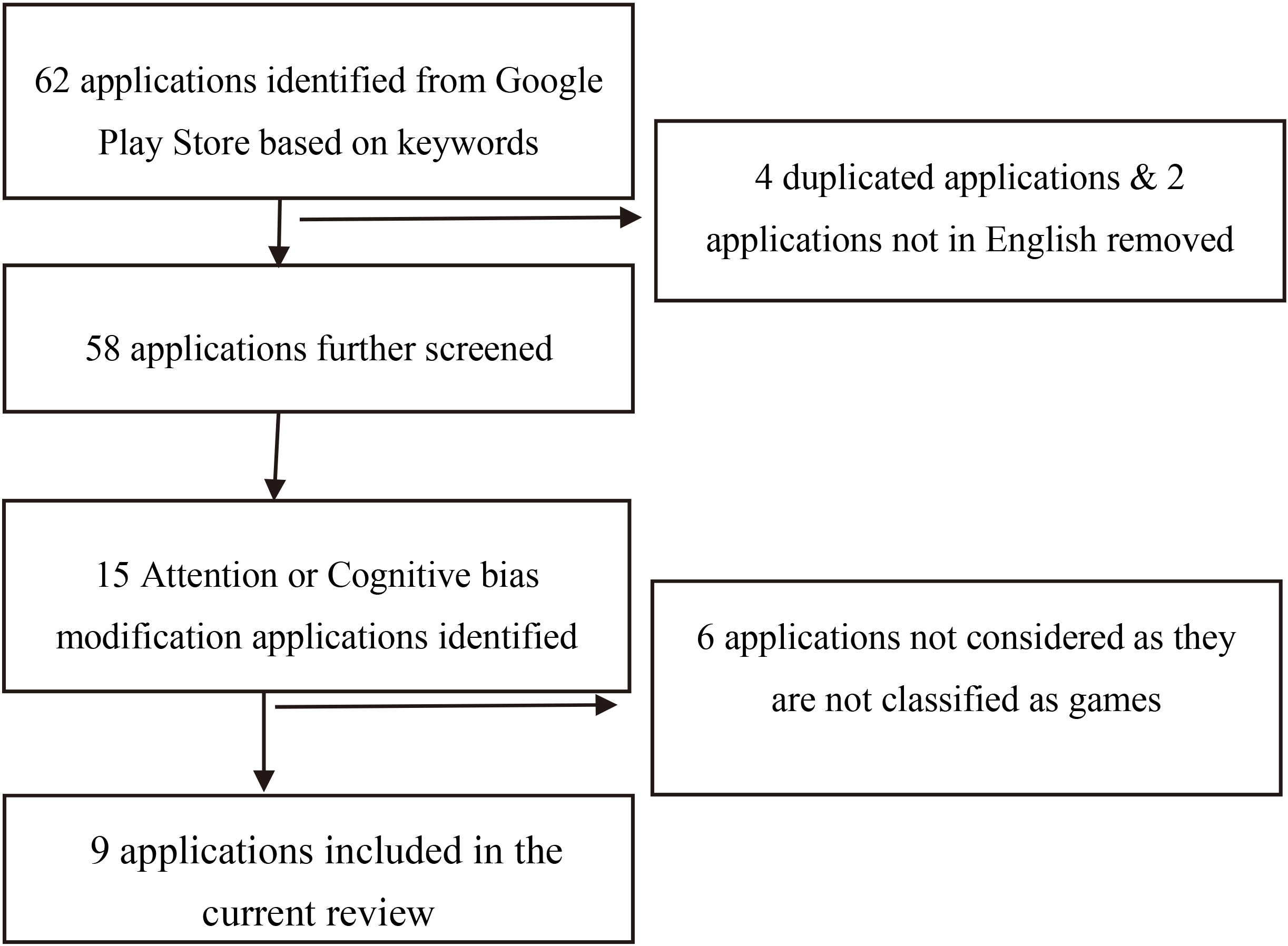
Among the nine applications that have been identified, most of the applications did not indicate that they were meant to target specific conditions, except for two applications targeting alcohol, two applications targeting smoking and lastly, one application targeting grief respectively. Some of these applications were highly downloaded, in particularly, that of Happy Face, which has a total download of 10000–50000. Most of the applications based their bias modification on the attentional visual search task. However, there were exceptions for four applications, in which the specific paradigm that has been used is different from the conventional tasks being described, and hence, we are unable to classify them based the classification of conventional tasks. Four out of the nine applications were paid applications.
The inter-rater reliability (Kappa) for the rating of the application was 0.74, thus there was substantial inter-rater reliability for the gaming applications that were rated based on Boendermaker et al. [17]’s
Characteristics of Commercial Games application
classification, five out of the nine applications involved the addition of gaming elements to an evidence-based task, and three involved the usage of intrinsic integration while leaving the evidence-based task intact. One application did not appear to make use of any of Boendermaker et al. [17]’s proposed methods. Across the applications, a variety of different gamification techniques have been utilised.
Figure 2 summarises the most common gamification techniques commercial applications, based on both Boendermaker et al. [17]’s and Hoffman et al. [18]’s classification. Based on Hoffman et al. [18] taxonomy, the most common gamification strategies are that of the inclusion of digital rewards (
Summary of gamification methods.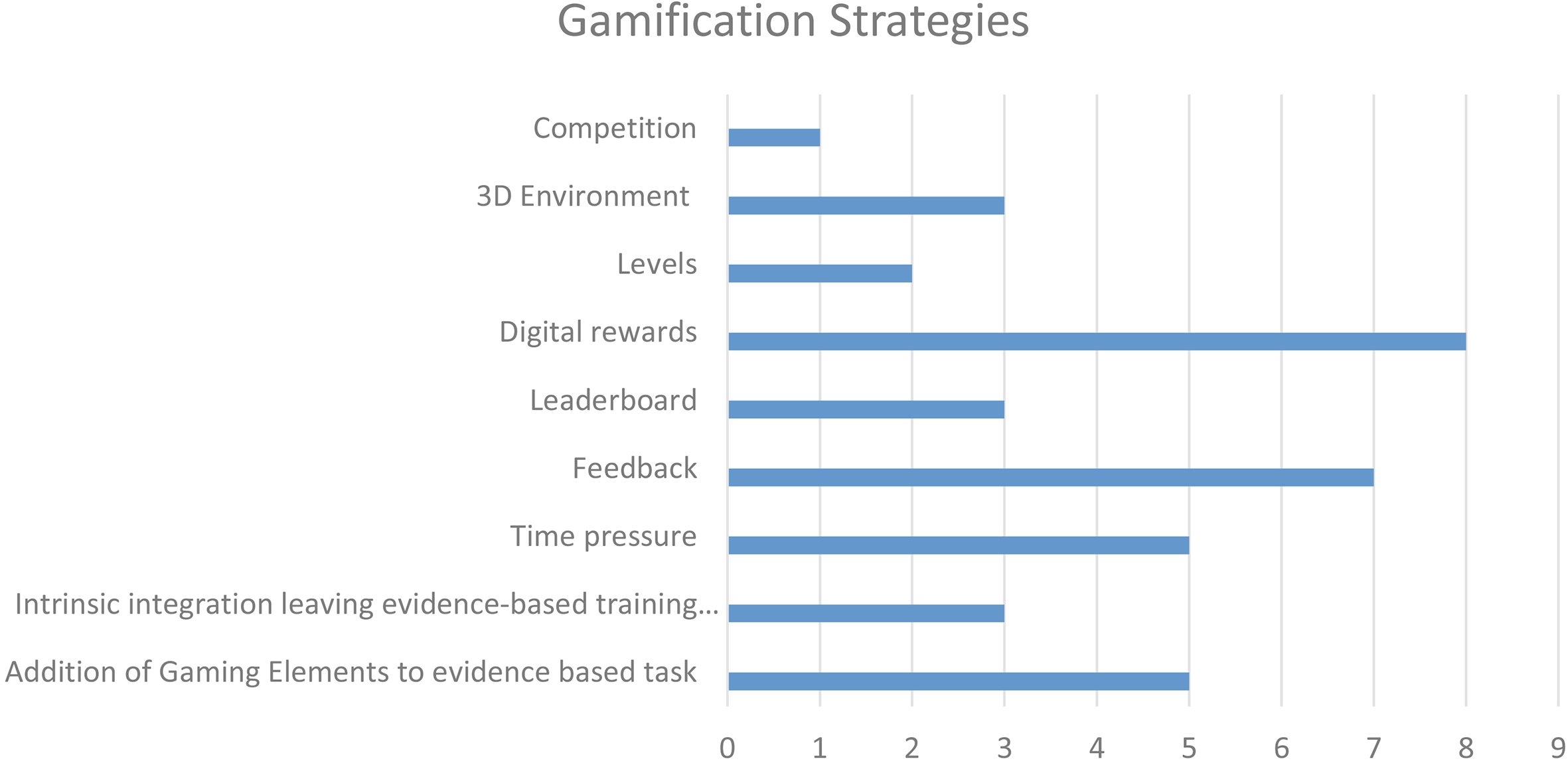
Table 3 provides an overview of the mean number of gamification techniques integrated within the application by the total download rates of the applications. While the computation of the mean number of gamification techniques per category of the download was limited by the absolute number of applications per category; we found that most of the commerical applications have included a mean of 3.5 gamification techniques and have a download of between 100–500. Feedback and time pressure were common gamification techniques in the 4 apps that have a download range of 100–500. There are outliers, with a single application incorporating 3 gamification techniques and having a total download range of 10000–50000. The analysis also demonstrate that the inclusion of more gamification elements does not lead to an app being more widely download, as there is a single application with 5 gamification techniques incorporated, but only having a total download range of 10 to 50.
Mean number of gamification techniques integrated by download rates of applications
Based on our knowledge, this is the first study that has examined the commercial gamified application for the delivery of cognitive bias modification interventions. As aforementioned, Boendermaker et al. [23] have previously reviewed gamified attention bias interventions evaluated in prior published literature. Our current review has identified nine attention bias applications that are classified as games based on their application descriptions. 5 of the identified applications targeted alcohol use, tobacco use and grief respectively, with the remainder of the applications not specifying the condition they seek to intervene. Application of Boendermaker et al. [23]’s classification system for gamification strategies in attention bias interventions revealed that most applications utilized addition of gaming elements to an evidence-based task (
The main objective of the current review was to identify the common gamification techniques that have been adopted by commercial applications. This helps to bridge the existing gaps in the literature. The prior review by Boendermaker et al. [23] have identified conventional methods, and referenced evaluated applications for each strategy. However, as aforementioned, there have been more commercial applications to date, and a number of these applications are widely used. An understanding of the gaming approaches utilized and correlation with downloads rates will enable us to have an understanding which technique are widely used and perhaps more well received by the public. In our current review, we found that the most common gamification method adopted by our cognitive bias intervention tasks was that the addition of gaming elements to an evidence-based task and the use of intrinsic integration while leaving the evidence-based task intact. The addition of gaming elements to an evidence-based training task is the most common, and this is expected, given that this is the most common initial step in gamification [23]. Routinely, this would involve the addition of game-like elements that seek to motivate participants extrinsically, such as the provision of motivating feedback and points [23]. The addition of features that seek to motivate extrinsically has been criticised by prior research, as it has been suggested that extrinsic motivation might eventually undermine intrinsic motivation for a task; and it might also hinder participants’ performance on a task. In our current review, we have not managed to identify any commercial applications that have adopted the method of intrinsic integration using evidence- based task as a fundamental basis. This strategy preserves the theoretical basis of the task and helps to motivate participants intrinsically to continue with the intervention. Our review demonstrated that several applications appeared to have applied intrinsic integration leaving the underlying evidence-based training paradigm intact. Several applications appeared to have their basis on an existing popular game, that of a mobile runner game and this game was modified for cognitive bias modification. Boendermaker et al. [23] have identified an cognitive bias modification game that has its basis on a popular card game and reported that there were disagreements in the biases targeted. Similarly, in our analysis, we believe that the adaptation of a mobile runner game for bias modification does confound the nature of the biases targeted. In each game, participants are asked to avoid either the tobacco or alcoholic substance while running in the gaming environment. It does appear that both biases, that of attention bias and approach/avoidance biases are simultaneously being targeted in such an intervention. As aforementioned, one application (Quitty) does not appear to have utilized any of the approaches that Ubhi et al. [22] have previously described, thus raising doubts about the validity of the bias training that the application provides.
Further analysis of gamification techniques integrated into commercial applications was performed using Hoffman et al. [18]’s taxonomy of gamification strategies. Our current review showed on average 3.2 gamification techniques across the nine-identified applications. Our average number of gamification techniques included appears to be much higher than that of Hoffman et al. [18]’s analysis of gamification techniques in stress-management applications, in which only 0.5 gamification techniques were found across 62 applications. One of the reasons for the discrepancy is because we have specifically looked at applications classified as games. Our analysis, based on Hoffman et al. [18]’s taxonomy also revealed that the most common gamification techniques applied were that of digital rewards and the provision of feedback. Digital rewards, while not commonly utilised among stress management applications [18], are commonly utilized in other gamification applications and offer individuals an extrinsic incentive to continue with the intervention. Feedback is not just a gamification technique, given that the provision of feedback could also encourage behavioural change.
There are several research implications arising from our current review. The adaptation of a typical game for bias modification might confound the nature of the biases being targeted, whether that of attention or approach/avoidance biases. Hence, there needs to be further research investigating how such a strategy could be adopted to gamify a cognitive bias intervention, yet not confound the nature of the biases being targeted. Given that such a strategy has already been implemented in existing commercial applications, there needs to be further evaluation of these commercial applications for the nature of the biases they seek to target. Further research needs to be undertaken to determine the efficacy of including other gamification techniques. Research should determine if the inclusion of these strategies does indeed increase the motivation to train and which strategies are more efficacious. The identified applications in our current review will be helpful in further co-design processes, seeking to implement and evaluate new gamified attention bias modification applications. In terms of clinical implications, while these applications might have included evidence-based gamification strategies, there remains a need for there to be further research evaluating the effectiveness of these application on a community or treatment-seeking cohort.
One of the major strengths of the current study is that we have managed to identify commercially available gamified attention bias modification applications, and we have also managed to apply two gamification taxonomies to classify the gamification strategies that are integrated into these applications. Our findings are of importance for future research seeking to implement and evaluate gamified attention bias modification interventions. Despite the strengths, there remain several limitations of the current study. The identification of the applications was confined to that of the Android store. The Android store was selected as it provides a clear overview of the characteristics of the applications, such as the download rates. Applications from the Apple Store routinely do not provide such comprehensive information, which could be used for further analysis in our current review. In our current review, we have limited our search only to English applications. Also, our search was confined to a fixed duration, and it is possible that new applications are left out given how rapidly new applications are added to the Android store.
Conclusions
The findings from the current review pertaining to the gamification techniques of commercial applications add on to the findings of previous review. Even though most commercial applications appear to have their basis on a validated gamification approach for the delivery of attention bias modification, there remains a need for further research in evaluating these applications clinically. Such an understanding of gamification approaches adopted in commercial application is crucial in future conceptualization and co-design of gamification attention bias modification interventions.
Footnotes
Conflict of interest
None to report.