



Abstract
BACKGROUND:
Walking is one of the important actions of the human body. For this purpose, the human brain communicates with leg muscles through the nervous system. Based on the walking path, leg muscles act differently. Therefore, there should be a relation between the activity of leg muscles and the path of movement.
OBJECTIVE:
In order to address this issue, we analyzed how leg muscle activity is related to the variations of the path of movement.
METHOD:
Since the electromyography (EMG) signal is a feature of muscle activity and the movement path has complex structures, we used entropy analysis in order to link their structures. The Shannon entropy of EMG signal and walking path are computed to relate their information content.
RESULTS:
Based on the obtained results, walking on a path with greater information content causes greater information content in the EMG signal which is supported by statistical analysis results. This allowed us to analyze the relation between muscle activity and walking path.
CONCLUSION:
The method of analysis employed in this research can be applied to investigate the relation between brain or heart reactions and walking path.
Introduction
Human leg muscles play an important role in adjusting the movement of humans during walking. In fact, leg muscles are actively working during walking and if any problem occurs, humans cannot walk correctly. Therefore, analyzing the activity of leg muscles has a very important role in understanding the human movement that can be specially used for rehabilitation purposes.
By referring to the literature, several works were found that investigated the human muscle reaction during walking using different methods. The reported studies that analyzed surface EMG signal of tibialis anterior muscle in walking with FES in stroke subjects [1] have investigated the EMG signals of TA and GAS muscles during walking in case of children with Autism Spectrum Disorder (ASD) [2], have analyzed EMG signal in case of level and incline walking in reebok EasyTone ET calibrator [3], have analyzed EMG signal to characterize walking asymmetry in children with mild hemiplegic cerebral [4]. They have also worked on the modelling of the surface EMG signal in order to analyze muscle activity during the gait cycle [5], have investigated how gait cycle selection affects EMG signal during walking for adults and children with gait pathology [6], and have worked on EMG biofeedback analysis in foot-drop after stroke with rehabilitation purpose [7]. Moreover, researchers have evaluated EMG signal recorded from distal leg muscles in treadmill and ground walking [8], have identified walking patterns in normal healthy subjects by analysis of EMG signal [9], have investigated EMG patterns during slow, free, and fast walking [10], analyzed EMG patterns during assisted walking in the exoskeleton [11], and analyzed the differences in the EMG signal during locomotion in patients with Parkinson’s disease [12].
Besides the reported studies, no work has analyzed the relation between the characteristics of the movement path and the characterises of EMG signal from an information point of view. In fact, the problem statement of this study is to find a similar feature between walking path and EMG signal, and since both walking path and EMG signal can be quantified using entropy concept, we have applied Shannon entropy for the analysis. This is an indicator of information content of the signal and greater Shannon entropy indicates greater information in the signal [13]. Therefore, in this research, we analyzed the Shannon entropy of EMG signal and path of movement (in signal shape) to investigate how walking on a path with greater information content can affect the information content of muscle reaction signal.
Besides work that used different techniques such as fractal theory for analysis of different physiological signal [14, 15, 16, 17, 18, 19, 20, 21, 22, 23, 24, 25, 26, 27, 28, 29, 30] in different conditions, several studies have been reported which applied different types of entropy for their analysis. The works that employed entropy for analysis of electroencephalography (EEG) signal [31, 32], magnetoencephalography (MEG) signal [33, 34], eye movement [35], and Heart Rate Variability (HVR) [36, 37] are worth mentioning.
Similarly, some researchers applied entropy analysis on the EMG signal in order to study its variations in different conditions. The reported studies that worked on scale symbolic transfer entropy (VS-STE) analysis of EMG signal for patients with stroke [38], have evaluated the effect of ageing on leg muscle by calculating multiscale entropy for subjects during walking on treadmill [39], have detected neuromuscular disease by neural networks and fuzzy entropy of EMG signal [40], and have calculated entropy of EMG signal for detection of muscle onset [41, 42]. They have also worked on the classification of neuromuscular disorders by multi-scale entropy analysis of EMG signal [43], and analyzed multi-scale entropy of EMG signal during gait in children with cerebral palsy [44].
Therefore, in this research, we linked the structure of the EMG signal (as an indictor of muscle reaction) to the complex structure of the walking path using Shannon entropy.
In the following section the method is discussed. Then, we present our data collection and analysis method. The obtained results are provided in the section thereafter. In the last section, we discuss the results and suggest future works.
Method
In this research, we aimed to investigate the relationship between human muscle’s reaction and walking path. For this purpose, we used the entropy concept and analyzed the variations of EMG signals (as the feature of muscle reaction) versus the variations of path movement using Shannon entropy.
Shannon entropy is the expected value (average) of the information contained in each message, where in this research, the EMG signal is considered as a message. In fact, greater values of Shannon entropy indicate greater information in the signal.
In general, Shannon entropy is defined as [13]:
In Eq. (1),
It should be noted that in the main experiment that analyzed the effect of the complexity of walking path on the fractal dynamic of human EMG signal [45], we designed five walking paths based on their complexities. However, in this research, we only consider three paths for our analysis. The reason for this selection is due to the variety of Shannon entropy for these walking paths that enable us to examine the effect of walking path on the variation of entropy of EMG signal. The used walking paths are shown in Fig. 1 based on their specific number in our main experiment. Each path contains 120 points, which were randomly distributed on the path. The Shannon entropy of different walking paths are listed in Table 1. Based on this table, the third and fourth path respectively has the greatest and lowest Shannon entropy. In other words, it can be said that the third and fourth path respectively has the greatest and lowest information content. In fact, choosing these paths enabled us to investigate the relationship between the information content of the EMG signal and the information content of the walking path. Therefore, in case of different walking paths, we would like to analyze how the variations of the information content of walking path affect the information content of EMG signal, or in other words, how their information contents are related. Therefore, the result of the variations in Shannon entropy of muscle signal (EMG) will be discussed in relation to the variations of Shannon entropy of walking paths.
The designed walking paths.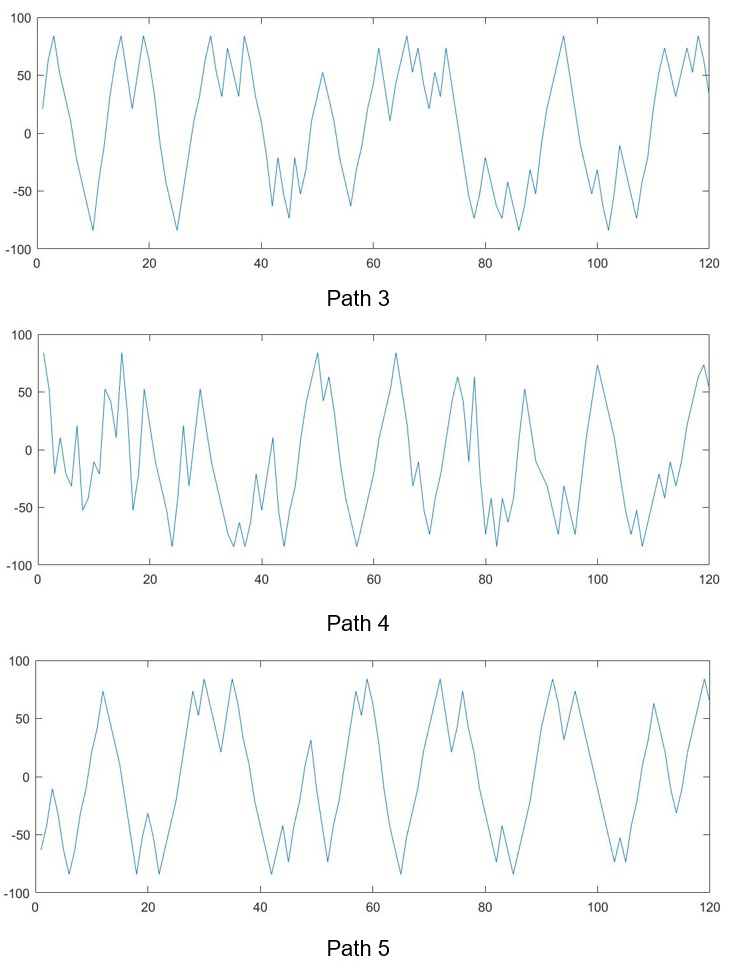
The Shannon entropy of different walking paths
All procedures of recruiting subjects and conducting the experiment were approved by Monash University Human Research Ethics Committee (MUHREC) with ethical number 18265. The study was carried out in accordance with the approved guidelines.
The experiment has been conducted on seventeen healthy students (18–22 years old) from Monash University, Malaysia. Initially, the experiment was explained to subjects and they signed an informed consent form. It should be noted that several questions were included about the history of mental disorders and consuming alcohol/caffeine in order to ensure their health conditions.
As is shown in Fig. 2, the experiment was conducted in a quiet hall in order to reduce the effect of external disturbances on data collection. The subjects were instructed to only focus on putting their feet on the specified bold dots on the path, without doing any other movement. During walking, first, they put one of their feet on a point and then put other foot near the first one. This procedure continued for subjects to walk through the path by putting their feet on 120 points. If subjects made a mistake during walking, they had to step back to the first point and start walking over.
Procedure of the experiment.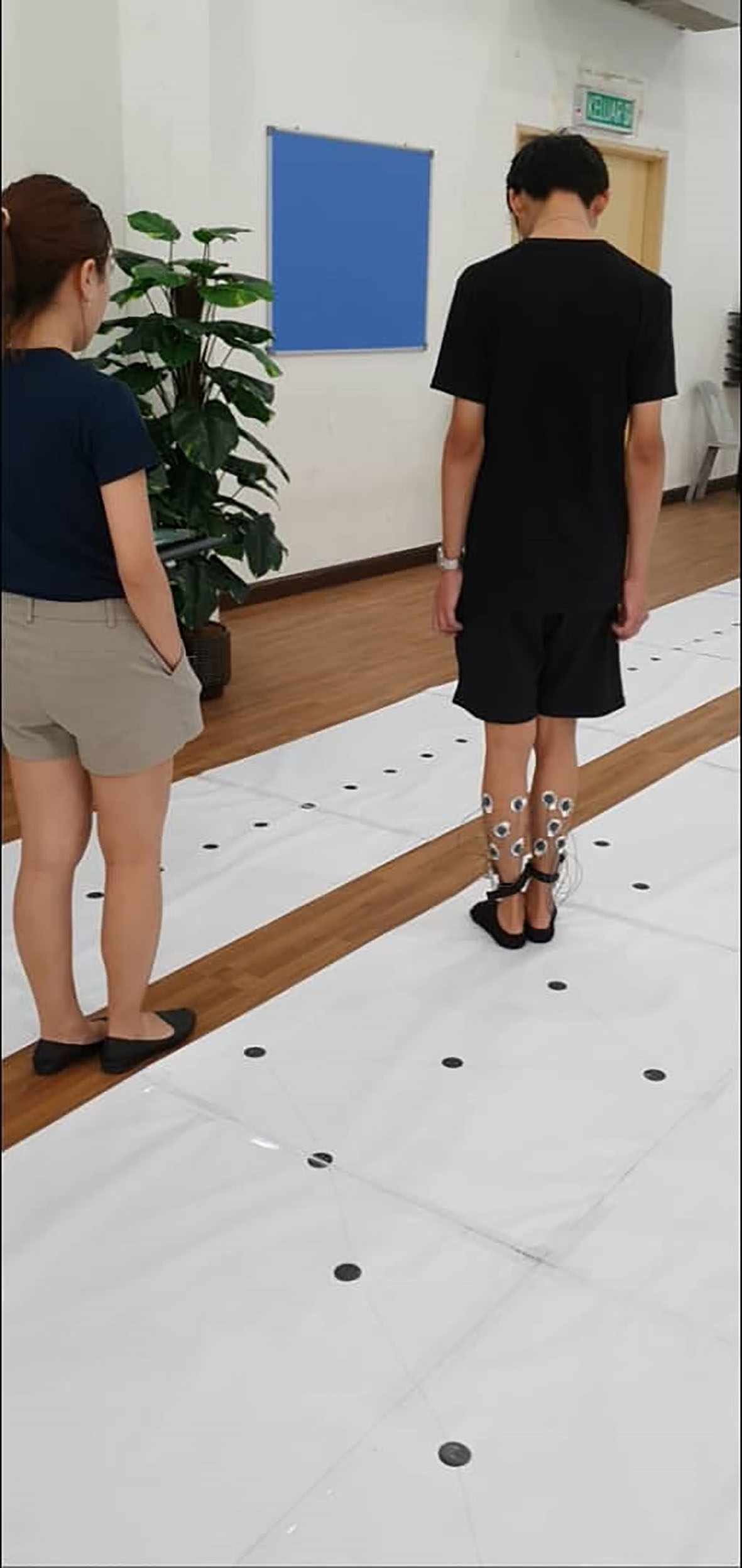
EMG signals were noninvasively recorded from the subject’s right and left leg muscles using Shimmer EMG device with the sampling frequency of 256 Hz. As can be seen in Fig. 2, five EMG electrodes have put on each shin muscle of the subject.
Initially, EMG signals in rest condition for one minute were recorded, while they sat on a chair without any movement. As mentioned before, subjects had to walk on different paths with different complexities. However, in this research, only the third, fourth and fifth path are considered as their information contents change significantly. Subjects had to walk on each path for different durations. It should be noted that the one minute rest was considered between different walking periods. In fact, this rest period relaxed subjects’ muscles and prepared them for the next walking round. The data collection was repeated for the second session in order to consider the repeatability of the collected data.
Initially, we applied filtering on recorded signals in order to remove noise. For this purpose, a code was written in MATLAB based on Butterworth filter in the frequency range of 25–80 Hz. The Shannon entropy for filtered EMG signals in case of the initial rest period and different walking paths was calculated. Here, it should be mentioned that although one minute of data collection during rest was considered, due to inconsistency in sampling frequency of the recording device, some subjects’ data have been recorded for less than one minute. Hence, to analyze the same length of data, 52 seconds of data in case of all subjects was considered for the processing in the rest condition. However, since each subject walked with different speeds, different lengths of EMG data were obtained in case of different walking paths, and therefore, the recorded length for each subject was exactly processed without any deduction.
In case of statistical analysis, initially, the normality of calculated Shannon entropy was checked. Then, the effect of different walking paths on variations of Shannon entropy of EMG signals using one-way repeated measures ANOVA was analyzed. In order to compare the information content of EMG signals in case of different pairs of conditions, a post-hoc Tukey test was run. Also, effect size analysis was conducted to check the effect of different walking paths on the information content of EMG signal. The significance level of 95% was considered in all statistical analyses.
The results of the analysis are based on the average of Shannon entropy for right and left legs in both sessions of the experiment. Out of seventeen subjects that participated in this study and provided us with a total of 136 sets of data in case of rest and three walking paths, three sets of data did not fall within the proper range of values and therefore those data were excluded in our analysis.
The variations of Shannon entropy for EMG signal in case of rest and different walking paths, and the Shannon entropy of different walking paths are shown in Figs 3 and 4 respectively.
The absolute value of Shannon entropy of EMG signal in case of different walking paths.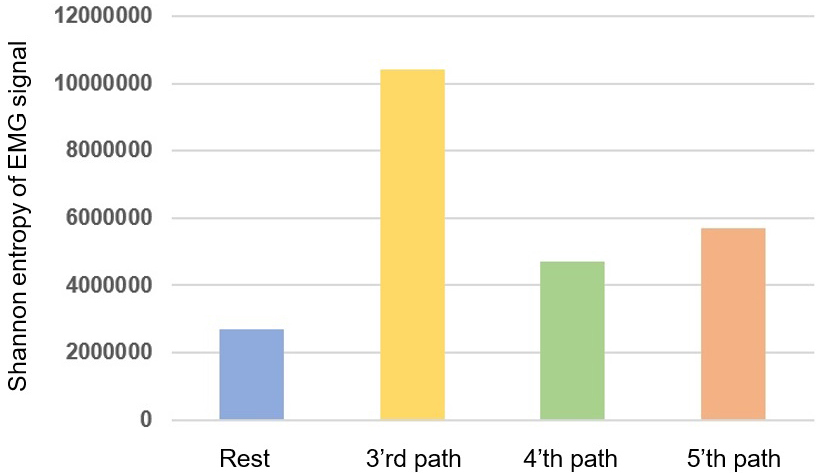
The Shannon entropy of different walking paths.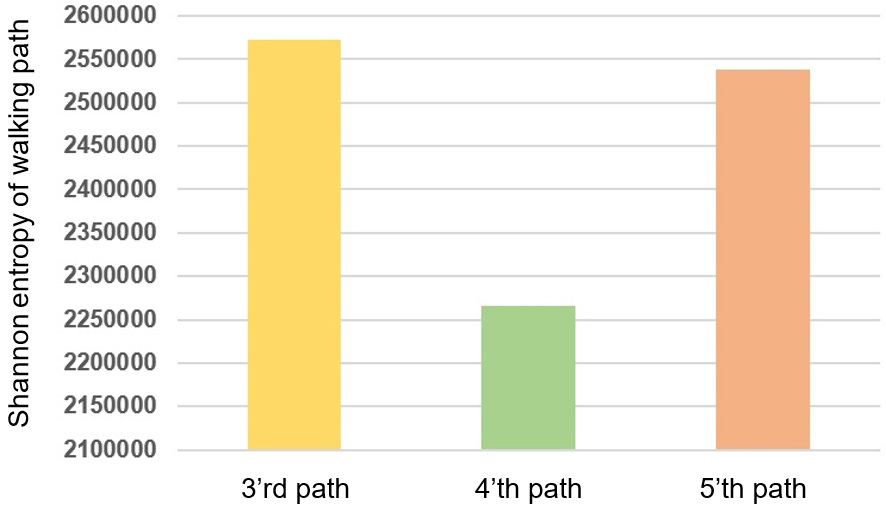
The result of ANOVA test (
Based on the results, EMG signal has the greatest Shannon entropy in case of the third walking path. After that, EMG signal experiences greater Shannon entropy in case of the fifth walking path. Also, as is clear from Fig. 3, walking on the fourth path causes the lowest Shannon entropy in EMG signal between all walking paths. As mentioned before, Shannon entropy indicates the information content of the signal, and it can therefore be said that walking on the third, fifth and fourth paths cause greatest to lowest information content in EMG signal.
From Fig. 4 it can be seen that the variations of entropy of EMG signal match the variations of entropy for different walking paths. In other words, the variations of the information content of EMG signal are linked to the variations of the information content of walking path, where walking on a path with greater information results in greater information in EMG signal.
Comparisons of Shannon entropy of EMG signal between different pairs of conditions are listed in Table 2. Based on the results of the Tukey test, the variation of Shannon entropy of EMG signal between rest and third walking path was significant. However, in other pairwise comparisons, we did not see any significant difference. In fact, this result is dependent on the information content of the walking path, and walking on a path with greater information content may cause a significant variation in a pairwise comparison.
The result of effect size analysis that is listed in Table 2 shows that the third walking path with greatest information content had the greatest effect on variations of the information content of EMG signal.
In general, it can be concluded that the variations of the information content of EMG signal are linked to the variations of the information content of walking path. When subjects walk on a path with greater information content, their muscle reaction (EMG signal) contains more information.
In this research, we investigated how the variations of different walking paths can affect human muscle reaction. For this purpose, Shannon entropy was employed to analyze the variations of the information content of EMG signal and walking paths. Based on the results of the analysis, EMG signal has the lowest information content in rest condition. When subjects walk on different paths with increasing Shannon entropy, the Shannon entropy of EMG signal increases. Therefore, it can be concluded that by increasing the information content of the path of movement, the information content of EMG signal increases. In other words, the information content of the EMG signal is linked to the information content of the walking path. In fact, the analysis is more advanced compared to the studies that only investigated variations of EMG signal during walking, without linking its characteristics to the characteristic of the path of movement.
In future research, the analysis to investigate the variations of other physiological signals of humans during walking can be extended. For instance, since walking affects human heart rate [46], the relation between information contents of heart rate variation (HRV) and path of movement can be analyzed.
All actions of the human body are controlled by the brain. Therefore, there should be a relation between activities of different organs and the brain. In fact, variations in the information content of the EMG signal during walking should be controlled by the brain. Therefore, in future research, it can be investigated how the information content of EMG signal is linked to the information content of EEG signal as the feature of brain activity in case of different walking paths. The relation between muscle and brain activities could then be decoded.
The analysis done in this research can be expanded in case of patients with different movement disorders. This way, it can be understood how the disorder affects the reaction of muscle during movement. Therefore, by adjusting the path of movement, the muscle reaction for rehabilitation purpose can be potentially controlled.
Another interesting area of work is the modelling of the relation between muscle reaction and path of movement using different mathematical models [47, 48, 49]. In fact, if we can successfully model their relation, muscle reaction before human walks on different paths can be predicted. It can also be very useful for designing paths in order to regulate muscle reactions.
Overall, it can be said that all these efforts can help researchers to better understand muscle reaction in case of different movements. This especially has a great advantage in the rehabilitation of patients.
Footnotes
Conflict of interest
None to report.