



Abstract
BACKGROUND:
Absent or abnormal fidgety movements in young infants are associated with subsequent diagnoses of developmental disorders such as cerebral palsy. The General Movement Assessment (GMA) is a qualitative clinical tool to visually identify infants with absent or abnormal fidgety movements associated with developmental stage, yet no quantitative measures exist to detect fidgety activity.
OBJECTIVE:
To determine whether a correlation exists between quantitative Center of Pressure (CoP) measurements during supine lying and age.
METHODS:
Twenty-four healthy full-term infants participated in the Institutional Review Board-approved study. Participants were placed supine in view of a GoPro camera on an AMTI force plate for two minutes. Spontaneous movements were evaluated by three trained raters using the GMA. Traditional CoP parameters (range, total path length, mean velocity, and mean acceleration of resultant CoP) were assessed, and complexity of each of the resultant CoP variables (location, velocity, and acceleration) was calculated by sample entropy. Linear regression with Pearson correlation was performed to assess the correlations between the CoP parameters and adjusted age.
RESULTS:
Nineteen infants were deemed fidgety per the GMA and were included in further analyses. All Sample entropy measures and range of resultant CoP had significant correlations with adjusted age (
CONCLUSION:
The results suggest that complexity of CoP and range of CoP are good predictors of age in typical developing infants during the fidgety period. Therefore, an approach using these parameters should be explored further as a quantifiable tool to identify infants at risk for neurodevelopmental impairment.
Introduction
Qualitative evaluation of spontaneous movements is often utilized to predict neurodevelopmental impairments in young infants. One such tool is Prechtl’s General Movement Assessment (GMA), which has been established as a predictor of cerebral palsy (CP) diagnoses [1, 2, 3]. The GMA classification is age-dependent since the characteristics of spontaneous movements evolve with age [4]. The classification of general movements via GMA is based on the quality of the infant movements focused on complexity, fluency, and variation during supine lying positioning [5]. The GMA classifies general movements as “normal”, “absent”, or “abnormal” based on the impression of the clinicians. Thus, the current GMA method is purely observational and qualitative.
Fidgety movement is a type of general movement characterized as small movements of the neck, trunk, and limbs at moderate speed with variable acceleration in all directions [1, 6, 7]. Fidgety movements may be seen as early as 6 weeks post-term but are usually predominantly observed from 9 to 20 weeks post-term. If the fidgety movements are never observed from 9–20 weeks post-term, infants are classified as absent fidgety on the GMA. Additionally, the fidgety movements which are moderately or greatly exaggerated in amplitude, speed and jerkiness are considered as abnormal fidgety movements. Absent or abnormal fidgety movements have been associated with subsequent diagnoses of developmental disorders such as CP [1, 2, 3], and the GMA is the current clinical tool for identifying these infants early in life. Early intervention can optimize motor, cognition, and communication outcomes with promotion of learning and neuroplasticity as well as prevent secondary impairments and minimize influence of complications [8], yet the GMA is solely based on clinicians’ observation, with poor inter-rater reliability [9]. Although the GMA shows high sensitivity and specificity (95% and 96%) of fidgety movement assessment [1], it still provides limited discrete values rather than continuous values. Thus, a robust and objective quantification of general movements in the fidgety age of infancy is necessary to provide a refined assessment tool for better identification and classification of the risk for neurodevelopmental disorders and would benefit from early intervention.
Entropy measures of infants’ center of pressure (CoP) have previously been utilized to identify abnormal movement patterns in early infancy [10, 11, 12, 13]. Sample entropy (SampEn) quantifies the structure of variability and randomness in time series data [14]. Supine lying entropy measures have previously been used to determine differences in CoP movement patterns between full term vs. pre-term babies [10, 11]. SampEn measures of CoP have also been used to distinguish sitting postural control between infants with typical vs. delayed development [12]. A recent study reported that infants at high risk of developmental delay showed smaller supine lying SampEn values of spontaneous leg movement, as measured by wearable accelerometers [13]. Supine lying SampEn of infants, therefore, may be a feasible tool to assess abnormal infant movements related to potential developmental disorders. The purpose of this study was to determine whether quantitative CoP measurements during supine lying were associated with age in healthy full-term infants. We hypothesized that the complexity of CoP (SampEn) during supine lying would be significantly correlated with age in infants with normal fidgety movement.
Methods
After recruiting caregivers of potential participants via flyers, phone screen interviews were performed to see if their infant would qualify for this Institutional Review Board-approved study. Infants were excluded if they had any orthopaedic or neurological conditions or had received vaccinations within two weeks prior to data collection. Infants included in the study were born
Test setup (force plate – dashed outline).
Raw CoP data from the force plate was down sampled to 200 Hz, with the middle 100 seconds of CoP data used for analysis. The CoP data were filtered using a low pass 4
Where
Statistical analysis
There were seven dependent variables: SampEn of RCoP, RCoP velocity, and RCoP acceleration (complexity parameters); range, total path length, mean absolute velocity, and mean absolute acceleration (traditional CoP parameters). Descriptive statistics were calculated for each RCoP variable (Table 1). Correlations between the CoP parameters and adjusted infant age were assessed using Pearson’s
Results
Significant correlations were observed for SampEn of RCoP (
Correlations between CoP parameters and adjusted age
Correlations between CoP parameters and adjusted age
Correlations between adjusted infant age (weeks) and A) Sample Entropy of RCoP and B) range of RCoP.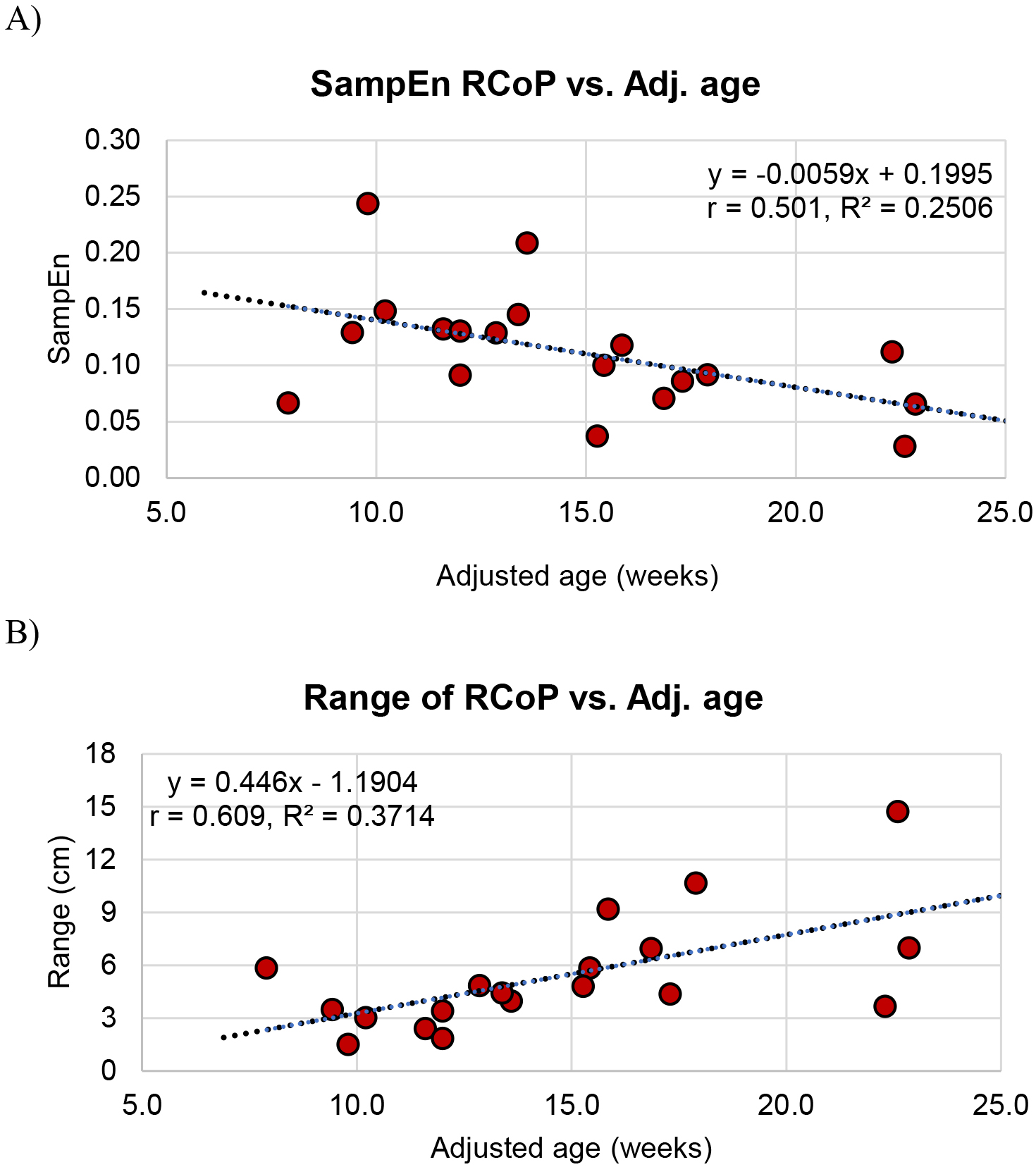
The purpose of this study was to determine whether quantitative CoP measurements during supine lying were associated with age in healthy full-term infants. Complexity of RCoP parameters (RCoP, RCoP velocity, RCoP acceleration) and traditional CoP parameters (range, total path length, mean absolute velocity, and mean absolute acceleration of RCoP) were calculated and then correlations between these CoP parameters and infant age were assessed. Infants in the fidgety period exhibited lower complexity with increasing age. Interestingly, SampEn of RCoP was significantly associated with infant age. A non-linear data analysis approach has been previously used to identify infants at high risk for developmental delay. Dusing et al. reported that full-term infants at 1 to 3 weeks of age had greater entropy values of CoP (higher complexity) compared to pre-term infants of the same age during supine lying, which indicates the pre-term infants (who have a higher risk of developmental delay compared to full-term infants) exhibited lower complexity of their CoP movement [10]. Deffeyes et al. also used entropy measures of CoP to detect differences between infants and toddlers with typical vs. delayed development and reported greater entropy values for infants with typical development during sitting postural control [12]. Furthermore, Smith et al. found that infants with typical development showed increased SampEn of spontaneous leg movements compared to infants at risk of developmental disorders [13]. These previous findings support the idea that the entropy measure of CoP can be a useful tool to detect infants at high risk of developmental disorders. Our results also indicate that this approach might be useful to develop a screening tool for neurodevelopmental disorders in early infancy (fidgety period:
In addition to the nonlinear SampEn parameters, range of RCoP was a significant predictor of infant age while other traditional CoP parameters appeared not to be associated with infant age. Range of RCoP had the highest correlation (
Footnotes
Acknowledgments
The research reported in this publication was supported by the National Institute of General Medical Sciences of the National Institutes of Health under Award Number P20GM125503.
Conflict of interest
None to report.