



Abstract
BACKGROUND:
Internet of Things (IoT) technology provides a tremendous and structured solution to tackle service deliverance aspects of healthcare in terms of mobile health and remote patient tracking. In medicine observation applications, IoT and cloud computing serves as an assistant in the health sector and plays an incredibly significant role. Health professionals and technicians have built an excellent platform for people with various illnesses, leveraging principles of wearable technology, wireless channels, and other remote devices for low-cost healthcare monitoring.
OBJECTIVE:
This paper proposed the Fog-IoT-assisted multisensor intelligent monitoring model (FIoT-MIMM) for analyzing the patient’s physical health condition.
METHOD:
The proposed system uses a multisensor device for collecting biometric and medical observing data. The main point is to continually generate emergency alerts on mobile phones from the fog system to users. For the precautionary steps and suggestions for patients’ health, a fog layer’s temporal information is used.
RESULTS:
Experimental findings show that the proposed FIoT-MIMM model has less response time and high accuracy in determining a patient’s condition than other existing methods. Furthermore, decision making based on real-time healthcare information further improves the utility of the suggested model.
Keywords
Introduction
Hardware, software, physical objects, computing devices, and humans are integrated with the growing Internet of Things (IoT) ecosystem to enable communication, interaction, collection, and information exchange over a network [1]. The rapid development of IoT and miniature wearable bio-sensors provided a great opportunity for healthcare services [2]. On the wearable or cyber-physical systems, smart healthcare services collect various types of data through sensors in the sensing layer [3, 4]. IoT fog services distribute the latency sensitivity in smart healthcare systems at the edge of the network [5]. IoT fog in smart healthcare provides less latency, quick response, and readability to healthcare applications [6, 7]. System failure and latency are considered the main challenges in healthcare systems, and it can be solved by optimal job allocation and resource management by managing fog performance and functionalities [8, 9]. Data processing, push notification, channel management, and categorization are advanced services provided by fog-based healthcare systems at a hospital and at homes to avoid serious consequences by notifying emergencies in real-time to doctors to take immediate actions [10, 11].
Health monitoring is important to diagnose diseases and to provide appropriate treatment [12]. Abnormalities of patients, elderly peoples in real-time, are indicated to caretakers by detecting the abnormalities through a monitoring system and send the information to caretakers [13]. Fog-based health monitoring is a growing concept in recent years [14]. Fog increases network efficiency and reduces bandwidth requirement by adding real-time information to mobile users closer to the network edge [15]. Fog-based health monitoring system is suggested due to its high efficiency in distributing time-sensitive information to users [16]. Safeguarding security and privacy, organizational barriers, financial cost, training programs for healthcare providers, and technical problems should be considered while implementing a health monitoring system [17, 18]. In rural areas, low power wide area network (LPWAN) is used to implement the fog-based healthcare monitoring system. Long- short-term memory layers with a recurrent neural network (LTSM RNN) is implemented to enable real-time notification and alters when the demand for data to be transmitted to servers for analyzing purpose [19].
The multisensory data fusion approach determines the risk level of the patient. Technology plays a vital role in the aging population for monitoring the quality of life [20]. Automatic Tele-monitoring in the home concentrates on Geron technology, which provides an interesting solution by offering healthcare in a known atmosphere for older people and patients [21, 22]. Various distress situations are detected to increase the reliability of the system by multimodal fusion. Environment multimodal pour tele-vigilance medicale (EMUTEM) is used for home healthcare monitoring [23]. Fuzzy logic-based multisensory data fusion provides high flexibility for the EMUTEM framework [24]. Multiple sensors are used to obtain the breadth of information required, and multi-sensors fuse output to obtain the depth of information required when a single sensing method is insufficient [25]. Computed patient risk level gives meaningful information to perform multi-sensor data fusion. The input data and output data are mapped by fuzzy set theory used in Fuzzy interference system (FIS) to determine the risk level by having health condition information about the patient during emergencies to know how critical the patient’s health condition.
Related work
Mani et al. [26] proposed an IoT-guided healthcare monitoring system by fog computing services to manage real-time notifications. The objective of the proposed work is to reduce the cost of delivering the data in the cloud. IoT-based fog computing saves billion of patients’ lives. In spatial, temporal dimensions, the medical services are accelerated by the transmitted and communicated signals from the remote sensors.
An energy-efficient fog-assisted IoT system is suggested by Gia et al. [27] for monitoring diabetic patients with cardiovascular disease. A fog-based system monitors ECG, glucose, body temperature, contextual data life humidity, room temperature, air quality in real-time. The accurate system operation and energy-efficient wearable sensor nodes are obtained as a result.
Tiwari et al. [28] used fog-assisted healthcare architecture to reduce latency for pre-operative support. The proposed framework is to provide treatment for the patients in a remote location at the right time. Tele-surgery offers various opportunities for skilled doctors to provide medical services. Resource scheduling problems are reduced by the artificial intelligence, tactile internet and 5G technologies required by Tele-surgery.
A highly efficient fog and deep learning-based AAL fall detection system is recommended in [29]. The wearable tri-axial accelerometer collects the monitored data of patients. Deployment and management of deep learning models are supported by smart IoT gateway architecture. To optimize and evaluate the resource performance and interference time LSTM/GRU deep learning model is used. The proposed model is more accurate in detecting the fall, and it is efficient with less delay and service improvement.
A hybrid deep learning model is considered by Gumaei et al. [30] using multimodal body sensing data for human activity recognition. The proposed simple recurrent units and gated recurrent units are combined to process the sequence of input data and store and learn the past information for solving the instability and fluctuation problems. The proposed work performance is compared with the state of art methods.
Khan et al. [31] designed an IoT-based multisensor patient fall detection system. Visual-based classifier use of the camera and k-Nearest neighbor and Naive Bayes’ classifier is used to analyze the sensor data. An attendant is informed immediately when the fall is detected. The accuracy of the proposed method is evaluated, and various specifications are discussed.
Micro or Nano service composition is used in the continuous processing of health data in edge fog cloud computing [32]. The proposed work is created to handle big health data and execute services for fulfilling the non-functional requirements (NFRs). Analyzed ECG data will give a warning to the physician about the patient records. The content delivered to internal and external staff is studied. The feasibility of the study is evaluated by building interconnection between multiple service solutions.
IoT fog-based healthcare framework is modeled by Sood and Mahajan [33, 34] to identify and control hypertension attack. An artificial neural network is used to identify the risk level through hypertension patient health level. The information stored in the cloud is shared with the clinicians, doctors, etc. Precautionary measures are provided by temporary information created from the fog layer. Less response time, high bandwidth, and better accuracy are obtained.
An e-health system for monitoring elderly health based on IoT and fog computing is considered by Hassen et al. [35]. My signals HW V2 platform and the android app plays an important role in developing the proposed system. The general health parameters and physiological data are collected from older people, and the android app is used to monitor their health and communicate to healthcare providers continuously. The users who considered the proposed work as useful and easy to use and learn are evaluated to improve older adults’ healthcare services.
Zhang et al. [36] proposed emergency level-based healthcare information offloading over fog networks. The proposed work provides efficient healthcare services. Better service quality is provided by stored data of patients and prescription advice of doctors in the cloud. A metaheuristic is used to optimize the offloading problem and to find the best policy. Emergency supporting the measure is also designed to improve the service.
Internet of health things (IoHT) is suggested by Mukherjee et al. [37] using an integrated edge fog cloud network for personalized healthcare. The nearby health center is advised to the users by detecting the user’s mobility information and pattern. Theoretical analysis shows that energy consumption and delay are reduced greatly. An experiment is carried out with the help of health data of volunteer students in the laboratory.
A new fog IoT architecture for patients and elderly health monitoring is modeled by Debauche et al. [38]. Alone and the proposed system monitors older adults’ behavioral change and health state to provide healthcare. Fog IoT architecture is used to store the data, and Lambda cloud architecture is used to process the stored data. Graphical monitoring provides the originality of the proposed work. Data are accumulated to analyze the observed data automatically to achieve medical staff to follow the patients.
Tuli et al. [39] proposed an ensemble deep learning-based smart healthcare system by health fog to automatically diagnose heart disease in an integrated IoT and fog computing environment. Heart patient data are managed efficiently. The fog tests the proposed work-enabled cloud framework in terms of network bandwidth, jitter, accuracy, execution time, power consumption, and latency. Health-Fog configures different operation modes to provide better Quality of Service.
Mahmoud et al. [40] recommended a novel method including the cloud of things to provide energy efficiency in cloud-based healthcare. By using the iFogSim simulator, the proposed work’s performance is evaluated by comparing it with cloud-only policies and default allocation. The solution observed is more energy efficient by saving more energy than the cloud only and Fog-default.
Fog-IoT-assisted multi-sensor intelligent monitoring model
Fog-IoT is used to tackle the service deliverances to the remote patients by detecting the health condition. This work focuses on improving the accuracy of patient health and provides alerts to abnormal patients remotely. The data is sensed from the multi-sensor and forwards to the fog devices; this fog device finds the nearby nodes. The nearby nodes are identified by introducing a KNN method that deploys Euclidean distances. In this work, the FIoT-MIMM method is proposed to analyze the patient’s health condition by collecting the biometric and medical observing data. Figure 1 presents the proposed fog model for health monitoring.
Fog model for health monitoring.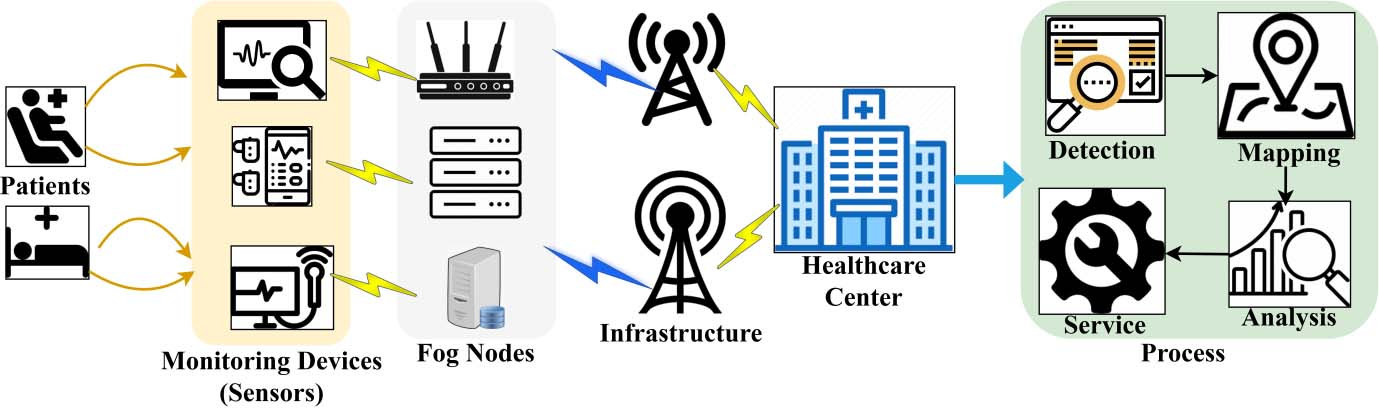
The patient’s health is monitored, and sensors collect the information. The collected information is given to the healthcare center through wireless infrastructure with fog nodes for detection, mapping, and analyzing process to take place to provide services according to the information collected.
The scope of this paper is to generate an emergency state that occurs by detecting the abnormal condition of the patients. Here, the suggestion model is developed to store the medical data on the cloud and maps with the sensed information. By performing this, the service deliverance rate is improved for the varying multisensory data. The preliminary step is to analyze the multisensor data on the varying time interval, and it is equated in the below equation as follows.
The analysis is done on the above Eq. (1a), which is associated with the varying data sensed from the multisensor. The number of data is represented as
In this evaluation step, the forwarding of the alert signal is done on time, and it is equated as
The data is differentiated to find the data’s normal and emergency state and provides the necessary step to avoid the critical situation level. Both normal and abnormal data is differentiating from the history of data analysis method that deploys efficient service delivery on time. The data is sensed and forwarded to the healthcare system and maps with the preceding state and provide the result promptly to estimate this. Here, differentiation is computed for every iteration step to find the state of the data. The following equation is used to evaluate the differentiation of data from the multisensor.
Differentiate of data is examined in the above equation to analyze the normal and abnormal data that is associated with the suggestion model, and it is termed as
The second derivation relates to abnormal data. Here, the mapping with the previous state defines it as abnormal, and the alert message is forwarded. By evaluating this process, the fog nodes are responsible for finding the nearby nodes and sending the data; this evaluation step decreases the healthcare system’s cost of monitoring. The periodic monitoring is done from the multisensor devices and forwards the data to the fog node, and it is denoted as
The mapping is performed by acquiring the data from the multisensor that deploys the patients’ varying state and forwards the response continuously. The preceding state of sensed information is mapped with the pursuing state and provides the result promptly, and it is equated as
For every stage of information acquiring, the mapping is associated with the fog node that deploys the preceding state. The suggestion model is used to provide feedback reliably. In this approach, the fog nodes are responsible for efficiently moving the data that deploys with the previous state. The mapping is done in a reliable manner associated with the varying data sensed from the multisensor devices on time. The detection of data from the multisensor is done for low-cost healthcare data monitoring, and it is estimated in the below session.
The data is detected from the multisensor that deploys the state of the data, associated with normal and abnormal conditions. Continuous detection is performed that deploys the fog nodes in the IoT, for this FIoT-MIMM method is proposed to analyze the healthcare condition. In this evaluation step, the alert
In the above equation, the detection is performed for the varying data sensed on the patient healthcare system’s different aspects. Here, it is associated to find normal and abnormal data, and it is represented as
The detection is determined in a reliable manner that estimates the data’s condition state in the IoT environment and provides feedback. The identification is denoted as
The determination of various biometric and medical observing data is collected from the sensor based on the data’s nature. If the data is biometric, it includes the fingerprint, iris, and another patient’s body detection state. In contrast, medical observing data relates to the ECG signal and other data from the patient. The first derivation is associated with the biometric of the patient collected at the time of sensing, and the biometric is denoted as
The determination is represented as
Data detection process.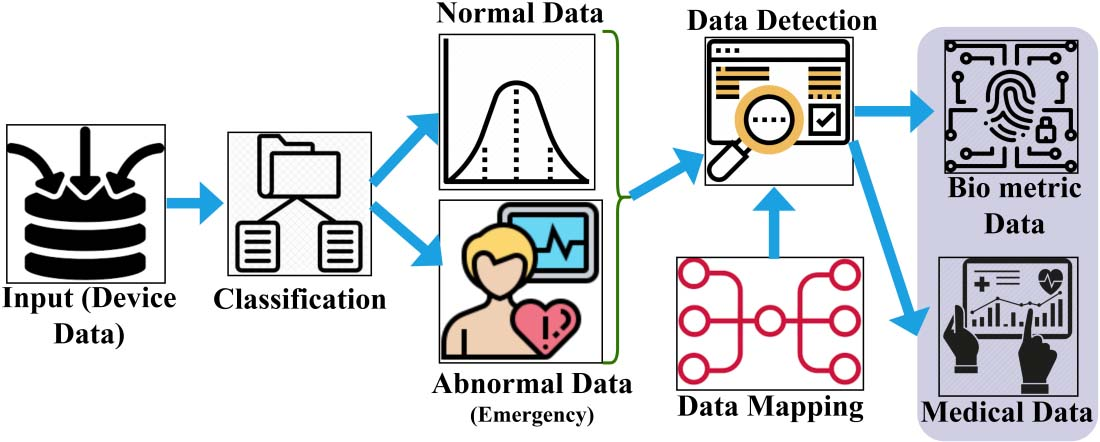
Device data are given as input to the classifiers for classifying the data into normal and abnormal (emergency) data. Both normal and emergency data are given to data detection along with mapped data. Detected data is then divided into medical data and biometric data to store it for future use. The data sensed from the multisensor differentiate the state and provides the feedback appropriately. Thus, the data is determined and finds reliable processing on time, and from this fog, nodes are responsible for transmitting the data to the nearby nodes. The nearby nodes are detected by proposing the KNN method. The data differentiation and mapping for different monitoring intervals are presented in Fig. 3. In Fig. 4, the data points for different users and monitoring levels are illustrated.
Data (differentiation and mapping).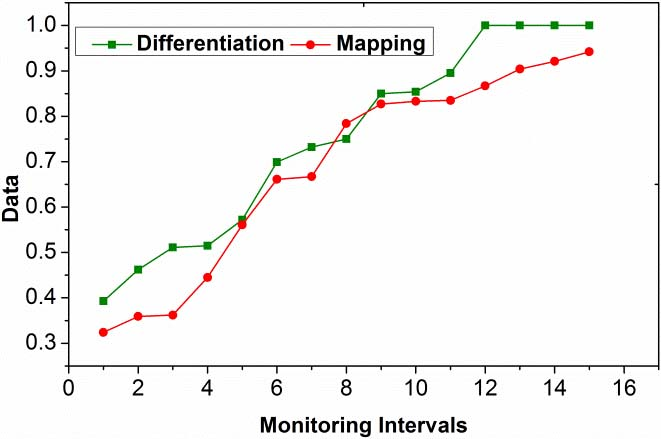
Data points.
The monitoring intervals vary for data differentiation ranges from low to high and high to constant. Here, the mapping is done from low to high value, and it deploys the detection of normal and abnormal data. If the monitoring interval increases, data differentiation decreases, and mapping show better improvement (Refer to Fig. 3). Monitoring interval varies for data points that range from low to high value, which is done to the user’s number. The users are defined from 8 to 16, and the data points are used to find the nearby nodes. This data point is determined by finding the Euclidian distance and provides reliable monitoring on time. If the data points increase, the number of users shows a higher range for 16 compares to 8 (Refer to Fig. 4).
It is a classification method done for the previous state and new data sensed from the sensor device; for varying times, the sensor senses the data that deploys the patients’ feedback. In this processing, the patient’s condition is detected, and an alert is forwarded on time by determining the biometric and medical observing data. For evaluating this KNN process, the data points are necessary to map with reliable data and send it to mobile phones. The following equation is used to detect the nearby nodes for this Euclidean distance is measured.
The Euclidian distance is measured by determining the space related to the collection of data in IoT, and it is termed as
Thus, the distance is denoted as
The forwarding is done to the nearby nodes; for this evaluation, the Euclidian distance is measured to the sensor data. The normal and abnormal data is detected in the Eq. (1b); the determination of data is carried out on time. This forwarding approach decreases the KNN is used to find the nearby nodes and decreases the processing time. If the processing time is decreased then, the forwarding is carried out reliably. In Fig. 5, the KNN representation for different data is illustrated.
KNN representations for data (biometric and medical).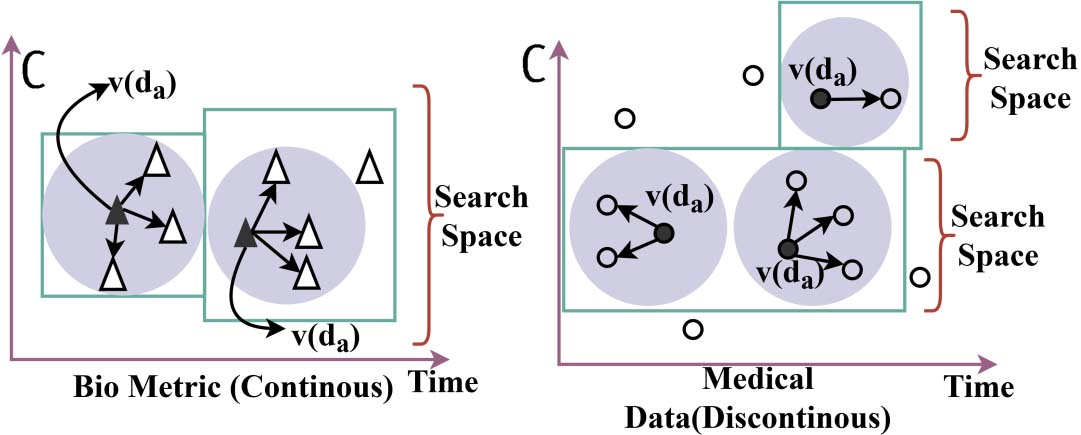
The biometric data is continuous, and medical data is discontinuous for time. The variation in time is given on the x-axis, and the data detection is given on the y-axis. The time increases for detected data represents a single search space for biometric data, so it is continuous. The double search space is represented for discontinuous medical data due to increased time for detected data. The searching differs for every set of acquiring data from the multisensor, and it is denoted as
In the above equation, the data points are used to define the patients’ state for this KNN uses the similarity of data, and this is done by mapping approach. The mapping is carried out for the varying data associated with the patient’s abnormal condition; in this evaluation step, the message is sent to the remote patient. In this processing, the identification is done with the preceding data. The time is estimated to provide the service to the user. The fog node does this, and it utilized cloud computing; the medical healthcare data is stored in the cloud environment. The points in the planes are used to define the fog nodes that relate to the nearby nodes to the easy and fast transmission that avoids the emergency state, and it is computed as
The suggestion model is designed to forward the feedback regarding the data identified in the preceding state. Differentiate is done on KNN to examine the data points on the plane. It is defined as similar data that is already detected at the stage of mapping. Thus, the data point is detected, and it is termed as
The forwarding of data is done for the abnormal patients to decreases the risk, and it deploys the detection of data by mapping with the history of data processing; the condition is termed as
The new data points are assigned
Data point assignments.
The x-axis increases for data detection value in the y-axis develops continuous biometric data and discontinuous medical data. The data point’s response space and search space are developed separately and new points in continuous biometric data and discontinuous medical data. Thus, the forwarding is determined by utilizing the suggestion model and temporal information associated with the continuous detection of data from the sensor. Thus, the assigning of data is evaluated to determine the plane’s data points and analyze the user’s abnormal condition, and the suggestion is forwarded at the emergency state. In this fog, layers deal with the temporal information associated with the detection process; the following part is used to identify the service deliverances. In Table 1, the data assigning and forwarding for different detection factor is tabulated.
Data assigning and forwarding for different detection factor
The detection factor for varying data deploys by assigning to the number of data and provides efficient sharing. The forwarding is done from the low to high and resides to constant and determines better processing. Here, assigning and forwarding for the proposed work shows low to a high and constant value. In Table 2, the data points for different detection factor and fog nodes are tabulated.
Data points for detection factor and fog nodes
The detection factor is done that deploys the data points, and it is associated with the fog nodes. If the detection is improved then, the number of data points for the proposed work shows better processing. Here, the different fog nodes ranges from 10 to 40 and shows a higher detection factor for 16 compare to 10.
The service deliverances are identified by determining the time that deploys the mapping method of data with data history. This identification is carried out on the initial stage, and forwarding is done on the fog nodes. Here, temporal information is handled by the fog layers that are used in an emergency. Evaluating this service delivery is determined and provides the patient’s result; in this, feedback and suggestion are forwarded on time. This work aims to improve the service deliverances, for this identification is determined and examined in the below equation.
The service deliverance estimated in the above Eq. (8b) is related to the forwarding of the data in the fog nodes; thus, distance is detected between them. The points are used to define the similar data from the history mapping represented as
The mapping is performed on the IoT environment associated with the healthcare system that stores the collection of biometrics and medical observing data. The mapping is evaluated; post to this process, the forwarding is carried out; it finds the nearby nodes and passes the data. The nearby nodes provide the patient feedback on time; this evaluation step addresses the service failure and improves the better service deliverances. The analysis is done for the precaution and suggestion the patient asks for, and it uses Equation (9); this is used to improve the suggestion model.
The analysis of the suggested model is examined in the above equation, which is measured to forward the reliable data to the patient. Here, the suggestion model is improved with the data points on KNN and determines the nearby node. The KNN is used to find the nearby nodes on the space, transmit the medical data, and tackle the service deliverances. Thus, the searching is done for similar data from the sensor and suggests the patient termed as
The emergency state is detected if there is abnormal data detected at the multisensor devices and is associated with the mapping process. The continuous detection of abnormal data is estimated and provides the suggestion by performing mapping, and it is represented as
In the above Eq. (10b), the accuracy level is improved, which is associated with the true positive and true negative, and it is defined as patient condition and emergency detection. The number of data sensed in the multisensor devices deploy the biometric and medical observing. The new data is assigned by evaluating the KNN method associated with the FIoT-MIMM approach and decreasing the service deliverances. Thus, the suggestion model is enhanced by deploying the temporal information acquired from the patient in the emergency. If an emergency occurs, the alert message is forwarded to the mobile phone and improves physical healthcare. In Figs 7 and 8, the service delivery and accuracy for different assigning factors are illustrated.
Service delivery % (assigning factor).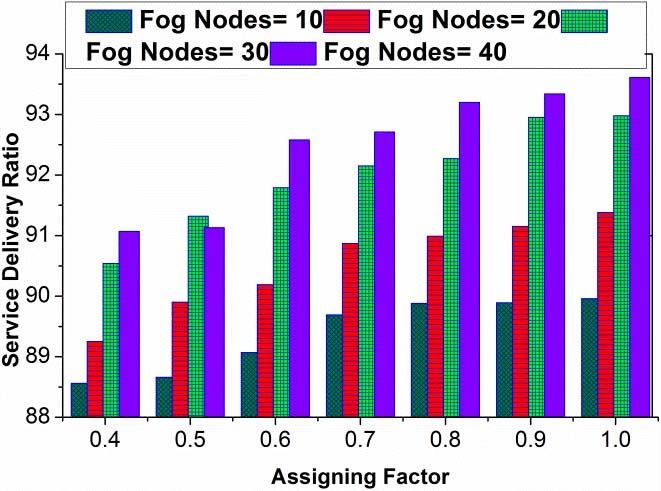
Accuracy (assigning factor).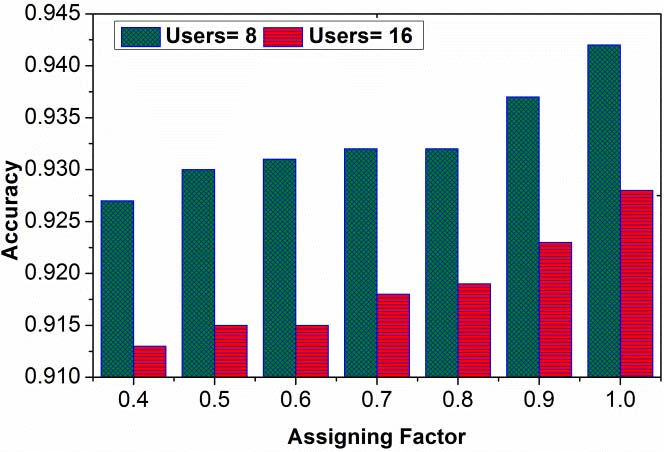
The assigning factor varies for service delivery ratio that deploys fog nodes from 10 to 40. If the service delivery ratio increases, the assigning factor for the proposed work increases. The fog node for 10 shows a better assigning factor than 40, and the service delivery ratio relies low on high (Refer to Fig. 7). The assigning factor for the accuracy level shows a higher range for the number of users from 8 to 16 (Refer to Fig. 8). If the assigning factor increases, the accuracy level also increases for the varying users. The accuracy ranges from low to high, and user 8 shows a higher assigning factor than 16 values. If the number of users increases, the accuracy of the proposed work increases.
This section presents the discussion on the performance of the proposed FIoT-MIMM using the OPNET simulations. In this simulation, 16 user devices are deployed 50 fog nodes serve that. The network is modeled as illustrated in Fig. 1, in which a centralized server is considered a data analyzer. This system makes use of the existing recommendation for responding to 15 monitored intervals. The storage of the server is 1TB with a processing speed of 2.4 GHz. The performance is verified using the selected metrics accuracy, service delivery ratio, response time, and data utilization. For verifying the consistency of the proposed method, a comparative analysis with SAOA [24], HealhtFog [27], and MAIoHTF [25] is performed.
Accuracy
Accuracy (monitoring intervals).
Accuracy (fog nodes).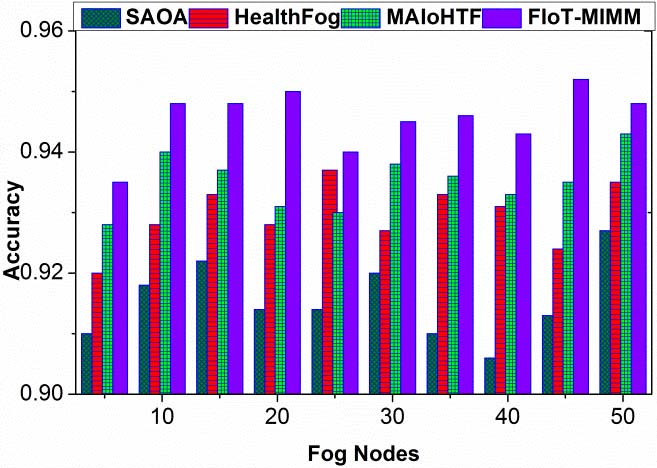
The accuracy of the proposed work increases for varying monitoring intervals and fog nodes. Here, the initial step is to acquire the data from the multisensor and analysis the state is either normal or abnormal. Based on this evaluation step, the accuracy rate is improved, and this data is associated with the sensor data. If there is abnormal activity is detected, the alert signal is forwarded to the end-user, and it is denoted as
Service delivery ratio (fog nodes).
Service delivery ratio (users).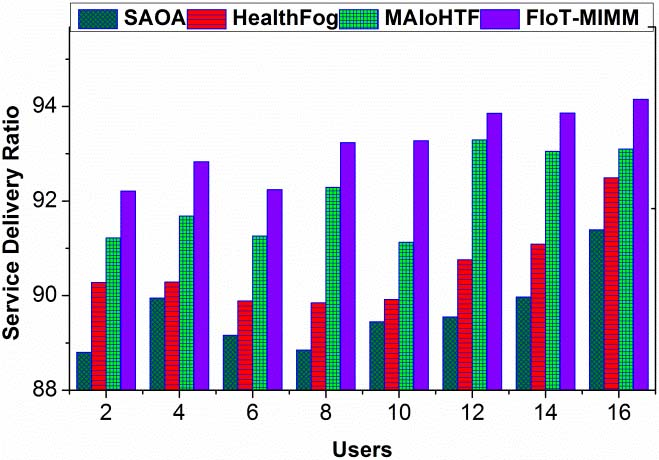
In Figs 11 and 12, the service delivery ratio increases for varying fog nodes, and the number of users accesses the data. If the patient is in an emergency state, the data is acquired from devices and matches the medical center in IoT. From this, if the data is normal, the forwarding is carried out as the alert signal. In this manner, the service delivery ratio is improved, and it is formulated as
Response time (fog nodes).
Response time (users).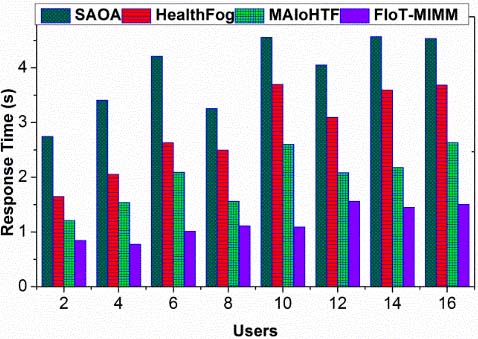
The response time for varying fog nodes and the user decreases in the proposed method and deploys the detection process. The data is forwarded to the fog nodes and determines the mapping with the suggestion model computed as
Data utilization (monitoring intervals).
The data utilization for varying monitoring intervals and fog nodes increases and shows better performances than the other three methods. The utilization of the data is determined from the previous state and deploys the efficient processing denoted as
Results summary for monitoring intervals
Results summary for fog nodes
Results summary for users
Data utilization (fog nodes).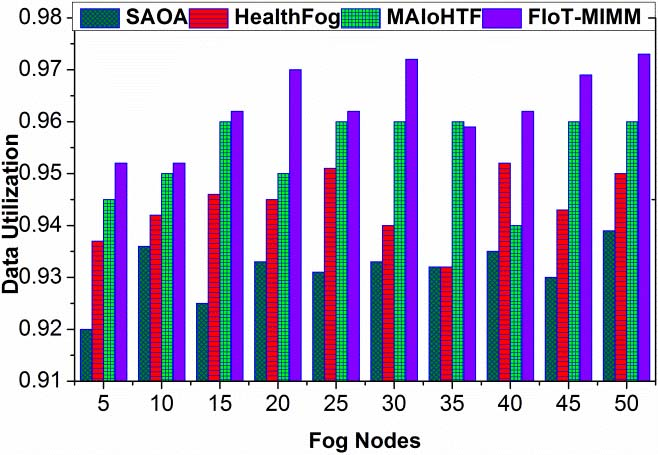
This paper proposed a Fog-IoT-assisted multisensory intelligent monitoring system to improve the service delivery ratio of mobile healthcare and remote monitoring systems. The proposed method relies on observed wearable sensor data for service responses without prolonged delays. The data is segregated using k-nearest neighbor learning for its continuous and discontinuous sequence. The discontinuous observed data points are mitigated by reassigning temporal information based on the learning. Suggestions and recommendations for the patients are assisted based on the information analyzed by the learning. The segregated sensor data learning reduces service response delays, improving detection and data utilization accuracy. In the future, variant sensor data is planned to be analyzed using dataset correlation for augmenting the multi-application (smart medicine) support. Besides, online learning practices are planned to be integrated for improving the efficiency of classifier training.
Footnotes
Conflict of interest
None to report.