



Abstract
BACKGROUND:
Physical health monitoring may take several forms, from individual quality changes to complex health checks carried out by health staff. Present health issues are detected with monitoring, and potential health problems are expected. Wearable sensors provide users with ease in everyday tracking, although many issues must be addressed in such sensor systems. The devices take a long time to obtain the requisite detection and diagnostic expertise and produce false alarms.
OBJECTIVE:
In this paper, the Internet of Things-assisted Health Condition Monitoring system (IoT-HCMS) has been proposed to track and analyze the patient physical health condition.
METHOD:
The proposed IoT-HCMS utilizes the intelligent monitoring model to follow the patient physical health day by day activities and instantaneously generate the health records. The system will indeed support patients in tracking psychological signs to minimize risks to their well-being.
RESULTS:
The experimental results show that the IoT-HCMS improves accuracy in patient health monitoring and has less response time.
Keywords
Introduction
Monitoring physical health impacts the continued mental health and well-being [1]. Recently, the mental disorder has shown a significant effect on physical health [2]. A large analysis showed a 2.5 times higher mortality rate for those with a medical disorder than the overall death rate for all people [3]. For a variety of causes, people with mental health may have affected their physical health [4]. Compared to those without mental illness, they are not likely to provide proper healthcare [5]. It is an indictment of our mind-health environment that those with mental health facilities have sometimes ignored their physical health needs [6, 7]. Also, conduct-related causes like smoking, adverse alcohol and other medications, obesity, inadequate diet, poor housing conditions (e.g., homelessness) [8], and ill-treatment resulting from disease-related symptoms could increase susceptibility to physical health issues in individuals with mental disorders [9, 10].
In the last decade, Internet of Things (IoT) enables all devices internally connected and becomes the latest technical development [11]. Some of the IoT implementations include smart health regulatory framework, smart transportation, smart building, smart city, smart environment, manufacturing sites, and farming [12]. The most important usage of IoT-HCMS is health management that provides facilities for tracking health and the environment. IoT-HCMS is simply a connection between computers and the internet using sensors and networks [13]. These interconnected modules may be used for health monitoring devices [14]. The sensors send reliable information to remote places such as M2M, computing computers, people machines, portable devices, or smartphones [15, 16]. IoT-HCMS monitoring and optimizing health issues is simple, effective, much smarter, flexible, and compatible. Modern technologies like IoT-HCMS have a modular interface, support devices, and mental health treatment to ensure the smart life of humans.
Pulse rate and body temperature are the two most important indicators for human health. The pulse rate is the per minute number of heartbeat, also known as heart rate. The pulse rate can be calculated by measuring the pulses by increasing blood flow volume [17]. The average duration of the pulses ranges between 60 and 100 beats per minute in healthy individuals. In adult males, the normal heartbeat is around 70 bpm and in adult males 75 bpm.
In comparison to males, women aged 12 and over generally have a higher heart rate. The body temperature and the amount of heat radiated by the body are only measured by the heat of the body [18]. The normal body temperature depends on many factors, including the environment, gender and eating habits of the person [19]. The human body temperature is generally the body heat, and the amount of radiated heat is scientifically calculated. The average temperature of the person’s body depends on various factors such as climatic conditions, gender, and food behavior [20]. It can vary from 97.8
The suggestion is that health care encourages patients by having good ambient. Some measurements, such as room temperature, toxic gas levels like CO and CO
The core objectives of our research are summarized as:
IoT assisted patient healthcare monitoring in the smart environment. Real-time response from classification algorithm based on Cloud computing. Event process-based mechanism of patient healthcare data mining at cloud environment. Real-time notification-based decision-making framework with patient health record information deliverance to healthcare providers and caregivers under different circumstances.
This research work is outlined in different sections. Section 2 gives a review of several relevant Cloud and IoT-based healthcare monitoring literature. Section 3 provides a complete overview of the proposed structure for IoT-based patient healthcare management system. Section 4 addresses the result and discussion of the proposed classification algorithms embedded with real-time alerts with relevant outcomes. Finally, Section 5 summarizes the paper with certain important statements.
Mutlag et al. [28] discussed the low-cost ECG health surveillance and automated review and warning system provides reliable remote management. The device consists of energizing sensor nodes and a fog layer using IoT. The sensor nodes store and relay ECG, breathing rate, and body temperature remotely to an intelligent door accessible by the appropriate attendants [29, 30]. The device can also offer helpful information gathered, automatically determine and provide specialized resources for urgent consideration, such as real-time alerts [31].
Sodhro et al. [32] developed an intelligent patient monitoring system to monitor patients’ heart rates automatically with a novel, healthy, and intelligent IoT solution based on an agent. Our machine is smarter and can predict the critical situation. Send a note to the families of patients, physicians, nurses, and the person in charge of hospitals and trigger an alert with the closest people’s help [33].
Subahi [34] proposed telehealth based on IoT is a new concept in the health field. The suggested work includes incorporating a pulse tracking system based on IoT. A health care sensor interfacing with a microprocessor is checked with the proposed procedure [35]. The microprocessor tracks the sampling rate of cardiac beats and then communicates distinct values by Wi-Fi modules ESP8266.
Tekeste et al. [36] presented a new model in health care called SMEAD to implement a method of end-to-end safe management of diabetic patients. Includes wearables for observing and forecasting the patient’s diabetic condition while monitoring various parameters [37]. The device suggested uses a MEDIBOX that configures the appropriate dose and warns users to take medication on time. In this situation, insulin dosage will be sustained under sufficient cooling conditions and tracked continuously using the device.
Woo et al. [38] proposed a modern context-aware framework that tracks and assesses dependence based on a practical measuring system. Our system assesses an individual’s support, forecasts his or her health status, identifies abnormal situations and dangerous behavioral changes, and provides appropriate services.
Wu et al. [39] focused on designing an IoT device that effectively detects an individual’s stress level and provides input to help individuals handle stress. The machine comprises an intelligent band module and a module for the heart and the hand. The machine tracks Electro Dermal Movement and Heart Rate in real-time and transmits the data to an Online IoT network.
In this research, the IoT-HCMS method using nano-sensors is built which includes task algorithms based on the network algorithm, the smart healthcare sensors, and the highly sensitive nano-sensors. Moreover, IoT-HCMS can decrease the wait time when transmitting data while requiring lower memory.
Overview of IoT-HCMS
IoT-HCMS development consists of IoT healthcare sensors, data handling framework, and decision-making framework. The hardware includes nodes on the Pi Zero Raspberry (RPIZ). The software features include a fuzzy cloud cover decision-making framework. Nodes gather unique critical data from participants to assist people in different situations such as doctor reference, patient history, and high-risk warnings. Also, nodes collect and amend their healthcare decision-making guidelines. The following sections provide a detailed overview of each component involved in IoT-HCMS. Figure 1 shows the proposed methodology and the fundamental functioning of the IoT-HCMS framework.
IoT-HCMS framework high-level architecture.
This IoT healthcare sensor captures proximity data using wireless networks and connects with a server via the mobile data network via an optimized consumer smartphone. The absence of a cellular and wireless data network is composed of the RPIZ as central processor, pulse rate sensors, body temperature sensor, room temperature and humidity sensor, harmful gas sensors, and the LoRa data transmission module.
Central processor (RPIZ)
RPIZ is one of the most important components of IoT-HCMS. It provides a total Linux system for a very low cost on a small stage. RPIZ enabled with GPIO pins to device sensors and drives. In the area of health care, RPIZ and IoT are a modern technology for innovation.
The RPIZ builds fully designed antenna switches, antenna, control amplifier, low noise amplifier and even power management modules. It can perform as a full stand-alone scheme minimizing general communication in the main processor.
Pulse rate sensors
Based on the plethysmographic theory, the pulse rate sensor is developed. It monitors blood pressure changes through someone’s organ, which allows the light intensity to pass into the organ. The pulse rate sensors monitor the heart pulse rate and timing of pulses. The frequencies of heartbeats decide how much blood flow expands, and as light is absorbed in the blood, the signal are similar to the heartbeat pulses.
Body Temperature sensor
The Body Temperature sensor consists of accurately-optimized output-voltage temperature loops, linear with centigrade temperature. The body’s temperature sensor has a view over the rigid Kelvin temperature sensors, so the user can’t separate the massive constant voltage from the display through pragmatic centigram scaling.
Room temperature and humidity sensor
DHT11 is a generally used sensor for measuring humidity and temperature. The sensor comprises an NTC and an 8-bit array temperature and humidity measuring microprocessor. In the whole device, the sensor is also calibrated by simply communicating with other microprocessors.
Harmful gas sensors
MQ-9 is suitable for the measurement of LPG, CH4, and CO. Due to its high sensitivity and fast reaction time, measurements can be quickly performed. Responsive sensitivity with the potentiometer can be changed. MQ-135 is suitable for identifying NH3, Particulate matters, Smoke, CO2 detection and employed for air quality control systems. The MQ135 sensor is fitted with a digital pin that can be used to identify particular gases without a microcontroller.
LoRa data transmission module
LoRa data transfer module performs the task of recovering data on separate activities directly or indirectly relevant to the patient from IoT systems in the room environment. The data were obtained from various wireless hardware sensors utilized in various locations in the room and from the patient’s body sensing network. These hardware systems can operate on the wireless sensor principle and relay data in real-time. With bio-sensor devices and other medical sensors, each sensed data is integrated. The patient’s behavioral and physiological parameters are gathered numerically and graphically using the IoT-HCMS framework.
Data handling framework
Researches have recorded a decrease in body immunity among persons with normal health conditions. These patients are also more sensitive than those patients who have regular health issues. These patients need to be continuously monitored using the IoT-HCMS framework with different datasets listed in Table 1.
Dataset relation in IoT-HCMS framework
Dataset relation in IoT-HCMS framework
The Health dataset contains data values that affect patient health directly. These values are drawn from the body sensor network of patients. Remote control systems for cardiac rate, nasal respiratory sensors, blood pressure arterial catheter sensors, blood pulse oximeter saturation sensor, fever temperature sensor, glucose level glucometer adaptors, and Electrocardiograph (ECG) devices are used to measure the health condition of the patient.
Ambient dataset (AD)
Many health studies have demonstrated the environmental factors are more significant to the health of patients. Therefore, values relevant to the environment are collected and preserved in Ambient Dataset. It covers the quality of the ambient air, noise, ambient temperature, etc. Different sensors positioned in different positions in a room acquire this sort of data. Different sensors are positioned at different points in the room to capture such data.
Behavioral dataset (BD)
Patients with regular health issues are advised to take bed rest. Prolonged bed rest will lead to patients’ discomfort, anxiety, and restlessness. Sensors are integrated into the bed and the patient body to gather the behavioral parameters of the patients. ECG and EMG devices track the brain’s electrical impulses by an electrophysiological approach to cope with behavioral disorders. Furthermore, ECG and EEG signals contain trillions of data not analyzed on the data handling framework. Thus, when the patient’s Degree of Impact (DOI) reaches a certain amount, the data handling framework sends ECG and EEG to the cloud for further analysis instantly.
Decision making framework
In the decision-making framework, the first protocol is to gather all IoT-HCMS data using data mining technology. Data mining is intended to extract valuable data in real-time from the cloud data providers. In other words, the research relies on a time-based analysis of different data collected from the cloud environment. Data mining is based on pure sequential mining technology because patient welfare is a time-sensitive parameter. Sequential mining is the technique of data analysis in time series models (TSM) for collecting datasets. Time series models can be mathematically derived as
Whereas
By approaching the sliding window technique, a time interval
In the case of a Patient Health Index (PHI), the probabilistic values are determined from the values of the attributes selected by the Time Series Model (TSM) for a specific period. The higher PHI value suggests that the health of the patient is bad and vice versa. Moreover, PHI is vital that any irregularity in the patient’s health can be transmitted to the healthcare provider so that the healthcare provider involved can take suitable action. To calculate the PHI value, the weighted average conditional probability approach can be implemented. Mathematically PHI can be derived as
Here
Forming of temporary granules.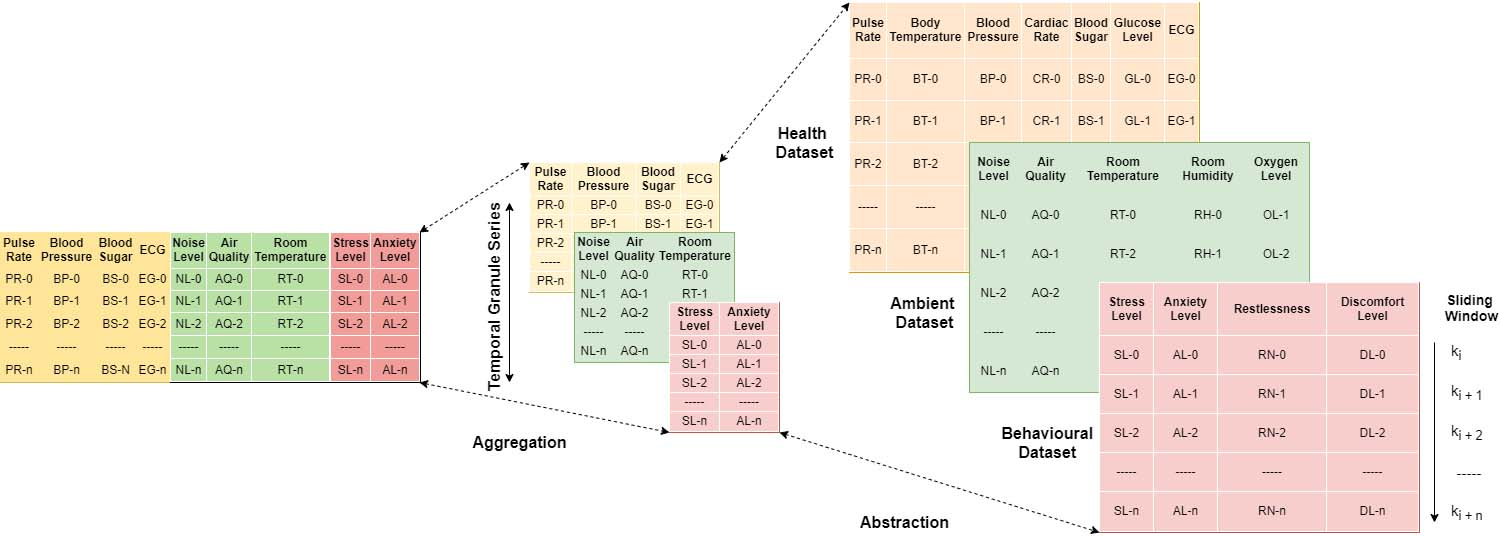
Once the data mining is completed, IoT-HCMS process the decision-making framework. This means that the cloud environment defines the patient’s health status as a healthy condition (HC) or unhealthy condition (UC). HC implies that a patient’s PHI value is not needed to determine. On the other hand, the UC suggests that patients’ health is unstable, and the healthcare provider must immediately take urgent action. Also, if the patient’s condition is unsafe, two measures are taken by the healthcare provider. Firstly, quick warning signals are intimated. Second, for further analysis, patient health data are moved to the cloud layer in real-time. Figure 3 displays the process to assess the patient’s condition based on the sampled characteristics of health and climate in the Cloud environment.
Patient state identification flowchart.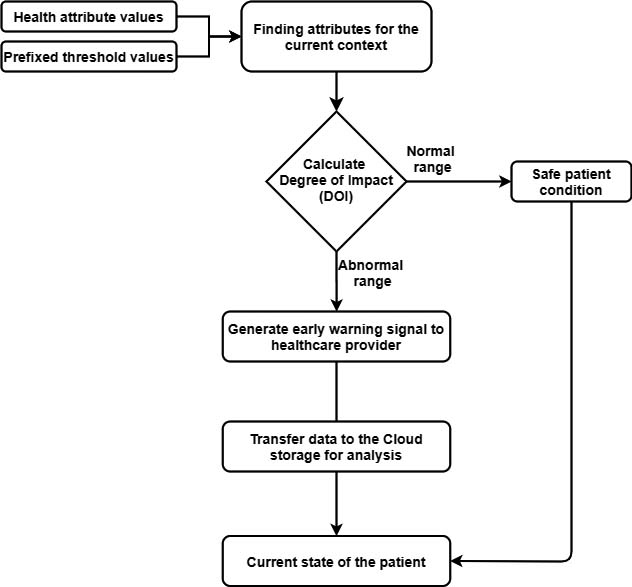
The criteria of direct significance are, however, used to measure the health status of the patient. Figure 4 reveals the decision-making process dependent on the cloud. Since the cloud layer addresses reasonably straightforward incidents, then event-based signals should be passed to the cloud layer to calculate the PHI value of patients for successful decision-making. The threshold limit
Emergency alert generation flowchart.
Healthcare providers are notified by warning signals from statistics measured with the DOI at the cloud environment regarding the patient’s health. Also, patient-specific health information after identifying PHI value on the cloud level is given to the healthcare providers. Based on that detail, the healthcare providers the emergency treatment under a certain degree of urgency. The patient family members will also be notified with modified warnings if the value of PHI is above the threshold level. The Decision-making framework also offers information on the location of the ambulance and other emergency facilities. Many healthcare facilities may use summary data to create alternative drugs or medications for various diseases. Finally, a decision-making framework sends application rules and pattern updates to cloud data providers to process multiple applications.
The proposed system’s effectiveness is analyzed, and the outcomes are reviewed for efficiency. For a proper understanding, the experimental design of the proposed device is split into four parts.
Creation of IoT-HCMS-based patient healthcare data Testing of BBN classification algorithm Performance investigation on IoT-HCMS framework Cloud supported IoT-HCMS framework readiness level for smart environment
Due to the object model’s high-risk level, IoT-based smart healthcare sets are regularly generated to cover many instances in our experimental segment. Initially, 75 persons were classified into three categories based on patient clinical history characteristics: i) persons with healthy condition ii) persons with unhealthy condition iii) persons with severe diseases. We use static data sets, namely health and ambient datasets, to effectively produce Health Report (HR) data sets for each category. The Health dataset was gathered from the UCI database system consists of 17,806 sets of data. It comprises body heat, blood pressure, pulse rate, and blood sugar. Also, more than 18,000 ambient datasets have been accessed from the US EPA data source. Cloud server stores data collected from these separate datasets. By setting the probabilities health dataset and ambient dataset linked to each category, health report generated for this dataset.
Testing of BBN classification algorithm
To validate the BBN classification algorithm, systematic data sets developed using IoT-HCMS-based patient healthcare data. This classification is used to categorize events into the regular and irregular range of our suggested approach. Seventy-five patients IoT healthcare data is used for creating a Neural framework with the “bnlearn” package based on the R studio. Table 2 explains the outcomes of various classification algorithms. This table indicates that, because of minimal response time and more learning arcs, “GS” and “MMPC” can be chosen for the proposed method. The training classification BBN is checked for different statistical parameters in Weka. The BBN classification algorithm is divided into two different BBN elements, named first and second category. Three-stage experimental observation discussed as follows: i) The first step measures the risk of environmental and medical history exposure, ii) The second stage measures the probability of event systematically after the first stage probabilities are identified, and iii) The complete BBN estimates the probability of incidents both stages of BBN classification algorithm.
Outcomes of various classification algorithms
Outcomes of various classification algorithms
Accuracy measurement of BBN classification algorithms
Table 3 indicates the overview of the BBN classification algorithm. In several points, the sensitivity of the classification algorithm is greater than 85%. In comparison, with the degree of findings from the statistical parameter, the two-stage BBN classifier’s applicability in our proposed framework shows better results. Table 3 also lists the precision and accuracy of each class parameter using the BBN classification algorithm.
Accuracy-based performance analysis of different classification algorithms.
Repeatability-based performance analysis of different classification algorithms.
In the Cloud environment, data are stored on the patient simulated instance. Our proposed BBN method is also applied by various classification algorithms such as the Grow-Shrink (GS), Fast Incremental Association (Fast-IAMB), Interleaved Incremental Association (Inter-IAMB), Incremental Association with FDR Correction (IAMB-FDR), Max-Min Parents & Children (MMPC), Hybrid Parents & Children (HPC). The use of the BBN classification algorithm can be experimentally justified in the real-time healthcare monitoring environment using the IoT-HCMS framework. The comparison of various statistical calculations of using classification algorithms on different user data sizes. The different algorithms accuracy is illustrated in Fig. 5, and the classification algorithms repeatability is shown in Fig. 6. The two-stage GS classification algorithm exhibits better results than all other classification algorithms in accuracy and repeatability. However, classification algorithms’ accuracy and error rate for MMPC is still similar to GS, but MMPC takes much higher classification time than GS, as shown in Fig. 7. Figure 8 shows five classification indicators: Precision, Recall, F-measure, ROC Curve, and Specificity. In all statistical indicators which justified their use within the proposed method, the two-stage BBN outperformed well than any other comparable algorithm.
Classification time-based performance analysis of different classification algorithms.
Perfectness rate of different classification algorithms.
Accuracy is the key element for the analysis of the physical health condition. Figure 5 illustrates the accuracy of various IoT-based classifications. Out of these six algorithms GS method shows the better outcome followed by MMPC provides better performance in accuracy in comparison with all other technique. Even though Fast-IAMB, Inter-Iamb, and IAMB-FDR shows better performance as compared with HPC. Comparing with traditional algorithms, GS-based Internet of Things-assisted Health Condition Monitoring system (IoT-HCMS) provides better performance in accuracy over number of iterations, because proposed method follows sequential computerized procedures.
Forecasting the medical emergency is the key parameter to safeguard the human lives in emergency situations. Figure 6 illustrates the repeatability of various IoT-based classifications. Compared with traditional algorithms, GS classification algorithm shows the better repeatability rate followed by MMPC, IAMB-FDR, Inter-IAMB, Fast-IAMB, and HPC. HPC-based classification algorithm exhibits the poor performance as compared with advance classification algorithms, it leads to a poor medical service. Comparing with traditional algorithms, GS-based Internet of Things-assisted Health Condition Monitoring system (IoT-HCMS) provides better performance in forecasting the medical emergency over number of iterations, because proposed method follows systematic simulation procedures.
Classification time plays a vital role in ensuring the physical health condition of the patients. Figure 7 illustrates the classification time taken for various classification algorithms for a number of iterations. In comparison with traditional classification algorithms, GS classification consumes the very low classification time in physical health monitoring system. Comparing with HPC classification algorithms, GS-based Internet of Things-assisted Health Condition Monitoring system (IoT-HCMS) provides better performance in minimal classification time in association with physical health condition, because proposed method follows systematic knowledge.
Perfectness rate in physical health monitoring system plays a key role in emergency need of the patients and it provides the effective information’s in emergency situation to the healthcare providers. Figure 8 illustrates the perfectness rate of the various classification algorithms based on precision, recall, F-measure, ROC curve, specificity, and MCC. GS and MMPC ensure the utilizing of high-standards in every stages of physical health monitoring system. Out of these classification algorithms GS method exabits the superior effect followed by MMPC method shows some better performance in utilizing standards and effectiveness in physical health monitoring system in compare with other techniques. Comparing with HPC, GS method and MMPC method provides better results in ensuring utilizing standards and effectiveness over number of iterations, because proposed model follows IoT-based physical health monitoring system.
Readiness level of cloud supported IoT vs. healthcare surveillance.
Figure 9 indicates the readiness level of cloud supported IoT relative to a variety of patients in the smart environment and healthcare surveillance. Figure 9 concludes that chronic respiratory disorders, healthcare-related living standard, and cardiac problems of patients who have less focus on fall detection and tracking routine practises in smart environments and healthcare surveillance. Finally, IoT-based smart healthcare monitoring system is better controlled for situations or activity discussed by the smart environment.
The proposed system shows very explicitly that IoT-based cloud technology provides end users with patient health reports. This research has implemented the IoT-HCMS framework for health monitoring system enhancement gateway, which provides fast treatment with minimum delay. We also characterized the patient’s health condition as healthy or unhealthy by using the IoT-HCMS framework by minimizing the quantity of data transmitted into the cloud. For numerical adversity incidents, real-time instances on the cloud environment are tracked. Furthermore, an incident initiating mechanism is implemented to pass patients’ critical signals to the cloud during the transition to an unsafe condition. The patient’s health index (PHI) is calculated in a cloud environment to govern the emergency need. The time-sized data granules for successful decision-making correlate with different incidents. The provision of information to the cloud response plays an important role in the control of medical emergencies. Finally, the proposed framework’s effectiveness is improved by an actual time warning generation with an event severity calculation.
Footnotes
Conflict of interest
None to report.