



Abstract
BACKGROUND:
Ficus benghalensis has been used by local health care practitioners to treat pain, inflammation, rheumatism, and other health issues.
OBJECTIVE:
In this study, the crude extract and diverse fractions, along with the isolated compound of F. benghalensis were examined for their roles as muscle relaxants, analgesics, and sedatives.
METHODS:
The extract and isolated compound 1 were screened for muscle-relaxant, analgesic, and sedative actions. The acetic acid-mediated writhing model was utilized for analgesic assessment, the muscle relaxant potential was quantified through traction and inclined plan tests, and the open field test was applied for sedative effects.
RESULTS:
The extract/fractions (25, 50, and 100 mg/kg) and isolated compounds (2.5, 5, 10, and 20 mg/kg) were tested at various doses. A profound (
CONCLUSION:
The extract and isolated compounds of Ficus benghalensis can be used as analgesics, muscle relaxants, and sedatives. However, detailed molecular and functional analyses are essential to ascertain their function as muscle relaxants, analgesics, and sedatives.
Introduction
Herbal products and medicinal plants have been utilized for several centuries to treat human illness. Medicinal plants contain many dynamic chemical constituents with beneficial value [1]. Across the globe, about 80% population relies on medicinal plants, which provide the first line of health defense to maintain health and conflict with disease [2]. The 50% and of all advanced clinical medicines are having their beginning with natural products [3]. Medicinal plants are a key and rich source for identifying diverse classes of natural products extracted and used in herbal formulations and remedial applications. Drugs are mostly derived from wild plants or plants under cultivation [4].
Ficus benghalensis is a large green tree from Moraceae [5] that comprises several spiritual and mythological circumstances [6]. F. benghalensis is cultivated in South Asia, especially in Sri Lanka, India, Pakistan, and Bangladesh [7]. Creative physicians distinguish the medical assets of a variety of parts of a tree. The milky fluid from F. benghalensis is used to treat superficial pain, bruises, back pain, and fractured and inflamed soles of the foot [8]. In India, the roots are used for the treatment of gonorrhea, biliousness, dysentery, and liver inflammation. Aerial root tips are utilized to treat vomiting and dysentery. The small branches are used for hemoptysis, and the bark of the infusion can be an effective tonic with anti-diabetic properties [9, 10]. F. bengalensis is also used to treat inflammatory and rheumatism diseases [11]. They are used for the treatment of immunomodulatory [12], hypolipidemic [13, 14], and antiasthmatic diseases [15]. F. bengalensis extract exhibited antioxidant properties [16]. F. bengalensis bark extracts have been reported to have anti-inflammatory, hypolipidemic, anti-allergic, anti-diabetic, antihelminthic, wound healing, and antidepressant properties. The aerial roots of F. benghalensis are also used for immunomodulatory functions and to improve the immune system [17, 12]. Aerial root extract is utilized to increase hair growth and decrease hair loss [18]. In this study, we used the extracts and isolated compounds from F. bengalensis for their potential as analgesics, muscle relaxants, and sedatives. Molecular docking studies were performed to determine their bioactive functions.
Materials and methods
Plant material
F. benghalensis stems were obtained from Anbar Swabi, KP, Pakistan, in June 2020. The collected specimens were verified and stored in the herbarium of the Botany Department, University of Swabi, KP, Pakistan.
Extraction and isolation
F. benghalensis stems were dried for 24 d under shade and then powdered. The powdered stem (2.00 kg) was treated with methanol to yield a methanolic extract. The methanol extract was treated with hexane, chloroform, and ethyl acetate using a Soxhlet apparatus to obtain hexane and ethyl acetate fractions. The ethyl acetate extract (20 g) was administered to silica gel column chromatography and eluted with methanol and chloroform (20:80), which yielded 20 subfractions (BK1–BK20). On the basis of TLC profile, BK4 was treated to repeated silica gel column chromatography by elution with methanol and chloroform (8%:92%) to obtain compound 1. The structure of compound 1 was determined by comparing the spectroscopic data with earlier data [19].
Animals
The experimental animals were procured from the Department of Pharmacy, University of Peshawar, KP, Pakistan, and transferred to the animal house of the Department of Pharmacy, University of Swabi KP, Pakistan. BALB/c albino mice (18–22 g) were utilized in the experiments. Only healthy mice of either sex were included in this study. Immobile and unhealthy mice were excluded from the study. All animals were stored under standard laboratory conditions with recommended food and water.
Analgesic activity
The acetic acid-mediated writhing model was used for screening [20], and the animals were grouped into various groups (
Muscle relaxant activity
The muscle coordination action of the samples was analyzed using traction and inclined plane models [20]. In both experimental paradigms, animals were classified as above, with the only difference being that the positive control group was subjected to diazepam (0.5 mg/kg).
Traction test
In this case, a rubber-coated metallic wire was tightly secured at a height of 60 cm from the working bench [20]. After administration of the respective substances (extracts, fractions, isolated compounds, diazepam, or normal saline), the substances were allowed to react for 30 min. Each animal was endorsed to hang using a metallic wire for 5 s. The animal was considered devoid of muscle relaxant effects if the animal was left hanging for 5 s. Animals that failed to hang for the given duration were considered to have relaxed muscles. The percentage of animals in each group was calculated as follows:
Inclined plane test
In this experimental paradigm, the inclined plane is fixed at an angle of 650. After 30 min of the above treatments, animals were kept individually at the top of the inclined plane, and the sliding of each animal was checked at a given time duration of 5 s [20]. The animals were declared to relax their muscles if they failed to slide within 5 s. The percentage effect was calculated using the above equation:
Sedative activity
An open-field animal model was employed to evaluate the sedative effect. According to our published method [21], a specially lined box was used for this activity. This activity was conducted in a soundproof laboratory. The animals were classified as described above. After 30 min of treatment, each animal was checked individually for movement in a special box. The animals crossing maximum lines were considered non-sedative, and vice versa.
Molecular docking study
Molecular docking analysis was used to examine the nature of the interactions between ligands and drug targets. The chemical structure of the carbapenem compound was drawn in Chem Draw v16 and saved in. mol format. The energy of the compound was minimized using MOE software, and the energy-minimized structure was used as the input for the molecular docking study [22]. The crystal structures of COX2 and GABA receptors (PDB ID: 3LN1 and 6X3T, respectively) were obtained from PDB [23]. Proteins were prepared by removing the water molecules, co-crystallized ligand, and cofactors before docking. A maximum of ten confirmations were generated for the extracted compounds [24]. The conformation with the lowest docking score was identified to examine the interactions between the target receptor and the compound using the MOE and PyMOL software.
Results
Isolation and characterization of compound 1
The extract (20 g) was endorsed to repeated column chromatography (CC) using chloroform and methanol (80:20) as a solvent system that afforded compound 1. Compound 1 was isolated as a yellow powder from the ethyl acetate extract of F. benghalensis. ESI-MS showed m/z 337 (M
Analgesic effect
The analgesic actions of the crude extract/fractions and isolated compounds are given in Table 1. A dose-mediated response was noticed at various doses. The isolated molecule demonstrated a maximum (
Analgesic activity of extract/fractions and carpachromene isolated from F. benghalensis
Analgesic activity of extract/fractions and carpachromene isolated from F. benghalensis
Data are given as mean
Figure shows the chemical structure of compound 1.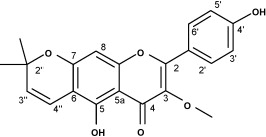
The relaxant actions of the extract/fraction and carpachromene are provided in Table 2. In both muscle relaxant paradigms, dose- and time-dependent muscle relaxant activities were observed. A profound action was observed against the isolated compound (71.09%), followed by ethyl acetate (66.98%) and methanol (67.10%) fractions. The maximum muscle coordination effect was achieved 90 min after application.
Muscle relaxant activity of extract/fractions and carpachromene isolated from F. benghalensis
Muscle relaxant activity of extract/fractions and carpachromene isolated from F. benghalensis
Data are given as mean
Analgesic effect of extract and fraction in acetic acid model.
The sedative functions of all tested samples are given in Table 3. The sedative effect was dose-dependent. The maximum hindrance in the movement of the animals was due to the isolated compounds (27.02 lines crossed at 20 mg/kg). The methanolic extract also demonstrated maximum hindrance to the movement of animals at a dose of 100 mg/kg. The effects of chloroform and ethyl acetate were similar and significant (
Sedative activity of extract/fractions and carpachromene isolated from F. benghalensis
Sedative activity of extract/fractions and carpachromene isolated from F. benghalensis
Data are presented as mean
Molecular docking analysis of compound carpachromene extracted from F. benghalensis
To predict the binding mode of the extracted carbapenem towards COX2 and GABA, a molecular docking study was executed. Carbapenem was found to be a highly potent compound with an increased binding affinity (
(A) 3D interaction of standard drug celecoxib in complex with COX2 receptor. (B) 3D association of Carbapenem into the active site of COX2 and (C) interaction of Carbapenem into the active site of GABA receptor. The blue dash lines represent bond. Ligands are indicated by Magenta sticks.
Docking validation
Using MOE (2016) software, the docking protocol was validated by removing the co-crystal ligand (PDB ID: 3LN1) and re-docking it into the active site [25]. The RMSD score between the co-crystallized ligand and top-ranked docked form was likely to be 0.018 Å (Fig. 4), which revealed the validity of the MOE docking protocol.
Validation of docking by superimposing native ligand to re-docked ligand (PDB ID: 3LN1). The co-crystal ligand is displayed in green stick while the docked pose is displayed by grey stick.
Natural products are potential sources of biologically active compounds. These biologically active compounds may be significant drug candidates. Therefore, researchers screened the crude extract and isolated compounds with the best hope of finding safe, impactful, and economical drug molecules. In this study, the crude extract fractions and isolated compounds of F. benghalensis were tested for their various pharmacological effects. F. benghalensis is a potential medicinal plant that has been used locally as a painkiller and anti-inflammatory agent. The topical application of this plant as a topical analgesic has also been reported. The anticonvulsant and anxiolytic effects of this plant have been reported previously [26, 27].
The analgesic effect of the extract and isolated compounds from F. benghalensis was significant. The acetic acid-based pain model has been associated with peripheral analgesia [28]. The writhing induced after acetic acid injection is associated with the stimulation of local pain receptors or the production of prostaglandins. It has also been reported that acetic acid-induced pain is associated with stimulation of vanilloid receptors and prostanoids [29]. Therefore, we suggest a possible mechanism for our samples as painkillers through the inhibition of vanilloid receptors or prostanoids.
Marzouk et al. [30] isolated a compound (11-deoxocucurbitacin-I-2-O-
Inflammation is a defense mechanism that develops in response to tissue injury and infections. Chronic inflammation is implicated in diverse inflammatory diseases namely cancer. Anti-inflammatory drugs function by inhibiting cyclooxygenases (COX), which play a role in prostaglandin synthesis and trigger inflammation. Traditional nonsteroidal anti-inflammatory drugs (NSAIDs) are often related with gastric and renal side effects. COXIB is a class of selective COX-2 suppressors that have no other side effects but are linked to cardiac complications when used in the long term [33]. A previous study reported that peshawaraquinone showed enhanced sedative effects at a dose of 2.5 mg/kg [32]. As a result, the ongoing effort of pharmaceutical companies is to create anti-inflammatory drugs with no side effects. In Western countries, osteoarthritis (OA), a common joint disorder, affects more than 70% of people under the age of 55 to 70 years [34]. Selective COX-2 suppressors such as celecoxib, an anti-inflammatory and analgesic drug, are utilized to treat pain and inflammation in OA patients [35]. GABA plays a role in autoimmune diseases like multiple sclerosis, rheumatoid arthritis, and type 1 diabetes [36]. In the present study, two drug targets, COX2 and GABA, were selected for molecular docking studies of the natural compound carbapenem. Carbapenem was docked into the active site of COX2 and compared to the anti-inflammatory and analgesic drug celecoxib. Compared with the standard drug, carbapenem showed a good docking score of
Conclusion
In traditional medicine, Ficus benghalensis is used as a painkiller in alternative medicines. In this study, we examined the analgesic, muscle relaxant, and sedative effects of the fractions and isolated compounds from F. benghalensis. We noticed a potent reduction in the acetic acid-mediated writhing model against carpachromene, followed by the ethyl acetate and methanol fractions. Considerable muscle relaxant and sedative effects were observed against the isolated compound compared to the ethyl acetate and methanol fractions. In addition, the molecular docking results showed that the isolated compound exerted an increased binding affinity towards COX2 and GABA receptors. This study suggests the use of F. benghalensis and its isolated compounds might be used as painkillers, muscle relaxants, and sedatives. However, detailed molecular and functional analyses are essential to ascertain their function as muscle relaxants, analgesics, and sedatives.
Author contributions
Concept, methods, TA., S.N., MI., M.T., Software, Validation, Analysis, Investigation A.R., B.V., N.M., A.W., Resource, data curation A.A., S.F., P.W. All authors contributed equally to this paper and approved the manuscript for publication.
Ethics approval and consent to participate
The animal study was approved by the Institutional Animal Ethical Committee of the Department of Pharmacy, Swabi University (UOS/Pharm-654). All experimental procedures were performed in accordance with the guidelines for animal experimentation at Swabi University and were approved by the animal ethics committee of Swabi University. All animals were euthanized using the cervical dislocation method. In this method, no anesthesia is required according to published protocols.
Data availability
All data associated with this manuscript are included in the text of this paper.
Footnotes
Acknowledgments
The authors are thankful to the Department of Chemistry, University of Swabi, for providing funds to complete this project.
Conflict of interest
The authors have no potential competing interests.