



Abstract
Software Defined Network (SDN) facilitates a centralized control management of devices in network, which solves many issues in the old network. However, as the modern era generates a vast amount of data, the controller in an SDN could become overloaded. Numerous investigators have offered their opinions on how to address the issue of controller overloading in order to resolve it. Mostly the traditional models consider two or three parameters to evenly distribute the load in SDN, which is not sufficient for precise load balancing strategy. Hence, an effective load balancing model is in need that considers different parameters. Considering this aspect, this paper presents a new load balancing model in SDN is introduced by following three major phases: (a) work load prediction, (b) optimal load balancing, and (c) switch migration. Initially, work load prediction is done via improved Deep Maxout Network. COA and BWO are conceptually combined in the proposed hybrid optimization technique known as Coati Updated Black Widow (CUBW). Then, the optimal load balancing is done via hybrid optimization named Coati Updated Black Widow (CUBW) Optimization Algorithm. The optimal load balancing is done by considering migration time, migration cost, distance and load balancing parameters like server load, response time and turnaround time. Finally, switch migration is carried out by considering the constraints like migration time, migration cost, and distance. The migration time of the proposed method achieves lower value, which is 27.3%, 40.8%, 24.40%, 41.8%, 42.8%, 42.2%, 40.0%, and 41.6% higher than the previous models like BMO, BES, AOA, TDO, CSO, GLSOM, HDD-PLB, BWO and COA respectively. Finally, the performance of proposed work is validated over the conventional methods in terms of different analysis.
Nomenclature
Nomenclature
Three key elements define SDN as an emerging generation of networks [9,27]. The first aspect is the separation of the control plane’s packets evaluation that arrive, decision-making regarding data plane components like switches from the data plane’s ability to transfer packets in response to decisions taken by the controller. The two additional features are centralized administration [3], where several forwarding tools (such as switches, routers, and firewalls) are handled by a single controller, and giving administrators a broad view of the whole network. Additionally, rather than executing modifications one at a time, this technology enables changes to be made to the whole network. In order to interact with the switches within their control, SDN [4,21] employ the Open Flow protocol, which also notifies the switches of the network’s rules. The switches store a flow table in its memory that governs how they carry out packets. When a packet goes into a switch, if the table contains no rules for the newly obtained packet, the switch transmits a packet-in to the controller, who then includes the necessary rules to the switch table following making the calculations that are required. As a result, when a packet is received, the primary controller’s duty is to perform the appropriate calculations.
Distributed controller architecture is used by SDN [19,23,25] to offer a dependable, scalable, and accessible control plane for the network. Even if this structure is an excellent choice for network scalability as well as two other issues, one of the biggest difficulties is the load imbalance between the controllers. In this design, several kinds of controllers operate together as a logic controller to jointly govern the network. Unbalanced incoming traffic [7,13] from the controllers would produce congestion in some of them and render others ineffective. This will significantly lengthen the time it takes for the overloaded controllers to respond, lengthening the network’s overall average response time. Additionally, the throughput will drop in this scenario if some controllers are left idle.
Switches are typically dynamically attached to the controllers to address this issue; in the event of a load imbalance [15,28], switches could shift between the controllers in order to attain load equilibrium. The most important choice for an optimal migration is choosing the switch and target controller because an incorrect migration would undoubtedly have a negative impact on network efficiency. Various researches have suggested strategies including the application of genetic algorithms, game theory, and other strategies. Additionally, other parameters, such as incoming packet flow rate, Random Access Memory (RAM), CPU power, and bandwidth, have been utilized in several studies for load imbalance detection [10] or selecting the best switch and controller. To address the drawbacks of dynamic algorithms, meta-heuristic algorithms could be employed. Evolutionary algorithms, including genetic algorithms and distribution estimation techniques, have been used in the past to tackle a wide range of scheduling and mapping problems. Therefore, the traditional methods also don’t provide much satisfaction. Therefore, the goal of this research is to present a unique optimization strategy based on load balancing that speeds up execution and solves the issues with current approaches. Also, the optimal allocation of tasks in machines is considered under the consideration of constraints like migration efficiency, and migration cost. In this paper, we propose a new load balancing model in SDN with major contributions given below:
The workload prediction is done via the deep learning model called Improved DeepMaxout by considering the VM capacity and the task capacity as the input features.
Proposing a new hybrid optimization strategy named CUBW for optimal load balancing by considering migration time, migration cost, distance and load balancing parameters like server load, response time and turnaround time.
Switch migration is carried out by considering the migration time, migration cost, and distance.
Organization of this work: Section 1 includes the part of introduction. Section 2 includes the part of literature survey. Section 3 includes the part of proposed load balancing model in SDN. Section 4 includes the part of result and discussion. Section 6 includes the part of conclusion.
Literature review
In 2021, Rohit Kumar et al. [14] introduced Optimized load balancing based Admission Control Mechanism (Opt-ACM) to regulate network flow effectively, reducing network congestion. In addition, the article analyzes an Software Defined Hybrid Wireless based IoT (SDHW-IoT) network structure made up of SDWSN as well as SDWMN and identified the drawbacks of the currently available solutions. Because network-specific parameters were used to define network congestion and QoS, the corresponding Optimized load balancing based Admission Control Mechanism (Opt-ACM) implementations must be adjusted. Future research additionally needed to consider the implementation of network traffic according to practical applications.
In 2020, Penghao Suna et al. [26] put forth the MARVEL dynamical controller load-balancing method, which uses multi-agent reinforcement learning to generate switch migration operations.The two stages of MARVEL’s operation were offline instruction and online decision-making. During the stage of training, each agent interacts with the network to acquire knowledge how to make switches. MARVEL was used in the online stage to determine switch migration decisions. Additional distributed AI models would be used in this work’s future study to further improve performance.
In 2020, Vivek Srivastava and Ravi Shankar Pandey [24] presented a load-balancing method. They viewed the system as a graph, where the switches constitute the vertices and the channels comprise the edges, and they took into account the channel capacity’s supremacy over server load while determining the best course of action. Future study will focus on enhancing this technique’s other QoS parameters, such as network cost optimization and cost in regard to delay. They have used a mathematical example to illustrate how this algorithm works.
In 2021, Jayaprakash Mayilsamy and Devi Priya Rangasamy [16] created a reliable load-balancing method for SDN networks. In this study, LB-SMOA was introduced with this solution in mind. Using this method, the controller with the lightest load is chosen, balancing the burden of the controller with a heavy load. The effectiveness of the LB-SMOA has been contrasted with that of the already-in-use techniques, the LB-GA and EASM. The suggested LB-SMOA offered a faster throughput and a slower average reaction time than current methods, according to simulation data.
In 2021, Masoud Ider and Behrang Barekatain [12] controlled the load balancing using a changing threshold determined by the workload of the controllers. To put it another way, migration was carried out by choosing the best switch and controller, with the goal of picking the switch with the smallest traffic generation rates that might restore the steady state of the primary controller. With the suggested approach, the final controller was chosen based on a variety of crucial factors, including CPU usage, the rate of packets that arrive, and the distance connecting the switch and controller. The AHP method was used to calculate the ratio of each requirement, and the TOPSIS method was used to choose the best controller according to the aforementioned criteria.
In 2020, Yang Ping [18] started with SDN design and load balancing method in order to steadily increase the real-time and dependability of heterogeneous computing. In contrast, the heterogeneous computing information from the cloud computing system as well as fog node was dispersed. Mobile edge terminals and their subnet combine dispersed computing with the central services of aSDN. On the other side, they described the network’s central data and dispersed scheduler. Additionally, they implemented the ellipse-partitioned region as the object for the best allocation of sharing data and computing jobs in real time.
In 2022, Anuradha Banerjee and D. M. Akbar Hussain [2] presented an EXPRL technique to effectively identify overloaded controllers and choose target under-loaded controllers to transfer some of the load onto the overloading ones. EXPRL demonstrated a method to foretell when a controller would be overloaded based on the history of call calls arriving at various timestamps during the day.This aided in identifying target candidates in line with a controller that was overloaded. Target candidates ought not to currently be overcrowded and ought to have little likelihood to become overloaded in a few years, based on EXPRL. Switching switches from the overworked controller to the target candidates should have a low cost. The target candidate with the lowest balancing expense was the target controller.
In 2020, Ali El Kamel and Habib Youssef [8] addressed the SD-WAN controller performance problem. It primarily suggested a novel strategy to assist load balancing while optimizing the switch-to-controller allocation issue. The problem was presented as a Minimum Cost Bipartite Assignment optimization problem, and it was resolved by enhancing the Hungarian method. The novel approach was founded on the development of an idea of a load-driven cost, which seeks to accomplish a trade-off among the round-trip time as well as the controller load. The suggested solution was finally implemented in multi-controller setups using a new protocol known as DHAP.
Ahmed et al. proposed a general load scheduling optimization model in 2021 [22] that could be used for a variety of operational scenarios and scheduling criteria. The model specifically took TOU into account and permits the incorporation of distributed renewable energy systems (DRES). Additionally, the Cuckoo optimization technique was used to resolve the load scheduling model. The Cuckoo algorithm’s performance was verified by creating and resolving a MILP model that was similar to the load scheduling problem. To assess the optimality and time performance of the Cuckoo and its corresponding MILP model, a set of experiments was created. The Cuckoo results also demonstrated better, or at the very least comparable, results to those seen in the literature.
Hybrid approach based resource provisioning and load balancing framework for work flows execution that optimizes the consumption of VMs with uniform load distribution was presented by Amanpreet Kaur and Bikrampal Kaur [13] in 2022.To attain its best performance in terms of make span and cost, the proposed framework was based on the hybridization of heuristic methodologies with metaheuristic algorithms. Two hybrid strategies – Hybrid Predict Earliest Finish Time (PEFT) Heuristic with Ant Colony Optimization (ACO) metaheuristic (HPA) and Hybrid Heterogeneous Earliest Finish Time (HEFT) Heuristic with ACO (HHA) – have been presented for the HDD-PLB framework. For the proposed HDD-PLB architecture, the two load balancing methodologies have been examined and compared to see which is better.
Durai et al. [6] developed a Hybrid Invasive Weed Improved Grasshopper Optimization Algorithm-based-efficient Load Balancing model to determine the near-best solution that provides optimal load balancing. To avoid the local point of optimality problem,the random walk technique is introduced. It makes use of classifying the alteration of the exploitation coefficient associated with the conventional GRO for equilibrium of the rate of exploration and exploitation. But, local optimality problems require more consideration.
Ramya et al. [20] deployed a hybrid dingo and whale optimization algorithm-based load-balancing model to provide an effective load balancing with maximized throughput, reliability, and resource utilization in the clouds. Here, the hunting characteristics of dingos and VMs as their prey for mimicking. It assumes the exploration and exploitation phase to identify the optimal allotment of incoming tasks to the relevant VM. It uses the benefits of whale optimization for increasing the exploitation phase of DOA to equal the trade-off between local and global search. But, more comparisons with different constraints should be required. Table 2 shows the features and challenges of the traditional methods.
Features and challenges that exist in the traditional work
Features and challenges that exist in the traditional work
Similar to traditional networks, load balancing has a significant impact on the SDN availability and performance. So CPP has an impact on SDN load balancing systems. The following were some of the major issues that the traditional work that we studied (Table 2) had to deal with: Implementations of network traffic determined by real-world applications must be considered while employing the Opt-ACM [26] Model. In MARVEL [24] model, it was difficult to use alternative distributed AI models to improve performance. There is a need to enhance other QoS aspects for Open Flow Model [16], such as network cost optimization. Choosing the best controller was difficult while using the LB-SMOA model [12]. In TOPSIS model [18], it was difficult to increase the amount of actual servers. The difficult issue in LBBS [2] is how to increase Edge Network performance assurance and massive data stream processing efficiency. Target candidates could not overload currently while using EXPRL model [8]. SD-WAN have an issue in controller performance. More predominantly, the goal of this study is to address the shortcomings of the existing approaches indicated above. And so, a novel CUBW is suggested, by incorporating the concept of both COA and BWO algorithms for load-balancing on cloud computing.
Proposed optimization model for load balancing in SDN
In SDN, the controller plane load balancing is very crucial. If the flow of input traffic was not evenly split among the controllers in this design, congestion would develop in some controllers while others would go idle. This happens if the switches are not evenly distributed between the controllers or if the switches’ rates of generating traffic are unbalanced. Unbalanced load lengthens response times and causes more migrations, which eventually reduces network performance. To solve this problem, the switch has to be dynamically coupled with the controller, and in the event of a load imbalance, the switches must move to create a network that is stable and well-balanced. The design of a network for SDN load balancing is shown in Fig. 1.In this work, Load balancing in SDN is done with the following three phases:
Workload Prediction
Optimal Load Balancing
Switch Migration
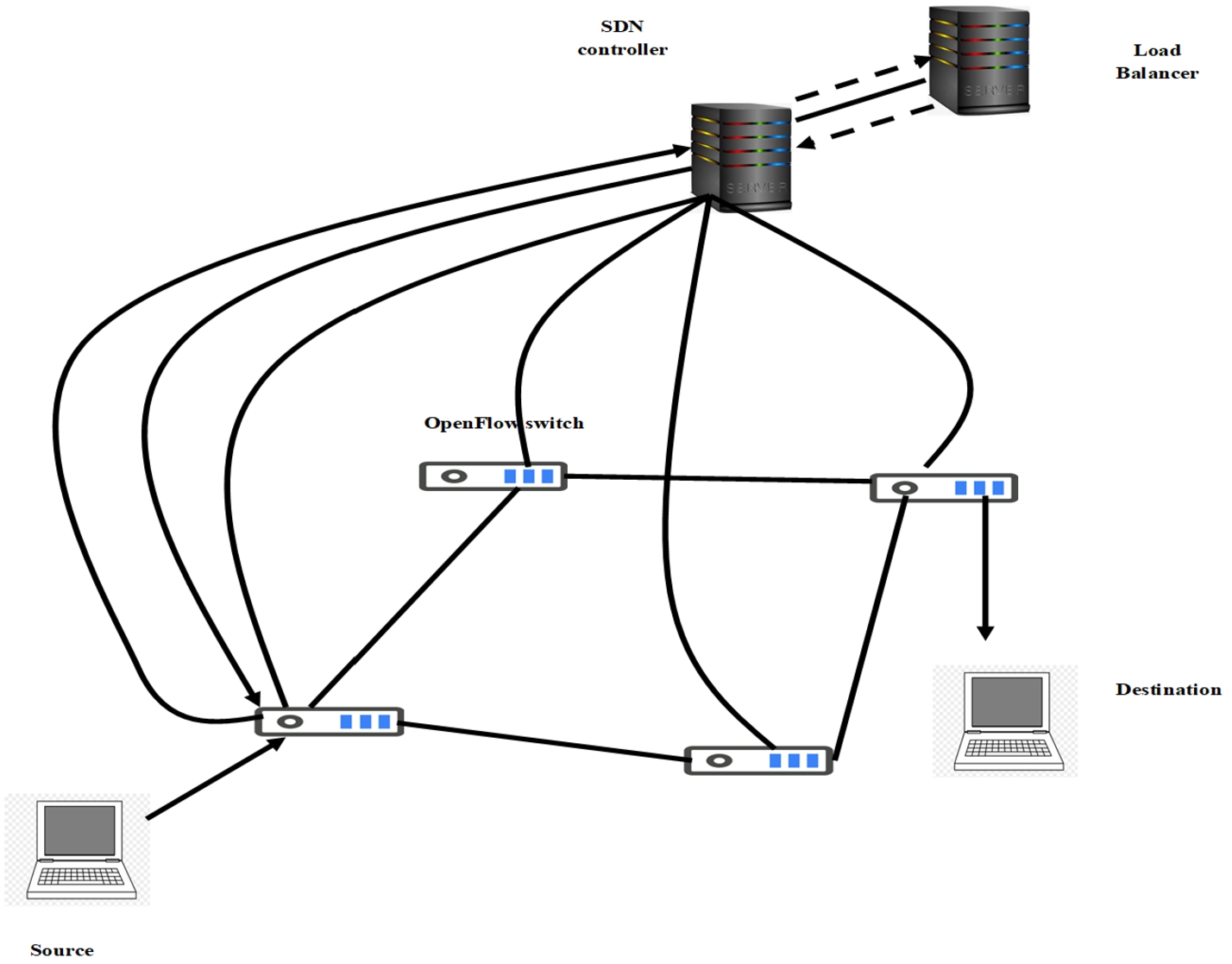
Design of a network for SDN load balancing.
One of the factors that can increase the networks’ effectiveness and operational costs is workload prediction. The main factor in workload prediction is accuracy, yet current methods fall short of achieving 100% accuracy. Figure 2 represents the fundamental workload prediction model. The fact that workload prediction enables precise plan for capacity and resources may be its most significant advantage. It is evident having the ability to allocate resources effectively when they are aware of the amount of work that must be done in advance. Hence, to enhance or improve load balancing, the workloads are predicted priorly. In this paper, the workload prediction is done via the DL model called Improved DeepMaxout. Here, the virtual machine (VM) capacity and the task capacity are considered as the features for the Improved DeepMaxout model [17]. The target set is calculated based on three conditions mentioned in below three steps and the example for the load prediction is represented in Table 3. In this example, the overloaded machine (PM) is 1, under loaded machine (PM) is 3 and 4, and the overloaded machine (VM) is 5 and 4. If the initial solution is [0.3, 0.2], then the representation of this is given in Table 4. The index wise sorting process is done for Table 4, which is represented in Table 5. Here, the under-loaded machine will be sorted as [3,21], in this the task over-loaded count is 1. Machine 4 now includes 1 task space, so this over-loaded task is allocated to PM 4. At last, the load will be balanced.
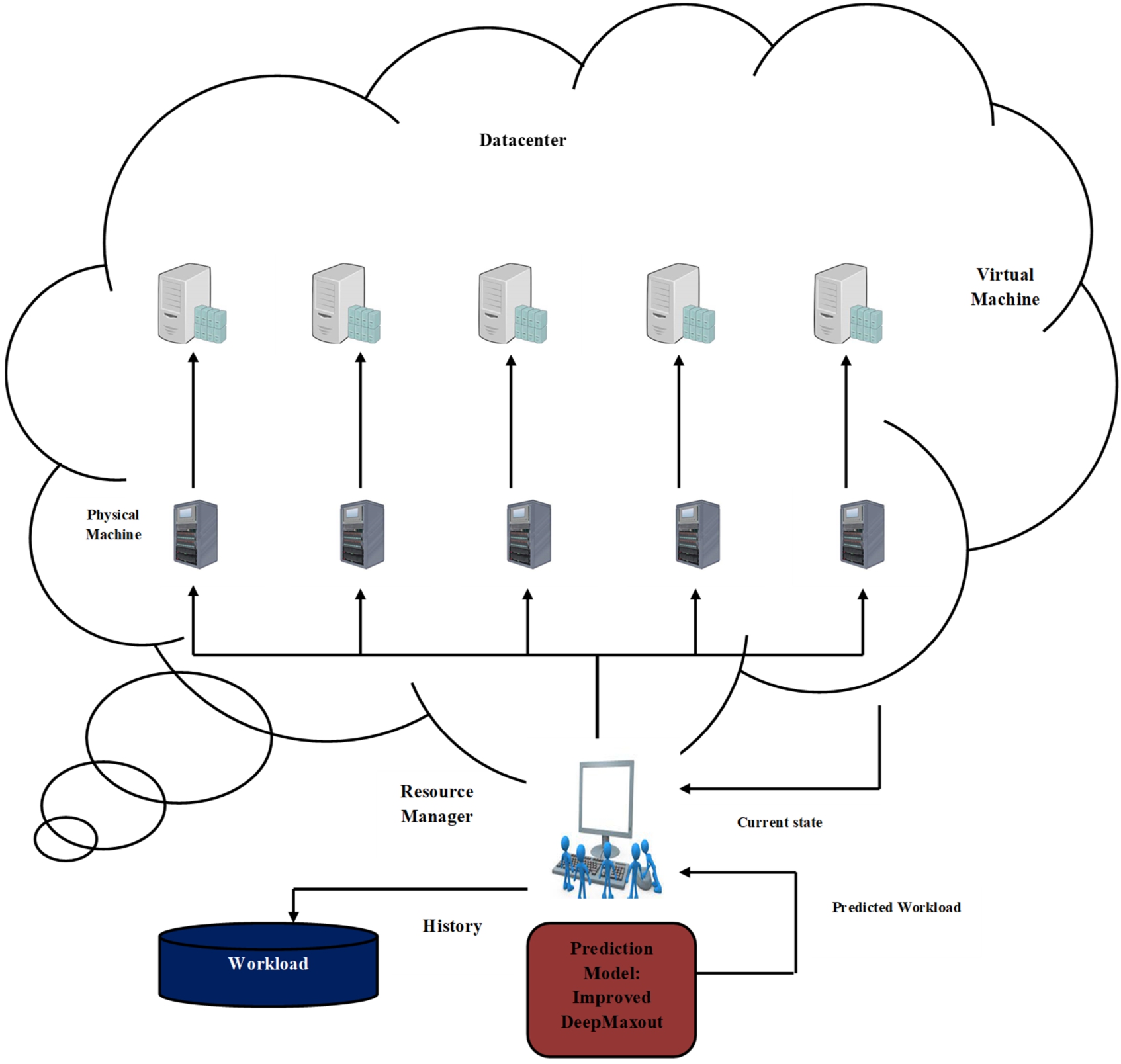
Workload prediction model.
Example for the load prediction
Initial solution representation
Index wise sorting process
Improved DeepMaxout model takes the input as VM capacity and task capacity (X) to define the target set. It effectively improves the performance by utilizing both the dropout and a maxout layer.The recommended model’s robustness is increased by the improved Softmax activation function of this model. Input, embedding, dropout, convolution, maximum pooling, as well as dense layer (fully connected) containing activation and maxout functions are some of the layers that make up the network structure.Equation (1) depicts the maxout unit for this network, in which
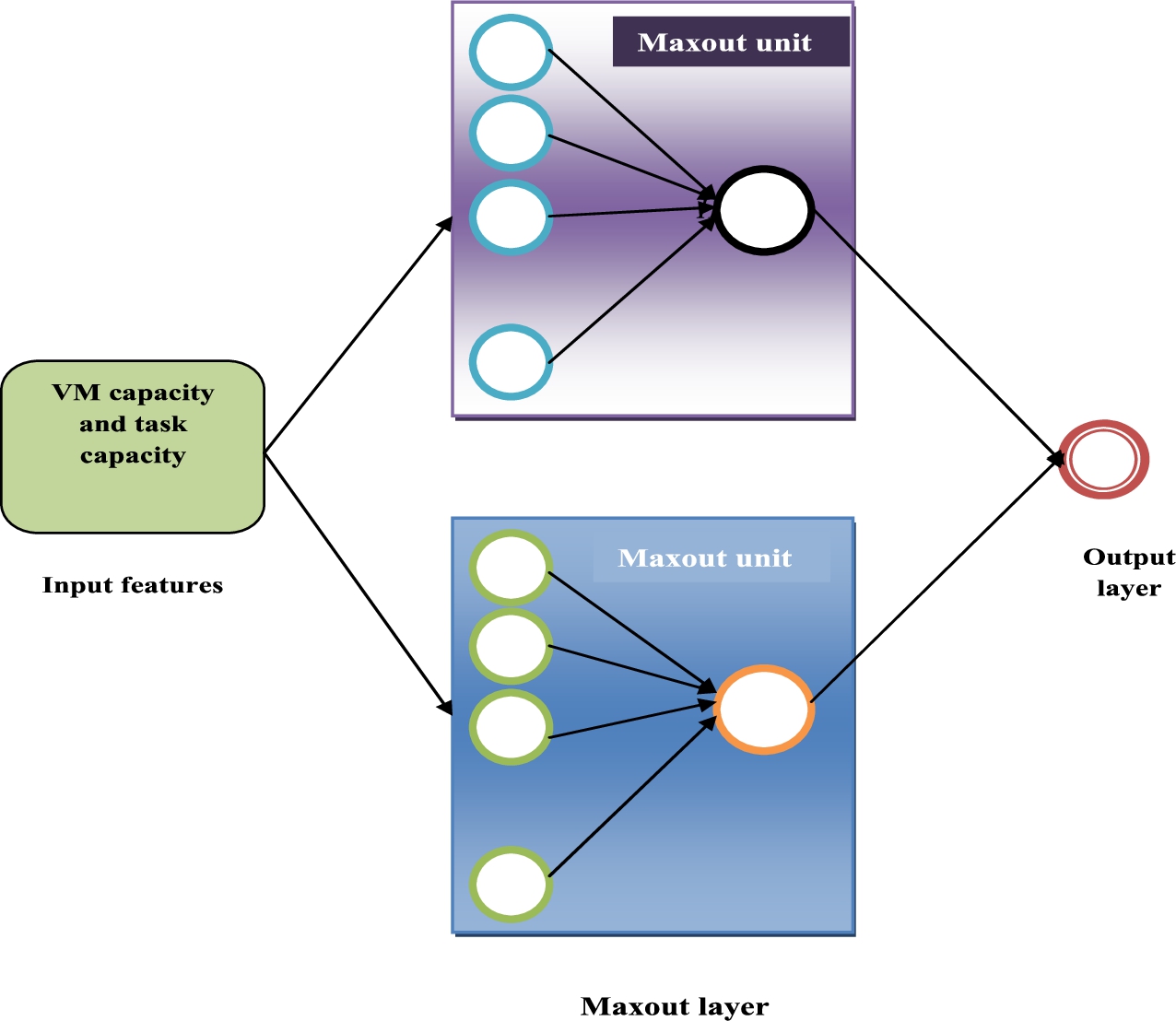
DeepMaxout model.
By uniformly distributing, load balancing enables us to avoid resource failure brought on by resource overload. By providing control over the complete network applications and web servers, an SDN oriented load balancer reduces running time.In SDN, load balancing identifies the optimum server and method for the quickest transmission of requests. Let’s assume that the work is 1000 and that there are four variations of it: 500, 1000, 1500, and 2000. Think of the PM (Physical Machine) as 50 and the VM as 20 to 25. Each PM has a small number of virtual machines, often 20 to 25. Allocate each work to PM at random. We optimally balance the load in this paper by using a new hybrid optimization algorithm named CUBW (Hybrid Model: COA [5] +BWO [11]) under the consideration of the constraints including migration time, migration cost, distance, server load, response time, and turnaround time. Both COA and BWO excel at resolving challenging optimization issues devoid of local optima. Predominantly, BWO provides an opportunity to substitute vectors with the survival rate of low dingoes which attained worse fitness values before moving to the next iteration. CUBW is very easy to implement, provides proper exploitation and exploration and this optimizer never caught up in local optima. In addition, hybrid optimization techniques are effective at accelerating the convergence of the solutions. By combined COA and BWO, we too have achieved greater convergent answers. The objective function of this optimization model is defined in Eq. (12), in which
Migration time
It describes how long it takes to migrate and move a task. Equation (6) is used to calculate it, in which
Migration cost
The costs and overhead involved with switching from one switch to another are referred to as migration costs. It is calculated in Eq. (7).
Distance
By evaluating the distance between the VMs, it is utilized to identify which VM is best for load balancing. The minimum distance is chosen in this case. It is calculated in Eq. (8).
Server load
The number of processes queuing up to get to the computer processor is known as the server load. It is calculated in Eq. (9), in which
Response time
In this instance the application servers’ response times decide which application server gets the following request. It is calculated in Eq. (10), in which K is task count, and
Turnaround time
It displays the total length of time that has passed between the processing operation and the output’s return. It is calculated in Eq. (11), in which
CUBW optimization algorithm for optimal load balancing
The coatis are regarded as people of the CUBW method, a population assisted meta-heuristic. The values of the decision variables are determined by the positions of each coati within the search area. Consequently, coatis’ perspective suggests a potential solution for the issue in the CUBW. When the COA is first implemented, Eq. (13) is used to initialize the coatis’ location within the area of search at random, in which
If the updated position for each coati increases the quantity of the objective function, it is suitable for the modification process; alternatively, the coati stays in its former position. Using Eq. (18), this update state is modelled.
The new determined location is suitable if it raises the value of the objective function, which is simulated by this condition using Eq. (21). According to the proposed model, the else condition of Eq. (21) is replaced by the BWO proposed equation, which is defined in Eq. (22), in which
Parameters of the proposed model
Parameters of the proposed model
Switch migration [1] is the process of moving or redistributing network traffic between switches. In this, the switches will be considered under the constraints including migration time, migration cost, and distance.Dynamic mapping requires constant resource monitoring and switch migration from overloaded to under-loaded controllers. Switch migration became possible once OF protocol V1.2 included support for multiple controllers and a four-phase switch migration protocol was developed. In a multi-controller SDN, a controller could be the slave, the equal, or the master. Only the master controller is capable of changing the flow table via the switches. That is, every switch might include a single or more slave and comparable controllers, but there can never be a single master controller. In the event that a master controller fails, a slave or comparable controller may take over. A switch’s master control being moved is referred to as “switch migration.” 3 unidentified sets must be discovered in order to find a solution to SMP: immigration controllers switched for migration and outmigration controllers. A heuristic strategy must be used to swiftly resolve this NP-hard problem. Load balancing is a challenge in multi-controller systems and is one of the main reasons switches migrate. To effectively administer the SMP, it is essential to understand the main responsibilities that controllers must handle. The following tasks make up the majority of a controller’s workload:
Installs forward rules and analyzes the input packet as messages
Topology Management
Information about network traffic and other signal events
Rules need to be updated since network policies can change.
Each of these tasks makes a controller work harder, but the majority of that work is spent processing packet-in messages.As a result, when designing switch migration, the quantity of packet-in messages collected at the controllers is the main aspect taken into account.A critical component is figuring out when switch migration is necessary. Despite the fact that switch migrations are required in a number of situations, the following ones are most likely to happen:
When load unbalancing occurs, some controllers become more dedicated (hot spots), while others are under-loaded. When every controllers have been fully utilized, additional controllers must join the control plane pool. This can be accomplished by shutting off a few controllers as a result of the dynamics of the network traffic in order to save both energy and money (cold spots) on communication. Some switches need to be moved in order to balance the load and enhance the network’s utility. In practice, an overload controller’s failure might result in a cascade fail; if a switch’s master controller cannot be reached due to a node/link failing, the “orphaned” switch needs to be reallocated to another controller. Switch migration might additionally take place for security motives.
Results and discussion
Simulation procedure
The proposed based load balancing model in SDN was simulated in PYTHON. Further, the python version was “PYTHON 3.7” and the processor utilized was “AMD Ryzen 5 3450U with Radeon Vega Mobile Gfx 2.10 GHz as well as the installed RAM size was “16.0 GB (13.9 GC usable)”. In this proposed simulation, the total number of Virtual Machine (VM) is utilized from 20 to 25 and the number of Physical Machine (PM) used is 50. Further, the task generated is varied from 500, 1000, 1500 and 2000. Table 7 represents the system configuration model.
System configuration
System configuration
Moreover, the examination was carried out with respect to Distance, migration Cost, Fitness, Migration Time, Response Time, Server Load and Turn Around Time. Similarly, the CUBW is compared with the state-of-art methods, such as, GLSOM [22] and HDD-PLB [13] and it was contrasted to traditional classifiers, including, BMO, BES, AOA, TDO, CSO, BWO and COA.
Comparative analysis on distance and fitness measure
The evaluation on CUBW is contrasted with BMO, BES, AOA, TDO, CSO, GLSOM [22], HDD-PLB [13], BWO and COA with regard to distance and fitness for Load Balancing in SDN is displayed in Fig. 4(a) and Fig. 4(b). Here, the model with minimal distance will be considered as effective approach for load balancing in SDN system. Mainly, the minimal distance is attained using the CUBW approach is 1.110 at the task 2000, mean while the traditional techniques obtained higher distance values, including, BMO = 1.294, BES = 1.454, AOA = 1.364, TDO = 1.352, CSO = 1.560, GLSOM [22] = 1.125, HDD-PLB [13] = 1.446, BWO = 1.402 and COA = 1.403, correspondingly. Regarding the Fig. 4(b), given that fitness is a diminishing function, the results must be less significant so as to achieve the objectives. In a similar manner, the CUBW generated minimal fitness rate in almost all the task. Particularly, for the task 500, the CUBW acquired the fitness rate of 4149.736, which is extremely lower over the BMO, BES, AOA, TDO, CSO, GLSOM [22], HDD-PLB [13], BWO and COA, respectively. Therefore, the CUBW has proven its superlative for load balancing in SDN and this is due to the Improved Deep Maxout with hybrid optimization strategy (BWO and COA).
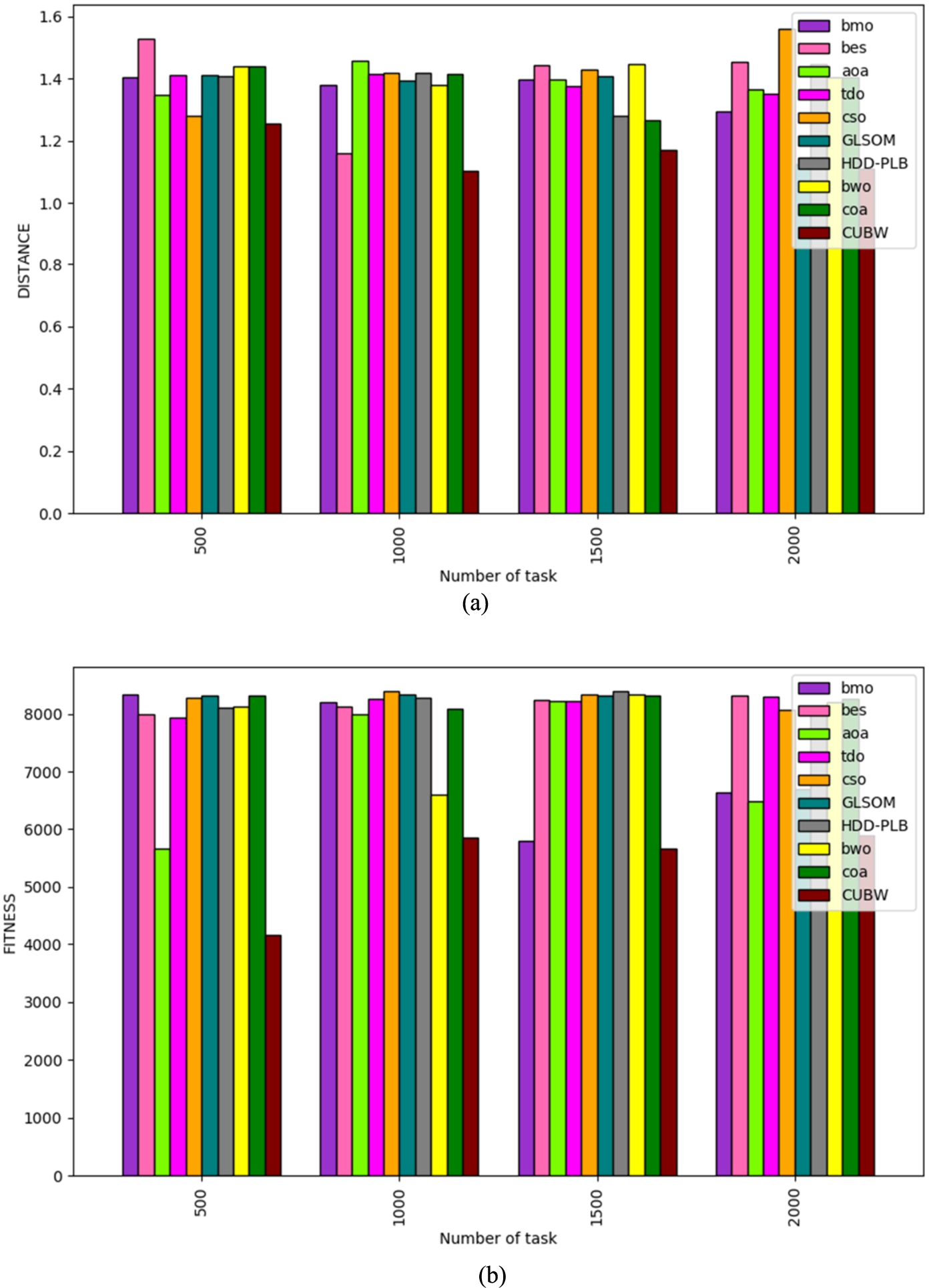
Validation on CUBW and conventional strategies a) distance and b) fitness.
Figure 5 explains the evaluation on migration cost and server load of the CUBW approach and the conventional methods for Load Balancing in SDN. Moreover, it is assessed for assorted number of tasks. The system can operate effectively since the migration costs for load balancing in SDN must be minimal. Similarly, task = 2000, the migration cost of the CUBW scheme is 5.900, whilst the BMO, BES, AOA, TDO, CSO, GLSOM [22], HDD-PLB [13], BWO and COA acquired higher migration cost. Additionally, analyzing the server load for the CUBW and conventional strategies is shown in Fig. 5(b). Further, the server load needs to be lower for the effective performance of load balancing in SDN. The server load is lower for the CUBW scheme at task count 1500, whilst the BMO, BES, AOA, TDO, CSO, GLSOM [22], HDD-PLB [13], BWO and COA yielded higher server load. The overall outcomes confirmed that the CUBW is substantially more optimal for load balancing in SDN with lower migration cost and server load than the conventional techniques.
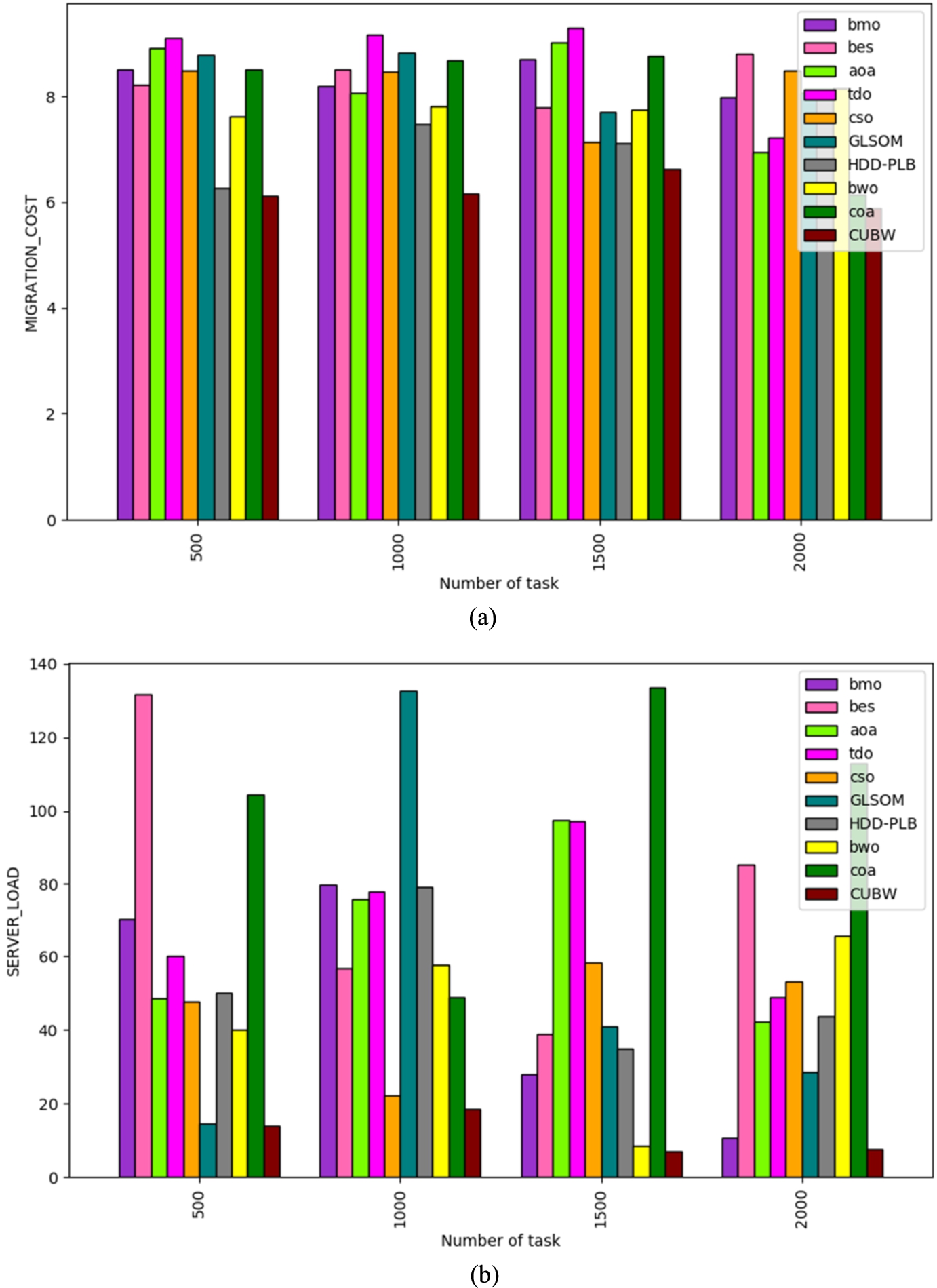
Validation on CUBW and conventional strategies a) migration cost and b) server load.
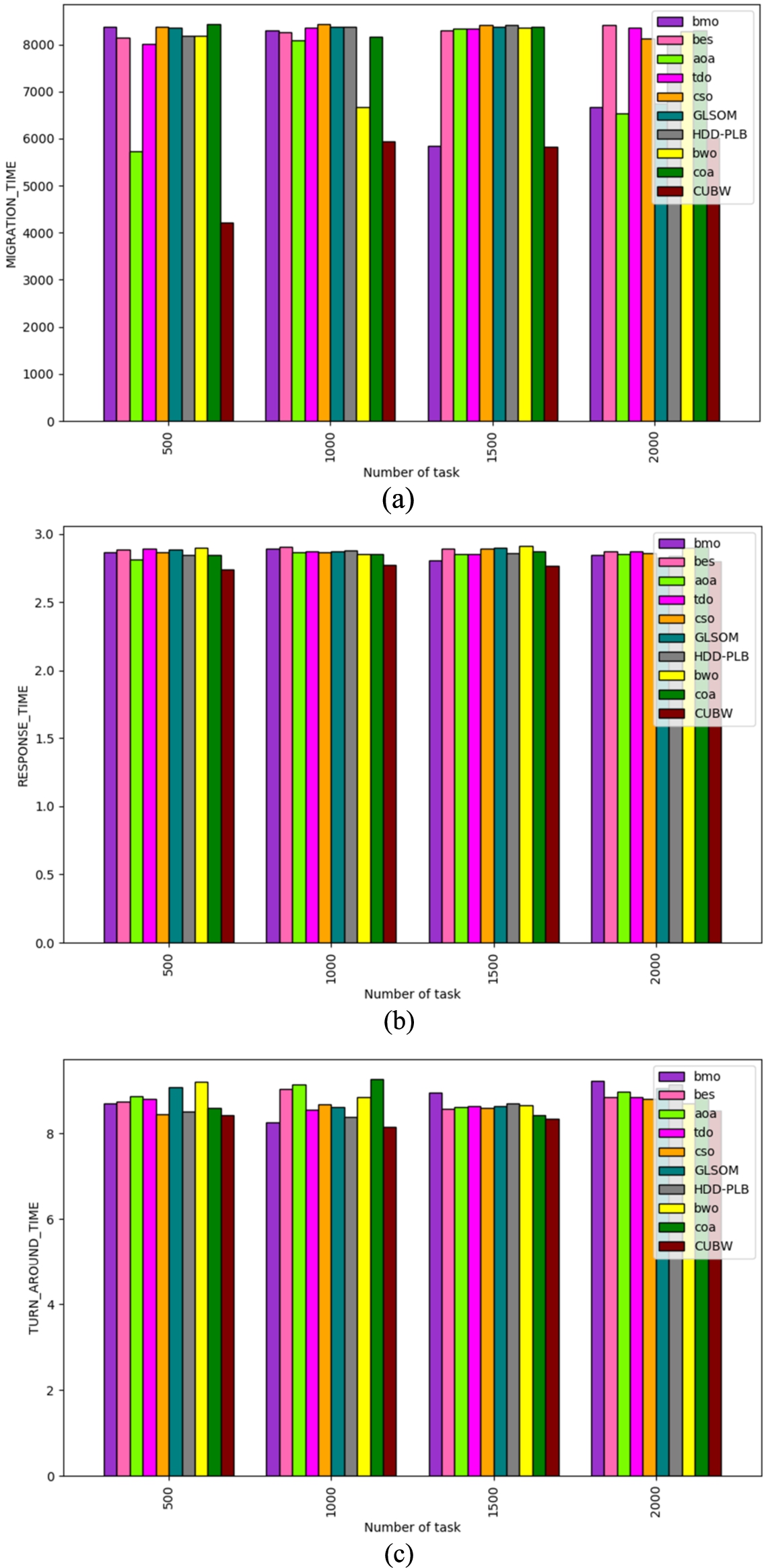
Validation on CUBW and conventional strategies a) migration time b) response time and c) turnaround time.
The evaluation on CUBW is contrasted with BMO, BES, AOA, TDO, CSO, GLSOM [22], HDD-PLB [13], BWO and COA with regard to migration, response and turnaround time for load balancing in SDN is exposed in Fig. 6(a), Fig. 6(b) and Fig. 6(c). Also, the analysis of CUBW for load balancing in SDN is evaluated for varied number of tasks from 500–2000. While examining those figures, the CUBW generated superior outcomes than the conventional strategies. Particularly, for the task 500, the migration time of the CUBW is much lowered (4216.594) over the BMO, BES, AOA, TDO, CSO, GLSOM [22], HDD-PLB [13], BWO and COA. Moreover, the CUBW offered the minimal response time of 2.771 (task = 1500), although the existing methods scored greater response time, including, BMO = 2.892, BES = 2.905, AOA = 2.867, TDO = 2.873, CSO = 2.865, GLSOM [22] = 2.874, HDD-PLB [13] = 2.879, BWO = 2.855 and COA = 2.853, correspondingly. Comparing the suggested approach to other current methodologies, the migration cost expense is lowest as the amount of tasks increases. As an outcome, the predicted framework has been found to be the best approach for managing load in the cloud. Additionally, among all variations in task count, the predicted model recorded the shortest responses period. It has been determined as a result that the projected approach is highly appropriate for cloud load balancing.
Simultaneously, evaluating the turnaround time of the CUBW and prior methods is depicted in Fig. 6(c). Here, the turnaround time ought to be lower for the efficacious performance of load balancing in SDN. This statement is achieved by the CUBW scheme. Further, the CUBW accomplished minimized turnaround time in all the number of tasks. At the task 1000, the CUBW scored minimal turnaround time of 8.146, whilst the BMO, BES, AOA, TDO, CSO, GLSOM [22], HDD-PLB [13], BWO and COA gained greater turnaround time. Thus, the hybridization of BWO and COA method paves way for the CUBW scheme to offer a high effective load balancing in SDN framework. When the volume of work grows, the developed method produces the maximum throughput value.
Convergence analysis is performed to assess the performance of CUBW work does in identifying the best path to convergence towards the fixed cost. The convergence study on CUBW is contrasted with BMO, BES, AOA, TDO, CSO, GLSOM [22], HDD-PLB [13], BWO and COA for load balancing in SDN is depicted in Fig. 7. In order to evaluate the effective load balancing in SDN of the CUBW, the convergence analysis is conducted. Here, our CUBW methodology converges quicker than the conventional methods. During the initial iteration, the CUBW and traditional methods scored greater cost rate, yet as the iteration improved the cost value get dropped. Nonetheless, the CUBW strategy achieved the lowest cost by performing the shortest iterations. Mainly, the CUBW scored the least cost value of 4.013 from the iteration 7–25, though the BMO, BES, AOA, TDO, CSO, GLSOM [22], HDD-PLB [13], BWO and COA have obtained maximal cost ratings. The suggested approach has managed to reach the lowest cost function of even in the smallest iterations. Overall, the anticipated paradigm is now ideal for cloud computing load balance. In general, the cost assessment reveals that the suggested approach converges faster than the conventional techniques, which lowers the cost rate and results in optimal load balancing in SDN framework.
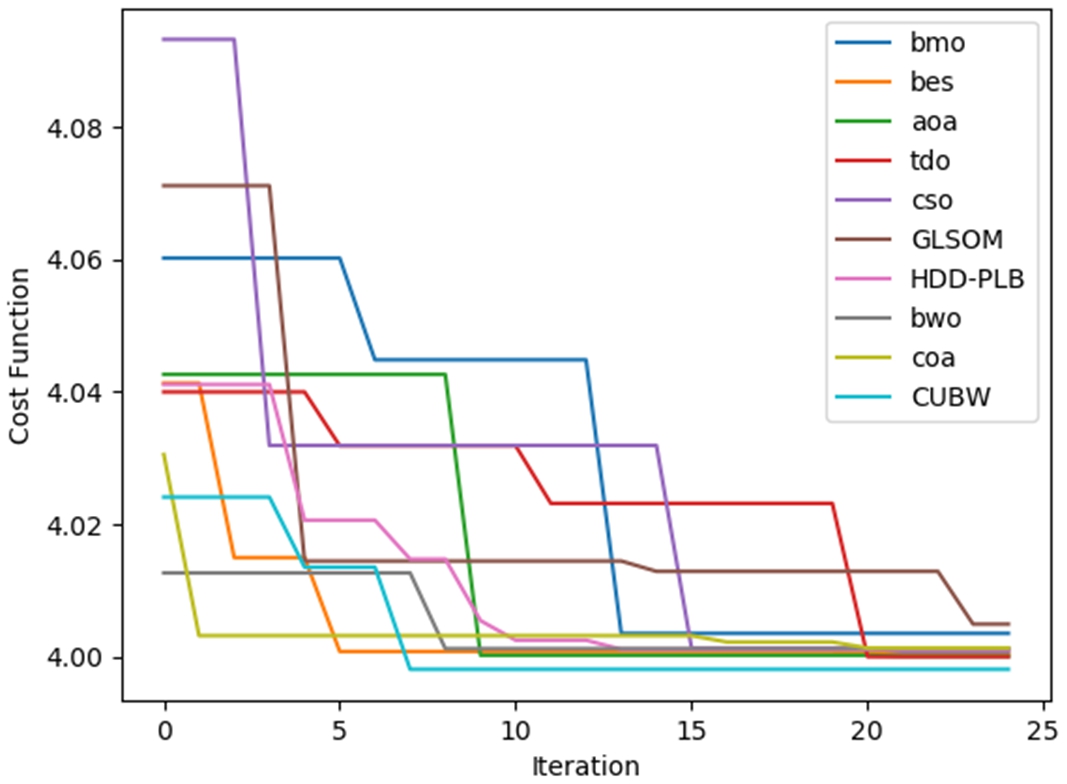
Convergence study on CUBW and traditional methodologies.
The error evaluation on CUBW methodology is compared with CNN, NN, RNN, Deep Maxout regarding MSE, MAE, MSLE and RMSE for load balancing in SDN is summarized in Table 8. Here, the error is calculated between original and target load, which is to be minimal considering the best performance.As per the results, the CUBW generated lesser error values than the traditional methods in all the error metrics. Mainly, the RMSE of the CUBW is 0.583, whereas the CNN is 0.761, NN is 0.812, RNN is 0.678 and Deep Maxout is 0.630, respectively. Likewise, evaluating the MAE error metric, the CUBW offered the MAE of 0.220, mean while the CNN, NN, RNN and Deep Maxout obtained higher MAE ratings. As a conclusion, it is exhibited that the CUBW framework is more successful and affords best load balancing in SDN.
Error analysis on CUBW and traditional schemes
Error analysis on CUBW and traditional schemes
The statistical study on CUBW and traditional schemes with regard to distance, fitness, migration cost, migration time, response time, server load and turnaround time for load balancing in SDN is described from Tables (9–15). The metaheuristic techniques are uncertain, and each method is analyzed numerous times to ensure improved estimation. For this, it is examined under five distinct types of statistical metrics, such as, Mean, Maximum, Standard Deviation, Median and Minimum. Further, the evaluation is carried out for distinct type of task generator (500, 1000, 1500 and 2000) and the VM varied from 20 to 25 as well as the PM is 50. The distance attained using the CUBW approach is 1.103 at the minimum statistical metric, mean while the BMO (1.295), BES (1.16)), AOA (1.347), TDO (1.352), CSO (1.280), GLSOM [22] (1.125), HDD-PLB [13] (1.280), BWO (1.378) and COA (1.266) maintained higher distance ratings.
Statistical evaluation on distance
Statistical evaluation on distance
Statistical evaluation on fitness
Statistical evaluation on migration cost
Statistical evaluation on migration time
Statistical evaluation on response time
Statistical evaluation on server load
Statistical evaluation on turn around time
Additionally, the migration time of the CUBW approach is 5881.794 under the median statistical metric, whereas the BMO, BES, AOA, TDO, CSO, GLSOM [22], HDD-PLB [13], BWO and COA scored greater migration time. In addition, for the mean statistical metric, the CUBW offered the server load of 11.846, which is extremely lower than the conventional strategies.
The time complexity analysis is shown in Table 16. The amount of time an algorithm requires to execute based on the input length is called temporal difficulty. It determines how long it takes for each code statement in a method to execute. The proposed method attains minimum time as compared to the other methods like BMO, BES, AOA, TDO, CSO, GLSOM [22], HDD-PLB [13], BWO and COA respectively.
Time complexity analysis
Time complexity analysis
We provide a comparative analysis of studied articles based on various metrics used by these techniques in the cloud computing environment shown in Figs 4 and 5. Table 6 shows the error analysis on CUBW and traditional schemes. After reviewing the various load-balancing techniques comprehensively, it can be stated that different techniques have considered different metrics for evaluation. Some of the papers have considered a single objective, while some have considered multiple objectives for metrics. Figure 5 shows the percentage of load-balancing metrics considered by different articles. Figure 6 shows the evaluation tools used in different research papers. We also have analyzed the various research papers based on simulations and results available. Tables 7–13 shows that most users have concentrated on response time to the tasks coming up for execution, followed by resource use, make span, and migration time.
Conclusion
This paper developed a new load balancing model in SDN was presented by following three major phases: work load prediction, optimal load balancing, and switch migration. Initially, work load prediction was performed using the improved DeepMaxout Network. Then, optimal load balancing was performed using the hybrid optimization named CUBW Optimization Algorithm. The optimal load balancing was performed under considering migration time, migration cost, distance and load balancing parameters like server load, response time and turnaround time. Finally, switch migration was carried out by considering the constraints including the migration time, migration cost, and distance. Therefore, the load was balanced in SDN in a precise manner. At the task 1000, the CUBW scored minimal turnaround time of 8.146, whilst the BMO, BES, AOA, TDO, CSO, GLSOM [22], HDD-PLB [13], BWO and COA gained greater turnaround time. Load balancing ensures that resources are used efficiently and that there is no single point of failure, which helps to improve the overall performance and dependability of cloud-based services. Additionally, it offers high availability and fault tolerance to manage traffic spikes or server outages, and it aids in the scalability of applications on demand. In the future, algorithm complexity can be lowered by measuring how long it takes an algorithm to calculate the requests’ order in a cloud computing environment and on virtual servers. The new algorithms will impact overall performance and offer better response times and high resource availability. Several algorithms can be considered to handle requests, and the grid computing technique can be used to manage resources efficiently.