



Abstract
Introduction
Nowadays, most workers spend nearly 50% of their lives in the office workplace [1–3]. In fact, the number of computer users in the office has risen dramatically in the last 20 years and about 80% of their daily work routine involves using a computer [2, 3]. Computer and office based work such as customer service is one of the growing occupations [3]. Office workers are associated with Musculoskeletal Disorders (MSDs) [4]. Office work may increase the risk of musculoskeletal disorders (MSDs), with consequences especially for workers, employers and the society [4, 5]. It occurs when worker experience high work strain, longer mouse and keyboard use, perceived high muscle tension and previous MSDs in the neck and shoulder [6] This work is also related to an increase in MSDs related to the upper leg and neck [3, 8]. Computer users often face health problems related to MSDs because of inappropriate posture and movement retained throughout a period of several hours of work [7–10]. Other than that, MSDs of upper extremities were more likely to cause mental distress among office workers (psychosocial stress) [11, 12]. Among the risk factors with associated MSDs are maintaining a static sitting posture for a long time and awkward posture of the head, neck and upper limb [2, 14]. Besides that, MSDs occur because of the repetition, motion of the fingers, hand and wrist, sustained awkward posture of the wrist and forearm and contact pressure in the wrist have been proposed. All of the exposure is related to the use of the keyboard and mouse [13]. In addition, problems associated with the eyes could also occur due to constant use of computers. It produces visual discomfort and symptoms such as eye strain, blurriness, dryness and difficulty to focus [3, 15].
Various method were developed to assess posture in order to assess risk factors for work-related musculoskeletal disorders. Observational assessment tools is one of the methods and commonly be done using simpler observational tools (pen-and-paper) or advanced computerized tools [16]. In general, pen-and-paper-based observational techniques are mainly based on postural assessments that are relatively inexpensive to carry out, and are easy to used at the workplace [17–20]. Pen-and-paper-based observational methods are commonly used to perform ergonomic risk analyses, especially in jobs of low intensity, repetitive work or employees performing awkward postures [2, 22]. In addition, ten studies have been conducted on the assessment of the computer work risk factors related to MSDs as shown in Table 1. Rapid Upper Limb Assessment (RULA) has been used for computer work which includes “children’s computing posture” [23] and “computer users of Zahedan Universities” [24]. Rapid Entire Body Assessment (REBA) Tool assessed studies for office administration at a hospital” [25]. Quick Exposure Checklist (QEC) Tool assessed computer case study librarians’ health” [26]. Rapid Office Strain Assessment (ROSA) has been used for “Photograph-based ergonomic evaluations” [27]; “call center workers” [7]; “Health risk among office workers” [10]; and “ergonomic evaluation of office workplace” [8]. In addition, the RULA and REBA tool were used for assessment in case studies on librarians [28]. Besides that, RULA and the Office Ergonomic Assessment (OEA) Tool were used in case studies such as “office ergonomics training and chair intervention” [9]. The objective of this paper is to review and identify pen-and-paper-based observational methods for assessing risk factors of computer work including working posture, office component, force, repetition and office environment
Pen-paper based observational methods for assessing exposure to risk factors for Work-related Musculoskeletal Diosorders related to office workstation (from 1993 to 2012)
Pen-paper based observational methods for assessing exposure to risk factors for Work-related Musculoskeletal Diosorders related to office workstation (from 1993 to 2012)
Selection of literature from database
The selection of literature was done using an electronic database. This database included PubMed, Science Direct, Scopus, Springe link, and Google. The searches were conducted in which the materials from 1992 until 2015 were covered. The sources used a combination of terms related to observational methods for computer work using “OR” and “AND”. The terms or keywords that were used include computer works, office ergonomics, observational methods, office worker’s posture, office risk factors, musculoskeletal disorders, upper limbs, carpal tunnel syndrome, musculoskeletal symptoms, risk assessment, ergonomic assessment, ergonomic method and pen and paper based observational methods. Other than that, searches were done using the option of “related articles” of the key references. About 154 journal articles and review reports were screened by the title and abstract first, and the appropriate articles related to observational methods were identified. However, this paper only reviews the methods that related to pen and paper based observational methods for assessing an ergonomic risk factors computer work. The inclusion criteria for current techniques were based on the evaluation criteria developed by researchers in Section 2.2.
Developing the evaluation criteria
The evaluation criteria for these review methods were based on objectives and function of pen-and-paper-based methods, the exposure risk factors (posture, office components, force, repetition, and office environments), tool development process, types of rating scale, and potential users as shown in Tables 1, 2 and 3. These reviews involved evaluating the intra- and inter-observer reliability and also assessed the concurrent validity as shown in Table 4.
Summary of the objectives, function and risk factor for pen and paper based observational methods for computer works
Summary of the objectives, function and risk factor for pen and paper based observational methods for computer works
*Working Posture (P), Office Components (C), Force (F), Repetition (R), Office Environment (E).
Basic characteristics of the pen and paper based observational methods for computer work
*Worker/supervisor (W); researcher (R); Occupational safety/health practitioner/ergonomists (O).
Evaluation of concurrent validity, intra- and inter- observer reliability
aConcurrent Validity value – During the development process, how well does method correspond with more valid methods: Good, Moderate, Low. bThe reliability value: <0.20 (Poor); 0.21 to 0.40 (Fair); 0.41 to 0.60 (Moderate); 0.61 to 0.80 (Good); 0.81 to 1.00 (Very Good) [29–31].
The evaluation process for selected publication was conducted by two researchers. The evaluation process identified the current technique from previous case studies related to exposure risk for computer work or office workstation. The objective of the evaluation process was to identify the limitition of the study or advantages/disadvantages of current techniques. Each current techniques was evaluated based on the evaluation criteria in Section 2.2.
Results
A total of the seven eligible pen-and-paper-based observational methods were identified in Fig. 1 which includes Rapid Upper Limb Assessment [21]; Rapid Entire Body Assessment [22]; Computer Workstation e-Tool [29]; Quick Exposure Checklist [30]; Assessment of Repetition Tasks [31]; Office Ergonomic Assessment [9]; Rapid Office Strain Assessment [2]. Table 1 shows the existing observational method from 1993 until 2012. The seven previous pen-and-paper-based observational methods have been recognized from the ten different computer work case studies. The following sections discuss the details of the pen and paper based observational method that related to work-related musculoskeletal disorder (WMSDs) that have been published. The methods were defined using journal articles, review reports and previous case studies related to computer work or office workstations. About 154 reference documents were described and 35 papers contained a potentialreference.
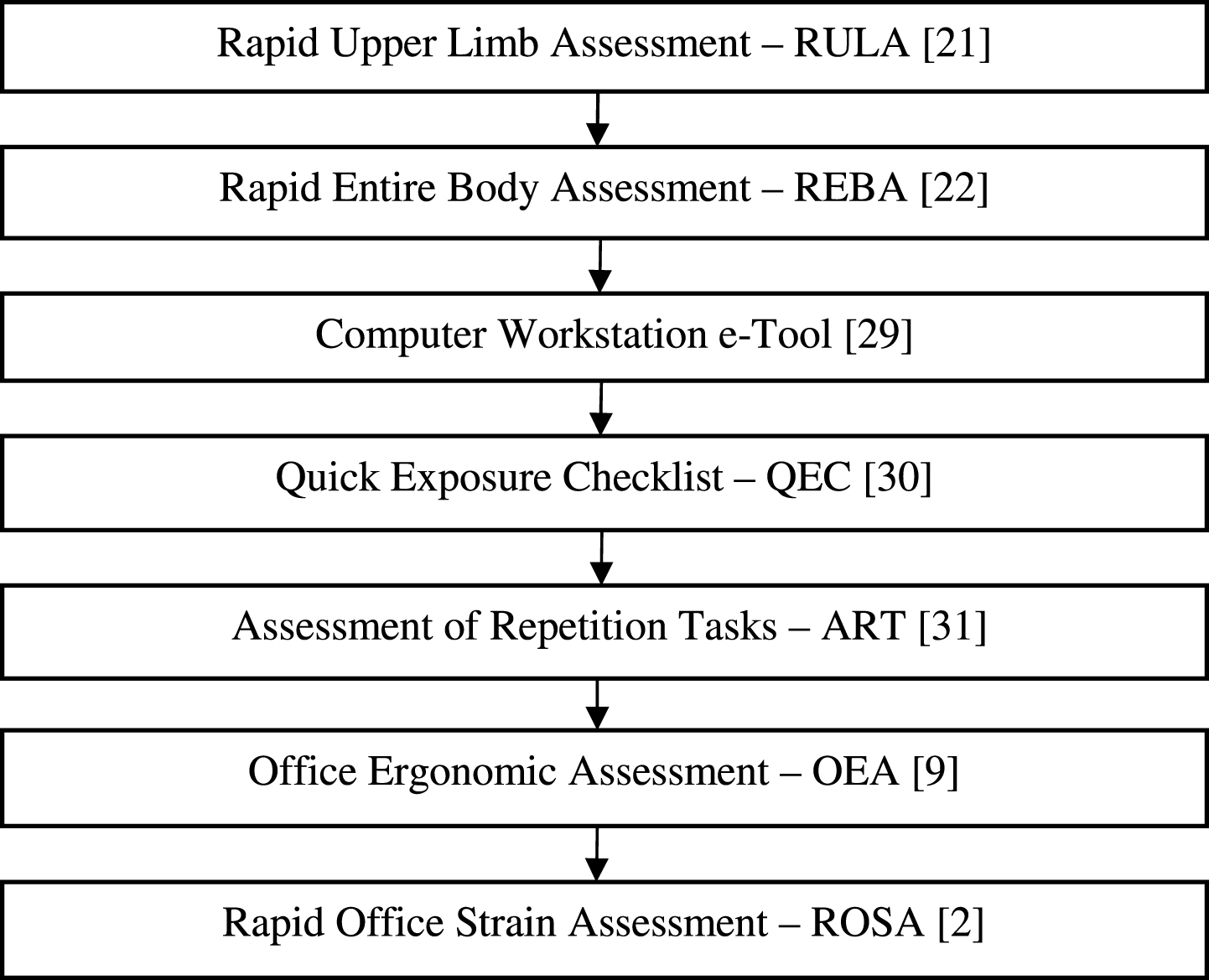
Pen-paper based observational methods.
Table 2 shows the summary of the objectives, functions and risk factors for pen-and-paper-based observational methods for computer work. From the seven pen-and-paper-based observational methods, three of the tools (RULA, REBA, and ART) covered three risk factors which are working posture, force and repetition. Table 3 shows the basic characteristics of the pen and paper based observational methods for computer works. The basic characteristics include the development process, types of rating scores and potential users. Table 4 shows the evaluation summary of concurrent validity, intra- and inter-observer reliability. The table shows that the results can be divided into three categories namely low, moderate and good. Most of the tools show moderate results.
A quick observational method known as Rapid Upper Limb Asssessment (RULA was developed to analyse the posture that focuses on the upper limb disorder as well as the lower body related to work tasks [21]. These tool requires no special equipment in providing a quick assessment of the posture of the neck, trunk and upper limb along with muscle function and the external loads experienced by the body. RULA tool uses diagrams for body posture and three scoring table. It provides for the evaluation of the exposure risk factors. In this tool, the risk factors investigated included a number of movements, static muscle work, force, work posture (upper arm, lower arm, wrists, neck, trunk and leg) and workduration.
In RULA methods, three stages are needed to develop RULA basic which includes the working posture recording, the scoring system and the scale of action levels. RULA shows the different illustration of body posture and the numerical score is allocated to two group there are group A and group B. Group A consists of an upper arm, lower arm and wrist, and for group B consists of the neck, trunk and legs. The concept of RULA based on OWAS system. The range of movement for each body part divided into section depends on criterion: number 1 is a minimal risk factor and more extreme posture/movement higher the number.
To establish the validity of RULA tool using sixteen experienced operators (1 male and 15 females) to performed a VDU-based data entry task were assessed using RULA. From validity testing, the neck and lower arm are significant (P < 0.01) while trunk, upper arm, and wrist score were not significant. Besides that, more than 120 professional practitioners were trained using videotape examples of an operator performing screen-based keyboard operation as well as packing, sewing and brick sorting tasks to test inter-observer reliability and to obtain a high consistency [21].
Rapid Entire Body Assessment (REBA).
Rapid Entire Body Assessment tool was developed to fill a perceived need for a practitioner’s field tool and was specifically designed for analyzing unpredictable working postures in healthcare and other service industries [22]. This tool uses diagrams for body posture and three scoring table. It provides for the evaluation of the exposure risk factors. In this method, several postures and forceful exertion risk factors were assessed. To develop the REBA tool, three stages which include the working posture recording, scoring system development and development of the action level wererequired.
To test the reliability for REBA tool, more than 14 professionals (occupational therapists, physiotherapists, nurse and ergonomists) were involved in collecting and coding over 600 examples of posture from health care, manufacturing and electricity industries in two workshop sessions. The main objectives of this training/workshop are to further refine REBA and the starting an analysis of the inter-observer reliability of body part coding. The inter-observer reliability results had shown moderate to good for leg and trunk posture but low for the upper body. Concurrent validity is moderately correlated withOWAS [32].
Computer workstation e-Tool
Computer workstation e-Tool was developed as a simple illustration, inexpensive principles that help to create a safe and comfortable computer workstation [29]. The type of this tool is pen and paper observational method called as a checklist. The rating scores that were used are nominal scale (yes and no). An “NO” response indicates that a problem may exist. The exposure risks involved in this checklist were working posture, seating, monitor, work area, accessories and device input. So, the result of evaluation using this tool can recognize by percentage or graph. During the development process, no action level was available and no formal studies were conducted to test the reliability and validity.
Quick Exposure Checklist – QEC system
Quick Exposure Checklist has been developed by David et al., [30]. QEC is one of the observational tools that evaluate the ergonomic risk factors that related to work-related musculoskeletal disorders (WMSDs). Two phases that involved in developing QEC tool with the participation of 206 practitioners. This tool has been tested, modified and validated using simulated and real workplace tasks. Four main body areas have been assessed by QEC tool and involve practitioners and employees in the assessments. The four postures and movement involved in developing QEC tool includes back, shoulder/arm, wrist/hand, and neck on 2 or 3 step scale using “fuzzy logic”. The QEC tool development process, there are have 2 phase of development. Phase 1 develops at 1996 until 1998 there are the initial construction and evaluation of the QEC [17]. Other than that, Phase 2 have been evaluated and refine the QEC content and its presentation format has been reviewed by following the period of use by practitioners.
In Phase 1, the risk assessment method using video film showed that the observer-reliability of QEC had ‘fair to moderate’ levels of agreement. For the phase 2, the inter-observer reliability was designed to complement the trial result in Phase 1 with using the video film [18]. In Phase 2, the evaluation of inter-observer reliability in the workplace showed the levels of agreement were good. Other than that, the validity testing of the QEC tool used two methods which are concurrent validity and predictive validity. The result of concurrent validity indicated good correspondence with other measures for establishing reliability used for both phases which are intra- and inter-observer reliability [18, 30]
Assessment of Repetitive Task
Assessment of Repetitive Task develops a tool that used to define the risk of repetitive task of the upper limbs [31]. The risk factor that involved were frequency and repetition of movements; force; awkward postures (neck, back, shoulder/arm, wrist and hand); and additional factors (task duration, recovery, perceived workspace and other object and work environment factors). Two stages of the development process for this tool are the selection of risk factors and criteria, and development of the scoring system and action level. The rating score that was used is traffic light system for risk factor score (red-high; yellow-medium; green-low). The simulated user trial for reliability was conducted by thirty-two Health and Safety Executive (HSE) and LS Inspector. This trial used video case studies to explore the concept of ART Tool with a user and at the same time, it can make the improvement to the reliability of ART Tool. From the trial, the result comes out with good agreement. During the development process, no formal studies have been conducted to test the validity.
Office Ergonomic Assessment (OEA)
Office Ergonomic Assessment is one of the observational tools intended to evaluate the ergonomic configuration of the overall workstation and items within the worker’s control to change [9]. OEA tool is used for measuring adjustability and employee training outcomes. However, the results show no direct correlation with worker discomfort and did not provide the scoring and action level like in RULA, REBA, QEC and ROSA that indicate when further investigation is required. From the worksheet shows that tool is more general its only check the parameter that has in office workstation and give a recommendation. Beside that this tool only stated the three priority (action level) there are high (immediately), medium (within 30 days) and low (for consideration). This priority as an indication for the worker knows the level of risk at their office. The ergonomic risk factors for OEA were office components such as chair, monitor, keyboard, mouse, telephone, work area, desk and others. During the development process, no formal studies were conducted to test the reliability and validity.
Rapid Office Strain Assessment (ROSA)
Rapid Office Strain Assessment (ROSA) was designed to quantify risk associated with computer work that related to discomfort [2]. The purpose of this tool is to develop and evaluate a new office risk assessment tool. Four methods were involved in the development of ROSA which includes tool development, creation of scoring chart, individual posture and equipment score, and tool use instruction. The risk factors were diagrammed and coded as an increasing score from 1 to 3. The final score for ROSA ranged from magnitude 1 to 10, with each successive score representing an increased presence of risk factors. The risk factors involved are; chair (seat pan height, seat pan depth, armrest, and back support), monitor, telephone, keyboard, and mouse.
The action level for ROSA tool is referred from RULA and REBA [21, 22]. Have four action level have been providing, it considered from the risk factors that founded from posture score and scoring system. The action created to know the level of ergonomic risk into the workers and to make a prevention for the workers, it can avoid worker to get WMSDs. Three trained observer were involved in completing of 14 workstations simultaneously in the participating organization for assessing the inter-observer reliability of ROSA. Each obsever have been examined the final scores and each risk factor score with two-way random analysis for absolute agreement. From the initial evaluation shown high level of inter- and intra-observer reliability using the ROSA, and a moderate correlation between total discomfort and ROSA final score. To determine the validity, ROSA involved 72 offices ergonomics assessments.
Discussion
This paper has reviewed pen-and-paper-based observational methods for assessing ergonomic risk factors of computer work. The seven eligible previous pen-and-paper-based observational methods that assess ergonomic risk in office workstations or computer work have been identified including RULA [21], REBA [22], Computer Workstation e-Tool [29], QEC [30], ART [31], OEA [9], and ROSA [2]. In addition, the seven observational methods were defined from ten different computer work case studies as shown in Table 1. From the objective for each tool, it can be concluded that the aim was not entirely focused on assessing the ergonomic risks for computer work. Most of them only focused on general ergonomic risks. Besides that, most of the tools that were reviewed included posture risk factors but did not include all ergonomic risk factors for computer work as shown in Table 2.
Table 3 shows the characteristics of the pen-and-paper-based observational methods for computer work. Basic characteristics include the development process, types of rating scores and potential users. The Table 3 summarized the process for developing the tool. The scoring system they used is hypothetical (no scientific evidence to develop scoring system). Each tool used different rating scores such as numerical score, nominal score and traffic light rating score. The potential users of each tool include workers/supervisors, researchers, and occupational safety/health practitioners/ergonomists.
Table 4 showed only five out of seven tools testing the intra-observer reliability. This includes RULA, REBA QEC, ART and ROSA. ART and ROSA Tool showed good results for intra-observer reliability. In addition, inter-observer reliability was tested for four methods which are RULA, REBA, QEC, ROSA. All of the tools showed moderate to good results as shown in Table 4. In addition, the values of intra- and inter-observer reliability ranged between <0.20 (Poor); 0.21 to 0.40 (Fair); 0.41 to 0.60 (Moderate); 0.61 to 0.80 (Good); 0.81 to 1.00 (Very Good) [33–35]. Other than that, five out of seven observational methods tested for concurrent validity include RULA, REBA QEC and ROSA as shown in Table 4. From the validity result, only QEC tool showed good to moderate correlation. In the validity test for RULA, for example, the neck and lower arm are significant (P < 0.01) while the trunk, upper arm, and wrist score were not significant (P > 0.01). Only three tools went through reliability and validity tests. The most important part of developing a tool is to validate exposure assessment techniques, yet most of the existing observational methods did not test for reliability and validity.
Conclusion
To conclude, the current techniques of pen-and-paper-based observational method for assessing exposure to office risk factors for work-related musculoskeletal disorders studied from 1992 until 2015 were reviewed and discussed in this paper. This review covered seven existing methods to assess computer work. However, from the seven existing tools that have been reviewed, several gaps in current knowledge were discovered. From the review, it was shown that no existing tool covered all the risk factors including working posture, office components, force, repetition, and office environment. Most of the existing tool cover only three from five risk factors. Not a single tool covered office environment as a risk factors as shown in Table 1. Most of the observational methods only focused on working posture risk factors. Besides that, during the tool development process, it was found that some of the existing observational methods were not tested for their reliability and validity. Futhermore, this review could provide ways for researchers to improve the pen-and-paper-based observational method for assessing ergonomic risk factors of computer work.
Conflict of interest
None to report.
Footnotes
Acknowledgments
This research is funded by Ministry of Higher Education of Malaysia (MOHE) and Universiti Tun Hussein Onn Malaysia (UTHM) under Fundamental Research Grant Scheme (FRGS, Vot 1495).