



Abstract
BACKGROUND:
Organizational citizenship behavior (OCB) is important to the development of an organization. Research into factors that foster OCB and the underlying processes are therefore substantially crucial.
OBJECTIVE:
The current study aimed to test the association between trait self-control and OCB and the mediating role of consideration for future consequence.
METHOD:
Four hundred and ninety-four Chinese employees (275 men, 219 women) took part in the study. Participants completed a battery of self-report measures online that assessed trait self-control, tendencies of consideration of future consequence, and organizational citizenship behavior. Path analysis was conducted and bootstrapping technique (N = 5000), a resampling method that is asymptotically more accurate than the standard intervals using sample variance and assumptions of normality, was used to judge the significance of the mediation.
RESULTS:
Results of path analysis showed that trait self-control was positively related to OCB. More importantly, the “trait self-control-OCB” link was mediated by consideration of future consequence-future, but not by consideration of future consequence-immediate.
CONCLUSIONS:
Employees with high trait self-control engage in more organizational citizenship behavior and this link can be partly explained by consideration of future consequence-future.
Introduction
As Chinese enterprises have undergone tremendous industrial transformation and innovation in recent years, employees’ behaviors at work are more and more emphasized by Chinese enterprisers. Organizational citizenship behavior (OCB) refers to the work behavior that employees voluntarily sacrifice their own short-term benefits to facilitate long-term interests of the organization [1, 2], such as helping, sportsmanship, loyalty, organizational commitment, civic virtue, and so on [3]. As a contextual performance, OCB is greatly beneficial to the development of an organization, such as enhancing the operating efficacy [4], helping secure advantages in intensive marketing competition [5], and facilitating harmony interpersonal relationship, good organizational climate, and productivity [6]. A core characteristic of OCB is sacrificing one’s own interests and this requires the exercise of self-control, suggestingself-control may play an important role in OCB [7]. As far as we know, little research has examined whether and how self-control is associated with OCB. Hence, the current study aimed to fill this void.
Self-control and OCB
Employees are often faced with motivational conflicts when he/she makes a decision of engaging in OCB, namely the one that sacrificing one’s own short-term interests and facilitating organization’s long-term benefits. For instance, picture the following scenario: an employee voluntarily helps a colleague finish his/her boring job on a chilly Sunday morning without asking for any payment. There are a series of motivational conflicts in this case, such as getting out of bed early versus taking rest, enduring cold versus keeping warm, and exerting energy in tedious job versus in other pleasant activities. Self-control is an ability to solve motivational conflicts to behave in a socially acceptable way [8, 9]. Previous work has demonstrated that employees high in trait self-control have more interpersonal trust tendencies [10], cooperative behavior [11], and prosocial behavior [12]. Evidence from experimental studies also show that self-control resouce depletion causes more self-interested behavior in a dictator game [13], leads individuals to focus on short-term benefits, and increase free-riding in a public goods game [14]. In sum, OCB is often accompanied with motivational conflicts, and employees need to exert self-control to overcome self-interested tendencies to behave in a prosocial way in the organization. In line with this, we expected that employees with high self-control would better inhibit their selfish tendecies and thus engage in more OCB.
The role of consideration for future consequences in the self-control-OCB link
If employees with high self-control are more likely to engage in OCB, then what is the underlying mechanism? We assume that consideration for future consequences (CFC) may be a candidate thatmediates the self-control-OCB link.
As a future orientation, CFC refers to the extent to which an individual is concerned about future outcomes before engaging in current behavior [15]. CFC is thought to contain two dimensions [16], namely CFC-future (CFC-F) and CFC-immediate (CFC-I). People high in CFC-F are more likely to guide their behavior with long-term goals and less likely to be influenced by immediate benefits. If a behavior entails long-term benefits, then people high in CFC-Fare willing to engage in such behavior even though it results in immediate loss. On the contrary, people high in CFC-I usually focus on immediate rather than on long-term rewards. They are more concerned about their immediate interests and less concerned about what consequences their current behavior will lead to in the future [16, 17].
According to self-control theory [18], a primary characteristic of low self-control is “a tendency to respond to tangible stimuli in the immediate environment, to have a concrete ‘here and now’ orientation”, and by contrast, people with high self-control tend to defer gratification. This theory also states that people with low self-control are “little interested in and unprepared for long-term pursuits”. These statements have been proved by the delay of gratification experiment [19]. Recent research has also found that people with high trait self-control report higher level ofCFC-F and lower level of CFC-I [16].
CFC is important to OCB. As stated earlier, OCB requires individuals to inhibit, or even sacrifice, their immediate benefits to facilitate the long-term interests of the organization. This suggests that people high in CFC-F are more prone to engage in what they believe will result in good consequences in the future compared to their low self-controllers’ counterpart. Previous literature has demonstrated that although engaging in OCB may cause personal loss in the short-run, it indeed leads to greater rewards in the long-term [20–22].
In sum, it is possible that people high in self-control tend to be more future-oriented, which in turn promotes them to engage in more OCB. This implies that CFC (especially CFC-F) may mediate the association between trait self-control and OCB. Although plausible, no previous research, as far as we know, has examined this idea.
The present study
The current research aimed to investigate the relationship between trait self-control and OCB as well as the mediating effect of CFC among Chinese employees. In line with aforementioned literature, we expected that (1) trait self-control was positively related to OCB; (2) trait self-control was positively and negatively related to CFC-F and CFC-I, respectively; (3) CFC-F and CFC-I were positively and negative related to OCB, respectively; and (4) CFC mediated the trait self-control-OCBlink.
Methods
Participants
Four hundred ninety-four full-time employees took part in the study completing a battery of questionnaires online to enter a drawing of 100 RMB (approximately 15.5 U.S. dollars). Participants were from a variety of enterprises and public institutes from 15 provinces of China. Demographic characteristics are presented in Table 1.
Description of the sample
Description of the sample
Trait self-control
The Brief Self-Control Scale (BSCS) was used to assess participants’ level of trait self-control [23]. This scale consists of 13 items rated on a five-point scale, from 1 (not at all like me) to 5 (very much like me); and a higher score indicates better self-control. This scale has been used among Chinese employees, showing good internal consistency reliability and criteria validity [24, 25]. Sample items include “I am good at resisting temptation” and “I do certain things that are bad for me, if they are fun”. The Cronbach’s α was 0.83 in this study.
Consideration of future consequences
The Consideration of Future Consequences Scale (CFCS) was used to assess participants’ tendency CFC-F and CFC-I [15]. This scale was translated following a back-translation procedure. This scale contains 12 items. Five items assess CFC-F (e. g., I am willing to sacrifice my immediate happiness or well-being in order to achieve future outcomes) and the remaining seven items measure assess CFC-I (e. g., My behavior is only influenced by the immediate (i.e., a matter of days or weeks) outcomes of my actions). All items are rated on a seven-point scale, from 1 (extremely uncharacteristic) to 7 (extremely characteristic). A higher score indicates higher tendency of CFC-F or CFC-I. The Cronbach’s α was 0.67 and 0.74 for CFC-F and CFC-I,respectively.
Organizational citizenship behaviors
The Organizational Citizenship Behavior Scale (OCBS) developed by Aryee, Budhwar and Chen [26] was used to assess participants’ organizational citizenship behaviors. This scale consists of 9 items rated on a seven-point scale, from 1 (strongly disagree) to 7 (strongly agree); a higher score indicates more OCB. Sample items include “makes suggestions to improve work procedures” and “expresses opinions honestly when others think differently”. This scale has been used among Chinese employees, showing good internal reliability consistency and criteria validity [27]. The Cronbach’s α of this measure was 0.91 in the current study.
Procedures
Ethical approval was obtained from Guangzhou University. Participants provided their consent which was embedded in the online survey website 1 prior to completing self-report measures. They were informed that their identity would not be revealed and that only pooled data would be analyzed and reported.
Data analyses
SPSS 21.0 was used to analyze the data. First, we performed preliminary analyses to check whether employees’ OCB was related to demographic variables (i.e., gender, marital status, etc.). Second, correlation analyses were carried out to capture the association between trait self-control, CFC-F, CFC-I, and OCB. Last, mediation analyses were conducted using Hayes’ PROCESS 2.13 (model 4) [28]. We drew 5000 bootstrap sample and used the 95% confidence interval to determine the significance of the mediating effect. If the 95% CI did not include 0, then the mediating effect wassignificant.
Results
Preliminary analyses
Independent t-test and correlation analysis were performed to investigate possible demographic differences in OCB. Results showed that married employees (M = 5.45, SD = 0.86) reported higher OCB than unmarried employees (M = 5.73, SD = 0.95), t (492) = –3.56, p < 0.01, d = 0.31. Correlational analyses showed that OCB was significantly related to tenure (r = 0.14, p < 0.01), monthly income (r = 0.20, p < 0.001) and education levels (r = 0.19, p < 0.001). Therefore, marital status, tenure, monthly income and education levels were included in the subsequent mediation model as covariates.
Descriptive statistics and correlation analyses
Descriptive statistics and correlation analyses were carried out. Findings are shown in Table 2. Specifically, trait self-control was significantly related to CFC-F (r = 0.29, p < 0.01), CFC-I (r = –0.40, p < 0.01) and OCB (r = 0.39, p < 0.01). Furthermore, both CFC-F (r = 0.30, p < 0.01) and CFC-I (r = –0.27, p < 0.01) were significantly related to OCB.
Descriptive statistics and bivariate correlations
Descriptive statistics and bivariate correlations
Note. Figures in parentheses are Cronbach’s alphas. CFC-F = consideration of future consequence-future;CFC-I = consideration of future consequence-immediately; *p < 0.05. **p < 0.01. ***p < 0.001.
The PROCESS macro (model 4) was used to test the mediating effect of CFC in the “trait self-control-OCB” link. In this model, trait self-control and OCB served as independent and dependent variables, respectively. The two dimensions of CFC, namely CFC-F and CFC-I, were the two mediators. Demographic variables (e.g., gender, education and tenure) were treated as covariates in the model.
Results showed that the model was significant, R2 = 0.232, F (10, 483) = 14.62, p < 0.01. Coefficients of the model are displayed in Fig. 1. As expected, trait self-control was significantly related to OCB (B = 0.37, S.E. = 0.08, p < 0.01). Importantly, the relationship between trait self-control and OCB was mediated by CFC-F (estimate = 0.102, 95% CI = [0.048, 0.171]). However, the mediating effect of CFC-I was not supported by the data (estimate = 0.059, 95% CI = [–0.013, 0.146]). Total effect and indirect effect are summarized inTable 3.
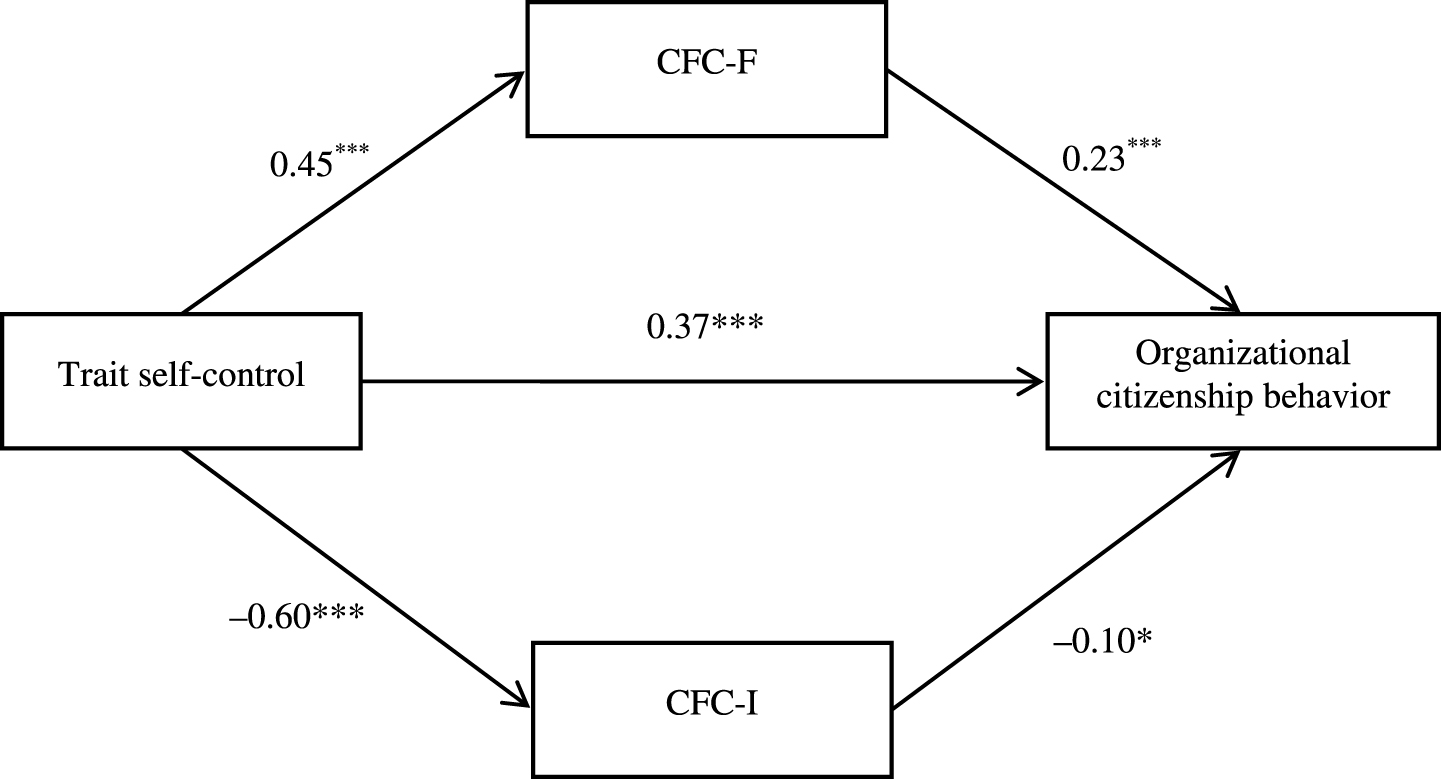
The mediation model of CFC-F and CFC-I in the relationship between trait self-control and organizational citizenship behaviors.
Summaries of direct effect, indirect effect and total effect
Note. S.E. = standard error; CFC-I = consideration of future consequence-immediately; CFC-F = consideration of future consequence-future.
The current study examined the relationship between trait self-control and OCB and the mediating effect of CFC among Chinese employees. Results showed that trait self-control was positively related to OCB; more importantly, this relation was partially mediated by CFC-F.
Consistent with prior studies [29–32], the current findings provide convergent evidence for the fact that self-control, as a stable trait, fosters employees’ OCB. In the perspective of the contents of OCB in Chinese background (e.g., helping colleagues, attending collective activities, maintaining interpersonal harmony, saving organizational resources, obeying organizational disciplines, etc.), self-control is needed to resist temptation of personal gains [30], complete emotional labor [33], managing impression [34], and adjusting interpersonal conflicts [35, 36].
More importantly, the present research extends this link by examining its underlying mechanism by highlighting the role of CFC. This paper reveals that self-control influences OCB through CFC-F, implying that the reasons why employees high in self-control engage in OCB is because they are adept at long-term thinking and time-conflict prohibition. Therefore, employees with higher levels of CFC-F are more concerned about the long-term outcomesthat OCB can bring regardless of short-term sacrifice. This is consistent with previous finding which demonstrates that time-orientation influencespro-organizational behavior [37].
Some limitations should be noted. First, causal relationship cannot be obtained due to the nature of cross-sectional design. Second, according to realistic experience, employees high in self-control do not always pursue public-interest. For example, recently more and more government officials are arrested because of corruption, which implies that factors like employees’ social value orientation, organization identity and organization belongingness may moderate the relation of trait self-control and OCB. Therefore, more research is needed to provide a better picture of how trait self-control is related to OCB.
This study bears some theoretical and practical contributions. On one hand, it widens the application of two-stage model theory of self-control in organization behavior. OCB is considered a prosocial behavior when people are faced with social dilemmas (e.g., individual interests vs. collective interests, short-term interests vs. long-term interests). Employees who confront such dilemmas can perceive a mixed-motive conflict. According to this theory, whether one can recognize this conflict is key to resist temptation and exert self-control. To a certain extent, recognition of this conflict relies on employees’ thinking for the future (e.g., development of the organization). On the other hand, trait self-control and consideration for long-term outcomes are positively related to OCB, which implies that self-control and consideration for future should be included in talent evaluation system in the processes of recruitment. In addition, improvement of self-control can be added to employees training program. In addition, trait self-control has a beneficial association with numerous life outcomes [38–40], but the underlying mechanism receives little research. The present study adds to the literature by demonstrating that one possible process of how trait self-control relates to OCB is through guiding people to think for the future. This expands our understanding of how trait self-controlworks.
In conclusion, this preliminary study found that individuals with high trait self-control engage in more pro-organizational behavior and this link can be partly explained by consideration of future consequence-future.
Conflict of interest
The authors have no conflict of interest to report.
Footnotes
In the online survey website, before answering the self-report measures, participants were presented with a page of consent. If they were willing to take part in the study after reading the consent, they could continue by clicking “I agree to participate” and then they began answering the measures. If they were not willing to participate after reading the consent, they could withdraw by clicking “I don’t agree to participate” and then the study was over.
Acknowledgments
This research is funded by the MOE (Ministry of Education in China) Project of Humanities and Social Sciences (No. 17YJCZH040), the Characteristic Innovation Project of Guangdong Province Office of Education (Grant No. 2016GXJK128), the 13th “Five-Year” Plan of Philosophy and Social Science of Guangdong Province (Grant No. GD16YXL01), the Natural Science Foundation of Guangdong Province (Grant No. 2015A030310209), the 13th “Five-Year” Plan of Philosophy and Social Science Development of Guangzhou (Grant No. 2016GZQN27) and Guangzhou University’s training program for excellent new-recruited doctors (Grant No. YB201707).