



Abstract
BACKGROUND:
Self-control is an important factor in predicting employees’ organizational citizenship behavior, but previous studies have not examined the internal mechanism by which self-control affects organizational citizenship behavior.
OBJECTIVE:
The current study aimed to explore the relationship between self-control and employees’ organizational citizenship behavior and to test the mediating effects of vocational delay of gratification and job satisfaction.
METHODS:
Participants were 474 full-time employees (187 male, 287 female) from different companies in South China. They answered online self-report questionnaires that assessed self-control, vocational delay of gratification, job satisfaction, and organizational citizenship behavior. Path analyses were conducted and a bootstrap technique was used to judge the significance of the mediation.
RESULTS:
The results showed that high self-control employees were more willing to engage in citizenship behavior that benefitted their organizations and colleagues, and the chain mediating effect of vocational delay of gratification and job satisfaction between self-control and organizational citizenship behavior was significant.
CONCLUSIONS:
These findings provide insights to management regarding the mechanism to promote and maintain employees’ pro-organizational behavior.
Keywords
Introduction
Organizational citizenship behaviors (OCB) are a type of individual behavior beyond the scope of work that is not clearly defined by the formal reward system, that has been regarded as a key factor in promoting corporate sustainability, enhancing corporate cohesion, and building company culture [1, 2]. As the market becomes increasingly competitive, a growing number of companies propel employees engaging in OCB to meet the needs of business development with few extra economic costs [3]. Past research has shown that creating a fair organizational atmosphere for employees [4], adopting paternal leadership with kindness and carefulness [5], and providing more organizational support [6] are all beneficial to developing more OCB. In addition to these organizational factors, researchers have found that personal traits, such as a proactive personality [7], collectivist tendencies [8], and work enthusiasm [9] can promote employees’ OCB. Self-control is the psychological ability for employees to carry out impression management, emotional labor, and conflict suppression, and is an important factor in predicting employees’ OCB [10]. However, there has been little quantitative analysis of the internal mechanism of how self-con-trol impacts employees’ OCB. Therefore, in focusing on employees’ career development and work attitudes, the present study seeks to examine the chain mediating effect of vocational delay of gratification and job satisfaction on self-control affecting OCB.
Literature review and hypothesis development
Self-control and organizational citizenship behavior
Self-control refers to the ability to change one’s thoughts, emotions, and behaviors to comply with social norms and to support goal-directed behavior [11, 12]. Previous studies have found that individuals with a higher level of self-control tend to show more positive outcomes in many areas of life (such as healthier lifestyle, academic success, and gaining trust from others) and fewer negative outcomes (such as aggressive behavior, impulsive consumption, and addictive behavior). Furthermore, it is easier for these individuals to realize goals, adapt to the environment, and achieve success [12–14]. Recently, self-control theory has been widely applied in the field of work behavior to explain employees’ problematic behavior when facing work stress [15], irregular working hours [16], abusive management from superiors [17], and other issues in the organizational context. Researchers believe that in the organizational context, low self-control or the consumption of self-control resources can lead to a series of problematic behaviors, such as anti-productive work behavior [18], unethical behavior [19] and reduced OCB [20]. Along with this growth in the research on the influence of self-control, there is increasing concern over why does self-control affect employees’ OCB?
Engaging in organizational citizenship behavior often means giving up self-interest, such as time, mo-ney, energy, or other valuable resources. In this case, displaying behavior that benefits an organization or colleagues requires individuals to overcome the in-stinctive impulse for selfishness. To overcome this impulsiveness, individuals need to utilize the psychological processes of self-control [10, 21]. In the organizational context, employees’ implementation of OCB can be regarded as a type of self-control act-ivity that is manifested in three aspects. Firstly, suppressing impulsiveness, which means resisting self-interested impulses and untimely emotional impulses; secondly, overcoming inner resistance, such as when employees are not interested in their work but can still maintain their working enthusiasm; and thirdly, resisting distraction, which is demonstrated when employees resist various temptations in the process of working and can maintain their attention on their current task [22, 23]. An idiom in China, “repressing the private for the public”, is a good interpretation of the relationship between self-control and OCB, meaning that employees with higher self-control are more willing to engage in OCB. This view has also been supported by some recent empirical studies [10, 24]. In view of all that has been mentioned so far, the following can be hypothesized:
Hypothesis 1: Self-control can positively predict employees’ OCB.
Vocational delay of gratification as a mediator
Life experience reminds us that we cannot be in a hurry to succeed. Restraint and persistence are often the only ways to maximize long-term benefits. Mischel and Underwood defined this tendency to delay immediate satisfaction for greater rewards and to maintain target behavior as the delay of gratification [25]. Based on this definition, vocational delay of gratification (VDOG) emphasizes the delay of an individual’s gratification in his or her career. It indicates that employees with this ability would willingly give up immediately satisfying rewards (e.g., take a rest, entertainment, or impulsive behavior) in pursuit of valuable long-term outcomes in occupation (e.g., promotion, compensation increase) [26, 27]. They are more concerned about accomplishing assigned tasks, obtaining greater rewards, and achieving higher career goals, instead of giving in temptation.
Compared with individuals with low self-control, people with high self-control are more capable of suppressing the temptation of short-term interests and weighing the current choices in relation to long-term interests; thus, they show better ability in delaying gratification [10]. A longitudinal survey of college students found that self-control could significantly predict an individual’s delay of gratification, and individuals with high self-control considered problems in relation to long-term outcomes [28]. Wang et al. found that employees with better self-control ability were more likely to give long-term consideration and resist temptation related to short-term self-interest to achieve their own and collective long-term interests [10]. Evidence from experimental studies suggests that when making intertemporal choices, it is more difficult for low self-control individuals to resist the temptation of short-term benefits. Thus, these individuals tend to make more impulsive decisions [29, 30]. Together, these studies outline that high self-control individuals demonstrate better performance in delaying satisfaction.
A previous study found that VDOG not only helped individuals achieve long-term career goals but also promoted organizational development [31]. Employees who maintained a high level of delayed satisfaction in their careers had work behaviors that showed better job performance and were more satisfied with their work [32, 33]. At the organizational level, employees who were able to resist temptations that may hinder their career development and job promotion maintained a high level of work commitment and organizational commitment [27], and were more willing to perform more extra-role behavior for the benefit of the organization. It can be speculated that vocational delay of gratification positively predicts employees’ job satisfaction and OCB, and may also play a mediating role in self-control affecting OCB.
Hypothesis 2: Vocational delay of gratification mediates the relationship between self-control and OCB.
Job satisfaction as a mediator
The sense of satisfaction generated from work reflects employees’ positive attitudes toward their work and their organizational environment [34, 35]. Job satisfaction arises when employees’ actual values (such as income, promotion opportunities, or platforms for displaying capabilities) are greater than they expected [36]. Although many previous studies have confirmed the positive impact of job satisfaction on employees’ OCB [37–40], the research to date has tended to focus on the role of job satisfaction in the mechanism between external environmental factors (such as leadership-member exchange, leadership style, and job requirements) and OCB [41, 42]. However, few writers have been able to draw on any systematic research into whether personal trait factors (e.g., self-control, VDOG) would increase employees’ engagement in OCB by bringing them greater job satisfaction. The present study explored whether self-control could enhance the tendency to engage in OCB by helping employees experience higher job satisfaction.
A literature review found that high self-control employees may experience greater life satisfaction, job satisfaction, and happiness [43, 44]. This is because self-control helps to reduce employees’ mot-ivational conflicts when they face work stress, abusive management, and emotional labor; thereby alleviating these negative influences [45]. For example, employees who were good at restraining themsel-ves (including through an external work schedule) often experienced higher job satisfaction when facing work-family conflicts or high job requirements [46, 47]. Additionally, according to the social exchange theory, employees who showed greater job satisfaction were inclined to reward their organizations by taking actual actions such as engaging OCB [48]. Besides, Ilies and colleagues (2018) found that emp-loyees who had higher levels of performance and satisfaction are more likely to display higher levels of OCB [39]. Therefore, we speculate that self-control may indirectly affect employees’ OCB through job satisfaction.
Hypothesis 3: Job satisfaction mediates the relation between self-control and OCB.
According to the perspective views OCB as a form of self-control [49], self-control may enhance employees’ level of motivation to resist short-term temptations and achieve long-term goals in their car-eer development [10]. Thus, these employees often experienced a pleasant experience brought about by professional success. As described by Liu and col-leagues, vocational delay of gratification, as a self-regulating ability for employees to achieve long-term career development, can indirectly enhance their emotional commitment to the organization by incr-easing their satisfaction with their work [27]. To sum up, we propose a chained intermediation model (as shown in Fig. 1) that demonstrates that employees who have high self-control show a better delay of gratification in their career development and receive positive psychological experiences from work. Thus, they are more willing to engage in OCB.
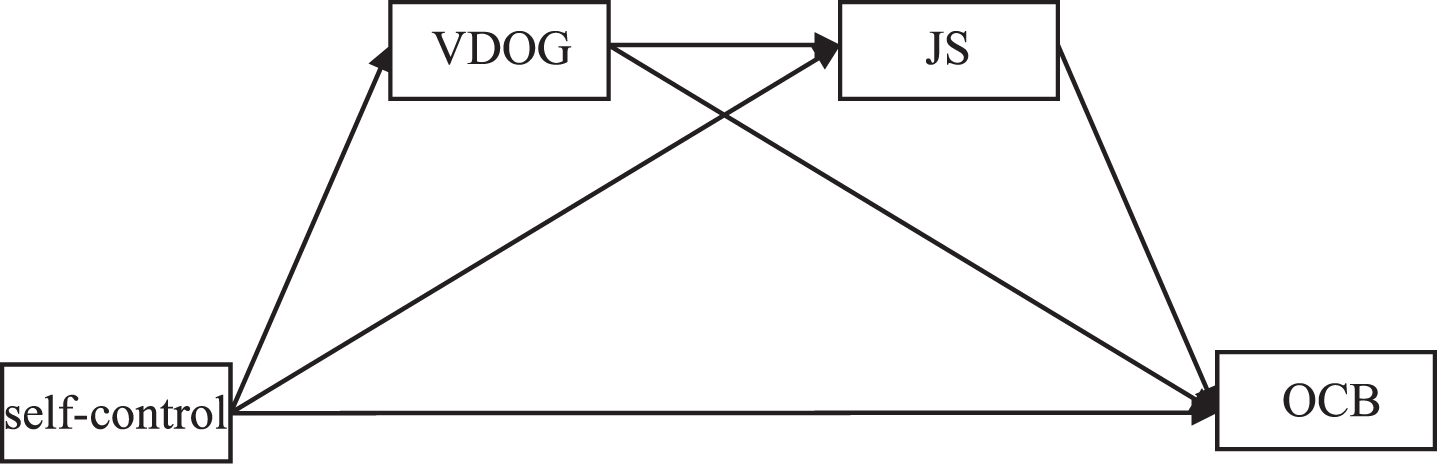
Hypothesis testing model.
Participants and procedures
The Ethics Committee of the School of Management, Jinan University, approved the study and data collection protocol. To mitigate the social desirability response bias, all participants were provided consent forms prior to completing the online questionnaires, which notified the participants potential benefits, possible risks and discomforts, confidential issues, compensation, and their rights to refuse to participate in or withdraw from the current study any time without penalty. A total of 521 full-time employees who worked in different companies in South China were recruited through online advertisements in exchange for the chance to win 100 RMB (data were collected between May and July 2017).
After some copies of questionnaires were excluded because they contained too many identical answers, 474 valid surveys remained for analysis (a response rate of 91.0%). Among these 474 employees, 39.5% were male. The participants ranged in age from 19 to 64 years (M = 28.99 years, SD = 5.27 years), and they averaged 51.02 months at their jobs (SD = 67.41 months). The participants’ demographics are presented in Table 1.
Demographics of the sample
Demographics of the sample
All English-language outcome measures had been adapted into Mandarin Chinese language by a “translation/re-translation” method. The alpha coefficient for each scale is presented in Table 3.
The means, standard deviations, correlations, and reliabilities among the variables
The means, standard deviations, correlations, and reliabilities among the variables
Note. N = 474. Cronbach’s alpha is reported along the diagonal. *p < 0.05; **p < 0.01; ***p < 0.001.
Tangney et al.’s (2004) Brief Self-Control Scale (BSCS) was used to assess employees’ self-control. This scale has been shown to have good psychometric properties in different cultures [11, 50]. This measure consists of 13 items rated on a five-point scale (from “1 = not like me at all” to “5 = very much like me”). A total score can be obtained by summing all 13 items, and high scores indicate better self-control. Sample items are “I am good at resisting temptation” and “I have a hard time breaking bad habits”.
Vocational delay of gratification
The Vocational Delay of Gratification Questionnaire (VDGQ) developed by Liu et al. (2007) was used to measure employees’ vocational delay of gratification behavioral intention [27]. This scale consists of eight items rated on a 7-point scale (from “1 = very strongly disagree” to “7 = very strongly agree”). The scale is divided into two subscales: work delay of gratification (WDOG; i.e., “I often work late until midnight to better complete the work”) and career delay of gratification (CDOG; i.e., “It isn’t a problem to start my career as an ordinary clerk as long as there is a promotion possibility”). In this scale, the scores for work and career delay of gratification were obtained by summing all respective items.
Job satisfaction
The Minnesota Satisfaction Questionnaire (MSQ) was used to assess employees’ job satisfaction toward their current job [36]. Participants were required to indicate their degree of relative satisfaction on a 5-point scale (from “1 = very dissatisfied” to “5 = very satisfied”). This scale includes 20 items and is divided into two subscales: intrinsic job satisfaction (i.e., “being able to keep busy all the time”) and extrinsic job satisfaction (i.e., “the way company policies are put into practice”). In this scale, scores of intrinsic and extrinsic job satisfaction were obtained by summing all respective items.
Organizational citizen behaviors
The Organizational Citizenship Behavior Scale (OCBS) developed by Aryee, Budhwar and Chen was used to assess participants’ organizational citizenship behaviors [51]. This scale has two dimensions, one measuring OCB at individual level (OCBI; i.e., “expresses opinions honestly when others think differently”) whereas the other measuring OCB at organizational level (OCBO; i.e., “makes suggestions to improve work procedures”). This scale has been used among Chinese employees and has shown good internal reliability consistency and criterion validity [10]. This scale consists of nine items rated on a 7-point scale (from “1 = strongly disagree” to “7 = strongly agree”); a higher score indicates more OCB.
For the control variables, meta-analytic findings revealed a significant association between OCB and age and gender; respectively [52]. Hence, we measured age and gender to control for their potentially spurious effects.
Statistical analyses
SPSS v.21.0 and Mplus Version 7.0 were used to analyze the data. First, we conducted confirmatory factor analyses (CFAs) to examine the discriminant validity of the employees’ four self-reported variables (i.e., self-control, VDOG, job satisfaction, and OCB). Second, correlation analysis was conducted to explore the correlations among the main variables. Third, the hypotheses were tested using structural equation modeling (SEM) with demographic variables (age and gender) controlled as covariates in the model. Finally, mediation analyses were conducted to examine the hypothesis model. A robust method of maximum likelihood was used because the dependent variable was ordinal. A Root Mean Square Error of Approximation (RMSEA) value below 0.08 and a Confirmatory Fit Index (CFI) value over 0.90 indicated a good fit [53]. In addition, 5000 bootstrap samples were drawn from the full dataset and a 95% confidence interval (CI) was used to determine whether the mediation effect was significant. When the 95% CI for an indirect effect did not include 0, the indirect effect was significant.
Results
Discriminant validity
As shown in Table 2, the chi-square of each of the other three models showed a significant increase compared to the four-factor model (M1), and the four-factor model was superior in the other fit indices. Thus, we concluded that the four variables were empirically distinct from one another, representing four distinct constructs.
Model fit results from confirmatory factor analyses
Model fit results from confirmatory factor analyses
Note. N = 474. SC = self-control, VDOG = vocational delay of gratification; JS = job satisfaction, OCB = organizational citizenship behaviors. All alternative models were compared with the hypothesized four-factor model. All Δ χ2 values are significant at p < 0.01.
Structural Equation Modeling results of direct, total indirect, and specific indirect effects
Note. N = 474. VDOG = vocational delay of gratification; OCB = organizational citizenship behaviors.
The mean value, standard deviation and correlation coefficients of all key variables are presented in Table 3. Self-control was significantly and positively related to VDOG (r = 0.13, p < 0.01), job satisfaction (r = 0.23, p < 0.001), and OCB (r = 0.39, p < 0.001). VDOG was significantly and positively related to job satisfaction (r = 0.32, p < 0.001) and OCB (r = 0.49, p < 0.001). Additionally, job satisfaction was significantly and positively correlated with OCB (r = 0.47, p < 0.001). These findings provided preliminary support for the hypothesized relationships.
The mediating effect test
We used Mplus Version 7.0 to create a latent variable for organizational citizenship behavior (OCB) using OCBI and OCBO. We then used SEM (5000 bootstrap samples) to examine the relationship bet-ween self-control and OCB. The model suggested a good fit to the data: χ2/df = 1.798, CFI = 0.997, TLI = 0.988; RMSEA = 0.041 (90% CI = [0.001–0.108]); SRMR = 0.01. The results showed that self-control was positively associated with OCB (β= 0.418, p < 0.001).
We then performed SEM (5000 bootstrap samples) to examine the multiple mediating effects of VODG (a latent variable created by two dimensions: WDOG and CDOG) and job satisfaction (a latent variable created by two dimensions: intrinsic job satisfaction and extrinsic job satisfaction), as illustrated in Fig. 2. The model suggested a good fit to the data: χ2/df = 2.978, CFI = 0.975, TLI = 0.956; RMSEA = 0.065 (90% CI = [0.046–0.084]); SRMR = 0.042.
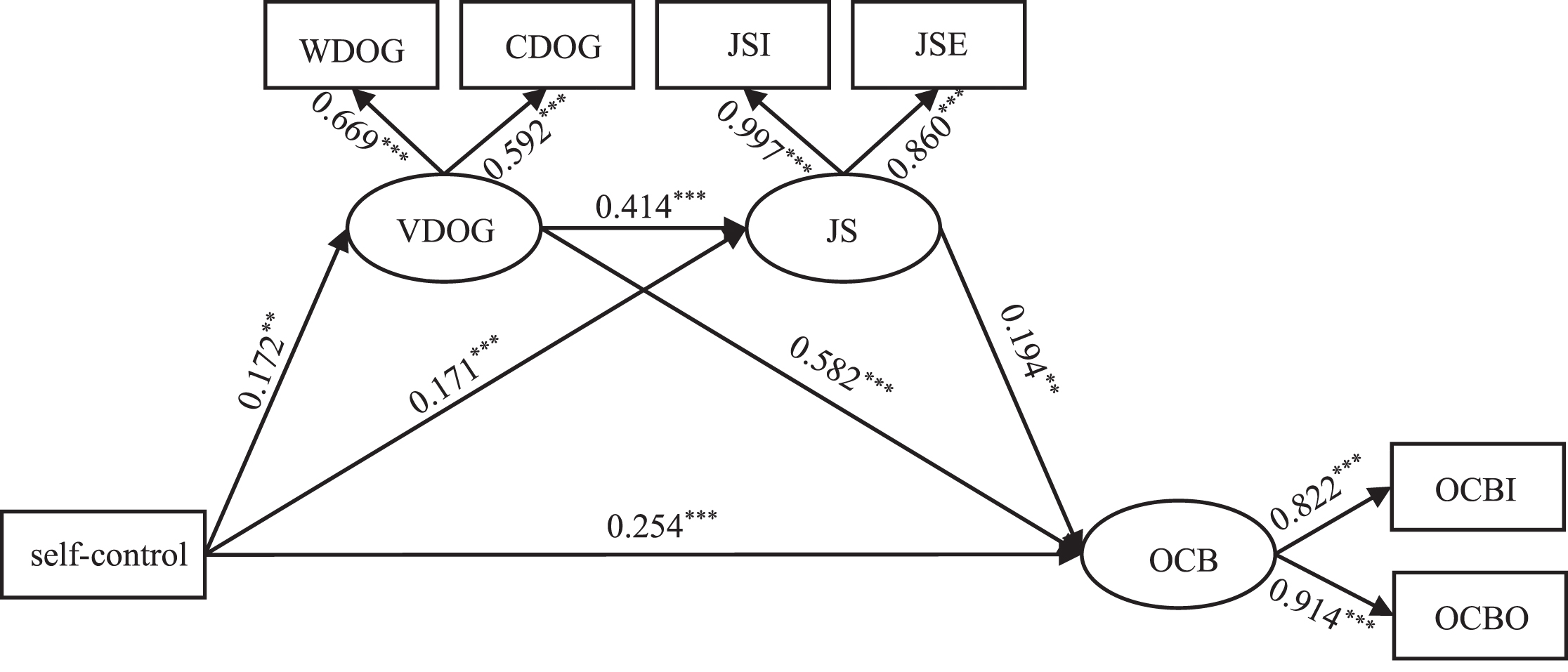
The multiple mediating effect of VDOG and JS on the relationship between self-control and OCB. Note. VDOG = vocational delay of gratification; JS = job satisfaction; OCB = organizational citizenship behaviors.
Consistent with our hypothesis, the path from self-control to OCB through VDOG was significant (indirect effect = 0.100, SE = 0.038, p < 0.01), and the 95% CI for an indirect effect (0.025, 0.175) did not contain zero. Self-control was positively (but weakly) associated with VDOG (β= 0.172, p < 0.01), and VDOG was positively and moderately associated with OCB (β= 0.582, p < 0.001). We also found that the path from self-control to OCB through job sat-isfaction was significant (indirect effect = 0.033, SE = 0.015, p < 0.05), and the 95% CI for an indirect effect (0.004, 0.062) did not contain zero. Self-control was positively and weakly related to job satisfaction (β= 0.171, p < 0.001), and job satisfaction was positively and weakly related to OCB (β= 0.194, p < 0.01).
As expected, the chain mediating effect of VDOG and job satisfaction between self-control and OCB was significant (indirect effect = 0.014, SE = 0.006, p < 0.05), and the 95% CI for the indirect effect (0.001, 0.026) did not contain zero.
Based on previous study [10], the present study draws upon a collectivist cultural background with regard to employee career development and working attitude. The purpose of this study was to reveal the internal mechanism of the effect of self-control on employees’ organizational citizenship behavior. The results demonstrate the effect of self-control in promoting employees’ organizational citizenship be-havior and show that career delay satisfaction and job satisfaction function as chain mediating effects in self-control and organizational citizenship behavior. These results enrich and broaden self-control theory concerning social dilemmas and provide insights to management by revealing employees’ pro-organiza-tional promotion and maintenance mechanisms.
Theoretical implications
First, the present study found that high self-control employees were more inclined to engage in behaviors that benefit their organizations and colleagues in organizational situations. This finding supports previous studies [10, 18] and broadens self-control theory by applying social dilemma issues to organizations [49, 54]. According to the theory of self-control in relation to social dilemmas, when individuals are confronted with choices in which short-term self-interests conflict with long-term collective interests, self-control helps individuals resist the temptation of short-term benefits and perform cooperative behaviors that maximize collective interests [55]. The present study confirms that this theoretical opinion helps to explain why employees are willing to engage in organizational citizenship behavior. When they need to make decisions that are pro-organization or pro-self-interest, employees face a self-control conflict: to maximize the long-term interests of the org-anization, employees must sacrifice their short-term interests. Overcoming this conflict requires individuals to use self-control [55].
Second, job delay satisfaction provides a path for explaining high self-control employees who are more willing to engage in organizational citizenship behavior. According to the rational-economic assu-mption, humans pursue the maximum benefit under constraints, and the main motivation for people’s behavior is to strive for the greatest economic benefit. Following this assumption, when facing a social dilemma, people should maximize their self-interest as the only criterion for action [55, 56]. However, life experience and empirical studies have shown that although obtaining immediate rewards is tempting, people will also use self-control to resist the temptation of self-interested impulses to pursue longer-term interests or to be completely altruistic [57, 58]. With regard to employee career development and working goals, in order to get promotion and/or raise of salary, employees with high levels of self-control are supposed to be more adept at dealing with negative working environments [18], reducing the negative impact of work-family conflicts [49], and regulating the emotional imbalance caused by work stress [59]. Moreover, they are also more likely to balance their future career development and perform organizational citizenship behaviors at the expense of short-term self-interest.
Lastly, the present study found that satisfaction from working is an important reason why high self-control employees were willing to engage in organizational citizenship behavior. In contrast to previous studies in the field of organizational behavior in addition to providing employees with a fair environment and organizational support at the organizational level to enhance employees’ job satisfaction [60, 61], the present study found that employees’ self-control ability and long-term planning for their careers enabled them to experience satisfaction from their work, and inspired them to engage in more organizational citizenship behaviors. High self-control individuals can suppress the temptation of short-term benefits in inter-temporal choices and think more about their decisions in the long-term [29, 62], which leads them to experience satisfaction due to career success and financial freedom.
Practical implications
The findings of this study also have implications for human resource management practices.
First, in addition to using external means to encourage employees to engage in civil behavior that ben-efits organizations or colleagues, such as providing more organizational support [6], or creating a fair org-anizational atmosphere for employees [4], the present study found that high self-control was a major driving force for employees to engage in more organizational citizenship behaviors. Managers can incorporate high self-control into the evaluation system during employee recruitment or promotion, and self-control training can be included in employee training to increase the possibility of employees engaging in organizational citizenship behavior.
Second, this study found that the reason high self-control employees were more willing to contribute to their organization was closely related to their future career development plans. Compared to low self-control employees, high self-control employees can better balance current choices in relation to their long-term career interests to gain positive experien-ces from working. This finding suggests that human resource managers can provide employees with empl-oyee assistance programs and career development consulting services, and can explain to employees the future development strategy of the company to clarify the relationship between employee career planning and enterprise development [63].
Limitations and future research
Despite the contributions of this study, there are some methodological limitations. This study avoided interference from common method variance by emphasizing anonymity and unified test guidance, and the validity test also excluded this possibility. However, the use of mediation analysis with a cross-sectional data, so there is insufficient evidence to deduce causal relationships between self-control and organizational citizenship behavior. Future research is required to determine the causal association bet-ween employee self-control and pro-organizational behavior through a longitudinal cohort design with multiple time points. This study confirmed that high self-control employees were more likely to suppress self-interest in their careers and show more pro-organizational behavior. However, as frequently re-ported by the media, some honest and self-disciplined officials have lost their jobs due to corruption and undesirable affairs. To a certain extent, these situations suggest that the influence of self-control on pro-organizational behavior is also regulated by many environmental factors, such as the organization’s culture of ethical behaviour and leadership style. Therefore, future research should consider moderating variables for self-control that affect organizational citizenship behavior.
Conflict of interest
None to report.
Funding
This research is funded by the National Natural Science Foundation of China (No. 31970990), the MOE (Ministry of Education in China) Project of Humanities and Social Sciences (No. 17YJCZH040), the Characteristic Innovation Project of Guangdong Province Office of Education (No. 2017GGXJK001), and the Philosophy and Social Science Project of Guangdong Industry Polytechnic (Grant No. KJRW001).