



Abstract
BACKGROUND:
Within a Job Demands-Resources Model framework, formal mentoring can be conceived as a job resource expressing the organization’s support for new members, which may prevent their being at risk for burnout.
OBJECTIVE:
This research aims at understanding the protective role of formal mentoring on burnout, through the effect of increasing learning personal resources. Specifically, we hypothesized that formal mentoring enhances newcomers’ learning about job and social domains related to the new work context, thus leading to lower burnout.
METHODS:
In order to test the hypotheses, a multiple regression analysis using the bootstrapping method was used.
RESULTS:
Based on a questionnaire administered to 117 correctional officer newcomers who had a formal mentor assigned, our results confirm that formal mentoring exerts a positive influence on newcomers’ adjustment, and that this in turn exerts a protective influence against burnout onset by reducing cynicism and interpersonal stress and also enhancing the sense of personal accomplishment.
CONCLUSIONS:
Confirming previous literature’s suggestions, supportive mentoring and effective socialization seem to represent job and personal resources that are protective against burnout. This study provides empirical support for this relation in the prison context.
Introduction
Within the Job Demands-Resources (JD-R) model, job resources are all those factors that can help employees in reducing job demands and related costs, thus balancing their effect in fostering job strain and, in extreme cases, burnout [1]. In fact, job resources include factors capable of fostering personal growth, learning and development by providing feedback, enhancing task significance, and stimulating employees’ motivation [1–3]. In addition to this direct effect on positive outcomes, some scholars assert that when job resources activate learning processes, they also enhance individuals’ mastery in coping effectively with demanding conditions, consequently protecting them from negative outcomes [4].
Job resources may be related both to informal events (such as peer support) and to more strategically enacted actions (such as career opportunities) that are expressive of the organizational politics and investment in its human resources. Albeit these organizational-based interventions are less frequent than individual-based ones, and are rarely carried out with the explicit intent to combat burnout [4], according to some authors they are still the most recommended [4, 6]. In the present study we consider formal mentoring as an organizational intervention targeted to individuals [3] and aimed at enhancing newcomers’ learning resources, making them more socialized into the organization, and in turn exerting a protective effect on burnout.
Although some scholars have shown that mentoring could be treated as an organizational factor exerting a primary prevention function with respect to newcomers [7–9], the relationship between mentoring and burnout is not yet well established. Given this, the first aim of this paper is to examine the role played by formal mentoring as an organizational intervention capable of protecting newcomers from the risk of burnout. Formal mentoring can also be conceived as a job social resource that supports and facilitates learning processes and role transitions [10]. Thomas and Lankau [9] showed that non-supervisory mentoring had a positive influence on newcomers’ organizational socialization (that is, the increase in newcomers’ learning about different domains of organizational life) and this, in turn, reduced their role stress and consequently burnout. To the best of our knowledge, this is the only study that examined these factors together.
An important extension of the JD-R model includes personal resources, as a further protective factor that can trigger positive outcomes [3, 11]. Some scholars [12] verified that job resources influenced personal resources – conceived as the individuals’ sense of ability to successfully control their environment – and this, in turn, had a positive impact on burnout reduction. The mediation role played by personal resources suggests that job resources enhance their development [11]. Following this suggestion, we considered the learning process as a personal resource that is useful, above all in the socialization phase, to understand and control the work environment; and that this resource can be enhanced thoroughly organizational strategies aimed at fostering it in employees. In other words, our second aim is to examine the role played by formal mentors as a job resource helpful in promoting newcomers’ learning resources (i.e., their understanding of organizational goals and values and their integration among teammates), and by this preventing the onset of burnout. In fact, although researchers have made considerable progress in understanding the role of personal resources within the JD-R model [12–15], further research on their relationship with both job resources and burnout–wellbeing outcomes is still needed.
To further explicate the nature of our research, we briefly review the relevant literature regarding mentoring, socialization processes and newcomers’ burnout, describing the theoretical framework upon which our hypotheses are based. Then, we report the research findings based on a questionnaire administered to new hired correctional officers (henceforth, COs) working in Italian prisons. In fact COs are highly exposed to job-related stressors (such as high demands, workload, role ambiguity, lack of rewards, negative emotions, work-life conflict, etc.) that may result in burnout, poor health conditions, work-related violence and even death [16, 17]. Thus, in line with the increasing international interest and research on the wellbeing of prison staff, the present work also aims to contribute to the on-going debate to improve the Italian detention system [6, 18-20].
Theoretical framework and hypotheses
Mentoring as a job resource for correctional officers’ burnout
Prisons are, by definition, isolated and enclosed environments, with high human and emotional density (e.g. because of forced relationships, the suffering faced each day, the feeling of helplessness that is often felt by both prisoners and agents). Working in a prison requires COs to express simultaneously aptitudes and skills really far from each other, and not easily reconcilable. On the one hand, they must maintain custody and control of the inmates, while at the same time supporting them in view of their social reintegration. This dual mandate gives rise to role ambiguity and generates complexity in the job, making prison a highly demanding work context. Thus, scholars have extended their studies on the job burnout syndrome also to COs’ specific occupation. Substantial previous research has demonstrated that correctional work is more stressful than many other occupations, and work-related stress and burnout levels among COs have been reported as growing consistently higher over the past 30 years [16, 21-23]. A comprehensive overview of this literature is provided by Schaufeli and Peeters’ [6], and in Dowden and Tellier’s meta-analysis [24].
Similar to other high-demanding work contexts, the many job demands – such as workload, understaffing, shift work and overtime, role ambiguity, management of critical events, and stressful social encounters with superiors, colleagues and inmates [6, 25] – represent stressors for newcomers and can produce a severe ‘reality shock’ [4, 26]. Thus, for COs the early stage of entry is a sensitive period for burnout development [10]. At this stage, some specific organizational strategies to support newcomers can be particularly effective in preventing burnout onset, such as an introductory mentorship system in order to avoid early career burnout [27]. Organizations that seek to develop formal mentoring programs operate on the assumption that mentoring relationships have a beneficial impact on those involved. A meta-analysis by Eby and colleagues [28] reported on many of the potential benefits of mentoring relationships for protégés, such as increased performance, improved attitudinal outcomes, higher motivation and lower stress and strain. Specifically, in a work context typically characterized by a highly formalized rule–based culture, formal mentoring represents a valuable resource that can help employees to cope with job demands (e.g. role problems, workload, demanding social contacts, poor social status) [6, 9]. Previous literature shows that informal mentoring has greater effects on positive outcomes than formal mentoring, while formal mentoring interventions represent an opportunity whose success depends on the program design and participants’ reactions, and does not necessarily result in positive outcomes [29]. The simple presence of a formal mentor is not enough to make a program effective, because this is the result of many factors such as mentor’s commitment, protégés satisfaction and the overall quality of their relationship [30, 31].
Considering that mentoring provides a vehicle for transmitting encouragement, counsel and social support [32, 33], and represents a learning source that reduces uncertainty related to newcomers’ organizational roles and understanding of organizational culture [34], it can be conceived as a job resource capable of exerting a direct effect on the reduction of role stress and burnout. Some scholars have focused on mentoring influence for prevention of negative outcomes such as turnover intention [7, 35]. For instance, Lankau, Carlson and Nielson [36] showed that formal mentors could support their protégés in clarifying their work roles and reducing role ambiguity, such that newcomers perceive fewer role stressors and experience more positive attitudes. As well, Han and colleagues [37] reported that mentoring decreased nurses’ stress (role conflict and role ambiguity), and that in turn reduced their intention to quit and work burnout. Hu and colleagues [38] found that the psychosocial function of formal mentors in the military academy context had an influence not only on satisfaction and commitment but also on stress reduction, as mentors provided reassurance to their protégés and afforded them opportunities to take new risks. Overall, protégés’ perceptions of mentors’ contributions (in providing them psychosocial support, uncertainty disentangling and support for future career) is related to better performance and higher commitment in protégés [29]. Considering the overall literature, and in line with the JD-R model framework, we hypothesize that formal mentoring can represent a job resource exerting a protective role on burnout in all its features:
H1) Formal mentoring is negatively related to newcomers’ burnout.
Formal mentoring for personal resources development
A recent conceptualization of the original JD-R model extends it by including personal resources, which are related to individuals’ perceived ability to control and impact their environment successfully [3, 11]. Scholars assumed that personal resources contribute to resiliency and showed that they predict employees’ lower burnout and higher engagement, motivation, and other positive outcomes [3]. Literature examined different personal resources, mainly related to personal traits (e.g. self-efficacy, self-esteem, optimism, trait competitiveness) or characteristics (e.g. mental and emotional competence, compassion satisfaction) [12–15, 39]. At any rate, in personnel intensive organizations, where the human capital represents their main asset [4, 40], the employees’ capability to learn is a fundamental basis for understanding and exerting a control upon their work environment and improving performance [11]. Further, the increase of learning about different domains makes the environment more predictable and allows employees – above all when they are newcomers–to build appropriate sense-making frameworks and reduce uncertainty [26, 41].
Thus, in this study we considered the learning process as a specific domain of personal resources. The learning process [42] refers to self-initiated and self-directed individual behaviors, by means of which employees (in the present research, newcomers) actively improve their competencies and work environment [43–45] and effectively cope with demanding conditions [3]. Thus, learning process represents a personal resource that enables people to develop strategies to acquire new information, to disentangle the amount of new information and choose those aspects that allow for better understanding of the working environment.
Previous research also indicates that formal mentoring is a resource by which organizations may convey normative information about their goals, culture and values [46]. The new employees, since their first entry into the organization, increase their level of learning about different areas of content [46] mainly through communication with stable figures such as supervisors or colleagues, representing different learning sources they may rely on [41, 47]. Formal mentors fulfill this function in different ways, for example enhancing communication between the newcomers and their colleagues, eliciting the expression of their opinions and doubts, giving emotional support in situations with high emotional impact, encouraging their work self-esteem and taking pride in their professional accomplishments.
Research shows that newcomers who have experienced effective mentoring relationships appear to be better integrated than non-protégé newcomers [29, 46–48]. They also feel increased self-esteem, enhanced self-image, confidence and efficacy [33]. Overall, these newcomers have a higher level of learning in the different content dimensions of the socialization domain, and this effect is already visible in the first phase of the organizational socialization process [29, 50]. Moreover, formal mentoring represents a source of support for newcomers not only in the early stages of the organizational socialization process, but also in their future careers [51, 52]. For instance, Chatman [31] found that the higher the quality of time spent with their mentor during the first year on the job, the higher the person-organization fit would be.
Drawing on theoretical framework of the JD-R model, we can consider formal mentoring as a job resource that fosters newcomers’ personal resources by enhancing their learning and awareness about their role within the work and the social environment. Considering that the relationship between job and personal resources is rather understudied, this research is aimed at addressing this gap, hypothesizing that:
H2) Formal mentoring is positively related to newcomers’ learning personal resources.
Mentoring, learning processes and burnout
Most research on organizational socialization conceived it as a learning process and focused on what newcomers actually learned (i.e. organization’s long-held traditions, slang and special jargon, cultural values, etc.) in their attempts to become effective organizational members [34, 53]. In fact, increased learning provides newcomers with higher sense-making capability and increased active control of their work environment. An effective socialization process results in an appropriate understanding of role behaviors, duties and norms clarification, and improved skills to manage conflicting role demands, in minimizing of differences between unrealistic expectations and the reality of the work role, and in reduced role stress [8, 9]. On the other hand, if learning processes fails, new members tend to feel uncertainty and lack of congruence between their efforts and outcomes, and a consequent emotional and cognitive distance from their jobs and from other people at work [54].
Although some research in military contexts confirms the importance of the socialization learning processes for many positive organizational outcomes – such as cohesion in teamwork and the acquisition of insiders’ norms [41, 55] – to our knowledge no study has yet focused on these processes as protective factors against burnout in COs. Bearing in mind the JD-R model framework, in this study we focus on the relationship between personal resources and burnout [12, 14], specifically hypothesizing that, also for new hires entering the prison context, learning processes represent a personal protective factor for burnout onset:
H3) Newcomers’ learning personal resources are negatively related to burnout.
Lastly, this paper aims to contribute to the JD-R extended model conceptualization, which adds personal resources into the model, suggesting an interplay between them and job resources, and a direct effect on burnout-engagement outcomes [3, 11]. Research on personal resources in the organizational literature currently provides little and not consistent evidence regarding their role. For instance, some scholars considered personal resources as a factor that, together with job resources and job demands, contributed to enhance employees’ engagement [13, 39]. Some others considered their moderator role in the relationship between job demands-resources and outcomes, but obtained conflicting results [12, 15]. Others confirmed that personal resources had a mediating role between several job resources and engagement-exhaustion [12], showing their contribution in explaining this process. Thus, more research is needed to better understand the contribution of personal resources together with the other factors composing the model.
In this study we hypothesize that personal resources have a mediating role between job resources and burnout. Specifically, we posit formal mentoring is a job resource capable of exerting a positive influence on burnout not only directly, but also by activating COs’ personal resources (i.e. learning resources) that, in turn, may prevent them from experiencing a range of negative outcomes. In other words, we aim to verify whether formal mentoring represents an effective support for enhancing new COs’ learning resources (feeling more adjusted in the social and work system); that, in turn, reduces the sense of burnout stemming the feeling of interpersonal strain, and strengthens their job-related sense of adequacy. Thus, we hypothesize that:
H4) Formal mentoring is positively related to newcomers’ learning personal resources that, in turn, are negatively related to their degree of burnout.
The set of the hypothesized relationships is summarized in Fig. 1.
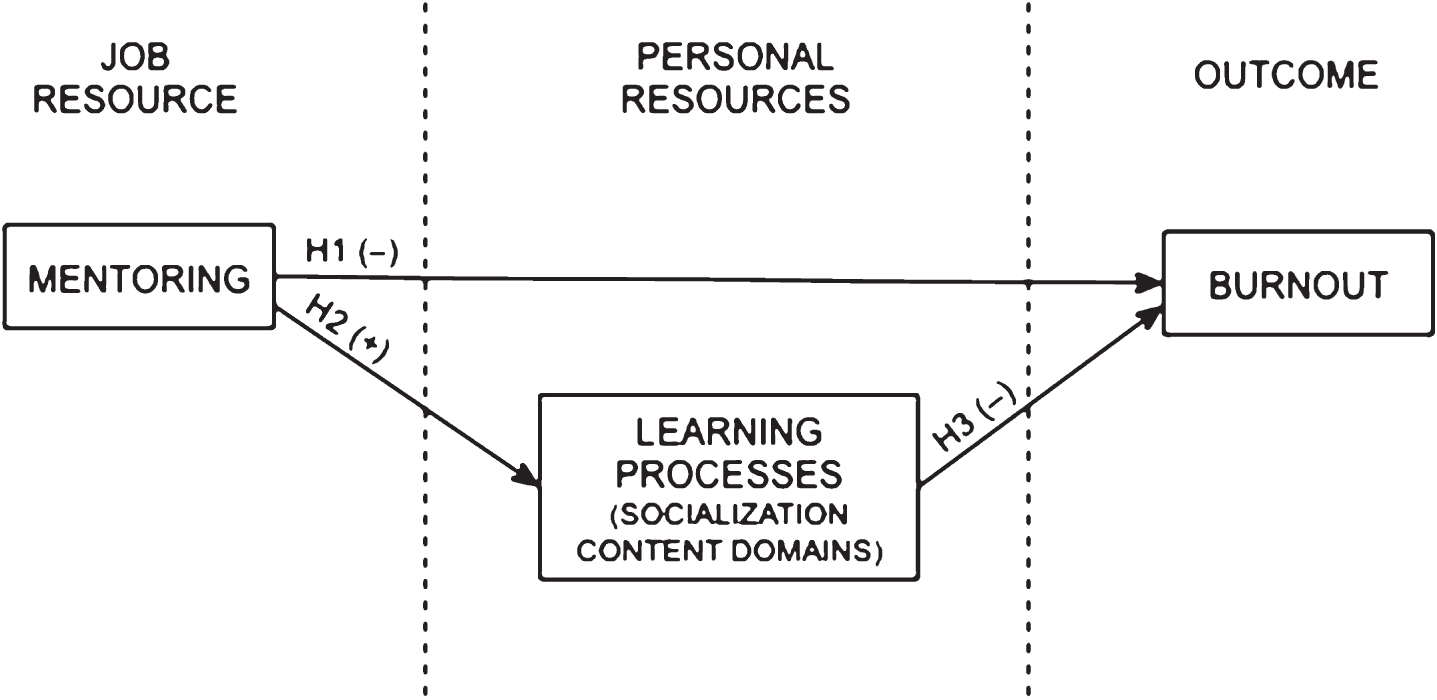
The hypothesized model.
The research context
This study is part of a wider action-research program on the COs socialization process, promoted by the Training Office of the Italian Ministry of Justice, to stem entry difficulties in newcomers. The project aims to counteract the frequent and untimely absenteeism, withdrawal and burnout phenomena common in COs by intervening early to prevent them. In Italy, prison environmental conditions are steadily worsening and are more emotionally demanding. It is estimated that since 2001, prisons are increasingly overcrowded (inmates, on average, exceeding from 128% in 2001 to 146% in 2013 [18]). Presumably because of this, the rate of inmate suicide attempts has gradually grown over the years [20]. For this purpose the Training Office has introduced, for the first time, the mentoring function to facilitate newcomers’ orientation and role adjustment in their first weeks of work. Bearing in mind the overall literature on formal mentoring summarized above and Chao’s [29] and Inzer & Crawford [56] suggestions, a detailed program to train the mentors and to set the mentoring intervention was implemented [7].
The mentors were COs higher-ranking but not direct supervisors of the protégées, and were identified on the basis of their motivation and previous experience as tutors in the apprentice phase of other courses. Each mentor was assigned from one to five protégées, depending on the newcomers’ allocation institute, so no matching process was possible, although ice-breaking activities were established to promote mutual understanding of mentors’ role expectations. Mentors received some days of training designed to give them methodological skills and to define and share the guidelines of their mentoring intervention, to enhance their commitment and to foster joint goal setting [29, 56]. The mentors’ training followed a standardized intervention guideline, aimed at reducing the variation in personal and contextual factors. Mentors were mainly asked to serve a psycho-social function (as in most mentoring programs [29]), because the new officers already follow a 12-month training period, with an apprenticeship phase included (followed by a trainer in a prison different from the workplace they have been assigned), and because career-related support is not so relevant for this occupation. The request was, overall, to promote a whole, systemic vision of the penitentiary (for example, making a job rotation in the first weeks of work; giving organizational and historical information about the prison), and to be acquainted with superiors and colleagues (for example, organizing a meeting to present the newcomers to the Director and the security area’s Commander of the prison; introducing the newcomers at the first daily service conference).
Participants and procedure
Participants were correctional officer new agents, hired for six months, working in different prisons in Italy. The research sample included all past students (396 COs) who had followed a mandatory and highly standardized training (theory–apprenticeship – theory) for 12 months conducted by Ministry of Justice. They received the questionnaire in their workplace from the training office. To provide anonymity, respondents were given a prepaid envelope to be returned directly to the university following the research project.
Subsequently, 117 of them (29.5%) answered the survey. Respondents were all young (mean age: 25.9 years, SD: 2.52) and mainly males (67%). About 68% of the sample had completed high school, while 4.6% had a university degree. They had three years’ average of previous work experience in the Army (from 1 to 7 years), since it was a selection criterion. These characteristics are similar to correctional officer newcomers in previous courses.
Measures
Mentor support usefulness
As noted by Ragins and colleagues [30], the simple presence of a mentor may not automatically lead to positive outcomes, because this depends on the quality of the mentorship [29, 56]. Thus, we considered the perception of usefulness of having assigned a formal mentor in the early phase of working. We measured it with a single-item (‘How much the support of your formal mentor was useful for you?’) on a 5-point scale (from 1 = completely useless to 5 = completely useful). Newcomers with a high score on this variable perceive that the mentor they were assigned to provided them valuable support during their entry period.
Learning processes
We assessed the extent to which a newcomer felt he/she had learned the information necessary to adjust to the CO role with Chao et al.’s [46] scale, a self-report measure of socialization content domains. We considered the two dimensions mainly related to the functions that mentors were asked to pursue: to improve the newcomers’ integration into the roles system and to provide them an integrated understanding of the overall work context. The first dimension, People (6 items), refers to the degree of newcomers’ capability to establish successful and satisfying relationships with colleagues and to be accepted (sample items are ‘I believe most of my co-workers like me’, ‘I do not consider any of my co-workers as my friend—R’). The second dimension, Goals & Values (7 items), refers to the capability of understanding and sharing the goals and the values governing organizational life (sample items are ‘I do not always believe in the values set by my organization—R’, ‘I support the goals that are set by my organization’).
Burnout
Burnout was assessed considering its different features. Taking into account the dimensionality proposed by Maslach [57], we included Personal accomplishment, a 6-item scale reflecting a job-related sense of adequacy and feelings of achievement in one’s work (sample items are ‘I deal very effectively with the problems of my work’, ‘I have accomplished many worthwhile things in this job’); and Cynicism, a 5-item scale, reflecting a distant and disengaged attitude toward work (sample items are ‘I just want to do my job and not be bothered’, ‘I have become less enthusiastic about my work’). Emotional exhaustion is a 5-item scale referring to the depletion of an employee’s internal resources, leading to the feelings of emotional and physical fatigue (sample items are ‘I feel emotionally drained from my work’, ‘I feel used up at the end of the workday’). These three dimensions were measured with the Maslach Burnout Inventory–General Survey (MBI-GS [57]). Taking into account the social nature of COs job, we added a further burnout dimension, Interpersonal strain, related to mental and emotional distancing from other people at work. It reflects a self-protective reaction from demanding relationships at work and social pressures coming from both within and/or outside the organization. We measured it with a 6-item scale by Borgogni et al. [58] (sample items are ‘At work, I treat others in a cold and detached manner’, ‘At work, I feel irritated by other people’). For all scales, response choices ranged from 1 = totally disagree to 5 = completely agree.
Results
Table 1 shows means, standard deviations, Cronbach’s alpha coefficient and correlations. All the scales used in this study showed adequate internal consistency with Cronbach’s alpha coefficient ranging from 0.69 (People) to 0.86 (Interpersonal strain). Considering relationships among variables, Mentoring was positively correlated with both learning processes. It also was significantly related to the burnout dimensions, in line with the literature suggestions: it was positively slightly correlated with Personal accomplishment and negatively correlated with Cynicism and Interpersonal strain, but not with Emotional exhaustion. Furthermore, the two indicators of socialization – People and Goals & Values–were correlated with each other, and with most burnout dimensions (except for Goal & Values and Emotional exhaustion). Specifically both of them were related positively to Personal accomplishment and negatively to Cynicism, Interpersonal strain and Emotional exhaustion.
Mean, standard deviation and correlations for all the investigated variables
Mean, standard deviation and correlations for all the investigated variables
Note: N = 117; Pearson 2-tailed correlations; *p < 0.05: **p < 0.01 (Cronbach’s alpha in parentheses).
To test the hypotheses, we used multiple regression analysis based on the bootstrapping method with bias-corrected confidence estimates [59, 60]: the 95% confidence interval of the indirect effects was obtained with 1,000 bootstrap resamples [61]. The Preacher and Hayes script [61] allowed us to test the effect of two mediators simultaneously, Goals & Values and People, in the relationship between Mentoring support usefulness and four burnout dimension: Personal accomplishment, Cynicism, Interpersonal strain and Emotional exhaustion. We have controlled for age, sex and years of previous experience in the Army. Age and sex were not statistically significant and their inclusion would not change the R-square. Therefore, we have decided to remove them from the models for parsimonious reasons, including only Years in the Army as control variable. Table 2 shows the results.
Bootstrapped mediation effect of the mediator variables (M: Goals & Values; People) on the relationship between Mentoring (IV) and burnout dimensions (DV: Personal accomplishment; Cynicism; Interpersonal strain; Emotional exhaustion)
Note: B = unstandardized coefficient; CI = confidence interval. Control variable: correctional officers’ number of years of experience in the Army.
Results show that the a paths are both significant: Mentoring positively influences the two newcomers’ learning processes considered, Goals & Values and People. For what concerns the burnout outcomes, for the Personal accomplishment dimension, only the b path related to Goals & Values is significant, that is Goals & Values positively influences Personal accomplishment. The c path is significant (Mentoring positively and directly influences Personal accomplishment) but the c’ path is no longer significant when both the learning mediators are included (full mediation). However, according to confidence intervals, we can specify that Goals & Values is the only significant mediator in the relationship between Mentoring and Personal accomplishment.
Results related to the Cynicism burnout dimension show that, in this case, only the b path related to People is significant, that is People negatively influences Cynicism. Also the c path is significant (Mentoring negatively and directly influences Cynicism) but the c’ path is no longer significant when both the learning mediators are included (full mediation). However, according to confidence intervals we can specify that People is the only significant mediator in the relationship between Mentoring and Cynicism.
Results related to the Interpersonal strain burnout dimension show that only the b path related to People is significant: People negatively influences Interpersonal strain. The c path is significant (Mentoring negatively and directly influences Interpersonal strain) but the c’ path is no longer significant when both the mediators are included (full mediation). However, according to confidence intervals we can specify that People is the only significant mediator in the relationship between Mentoring and Interpersonal strain.
Lastly, results related to the Emotional exhaustion burnout dimension show that neither of the two paths is significant (neither the c path nor the c’ path). The only significant path is the one between the control variable Years in the Army and Emotional exhaustion burnout dimension, showing a positive relationship. That is, the longer the previous tenure in the Army, the higher the level of Emotional exhaustion.
To summarize, the first hypothesis (H1) is confirmed, as Mentoring proved to be a protective factor against burnout onset, influencing its facets (except for Emotional exhaustion). More specifically, Mentoring positively influences Personal accomplishment and negatively influences Cynicism and Interpersonal strain.
Also the second hypothesis (H2) is confirmed, as Mentoring positively enhances personal learning resources influencing both the two socialization dimensions (Goals & Values and People).
The third hypothesis (H3) is partially confirmed, since results show two patterns: Goals & Values positively influences Personal accomplishment, while People negatively influences Cynicism and Interpersonal strain. We did not find any influence of these variables on Emotional exhaustion.
Finally, the fourth hypothesis (H4) is partially confirmed, as the relationship between Mentoring and three dimensions of burnout is fully mediated by the two learning mediators; the only exception is Emotional exhaustion. More specifically the results show a) a significant mediation of Goals & Values in the relationship between Mentoring and Personal accomplishment, and a significant mediation of People b) in the relationship between Mentoring and Cynicism, and c) in the relationship between Mentoring and Interpersonal strain.
Overall results support our hypotheses. Broadly speaking, both formal mentoring and the two learning socialization processes (People and Goals & Values) confirmed to be negatively related to burnout. Thus, all factors considered contribute to enhance the feeling of effectiveness and achievement at work (Personal accomplishment) and to shrinking both a disengaged attitude toward work (Cynicism) and the mental and emotional distancing from other people (Interpersonal strain). In line with literature suggesting [1, 12] supportive mentoring and effective socialization seem to represent job and personal resources protective against burnout, our study provides empirical support for this relation also in the prison context. However, it is worth noting that neither the perception of an effective mentorship nor the understanding of organizational goals and values are related to the Emotional exhaustion dimension of burnout. A possible explanation of this could concern the characteristics of our sample, consisting of young people and new hires, presumably still far from this burnout condition. Albeit this cross-sectional study does not allow us to assess this effect, still our results are in line with the literature, indicating that newcomers have lower initial emotional exhaustion but show a stronger increase over time if compared with other transitional states, such as job promotions or transfers [62].
Formal mentoring also has a positive effect on the newcomers’ learning process related to the understanding of the organizational goals, rules and principles (Goals & Values), and to the establishment of successful relationships with other organizational members (People). This result is consistent with the suggestions in the socialization literature [9, 46-48]. It further confirms the role of mentoring interventions as a specific job resource able to enhance personal growth [1, 11].
More importantly, this study outlines a double process from formal mentoring to reduced burnout by the means of personal learning resources. Specifically, mentors represent a job resource capable, on one hand, of improving the newcomers’ understanding of organizational goals and values, and by this helping them to feel more effective at work and capable to cope with problems and stressful situations (Personal accomplishment). Mentors also appear to nourish the newcomers’ social networks and encourage their integration and acceptance processes, thus helping to prevent a distant and disengaged attitude toward work (Cynicism), and reducing the distance from other people at work (Interpersonal strain). This result is consistent with the well-established specificity of the personal accomplishment dimension, compared to the other burnout dimensions, although sometimes being considered the weakest when related to predictor variables [63]. It further provides some empirical support to the specificity of the recently introduced Interpersonal strain burnout dimension, a facet capturing the relational nature of burnout syndrome. Lastly, a final consideration is the positive relationship between tenure in the Army and Emotional exhaustion burnout dimension. As some literature pointed out [64] this dimension is considered the final stage of burnout also related to tenure in Army [65] and in our sample it might not be yet developed.
Theoretical and practical implications
Several studies have shown how the intrinsic characteristics of working in prison represent, for COs at the beginning of their careers, a source of strain that can degenerates into burnout [6, 17]. A renewed attention to this problem is occurring in the Italian detention system. Indeed, in recent years, the Ministry of Justice has initiated a number of changes aimed at improving the well-being and the living conditions, not only for the inmates [20] but also for the professionals working in Italian prisons [7, 18, 19]. Even today, prison is often described as Dante’s Inferno, inhabited by lost souls and their guards, a place of pain and violence for everyone. Much is being done to review the sense and significance of such institutions, to try to change the culture of imprisonment in Italy. This is why we have turned, in the title of our study, the sense of the phrase that Virgil addresses to Dante, at the gates of hell.
This study addressed two questions: a) can formal mentoring represent a job resource for burnout hindering?; and b) what role does personal learning resources play in the process that from mentoring leads to downsized burnout? Regarding the first research question, results confirmed that job resources also represents an antecedent for burnout, showing a negative relationship [3]. To the best of our knowledge, this is also the first study to analyze the role of formal mentoring as a job resource. Further, in line with scholars’ theoretical suggestions about organizational-level interventions [11], this study provides some empirical support for formal mentoring as an effective organizational intervention for reducing burnout, above all in a highly demanding work context, helping newcomers to overcome the ‘reality shock’ that they experience [4, 32, 33]. Thus, we believe it may offer important practical implications for the improvement of the detention system.
Second, personal learning resources mediated the process from job resources – i.e. mentoring – to burnout. Indeed, mentoring directly promoted the newcomers’ adjustment and personal growth and, by this, indirectly contributed to reduce the onset of burnout, playing a protective role in a sensitive phase of work life (and above all in a potentially shocking context) [26]. The process highlighted, in line with some other scholars’ results [9, 12], identifies formal mentoring as a job resource that can activate newcomers’ personal resources, making them more resilient to strain factors more capable of sense-making in the work context, and able to cope more effectively with stressors. Specifically, different patterns emerged for learning processes related to different domains. On one hand, mentoring promoted a deeper understanding of the organizational culture and norms, making newcomers feel more adequate and professionally accomplished, more capable of controlling their work environment and reducing uncertainty. On the other hand, mentoring facilitated social acceptance by allowing newcomers to feel less distant from other people and their work, thus strengthening their feeling of inclusion and commitment.
Thus, this study adds to the JD-R extended model conceptualization providing some empirical support to the moderator role of personal learning resources. It further offers a novel contribution in explaining the underlying mechanism of the process that leads from job resources to reduced burnout [12], focusing on learning as a specific resource. This supports scholars’ suggestions about competencies development as a main organizational-level intervention targeted to employees [11]. Overall, this findings might open the way to further (longitudinal) research to explore the development of such processes and establish causality [11, 14].
Limitations and future research
Although the proposed hypotheses in this study received empirical support, several limitations deserve comment. First, the sample size was relatively small, although the whole population of the new hires participating in the action-research project was involved.
A more severe limitation concerns the cross-sectional nature of our data, that does not allow for capturing the dynamism of the learning process in preventing burnout as well the onset of this syndrome. Albeit we verified its early detection, focusing on the first perceptions of newcomers, a longitudinal design is needed to give greater consistency to these results and to better understand the entire process since in order to see the effect of the independent on the dependent variable it is better to let some time pass [66].
In addition, we relied on a single-item self-report measure for mentor support usefulness, which in principle reduces reliability and limits content validity. Future research could focus on more behavioral indicators of mentor support, or alternatively, include multi-item and even multidimensional representation of the mentoring function.
Moreover, the relationship between our independent variable, the mediators and the dependent variables can be influenced by the fact that all measures were collected using the same survey methodology. In our case it was not possible to obtain the measures from different sources as a technique to avoid this problem or to apply a statistical remedy, as suggested by Podsakoff and colleagues [67].
Lastly, we monitored a trial format during the training process that, for the first time, introduced the function of mentoring in the Italian prison context. We know that both the mentor’s commitment and the protégé’s satisfaction with mentorship are characteristics of formal mentoring programs that influence their effectiveness [29]. Because in trial programs participants’ motivation is usually higher, a follow-up or a repetition of this study in later courses would be useful. Furthermore, to avoid social desirability biases, we couldn’t ask for the match agents-mentor, so we hope that future research will consider this level of analysis. We also believe that some organizational characteristics could affect the effectiveness of formal mentoring programs, so future research should replicate our study in culturally different contexts (e.g. low-high formalization or with different power distance) to draw more stable conclusions.
We conducted this study within a specific national context, which could represent an added value since, following Schaufeli and Peeters’ [6] solicitation, research on COs and burnout has mostly been carried out in the United States. But the situation of prisons differs greatly from country to country. In addition, the role of COs in Italy is different from that of many other countries, as they are formally requested to play not only a custodial function but also a treatment function. This characteristic of their role implies a closer relationship with the detainees and a different way to perform some tasks (e.g. observation), increasing the risk of intra-role conflict and interpersonal strain. We hope that this study will stimulate additional inquiry in other national contexts to allow further confirmation and generalization of these results.
Conflict of interest
All the authors declare they have no conflicts of interest.
Footnotes
Acknowledgments
The authors are grateful to Paola Gubbiotti (Training Office – Italian Ministry of Justice) for her support during the administration of the questionnaires and for helpful suggestions to better understand the results within the Penitentiary Administration context.