



Abstract
BACKGROUND:
Night shift workers, particularly those working offshore, take a long time to recover from their shifts. The activities that shift workers, such as offshore employees, pursue during their leisure time can influence the process of recovery from work-related fatigue, but little is known about these leisure time activities.
OBJECTIVE:
To explore what leisure time activities are pursued that may be relevant to recovery for offshore employees.
METHODS:
Sixty-one offshore working family men—20 night shift, 16 swing shift, and 25 day shift workers—reported on six predefined activities for 14 days following their offshore tours. Generalized estimating equations analysis was used to explore trends in the data.
RESULTS:
From the start of the free period, almost all participants were involved in household chores and childcare; these activities declined over the 14 days. Throughout the study period, participants actively pursued social, volunteer, and leisure time physical activities. Work-related activities were pursued by half of the participants at some time during the 14 days. Night and swing shift workers were more physically active than day workers throughout the first 14 days of the free period.
CONCLUSIONS:
The transition from offshore work to family life can be characterised as active. The activities engaged in by this sample of employees are likely to promote their recovery.
Introduction
In the petroleum industry, offshore installations are remote and production processes take place round-the-clock. Hence, offshore employees are required to remain offshore—away from their families—for several consecutive weeks, working 12-hour shifts, day and night [1]. In the Norwegian offshore petroleum industry, common schedules consist of 14 day periods of day shifts, night shifts, or swing shifts (7 nights followed by 7 days, or vice versa) [1, 2]. These long working hours and long working periods can be tiring, especially for those working at night where disruptions to their sleep/wake cycles also occur [3–9]. After an offshore tour, employees have 21–28 days free.
After an offshore working period, the employee (usually the husband) returns home tired [10, 11]. Night workers are tired and may take a couple of weeks to recover from their offshore tour [10, 12–14]. Even though the employees may be tired, the family may demand attention and expect participation in shared activities after the 2-week absence [15]. An employee may be reluctant to participate given their level of fatigue especially during the first few days or weeks at home. During this period an employee needs to recover and to adapt to a normal day-time rhythm [12–15]. The return home and the free period paradoxically coincide, as it is a time to rest and recover as well as a period in which the employee is expected to be an active participant in family and social life.
Activities pursued by employees during their leisure time influence recovery from work-related fatigue; a process that is important for health maintenance [16–19]. Sonnentag [20], the pioneer of leisure time activity in relation to recovery, differentiated between various activity categories including household and child-caring activities, social activities, leisure time physical activities, and work-related activities. It is hypothesised that recovery is facilitated by active engagement in leisure time activities [19]. The strongest predictor of recovery is leisure time physical activity, while childcare and social activities have also been found to facilitate recovery [20, 21]. However, activities that may be experienced as demanding may impede recovery, such as work-related activities and household chores [20]. Compared to day work, it has been suggested that shift work may reduce the opportunity to pursue activities that promote recovery, such as physical activity, due to tiredness and the timing of social sports activities [22]. However, this may not be applicable to all schedules: extended shifts that provide extended free periods may provide the time and opportunity for activities, including physical activity, that promote recovery [23, 24]. An overview of which activities shift workers in general, and offshore employees in particular, pursue during their free period was not found in the literature reviewed for the present study [20]. Specifically for night workers, who take a long time to recover, insight into these activities would be the first step towards understanding the role that activities play in recovery for shift workers. It would also be the first step towards developing interventions, for example time-use programs, that could promote recovery and health.
The present study was designed to explore the pursuit of activities relevant to recovery in six distinct categories: home, childcare, social, volunteering, leisure time physical activity and work-related activity. A sample of offshore family men was used and their activities were monitored during the first 14 days of a free period. Both frequency and duration of these activities were recorded. Additionally, analysis of any trends and possible differences between schedules of day shifts, night shifts, and swing shifts (7 night shifts followed by 7 day shifts) were of interest.
Hypotheses
Due to the needed period of recovery and re-adaptation after an offshore tour as identified in our and previous studies on self-reported and physiologically assessed recovery [10, 14], we hypothesised that the transition from an offshore working period to family life is characterised by little activity in the six activity categories. Therefore, we expected to find a positive trend in activity during the first 14 days of the free period. Further, we hypothesised that a lesser proportion of night workers and swing shift workers would pursue these activities at the start of the free period when compared to day workers, and that this proportion will be similar after 14 days.
Methods
Participants and procedure
The sample and sampling methods used here were described in our earlier publication on self-reported fatigue and recovery during the free period after 14 days of offshore work [10]. Invitations were distributed in eight oil companies active on the Norwegian Continental Shelf (N = 2492). Inclusion into the study was restricted to: 1) male employees, 2) at least two years offshore experience, and 3) parental responsibility for at least one child living at home under the age of 18 years. In total, 184 employees responded to the invitation. However, 20 employees did not have children and had to be excluded, 60 declined to participate or withdrew from the study, and 33 were lost to follow-up. A further eight swing shift workers rotating from day to night shifts were excluded from the analysis due to the small group size, as were two swing shift workers whose shift rotation direction was unknown. The final study sample consisted of 61 participants: 25 day shift workers, 20 night shift workers, and 16 swing shift workers.
Our study concerned a diary study collecting data during the first 14 days of a self-chosen free period immediately following the end of an offshore tour. The diary assessed daily fatigue and recovery after work, as well as activities pursued by the participants. The results concerning fatigue and recovery after work have been reported elsewhere [10]. The present study describes the activities that the workers engaged in. Additionally, data were used from a questionnaire that was completed on the first day of that free period which included demographic, work-related, and health-related information. A booklet containing the diary and questionnaire was received and returned by regular mail.
Activities
Participants were asked to report the daily activities they pursued under one of six predefined categories: (a) activities related to the home, for example, general chores, gardening, and finances, (b) activities associated with childcare, (c) social activities, for example, cultural activities and activities with friends, (d) leisure time physical activity, for example sports and exercise, walking, hunting, and fishing, (e) participation in volunteer work, for example, at a sports club, or at a political or religious organisation, (f) work-related activities, for example, courses and meetings. Participants were free to choose where they reported certain activities, for example, a physical activity with friends could be reported as a physical activity or as a social activity, depending on which category they thought best described their activity. In addition, the duration of each activity was reported by using the following scale: <1 hour, 1-1 : 59 hours; 2-2 : 59 hours; ≥3 hours.
For each category, the daily activities were dichotomised (Yes/No) and the cumulative daily duration of the activities were computed [20, 25]. When an activity was left blank nothing was recorded for analysis purposes. Data was considered to be missing when the complete form for a given day was not filled in.
Background information
Demographic and health-related information
Age, marital status (partner/no partner), age of the children living at home, and level of education were collected. Self-perceived general health status was reported using a single-item question (i.e., “How would you generally describe your health?”) with answers on a 5-point Likert scale where 1 = ‘very good’ and 5 = ‘very poor’ [26]. For more information see Merkus et al. [10].
Work-related information
For the offshore working period preceding the diary study, the shift schedule was assessed and categorised into day shifts, night shifts, and swing shifts (7 night shifts followed by 7 day shifts). The total amount of overtime during the offshore tour was also assessed and dichotomised into the categories ≤14 hours and >14 hours, corresponding to on average of ≤1 hour per day and >1 hour per day, respectively. See also Merkus et al. [10].
The quantitative demands and decision demands subscales from the General Questionnaire for Psychological and Social Factors at Work (QPSNordic) were used to assess job demands [27]. The control of decision-making and control of work pace subscales from the QPSNordic were used to assess job control. Answers on the scales were recorded using a scale where 1 = ‘very seldom/never’ and 5 = ‘often/always’. Other work-related information included offshore experience (in years). See also Merkus et al. [10].
Data analyses
Data analysis was conducted in IBM SPSS (22.0). Statistical significance was set at p < 0.05. Differences in demographic, health-related, and work-related background variables between the shift groups were studied by performing Chi2 tests for categorical outcomes and analysis of variance (ANOVA) for continuous outcomes.
For each activity category, the most commonly pursued activities were determined and the frequency of pursuit and average daily durations were summarised. Additionally, for each activity category, trends over the 14-day study period were analysed with generalised estimating equations (GEE) analyses for dichotomous outcomes (activity pursued yes/no). Trends were studied by adding ‘days in the free period’ as a covariate to the equation. Analyses were performed using robust standard errors and an exchangeable working correlation matrix. GEE analysis is well suited for analysing data when there are repeated measures and missing data.
Differences in these trends in activities between shift schedules over the free period were also studied using GEE analyses for dichotomous outcomes (activity pursued yes/no). This was done by comparing night and swing shift schedules to day work schedules. For this purpose, the model included shift groups as a factor, ‘days in the free period’ as a covariate, and interaction terms between shift and ‘days in the free period’.
Ethics
This study was reviewed by the Region West-Norway Ethics Committee for Medical and Health Research who granted approval for the study (numbers 2009/187-7). Signed informed consent was provided by all participants prior to their inclusion in the study.
Results
In total, 61 employees filled in an activity diary after an offshore tour. Complete data, i.e., 14 days of diary reports, was available for 49 of these participants (Table 1). Twelve of the participants had missing data: eight participants had missed one day, two participants had missed two days, one participant had missed six days, and another one had missed nine days. Data from all 61 participants were analysed regardless of the amount of missing data.
Number of participants with complete data on each day of the study period
Number of participants with complete data on each day of the study period
Demographic, health-related, and work-related background information of the study sample is presented in Table 2 (see also Merkus et al. [10]). Statistically significant differences between the shift groups were found for level of education (p = 0.043): more day and swing shift workers had college or university degrees than night workers. Statistically significant differences were also found for overtime during the offshore working period (p = 0.030): swing shift workers worked less overtime than day or night shift workers.
Distribution of demographic, health-related, and work-related background variables for the whole sample and for day shift, night shift, and swing shift workers
*For one shift worker the information on job control and offshore experience was missing.
Under the category activities related to the home, participants reported household chores, food preparation and grocery shopping, renovation and maintenance of the house, gardening, finances and paper work, and car/boat/caravan maintenance. Childcare activities included general childcare, such as feeding, bathing, and bedtime care; as well as activities related to school or day care, such as accompanying the child to school or day care, parent-teacher meetings, and homework help. Childcare also included leisure activities together with the child, such as playing, reading, and outdoor activities; and activities for the child, such as driving the child to football. The most frequently reported social activities were social gatherings with friends and extended family. Leisure time physical activities included sports and exercise, such as walking, running, cycling, skiing, and football, as well as hunting, fishing, and snow shovelling. Volunteer activities included activities related to sports clubs, political organisations, and community service. The reported work-related activities included extra work, correspondence with work, work-related courses, and other work gatherings (e.g., meetings or seminars).
Frequency of activities pursued
Table 3 shows the number of participants in each activity category who pursued these activities during the 14-day study period. All participants engaged in activities related to the home, almost on a daily basis. Childcare activities were pursued by 98% of the participants, on the majority of the days (10 out of 14 days). Social and leisure time physical activities were pursued by the vast majority of participants, 93% and 97% respectively, on average every other day. Volunteer activities and work-related activities were pursued by approximately half of the participants, who did so on 3-4 days of the 14-day study.
The number of participants (n = 61) who pursued activities during the 14-day study period; and the mean (SD), median and range of the number of days these activities were pursued by those who pursued them
The number of participants (n = 61) who pursued activities during the 14-day study period; and the mean (SD), median and range of the number of days these activities were pursued by those who pursued them
Table 4 shows the average daily duration of activities for the different activity categories every time activities were pursued. Over half of the participants who pursued activities related to the home, to childcare, to social activities, or to work did so for two hours or more (54–63%). Just under half of those who pursued volunteer activities (48%) spent two hours or more on these activities. Regarding leisure time physical activities, the majority (70%) were physically active for less than two hours.
The average daily duration of activity for those pursing activities in the six assessed activity categories
The average daily duration of activity for those pursing activities in the six assessed activity categories
Total sample
The proportion of participants pursuing activities during the first 14 days of the free period is depicted in Fig. 1. All participants pursued activities related to the home on the first day at home; this percentage declined during the study period to 78–85% during the second week (p = 0.004). Childcare activities were pursued by 81% of the participants on the day of their return home, which declined to between 56–70% towards the end of the 14 days (p = 0.001). Work-related activities showed a slight increase over the study period that did not reach statistical significance (p = 0.053). For social activities (p = 0.460), volunteer activities (p = 0.813), and leisure time physical activities (p = 0.083), no statistically significant trends were found from the start to the end of the 14-day study.
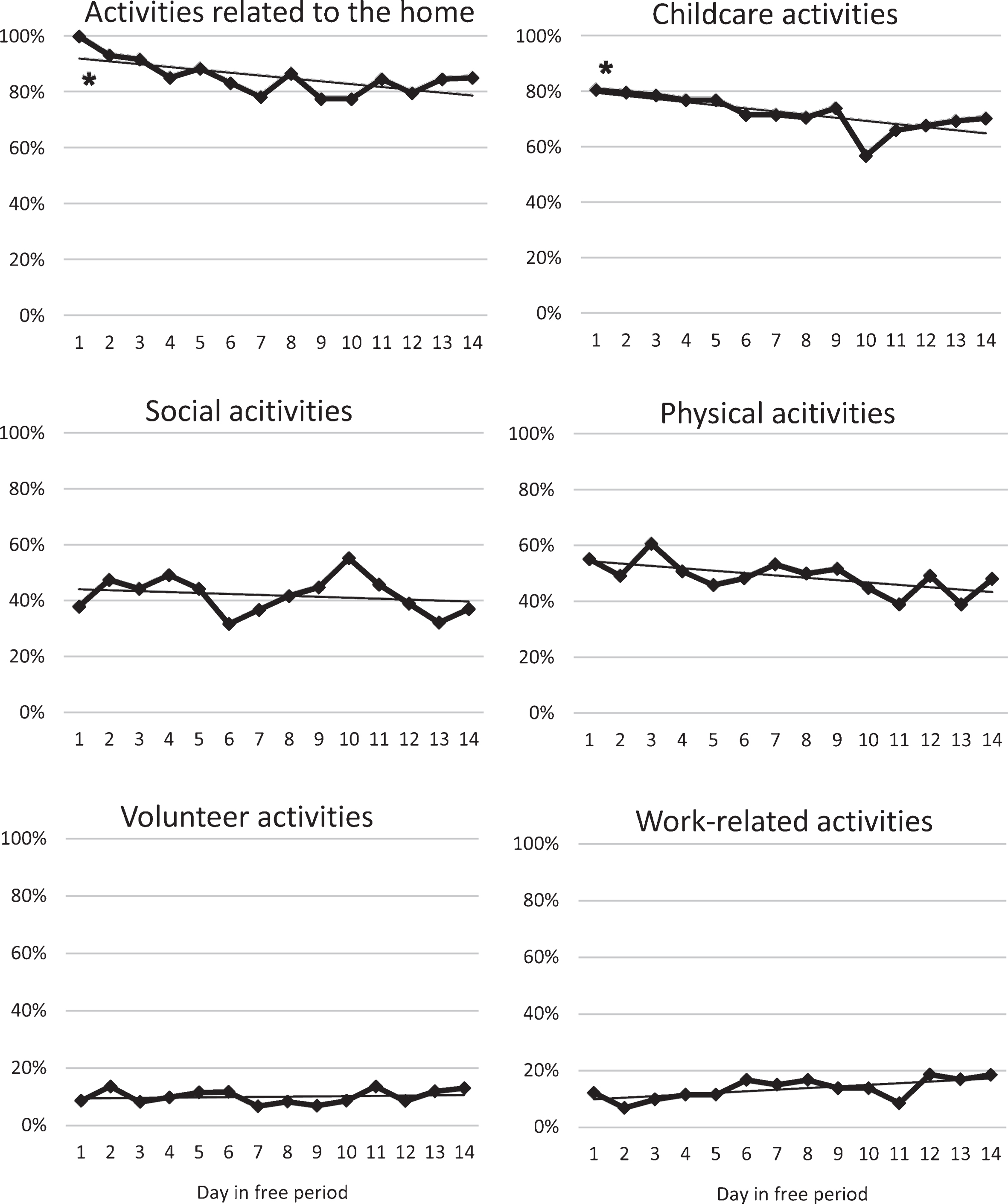
Proportion of participants who pursued activities in six activity categories during the first 14 days of a free period (* significant trends).
No statistically significant differences were found between night and day workers on the first day of the free period for any of the activity categories (all main effects had p-values between 0.116–0.990). Additionally, for activities related to the home, childcare, social, volunteer, and work-related activities no interaction effect was found between night shift and day in the free period (p-values between 0.267–0.980). These findings indicate that an equal proportion of night workers and day workers pursued these activities throughout the 14-day study period. For leisure time physical activities, there was a significant interaction effect (OR 1.10; p = 0.029); the data showed that the proportion of physically active night workers stayed the same over the 14-day study, while it decreased for day workers.
Comparison swing shift workers and day workers
No statistically significant differences were found between swing shift workers and day workers on the first day of the free period (p-values between 0.052–0.891). In addition, for activities related to the home, childcare, volunteer, and work-related activities, the interaction effects between swing shift and day in the free period were not statistically significant (p-values between 0.353–0.834). These findings indicate that a similar proportion of swing shift and day workers pursued these activities throughout the 14-day study period. The interaction effects were statistically significant for social activities (OR 1.10; p = 0.006) and leisure time physical activities (OR 1.10 p = 0.009). For social activities, the data showed a decrease in the proportion of day workers and an increase in the proportion of swing shift workers during the 14-day study period. For leisure time physical activities, swing shift workers remained equally active over the 14-day study period, while the proportion of day shift workers who were physically active during leisure time decreased.
Discussion
Contrary to what we expected, the transition from offshore work to family life was not characterised by rest, but by the pursuit of activities. Directly after returning home, participants engaged in childcare activities and activities related to the home; a trend that decreased rather than increased over the 14-day study period. Participants remained equally active in social, leisure time physical, volunteer, and work-related activities throughout the 14 day study period. Participants spent a good amount of time on all these activities.
Contrary to what we expected, at the start of the free period night and swing shift workers showed the same amount of activity in the six categories as day workers. Further, the shift groups behaved similarly to day workers for most activities over the 14-day study period. For leisure time physical activities, however, night and swing shift workers remained equally active throughout the study, while fewer day workers were active as the free period progressed. Additionally, day workers and night workers became less socially active over the 14-day study period, while swing shift workers became more socially active.
Compared to standard shift schedules, previous studies suggested that schedules with long free periods improve the time spent on recreation, household chores, and family and social activities [24]. Likewise, in the petroleum industry, offshore employees with longer free periods spend more time with family and friends than onshore employees with shorter free periods [28]. Similarly, in the present study, offshore employees spent a substantial amount of time participating in household chores, childcare, and social activities during their free period.
Directly upon return home after an offshore tour, the participants were involved in all aspects of family life including food preparations and household chores, as well as caring for their children, such as feeding and bathing them, and helping them with homework. Just under half of the participants spent ≥3 hours a day on such chores, which is in line with the Norwegian average of about 3.5 hours per day [29]. The level of involvement suggests that the lower energy level for activities related to the family and home at the start of their free period, as reported in our earlier publication, did not reduce their involvement in family life [10]. Potentially, the fathers wanted to be involved, regardless of any tiredness, possibly to make up for two weeks of missed family time. Alternatively, spouses may have expected their husbands to share or ‘take over’ the burdens associated with being a temporary single parent (‘absent husband syndrome’ [15]). Whatever the reason, the results showed that offshore family men were active participants in their family lives from the start of the free period.
The participants were also active in their social lives and within their community. They spent a substantial amount of time during their free period on social gatherings with extended family and friends. Forty-three percent of the participants spent time on sports clubs, political organisations, and community service, a percentage similar to the Norwegian working population [30]. This indicates that even though the employees spend a large amount of time away from their extended family, friends, and their community, they still contributed to their different life arenas when they could.
In general, shift workers are thought to be less physically active during leisure time than other workers. One of the reported reasons is that organised, social sporting activities, such as team sports, are not scheduled at times that suite the shift worker [22]. Indeed, the present study participants hardly engaged in organised sports. However, more participants engaged in leisure time physical activity than the general Norwegian population, 97% versus 82% [31], by predominantly pursuing solitary leisure time physical activities, such as walking, jogging, and cycling. Shift workers are also thought to be less physically active as they may be tired from working at night [22]. Results of our earlier publication showed that offshore workers were more physically and mentally tired at the start of their free period and this lasted for approximately a week or two. This indicates that even though they reported being tired, this did not stop them from being physically active from the start of their free period. Therefore, the assumption that shift workers may be too tired to pursue physical activities during their free time was not supported by the present study. Not only may physical activity maintain health by promoting recovery, it may reduce cardiovascular disease risk factors such as high blood pressure and low- and high-density lipoprotein levels [32].
Work-related activities were pursued by 32% of the sample at some point during their free period. The working hours may be considered overtime or form part of the employment contract [33]. In the general Norwegian working population, 18% report engaging in some work outside of working hours on a daily basis [34]. This number is much lower in the present sample as only one participant worked almost all days (11 of the 14); most worked 3 of the 14 day reporting period.
Regarding those who had worked at night, i.e., night and swing shift workers, these participants were equally active in household chores and childcare activities throughout the 14 day study period when compared to day workers; and they were more frequently engaged in leisure time physical activity. This was not as hypothesised. Results from our earlier publication showed that when compared to day workers, night workers had less energy to pursue activities related to the family and home at the start of the free period, they felt less rested, were more physically and mentally tired, and had less energy to pursue activities of personal interest [10]. However, their tiredness and lower energy levels neither stopped night workers from being involved in their family lives nor stopped them from being physically active. Engagement in leisure time physical activity by night workers, as well as living up to external demands from the family, may facilitate re-adaptation of the sleep/wake cycle [35]. Therefore, from personal experience, night and swing shift workers may have pursued leisure time physical and family activities in order to speed up re-adaptation to a day-time rhythm [22]. Alternatively, their spouses may have disregarded their need to recover and re-adapt, and may have expected them to take over and share household and childcare responsibilities [15].
During the first days and weeks off, a period of recovery is needed from the long working hours and night work offshore [10, 12–14]. Our study results showed that even though the participants may have been tired after their offshore tour, they did not take much time to rest. Instead, the participants, including those who had worked at night, were actively involved in various areas of their lives. Participants may have wanted to make up for missed time, to live up to their spouse’s expectations to ‘take over’, or–specifically for those who had worked at night—the activities may have been part of their recovery schema. Insight into the actual reasons and motivations for pursuing activities may be provided by future studies using a qualitative design.
The activities that were predominantly pursued by offshore family men, i.e., leisure time physical activity, social activities, and childcare activities, are activities that may promote recovery [20, 36]. Irrespective of the reasons and motivations, the pursuit of these types of activities suggests that offshore family men may be using their time well when it comes to promoting recovery after work-related fatigue. However, whether the activities actually have a positive effect on the recovery process in shift workers, remains to be studied in future research. This knowledge would contribute towards developing interventions with time-use programs that can be relevant not only for offshore employees, but for shift workers in other sectors as well.
Strengths and limitations
Our study had both strengths and limitations. The main strength of the study was the use of a diary format which may have reduced recall bias as it required participants to report the pursued activities and the duration of the activities on the same day as they were pursued. Another strength of the study is the relatively long follow-up duration of two weeks, which gave a good indication of when activities were pursued throughout the first half of their free period. A limitation may be the open interpretation of the six categories of activity that the participants were asked to report on, i.e., participants were free to choose where they reported certain activities, which did not make this reporting mutually exclusive. For example, a physical activity performed with friends could be reported as a social activity or as leisure time physical activity. Additionally, self-reports have the limitation that the given answers may be influenced by social desirability. The open interpretation of the six categories together with possibility of socially desirable answers may have led to an overestimation of activities in some categories and an underestimation in others. Another limitation is the inability to calculate the exact durations of the offshore workers’ activities, since durations were reported by crossing off boxes with one-hour ranges and the highest category was ≥3 hrs. Therefore, based on the current questions we were not able to develop a time-use profile for a ‘typical’ day during the free period that might be of interest when studying the effects of activities on recovery.
Conclusions
The transition from offshore work to family life was characterised by the pursuit of activities related to the home; to childcare, social, and volunteer activities; and the engagement in leisure time physical activity. Working at night had little effect on the level of activity in five activity categories; only leisure time physical activities were pursued more often by those who had worked at night. Considering the type of activities pursued, the active transition may have been beneficial for recovery from work-related fatigue. Future studies that can relate the activities to a ‘good’ recovery process may provide insight into the time-use that can promote recovery. This in turn will contribute towards the development of interventions for shift workers who do not recover very well, be it offshore employees or shift workers in other sectors.
Conflict of interest
The authors report no conflicts of interest.
Funding
This work was supported by the Research Council of Norway (Grant numbers: 189 554, 183 214, and 203 418), with an additional 20% funding from partners in the oil and gas industry (The Norwegian Confederation of Trade Unions, Oslo, Norway; Norwegian Shipowners’ Association, Oslo, Norway; The Norwegian Oil and Gas Association, Stavanger, Norway; Statoil, Stavanger, Norway; and Industri Energi, Stavanger, Norway).
Contributor statement
Suzanne Merkus, Kari Anne Holte, Maaike Huysmans, Allard van der Beek and Willem van Mechelen designed the research; Suzanne Merkus and Kari Anne Holte conducted the research; Suzanne Merkus analysed the data; all authors contributed sufficiently to the interpretation of the data, to the critical revision of the paper for important intellectual content, and approve of the final version of the manuscript.