



Abstract
BACKGROUND:
Pressure on the shoulder can be a major limiting factor to backpack use and poor design can lead to pain and injury.
OBJECTIVE:
To evaluate the effect of shoulder strap width and load placement in a backpack on the shoulder and axilla.
METHODS:
A manikin fitted with a backpack load of 20 kg mass and four different width straps (5, 6, 7, and 8 cm) was used. The load was placed high or low. Interface pressure sensors were placed over the shoulder and chest wall at the axilla.
RESULTS:
A significant interaction was observed between shoulder strap width and load placement. The positive effect of wide straps on shoulder pressure is greater with high load placement and the benefit of wide straps on axillary pressure is improved with low load placement. Interface pressure decreased significantly from narrow to wide straps. A large difference was noted between interface pressure on high and low load placement with narrow straps; however, as shoulder strap width increased, the difference between the two load placements decreased.
CONCLUSION:
The least amount of interface pressure was observed with 8 cm shoulder straps and high load placement. These findings should influence design and use of backpacks.
Keywords
Introduction
Backpack loading in excess of recommended limits can lead to aberrant physiological events, pain and injury [1–8]. When heavy loads are supported on the shoulders, injury can occur due to forces at the backpack–shoulder interface [9]. The estimates of prevalence of shoulder pain related to load carriage among backpack users ranges from 14.7% to 34.5% [8, 10]. In most situations, the shoulder girdle bears, and then transfers, a substantial proportion of the backpack load to the body. Shoulder pain [11, 12], brachial plexus injury [9] and higher levels of activity of shoulder muscles [13] have been reported after using a backpack to carry loads for prolonged periods of time.
Direct measurement of backpack–skin interface pressure is a method for measuring external forces exerted on the body by the backpack. Interface pressure is defined as pressure that occurs at the interface between the body and the shoulder straps of a backpack. A continuous pressure of 14 kPa has been recommended as the threshold to prevent tissue damage and discomfort during prolonged load carriage [14]. However, shoulder interface pressures while carrying backpacks has been recorded as higher than the recommended threshold [15–17] and interface pressures under the shoulder straps is reported as a factor limiting backpack carriage [15]. Therefore, development of backpack designs that help distribute and alleviate pressure could be critical in offsetting discomfort and pain [18]. Poor design characteristics of backpacks, such as shoulder straps without ergonomic consideration, have been proposed as a main contributing factor for upper body injuries [19]. Widening of shoulder straps has been recommended to reduce interface pressures and increase comfort but research on this matter is limited [17].
The literature shows that load placement within a backpack affects physiological and biomechanical measurements [7, 20]. High load placement results in lower oxygen consumption [20], while low load placement leads to less postural change when compared to high load placement [7]. In addition to shoulder strap width, load placement within a backpack might also influence interface pressure. Gaps in the science around these issues is supported by a systematic literature review that revealed the effect of load placement and widening of shoulder straps on interface pressure has not been properly investigated [21]. Therefore, the aim of the present study was to evaluate the effect of backpack shoulder strap width and load placement within a backpack on shoulder–backpack interface pressure. We hypothesized that wider shoulder straps would distribute the load over a greater area and thereby reduce interface pressures and load placement would affect the amount of interface pressure.
Methods
A manikin model was used to maximise the internal validity of the results. The manikin consisted of a firm shell that simulated a 50th percentile adult male torso; it was supported by two steel rods attached at the thigh stumps, with the lower ends fixed to a solid wooden base (see Fig. 1).
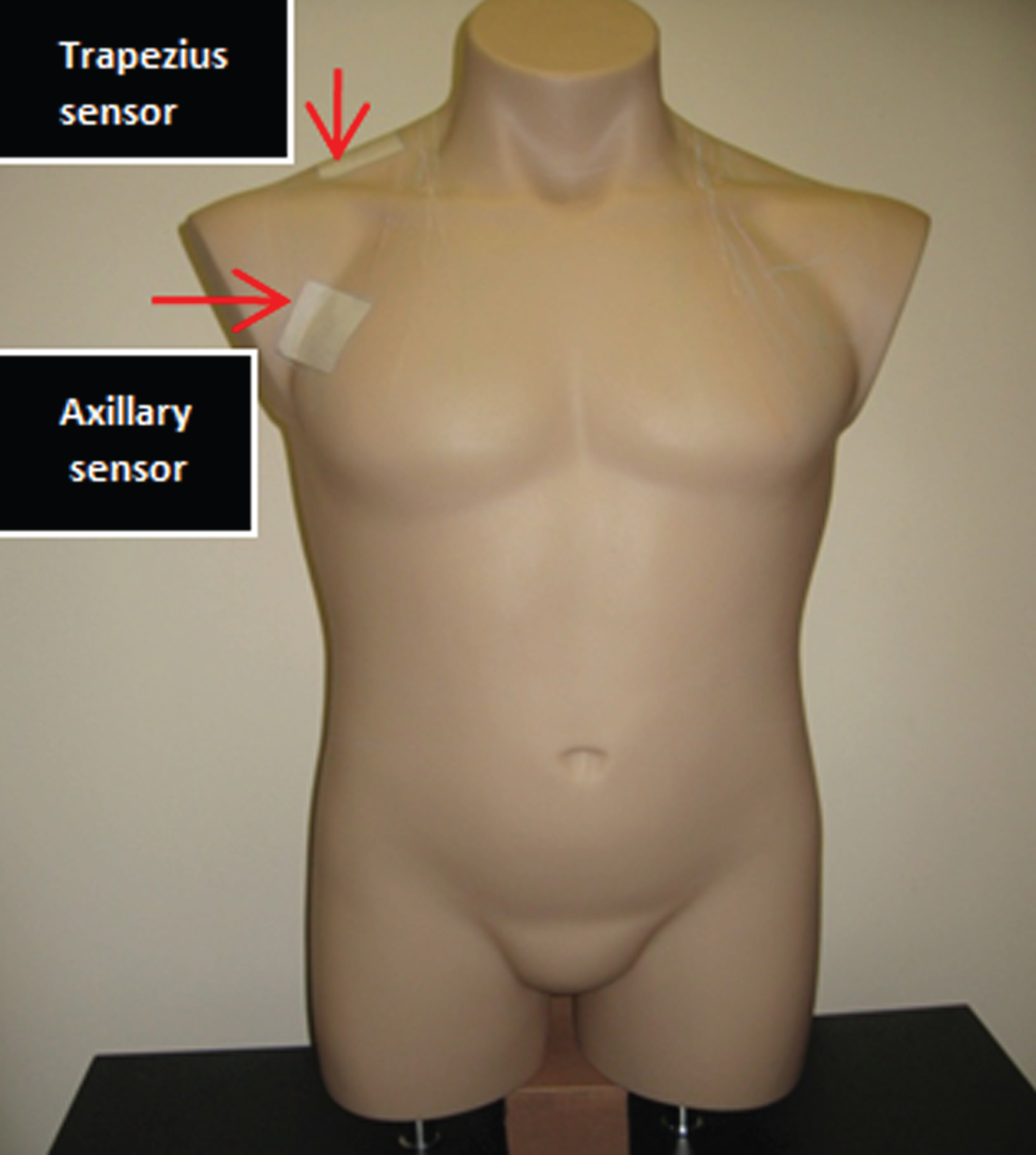
The manikin and position of the pressure sensors.
We compensated for the shift in the centre of gravity (COG) resulting from an external load [22], by adjusting the anterior lean of the manikin to replicate a balanced position with a 20 kg load in a backpack. The anterior lean angle was estimated by placing the manikin (with the 20 kg loaded backpack) on an Accugait-AMTI force plate (Advanced Mechanical Technology Inc., Watertown, USA), and wedges were placed under the base of the manikin to progressively lean the manikin forward. Movements of the COG of the manikin were followed to the point where the COG was aligned with the centre of pressure in the X and Y directions (i.e. the manikin was “balanced”). At this point, a Dasco Pro angle meter (Dasco Pro, Inc. Rockford, IL, USA) was placed on the base stand of the manikin and the angle was recorded. We repeated this 5 times with consistent results of 10 degrees; therefore, the manikin was fixed to a table with an anterior tilt of 10 degrees to replicate as normal a situation as possible and to resemble the human body under load more closely. This degree of forward angle was constant across all combinations. Our choice of 10 degrees for a 20 kg loaded backpack is supported by a study that shows that 10 degrees of trunk forward flexion is recommended as an angle to balance anterior and posterior moments for backpack loads approximating up to 25 kg [23].
Four identical backpacks manufactured by Explore Planet EarthTM, SAS harness model (New South Wales, Australia), with dimensions of 45×32× 20 cm (H×W×D) and weight of 1.4 kg were used in this study (Fig. 2). The backpacks were identical except for their shoulder straps. Shoulder strap widths were 5, 6, 7 and 8 cm in width.
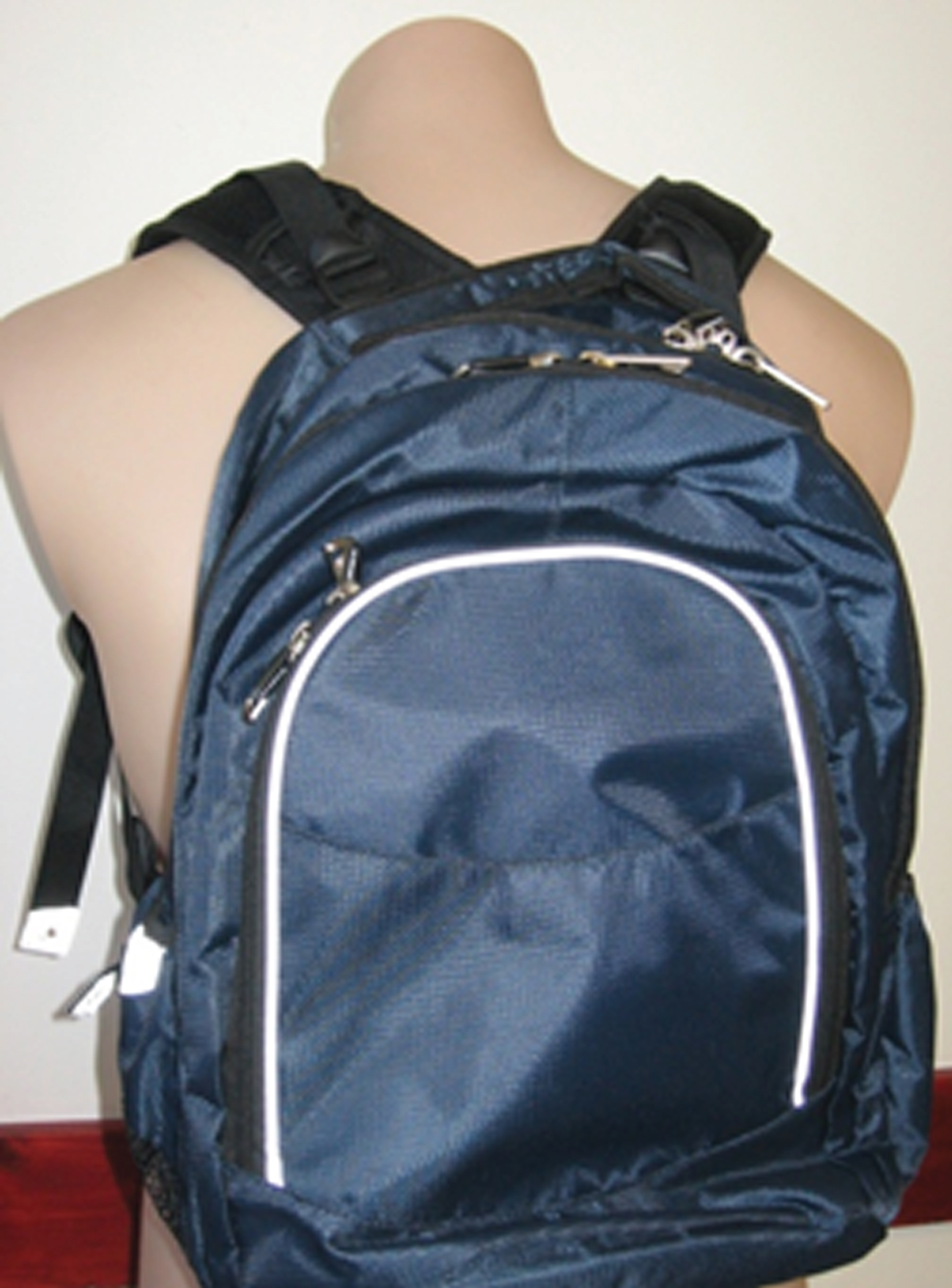
The SAS harness backpack.
Shoulder strap length and backpack position was standardised to ensure consistency across all comparisons. The backpack was placed approximately 10 cm below the shoulder line. Loads were positioned into the innermost compartment of the backpack to maintain the backpack COG as close to the manikin as possible. The internal space of the backpack was divided into high (high load placement, HLP) and low (low load placement, LLP) space and loads were fixed with high-density foams inserts. For the high load placement, loads were placed in the upper space and for the low load placement the loads were placed in the lower space of the backpack. In the high load placement the COG of the backpack was around mid-thoracic region and in the low load placement the COG of the backpack was around mid-lumbar region. The backpacks were loaded to 20 kg and the hip belt of the backpack was unfastened. Four different shoulder strap widths were tested, at both a high and low position.
Contact pressure measures were obtained using tactile sensor pads manufactured by Pressure Profile Systems, Inc. (Los Angeles, CA, USA). This system uses capacitive based pressure sensing technology. The sensor pads were 50×50 mm2, constructed of a thin (1.1 mm) conformable and flexible conductive cloth, with relief cuts to allow for additional conformability around multi-curved surfaces. The pads are designed to accommodate moderate flexing without affecting sensor performance. The sensors were rated at pressure range of zero to 138 kPa and calibrated for this range by the manufacturer. The data were acquired and recorded using Chameleon software (Los Angeles, CA, USA) at a sampling frequency of 30 Hz. Each measurement was recorded for two minutes duration and 5 measurements were taken. The data were recorded from the entire area that the sensors covered. When using capacitance pressure sensors, two minutes of measurement is an accurate reflection of a longer duration of 1 hour [19].
Sensor placement across all measurements was standardized by marking the outline of the inner and outer boundaries of the shoulder straps on the manikin. Two central and common areas between the outlines of the four shoulder strap configurations were used for sensor placement. The sensors were placed on the superior area of the shoulders at the mid trapezius line and the chest wall aspect of the axilla (see Fig. 1). The sensors were secured in these locations to ensure consistent placement across trials.
Interface pressure was measured under the right shoulder strap. The inactive sensor was placed on the left side to ensure backpack placement symmetry. We undertook a preliminary assessment of test–retest reliability, which yielded standard error of measurement values of 0.034 kPa for an average of five measurements. Therefore, the average of five measurements resulted in an optimal level of reliability.
Statistical analysis
Statistical analyses were conducted using SPSS version 17.0 (Chicago, IL, USA). A 4×2 repeated measures analysis of variance (ANOVA) with least significant difference pair-wise post hoc comparisons were conducted. The independent variables were shoulder strap width with four levels (5, 6, 7 and 8 cm) and load placement with two levels (high and low load placement). The dependent variables were shoulder and axillary average and peak pressures (kPa). Data were assessed for violations of sphericity with Mauchly’s test. Alpha was set at 0.05 for all comparisons.
Results
The results of average and peak backpack–shoulder interface pressures in the high and low load placements across different strap widths are presented as descriptive statistics in Table 1. The nature of the measure is such that real time information was obtained over a 2 minute measurement period (at a frequency of 30 Hz) and therefore some variability is to be expected and this is reflected in the average pressure outcomes. The results of average and peak backpack–axilla interface pressures in the high and low load placements across different strap widths are presented in Table 2. As average and peak pressures demonstrated similar trends, only the results of the average pressure are described in the text and presented in the figures.
Mean (SD) of peak and average backpack – shoulder interface pressure under different width shoulder straps (kPa) and load placements
Mean (SD) of peak and average backpack – shoulder interface pressure under different width shoulder straps (kPa) and load placements
HLP, high load placement; LLP, low load placement.
Mean (SD) of peak and average backpack – axilla interface pressure under different width shoulder straps (kPa) and load placements
HLP, high load placement; LLP, low load placement.
A significant interaction (p < 0.001) was found between shoulder strap width and load placement. The nature of the interaction between strap width and load placement encompasses all strap widths (see Table 1). Significant main effects were observed for shoulder strap width (p < 0.001) and load placement (p < 0.001). This means that higher shoulder interface pressures were observed with narrower strap widths and with lower load placements. The mean (SD) of the average shoulder pressure across the shoulder strap widths was 12.5 (1.9) kPa for 8 cm, 13.7 (1.4) kPa for 7 cm, 20.9 (9.1) kPa for 6 cm and 23.6 (9.6) kPa for 5 cm. Mean (SD) of average shoulder pressure was 13.8 (2.4) kPa for high load placement and 21.6 (8.6) kPa for low load placement.
Post hoc comparisons demonstrated differences between all of the combinations of load placements and strap widths. The combination of wide straps–high load placement resulted in lower shoulder pressure and the combination of narrow straps–low load placement generated higher shoulder pressure (see Fig. 3 and Table 1).
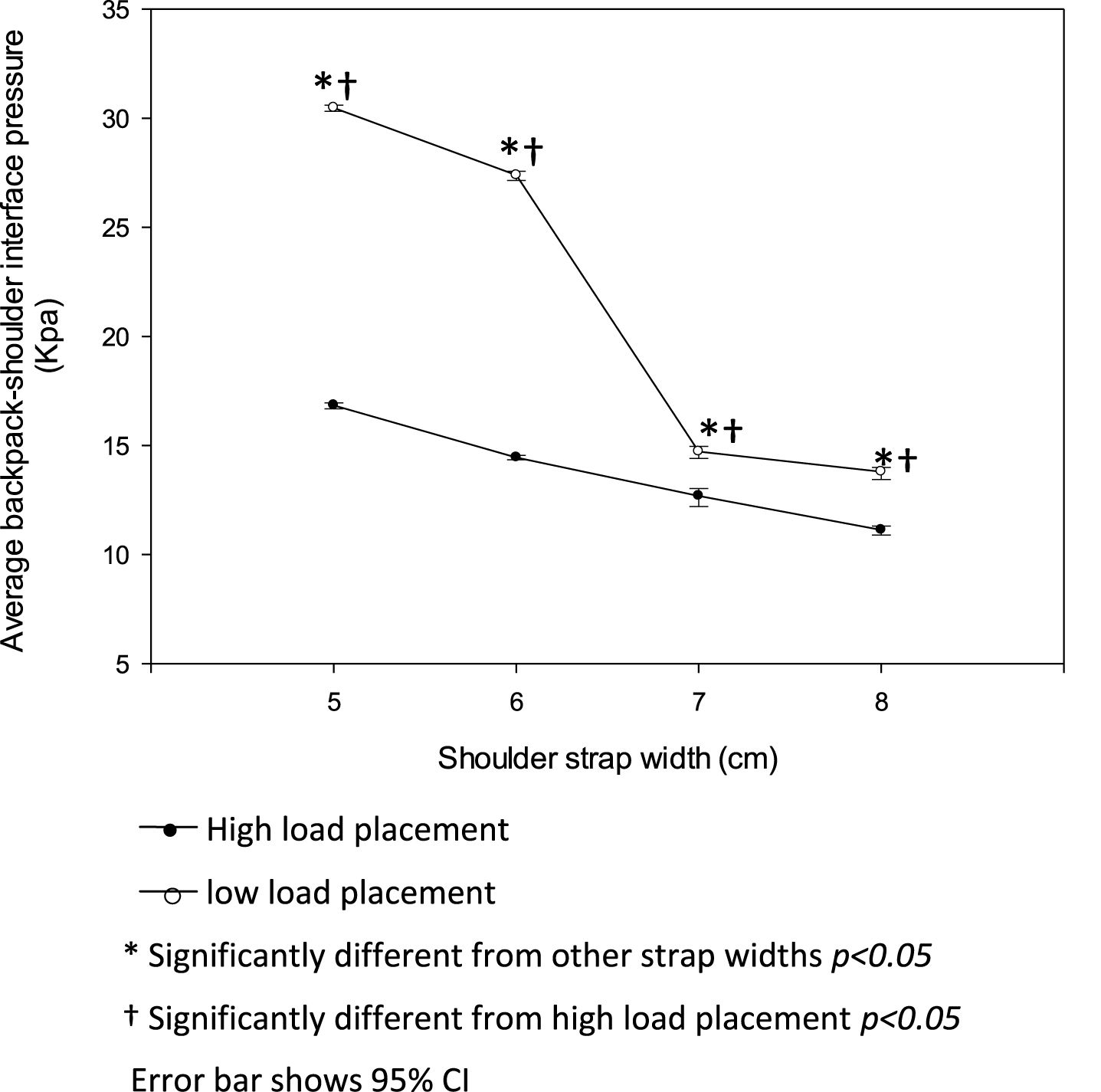
Average backpack-shoulder interface pressure under various shoulder strap widths in high and low load placement.
A significant interaction (p < 0.001) was noted between shoulder strap width and load placement. The nature of the interaction between strap width and load placement encompasses all strap widths (see Table 2). Significant main effects were observed for shoulder strap width (p < 0.001) and load placement (p < 0.001). This means that higher axillary interface pressures were observed with narrower strap widths and with lower load placements. The mean (SD) of the average axillary pressure across different shoulder strap widths was 3.6 (0.03) kPa for 8 cm, 4.2 (0.2) kPa for 7 cm, 4.5 (0.4) kPa for 6 cm and 6.1 (0.4) kPa for 5 cm. The mean (SD) of the average axillary pressure was 4.8 (1.2) kPa for high load placement and 4.4 (0.9) kPa for low load placement.
Post hoc comparison revealed no significant differences between the high and low load placements of the 8 cm strap. Significant differences between all of the other combinations of load placements and strap widths were observed. The combination of wide straps–low load placement resulted in lower pressure and the combination of narrow straps–high load placement generated higher pressure (see Fig. 4 and Table 2).
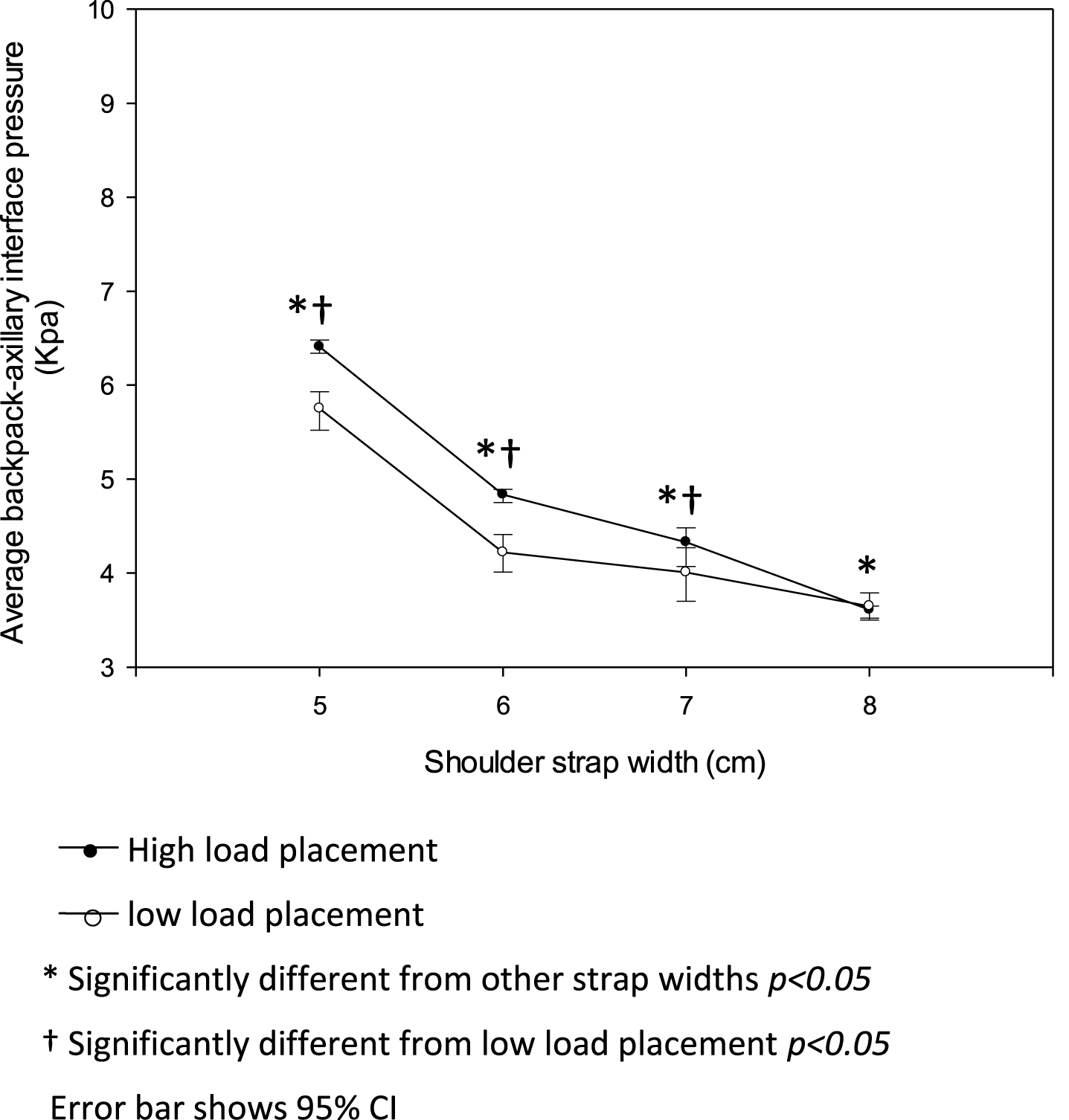
Average backpack–axillary area interface pressure under various shoulder strap widths in high and low load placement.
The purpose of this study was to evaluate the effect of shoulder strap width and load placement in a backpack on shoulder and axilla interface pressure. Our first hypothesis was that wider shoulder straps would distribute the load over a greater area and thereby reduce interface pressures. Our second hypothesis was that load placement would affect the interface pressures.
Our results support our first hypothesis. The 8 cm and 5 cm shoulder straps resulted in the lowest and highest amount of interface pressure, respectively. Wide straps help distribute the load exerted on the shoulders, thereby preventing concentration of the load and occlusive pressure over a small area. This increased pressure under narrow straps can lead to discomfort and pain for users and a significant correlation has been reported between increased contact pressure and pain [24]. Our finding was consistent with another study that showed a lower interface pressure for an 8 cm shoulder strap than for a 5 cm strap [15]. In that study, backpack–shoulder interface pressure was compared between two loaded army backpacks and shoulder strap width, among other backpack configurations, was one of the characteristics that affected interface pressure.
Another advantage of wide straps is that doubling the amount of load did not result in a significant increase in shoulder interface pressure when wide straps were used. In contrast, it resulted in an increase of 36% when narrow straps were used [15]. Furthermore, the narrowness of shoulder straps has been reported as a negative factor by participants as the narrow shoulder straps cut into the front of the shoulders and make backpack carrying uncomfortable [25].
Our second hypothesis was also supported by our findings. Load placement influenced interface pressure, as high load placement generated lower shoulder pressure and higher axilla pressure, and low load placement resulted in higher shoulder pressure and lower axilla pressure. A potential explanation for this involves the differing moment arms between the high and low load placements to the backpacks axis of rotation. The thoracic kyphotic curve results in a greater moment arm in the high loading position relative to the low load placement. This increases the moment caused by the backpack and will cause the backpack to attempt to rotate posteriorly, thereby increasing the pressure on the axilla. Conversely, the reduction in moment with the low load placement causes less pressure on the anterior part of the shoulder and more over the shoulders.
A significant interaction was observed between the shoulder strap width and load placement. The positive effect of wide straps on shoulder pressure is greater when high load placement is used and the benefit of wide straps on axilla pressure is improved when low load placement is used. The combination of high load placement–8 cm strap generated the lowest shoulder interface pressure. The 8 cm shoulder strap, regardless of load placement, generated the lowest axilla interface pressure.
We observed higher pressure over the shoulders and lower pressure on the axilla in all conditions, which agrees with other studies [15, 26]. Continuous pressure higher than the recommended threshold of 14 kPa has been suggested to result in tissue damage; therefore, 14 kPa is considered to be the safe upper limit [14]. In the current study, axillary interface pressure was below this recommended threshold in all load placement and strap width conditions and therefore within safe limits. Shoulder interface pressure for the high load placement–8 cm, low load placement–8 cm and high load placement–7 cm conditions were also below this threshold and within the safe limit, while the shoulder interface pressures for the 5 cm and 6 cm straps in both load placement conditions and for the 7 cm–low load placement condition exceeded this threshold. Considering the above, the combination of high load placement and 8 cm strap is the optimal configuration with respect to interface pressure between shoulder straps and the body.
Our findings favour the use of wider shoulder straps, but the stature and physique of the wearer should also be taken into account when choosing the optimal width of shoulder straps. The manikin used in this study represented a male body and the 8 cm strap resulted in the lowest contact pressure. However, the 8 cm strap might be too wide for smaller framed individuals and possibly too narrow for a very large framed person.
The findings of this study are limited as they were generated using a manikin and may not necessarily generalise to humans. We only measured pressure at two locations and this might have also limited our findings. Future research should seek to replicate our findings in vivo while incorporating person–centred information such as perceived pain, discomfort and exertion. In addition, future research should undertake more comprehensive pressure measurements to look at the effect of load placement and shoulder strap width on interface pressure.
Conclusion
The current study has shown that shoulder strap width and load placement within a backpack influenced shoulder interface pressure, such that wide straps and high load placement generated lower pressure. Therefore, these factors should be important considerations in backpack design and when packing a backpack for use. We recommend wide shoulder straps and high load placement, since these generated the lowest interface pressure in our study.
Conflict of interest
None to report.