



Abstract
BACKGROUND:
Backpacks used by children is a global concern, because may cause musculoskeletal discomforts and pain.
OBJECTIVE:
The purpose of this study was to test the usability and effects on gait kinematics wearing the Trunkpack versus a traditional backpack and no backpack.
METHODS:
Twenty-four children (9 to 11 years old) from a public school participated in this study. The usability was evaluated after a five-week testing period using a questionnaire. Gait kinematics was evaluated (Vicon) when the children were wearing a standard backpack, an optimized backpack (Trunkpack), and no backpack. Both backpacks were loaded with 10% of body weight.
RESULTS:
Was observed more trunk, hip and knee flexion when the children carried a standard backpack in comparison using the Trunkpack and not carrying a backpack (p < 0.01). The Trunkpack and no backpack were similar. The Trunkpack was well accepted by the schoolchildren (81% positive responses), 79% liked the head opening, 88% liked the waist straps, and 83% liked the facility to put and take objects in and out of the Trunkpack.
CONCLUSION:
Trunkpack requires less postural adjustments during gait than a standard backpack. Gait kinematics with the Trunkpack was comparable to the gait without carrying a backpack.
Introduction
The use of backpacks is associated with discomfort and pain in different body parts, including the back, shoulders, and neck [1, 2]. Wearing backpacks is associated with increased back muscle activity and postural alterations, which are risk factors for back pain [3, 4]. Although a few studies found no association between the weight carried and musculoskeletal pain [5, 6], the majority of studies agree that backpack weight is the main factor associated with pain and discomfort [7, 8]. The maximum weight recommended to be carried in backpacks is≤10% of bodyweight [9].
The most commonly used types of backpack by schoolchildren and adolescents are traditional backpacks, rolling backpacks, and unilateral backpacks, which are carried diagonally or on one shoulder, resulting is asymmetrical load [10]. The majority of the traditional backpacks currently used do not optimize the load-carrying abilities of children, overloading the spine and causing postural and kinematic changes in gait, such as decreased speed, increased single and double support time, and ground reaction forces even when loads are≤10% of body weight [7, 11]. The adjustments in gait kinematics include increased trunk forward (sagittal plane) and lateral (frontal plane) flexion [12], increased hip angle [11], and shoulder elevation [4].
Although some studies have evaluated the effects of carrying backpacks on child posture and spine development [7, 13], in order to optimize the load-carrying characteristics of backpacks, further studies are needed regarding their design and the effects of alternative designs [14, 15]. Redesigning school backpacks for optimal load distribution is important because of the potential effects on children’s musculoskeletal health. Ramadan and Al-Shayea [16] tested a modified backpack in which the load was distributed on the front and back, and found that less energy was spent during gait and there was less spine erectors and rectus abdominis activation compared to when using a traditional backpack. Additional studies are needed to evaluate the effects of new backpack designs, such as the ones that distribute the weight antero-posteriorly, on gait characteristics and load-distribution [17, 18].
Backpack redesign should consider ergonomics, usability principles, and the needs and capacities of the users [19]. Usability is the extent to which a product can be used effectively, efficiently, and satisfactorily in a specific context (ISO 9241-11) [20]; it refers to the application of knowledge of the capabilities and limitations of the human body for the development and design of a product [21]. One of the most important steps in the production of a new product is end-user feedback and acceptability [22].
There is limited research on backpacks for children that distribute the weight antero-posteriorly [16]. Therefore, the objectives of this study were to test the usability and effects on gait kinematics and posture of wearing a newly designed backpack, with anterior and posterior compartments, called the “Trunkpack”.
Materials and methods
Participants
Twenty-four children (9 to 11 years old) from a public school in Brazil participated in this study; twelve male and twelve female, with an average height of 145±9 cm, weight of 41±8 kg, and body mass index of 19±7 kg/m2. Prior to participation in the study, the parents gave their permission by signing an informed consent. The inclusion criterion was to use backpacks to carry school supplies and books. The exclusion criterion was a history of spine injuries or back pain. The study followed the standards of the Declaration of Helsinki (1964), and the procedures were approved by the institutional review board (CAAE 68080017.4.0000.5016).
Experimental protocol
This study was divided into two moments: a) usability and b) kinematic analysis. Initially, usability was tested. Participants answered a questionnaire after using the Trunkpack for 5 weeks, on 5 days a week, to carry their school supplies. After this period, the participants attended the Biomechanics laboratory on a single visit to investigate gait kinematics. For this, all participants were tested in three conditions: no backpack, Trunkpack (Fig. 1A), and traditional backpack (Fig. 1B), and the order of performance was randomized.
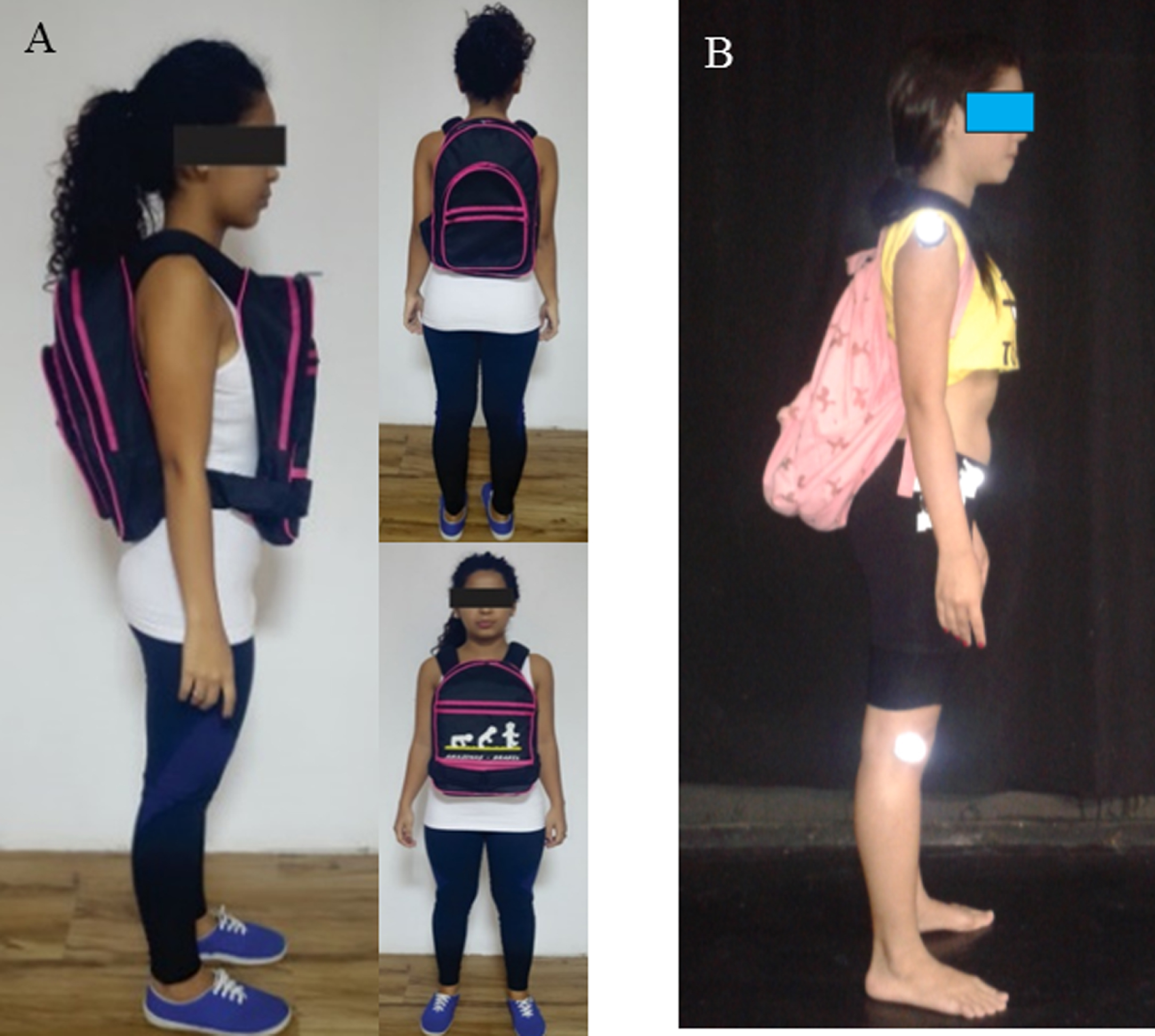
Participant wearing a Trunkpack with sagittal, front and posterior view (A); Participant wearing a traditional backpack (B).
The Trunkpack has anterior and posterior compartments for storing school supplies and materials, permitting balanced weight distribution around the child’s center of mass [18]. The compartments are connected by waist and shoulder straps made of comfortable materials, which allow adjustment to accommodate different anthropometric profiles. The waist elastic straps are anchored to the lower part of the posterior backpack compartment and there is a hook on the anterior compartment to fasten the straps around the waist and ensure that the compartments are held tightly around the child’s trunk (Fig. 1A).
Gait analysis
After a Trunkpack familiarization period of 5 days/week for 5 weeks, a motion analysis system (7 VICON 624 cameras at 200 Hz, with Nexus 1.8.5 software, Oxford, UK) was used to analyze gait while wearing the Trunkpack, a traditional school backpack, and no backpack (control condition). The system was calibrated prior to each data collection. All participants were asked to go barefoot and wear tight clothes and Lycra shorts on the day of testing to facilitate the placements of the body markers. Data collection lasted approximately 30 minutes/participant.
Reflective markers were placed bilaterally, directly on participants’ skin (except for the hip marker which was placed over the Lycra shorts) using the protocol from the School of Cologne on the following anatomical landmarks: shoulders (five centimeters distal from acromion), hips (greater trochanter), knees (midpoint between popliteal line and patellar center - lateral), ankles (lateral malleolus), calcaneus (posterior projection of calcaneus - at the same height as tiptoe marker), and tip of toe (head of fifth metatarsal) [23].
After a familiarization trial, all participants were asked to walk three times in each condition (no backpack/control, traditional backpack, and Trunkpack) at a comfortable self-selected speed on a flat 15-meter long walkway (Fig. 2). The Trunkpack and the traditional backpack were loaded with 10% of the body weight; for the Trunkpack, the weights were divided equally between the front and back compartments (5 and 5% body weight).
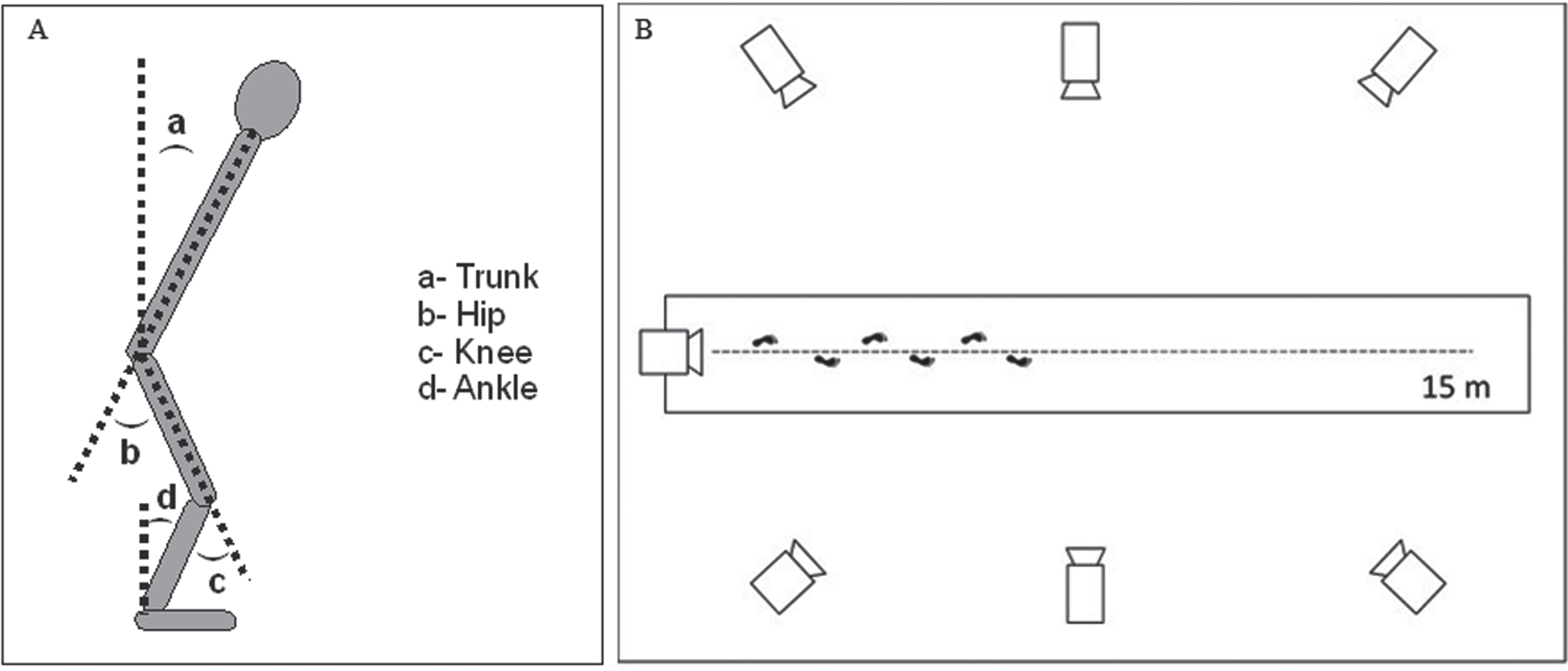
Angles measured (A), and data collection setting (B).
Three right and left gait cycles were analyzed for each condition. Trunk, hip, knee, and ankle angles are absolute angles of the segments with regard to the global reference coordinate system. The angles were measured as follows: a) trunk (angle between the trunk and vertical), b) hip (angle between trunk and thigh), c) knee (angle between thigh and leg), and d) ankle (angle between leg and foot) (Fig. 2). During gait, kinematic data were normalized with regard to the duration of the gait cycle.
All participants were given a Trunkpack and taught how to use it by dividing the weight between the anterior and posterior compartments, and adjusting the straps comfortably. The weight carried by the participants during the 5-week familiarization trial (used on 5 days/week) was not controlled. During the familiarization period, the use of the Trunkpack was checked by visiting the participants at school 3 times/week.
The usability questionnaire did not include the participants name or any identifier, and it was completed independently by each participant after the 5-week period. The questionnaire included questions about the satisfaction, strap adjustments, and comfort when using the Trunkpack. The pictorial answer choices were: A happy/smiley face indicating satisfaction, an impartial face indicating neutrality, and a sad/frowning face indicating dissatisfaction. In addition, the participants were able to write open-ended comments after each question.
Statistical analysis
The Kolmogorov-Smirnov test was used to evaluate the normality of the data (P > 0.05). One-way ANOVA was used to compare the 3 conditions during each 10% of the gait cycle (10 periods). The Scheffe post-hoc test was used to identify where the differences were when the ANOVA was significant (P < 0.05). All tests were performed using the Statistical Package for the Social Sciences (SPSS Inc. v. 20.0, Chicago, USA). We calculated the statistical power through GPower 3.1 software, and observed a statistical power ranging from 0.81 to 0.99 for the ANOVA test (used to compare angles of the trunk, hip, knee, and ankle). For usability, the responses were tabulated in Excel (Microsoft Office 2015) and analyzed using descriptive statistics (e.g., frequency and percentages).
Results
Gait analysis
Figure 3 presents the average sagittal plane angles of the trunk (A), hip (B), knee (C), and ankle (D) in the three conditions during the gait cycle. Trunk angles (3A) were significantly larger when wearing a traditional backpack versus the Trunkpack and no backpack from the start to end of the gait cycle (p < 0.01). The trunk angles were significantly different among the three conditions at 50 and 60% of the cycle. Interestingly, at these same percentages of the gait cycle, the angles were the smallest when using the Trunkpack.
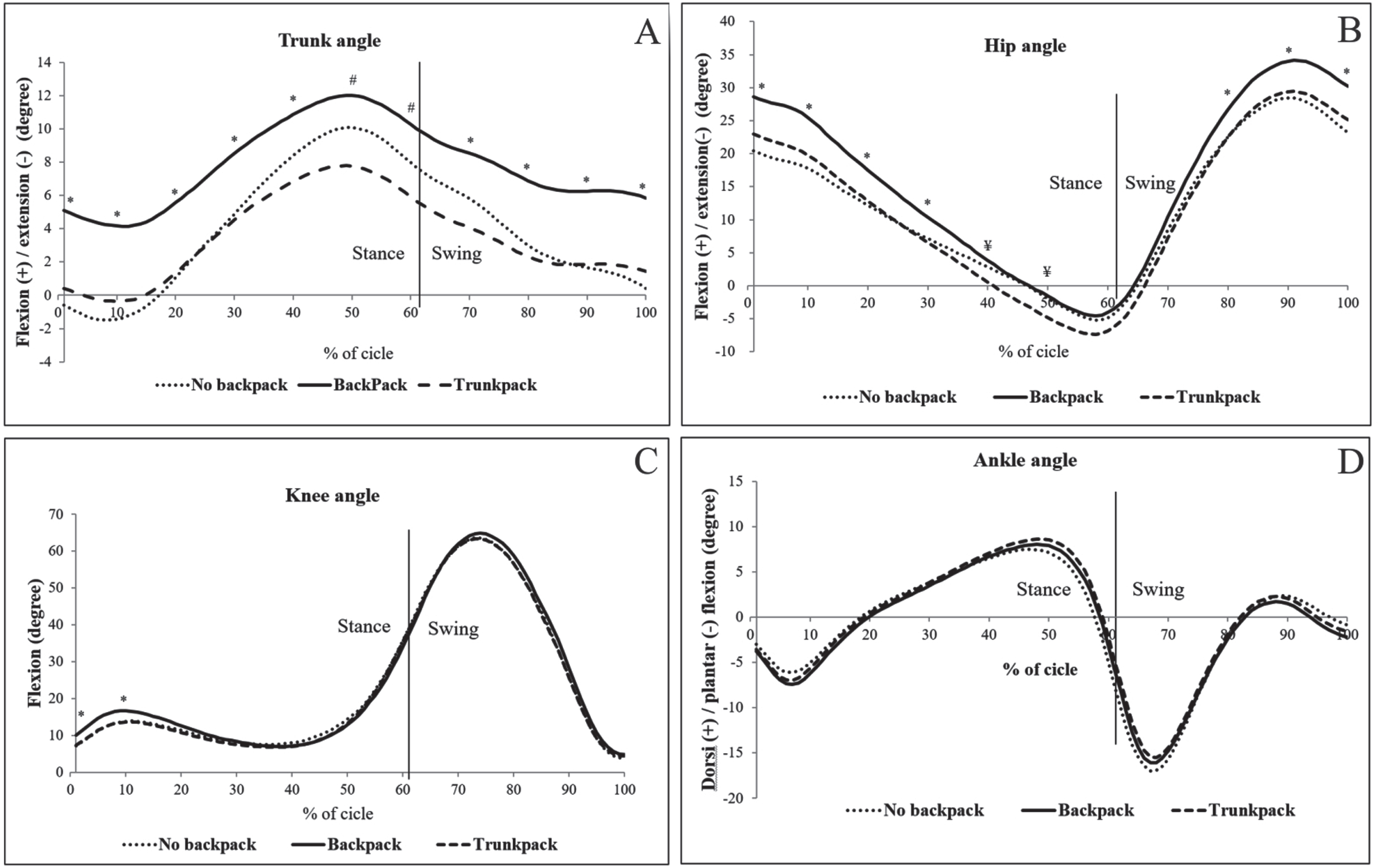
Sagittal plane angles of the trunk (A), hip (B), knee (C), and ankle (D) when wearing a traditional backpack, the Trunkpack, and no backpack.
The hip angles (3B) were significantly larger when wearing a traditional backpack versus the Trunkpack and no backpack from the start to 30%, and from 80% to the end of the gait cycle (p < 0.05). The hip angles were significantly larger when wearing a traditional backpack versus the Trunkpack at 40 and 50% of the cycle. There were no significant hip angle differences among the conditions at 60 and 70% of the gait cycle.
The knee angles (3 C) were significantly larger when wearing a traditional backpack versus the Trunkpack and no backpack at the start and at 10% of the gait cycle, without significant differences among the conditions after that point. Finally, there were no significant differences for ankle angle among the conditions during the entire gait cycle.
Table 1 shows the mean and standard deviation angular values at each 10% of gait cycle using no backpack, a traditional backpack, and the Trunkpack.
Mean and standard deviation of the sagittal plane angles (degrees) at each 10% of the gait cycle
t: Selected time during the gait cycle 0 to 100%. *Statistically significant difference between the traditional backpack and the other conditions. # Statistically significant difference between the three conditions. ¥ Statistically significant difference between the traditional backpack and the Trunkpack.
The children felt that the Trunkpack usability characteristics were good and, overall, 81% were satisfied with it (Table 2).
Trunkpack usability questionnaire results (n = 24 children 9 to 11 years old)
Trunkpack usability questionnaire results (n = 24 children 9 to 11 years old)


All children were satisfied with the process of loading and unloading school supplies into the Trunkpack. Only one child was not satisfied with the look of the Trunkpack, and half of the children (n = 12) liked its shape. Open-ended comments were made by 5 children (21%), all indicating that they felt more comfortable using the Trunkpack than the traditional backpack. The children reported that the load “becomes lighter” when using the Trunkpack compared to the traditional backpack, and 2 children commented that they would like the Trunkpack to have more “pictures and colors”.
Using backpacks can cause tension in the shoulders and back, which can lead to musculoskeletal injuries and postural problems [24]. Extended use of backpacks have been found to be associated with shoulder, neck, and back pain, and neck muscle fatigue [1]. Using the Trunkpack may cause less discomfort (as supported by the open-ended comments made by 5 children) because it was associated with a more neutral posture. There was more trunk flexion during gait when wearing a traditional backpack compared to the Trunkpack and no backpack (p < 0.01). Increased trunk flexion is used to compensate for the posterior torque generated by the backpack [10, 14]. This result corroborates the findings of a study that found greater trunk flexion during gait in children using a backpack compared to no backpack [25]. In addition, Dahl et al. [26] also observed greater trunk flexion when participants were carrying a traditional backpack compared to a backpack that distributed the load bilaterally on the trunk.
Surprisingly, the use of the Trunkpack was associated with less trunk flexion at 50 and 60% of the gait cycle than the no backpack condition (p < 0.01). This may have occurred due to the additional loading of the spine (10% body weight) which could have increased proprioception and/or elicited an attempt to reduce possible antero-posterior torques. More neutral back postures reduce the likelihood of back discomfort and pain [27], but may reduce overall walking velocity. Further investigation is required regarding the effect of the Trunkpack on walking speed. In addition, rates of discomfort and pain need to be assessed in future studies. However, it should be highlighted that prolonged use and carrying heavy loads (>10% of body weight) is discouraged independently of the type of backpack used [5, 11].
Although there were no significant differences among the conditions in peak hip extension, there was more hip flexion when wearing a traditional backpack than the Trunkpack during most of the gait cycle (p < 0.05). This is associated with increased trunk flexion because of the way the angle is calculated [25, 26]. Özgül et al. [28] also found increased hip flexion when wearing a unilateral backpack. Similarly, greater knee flexion was found at the beginning of the gait cycle when wearing a traditional backpack. The initial increase in knee flexion is likely associated with an attempt to attenuate the increased posterior load when wearing a traditional backpack. Dahl et al. [26] also found greater knee flexion during gait with a traditional backpack compared to a backpack that distributed the load antero-posteriorly.
There were no significant differences between the conditions in relation to sagittal plane ankle angles throughout the gait cycle. Similar results were found in previous studies [7, 25]; significant effects on distal joint angles during gait were found only when changing walking speeds or in subjects with health conditions [29].
Regarding the Trunkpack usability assessment; 81% of the participants reported good satisfaction; all were happy with the size of the compartments and the ease of putting the backpack on and taking it off; no child felt it was difficult to use the Trunkpack; 79% liked the head opening; 88% liked the waist straps; and 83% liked the facility to put in/take out objects from the Trunkpack, which is an improvement compared to conventional backpacks [30]. The anterior compartment enables objects inside it to be handled while wearing the backpack. Therefore, frequently used items such as wallets, pens, and phones are easily accessible. Four children were not fully satisfied with the comfort as they felt hot wearing the Trunkpack. The study was conducted in the summer when the average outside temperature was 30 degrees celsius. This needs to be considered in warm climates and alternative breathable materials may need to be evaluated.
Aesthetics is another important usability feature [31]. In this study, 83% of the participants were satisfied with the colors (black with blue or pink details) and the remaining 17% were impartial regarding the color options available. Freedom of movement for the arms when wearing the Trunkpack was considered good by 88% of the children, and the other 12% were impartial. This is important because movement restriction and the need for postural adjustments can affect musculoskeletal health [12]. The positive open-ended comments regarding the increased comfort and reduced loading when wearing the Trunkpack compared to the traditional backpack indicate that the distribution of weight between the front and back compartments was effective.
The limitations of this study include the fact that we did not control the actual weight that the children put in the Trunkpack during the 5 weeks of familiarization. During the assessment, the Trunkpack was only evaluated when loaded with 10% of body weight. Although this is the recommended load, children may carry heavier loads. Future studies should evaluate the effects of carrying heavier loads because the antero-posterior distribution of weight resulted in less perceived loading. This is likely to have the unintended consequence of children carrying heavier loads than they would otherwise have carried. Another limitation and direction for future research is that the psychometric properties of the usability measures were not tested. Future research could also, if possible, measure the obstruction caused by the backpack, evaluate the effects on spine curvatures (kyphosis/lordosis), and include other kinematic measures, such as gait speed and step length and assessment kinetic of ground reaction force. It is also suggested that future research can assess the influence of variation in trunk angulation and load distribution on muscle activity.
Conclusions
Greater trunk flexion during gait was found when wearing a traditional backpack compared to the Trunkpack and no backpack (control) and trunk flexion during gait when wearing the Trunkpack was even less than when not wearing any backpack. There was more hip flexion when wearing a traditional backpack than when wearing the Trunkpack during most of the gait cycle.
The participants reported good satisfaction with the Trunkpack; all children were happy with the size of the compartments and the ease of putting it on and taking it off, and most of them liked the head opening, waist straps, freedom of movement, and aesthetics of the Trunkpack.
Although a long-term follow-up is needed, the optimized design may reduce discomfort, potential postural alterations, and pain in schoolchildren. The Trunkpack improved gait biomechanics in children transporting school supplies and thereby may minimize health risks during the maturation of the locomotor system.
Ethics statement
The study was approved by the ethics committee of the Amazonas State University (CAAE 68080017.4.0000.5016). All participants signed the written informed consent form prior to the start of the experiment. All procedures performed in this study were in accordance with the ethical standards of the institutional and/or national research committees and with the 1964 Declaration of Helsinki.
Conflict of interest
The authors declare no conflict of interest.
Footnotes
Acknowledgments
Not applicable.
Funding
Not applicable.
Appendix: Usability questionnaire
Do you like the size of the compartments? Is the head opening size adequate? Are the lateral elastic straps size adequate? Is the Trunkpack easy to put on? Is the Trunkpack easy to take out? Is it easy to load and unload materials into the Trunkpack? Can you walk easily with good freedom of movement while caring the Trunkpack? Can you move your arms easily when carrying the Trunkpack? Is the Trunkpack comfortable? Do you like how Trunkpack looks? Do you like the Trunkpack color? Do you like the Trunkpack shape?