



Abstract
BACKGROUND:
Recommended weight limit for manual materials handlers has to be decided based on the individual characteristics of the person and age is one of the major variable affecting maximal lifting capacity. But there is limited information on pattern of change in lifting capacity with age.
OBJECTIVE:
To determine the influence of age on the maximum acceptable weight of lift among manual materials handlers.
METHODS:
Two hundred and seventeen male construction workers were grouped into four age quotas- 19–28, 29–38, 39–48 and 49–58 years. Lifting capacity was determined using progressive isoinertial lifting evaluation, adopting semi-squat technique of lifting at two levels: waist and shoulder.
RESULTS:
A statistically significant increase in the maximum acceptable weight was observed from first to second age group followed by a gradual decline. The percentage of decline from second to third age group was 11.89% and 14.34% and from third to fourth age group was 5.60% and 19.90% for waist and shoulder level respectively.
CONCLUSION:
Pattern of change in lifting capacity with age among manual materials handlers has been investigated in this study. Lifting capacity was found to be the greatest in 29–38 year age group, therefore prescribing recommended weight limit uniformly for all the workers may not be the best practice.
Keywords
Introduction
Occupation related low back disorder is the most common and most costly musculoskeletal disorder experienced in the work place [1]. The World Health Organisation (2005) [2] recognized low back disorders as one of the top three occupational health problems worldwide. Judith et al. (1999) [3] NIOSH (1997) [4] and Petit et al. (2016) [5] reported that Manual Materials Handling (MMH) activities are an important contributor to the etiology of low back disorders. NIOSH (2007) [6] describes MMH as the act of moving materials by hand by lifting, lowering, pushing, pulling and carrying. The peak lifting performance decreases progressively with age and recommended weight limit for manual materials handlers should be decided based on the age of the person [7]. But there is limited information available onpattern of change in lifting capacity with age.
Determining lifting capacity has been done using various methods namely isometric, isokinetic and isoinertial approach [8]. Among all three methods, the isoinertial approach is considered to be the gold standard for identifying the lifting capacity [9]. Progressive Isoinertial Lifting Evaluation (PILE) is a performance based method used to establish the lifting capacity. It is simple, easy to administer, reliable and dynamically represents real world lifting [10]. Bos and Kuijer (2002) [11] and Lygren et al. (2005) [12] have established the reliability and the validity of PILE and they have recommended PILE over isometric and isokinetic methods. Hence this study was conducted to determine the influence of age on lifting capacity among manual materials handlers using progressive isoinertial lifting evaluation.
Methods
The study was initiated after obtaining clearance from the institutional ethical committee, Manipal University. A verbal advertisement about the study at construction sites was done and the study was carried out in fitness laboratory of department of physiotherapy, Manipal.
Participants
Male construction workers who showed interest to participate were made to sign a written informed consent or thumb impression was taken from illiterate workers. Quota sampling was used to group the participants into four age quotas- 19–28, 29–38, 39–48 and 49–58 years.
Procedure
Baseline parameters like age, body weight, height, income category of job and resting heart rate (using polar heart rate (HR) monitor, FT1, Finland) after making them lie in supine position for five minutes were recorded. Standard instructions related to performance of PILE and termination criteria as set by the authors (Mayer et al. (1988) were given to all the participants before commencing the test. The participants were instructed to lift the box when the investigator said ‘start’ and a stop-watch also was started simultaneously. The order of the lift was randomized to minimize the influence of fatigue using fish bowl method without replacement [13]. The categories of lift – floor to waist and floor to shoulder were written in two separate chits and the participants picked one for deciding the order ofevaluation.
The participants were instructed to perform PILE from floor to waist (FW) and floor to shoulder (FS) and lower it back to the floor 4 times in 20 second interval adopting semi-squat technique. Semi-squat technique was used in this study as it is the commonly adopted technique at work place and to minimize the influence of low back and knee disorders which can occur during stoop or squat lifts. The parameters which were recorded were the increments and level of PILE and weight lifted in kg. The temperature inside the testing laboratory was set at 23 degree Celsius and relative humidity ranged from 30 to 50% .
Data analysis
SPSS for windows, version 16.0 (Chicago, SPSS Inc) was used to analyse the data. Descriptive statistics (mean, SD and percentage) was used to summarise the data. One way ANOVA was performed to find out any statistically significant difference between age categories. Tukey’s HSD was performed as post hoc analysis.
Results
Two hundred and seventeen male construction workers were stratified into four age groups using quota sampling. There were 60 workers each in the age group of 19–28 years and 29–38 years, 51 workers in 39–48 years and 46 workers in 49–58 years.
The demographic characteristics of the workers are depicted in Table 1. Mean height reduced gradually with higher age groups whereas mean RHR showed an increasing trend from younger to older age groups. Majority of the workers in all the age groups were doing multiple job related tasks like mixing, chipping, lay outing, demolishing, shovelling, demolishing, removing debris and scaffold erecting.
Demographic characteristics of the participants in different age groups (n = 217)
Demographic characteristics of the participants in different age groups (n = 217)
Mean lifting capacity in kg during two categories of lift in different age groups is represented in Table 2. Both the categories showed an increase in the weight lifted from first (19–28 years) to second age group (28–39 years) then a gradual decline.
Lifting capacity (kg) in different age groups (n = 217)
A statistically significant difference was observed in floor to waist between age groups (Fig. 1), hence a post hoc analyses (Tukey’s HSD) was carried out to find out between which group the difference exists. The interval plot (Fig. 2) and the Table 3 represent the results of post hoc analysis. There is no difference between first and second age group but there exists a significant difference between first and third and first and fourth age groups. Similarly, second and third and second and fourth age group also showed difference. A decline of 11.89% and 5.60% in lifting capacity was found from second to third and from third to fourth age group respectively.
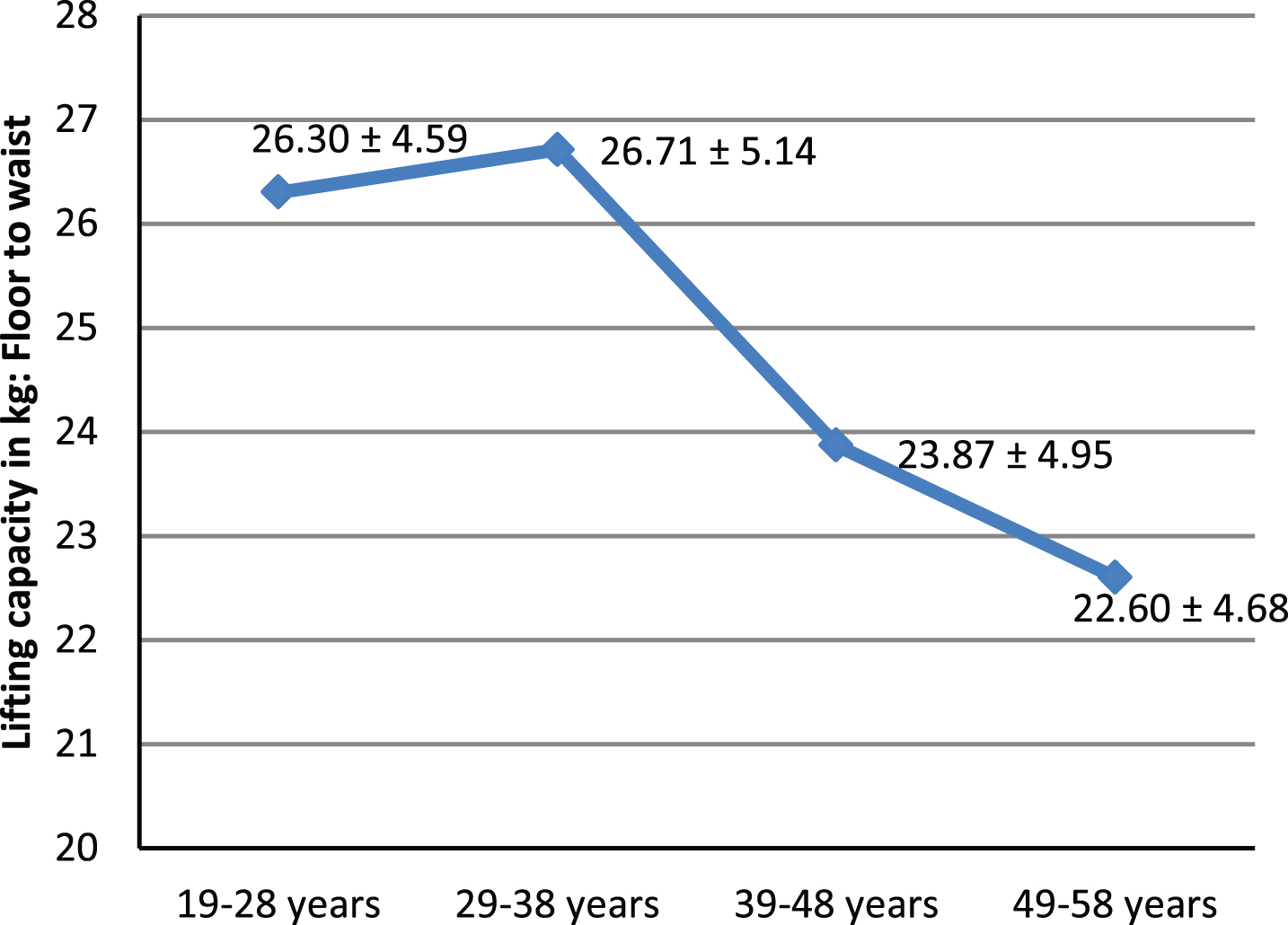
Comparison of mean lifting capacity (kg) during floor to waist category in different age groups.
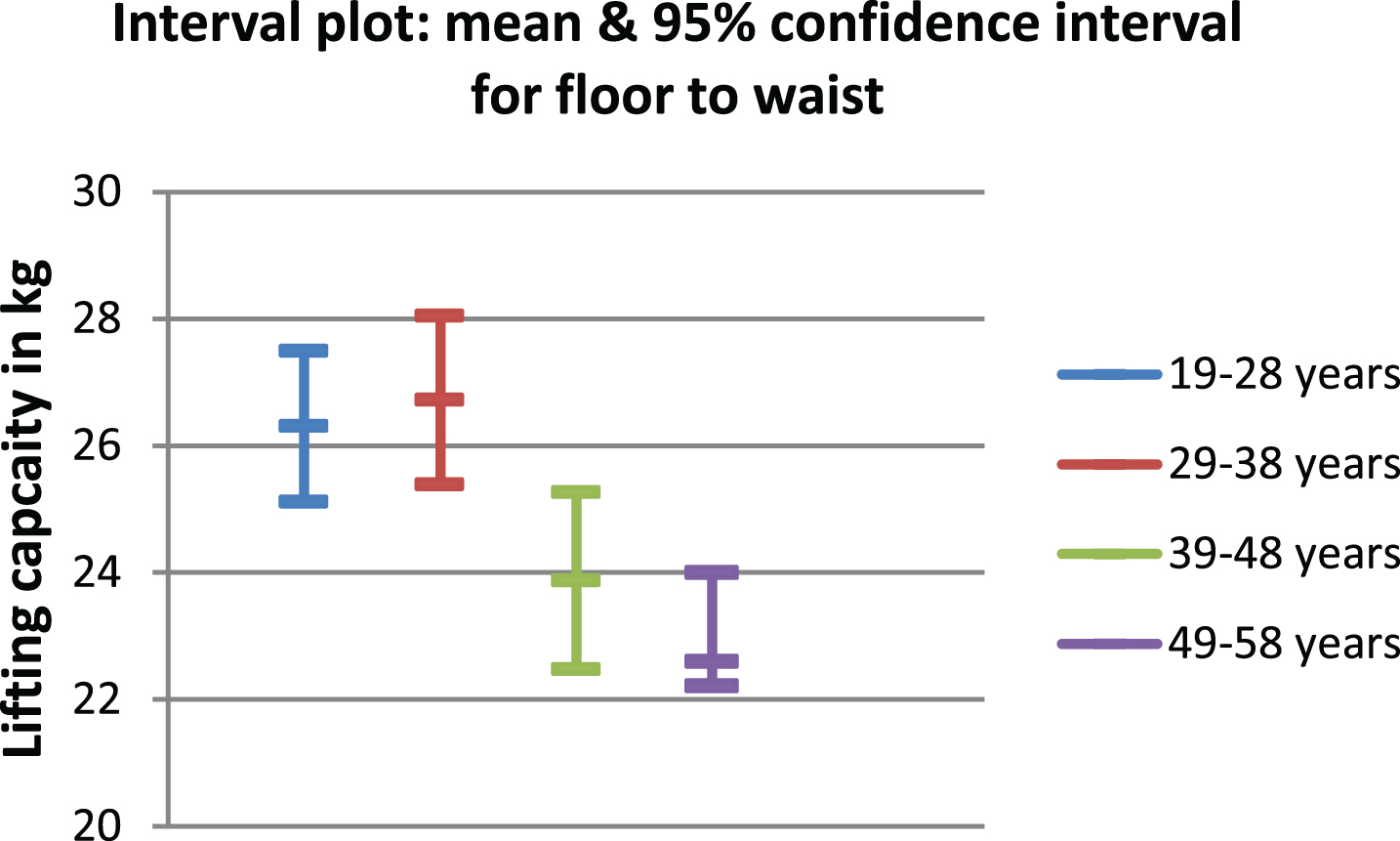
Mean and 95% confidence interval of lifting capacity (kg) during floor to waist category in different age groups.
Matrix for representing post hoc analyses (Tukey’s HSD) for comparison of lifting capacity during floor to waist category in different age groups
Figure 3 depicts the pattern of change in lifting capacity in floor to shoulder category in different age groups. A statistically significant difference has been observed between the age groups, hence a post hoc analyses was carried out to find out between which group the difference exists. The interval plot (Fig. 4) and the Table 4 represent the results of post hoc analysis. Statistically significant difference was found between all the age groups except between first and third.

Comparison of lifting capacity (kg) during floor to shoulder category in different age groups.

Mean and 95% confidence interval of lifting capacity (kg) during floor to shoulder category in different age groups.
Matrix for representing post hoc analyses (Tukey’s HSD) for comparison of lifting capacity during floor to shoulder category in different age groups
This study intended to find out the influence of age and pattern of change in lifting capacity with age among manual materials handlers. Extensive research on maximum acceptable weight during manual material handling has been done using psychophysical methodology in Liberty Mutual Research Institute for safety and have come up with manual material handling guidelines [14, 15]. However the limitations of the psychophysical tables were reported by Davis and Marras (2000) [16]. The perception and judgement of the participant, size weight illusion, moment arm distance and age could influence human performance and the maximal lifting capacity [17]. Hence this study adopted more reliable, performance based isoinertial approach.
A marginal rise in the lifting capacity of 1.55% in floor to waist category and 10.94% in floor to shoulder category has been noticed from first to second age group. The physical peak performance among men will be attained anywhere from late 20’s to early 30’s [18], this could be reason for increase in the lifting capacity from first to second age group. From second to third and third to fourth age groups a gradual decline has been noticed in the lifting capacity. A reduction of 11.89% and 14.34% from second to third age group and a decline of 5.6% and 19.90% from third to fourth age group have been observed in floor to waist and floor to shoulder categories respectively. This could be because of the age related decline in the aerobic and anaerobic muscular capacity [19–24]. Olnare (2011) [19] published a review titled “aging and work related musculoskeletal disorder” which states that the prevalence of musculoskeletal disorders (MSDs) may increase by 15% in the higher age groups when compared to the younger age because of decreased functional capacity and decreased physical work ability. An increasing trend in MSDs with age has been noticed in the present study also, where its prevalence increased from 33.33% in the first age group to 76.08% in the fourth age group.
Anton (2004) [20] mentioned that the peak anaerobic muscular power decreased progressively with age and the decline is greater in tasks requiring more complex and powerful movements. Bart et al. (1996) [21] has published a review titled “physical work load and the ageing worker”, reported a progressive decline in the physical work capacity which is characterised by diminished aerobic and muscular capacity. Annick et al. (2009) [22] has done a comparative study in order to investigate the back extensor muscle endurance between young males (n = 20) and healthy elderly (n = 16). The results showed a trend toward decreased back muscle endurance time and lower maximal lifting force compared to younger counter parts. Kenny GP (2008) [23] reviewed published articles to examine the functional work capacity in aging individuals and found a 20% decline in the physical work capacity between age 40 and 60 years due to reduced aerobic and musculoskeletal capacity. Another reason for decline in lifting capacity with age could be increase in the rate of comorbidities. Palmer and Goodson (2015) [25] reported that comorbidities like age related joint pathologies and non-communicable diseases increases with age among workers leading to reduced lifting capacity.
Lifting standards has been given by International Organisation for Standardisation [26] and International Labour Organisation [27]. ISO (ISO standard 11228-1:2003) has a reference mass for two handed lifting under ideal conditions. Ninety five percent of males will be able to lift a load of 25 kg (55 lb). International labour Organisation in ILO- codes of practice- safety and health in building and civil engineering work has mentioned 50 kg (110 lb) as the lifting limit. The existing lifting standards mention lifting capacity at a higher level than what was observed in this study. Also the existing standard does not take age, level, frequency and technique of lift into consideration during recommendation.
Limitations
Uneven distribution of workers in different age groups and poor generalizability of the results to other working population, ethnic or racial groups are the limitations of this study.
Conclusion
Influence of age and pattern of change in lifting capacity with age has been determined among manual materials handlers. A marginal increase in the lifting capacity has been found from 19–28 to 29–38 years and a linear decline thereafter.
Implications
Pattern of change in lifting capacity with age has been determined. Lifting capacity is found to increase from 19–28 years to 29–38 years and a decline thereafter. Therefore prescribing recommended weight limit uniformly for all the workers may not be the best practice.
Conflict of interest
None to report.