



Abstract
BACKGROUND:
Prolonged work pressure can contribute to burnout. The Job-Demands Resources model (the health impairment process and the roles of job and personal resources in it) provides a framework for studying work pressure.
OBJECTIVE:
The study aims were to understand the experiences of employees in the career services and a teaching department of a school for vocational education regarding the following: A) work pressure; B) its negative consequences; and C) how job resources and D) personal resources play a role in the employees’ experience of work pressure or in helping to cope with it.
METHODS:
A qualitative study based on 11 in-depth interviews with teachers (5) and supporting personnel (6) was performed at a Dutch organization for vocational education. The interviews were analyzed interpretatively.
RESULTS:
A) The teachers and supporting personnel generally experienced work pressure, which had both qualitative and quantitative aspects. B) The consequences included working overtime and lower job performance. Factors such as autonomy and social support from colleagues were C) job resources, and moving from idealism towards realism was D) a personal resource.
CONCLUSIONS:
Both the teachers and supporting personnel who were interviewed experienced work pressure and its related consequences, as well as job and personal resources. Work pressure may threaten the sustainable employability of these employees.
Background
Many employees in Western countries experience work pressure [see, for example, 1–3]. A certain amount of pressure that employees themselves think is acceptable may support their work performance [4]. However, when the degree of work pressure exceeds employees’ abilities to cope with it, work pressure can negatively affect their task performance [5]. Employees then are at risk for experiencing work-related stress [6, 7], which in turn may lead to, for example, anxiety [8], cynicism [9], stroke and coronary heart disease [10]. In addition, work stress or job strain may result in reduced work ability [11], productivity loss [12, 13], sickness absence [12, 14] and/or employee turnover [12, 15]. Prolonged sickness absence may ultimately result in worklessness [16]. Following this line of reasoning, working under excessive pressure is undesirable for employees, employers and governments who pay for benefits.
“In the educational sector, work pressure has been worrisome for years”, according to the Dutch Educational Council in 2002 [17, p. 9]. Several factors are considered to be responsible for this work pressure, such as the increasing amount of (new) tasks, spikes in work volume, having to do all work in approximately three-quarters of a year due to the long holidays, inability to schedule the work and changes in the work induced by governmental policy [17]. Schelvis et al. [18] described some other developments as well, such as the number of students per teacher increasing [19], administrative tasks intensifying [20] and students with special educational needs attending regular schools [21].
The Dutch media have particularly paid attention to work pressure among teachers in both primary and secondary education. Work pressure in vocational education remains underexposed, despite a strike among vocational teachers in 2014 to draw attention to their increasing work pressure [22]. Limited research has addressed the work pressure felt by employees in vocational education [see, for example, 23–25]. One study showed that not only educational personnel (almost 60%) but also supporting personnel (approximately 30%) experience a “too high or way too high” work pressure [24]. However, their experiences remain poorly understood. For example, we do not yet know how employees in vocational education experience their work pressure and what factors play a role in their experience of work pressure. This knowledge can be used to develop effective interventions for reducing work pressure. Such measures are relevant, given that burnout is most common in the educational sector and that burnout can be attributed to high work pressure among other causes [26, 27].
Work pressure and the Job Demands-Resources (JD-R) model
In the literature, work pressure has been defined in multiple ways. Some consider an acceptable amount of work pressure to be good for employees’ work performance [4]. Others think of work pressure as “a situation in which an imbalance has emerged between the job demands regarding job content and job context and the ability of the employee to do the job well” [6, p. 3]. Thus, as per this definition, these researchers consider work pressure to be a problem [28].
Work pressure can also be considered as a job demand, i.e., an “effort that employees have to put into their jobs” [29, p. 38]. Thereby, work pressure is considered from the perspective of the JD-R model [30–32]. This model makes a distinction between a stress or health impairment process and a motivational process. A stress process posits that job demands, such as work pressure, can cause burnout in the long run, which in turn results in undesired outcomes, such as employee dropout [30–32]. A motivational process means that employees can experience job resources that are “possibilities in the work or the work situation” [29, 30–32], such as support from colleagues, career opportunities, and autonomy, which can contribute to employee engagement. In turn, engagement can support positive outcomes, such as work performance. In addition, this model covers other relationships between the stress and motivational processes. For example, job resources and demands influence each other negatively [29–32]. A lack of job resources can contribute to burnout, while burnout can negatively affect engagement and vice versa. Moreover, burnout is negatively related to positive outcomes, such as work performance. Negative (such as health complaints) and positive outcomes (such as work performance) can influence each other negatively [29, 32]. Moreover, the JD-R model assumes that job resources can compensate for the negative effects of job demands on stress reactions [29, 30–32]. Job demands can moderate the relationship between resources and engagement [32]. Job resources will be particularly motivational in case of high job demands [29, 32]. Since 2011 [33], personal resources such as optimism have been included in the JD-R model as well [29]. Certain “job resources may help employees to develop personal resources, which may support employee engagement” [29, 34–36]. Personal resources may play multiple roles in the JD-R model. For example, they may affect employees’ perceptions of their job characteristics or moderate the role of job characteristics in burnout and engagement [29, 34–36]. Other examples of personal resources are mindfulness and resilience [37].
Objectives
This study was conducted in a Dutch organization for vocational education (see paragraph 3.2 for further information). Within this research setting, the objectives of this study were to enhance our understanding of the experiences of employees in the career services department and in the teaching department of the school for vocational education regarding the following: A) work pressure; B) perceived negative consequences of their work pressure; and C) how job resources and D) personal resources play a role in their experienced work pressure or help to cope with it.
The health impairment process and the roles of job and personal resources in it, as described by the JD-R model, served as a framework for studying work pressure [29–32]. We were particularly interested in studying work pressure as a job demand (study aim A) [29–31]. Moreover, we were interested in studying the stress process in the JD-R model, i.e. whether prolonged work pressure as a job demand may result in undesired outcomes, such as stress reactions, as well as in negative organizational outcomes (study aim B) [29–31]. In addition, we were interested in how job resources may affect work pressure as a job demand, as well as the buffering role of job resources regarding the negative role of work pressure in employees’ perceived negative consequences (study aim C) [29–31]. Further, according to Schaufeli & Taris, personal resources may, for example, help to perceive job characteristics or moderate the relationship between job characteristics and stress reactions (study aim D) [32].
Methods
Design
This was a qualitative interview study. The semi-structured nature of the interviews allowed us to use a topic list, and at the same time experience the freedom to let participants elaborate on other relevant topics as well [38].
The data for this study were collected from January-March 2016. At that time, there was no Dutch legislation indicating that this type of study required approval from an ethics committee. We did not submit this study to a medical ethics committee, as this was not needed according to the Medical Research Involving Human Subjects Act (in Dutch: Wet Medisch-Wetenschappelijk Onderzoek met Mensen). This Act applies to medical scientific research in which certain ways of acting are imposed on the participants. This was not the case in our interview study. However, this administrative fact does not change the obligation for researchers to follow ethical research norms. Naturally, we followed and implemented ethical norms into this study.
Setting
The Dutch organization for vocational education where this study was conducted, employs approximately 600 Full-Time Equivalent (FTE) employees (approximately 60% educational personnel) and provides education to over 8000 students.
The organization’s works council considered work pressure to be high and an issue among the employees. A quantitative inventory performed by the school itself showed that the employees of two departments, in particular, experienced high work pressure. These departments were the career services department and a department that hosts teachers in a certain profession (hereafter called ‘the teaching department’). These departments were considered to be adequate cases for this study. The employees from these departments were assumed to be well able to reflect on the existence and very core of the assumed problematic work pressure.
Participants
The inclusion criterion was that the participants were employed by either the career services or the teaching department of the organization for vocational education. Before recruitment of the participants, we made an estimation of the number of employees (N = 12) we would need to interview in order to achieve sufficiently representative study findings and that would enable us to protect the anonymity of the individual employees.
The participants were recruited with the help of the chairman of the organization’s works council, who in turn received the help of one contact person from the career services department and of one contact person from the teaching department. The chairman of the organization’s works council promised the researchers that information regarding the study participation would be treated entirely confidentially. The supervisors of the study participants, their colleagues and the organization’s daily board were not informed about who participated in the study. The chairman informed both contact persons that this study involved a qualitative interview study to gain in-depth insight into the work pressure in both departments. Each contact person shared this information with the employees during a meeting at each department separately. The employees were free to take the initiative to inform the contact persons of their department if they were willing to participate in this study. The employees who did this, gave their consent to the contact person to forward their names via the organization’s works council to KC (the member of the research team who conducted the interviews). Then, KC contacted these employees by e-mail to inform them about the content, purpose and confidential nature of the interviews. The potential participants were informed that only the two members of the research team (KC and NH) would be familiar with the content of the individual interviews. In addition, the employees were promised that they would remain anonymous in the description of the study results.
The criterion for data saturation was met at approximately the ninth interview. In this study, data saturation was considered to be the situation in which conducting more interviews would not result in essential new information about the study objectives. When data saturation was achieved, the content of the already conducted interviews could be considered sufficiently representative of the existing variation among the target population [38]. After meeting the criterion for data saturation, three more interviews were conducted. The initial sample consisted of six employees from each department. One employee of the teaching department did not give written consent for publication of the study findings in a scientific journal. This employee was interviewed and included in the first part of (but later excluded from) the data analyses. In the final study sample as presented in this article, five employees were male and six were female. In total, five participants were teachers and six were employed by the career services department. Even after excluding the twelfth participant, data saturation was achieved [38]. The privacy of the participants was well-protected, as we interviewed no more than 15% of the total number of employees from each department.
Procedure
Example topics that were derived from parts of a literature inventory by KC
Example topics that were derived from parts of a literature inventory by KC
The topic list was used flexibly during the interviews. KC assured that all the relevant topics were addressed. A flexible interviewing approach allowed the participants to talk about other relevant topics as well. The interviews were voice recorded with the consent of the participants. During the interviews, KC did not notice any tendency of the participants to give socially desirable answers.
The interview recordings were transcribed verbatim by KC. The recordings were destroyed afterwards. Transcriptions were available to the authors only. NH analyzed the data in light of this study’s objectives. The methodology used for the data analysis included an approach that was inspired by that of Boeije and that resulted in an Excel file with open codes (step 1), axial codes (step 2) and selective codes (step 3) [38]. Steps 1 and 2 were performed for each study objective separately. In step 1, NH used the open codes to cluster fragments of the interview data across the dataset that belonged together, i.e., data that covered a consistent and meaningful piece of information. In step 2, she searched for the open codes that belonged together. These were organized as sub topics of the main topics. In step 3, NH examined how the main topics and/or the sub topics related to each other. This concerned specifying any relations among the (sub)topics, for example between the subtopics regarding work pressure and their negative consequences [38]. The entire coding process took place within the framework provided by the health impairment process of the JD-R model and the roles of job and personal resources in the model [29–32].
To protect the privacy of the individuals, the final version of the results section does not cover any codes regarding the employees’ supervisors, or any codes that were reported by only one study participant, or by the teaching department/career services department only. Moreover, the final results section does not cover any codes (topics or sub topics) that were structurally different between the two departments (e.g., employees at one department would be positive about a topic or sub topic, while employees at the other department would report negatively about the same topic or sub topic). To further protect the participants’ privacy, the employee quotes are not numbered in the results section.
Our cyclic method for data analysis consisted of multiple steps and forward-backward movements between the steps and interview transcripts [38]. A more extensive log regarding the data analysis can be retrieved from the corresponding author. To support the reliability and validity of the study findings, KC checked the accuracy of the themes described in the results section of this article. KC was familiar with the content of the interviews (she had used the interview material for her student research internship project).
Results
The first paragraph describes the perceptions of the interviewed employees regarding their work pressure (study aim A). The second paragraph describes the perceived negative consequences of work pressure (study aim B). The third paragraph describes the interviewed employees’ experiences regarding the role of job resources (study aim C). The fourth paragraph focuses on the role of personal resources (study aim D).
Work pressure (study aim A)
All interviewed employees experienced work pressure. The work pressure consisted of both quantitative and qualitative aspects, which are described below.
Quantitative work pressure
Almost all the employees experienced work pressure in the total amount of work they are required to do. An employee, for example, mentioned the following: “Everybody has negative hours (i.e., working overtime), because he is doing way too much.. but yes, then there are still tasks to do”.
About half of the interviewed employees experienced a continuous pressure throughout the months. An employee mentioned the following: “(in the past) After that period, it was slightly more quiet. However, that is not so much the case anymore.. And that makes it, of course, more intensive”.
At the same time, almost all interviewed employees experienced peak pressure. This peak pressure existed during certain periods such as “..at the beginning of the school year”, or in the experience of having “to perform every three quarters (of an hour) again”. Most of the employees who experienced peak pressure, either implicitly or explicitly reported that there were no opportunities to spread the peak pressure out more evenly over the day or the school year. For example, an employee mentioned the following: “you know what, let’s park that task over there.. No, that is not possible. Because that task needs to be done at the beginning of the school year”. Almost a third of the interviewed employees experienced a lack of time for recovery from work: “I do it (certain work tasks) for example during.. (time period removed for anonymity purposes) while actually one needs to experience full rest”.
The majority of the interviewed employees experienced unforeseen work tasks and about half of the interviewees experienced inadequate work schedules. For example, an employee mentioned the following: “And this student who experiences troubles at home, you cannot support him or anything. Nothing is scheduled in advance. This adds up and that is.. the extra things that raise the bar a bit”. Some employees talked about unforeseen work tasks, such as “..stress-situations, chaotic situations”. This employee also mentioned “tasks that arise out of the blue.. that create the work pressure”.
Over a third of the interviewed employees noted that they had to process many emails. About half of the interviewed employees reported having to do many administrative tasks. Almost a third of the interviewed employees mentioned that those administrative tasks are stressful for different reasons, e.g., because it would be impossible to “..perform the administrative processes and deliver quality.. within the hours in which you actually are supposed to work”. According to about half of the interviewed employees, they are required to perform (too many) tasks that are not related to their actual job. These were particularly administrative tasks. An employee mentioned the following: “..the thing that you actually want to do is.. a minority, less compared to what you are doing..”.
Qualitative work pressure
Almost a third of the employees reported the issue of job insecurity. An employee talked about how this may contribute to work pressure by stating the following: “(regarding employees with temporary employment) They have to try; they try every three years to get fixed employment. They run along with everything. They overwork themselves by doing that”.
Moreover, work pressure could be derived from having to meet a high quality standard. “..you ought to deliver quality. I want to do that but I cannot always do that. That I find a pity”.
About a third of the interviewed employees experienced emotional demands related to students with special educational needs. An employee, for example, mentioned the following: “If it concerns a student with whom something really is going on.. everybody experiences difficulty in letting go of that”.
Almost a third of the interviewed employees experienced expectations of highly demanding parents: “..parents do not realize that we cannot provide the same.. as in special education..” The parents’ overly high expectations would sometimes result in confrontations with these parents. Regarding such a confrontation, an employee mentioned the following: “..(a certain period of time ago).. yes I still remember that”.
Perceived consequences of work pressure (study aim B)
The interviewed employees reported varying consequences of their perceived work pressure: working overtime or against the clock, lower job performance, stress-related complaints regarding their health or well-being and possible intentions to search for a new job.
Working overtime or against the clock
About half of the interviewed employees worked overtime. An employee noted the following: “..if it (the work) isn’t finished at five.. then I’ll continue until it is finished”. The degree to which the employees worked overtime and the moments that they chose for working overtime (e.g., weekend, summer holiday) seemed to differ among the individuals.
Some employees reported to not take any breaks during the work. For example, an employee mentioned the following: “..when you are having a conversation with a colleague you think ‘ come on, get to the point so I can continue”. This quote shows that, apart from working overtime, time pressure may have been experienced during the working hours as well.
Quantity can sometimes beat quality
Over half of the interviewed employees mentioned that it is not always possible to maintain a certain quality standard. An employee noted that “.. one tends to focus more on the quantity (of work), one has to get things done, than on the quality (of work)..” Other individuals, for example, mentioned that they could not do all the work tasks they would like to do (at the preferred time of the year) or perform them as well as they preferred.
Complaints regarding health and/or wellbeing
Almost three-quarter of the interviewed employees reported to have experienced complaints regarding their health and/or well-being. A considerable part of them experienced tiredness. “Well particularly.. when you come home in the evening after work then you are completely exhausted”. However, the nature of the complaints regarding the health and well-being of the participants varied among individuals. They mostly were stress-related psychological or psychosomatic complaints.
Considering intentions to search for a new job
Although it did not seem as though the participants were actively searching for a new job at the time of the interview, almost a third of the interviewed employees spontaneously expressed their possible future intentions to search for a new job, for example by stating the following: “I certainly like the work I do, but when a certain pressure is not taken away.. I will search for prosperity elsewhere”. The employees who mentioned possible future intentions to search for a new job, generally noted that their decisions depended on their future experiences at work.
The perceived role of job resources in work pressure and its negative consequences (study aim C)
Different job resources can play a role in the work pressure or in coping with it. All employees experienced the availability of, or complained about a lack of one or more of the following job resources: autonomy, social support by colleagues and adequate ICT-software.
Autonomy
Almost half of the interviewed employees experienced autonomy regarding their working hours. An employee noted the following: “.. even if you are bound by a.. schedule there are always possibilities..”. The employees, for example, chose the days or hours during which they would prefer to work or perform certain work tasks.
However, about half of the interviewed employees complained about the decisions regarding how the work should be done that were implemented in a top-down way and that would insufficiently be in line with the perspectives of the employees on the working floor. An employee, for example, mentioned the following: “In The Hague (i.e., the national government), they believe that one at least has to make a few changes each year.. that is simply frustrating work because you are doing things.. of which you know that the expiration date is a year.. the previous (approach) basically worked well”. This quote shows how the decisions that were implemented in a top-down manner have created extra work to be done.
Social support from colleagues
Nearly three-quarters of the employees talked about social support from colleagues, and a part of them was (predominantly) positive about this topic. These (predominantly) positive employees from both departments talked about support that can potentially help with coping with the work pressure. For example, social support from colleagues could consist of resolving work-related issues together.
Apart from asking for, and giving support, at least almost half of the employees mentioned that (some) colleagues take the easy way out of their jobs. For example, an employee mentioned the following: “Not all colleagues are so collegial (to do a certain work task that benefits a colleague); they create their own islands”. These employees expressed frustration because they were working more than (some) others.
Adequate ICT-software
Nearly three-quarters of the employees expressed an opinion (mostly either enthusiasm or disappointment) about the new ICT-software that was introduced by the organization for vocational education.
Among the enthusiastic employees, an employee, for example, considered a specific system to be “progression”.
Other employees expressed disappointment in the new ICT-software. Among the disappointed study participants, certain employees experienced that, in practice, the software could not live up to its promises. The employees who expressed disappointment in the new ICT-software experienced extra work due to the ICT-software’s limitations. For example, an employee mentioned the following: “And so yes, I spend (additional time) on school..”.
Apart from this, almost one third of the interviewed employees experienced a lack of (adequate) ICT support. For example, an employee mentioned the following: “There is help but if you call someone, you just cannot reach somebody. People whom you do reach, do not know it..”. One employee noted that the ICT-support had improved by stating the following: “..now they are more customer friendly, the help has improved a lot”.
The perceived role of personal resources in work pressure and its negative consequences (study aim D)
Moving from idealism and more towards realism was the only personal resource that was experienced by the employees of both the teaching and the career services departments. It can help to limit the quantitative workload or to cope with the qualitative work pressure.
Moving from idealism towards realism
About half of the employees expressed an idealistic responsibility towards their work. An employee mentioned this to be as a sort of “..calling..”. Almost a third of the employees talked about how feeling responsible can contribute to their work pressure, e.g., “If you feel responsible then the work pressure is high too.. another says ‘I’m going home in time, goodbye’. However, it often doesn’t work like that with us (laughs)”.
In addition, almost half of the interviewed employees stated there would be no replacement available if they called in sick. Almost a third of the interviewed employees mentioned that calling in sick would mean that they would have to do the work later, e.g., “..catching up with.. (removed for anonymity purposes) the week afterwards.. then you only experience more work pressure”.
More than half of the interviewed employees appeared to have moved more towards realism. These employees, for example, did a reasonable amount of work. “.. my colleagues say as well ‘you have to make choices. You cannot join everything”’. Over a third of the interviewed employees mentioned that they let go of things. “On a given moment you let things, after so many years, you can let them go”. Some of the employees mentioned that it helped them protect their work from impacting them or aspects of their lives too much in a negative manner. “..my job is important but not at the expense of everything..” Almost a third of the interviewed employees implicitly suggested that realism was a necessity, to protect their health or wellbeing: “.. I do not lay awake at night..”
Some employees reported that, compared to earlier days, they now give more responsibility to the students themselves. “.. I used to have more time to encourage students directly”. The last quote shows how the employees’ move towards realism may affect the students as well.
Conclusions
This study aimed to enhance our understanding of the experiences of employees of the career services department and the teaching department of the school for vocational education regarding the following: A) work pressure; B) perceived negative consequences of their work pressure; C) how job resources and D) personal resources play a role in their experienced work pressure or help to cope with it.
Regarding study objective A), the results showed that both the teachers and the supporting personnel generally experienced work pressure. Both the quantitative and qualitative aspects of the work pressure were mentioned. With respect to objective B), the negative consequences included working overtime and lower job performance. Factors such as autonomy and social support from colleagues were C) job resources and moving from idealism towards realism was D) a personal resource that can play a role in the work pressure or help to cope with it.
The issues described by our interviewees generally match the findings of other studies performed in the educational sector. Examples of matching themes are as follows: experiencing peak moments, administrative tasks and supporting students with special educational needs [17, 21]. Our study findings, such as the participants experiencing a lack of time to have a conversation with a colleague, suggest that the employees do not experience a strong collectivistic or team culture among colleagues. A lack of cooperation might have contributed to the work pressure.
However, based on the health impairment process and the roles of job and personal resources in this process according to the JD-R model, this study offers in-depth insight into the core factors that play a role in employees’ perceptions of their work pressure (see Fig. 1) [29–31].
Graphical representation of the study findings within the framework provided by the health impairment process and the roles of resources in this process [according to 29–32].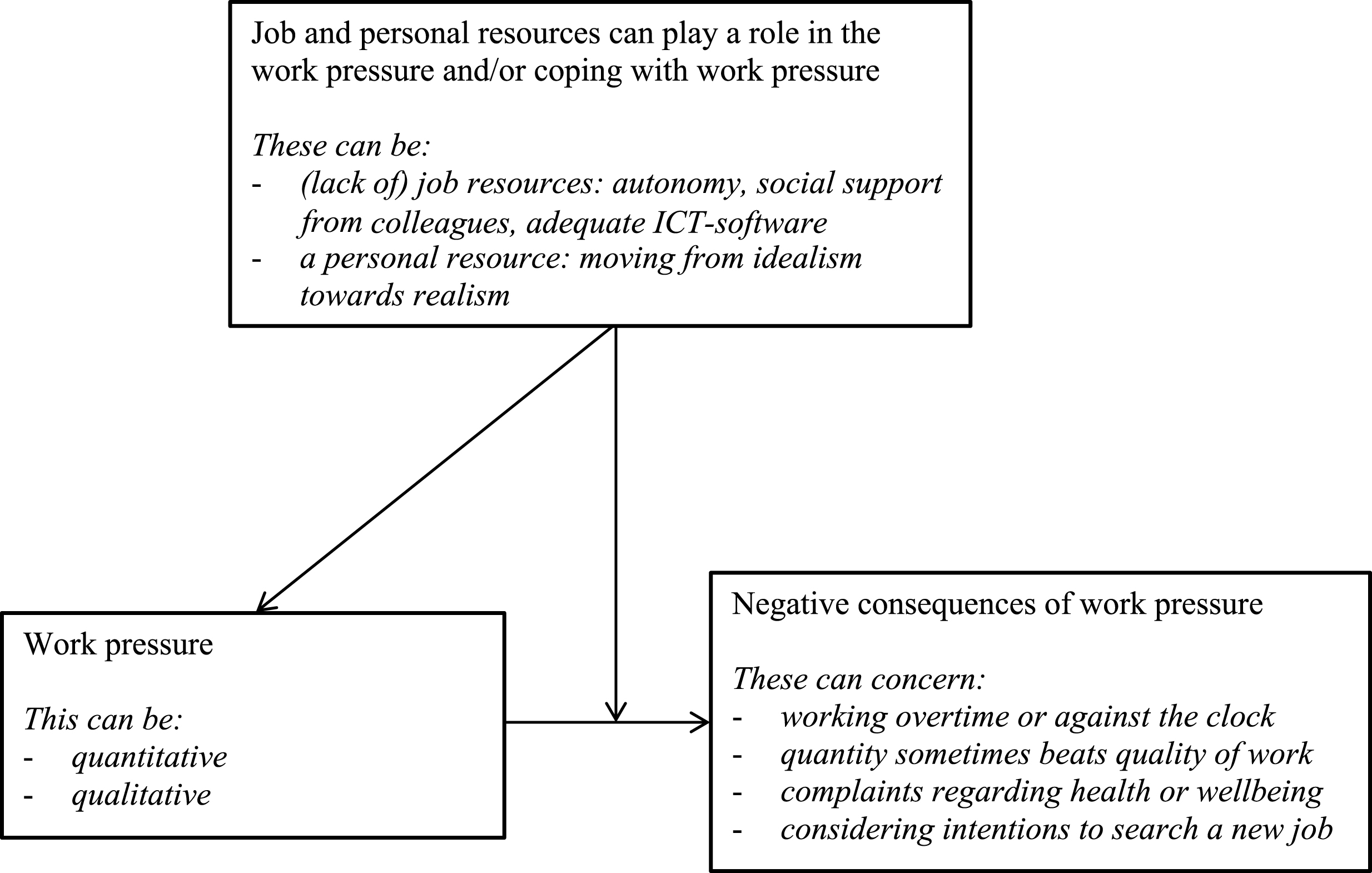
Aligned with the health impairment process of the JD-R model, the employees reported negative consequences of their work pressure on their health and well-being, as well as on their work performance, and they also reported potential intentions to search for new jobs. In line with the JD-R model, these findings suggest that the interviewees were undergoing health impairment because the experienced job demands were too high compared to the available job resources that could play a role in the work pressure or help to cope with it [29]. Yet, please interpret the arrows in Fig. 1 with caution, because our methodology did not allow us to draw conclusions about the causal relationships among the concepts.
From a JD-R perspective, some of the study findings are particularly interesting.
First, most of the sub topics such as job insecurity, were reported by only a part of the interviewed participants. Thereby, our analysis shows that, in a group of employees who experience work pressure within one organization, on an individual level, different factors can contribute to each employee’s experience of work pressure. This suggests that work pressure is a highly individualized experience.
Second, the study findings describe one personal resource, which was ‘moving from idealism towards realism’. To our knowledge, this personal resource has not been studied before within the JD-R model. Realism, as a personal resource, seems to stem from the work pressure that is related to ‘feeling (overly) responsible’ instead of to job resources, as is described in the literature [34, 35]. This may be explained by Hobfoll’s Conservation of Resources (COR theory), which, among others, states that people aim to acquire and retain resources and that stress arises when they lose, or will likely lose, resources [32, 39]. Our study findings suggest that experiencing work pressure threatened these employees’ health and well-being. To protect these resources, the employees may have moved from idealism towards realism. Moreover, according to Schaufeli & Taris, personal resources may affect employees’ perceptions of their job characteristics [32]. However, the employees’ move from idealism towards realism also motivated them to directly do something about (i.e., limit) their workload. In line with the Self-Determination Theory of Deci & Ryan, which informs us about the motivating potential of satisfaction of one’s need for competence, autonomy and relatedness [32, 40], (some) realism may have prompted the employees to experience their need for autonomy to be at least sufficiently satisfied, which, in turn, may have motivated them to do something about their high workload.
Third, employees themselves generally did not report that their job and personal resources had a motivational impact as described by the JD-R model. Engaged employees experience having a large amount of energy, and being active, optimistic and identify with their work [29–31]. The absence of a link between resources and engagement in our study findings will, in the first place, be a consequence of the scope of the framework for this study, which does not include the motivational process of the JD-R model [29–31]. However, the interviewed employees themselves did not bring up a motivational role of the resources either. Under work pressure, employees might focus more on job and personal resources that help to control, or cope (with), the workload than on job and personal resources that are energizers.
Overall, our study findings fit well within the health impairment process and the roles of resources in this process [29–32]. However, a critical note should be made, as the topics we studied did not exactly match with the concepts of the JD-R model and we did not study most of the concepts structurally in line with the JD-R model [32, 41]. For example, we did not make an explicit distinction between social support provided by the supervisor as a job resource and engaging leadership (that is targeted at connecting, strengthening and inspiring), as would be appropriately in line with the extended JD-R model [41]. The topic list, for example, included both the topic of ‘leadership style’ as a resource, as well as the supervisors’ role as overarching different resources, such as participation. In addition, the topic list included the role of the supervisor in the evaluation of the employees’ work. However, the results section does not include topics regarding the employees’ supervisors. As this study was conducted at two departments, the findings would only apply to a few individual supervisors, which would violate their anonymity. Similarly, in our study objectives, we did not differentiate between studying burnout symptoms as a result of the work pressure and the consequences of these burnout symptoms (such as a lower work performance). This distinction, however, is part of the health impairment process of the JD-R model [32].
Apart from the limitations described above that concerned the application of the JD-R model in this study, our research has other methodological limitations that raise questions concerning the reliability and generalizability of the study findings.
The issue of reliability mainly concerns non-systematical or random errors that would, for example, limit the replicability of the study [38]. In this study, it appeared impossible to report about one (or more) topic(s) and certain subtopics. One reason for this may have been that the data were insufficient or insufficiently explicit concerning how information may have played a role in the work pressure or in coping with the work pressure. This random error may have been prevented by asking more follow-up questions during the interviews. Further, we applied investigator triangulation to parts of the data analysis only [42]. KC checked the accuracy of the themes described by NH in the results section. As we did not apply researcher triangulation to all the study aspects, such as to the data collection, we cannot be certain that this study does not contain more random errors.
The reliability-related issues discussed above are also important for the generalizability of the study findings [38]. Regarding the generalizability of the findings, it should be noted that the data were coded by a health scientist (NH). She may have been more sensitive towards information regarding stress-related health complaints in the data than researchers with, for example, a background in management sciences. In other words, the educational background of the researcher who coded the interviews could have played a role in the study results. Although researcher educational background is not a typical limitation of this study, it is good for readers to take this into account when interpreting the study findings [38]. In addition, an adequate sampling method is an important prerequisite for the generalizability of study findings. We used convenience sampling [42] to recruit the interview participants, which is an opportunistic way of sampling. The study participants were included in the sample based on their accessibility instead of on their characteristics. This sampling method is typically applied if the researchers have access to one unit/organization only [38]. Convenience sampling raises the question of whether the study findings are sufficiently generalizable, as we did not make sure that the sample of the interview participants reflected the general population of employees in vocational education, with respect to their characteristics. Approximately 35–40% of the total Dutch population of employees in vocational education are supporting personnel [24]. Our sample consisted of 55% supporting personnel. The relative underrepresentation of teachers in our sample implies that our study findings are slightly more generalizable to supporting personnel than to teachers in vocational education [38]. In addition, the interviews were conducted with employees of two departments from one school for vocational education. It was already known at the beginning of this study that the employees of these departments generally experienced high work pressure. During the interviews and the data analyses, there was a focus on the negative employee experiences. These employees’ experiences may be more negative than those of the general population of employees in vocational education. Another limitation concerning the generalizability of our study findings is that the opinions about certain topics were expressed by the employees at one department only. The study sample was too small to report the study findings for the career services and teaching departments separately. There may, however, have been differences between the supporting personnel and the teachers in how they experience work pressure, its consequences and/or the role of resources. Moreover, it is likely that our sample of interview participants consisted of relatively less females than the total share of females among the total population of employees in vocational education. However, we did not notice any structural differences in the content between the interviews with males and with females. Therefore, the gender distribution of our study sample most likely did not affect the generalizability of the study findings. Despite these limitations, the main themes presented in the results section are generally in line with the issues described in other publications [see, for example, 17, 18, 20, 21, 43, 44].
Implications for future research
This is the first qualitative study to address the topic of the work pressure experienced by supporting personnel in vocational education. Our study was conducted based on the health impairment process and the related roles of job and personal resources in the well-known JD-R model [29–32]. Generally, this framework appeared to fit well with our study objectives [see, for example, 45 for another teacher study based on the JD-R model].
Both the teachers and the supporting personnel who were interviewed, experienced work pressure and the consequences of work pressure, as well as job and personal resources. Work pressure may be a threat to the sustainable employability of these employees. Given the limitations regarding the reliability and generalizability of our study findings, further research is necessary to develop an evidence-base for effective interventions. In particular, future qualitative interview studies on work pressure need to be conducted in multiple organizations in different countries. Further, qualitative interview studies should focus on the similarities and differences between groups of teachers and supporting personnel in organizations of vocational education. In these studies, purposive sampling and researcher triangulation need to be applied [38, 42]. Finally, more in-depth studies need to be conducted among scientific personnel in different areas. For example, interview studies can focus on (threats for) their job satisfaction and job performance, their occupational health, interpersonal relations and the influences it has on their students.
Conflict of interest
The authors have no conflicts of interest.
Author information
NH is employed as an assistant professor at the Department of Work and Organizational Psychology, Faculty of Psychology and Educational Science, Open University, Heerlen, The Netherlands. She completed a Ph.D. in the area of return-to-work after sickness absence from Maastricht University.
KC completed a Masters in Work and organizational psychology at Open University, Heerlen, The Netherlands.
Footnotes
Acknowledgments
The authors thank the organization for vocational education for its support of- and the interviewees for their participation in this study.