



Abstract
BACKGROUND:
Although job demands, supervisory support, and burnout have been identified as significant predictors of turnover intention, little attention has been paid to the mechanisms among these determinants.
OBJECTIVE:
Based on the job demand and resource (JD-R) model, this study examined the mediating roles of emotional exhaustion and depersonalization.
METHODS:
Data were collected from private sector social workers in three metropolitan areas of South Korea (N = 316). Two serial multiple mediation analyses were conducted to examine the mediating effects of emotional exhaustion and depersonalization in the relationships between job demands and turnover intention and between job resources and turnover intention, respectively.
RESULTS:
Job demands and resources were associated with turnover intention both directly and indirectly, through emotional exhaustion and depersonalization. Whereas job demands were positively associated with emotional exhaustion only, job resources were negatively associated with both emotional exhaustion and depersonalization. The sequential link from emotional exhaustion to depersonalization was present in both job demands and in the resources models.
CONCLUSIONS:
The findings underscore the importance of addressing potential burnout to effectively reduce turnover intention among social workers in South Korea. Implications and strategies for developing interventions and policies to reduce turnover by improving work environments are suggested.
Introduction
High turnover among social workers is a major concern in South Korea (hereafter Korea). According to a panel study including over 4,700 social workers in Korea in the 2018 Statistical Yearbook of Social Workers, between 42%and 61%of social workers in both the private and public sectors had experienced turnover during their career and approximately 23–39%had intentions to leave their current organizations [1]. Addressing the high turnover rate and turnover intention among social workers is crucial, as these issues pose great challenges to multiple stakeholders, including clients who receive services and their families, social work organizations, and social workers themselves. Given the numerous adverse impacts of high turnover—such as increased employer costs for replacement and training, reduced organizational effectiveness, reduced morale and productivity in the remaining coworkers, and reduced service quality and client satisfaction [2–5]—more attention needs to be paid not only to the determinants of turnover and turnover intention, but also to the potential mechanisms that influence turnover and turnover intention.
Previous research has identified a broad range of determinants of turnover and turnover intention among social workers, including work related (i.e., tenure and income), organizational conditions related (i.e., stress, social support, and fairness), and profession perception related (i.e., burnout, satisfaction, and commitment) predictors [2, 6]. Studies on turnover intention among social workers in Korea have shown similar findings, identifying job demands, supervisory support, burnout, emotional labor, and organizational trust as significant predictors of turnover intention [7–9]. However, despite the prior identification of various determinants of turnover and turnover intention, there is relatively little empirical evidence concerning the mechanisms among these determinants.
Using the job demands and resources (JD-R) model [10] as a conceptual framework, this study aimed to examine the mechanisms of the effects of job demands and resources on turnover intention by exploring the mediating roles of emotional exhaustion and depersonalization among social workers in Korea. The JD-R model posits that two categories of job conditions—job demands and job resources—lead to employee burnout [10]. Job demands refer to the aspects of the employees’ working conditions that accompany physical and mental efforts (e.g., physical workload, time pressure, excessive contact with clients, unfavorable work schedule, and physical working environment), whereas job resources refer to diverse aspects of employees’ working conditions that help them achieve goals, reduce job demands, and enhance personal development (e.g., performance feedback, rewards, and supervisor support [10–11]. Concerning the effects of job demands and resources on the development of burnout, the JD-R model considers two dimensions of burnout—emotional exhaustion and depersonalization—and suggests that job demands and resources are uniquely associated with these dimensions of burnout [10]. For example, job demands were mainly positively associated with exhaustion but not with depersonalization, whereas job resources were mostly negatively associated with depersonalization [10]. However, previous studies found that job resources had an important main effect on emotional exhaustion, albeit lesser than that of job demands [11] and its impact on depersonalization was via emotional exhaustion [12].
The JD-R model also assumes a sequential link from emotional exhaustion to depersonalization, which is supported by previous research [13–16]. For example, depersonalization—which refers to feelings of insensitivity and impersonal responses toward clients—is considered to be a defensive adaptation strategy to counter a persistent state of emotional exhaustion or feelings of being emotionally drained and exhausted, either physically or cognitively [13, 18].
A considerable number of social workers in Korea are exposed to high job demands (e.g., excessive caseloads, direct and intense contact with clients, and the burden of administrative duties), scarce resources (e.g., staff shortages and a lack of adequate supervision and support), burnout, and high turnover [19–22]. According to previous research, job demands and resources and burnout are well-known predictors of turnover intention among social workers [2, 23]. Additionally, job demands and resources have indirect effects on work outcomes via burnout among health and social service employees [16, 23–25]. Thus, this study examined the direct effects of job demands and resources on turnover intention and the mechanisms through which they influenced turnover intention by examining two burnout components—emotional exhaustion and depersonalization—as potential mediators. The study used turnover intention rather than actual turnover, as turnover intention is known as the strongest predictor of actual turnover and useful for employers to formulate preventive steps before employees leave [26, 27]. We hypothesized that job demands would be positively associated with turnover intention and that job resources would be negatively associated with turnover intention. We also hypothesized that the two components of burnout mentioned above would mediate the effects of job demands and resources on turnover intention and that the mechanisms would be different.
Methods
Participants
Data were gathered from surveys of employees at community social service centers, senior social service centers, and social service centers for persons with disabilities in three metropolitan areas of Korea (Seoul, Gyeonggi, and Incheon). After determining the total number of social service centers in each area (Seoul = 180, Gyeonggi = 187, and Incheon = 33), we targeted 10%of the total number of social service centers in each area (18 from Seoul, 19 from Gyeonggi, and four from Incheon) using proportional sampling. Upon receiving approval from the total of 41 organizations, our research team met with the potential study participants directly, obtained verbal informed consent after explaining the study purpose and procedure (including confidentiality issues) fully, and distributed the questionnaires to those who agreed to participate. These self-administered surveys were conducted with 400 licensed social workers who had a tenure of less than 10 years and provided direct social services (180 from the 18 Seoul centers, 187 from the 19 Gyeonggi centers, and 33 from the four Incheon centers) between November and December 2018. Each of the study participants received a gift card to the value of US $5 after completing the surveys. After discounting those who did not meet the eligibility criteria (n = 82) and those with more than 10%missing information (n = 2), the final sample size of the study was 316. This study was approved by the Institutional Review Board of the Yonsei University (7001988-201712-HR-289-05).
Measures
Turnover intention
Employees’ turnover intention was assessed by using a six-item scale developed by Mobley and amended by Blau [28–29]. We used a Korean-translated version of the scale that was also modified to better suit the characteristics of social workers in Korea [4]. Some example items include “I am seriously considering quitting my current job,” and “I often look to see if other organizations are hiring.” The items were rated on a 5-point Likert scale from 1 (not at all) to 5 (very much), with higher scores indicating a higher level of turnover intention. The reliability of the scale in the study was high (α= 0.92).
Job demands
The Korean Occupational Stress Scale –Short Form (KOSS-SF) developed by Chang et al. [30] was used to assess job demands. The KOSS-SF has seven subscales: job demands, lack of rewards, inadequate social support, insufficient job control, organizational system, job insecurity, and occupational climate. The job demand subscale contains four items: time pressure, increased workload, breaks between work hours, and multi-tasking. The items were rated on a 4-point Likert scale from 1 (not at all) to 4 (very much), and a positive item was reverse coded. Higher scores indicate higher levels of job demands, and the reliability of the scale in the study was satisfactory (α= 0.74).
Job resources
Job resources were assessed using a three item social support subscale of KOSS-SF to measure social support in the workplace. These are peer support, supervisor support, and emotional support. On the basis of previous empirical findings that social support in the workplace from supervisors or coworkers can be used as resources for social workers to address negative outcomes such as burnout and turnover intention [31–32], this study focused on social support in the workplace as a job resource. The questions included the following: “My supervisor helps me complete my work,” “my co-worker helps me complete my work,” and “when I have difficulties at work, I have someone who acknowledges and understands my difficulties.” The items were also rated on a 4-point Likert scale from 1 (not at all) to 4 (very much), with higher scores indicating greater support. The reliability of the scale in the study was satisfactory (α= 0.69).
Burnout
The Maslach Burnout Inventory (MBI) [33] consists of 22 items that measure three dimensions of burnout: emotional exhaustion (9 items), depersonalization (5 items), and personal accomplishment (8 items). However, on the basis of previous research that considers personal accomplishment as a consequence of burnout rather than a burnout component [18, 34], the present study considered emotional exhaustion and depersonalization as the two core dimensions of burnout, similar to other studies [10–11, 35]. All 14 items were rated on a 5-point Likert scale from 1 (strongly disagree) to 5 (strongly agree), with higher scores indicating a higher level of emotional exhaustion and depersonalization. The reliability of the subscales in the study were α= 0.85 and α= 0.74, respectively.
Control variables
The control variables were composed of demographic and job-related variables that could affect the turnover intention of social workers. Demographic information included gender (0 = female, 1 = male), age (0 = 20–29, 1 = 30–39, 2 =≥40), marital status (0 = not married, 1 = married), employment type (0 = non-regular, 1 = regular), and monthly salary (0 = < 2 million Won, 1 = 2–3 million Won, 2 = > 3 million Won).
Analytical strategy
Frequency distributions and descriptive statistics were performed to examine the sample characteristics. Additionally, a bivariate analysis of correlation between the main study variables was performed using SPSS 25.0 software. To test the indirect effects of emotional exhaustion and depersonalization on the relationship between job demands and turnover intention as well as between job resources and turnover intention separately, two serial multiple mediation analyses were performed using the SPSS macro PROCESS (version 2.16.3) developed by Hayes [36]. PROCESS is an SPSS macro for mediation analyses that is based on an ordinary least squares regression and the bootstrap method. To test the statistical significance of total and specific indirect effects, we used a bias-corrected bootstrap method with 95%confidence intervals (BC 95%CI) based on 5,000 bootstrap samples. As bootstrapping does not require the assumption of normality of the sampling distribution in testing mediation [37], it may be more appropriate in small samples—such as the present study—compared to Sobel’s test or structural equation modeling, which are often affected by the sample size [36, 37].
Results
Descriptive characteristics of the sample
The descriptive characteristics of the overall sample and study variables are summarized in Table 1. More than 67%of the respondents were women, and the mean age of the sample was 29.1 years (SD = 4.46; range = 20–53), with nearly 97%being under 40 years old. More than 72%were not married, and approximately 17%were non-regular employees. Over 52%earned less than 2 million Won (approximately US $1,800) per month. The average scores of job demands and resources were 2.91 (SD = 0.50) and 3.06 (SD = 0.52), respectively. Emotional exhaustion and depersonalization averaged at 3.08 (SD = 0.70) and 2.22 (SD = 0.68), respectively. The respondents’ turnover intention averaged at 2.85 (SD = 0.87), and over 24%of the sample had intentions to leave their current organizations.
Characteristics of the sample (N = 316)
Characteristics of the sample (N = 316)
The bivariate correlations between the study variables were examined (table not shown). As expected, job demands was positively associated with turnover intention (r = 0.34, p < 0.001) and job resources (e.g., social support in the workplace) was negatively associated with turnover intention (r = –0.34, p < 0.001). Additionally, job demands was positively correlated with both emotional exhaustion (r = 0.60, p < 0.001) and depersonalization (r = 0.26, p < 0.001), whereas job resources was negatively associated with both emotional exhaustion (r = –0.22, p < 0.001), and depersonalization (r = –0.37, p < 0.001). Emotional exhaustion (r = 0.44, p < 0.001) and depersonalization (r = 0.39, p < 0.001) were also positively associated with turnover intention.
Effects of job demands and resources on turnover intention
Figures 1 2 present the findings of the serial multiple mediation analyses of emotional exhaustion and depersonalization in the relationships between job demands and turnover intention and job resources and turnover intention, respectively. Job demands had a positive total (B = 0.532, SE = 0.094, p < 0.001) and direct effects on turnover intention (B = 0.242, SE = 0.105, p < 0.05), whereas job resources had a negative total (B = –0.559, SE = 0.089, p < 0.001) and direct effects on turnover intention (B = –0.370, SE = 0.090, p < 0.001) after controlling for the covariates.

Path diagram of the indirect effects of emotional exhaustion and depersonalization on the relationship between job demand and turnover intention.
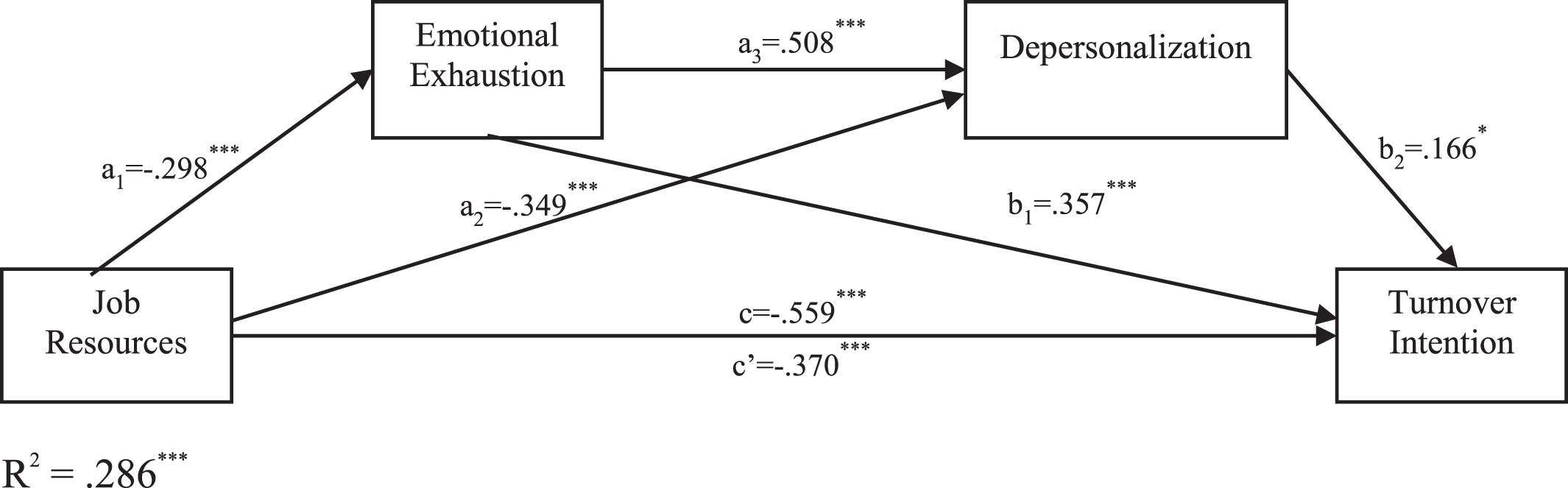
Path diagram of the indirect effects of emotional exhaustion and depersonalization on the relationship between social support in the workplace and turnover intention.
Concerning the mechanisms of the effects of job demands and resources on turnover intention, both emotional exhaustion and depersonalization were found to be significant mediators. In terms of the job demands model (Fig. 1), job demands exerted an indirect effect on turnover intention through emotional exhaustion, but not through depersonalization. However, emotional exhaustion had a direct effect on depersonalization (B = 0.617, SE = 0.057, p < 0.001), and the indirect effect of job demands on turnover intention was sequentially significant through emotional exhaustion and depersonalization. In terms of the job resources model (Fig. 2), job resources had indirect effects on turnover intention through both emotional exhaustion and depersonalization and also sequentially through exhaustion and then through depersonalization.
The findings concerning the total indirect and specific indirect effects of job demands and resources on turnover intention through emotional exhaustion and depersonalization are presented in Table 2. The results indicated that the total indirect effect (b = 0.290; SE = 0.065; BC 95%CI [0.171, 0.425]) and the indirect effect of job demands on turnover intention through emotional exhaustion as a single mediator (b = 0.192; SE = 0.072; BC 95%CI [0.058, 0.341]) were significant. We also found that emotional exhaustion and depersonalization sequentially mediated the relationship between job demands and turnover intention (b = 0.132; SE = 0.044; BC 95%CI [0.054, 0.228]). Furthermore, the results showed that the total indirect effect (b = –0.190; SE = 0.048; BC 95%CI [–0.294, –0.103]) and indirect effects of job resources on turnover intention through emotional exhaustion (b = –0.107; SE = 0.035; BC 95%CI [–0.189, –0.048]) and depersonalization (b = –0.058; SE = 0.030; BC 95%CI [–0.127, –0.009]) as a single mediator were statistically significant. Emotional exhaustion and depersonalization sequentially mediated the relationship between job resources and turnover intention (b = –0.025; SE = 0.014; BC 95%CI [–0.062, –0.004]).
Specific indirect effects of emotional exhaustion and depersonalization in the relationships between job demands and resources on turnover intention
Specific indirect effects of emotional exhaustion and depersonalization in the relationships between job demands and resources on turnover intention
The purpose of this study was to improve our understanding of the mechanisms through which job demands and resources influence turnover intention among social workers in Korea. Using the JD-R model, the study examined the mediating effects of emotional exhaustion and depersonalization in the relationships between job demands and resources and turnover intention.
Over 24%of the study participants reported that they had intentions to leave their current organizations. This rate was comparable to what has been reported in existing panel surveys on a large number of social workers in Korea [1, 38]. The findings of our multivariate analyses indicated that the effects of job demands and resources on turnover intention were both direct and indirect through the mechanisms of emotional exhaustion and depersonalization. Concerning the direct effects of job demands and resources, the results were in line with previous research, indicating a positive association between job demands and emotional exhaustion and negative associations between job resources and emotional exhaustion or between job resources and depersonalization [10–12, 39]. These findings suggest that job demands and resources exert different patterns on each dimension of burnout, which are in line with the JD-R model that proposes two different processes in burnout development: exposure to excessive job demands may lead to overtaxing, resulting in emotional exhaustion, and a lack of job resources may lead to depersonalization, as one can employ withdrawal behavior to self-protect against energy depletion [10, 40]. Also, our findings are consistent with existing results that lack of resources was directly linked to emotional exhaustion as well as depersonalization [11, 12].
Another particularly notable finding is that job demands and resources lead to turnover intention through the sequential mediation of emotional exhaustion and depersonalization. A further finding states that the mechanisms of the mediating effects of job demands and resources on turnover intention were unique. These findings integrate with existing research that supports the mediating role of burnout in the relationship between work environments (i.e., job stress, social support, job demands, job resources) and turnover intention among social service employees [16, 23–25] as well as previous evidence that supports a causal or sequential relationship between emotional exhaustion and depersonalization [12–16, 42]. Similar results have been found in previous studies using samples of social service employees or nurses in Korea. Kim [9] found that burnout mediated the relationship between job demands and turnover intention among social workers and Choi [43] found the sequential relationship between emotional exhaustion and depersonalization among case managers in social work fields of Korea. Moreover, Yom [39] showed a causal link between these two dimensions when explaining the development of burnout among nurses in Korea. The sequential link between emotional exhaustion and depersonalization demonstrated in the present study is supported by previous research that considers depersonalization as a reaction to emotional exhaustion or a self-protective strategy to help these workers cope emotionally [44].
There are several limitations to the study that should be noted when interpreting the results. First, because of the cross-sectional nature of the study design, the relationships among the study variables (i.e., job demands, job resources, emotional exhaustion, depersonalization, and turnover intention) cannot be interpreted causally. Second, the use of a geographically defined non-representative sample prevents the generalization of the study findings to the larger population of social workers in Korea. Future research should consider using longitudinal data with representative samples to better understand the impact of job demands and resources on turnover intention and their mechanisms. Third, the use of self-reported measurements represents another limitation of the study. Lastly, although the rationale for using turnover intention as a proxy for actual turnover was explained, turnover intention may not necessarily lead to actual turnover, as there are various factors that may lead employees to act on their intention to leave their organizations or not. Therefore, future studies should examine actual turnover in addition to turnover intention.
Conclusion
Despite the limitations, the study contributes greatly to the existing literature. It does so by examining potential pathways from job demands and resources to turnover intention through emotional exhaustion and depersonalization among social workers in Korea. Particularly, by focusing on how job demands and resources exert different patterns of effect on each dimension of burnout and how the mechanisms through which job demands and resources influence turnover intention can be different, the study provides significant implications for labor policy and—in particular—social service workforce management.
First, labor policy makers and social service leaders must recognize the challenges that social workers face daily in their workplace settings, such as excessive job demands, lack of job resources—including social support from supervisors or colleagues—and burnout—such as emotional exhaustion and depersonalization—which are well documented risk factors for higher turnover intention. Given that a high turnover among social workers may pose significant challenges to multiple stakeholders—including clients and their families, social work organizations, and social workers themselves—it is important to proactively address the high turnover issues among social workers. To reduce turnover among social workers in Korea, Korea-specific contexts need to be considered. For example, the fact that the majority of social workers in Korea are female needs to be considered and incorporated when making policies, as excessive job demands and lack of resources may result in work-family conflict issues. Although the Korean government has led its efforts to reduce working hours by revising the Labor Standards Act (e.g., from 68 hours a week to 52 hours a week including 40 hours per week, overtime and holiday work hours), the average working hours of social workers in Korea are still well over 40 hours per week, the appropriate working hours recommended by the International Labor Organization [45]. As excessive job demands lead to increased work exhaustion of social workers in Korea [9], strategies to alleviate excessive job demands need to be sought. For example, social work organizations may consider maximizing human resources by capitalizing on volunteers and social work interns in collaboration with social work schools. In addition, current excessive job demands and workloads should be adjusted to enable female social workers to better address work-family balance. Family friendly programs—such as a sabbatical leave system and flexible work hours—would be beneficial for social workers to prevent their emotional exhaustion or depersonalization caused by excessive job demands and lack of job resources.
Second, considering that our study identified burnout as a significant mediator of the relationship between job demands/resources and turnover intention, special efforts are needed to develop diverse interventions that can help social workers better manage their burnout symptoms. Burnout needs to be managed not only at an employee level but also at an organizational or societal level, through organic collaborations among labor and employment policy makers, social service organization leaders, and social workers. At an individual level, social workers need to be supported by improved work environments and enhanced provision of psychological and emotional support. At an organizational level, alternatives that may reduce the current work load and enhance the well-being of social workers need to be implemented. For example, the adequacy of the current work load and psychological and emotional needs of social workers could be regularly explored through regular consultations with agency managers. If necessary, external resources could be investigated by collaborating with other health and mental health centers within the community. The implementation of an Employee Assistance Program (EAP) to social work organizations would be worth considering as its need among social workers [46] and effectiveness [47] have been examined previously.
Third, given that the level of job resources—for example social support—that social workers receive from supervisors or coworkers significantly affected both emotional exhaustion and depersonalization, increased provision of supportive resources from supervisors and coworkers would help social workers to reduce or better manage burnout. The implementation of a more integrative system that provides supervision and psychological support from both supervisors and colleagues would protect social workers from feeling exhausted and depersonalized because of excessive job requirements and lack of social support in their workplaces.
Footnotes
Acknowledgments
This work was supported by the Yonsei University Research Grant of 2020.
Conflict of interest
None to report.