



Abstract
BACKGROUND:
Hammering is a functional task in which the wrist generally follows a path of motion, however, previous studies paid relatively little attention to it.
OBJECTIVE:
The main objective of this study is to determine the optimal working height while using a straight-handled hammer to perform the hammering task.
METHODS:
Ten participants performed the hammering tasks on three different working heights (64, 80, and 96 cm) using three subjective hammering forces (light, medium, and heavy).
RESULTS:
The results revealed that there were linear increasing trends of shoulder abduction, which increased with the increased working height when hammering and the trunk flexion revealed a contrary result. However, the ulnar deviation and trunk lateral bending were insensitive to the working heights. The hammering forces merely resulted in trunk flexion and lateral bending and no posture differences at upper extremities.
CONCLUSION:
The trade-off between acceptable trunk flexion and shoulder abduction was considered to determine a reasonable effective working height (by measuring downward from worker’s elbow height) in the range from 25 cm to 35 cm with a mean 30 cm. This range will be valuable for hammering job design.
Introduction
Poor design and excessive use of hand tools are associated with increased incidence of instantaneous trauma (i.e., cuts, punctures, sprains, etc.) and cumulative trauma disorder (i.e., nerve entrapment, epicondylitis, forearm peritendinitis, etc.) of the upper extremities [1–4]. It has been shown that, from literature review, tool design may play an important role in the development of work-related problems in the hand and forearm.
As mentioned in a previous survey [5], the two non-powered hand tools causing the highest injury were the knife and the hammer that accounted for 44.3% and 10.0% of injuries and illnesses, respectively. Many efforts have been dedicated by ergonomists to research the knife and proposed feasible guides for design [6–8]. As for the hammer, previous studies focused on the handle design and suggested that it should be angled in the range of 5–40° in order to reduce ulnar deviation, but there were no performance differences [1, 9]. It is well-known “to bend the hand tool and not the wrist”. Unfortunately, the laboratory and field studies conducted with bent-hammers could investigate only a relatively small range of work conditions [10]. An investigation dealing with hammer types used in Taiwanese metal industry and development of hand tool guides was studied by Hsu and Chen [11]. The result showed that the conventional straight-handled hammer is more popular than that with a bent-handled one.
As well improving the tool itself, Dempsy and Leamon [10] suggested that the range of combinations of operator and workplace geometry in which a hand tool may be used is far greater than what can normally be investigated in a single study. Hammering is a functional task in which the wrist generally follows a path of motion from a position of combined radial deviation and extension to combined ulnar deviation and flexion [12]. That is the so-called dart throwing motions [13]. Fogleman et al. [8] found the radial/ulnar deviation range was significantly affected by the different cut positions while performing the cutting task. Similar result was revealed in the study of hammers investigated by Schoenmarklin and Marras [1]. It is clear from the literature that the working height might be as a determinant for hammering job design to avoid the upper limbs injuries resulting from awkward posture adopted and unacceptable stresses imposed on body.
Generally, in a standing position and performing heavy manual work such as hammering, Ayoub and Miller [14] proposed that the working height for heavy work should be approximately 20 cm below elbow height (i.e., 85 cm to 100 cm for men). Grandjean [15] suggested that if the work involves much effort and makes use of the weight of the upper part of the body, the working surface needs to be lower. Though the recommended work height for heavy work is below elbow height, the conclusions proposed by previous studies have existed some discrepancies and need to be further clarified. The main objective of this study therefore attempted to determine the optimal working height while using a straight-handled hammer to perform the hammering task.
Methods
Participants
Ten healthy, right-handed male operators (with pay) were recruited as participants of this study, aged between 23 and 36 years (mean 26.4 years), participated in the study. They all graduated from the department of mechanical technique from senior industrial vocational schools in Taiwan and were practicing at the hammering task with a minimum of 3-years of experience, and had no hand or wrist injuries. Their mean height and weight were 170 cm and 68.8 kg, with standard deviations of 5.6 cm and 9.2 kg, respectively. Participants were familiarized with the experimental procedures before the experimental data was collected.
Instrumentation and procedure
A conventional, straight-handled hammer with a head weight of 16-ounce was employed in this study (Nio Gechen, Taipei). The hammer is extensively used in Taiwanese industry [11]. To understand any posture change in hammering task of different work heights, participant’s posture was recorded (60 frames/s) with two NEC T1-23A CCD cameras which were placed at right angles to the participant’s sagittal and posterior-frontal planes at distance of 5 m, respectively. The adhesive reflective markers were placed on the participant’s hand, wrist, elbow, shoulder, and hip in the view of sagittal plane and elbow, first thoracic vertebrae, and L5/S1 joints in the view of posterior-frontal plane while hammering in each task condition (as shown in Fig. 1). With the aid of a motion analysis system (Expert Vision, Vp110, Santa Rosa, CA), the three-dimensional coordinates of the markers were obtained. From the marker positions, the postures of upper limbs and trunk were then calculated. Additional markers were also attached on the experimental hammer to obtain the hammer orientation while hammering. For further kinetics analysis, the hammering forces were measured by a force plate (800×800×15 cm, force range 500×200×200 kg, T.K.K., Tokyo) using frequency of 60 Hz through an A/D converter to transfer the volt values to digital data and calibrated as hammering forces.

Bony landmarks on the hand, wrist, elbow, shoulder and trunk in the posterior−frontal and sagittal plane. MK1: located on T1 (1st thoracic vertebrae); MK2: located on L5/S1 disc (the disc located between the 5th lumber and 1st sacral vertebrae); MK3: located about elbow joint; MK4: located about shoulder joint; MK5: located on lateral epicondyle; MK6: located on palpable groove between lunate and capitate; MK7: located on 3rd metacarpophalangeal joint; MK8: located about hip joint; θ1: The degree of trunk lateral bending; θ2: The degree of shoulder abduction; θ3: The degree of trunk flexion; θ4: The degree of ulnar deviation.
All participants were familiarized with the experimental procedures and stretched themselves at least 15 min before the data was collected. They were randomly requested to perform all hammering tasks in a specific height and subjective force using their typical work posture. For each force level (i.e., light, medium, or heavy), the hammering task was repeated until three readings were obtained which were consistent within a range of 10 %. The median reading and the corresponding posture were then analyzed. A minimum rest period of 2 min was required between successive trials. The trials were conducted in 3-min blocks and all participants completed the nine hammering task combinations within one hour.
The working surface for the hammering task in this study was conducted at three different heights (64, 80, and 96 cm, which referred by Grandjean [15]) and three hammering forces (light, medium, and heavy in participant’s semantically perception). As a result, a total of 90 combinations (10 participants×3 heights×3 forces) were determined. For each combination, participant’s posture adaptations were recorded as dependent variables. They included trunk flexion, trunk lateral bending, shoulder abduction, and ulnar deviation.
Statistical analysis
While performing the hammering tasks, a randomized complete block design was used in the experiment. Each participant was considered as a block; he performed all treatment combinations in a random order. The posture differences of participants’ upper limbs were analyzed using two-way repeated-measures analysis of variance. Duncan Multiple Range Test (Duncan MRT) was used for post hoc comparisons. Moreover, the Pearson moment–product correlation and the least squares regression were used to develop the correlations and regression equations between the body postures and the effective working height (EWH) values, respectively. An alpha level of 0.05 was selected as the minimum level of significance.
Results and discussion
Table 1 illustrates posture difference while hammering at various working heights. As shown in the table, in general, working height variable was more dominant in posture differences than that of hammering force. The former had significant effects on ulnar deviation, shoulder abduction, trunk flexion and lateral bending (all p < 0.05). Hammering on working surface with height of 64 cm resulted in lightest ulnar deviation (6.0°), shoulder abduction (8.4°), and trunk lateral bending (3.2°), but caused largest trunk flexion (31.9°). On the contrary, data in the table indicated that the increased working height was associated with ulnar deviation, shoulder abduction, and trunk lateral bending increases. However, trunk flexion was more moderate.
Differences in working postures and the Duncan MRT grouping for various hammering heights and forces (data in degrees)
Differences in working postures and the Duncan MRT grouping for various hammering heights and forces (data in degrees)
*Standard deviation.
It is interesting to note that, as also shown in Table 1, the increased hammering forces would lead to more trunk flexion and lateral bending (p < 0.05) and no significant differences were found in ulnar deviation and shoulder abduction. The mean (SD) trunk lateral bending, in ascending order, were 8.2° (5.6°), 4.7° (2.2°), and 2.8° (1.9°) for hammering forces of heavy (average hammering force = 111.8 kg), medium (average hammering force = 63.6 kg), and light (average hammering force = 34.0 kg), respectively. As to that of trunk flexion, were 21.9° (11.4°), 14.9° (7.7°), and 9.5° (5.3°). The ulnar deviation and shoulder abduction always individually remained approximately 8° and 19°.
Figure 2 illustrates the effects of combined working heights and hammering forces on participant’s operating posture. It is clear to note that the effects of hammering forces were more inconsistent on posture changes than that of height variable. It can be observed in Fig. 2(a) that there was no difference in unlar deviation while hammering on working surface with height of 64 cm and, nevertheless, the unlar deviation was gradually increased with working height raised (from 64 cm to 96 cm). It was recognized that the unlar deviation was one of important factors resulting in work-related injuries in the hand and forearm [1–4].

The effects of working surface heights (WSH) and hammering forces on (a) ulnar deviation; (b) shoulder abduction; (c) trunk lateral bending; and (d) trunk flexion.
The higher work height would seriously cause the shoulder abduction increasing from 8.4° (when work height 64 cm) to 29.0° (when work height 96 cm). However, the effect was not found when hammering force was increased as illustrated in Fig. 2(b). Figure 2(c) illustrates that trunk lateral bending increased with higher hammering forces on working surface levels of 80 cm and 96 cm. It provides a hint that participants tended to recruit larger muscle groups (i.e., trunk) to compensate the relative weaker upper extremities while in a heavy hammering force demand. This can be explained why the trunk flexion also revealed a similar result though the trend was more moderate. However, the hammering task in this study is extremely asymmetrical to exerting forces of body. Therefore, the trunk lateral bending was more obvious than the flexion.
To work precisely and accurately, participants must flex his trunk when hammering on a lower work surface level (i.e. 64 cm). It apparently implied that the trunk flexion might be mainly affected by the work height variable. In addition, the hammering force also resulted in flexion of participant’s trunk. It can be also explained that the participant would flex his trunk to generate enough exertion. The phenomenon was more evident with higher hammering forces (see Fig. 2(d)).
For normalizing the individual anthropometric difference, Ayoub and Miller [14] proposed that the working height should be 20 cm below elbow height in a standing position and performing heavy manual work since the so-called ‘optimal absolute working height’ was not suitable for all task conditions. Table 2 illustrates the defined participant’s EWH between elbow and working height correlated with various dependent variables. It is interesting to note that the shoulder abduction and trunk flexion were highly correlated with EWH values. However, the EWH value seemed more practical for hammering job design than that of working height only.
Coefficients of correlation between the dependent variables and EWH values
*p < 0.01.
Figure 3 illustrates the posture adaptations at various hammering heights. The data was subjected to a least squares regression analysis and resulted in the four regression lines for ulnar deviation, shoulder abduction, trunk lateral bending, and trunk flexion with R2 of 0.04, 0.50, 0.10, and 0.80, respectively. The results revealed that there were increasing trends of shoulder abduction, which increased with the increased working height when hammering (p < 0.05) and the trunk flexion revealed a contrary result (p < 0.01). However, the ulnar deviation and trunk lateral bending were insensitive to the working heights (all p > 0.05). When the unacceptable postures were set at 20° [16], the trade-off between acceptable trunk flexion and shoulder abduction in Fig. 3 was used to determine a reasonable EWH range from 25 cm to 35 cm with a mean 30 cm. These values were larger than that suggested by Ayoub and Miller [14] with approximately 20 cm for EWH when heavy work. As suggested by Grandjean [15] that if the work involves much efforts and makes use of the weight of the upper part of the body, the working surface needs to be lower. This suggestion was not supported in this study since it could lead to more trunk flexion resulting in higher compressive force at L5/S1 disc [17] as illustrated in Fig. 3. Therefore, the trade-off range from 25 to 35 cm could be more valuable for hammering job design. Additionally, in this study, ulnar deviation could not be avoided since it might be improved by tool itself as investigated in previous studies [9]. A potential limitation of this study is the relatively small and young sample (male participants with mean 26.4 years) recruited in the test. The usefulness of the measure for other populations (e.g., the older professionals) is a matter for further investigation. Another limitation is that the head posture may be altered when participants hammering on various working heights and result in different neck muscle contractions (ex., trapezius) and loadings. This merits further study.
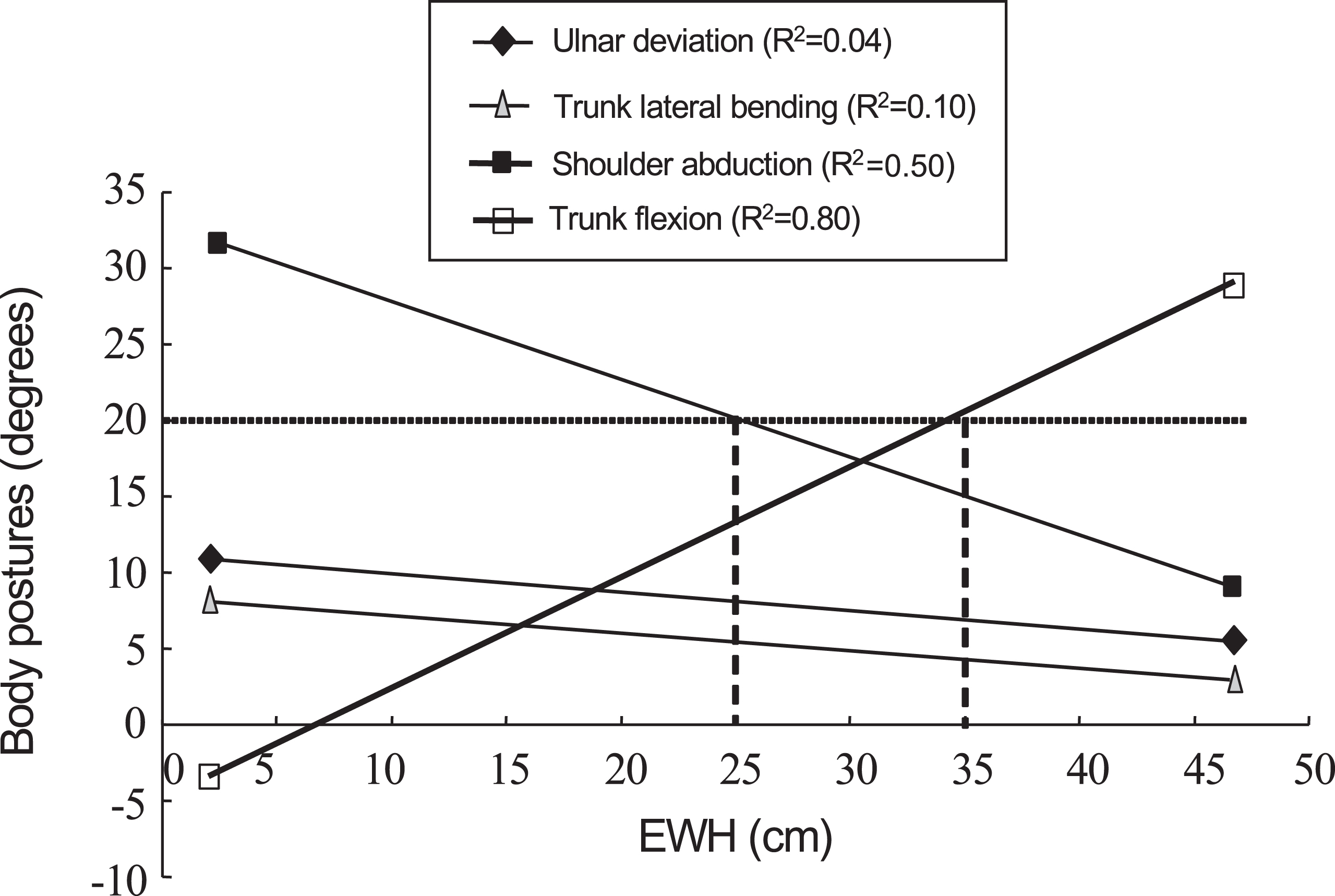
The relationships between the EWH (participant’s effective working height between elbow and working surface height) values and participant’s working postures.
In terms of ergonomic approach and focusing on determining the working height of hammering tasks, this study recommended that the optimal working height should be 25 to 35 cm below elbow height, with a mean 30 cm. These values were somewhat lower than Ayoub and Miller’s suggestion [14] that the working height should be 20 cm below elbow height and Humantech’s [16] that should be 10 – 20 cm below elbow height at heavy work. The result from this study was corresponded with the 15 to 40 cm that proposed by Grandjean [15] when the work involves much effort and upper body exertion. Therefore, in this study, the optimal work height when performing the hammering tasks could be lower than that generally proposed by the previous studies which focused on heavy assembly work. However, only ten male operators were recruited as participants in this study. This limitation should be taken into account before the result is widely applied.
Conflict of interest
None to report.