




Abstract
Despite the Americans with Disabilities Act mandate for reasonable accommodations, wheelchair users are often placed in the role of observer and note-taker when learning machining and fabrication skills due to a lack of accessibility. The focus of this case study report is to identify and develop reasonable accommodations for wheelchair users in an academic machine shop environment to address accessibility limitations of original equipment manufacturer (OEM) machines. Individual wheelchair users working and learning within the Human Engineering Research Laboratories (HERL) were observed and interviewed about their experiences using the machine shop equipment without modifications, followed by further observations after accommodations were implemented.
Introduction
In the United States, Section 504 of the Rehabilitation Act of 1973 [1] and the Americans with Disabilities Act (ADA) [2] requires schools and postsecondary educational institutions, public-serving entities, and workplaces to accommodate people with disabilities (PwD). However, legislative efforts addressing inclusion of PwD in education have primarily focused on promoting physical attendance in the classroom rather than full engagement in class and lab activities. Active participation during science, technology, engineering, and mathematics (STEM) education/training, which typically includes hands-on activities, is essential for success in the classroom and workplace. Because PwD are often not accommodated successfully by the curricula and equipment in STEM education, they frequently can only passively observe lab exercises, act as data recorders of class experiments, perform computer simulations, or read textbooks. Thus, the practice of “learning by doing” is essentially unavailable to them [3, 4].
Ensuring access to a high-quality education and employability is critical for the nation’s economy. In the United States, 95% of people who are employed do not have a disability [5]. PwD who are not employed may not be getting the hands-on training needed to build the skill sets demanded for available careers, such as those in manufacturing and STEM settings. Studies have shown that assistive technology (AT) plays a key role in the inclusion of PwD [6]. Assistive technology interventions and accommodations produced positive outcomes on job performance [7, 8], measured as a higher rate of accuracy and task completion, increased independence, and generalization of skills.
Case history
The focus of this project was to evaluate and improve accommodations used in the Advancing Inclusive Manufacturing (AIM) training program within the Human Engineering Research Laboratories (HERL). AIM is designed to teach basic manufacturing techniques to students with disabilities. Information was gathered by observation and interviews to assess the usage and efficacy of accessibility accommodations made within the HERL machining and fabrication laboratory. An ergonomic analysis was conducted based upon students’ relevant functional abilities. Tools for accommodations were made to be adjustable whenever possible to meet a variety of students’ needs in a machining learning and working environment. Some barriers considered when using conventional machining equipment included machine height, visibility of the controls and part to be machined, avoiding awkward or unsafe postures, and ability to reach key elements of the task. Methods for creating tools to overcome access and usage barriers included developing in-house devices and modifying OEM components. Task operation analysis and technology evaluation tools were used to assess user satisfaction with the resultant accommodations.
A convenience sample of five students who were participating or had participated in HERL machining training courses contributed to this assessment. Two participants used manual wheelchairs, and three were powered wheelchairs users. Table 1 shows relevant participant characteristics. The participants with lower-level (lumbar/thoracic) spinal cord injuries (SCI) and the participant with cerebral palsy demonstrated sufficient fine motor control of their upper extremities to safely operate hand controls without assistance. The two participants with upper-level (thoracic/cervical) SCI required the use of grip strength accommodations. None of the participants in this study had any type of cognitive or intellectual impairments, and the sense of touch was the only sensory impairment demonstrated by participants, with the level of impairment indicative of their level of SCI.
Participant Characteristics
Participant Characteristics
When using machining equipment, the user must have sufficient cognitive, sensory, and manipulation function to operate the machine successfully. A series of procedures must be followed to ensure safety, to successfully manufacture the component, and to perform proper maintenance of the machine used in the fabrication process. The user must be able to manipulate specific controls for basic use of machining equipment, as well as be able to select and align tooling and secure and align the material to be machined. For example, with a milling machine, the appropriate tool must be placed into the spindle (e.g. drill chuck, drill bit, etc.), the correct speeds and feeds need to be used, and appropriate jigs, clamps, and vices must be affixed to and aligned with the table to hold the part properly. Failure to observe proper procedures and safety regulations can result in grievous bodily injuries as well as damage to the machine being used.
While observing participants, it became apparent that the height and location of controls was a barrier to successful equipment operation. Several devices were applied to accommodate a wheelchair user in accessing a height level necessary to operate equipment.
For several machines, a simple platform with a ramp was used to raise the floor height. An ADA compliant ramp and platform was fabricated to increase the height and reach for wheelchair users (Fig. 1). The platform provided 10.16 cm (4 in) of additional height with caster bumpers to prevent rolling off the platform. Because the ramp was only 10.16 cm (4 in) tall, handrails were not implemented. The change of direction was more than 10.16 cm (4 in) by 20.32 cm (8 in). Lightweight, cost-effective wood was used to construct the ramp and platform, and they were coated with slip-resistant paint for additional safety.

Ramp and Platform.
A power wheelchair with a seat elevator was provided to allow wheelchair users increased height to reach and manipulate objects, fixation devices, and controls. Seating elevation facilitated better operation of controls and provided better view of digital read out screens and work pieces. However, frequent changes of seat elevation took extensive time, resulting in this method not being the preferred approach for manual wheelchair users.
One of the accommodations used to address the issue of reaching was lowering the spindle direction switch on HERL’s milling machine (JET, Model GS-18V, La Vergne, TN). This was moved from the original position to a universal location to better accommodate individuals with height-related barriers. The OEM switch to operate HERL’s manual mill was mounted at 177.8 cm (70 in) from the ground. This modification brought the reversing switch 154.9 cm (61 in) from the ground.
On the HERL milling machine, an accommodation was made to the spindle brake using a custom bracket and bicycle brake cable/lever to provide parallel operation with the OEM spindle brake. The bicycle brake lever location was located 86.36 cm (34 in) lower than the OEM spindle brake handle and at 91.44 cm (36 in) from the ground (Fig. 2). A simple tool was designed and fabricated to allow wheelchair users to operate the speed controls on the milling machine (Fig. 3).
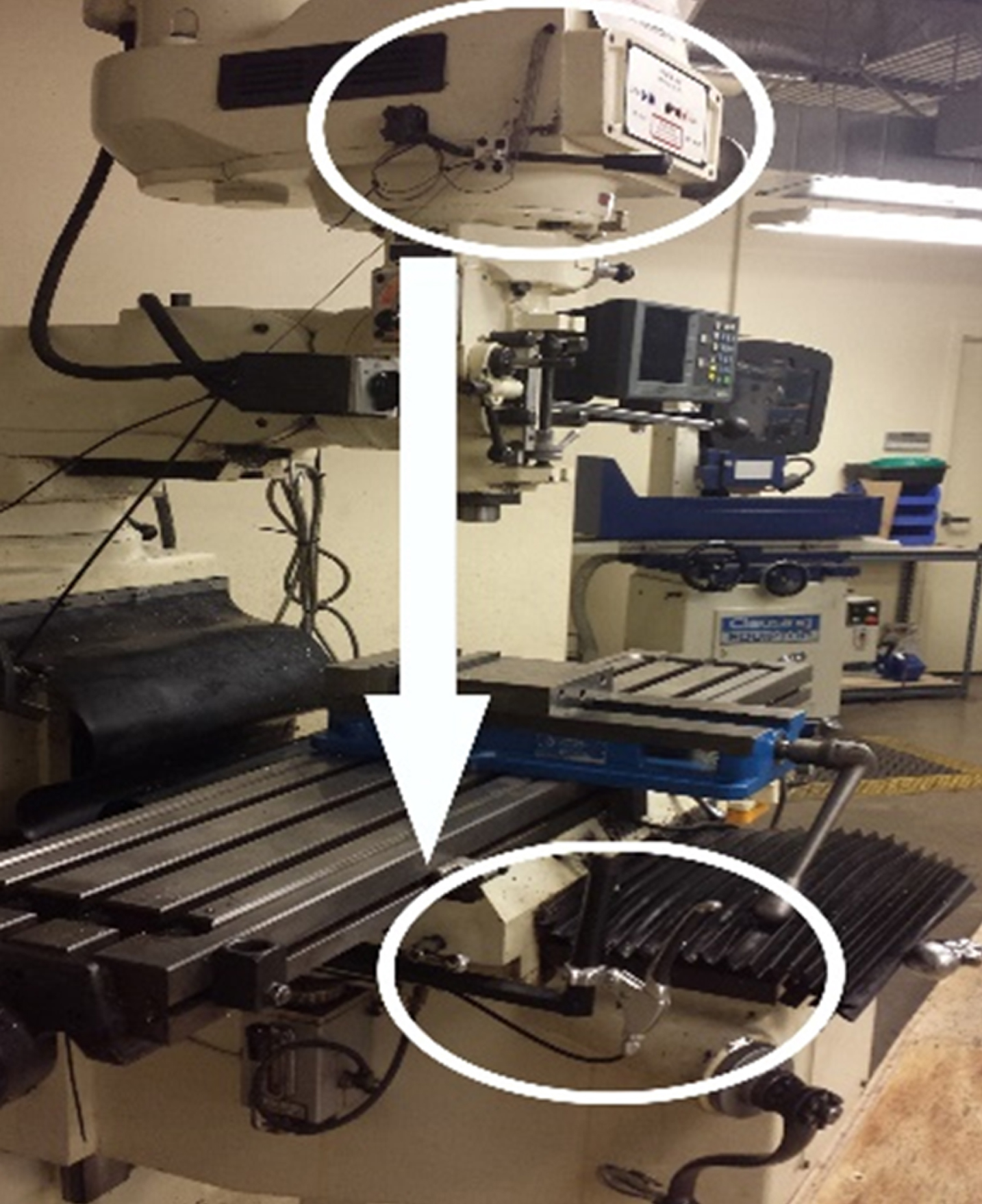
Brake Modification.
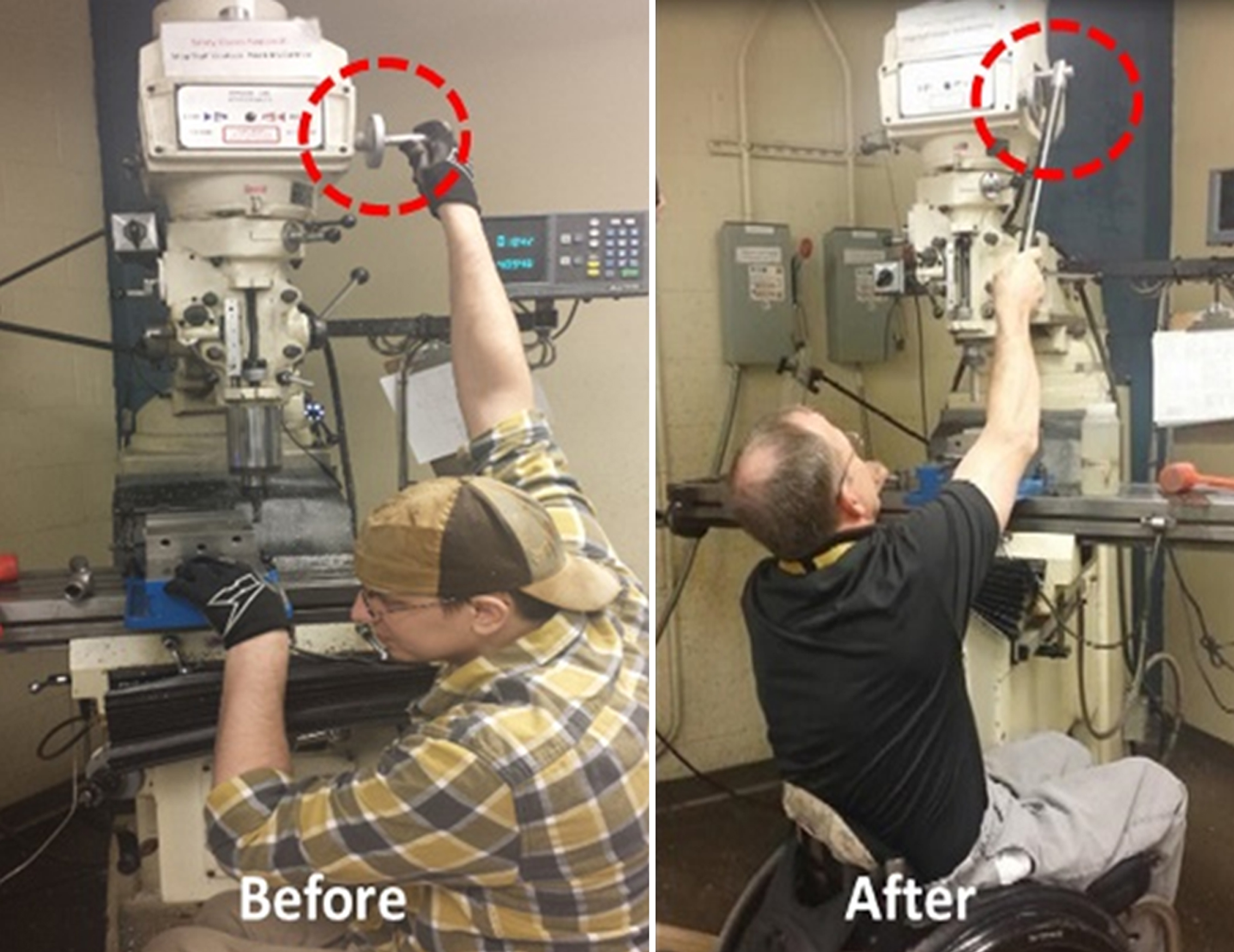
Multi-Purpose Tool.
A digital read out (DRO) is a numeric display with an integrated keyboard used to track machine axes, using these measures to keep track of and display to the operator the workpiece or tool position. DROs are designed for people who can operate machinery while standing. Adding a height adjustable mount to the DRO allowed all users to operate the machinery unimpeded. The custom mount provides for 15.24 cm (6 in) of adjustment for the DRO.
Another challenge identified was the ability to view whether the tool is in contact with the workpiece while machining. This is very important during machining in order to maintain safety, to control the cutting operation, and to ensure a quality component. Most machining equipment is designed to be used with the operator looking down onto the workpiece or part which is secured by a fixture, clamp or vise. This makes it difficult for anyone in a seated position to view the workpiece and tool from multiple angles and positions. Therefore, a camera system was devised to allow wheelchair users to easily see the tool and workpiece from multiple angles. Small off-the-shelf cameras were mounted on the machines to allow for viewing of the tooling and workpiece from multiple angles (X, Y, and Z axes). The cameras were placed to capture views difficult for the wheelchair users to achieve, and the images were livestreamed to a tablet or monitor screen (Fig. 4), allowing for remote, real-time viewing of the working surface.

Cameras and Remote Viewing.
During the task observation analysis, participants were asked to perform a drilling task and operate the mill - first without the use of assistive technology, and then again while using assistive technology devices. Participants were then asked to discuss their experience and complete a task observation analysis tool and technology evaluation form (appendices A and B). The task operation analysis graded each specific task for loading and unloading material onto the mill, scaled from “Not Possible” to “Easy.” The placement of machine components was also assessed on a scale from “Too High,” “Just Right,” and “Too Low.” These analyses were used to find a relationship in the placement of fixtures and controls before and after modifications were made. The technology evaluation form rated users’ experiences with each specific assistive device, scaled from scores 1–5: from “Not Satisfied at All” to “Very Satisfied.” Scores of each category were then averaged to give an overall level of complete satisfaction of the user (Table 2).
Technology Evaluation Satisfaction
The Institute for Accessible Science (IAS) has investigated the lack of accessibility for students with physical disabilities in biomedical and chemistry laboratories [7], using an accessibility-driven renovation of a laboratory space at Purdue University now known as the Accessible Biomedical Immersion Laboratory (ABIL). A 3D ABIL simulation was also developed to provide persons with physical disabilities a training facility for practicing lab techniques and to serve as an example for studying laboratory accessibility and ergonomics. The simulation is free and available online for other laboratories to adapt.
A study of science faculty, teachers of visually impaired students, students with visual impairments, and the students’ parents or legal guardians showed that these key stakeholders could draw on their strengths and expertise by working together to develop an effective implementation plan for students with visual impairments [9]. Including these stakeholders and making hands-on STEM learning accessible could improve the inclusion of students who are blind or have low vision.
Ergonomics play an important role in determining workstation space and layout decisions [10]. However, there is a lack of ergonomic analysis in machining environments relevant to wheelchair users. While reasonable accommodations for access for PwD is mandated, functional access to workspaces may be achievable for all intended users through universal design [11]. Worksite modification research at the University of Limerick identified that there are very few people with paraplegia working in engineering and technology environments. In addition, there was a scarcity of wheelchair users included in engineering education, training, or employment [9].
The use of assistive technology improved the ease of task operation and increased participation in machining that is included in both workplace and educational facilities. These findings suggest that the lack of assistive technology or environmental accessible accommodation does indeed play a role in keeping people with disabilities from attaining competitive employment and the inclusion in STEM fields. However, the main barriers are beliefs, perceptions, attitudes and economic factors. Changing the status quo and mentality of society is what will change the image of what it means to be disabled. The use of assistive technology within the workplace and educational institutions is extremely useful in enhancing an individual’s ability to perform.
Summary
Accessible machining has the potential to provide significant societal benefits by creating opportunities for full inclusion and participation in engineering and technical educational and workplace domains. There is substantial interest from industry to hire qualified PwD. The lack of accessible training programs and workplace facilities presents a hurdle for the employment of PwD in engineering and technical fields, but this technology evaluation identified simple accommodations that can be applied in a machine shop, modifications that support accessible machining for all.
Conflict of interest
None to report.
Footnotes
Appendix A: Task Operation Analysis Form
Participant Number: Height at Seated Position:
Type of Diagnosis/Injury:
Level of injury:
PWC or MWC:
Objective: During your Task Operation please check the level of effort that applied
Task Operation Analysis (Without AT)
Comments/Questions: What were some challenges? How did it affect your experience?
What could have been done to help solve your challenges?
Task Operation Analysis (With AT)
Comments/Questions: What were some challenges? How did it affect your experience?
What device helped and on what tasks? Why/why not? How?
If AT is offered, would you want to use the mill and or work in a manufacturing field? If so, why?
Appendix B: Technology Evaluation Form Participant Number:
Please complete the template with the piece of technology/device you used in as much detail as possible. We understand that not every field will be filled out, but please do your best.
Insert overview of specific product as well as how it is applicable to end-user
AT Satisfaction table
1
2
3
4
5
Not satisfied at all
Not very satisfied
More or less satisfied
Quite satisfied
Very satisfied
Affordability
Compatibility
Dependability
Durability
Ease of Assembly
Ease of Maintenance
Effectiveness
Flexibility
Learnability
Operability
Personal acceptability
Physical Comfort
Portability
Securability
Acknowledgments
The National Science Foundation (4201 Wilson Boulevard, Arlington, VA 22230, USA) Award #1406757, the U.S. Department of Veterans Affairs (810 Vermont Avenue, NW Washington, DC 20420, USA) Award #B9250-C, and the Mitsubishi Electric America Foundation (1300 Wilson Blvd., Suite 210, Arlington, VA 22209, USA) funded this project. We are grateful for those who contributed in this technology evaluation, the AIM program, and the staff at HERL for supporting this project. The contents of this paper do not represent the views of the Department of Veterans Affairs or the United States Government.