



Abstract
BACKGROUND:
Persons with disabilities face many obstacles in their attempts at social integration, particularly in the labor market.
OBJECTIVE:
The study investigates patterns of transition among different employment situations by persons with disabilities relative to persons without disabilities. It also studies employment transitions among individuals who hold part-time jobs in relation with their long-term level of physical disability.
METHODS:
Probability models that explain transitions in employment status among persons aged 25–54 in dependence of possible changes over time in the severity of their disability.
RESULTS:
Patterns of disability do not persist over time. Improvement of disability does not increase the share of persons employed in both investigation periods as well as the share of those not employed at both times. Unexpectedly, few people who are not employed and whose disabilities improve manage to join the labor market when their disabilities improve. Also, few who are employed part-time and whose disabilities improve managed to switch to larger posts when their disabilities improve.
CONCLUSIONS:
The labor market imposes scars on people with disability whose condition improves somewhat, hindering their chances of re-integration into the workforce. To assure them a regular income and employment rehabilitation, public-policy programs should be expanded.
Introduction
Persons with disabilities face many obstacles in their attempts at social integration. This is particularly so in the labor market, where the extent and patterns of their participation directly and indirectly affect the conditions and quality of their lives [1, 2]. Disabilities and morbidity inflict high costs on society, foremost for the payment of disability benefits. On average, the OECD countries expend 1.2 percent of GNP on such benefits, 2.5 times more in proportional terms than their outlays on unemployment compensation. Benefactees rates are high because many people enter the benefit system and few leave it [3].
Recent years have seen a lively debate over the nexus of employment and disability, with governments, policymakers, public and private institutions, researchers, and others devoting much attention to the topic [4–6]. Although statutes and regulations exist that are meant to prevent discrimination in employment against persons with disabilities, employment rates remain lower among members of this group than among persons free of disabilities [7].
The proportion of persons with disabilities in a population rises steeply with age. The upturn reflects the strong tendency of chronic health problems and disabilities to present and accumulate in the course of the life cycle, in contrast the minuscule share of disabilities that are congenital and discovered at birth [8]. This trend recurs consistently among persons with one disability and for each disability separately [9].
In most developed countries, a significant disparity persists in the employment rate of working-age persons with disabilities relative to that among persons without disabilities in the same age bracket. The employment rate is lower in many of those countries among persons with a severe disability than among the disability-free (see, for example: [10]). This situation leaves many such individuals dependent on disability benefits for their livelihood and below, or close to, the poverty line. It also excludes them from active and productive participation in society and in the social discourse. Furthermore, many of those who do work are underemployed relative to their abilities and the extent and types of the work that they do.
Persons with disabilities are overrepresented in positions that require scanty skills and education relative to the rest of the population [11]. The probability of part-time employment is higher among them than among others [12]. They are relegated to the secondary job market, hold part-time jobs, and earn paltry wages—even if one takes into account the low production capacity that some of them exhibit [13]. Some persons with disabilities find it physically difficult to work more hours than they do and, therefore, cannot “keep up” with persons without disabilities in this respect. The average difference in work hours alone, however, does not explain the wide wage disparity between persons with disabilities and others. This gap apparently attests, among other things, to discrimination against persons with disabilities on the job [14]. Consequently, they are at greater risk than persons without disabilities of having income below the poverty line [15–17]. This loss of income is not manifested only at the individual level; it appears at the household level as well [18].
The current study concerns itself with employment patterns among persons aged 25–54, the age cohort in which most activity in the labor market takes place. On the basis of data with which the disability characteristics and patterns of labor-market integration can be surveilled longitudinally, two main goals are set forth. First, the study will investigate and explain the patterns of transition between states of employment among members of this group, as they relate to a range of personal indicators and degrees of physical disability. According to [19], part-time employment allows persons with disabilities to combine work with the need to cope with health-related disorders that make it difficult for them hold a conventional full-time job. It should be borne in mind, however, that an individual’s level of health-related disability may change over time, for better or worse. Accordingly, the second goal of the study is to investigate the probability of transitions by individuals who work part-time, in relation to their long-term level of physical disability. The relevant research question here is: Can people who hold a part-time job at a particular point in time re-pattern their employment as a dependency of their degree of physical disability at some other given time?
The rest of this paper is organized as follows: The methodology—research population, databases, research variables, and econometric strategy—is described in the next section. Descriptive statistics on patterns of transition between states of employment are given right after. Following these are main findings from the estimation of probability models. The work concludes with a discussion of the main implications of the findings.
Methodology
For the purposes of the study, a unique information base focusing on 2002–2009 period was constructed. The analysis is performed on a surveillance population that was interviewed in the 2002–2005 Social Survey (hereinafter: “the first investigation period” or “Period 1”) and re-interviewed in the latest population census, conducted in 2008–2009 by the Israel Central Bureau of Statistics (hereinafter: “the second investigation period” or “Period 2”). With these data, it is possible to surveil transitions between states of employment in connection with a range of personal characteristics of the research population. These transitions are also analyzed against the background of economic conditions and institutional factors associated with the labor market and social-insurance systems, even though the models presented in this study do not research these factors directly. The process that was used to build the database is presented in Fig. 1.
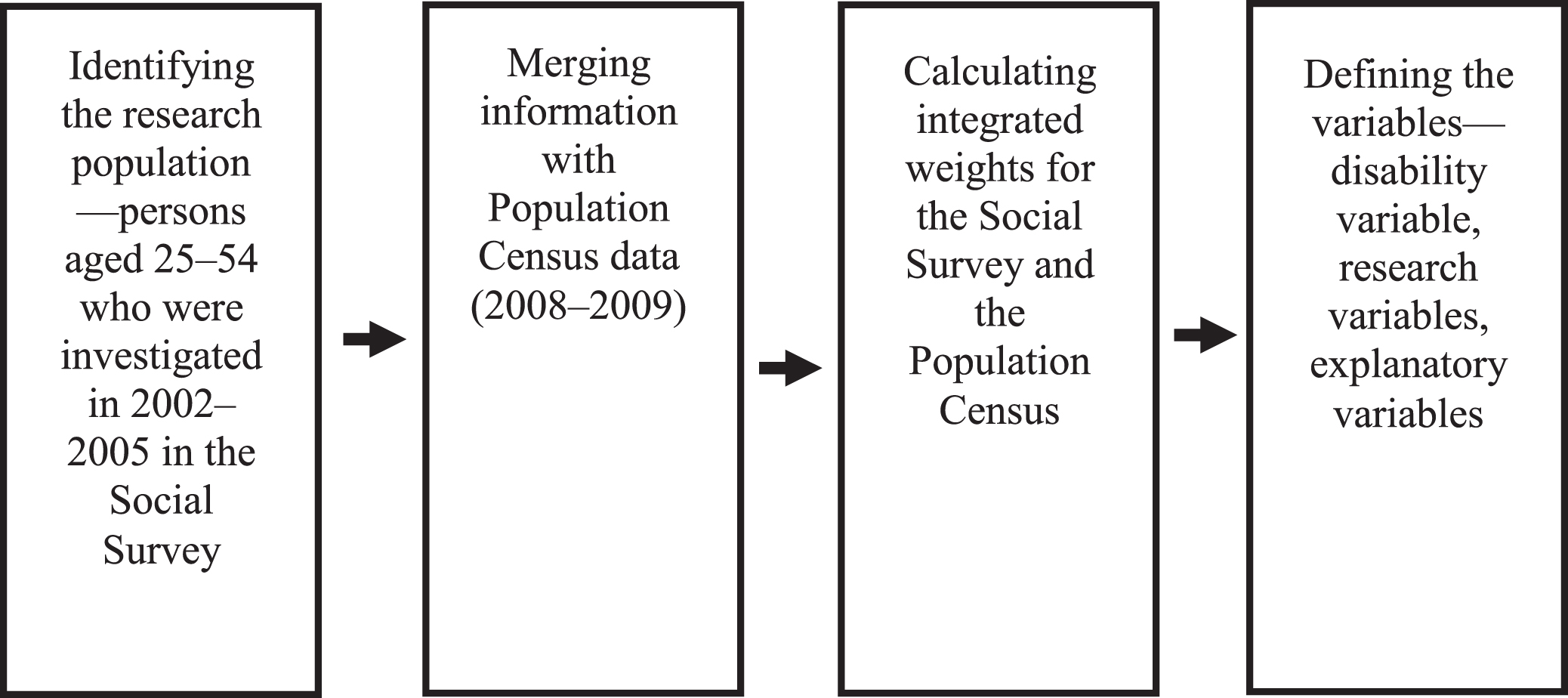
The process to build the database.
Thus, the study presents probability models that explain, by means of the personal indicators of a surveillance population—people who were interviewed in both investigation periods (a panel)—transitions in patterns and extent of employment during the interval between the two investigation periods. This technique made it possible to surveil the participants’ disability characteristics and integration into the labor market in both investigation periods. Importantly, the two investigations were performed on the sample independently, by means of different questionnaires and within the framework of different surveys. The parallelity of the data and the definition of the research variables are explained at length below in this section. The surveillance on which this study focuses is comprised of persons aged 25–54 who were interviewed in both periods—2,570 respondents distributed almost equally between the genders (1,249 male, 1,321 female).
The main reason for the construction of the database in this manner is that the participants in both sources of information were asked to assess their state of health in a way that allowed us to gauge their degree of disability in accordance with the conventional taxonomy. The Social Survey population is the permanent population of Israel aged twenty and above, including people who live in institutions (for other than caregiving needs, e.g., sheltered-housing programs for the elderly, immigrant-absorption centers, and student dormitories) and immigrants who have been in Israel for at least six months. The Population Census survey covers the population of Israel on the “determining date,” including anyone who was in the country at least one year on that date and excluding those who had been abroad for a year or more.
The study focuses on persons aged 25–54 in the first investigation period because most activity in the labor market takes place at these ages. Up to age 25, many Israelis perform supplemental military service or continue to acquire post-secondary or academic education, at which time only some work (the median age for the completion of a baccalaureate degree in Israel was 27.5 in 2016, see: [20]). [21] find that the employment rate of baccalaureate-degree candidates who began their degree studies in the late 1990 s rose during degree studies from 52 percent in Year 1 to 64 percent in Year 3. Once people cross into their mid-fifties, they embark on a process of disengagement from the labor market, either by full retirement or gradually, via “bridge jobs” [22].
One of the main problems in estimating degrees of disability and comparing them in different countries and different periods is that the concept of disability is inconsistent and vague [3]. In many overviews, disability is defined as individuals perceive it, specifically in the way they answer the question: “Do you have long-term health problems or a disability that interferes with your day-to-day activity?” The exact phrasing of this question, however, often varies from one overview to the next. For example, “long-term” is sometimes set at twelve months and sometimes as six [23]. The World Health Organization reflects this complexity by treating the concept of disability as an umbrella for disorders, functional disabilities, and impediments to participation [13].
The statistical information on disability gathered in the 2002–2005 Social Survey is based on individuals’ personal perception of their situation and, specifically, the way they respond to the existence of a health-related problem. Interviewees were asked whether they have “any health-related or physical problem” and were told that this means a chronic condition “that has existed for six months are more.” Those who answered in the affirmative were asked an additional question: “Does this problem interfere with day-to-day activities?” Four alternative answers were allowed: 1—interferes badly; 2—interferes; 3—not so much; and 4—not at all. Alternatively, the statistical information on health-related disability that was gleaned from the Population Census rested on a set of items relating to functional disorders and disabilities. Those interviewed were asked four questions about disability: “Do you have difficulties in hearing (even when you use a hearing aid)?” “Do you find it difficult to walk inside your house or to go up and down stairs?”; “Do you find it difficult to get dressed or to shower?”; and “Do you find it difficult to remember or to concentrate?” In addition, administrative information about vision difficulties was obtained. These five topics represent worlds of content that, together, test a person’s degree of disability in hearing, physical functioning, self-care, mental functioning, and visual functioning, respectively. As a possible response to each of these questions, four alternatives were offered: 1—no, no difficulty; 2—yes, some difficulty; 3—yes, severe difficulty; and 4—cannot at all.
Following the conventional definitions, those who responded “1—interferes badly” in the first investigation period were termed people with a “severe disability” whereas those responding “2—interferes” were defined as having “mild disability.” Those who chose the other options (even though they, too, reported a health-related problem that existed six months are more) and those who denied having any health-related or physical problem were classified as “without disability.” [14] shows that persons with disability who report that their disability bothers them not badly or not at all resemble persons without disability in their socio-demographic, educational, and occupational indicators. This is the rationale behind their exclusion from the population of persons with disabilities.
Following the World Health Organization taxonomy, participants in the census who answered one of the questions “3—yes, severe difficulty” or “4—cannot at all” were termed as people with “severe disability, whereas those answering “2—yes, somewhat difficult” as people with “mild disability.” All respondents who reported “no difficulty” in response to all four questions were classified as “persons without disabilities.” When asked about visual disability, respondents were allowed three alternatives: 1—No, no difficulty; 2—yes, severe difficulty; 4—cannot at all. The definitions presented above are valid for this disability as well.
Since the sources of information and types of investigation of the disability variable were different in each of the investigation periods, it was necessary to assure the avoidance of bias in the estimates obtained over time. Therefore, two stages of testing were performed. First, disability indices based on individuals’ personal perception of their situation were calculated on the basis of data from the Social Survey table generator and the research database for persons aged 25–54 in 2002–2009. This technique can confirm similarity in disability patterns between the research population in the current study and the population researched in the Social Survey in the same years (Fig. 2).
From year 2010 onward, the Social Survey questionnaire has also included a set of items on functional disorders and disabilities. The added items probe difficulty in walking or climbing stairs; difficulty in getting dressed or bathing; remembering or concentrating; seeing; and hearing. In terms of content, these items match those on functional disorders and disabilities that were asked in the Population Census, as described above. Accordingly, in the second stage we calculated disability indices on the basis of individuals’ personal perception of their situation, predicated on data from the Social Survey table generator; we then compared the outcomes with the disability indices derived from the set of questions concerning functional disorders and disabilities that was culled from the database of this study—all of which for persons aged 25–54 in 2010–2012. A significant correlation was found between the two data series over the years (Fig. 2). The correlation between the series of disability data based on the data file from the Social Survey table generator and the data file of this study is 0.962; that between the data series on severe disability derived from the Social Survey table generator and the data file of this study is 0.953. Consequently, the definition of disability based on individuals’ perception of their situation for the first investigation period, and that based on the umbrella of functional disorders and disabilities for the second investigation period, may be adopted.
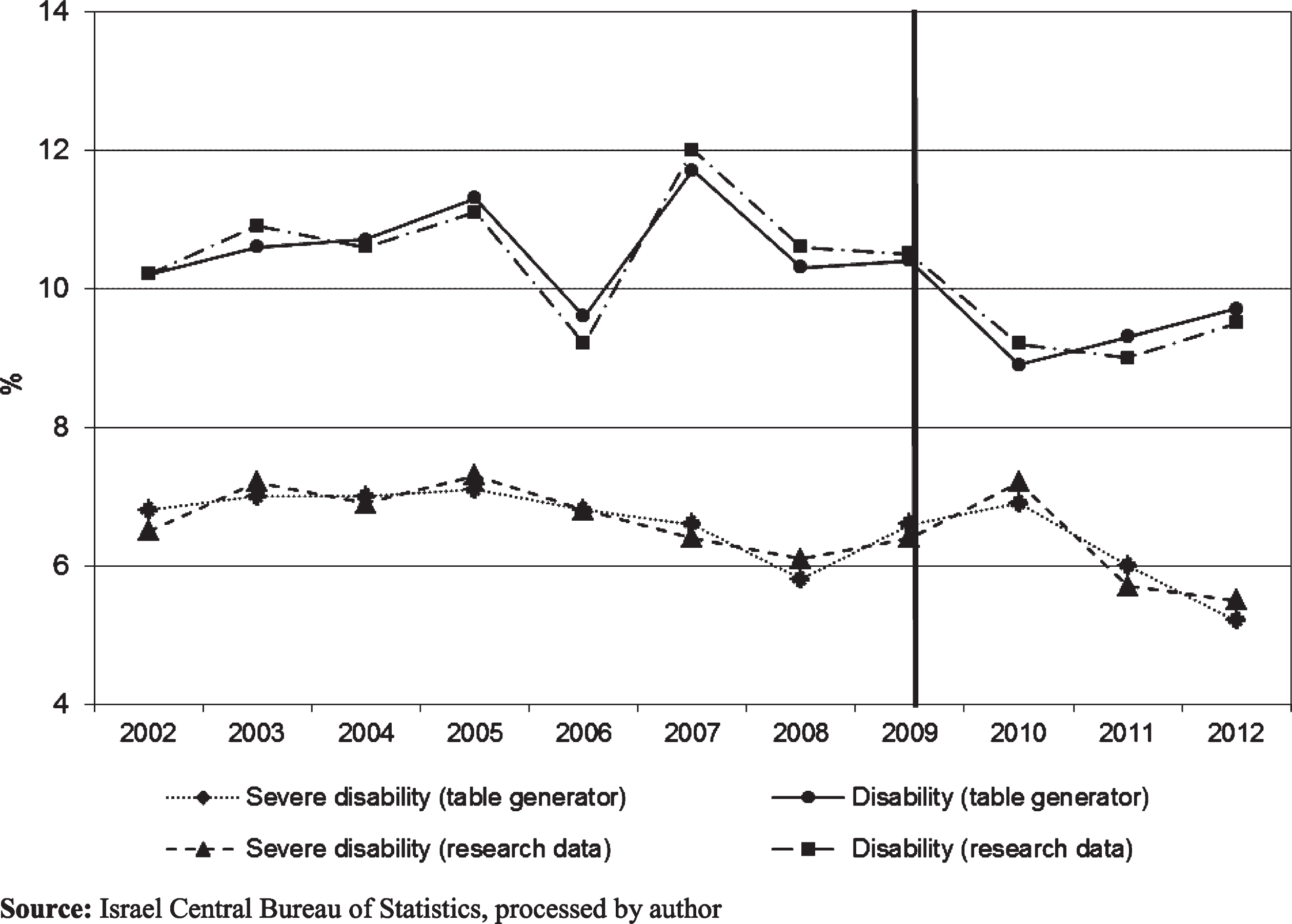
Distribution of Share of Persons with Disabilities and with Severe Disabilities aged 25–54, by Statistical Source of Information, 2002–2012. Source: Israel Central Bureau of Statistics, processed by author.
According to [24], when interviewees in the Population Census self-report, the rate of disabilities rises and approaches that reported in the Social Survey. Accordingly, the statistical analysis will focus on the 2,061 interviewees who responded directly to the disability items in the Population Census.
After the data from the first investigation period (the 2002–2005 Social Survey) were blended with those from the second period (the 2008–2009 Population Census), it was necessary to create integrated weights, on the basis of which a multivariate analysis would be performed. The point of reference in these weights is age in the census year (Investigation Period 2), a standard point of reference for each survey in Investigation Period 1 (2002–2005).
Research variables
For most seniors, labor-force participation is the key to finding one’s place in society. In this study, transitions in patterns and extents of employment among persons with disabilities are examined in reference to changes in individuals’ degree of disability over time. The respondents’ self-reportage on employment includes the following situations: employed in the labor force, unemployed in the labor force, and not in the labor force. Everyone who reported being employed in the labor force had to specify his or her weekly work week in hours (in all jobs held). This comprehensive information served as a basis for specifying the states and extents of employment in accordance with the accepted definitions. Thus, an employed person is one who reported having been employed in the labor force. An unemployed person is one reporting having been unemployed or not in the labor force. A part-time worker is one who worked fewer than thirty-five hours per week; a full-time worker is one whose work week was thirty-five hours or longer. These definitions were used to formulate the dependent variables in both types of models that were estimated in this study. In accordance with these variables, two types of transitions between states of employment were specified. The first relates to the entire research population and comprises the following: employed in both investigation periods; employed in Period 1 but not in Period 2; not employed in Period 1 but employed in Period 2; and not employed in both periods. The second focuses on part-time workers in Period 1 and includes the following transitions: remained part-time in Period 2; transitioned to full-time employment in Period 2; and ceased to be employed in Period 2.
Explanatory variables
Here, much as in other studies, a distinction was made among several groups of research variables that are gathered in Table 1. The first group includes personal characteristics of the individual; the second contains personal disability variables. The use of both of these disability variables allows us to cope with a possible endogeneity problem attending to the relation between a state of employment and a health-related disability. A detailed explanation of this matter is presented below in this section. The third group of variables captures information on household employment and income resources. Due to the unbalanced time interval between the investigation periods, the variable of time between the investigation periods is included within the models being estimated.
Explanatory variables(1)
Explanatory variables(1)
(1) All variables pertain to situation in Investigation Period 1 unless change between investigation periods is noted.
The statistical analyses in this study are two: an analysis of selected bivariate relations and a multivariate analysis via two multinomial models. A multinomial model is a regression model that includes a logistic element that allows for more than two discrete outcomes. Such a model is used to predict the probability of different outcomes in relation to the distribution of a categorical dependent variable [25].
Model A focuses on the probability of employment transitions among persons who were aged 25–54 in Investigation Period 1. The dependent variable is defined by four categories: employed in Period 1 and employed in Period 2; employed in Period 1 but not employed in Period 2; not employed in Period 1 but employed in Period 2; and not employed in both periods. The baseline group is the last-mentioned. Model B centers on the probability of transitions among individuals who worked part-time in Investigation Period 1: continuing to work part-time in Period 2, switching to full-time employment in Period 2, or ceasing to be employed in Period 2. This approach was used by other transitions studies [26–30].
The sets of explanatory variables in the respective models are not totally identical, each model gives representation to the group of socio-demographic variables, personal disability, and household employment and income resources. For each of the models, estimates of regression coefficients and average marginal effects are presented. Apart from the fact that economic research traditionally emphasizes the marginal effects of explanatory variables on the behavior being researched, such effects have the advantage of allowing comparison of their absolute magnitude for the same variables among the employment situations that appear in the multinomial models used in this study.
Statistical coping with the relation between state of employment and health-related disability
The relation between state of employment and health-related disability may be endogenous due to a direct effect of disability on the state of employment and vice versa. In addition, a bias may be introduced by the disregard of traits that affect both disability and state of employment, e.g., the individual’s time preferences and previous investments in human capital and health capital [31]. By using panel data, it becomes possible to hold the effect of individual-specific variables constant over time.
Current employment may be affected by previous employment patterns; namely, people who were unemployed in the past tend to be less employed in the present. This tendency is expected to hold true for all people, disabled or not. Accordingly, the use of this variable to explain the effect of disability on state of employment may result in misinterpretation.
Disability may lower the probability of prior employment; for this reason, it may indirectly affect current employment. Consequently, the use of panel data may cope with the endogeneity problem and allow us to estimate the relation between a state of disability and a state of employment. To solve this problem, we analyze the system of dynamic relations between state of health-related disability and state of employment on the basis of primary information concerning state of health-related disability and change in state of disability between the two investigation periods. [32] presents a dynamic estimation of the effect of disability on labor-force participation in Ireland in 1995–2000. For a similar analysis, see [33]. Importantly, however, the effects that were found attest not to a causal relation but to a statistical one. Furthermore, the use of information about the situation in Period 1 solves the endogeneity problem only in part because this situation may itself be a consequence of characteristics associated with employment at a time preceding Period 1 (i.e., weak exogenous information).
Patterns of transition between states of employment
Table 2 presents the matrix of disability transitions among members of the panel population who were aged 25–54 in the first investigation period. Most of those who had no disability in Period 1 remained disability-free in Period 2 (86.6 percent), 7.8 percent incurred mild disability, and the others sustained severe disability. Among those with mild disability, 32.8 percent retained this degree of disability in Period 2, 43.2 percent became persons without disability, and the others reported a worsening of their health-related disability. Among those with severe disability in Period 1, 35.6 percent remained such in Period 2; the others reported an improvement in their disability during the interim—34.9 percent to mild disability and the others to no disability. The findings show that among those aged 25–54 in Period 1, there is no evidence that a given state of disability in Period 1 assures the existence of this situation later on.
Matrix of Transitions among Degrees of Disability, Persons Aged 25–54 (First Investigation Period), Surveillance Population (pct.)(1) , (2)
Matrix of Transitions among Degrees of Disability, Persons Aged 25–54 (First Investigation Period), Surveillance Population (pct.)(1) , (2)
Notes: (1) Weighting is based on integrated weights. (2) The numbers in parentheses denote the number of observations in the sample.
Table 3 presents the health indicators of each of the four employment-transition groups. The bivariate analysis indeed shows significant relations between all personal health indicators in both investigation periods and membership in one of the state-of-employment groups. As expected, the share of persons employed in both investigation periods is negatively dependent on the degree of disability in Period 1, whereas the proportion of persons unemployed in both investigation periods is positively dependent on degree of disability in Period 1. The share of persons employed in Period 1 and not employed in Period 2 is positively dependent on the degree of disability in Period 1, whereas that of persons unemployed in Period 1 and employed in Period 1 is negatively dependent on the degree of disability in Period 1.
Employment Transitions by Degrees of Disability, Persons Aged 25–54 in Investigation Period 1 (pct.)(1)
*, **, and *** denote significance at 10%, 5%, and 1% levels, respectively. (1) Weighting is based on integrated weights.
Worsening of disability lowered the proportion of respondents who were employed in both investigation periods and raised that of those employed in Period 1 and not employed in Period 2. Worsening of disability also reduced the proportion of those who were not employed in Period 1 and employed in Period 2 and raised the rate of those unemployed in both periods—all of which as a direct function of the extent of inter-period change in degree of disability. Alternately, improvement of disability did not increase the rate of persons employed in both periods and of those unemployed in both periods. Unexpectedly, the share of persons unemployed in Period 1 and employed in Period 2 remained basically unchanged. Namely, few people who were not employed and whose disabilities improved managed to join the labor market when their disabilities improved.
Table 4 presents the respondents’ health indicators for each of the three specified employment-transition groups among those who worked part-time in Period 1. This may help to attain the second goal of the study, as described at length above. The bivariate analysis shows significant relations between all personal health indicators in both investigation periods and membership in one of the three state-of-employment groups: remained part-time, switched to full-time, and ceased to be employed. The share of those who continued to work part-time and who switched to full-time work is negatively dependent on the degree of disability in Period 1. Alternatively, the rate of people employed part-time in Period 1 and unemployed in Period 2 is positively dependent on the degree of disability in Period 1.
Transitions from Part-Time Employment to Full-Time Employment/Cessation of Employment by Degres of Disability, Persons Aged 25–54 in Investigation Period 1 (pct.)(1)
*, **, and *** denote significance at 10%, 5%, and 1% levels, respectively. (1) Weighting is based on integrated weights.
Worsening of disability lowered the shares of those working part-time and those working full-time in both investigation periods. The rate of part-time workers who ceased to be employed in Period 2, in contrast, was positively dependent on worsening of disability. Unexpectedly, improvement in disability had no significant downward effect on the proportion of part-time workers and no significant upward effect on the share of persons switching to full-time employment. Namely, few people who worked part-time and saw an improvement in their disabilities managed to switch to larger posts when their disabilities improved.
Employment transition results
Table 5 presents household socio-demographic characteristics and employment and income resources in relation to each of the four employment-transition groups. The bivariate analysis reveals significant relations among all personal and household characteristics. Significant differences are found among the four research groups in regard to the both socio-demographic indicators (e.g., age, gender, nationality, education, having a spouse, and household size) and the economic indicators (e.g., home ownership and total household income).
Employment Transitions among Persons Aged 25–54 in Investigation Period 1 (pct.)(1)
Employment Transitions among Persons Aged 25–54 in Investigation Period 1 (pct.)(1)
*, **, and *** denote significance at 10%, 5%, and 1% levels, respectively. (1) Weighting is based on integrated weights.
Table 6 presents the estimates of the coefficients of the multinomial logistic regression for analysis of employment transitions and marginal effects, with persons employed in both investigation periods as the baseline group. First we relate to the two groups that started out from weak position in the sense of not having been employed in Period 1—one remaining outside the labor cycle in Period 2 (the “weakest” group) and the other joining it in Period 2. Afterwards, the findings pertaining to the group that was employed in Period 1 but ceased to be employed in Period 2 are discussed.
Multinomial Logistic Model for Employment Transitions among Persons Aged 25–54 in Investigation Period 1 (Baseline Group: Employed in Period 1, Employed in Period 2)
*, **, and *** denote significance at 10%, 5%, and 1% levels, respectively.
The results of the estimation of the marginal effects (the right-hand column) show, as expected, that the probability of not being employed in both investigation periods rises with age. Each additional year of life raises the likelihood of remaining unemployed (relative to being employed in both investigation periods) by 1.7 percentage point. Furthermore, men tend less than women (by 11.3 percentage points) to stay outside the labor cycle in Period 2 as well.
The probability of remaining unemployed declines with increase in household size and is negatively correlated with education (persons with secondary education are 7.2 percentage points less inclined than those with primary schooling to remain unemployed; those with academic education are 8.0 percentage points less inclined than those with primary schooling), nationality (Jews are 9.3 percentage points less likely), and duration in Israel (nonimmigrants are 3.6 percentage point less inclined than those who immigrated to Israel from 1989 onward). As for the variables that signal an interaction between living with a spouse and spouse’s employment, it is found that those whose spouses are employed are more inclined (by 3.2 percentage points) to remain outside the labor cycle in both investigation periods than are those who have no spouse. In contrast, those whose spouses are not employed—due to disability or for some other reason—are less inclined to remain outside the labor cycle in both investigation periods (i.e., tend more to be employed in both periods) than those who have no spouse. These findings support the hypothesis that a spouse’s labor serves as an economic resource that facilitates unemployment. The effect of the variables of home ownership and total household income, indicative of the extent of the household’s economic strength, is found to be positive, meaning that they raise the probability of remaining outside the labor cycle.
The probability of not being employed in both investigation periods rises in relation to the degree of disability in Period 1. The model results concerning disability transitions between the investigation periods indicate that worsening of disability raises the probability of not being employed in both investigation periods (a marginal effect in the range of 2.1–4.7 percentage points). Improvement of the disability, in turn, lowers the probability of not being employed in both investigation periods, although the effect is significant only if the improvement is from severe disability to no disability. That is, maintaining the same degree of disability over time increases the probability of not being employed in both investigation periods (a marginal effect in the range of 4.0–7.7 percentage points). This finding lends further empirical corroboration to the results shown in Table 3.
Unemployed in Period 1 and Employed in Period 2 Relative to Those Employed in Both Periods
The marginal effects of the variables that explain joining the labor cycle in Period 2 are set forth in the third column from the right in Table 6. The effect of age on the probability of joining the labor cycle in Period 2 among those who were not employed in Period 1 is very small, negative, and significant at a 5 percent level.
Each year of age lowers the probability of joining the employed population (relative to being employed in both periods) by 1.2 percentage point. Furthermore, men are 1.7 percentage point less inclined than women to make this transition.
The probability of joining the labor cycle in Period 2 rises as household size increases, evidently due to the need to assure the economic wellbeing of all members of the household, and is positively correlated with level of education. (Those with secondary education are 2.4 percentage points more inclined to join, and those with academic education are 3.6 percent more inclined to join, than those with primary education.) The effect of nationality is positive (Jews are more likely to join the labor cycle) but smaller in size and statistically significant only marginally. Persons who live with an unemployed spouse are more inclined to join the labor cycle (a marginal effect of 4.1 percentage points if the spouse is unemployed due to disability and of 2.9 percentage points if it is for some other reason) but those who live with an employed spouse are 7.7 percentage points less inclined. These findings indicate that while living with a spouse motivates people to increase their income by working in order to meet the household’s needs, an employed spouse who brings in an assured income ab initio does not encourage work. The effect of the variables of home ownership and total household income, indicators of the household’s economic strength, proves to be negative, meaning that they reduce the probability of remaining outside the labor cycle (negative marginal effects of 1.5 and 2.3 percentage points, respectively).
The more disabled a person was in Period 1, the less likely it was that he or she would join the employed population in Period 2. The probability of joining was 4.2 percentage points lower among the mildly disabled, and 7.8 the percentage points lower among the severely disabled, than among those with no disability. The model results that relate to disability transitions between the investigation periods show, as expected, that an escalation in degree of disability lowers the probability of joining the labor cycle (a marginal effect within a range of 3.4–5.5 percentage points) and remaining at the same degree of disability over time has the same outcome (a negative marginal effect of 2.7–4.7 percentage points). Unexpectedly, however, an improvement in disability has no significant effect on the probability of joining the labor cycle (with the exception of transitioning from mild disability to no disability, which has a positive but marginal 0.7 percentage-point effect). In other words, few people who were not employed in Period and subsequently saw an improvement in their state of disability managed to join the labor market when their disabilities improved.
Persons Employed in Period 1 and Not Employed in Period 2 as Against Persons Employed in Both Periods
Observing the size of the marginal effects of the explanatory variables (third column from the left in Table 6), one sees, as expected, that the probability of leaving the labor cycle rises with age. Every year of age raises the probability of this outcome (as against a situation of being employed in both investigation periods) by 1.1 percentage point. Gender has a significant effect: men employed in Period 1 were 5.2 percentage points more inclined than women to quit the labor cycle.
The probability of leaving the labor cycle is negatively correlated with education (those with secondary education were 2.9 percentage points less inclined to do this, and those with academic education were 3.8 percentage points less inclined, than those with primary schooling), nationality (the likelihood of Jews quitting is 1.1 percentage point smaller), and duration in Israel (nonimmigrants are 3.1 percent less likely than recent immigrants, i.e., those who arrived in or after 1989). Among the composition-of-household variables, household size is positively correlated with the probability of employed persons leaving the labor cycle. Furthermore, in comparison with those who have no spouse, those who live with an employed spouse are more inclined to leave the labor cycle than to stay in it, whereas the marginal effect of living with a non-employed spouse is significant and negatively correlated with the chances of employed people leaving the labor cycle—whether their spouses are unemployed due to disability or for some other reason.
The effect of the home-ownership and total-household-income variables, indicative of the extent of the household’s economic strength, was found to be positive, meaning that they raise the likelihood of leaving the labor cycle (a negative marginal effect of 1.3 and 8.6 percentage points, respectively).
The more severe one’s state of disability was in Period 1, the more likely it was that one would leave the labor force: the probability of this outcome among those with mild disabilities and those with severe disability was 15.3 percentage points higher and 19.2 percentage points higher, respectively, than among those with no disability. The model results relating to disability transitions between the two investigation periods show that a worsening of disability raises the chances of leaving the labor force (a marginal effect of 4.8–16.6 percentage points); improvement in disability makes quitting the cycle less likely (a marginal effect of 4.9–8.0 percentage points), and staying at the same level of disability over time raises the chances of dropping out of the labor cycle only insofar as the degree of disability is severe.
Results Pertaining to Employment Transitions Among Part-Time Workers
Table 7 presents household socio-demographic characteristics and employment and income resources for each of the three groups that were specified on the basis of employment transitions among those who worked part-time in Investigation Period 1 (remained part-time, switched to full-time, and ceased to be employed). The bivariate analysis reveals significant relations between most characteristics and membership in one of these groups. One relation was not found to be significant: household size and membership in one of these groups.
Transitions from Part-Time Employment to Full-Time Employment/Cessation of Employment, Persons Aged 25–54 in Investigation Period 1 (pct.)(1)
Transitions from Part-Time Employment to Full-Time Employment/Cessation of Employment, Persons Aged 25–54 in Investigation Period 1 (pct.)(1)
*, **, and *** denote significance at 10%, 5%, and 1% levels, respectively. (1) Weighting is based on integrated weights.
Table 8 presents the results of the two multinomial logistic regression equations that predict the probability of switching to full-time work and of ceasing to be employed, both outcomes compared in both equations with those who worked part-time in both investigation periods. The results relate to estimates of the regression coefficients and the marginal effects of the explanatory variables.
Multinomial Logistic Model for Transitions from Part-Time Employment to Full-Time/Cessation of Employment among Persons Aged 25–54 in Investigation Period 1 (Baseline Group: Remained Part-Time)
*, **, and *** denote significance at 10%, 5%, and 1% levels, respectively. Note: (1) Two additional variables that were included in the model estimation used to investigate transitions from part-time empoymnent to full-time employment/cessation of employment are individual’s economic branch and occupation in Investigation Period 1.
The analysis shows that the chances of switching to full-time work in comparison with remaining part-time decline with age: each year of age lowers this probability by 5.6 percentage points. Men are more inclined than women to switch from part-time to full-time (with the same employer or with a different one) and less inclined to remain in their part-time jobs (Table 7).
The probability of switching to full-time work rises with the increase in household size and also correlates positively with education (those with secondary education are 4.7 percentage points more inclined to switch, and those with academic education are 7.4 percentage points more likely to do so, than those with primary schooling) and duration in Israel (nonimmigrants are 3.8 percentage points more likely than are persons who immigrated from 1989 onward). The probability of switching to a full-time post is 1.3 percentage point lower among wage-earners than among the self-employed, and duration in current part-time job lowers the probability of going full-time by 1.6 percentage point.
As for the variables that show the interaction between living with a spouse and spouse’s employment, it is found that those whose spouses are employed are 7.6 percentage points less inclined to switch to full-time work than those who do not have a spouse. Those whose spouses are not employed, in contrast—due to disability or for some other reason—are more inclined to go full-time than those who have no spouse. The effect of the home-ownership and total-household-income variables, indicative of the household’s economic strength, were found to be negative, meaning that they lower the probability of switching from part-time to full-time employment.
The more severe the disability in Period 1 was, the smaller the probability of going full-time. The likelihood of transitioning to full-time work was 9.7 percentage points lower among persons with mild disability, and 22.9 percentage points lower among those with severe disability, than among those free of disability. The results of the model that relate to disability transitions between the investigation periods show, as expected, that a worsening of disability lowers the probability of switching to full-time employment (a marginal effect of 1.6–6.7 percentage points). Staying at the same degree of disability over time reduces the likelihood of switching to full-time employment (a negative marginal effect of 1.4–2.8 percentage points). Unexpectedly, however, an improvement in disability has no significant effect on the likelihood of switching to full-time employment (except in the transition from mild disability to no disability, in which a positive but marginal 0.9 percentage-point effect was found). In other words, few people who worked part-time in Period 1 and saw an improvement in their disability managed to switch to larger posts when their disability improved.
Persons Employed Part-Time in Period 1 Who Ceased to be Employed in Period 2, Compared With Persons Employed Part-Time in Both Periods
The results of the model pertaining to the tendency of those working part-time in Period 1 to cease being employed in Period 2, compared with continuing to work part-time, show that the likelihood of leaving the labor force rises with age—by 5.2 percentage points per year. Men are less likely than women to leave the labor force altogether (a marginal effect of 5.0 percentage points). The probability of this outcome is negatively correlated with education (those with secondary education are 3.8 percentage points less likely to do this, and those with academic education are 1.4 percentage points less likely, than those with primary schooling) and nationality. (The probability is 6.5 percentage points lower among Jews than among others.)
As for the household-composition variables, a negative correlation was found between household size and the likelihood of part-time workers’ leaving the labor force, each increase in household size lowering the probability of transitioning to total cease of employment by 3.6 percentage points. Employees are 2.3 percentage points more likely than the self-employed to leave the labor force and duration in current job among part-time workers raises the probability of total cease of employment by 4.1 percentage points.
In comparison with those who have no spouse, those living with a non-employed spouse are more inclined to leave the labor force than to continue working, whereas the marginal effect of living with a non-employed spouse is significant and negatively correlated with the probability of part-time workers’ leaving the labor cycle—whether the spouse is unemployed due to disability or for some other reason.
The effect of the owned-housing and total-household-income variables, which are indicative of the household’s economic strength, were found to be positive, meaning that they raise the probability of switching to total cease of employment (marginal effects of -4.5 and -7.9 percentage points, respectively).
The more severe the degree of disability was in Investigation Period 1, the greater the probability of leaving the labor force. The probability of total cease of employment was 17.1 percentage points higher among persons with mild disability and 20.6 percentage points higher among the severely disabled than it was among those free of disability. The results of the model relating to disability transitions between the investigation periods show that a worsening of disability raises the probability of leaving the labor force a (marginal effect of 2.8–5.6 percentage points) and improvement of disability has no effect on the likelihood of cease of employment, although the effect is significant only if the improvement took place from severe disability to mild disability. Remaining at the same degree of disability over time does not affect the likelihood of a person’s leaving the labor force.
Discussion/Conclusions
Persons with disabilities face many obstacles in their attempt to integrate into society [34]. This is particularly the case in the labor market, where the extent and patterns of their participation have direct and indirect effects on the conditions and quality of their lives. The share of persons with disabilities in the population rises steeply with age. This tendency, which recurs in all countries, reflects the strong tendency of chronic health problems and disabilities to present and accumulate in the course of the life cycle, in contrast the minuscule share of disabilities that are congenital and discovered at birth.
The main goal of this study was to reveal and explain the employment transition patterns of persons with disabilities. Also investigated was the question of whether persons with disabilities who are employed part-time at a given point in time are more inclined than persons without disability to hold part-time jobs several years later. The findings show that the patterns of disability among persons aged 25–54 do not persist over time. By defining a panel population and surveilling the disability characteristics of those included in it over time, it is found that a considerable share of the population sees changes in its degree of disability—for better or worse—over the years. Participation in the labor force has a direct and indirect effect on individuals’ living conditions and quality of life. Accordingly, a change in state of disability may be positively dependent on the probability of such participation.
This study shows that the share of persons employed in the two investigation periods is negatively dependent on the degree of disability in Investigation Period 1, whereas the share of persons not employed in both investigation periods is positively dependent on the degree of disability in Period 1. The proportion of people employed in Period 1 who ceased to be employed in Period 2 is positively dependent on the degree of disability in Period 1, whereas the rate of people not employed in Period 1 and employed in Period 2 is negatively dependent on the degree of disability in Period 1.
Worsening of disability lowered the share of persons employed in both investigation periods and raised that of those employed in Period 1 and not employed in Period 2. Similarly, it reduced the share of people who were not employed in Period 1 and employed in Period 2 and raised that of people who held no job in either of the investigation periods—all of which as a direct function of the extent of change in disability in the interim. Improvement in disability, however, does not raise the share of persons employed in both periods and that of people not employed in either period. In other words, the labor market imposes scars on disabled people whose condition improves somewhat, hindering their chances of re-integration into the workforce. According to [35], the level of an individual’s past disability has a perceptible effect on the pattern of his or her labor-force participation in the present—an effect not significantly different in strength from the effect on the same behavior pattern that is attributable to his or her current degree of disability.
Consequently, policymakers should promote a policy of rehabilitation for persons with disabilities, whether these persons are employed or outside the labor force. This may, over time, improve their ability to join the labor force and remain in it in the long term and assure an adequate standard of living for themselves and their households. An optimal policy on rehabilitation and labor-force integration is one that brings to full fruition the individual’s personal traits, capabilities, and ability to participate actively in the labor force.
Unexpectedly, it is found that the percent of people not employed in Period 1 and employed in Period 2 is basically stable. In other words, few people who were not employed and saw an improvement in disability managed to find their place in the labor market once their disability eased. By extension, policymakers should do everything they can to make sure that persons with disabilities aged 25–54, irrespective of their degree of disability, will find their place in the labor force—be it in a post that suits their abilities or in some other position—in order to increase the likelihood of their long-term integration into the labor force as a positive function of the rehabilitation process and policy that seeks to alleviate their disability.
Sources [36] and [37] see part-time employment as a springboard to continued employment and a prime way of sustaining labor-market participation throughout the life cycle. Therefore, this kind of employment is a positive signal in the labor market, leading to the expectation that fewer persons with disabilities who work part-time will transition out of the labor market [38]. Several studies detect the positive correlation between disability and part-time work as a way of striking an appropriate balance between working life and health-related disability [19, 39–41].
A part-time job allows persons with disabilities to integrate work into the reality of a health-related disability that would make it difficult for them to hold a conventional full-time job. The current research found that a worsening of disability lowers the share of persons employed part-time and that of persons working full-time in both investigation periods. In contrast, the share of part-time workers who ceased to be employed in Period 2 is positively dependent on worsening of disability.
Source [42] shows that senior workers with disabilities are strongly inclined to continue working part-time even if their disability improves. This, [42] states, sends policymakers a signal about the need to assure more part-time employment opportunities for persons with disabilities as a substitute for their leaving the labor market. Unexpectedly, the current research found that an improvement in disability has no significant downward effect on the share of persons employed part-time and the labor market has no significant upward effect on the share of those who switch to full-time employment. In other words, few people who were employed part-time and whose disabilities improved managed to switch to larger posts when their disabilities improved. Those who remained at the same degree of disability showed a negative tendency to larger posts over time, as a direct function of their degree of disability. These trends concerning the inherent difficulties that people with disabilities face when their disabilities improve and they wish to join the labor force emphasize and amplify the need to deepen and expand public-policy and insurance programs in order to assure these people a regular income and employment rehabilitation.
Before concluding, we should relate to two limitations of the study at hand. First, as stated, the study is based on secondary sources of information that we use to examine the question of labor-force participation by persons with disabilities. This information cannot report what persons with disabilities feel about their attempts to participate in the labor force and the implications of their success or failure in doing so—their emotional states of mind, ways of life, and behavior patterns over time. The second limitation is the lack of information on the views of different classes of employers—their feelings about hiring persons with disabilities, their willingness to do so, and factors that inhibit or encourage them to do so. Future research that we intend to perform will invoke qualitative research tools and include interviews of persons with disabilities and various employers. This will broaden our knowledge about the integration of persons with disabilities into the labor force and fill gaps in our understanding of feelings that exist among persons with disabilities and among employers in this context.
Conflict of interest
The author declared no potential conflicts of interest with respect to the research, authorship, and/or publication of this article.
Ethics approval and consent to participate
Not applicable.
Funding
This research did not receive any specific grant from funding agencies in the public, commercial, or not-for-profit sectors.
Footnotes
Acknowledgments
I thank Dmitri Romanov for his counsel and insights in the course of the research. I am also indebted to the participants in the Fourth Annual Conference of ESPAnet and the Fifth Conference of the European Survey Research Association (ESRA), Ljubljana, Slovenia, 2013.