



Abstract
BACKGROUND:
In 1937, Ronald Coase published ‘The Nature of the Firm’ [1], addressing the question of why firms exist. He concluded that firms emerge to reduce costs of transactions. A ‘transaction’ is defined both as the action of conducting business, as well as an interaction between people.
OBJECTIVE:
Both senses of the term prompt the present social cybernetic analysis of the nature of the firm. Social cybernetics focuses upon the reciprocal feedback control and feedforward interactions between two or more individuals in a group or organizational setting, a process termed social tracking.
METHODS:
Social cybernetic principles can be used to understand how firms establish and maintain the high levels of transactional efficiency necessary to survive and remain competitive.
RESULTS:
Selected examples are introduced, and subjected to social cybernetic analysis, of the types of transactions that the manager of a firm is expected to engage in regularly and with a high degree of effectiveness.
CONCLUSIONS:
From the perspective of social cybernetics, the potential for continued market success of a firm is equated with the degree to which the fidelity of social tracking among transactional participants is developed, maintained and refined through organizational design and management.
Introduction
‘The Nature of the Firm,’ published by Coase in 1937 [1], offers an explanation of why firms exist. A firm in modern economic theory is an organization which transforms inputs into outputs [2, p. 5]. In his analysis, Coase addresses the question of why the economy features a number of business firms instead of consisting exclusively of a multitude of independent, self-employed people who contract with one another. His conclusion is that there are a number of transaction costs involved in using the market, such that the cost of obtaining a good or service via the market actually exceeds the price of the good. It is a host of other costs, including search and information costs, bargaining costs, keeping trade secrets, and policing and enforcement costs, that can all potentially add to the cost of procuring something from another party. This suggests that firms will arise in order to internalize the production of goods and services required to deliver a product, thereby reducing the costs of transactions tied to production [3].
A ‘transaction’ is defined both as the action of conducting business, as well as an interaction between people. Both senses of the term prompt the perspective provided in this report, which offers a social cybernetic interpretation of transactional exchanges that underlie the nature of the firm. The present focus is on firms in the U.S. — it is not assumed that the analysis necessarily applies to firms in other countries.
Social cybernetic analysis of transactional behavior
The most comprehensive behavioral theory of how people interact and exert control over themselves and the world around them is that of social cybernetics [4–6; 7, Chap. 8], focusing upon the reciprocal feedback and feedforward control interactions between two or more individuals in a group or organizational setting, a process termed social tracking. Social tracking is conceived as a dynamic linking of the social behavior of two or more people which is often goal-oriented as it usually is in the workplace. With social tracking relationships at the heart of transactions in the workplace, it is worthwhile to consider social cybernetic principles for insights regarding the determinants of transactional efficiency.
The cybernetic model of social behavior as a social tracking process is illustrated in Fig. 1. Social tracking is based on the specialized, coordinate motor behavioral and physiological responses which a given individual in a social group initiates in order to track and thereby control sensory feedback generated by the motor behavior of others in the group. Movements of one person generate sensory input to a second, who, in controlling this input as sensory feedback, generates input of a compliant sort back to the first person, and so on. During group social tracking, one individual generates sensory feedback which all other group members track in a compliant manner through their behavioral-physiological sensory feedback control mechanisms. In this manner, the group as a whole establishes a system of reciprocal social tracking relationships, in which the social partners become engaged in mutual exchange and control of sensory feedback to establish a yoked, behavioral-physiological, feedback-integrated system.
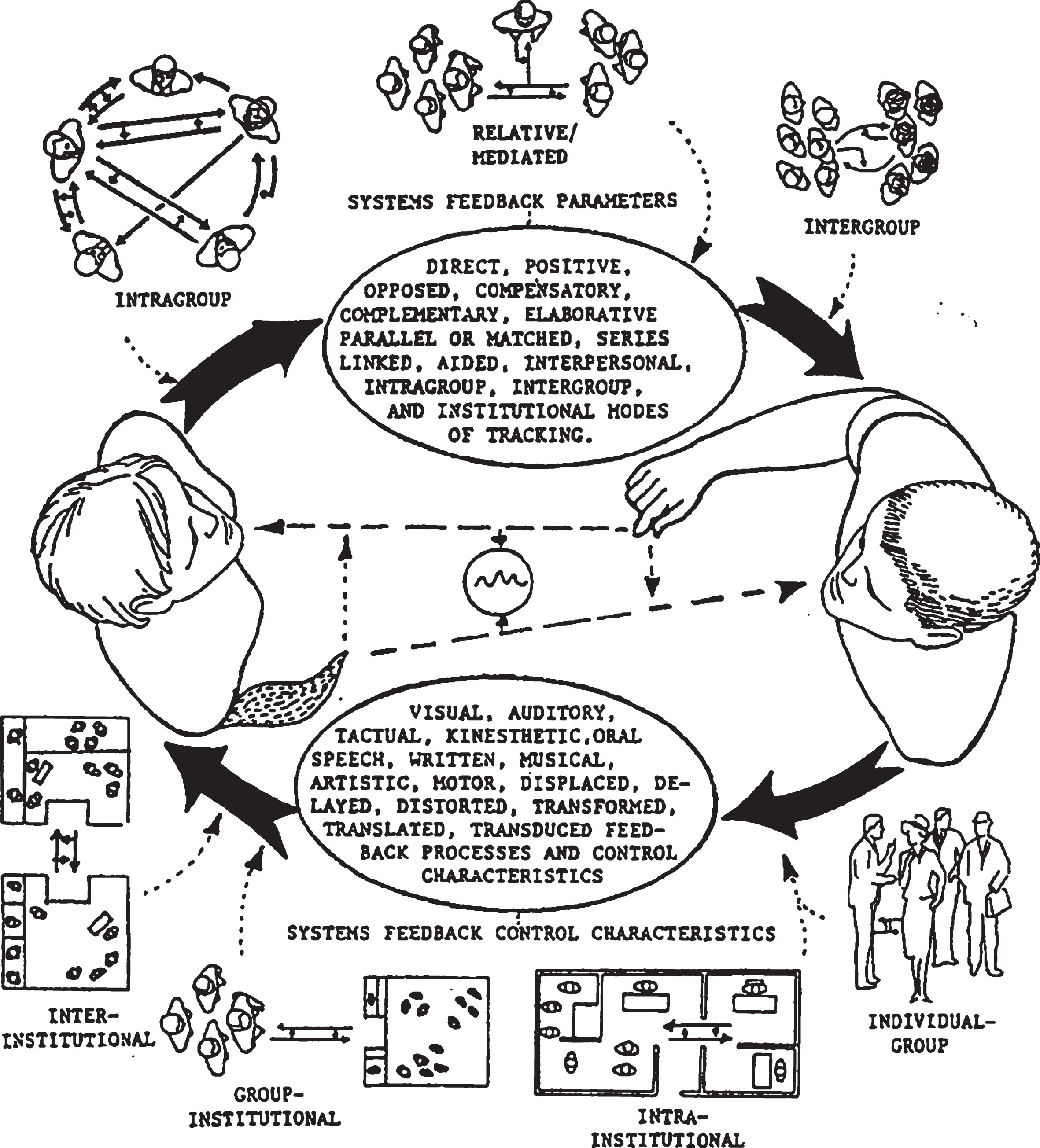
Social cybernetic model of social tracking.
As suggested by the feedback parameters and control characteristics depicted in Figure 1, social tracking typically involves many modes, variations, and conditions of mutual sensory feedback control. This social cybernetic model can be applied generally to interpret and analyze the systems properties of the entire spectrum of social behavior, encompassing work, verbal and nonverbal communication, language, predation, courtship and mating, artistic expression, parent-child bonding, education and training, and organizational and institutional behavior. It can involve parallel control (that is, symmetric or matched) or series-linked control (asymmetric and occurring in a serial manner via multiple people). It may involve positive, negative, compensatory, complementary, differential, integrative, and/or transformed types of social feedback control of activity by the interacting persons. All of these varied social tracking modes and conditions may also occur between groups, between a group and an individual, and between organized groups and institutions.
In comparison to social interaction between two individuals, group social tracking embodies more complex and ramified patterns and modes of sensory feedback control. Figure 1 illustrates several distinct types of group social tracking relationships, namely: (1) individual-group; (2) intergroup; (3) intragroup; (4) mediated group; (5) inter-institutional; (6) intra-institutional; and (7) group-institutional interactions. A general systems analysis of the human factors/ergonomic (HF/E) design of group and institutional organizations suggests that this limited number of social interactive groupings describes the large majority of social interactions in firms, as well as in society generally [4]. Indeed, Coase himself adopts a cybernetic perspective with his suggestion that economic systems are self-organizing [1, p. 387].
From the perspectives of social cybernetics therefore, the market success of a firm is dependent on the degree to which social tracking fidelity among transactional participants is developed, maintained and refined in the service of organizational development and management of the firm.
Social cybernetic principles can be used in three important ways to understand how firms establish and maintain the high levels of transactional efficiency necessary to survive and remain competitive in the face of changing economic, technological, demographic, cultural, and political environments. To begin with, application of social cybernetic principles can be used to rationalize why macro-ergonomic interventions are so important. For example, close examination of an existing transactional process may reveal that the feedback control behavior necessary to manage one aspect of a transaction has become burdensome due to delayed (non-compliant) feedback following a reorganization that has reduced transactional efficiency. Once feedback control aspects of this transaction are identified as problematic, new protocols and technologies can be considered for restoring prior levels of transactional efficiency or even surpassing them
Firms also need to act proactively to maintain and even improve transactional efficiency, offering distinct advantages over relying on compensatory approaches that would normally only occur following a degradation in transactional efficiency. For example, if management learns that new computer-mediated communication systems offer a means to boost transactional efficiency, adoption of these technologies is definitely worth considering. However, deliberating over which system is the best fit for the firm requires a means to predict whether a new communication system will function in the context of the firm and deliver on the promise of improved transactional efficiency. Such deliberation by management involves feedforward control of behavior that relies much more on existing social tracking relationships than is generally appreciated. As revealed in laboratory research on driving behavior, feedforward control actions in the form of proactive behaviors were found to be yoked to continuous steering behaviors [8]. Scaling up this relationship to an organizational level, a firm’s capacity to engage in proactive steering behaviors to benefit transactional efficiency will similarly depend on yoking these steering behaviors to the realities of ongoing social tracking relationships within the firm. Thus, a firm’s capacity via management to successfully engage in proactive steering behavior to benefit transactional efficiency does not magically emerge from a vacuum. It will depend on the degree to which the firm’s management is able to yoke these steering behaviors to existing social tracking relationships which form the backbone of all ongoing internal transactions among employees. Put another way, a firm’s capacity to capitalize on its internal strengths and engage in proactive steering behaviors will largely depend on management’s ability to leverage ongoing social tracking relationships within the firm.
As a case in point, a recent study in commercial aviation reported that the effectiveness of a multi-team system under simulated emergency conditions depended on team members functioning as boundary spanners who then communicated critical information between the teams [9]. When seeking a long-term solution to supporting these types of boundary-spanning transactions, an examination of the various modes of social tracking found that the existing communication protocols within teams would represent a good starting point. Any new communication protocols would need to consider the macro-ergonomic design factors necessary to support both feedback and feedforward control during social tracking, such as minimizing response delays in series-linked communications and supporting the parallel mode of social tracking during shared decision making.
Social cybernetic research on organizational learning conducted by Haims and Carayon [10] corroborates the importance of adopting macro-ergonomic designs that promote action-feedback relationships during social tracking, between individuals and teams and across all levels of a firm. Formation of these action-feedback relationships was found to be a prerequisite to organizational learning and development, and this therefore represents the third way that social cybernetic principles can be used to understand how a firm can both establish and maintain transactional efficiency over the long term in the face of changing environments. To this end, there is growing evidence in favor of implementing participatory programs that offer a structured process of employee engagement whereby employees at all levels of the firm are able to collaborate on intervention design efforts, and with line-level employees able to assume a central role in both initiating and steering the course of some organizational change efforts regarding safety and health initiatives [11]. The parallel mode of social tracking is at the heart of these participatory initiatives because it is integral to any shared decision-making process, and this explains why promoting yoked social tracking relationships in these initiatives can provide ancillary benefits beyond improved transactional efficiency, such as also improving the organizational health of the firm more generally [12].
Types of transactions involved in the management of a firm
This section introduces selected examples of the types of transactions that the manager of a firm is expected to engage in regularly and with a high degree of effectiveness. Coase’s postulate — that firms exist to reduce the cost of transactions — provides a rationale for this analysis. Before using social cybernetic principles to model a firm’s transactions, it is desirable to first understand the different types of transactions that we are talking about even though the analysis offered here cannot be considered definitive. Indeed, there is every reason to believe that, given the likelihood that the organizational design of each different firm is context specific (i.e., because it varies in relation to the social, cultural, economic, etc., environment in which the firm operates (7, Chap. 9)), the transactional environment of different firms is correspondingly highly context specific. Indeed, in his 1937 article, Coase notes that, “nothing could be more diverse than the actual transactions which take place in our modern world” [1, p. 396]. This analysis therefore focuses on transactions documented in the operations of a small firm and a large firm, on the assumption that at least some of the observed relationships may be found in other firms sharing similar organizational designs and contexts.
Small business transactions — Examples for one firm
To gain some insight into the nature of transactions and the concomitant social cybernetic challenges confronting a present-day small firm, in early November, 2017, Smith interviewed the owner of a small silicon rubber-molding company located in a suburb of the Twin Cities of Minneapolis and St. Paul in Minnesota. This small firm was selected for analysis on the assumption that the owner should be responsible for the entire range of transactions affecting company operations. At the time, the employee workforce comprised one product manager, three inspectors (including quality inspection), and 6–8 molders.
This focus on a small business is aligned with the original emphasis of Coase [1, p. 392], who notes that, “the operation of a market costs something, and by forming an organization (i.e., a firm) and allowing some authority (an “entrepreneur “) to direct the resources, certain marketing costs are saved. The entrepreneur has to carry out his function at less cost, taking into account the fact that he may get factors of production at a lower price than the market transactions which he supersedes.” It seems reasonable to assume that, with this thesis (the crux of his report), Coase is equating the idea of an entrepreneur with the organizer of a small, rather than a large, business.
Six types of owner-mediated transactions were identified with the interview, involving social interactions (SIs) by the owner with: 1) the 10–12 employees (18 face-to-face SIs/hour); 2) 100 customers (once/day to once/year SIs, mostly by phone); 3) 24 suppliers (12 SIs/week, by phone); 4) regulators (5 face-to-face SIs/year); 5) major equipment maintenance (1 face-to-face SIs/year); and 6) the landlord (1 face-to-face/month). Based on these results, a rough estimate in the range 150–175 SIs per 8-hour workday by the owner can be calculated, most involving face-to-face SIs with employees.
The social cybernetic model in Fig. 1 coupled with the above results underscore the considerable social behavioral skills required of the owner to engage in the transactions required for successful operation of the business. In particular, face-to-face transactions involve social tracking on the part of participants that requires control of both visual and auditory (speech) feedback, likely featuring both parallel and series-linked modes of social tracking either occurring alternately or in combination. Phone transactions involve asymmetric auditory social tracking because of required turn-taking. The social-behavioral skills necessary to successfully engage in these social tracking behaviors must be exercised multiple times per hour by the owner. As outlined in Section 2 above, the social behavioral demands of these transactions are amplified if the owner interacts with two or more respondents simultaneously. The social tracking demands on the owner remind us that social tracking is the most difficult type of behavioral skill to be mastered by the maturing individual. It is typically not fully refined until the late teen or early adulthood years, and for some individuals it is not ever effectively mastered [13, pp. 503-504].
The interview findings support the conclusion of Coase, noted above, that a firm consists of the system of relationships that comes into existence when the allocation of resources is dependent on an entrepreneur. Yet it is also clear that ”the system of relationships” in even a small firm can be highly complex, demanding refined social behavioral skills on the part of the participants in each transaction, a level of social tracking complexity that Coase’s broad analysis does not address. Moreover, it is clear that in the case of this small business, and possibly with many small businesses, the burden of managing transactional relationships falls primarily on the owner.
Modes of transactions in a large firm — One example
The question of why firms of various sizes exist represents a recurrent theme in the original 1937 report of Coase. His key conclusions [1, p. 396] are that an increase in the number of transactions as the size of a firm grows results in: 1) a drop in organizing costs; 2) a slower rate of increase in these costs with more transactions; 3) fewer mistakes by the entrepreneur, plus a smaller rate of increase in mistakes; and 4) a smaller rise in the supply price of factors of production. From these perspectives, we may expect both the magnitude and the modes of transactions to increase with larger relative to smaller firms, as this section documents with a few selected examples. One key consideration in this regard for large relative to small firms is that senior management of large firms may delegate responsibility for managing transactions to subordinate individuals in the firm.
Wells Fargo, one of the largest banks in the U.S., offers a prime example of the types of transactions involved with the management of a large firm. The context of this analysis is a notorious scandal that has engulfed the bank in recent years, involving [14]: 1) opening several million unauthorized retail customer accounts; 2) charging hundreds of thousands of customers for unauthorized protection insurance for their auto loans; and 3) firing thousands of employees for improper sales practices. As a result of these transgressions, the U.S. Federal Reserve Board imposed strong sanctions and, as well, identified a series of performance failures by the bank’s Board of Directors that needed to be redressed. Recommendations regarding the latter embody an ordered set of transactions involving various modes of social tracking: 1) communication of corporate values to all company employees; 2) auditing of system operations through SIs with relevant company personnel; 3) candid conversations among key personnel about integrity issues; 4) enterprise-wide review of risk analysis and mitigation policies and procedures; 5) SIs with employees, customers, and suppliers regarding company values and their application; 6) analysis of disputes and litigation confronting the company; 7) review of the impact of company culture and decision-making on operational performance; 8) in-depth analysis of the signals that the board conveys to company employees through its actions; 9) review of the nature and validity of performance reviews at all levels; and 10) promotion of a company culture of integrity and honesty. The common theme spanning all of these recommendations is that of feedforward control for continuous improvement. Presumably, some or all of these transactional strategies also may apply to other large firms.
Modes of transactions documented in sociotechnical experiments
Pasmore and colleagues [24] reviewed 134 studies of what they termed ‘sociotechnical experiments,’ reported in a series of publications spanning a 30-year period (1952–1982), most occurring in the nineteen seventies. Each study evaluated the sociotechnical features adopted by a particular organization selected for analysis. The sociotechnical systems perspective holds that organizations are made up of people that produce products or services using some technology, with system operation and effectiveness relying on the nature and quality of reciprocal interactions between these two system components [25].
The Pasmore et al. review focused on the degree to which an organization assessed by a given study had adopted one or more sociotechnical features in its design, management and/or operation. Results are summarized in Table 1.
The use and effectiveness of different organizational sociotechnical systems features, based on studies reviewed by Pasmore et al. [24]
The use and effectiveness of different organizational sociotechnical systems features, based on studies reviewed by Pasmore et al. [24]
The relevance of the summary in Table 1 for the present report is that 13 of the 18 features listed in the table rely on some sort of transaction, in the sense defined by Coase [1]. Moreover, six of the nine features with the highest reported percentages of use are based on a transaction, including the four features with highest percentages of use. These results suggest that sociotechnical system operations critically rely upon social transactional behaviors among participants within and outside of the system.
In the years since Coase published his seminal report [1], a number of new transactional challenges for firms have emerged that did not exist or were of minor importance 80 years ago. Selected examples include: 1) automation of work (based on computer-mediated transactions and applications of artificial intelligence) has been implicated both in improving or reducing productivity [18] as well as with the degradation of the quality of work [19]; 2) the internet enables computer-mediated transactions worldwide, yet because of cyberattacks (a malignant form of such transactions), Samuelson [20] ranks the internet as the greatest threat to the U.S. economy, and therefore the viability of U.S. firms; 3) one factor associated with the drop in U.S. productivity growth observed over the past decade is worker distraction attributable to interaction with social media, another popular mode of computer-mediated transaction [21]; 4) the 2010 Supreme Court’s Citizens United decision opened the gates for virtually unrestricted corporate political campaign giving, an heretofore entire ecosystem of firm transactions that has attracted both intense support as well as controversy [22]; 5) the need for organizations to assume a more active role in maintaining and promoting the health and wellbeing of their employees, both to attract and retain employees with the requisite skillsets as well as to better manage the cost of employee-subsidized health care; and 6) the most prominent example of a new challenge for firms is the emergence of a globalized economy, that for firms in most countries of the world (and certainly in all developed ones) requires understanding of state-dependent language, culture, regulation, and political differences for purposes of engaging in cross-border transactions, likely associated with increased cost per transaction compared to within-state transactions. New hierarchies of transactions are also emerging that undermine control by management over the transactions that conventionally have defined a firm. The associated sociotechnical systems challenges therefore define the role of macroergonomic interventions going forward.
Implications and conclusions
What does the foregoing analysis contribute to the original insights of Coase regarding the nature of the firm and its health and survival? One answer is suggested by Coase himself — as summarized above (Section 3.2), he notes that as the number of transactions increase as the size of a firm increases, both costs and entrepreneur errors tend to decrease. However, he also notes that, “as a firm gets larger ... the costs of organizing additional transactions within the firm may rise,” a relationship termed by economists, “diminishing returns to management” [1, pp. 394-395]. The interpretation of this pattern from a social cybernetic perspective is that social interactions during a given transaction impose inherently demanding behavioral control challenges (Fig. 1), especially if multi-person teams are involved (Section 2). However, the diminishing returns relationship suggests an amplification of difficulty in managing the behavioral demands of a growing number of complex behavioral transactions, thereby increasing the cost per transaction and reducing the economic viability of the firm.
This hypothesis underscores another putative insight of the analysis offered in this report, namely the need for further research to more carefully evaluate the behavioral parameters and dynamics of what is termed a “transaction” (a question not addressed by Coase). In terms of the cost per transaction: 1) Do different types of transactions exhibit different behavioral control demands? 2) Which modes of exchange of sensory feedback and of sensory feedback control are more effective for a given transaction? 3) To what extent do answers to these questions vary with multi-person versus two-person transactions? 4) How do possible behavioral differences in age, gender, religion, and cultural and political backgrounds influence the effectiveness of a given transaction? and 5) How can application of sociotechnical systems theory and macroergonomics principles contribute to the effectiveness of firms with the growing influence of information technology?
In other words, the social cybernetic perspective offered here opens an entirely new domain of analysis regarding the role and the costs of transactions in defining the nature of the firm, and a means of planning interventions to address emerging challenges. There are both scientific and practical considerations of this perspective that bear fundamentally on the nature of work. Our argument that the nature of the firm is mediated by transactional social behavior ties in with scientific evidence, dating back over a century that variability in behavior — both individual and group [7, Chaps. 1 and 9] — is highly context specific. The implication of this evidence is that the design and management of different firms also is highly context specific, a conclusion outlined in the first paragraph of Section 3. With his statement that, “nothing could be more diverse than the actual transactions which take place in our modern world,” Coase himself suggests the same idea [1, p. 396]. The lack of similarity in the different modes of transactions documented in the three subsections of Section 3, for different types of firms, provides further support for this conclusion.
Context specificity in the performance of firms also represents a practical challenge for those entrepreneurs and managers charged with guidance of their success and future trajectory. The nature of context specificity means that management success with each different firm is based on mastery of different patterns of transactional interactions, a reality that contradicts prevalent cookie cutter prescriptions for how to be a great manager.
A further implication pertains to demographic trends evident in the U.S. and other developed countries towards a more aging workforce. A related trend in these countries is a shrinking workforce and a scarcity of workers in a number of occupational sectors, prompting efforts among many firms to engage and satisfy workers. Two transactional strategies dependent upon social tracking between management and employees that are recommended to achieve the joint goals of increasing employee engagement and satisfaction are: 1) promoting a sense of shared leadership [15] and decision-making [16]; and 2) nurturing a company culture that fosters respect for employees [17].
Coase formulated his transactional model of the firm in the early twentieth century well before the adoption of workplace safety and health standards as we know them today, and so workplace initiatives to improve employee engagement and satisfaction would have occurred at the prerogative of an entrepreneur or senior management. Even today, it can be noted that most workplace health and wellness initiatives or programs are implemented in a top-down manner, with only limited shared decision-making on the part of the employees being impacted regarding initiative design or focus. In contrast, shared decision-making with employees at every phase of intervention planning and implementation, including initial issue prioritization and selection, is currently being tested as part of new programs for the promotion of worker health and wellbeing. A case in point is the Healthy Workplace Participatory Program developed by the Center for the Promotion of Health in the New England Workplace (CPH-NEW — https://www.uml.edu/Research/CPH-NEW/), a Center of Excellence (https://www.cdc.gov/niosh/twh/default.html) in the Total Worker Health® initiative led by the U.S. National Institute for Occupational Safety and Health (NIOSH). NIOSH defines Total Worker Health (TWH) as “policies, programs, and practices that integrate protection from work-related safety and health hazards with promotion of injury and illness prevention efforts to advance worker well-being” [26]. Researchers in CPH-NEW used participatory action research methodology to develop a set of tools for a TWH program that emphasizes employee participation [27, 28; https://www.uml.edu/Research/CPH-NEW/Healthy-Work-Participatory-Program/], with structured transactions that engage small teams of employees in the design of TWH interventions through a stepwise facilitated process [29, 30]. Employees on these teams are also charged with regularly seeking suggestions and other forms of input from their fellow employees in order to help guide ongoing intervention design efforts. Additional tools are available to help establish closed-loop serial-linked social tracking processes to support communicating back to employees who have offered suggestions about the progress of the team’s intervention design efforts. Thus, this program is designed to promote effective serial-linked social tracking among coworkers throughout the intervention design process, embracing a key transactional strategy for engaging all employees in a meaningful way in joint decision-making about the design of TWH interventions [31].
As worthwhile as engaging employee teams in the design of TWH interventions may be, such approaches should invite the same scrutiny placed on other internal transactions within a firm in order to avoid “diminishing returns to management” as noted above. Such scrutiny calls for new measures of teamwork transactions [28, 33]. One candidate measure is social physiological compliance (SPC), a phenomenon that is both an outcome and a determinant of effective social tracking behaviors [8]. SPC occurs because social behavior has reciprocal effects on the internal physiological states of the participants, which then have direct effects on their behavior going forward. As a process outcome, SPC is understood to reflect the extent of shared physiological changes that result when behaviors become socially integrated or yoked, something that would occur to various degrees whenever individuals engage in interdependent tasks. Social tracking behaviors reflect mutual control of behavior that can be distinguished from self-regulated behavior by individuals functioning in isolation. As an emergent systems phenomenon, high levels of SPC can be expected to place individuals in a better position to exert a high degree of mutual control over teamwork behaviors going forward; for example, making it easier to communicate or handle additional interdependent tasks. Effective forms of mutual control during teamwork would also depend on a combination of feedback control of behavior as well as feedforward control of behavior as team members both react together to address current task demands while also take proactive steps to jointly handle upcoming task demands. SPC based on heart rate variability, breathing rhythm, and electrodermal activity has been linked to various aspects of teamwork, including performance [34–36], stress resiliency [37], and cooperation [38]. A new measure of SPC being investigated is based on ventilatory drive [39]. Although studies with SPC measures have been limited to laboratory environments and task simulations, the increase in wearable technologies holds promise for future studies of SPC in field settings where the transactional dynamics among team members could be studied over longer periods in real work environments.
A final implication of the analysis in this report that merits emphasis pertains to macroergonomics, a core discipline of HF/E, originally termed organizational design and management [40–44]. These references support the customary view of macroergonomics — ‘concerned with improving productivity and the quality of work life by an integration of psychosocial, cultural, and technological factors with human-machine performance interface factors in the design of jobs, workstations, organizations, and related management systems’ [23]. Hendrick [40] lists a total of 30 criteria and measures of organizational effectiveness upon which such integration relies. Arguably, both the basic concerns of macroergonomics and the criteria identified by Hendrick rely upon the framework of transactions practiced by a given organization. Nevertheless, none of these reports cite the original work of Coase [1], and only Carayon and Smith [42] even mention the word ‘transaction.’ If the nature of the firm rests upon transactional behavior, and the effectiveness of organizational performance is related to a series of criteria also mediated by such behavior, then we conclude that macroergonomics needs to directly address the specific transactional underpinnings of the firm itself, including modes of social tracking along with their associated feedback and feedforward control relationships. The analysis in this report also brings a social behavioral perspective to the domain of market forces that — as Coase points out — have traditionally been assumed to represent the primary influence on the nature of the firm.
Conflict of interest
None to report.