



Abstract
BACKGROUND:
The workplace accommodation process is often affected by ineffective and inefficient communications and information exchanges among disabled employees and other stakeholders. Information systems (IS) can play a key role in facilitating a more effective and efficient accommodation process since IS has been shown to facilitate business processes and effect positive organizational changes.
OBJECTIVE:
Since there is little to no research that exists on IS use to facilitate the workplace accommodation process, this paper, as a critical first step, examines how IS have been used in the accommodation process.
METHODS:
Thirty-six interviews were conducted with disabled employees from various organizations. Open, axial, and selective coding were part of the analysis. Fuzzy set qualitative comparative analysis was used to identify different levels of IS use based on participants’ descriptions.
RESULTS:
An IS used in the workplace accommodation process consists of electronic request form, accommodation checklist, special budget, specific role, ancillary service, formal policy and procedure. There are different levels of IS use in the current accommodation process. The high-level IS use often results in a better accommodation performance than the low-level IS use, including high efficiency, high effectiveness, and low emotional tolls. Nevertheless, the high-level IS use often uses a specific, inflexible template as well as disregards human elements in the accommodation process.
CONCLUSION:
This work provides implications that future IS design should raise awareness of disability and accommodation, account for individual differences, involve multiple stakeholder inputs, as well as address the fundamental social issues in the accommodation process.
Keywords
Introduction
Around 15 percent of the world’s population, or roughly one billion people, live with a disability [1]. About 80 percent are of working age. A diverse and inclusive workforce, including people with varying abilities and talents, is critical in driving innovation and creativity through different ideas and perspectives [2, 3]. Studies have shown that employing disabled people 1 can lead to numerous organizational and societal benefits [4], including an increased bottom line [5], improved employee morale and commitment [6], decreased numbers of potential lawsuits [3], and improved social morality [6].
Disabled people, however, face enormous barriers to employment [1]. To illustrate the issues they encounter, imagine the following situation. Ms. G has a disability. She uses a power wheelchair and has restricted arm mobility. After struggling for several years after college to find a job, she is hired by a growing tech company. Ms. G applies for workplace accommodations once in her position. She discloses her disability and accommodation needs to the human resources (HR) department and her supervisor, Ms. K. She needs an accessible workstation and assistive technology for the computer equipment. However, she does not ask for a flexible work schedule, which would help her better manage pain associated with her disability, because she is concerned about increasing the work of her coworkers and damaging her work relationships with them. Ms. K receives the accommodations request and struggles with ways to process the request since she has no training in such matters. Ms. K is unfamiliar with accommodation options or how to address other accommodation related issues that may arise. In addition, HR often focus on limitations and are not familiar with job duties, thus they are unable to provide accurate and sufficient information about whether or not one’s ability fits for a job. Plus, there is no previously developed list of potentially suitable accommodations (i.e., similar accommodation solutions made in the past). Thus, Ms. K is limited in her ability to make good accommodation decisions to help Ms. G. Ms. K worries that even if she is able to get accommodations for Ms. G; they may not be the best ones. She does not control the flow of accommodation-related resources (e.g., accommodation budget) and cannot ensure activities are coordinated between departments (e.g., HR and finance department). After some delay, however, Ms. G finally receives her requested accommodations. However, there is no follow up about how the accommodations are working and if they need any modifications since Ms. K helped put the accommodations in place.
This complex, unclear, and slow process, with almost no organizational support, is unfortunately common in many organizations today. The accommodation process (decisions and outcomes) is affected by ineffective and inefficient communications and information exchanges among disabled employees, multiple internal (e.g., HR, supervisors, and Information Technology (IT) staff) and external stakeholders (e.g., clinicians and vendors) [8–12]. The process is also not well informed, and often lacking key stakeholders’ perspective and needs relevant information on specific disability or individual needs [8, 10].
Information systems (IS) can play a key role in facilitating a more effective and efficient accommodation process since IS has been shown to facilitate business processes and effect positive organizational changes [13, 14]. IS can help improve access to information, optimize processes, suggest new organizational strategies and solutions [15]. For example, the use of Electronic Health Records (EHR) in health care organizations can change the three Vs (volume, variety, and velocity) of health care data collected as well as increase efficiency and effectiveness of health care processes [15, 16]. Along with analytics of those data, they also provide innovative solutions to patient care, such as monitoring patients’ health and patient education [15, 17]. However, there is little to no research that exists on IS use to facilitate the accommodation process because the dominant IS paradigm, grounded in functionalism, has not paid enough attention to system design from the perspectives of disabled users [18]. This paper, as a critical first step, examines how IS have been used in the accommodation process through empirical research with disabled employees from various organizations and discusses a new IS design informed by the critical disability theory.
Methodology
Data collection
The present study aims to understand how IS has been used to manage the accommodation process for disabled employees in the workplace. Semi-structured interview is an appropriate method to acquire a rich understanding of this topic because it allows participants to talk around the main topic of IS use in the accommodation process as well as uses open-ended questions to elicit elaborated responses and new ideas [19, 20]. A semi-structured interview protocol (see Appendix A) was developed based on a systematic literature review in IS, disability, and management studies as well as reviewed by experts both in academia and the disability and accommodation field. Overall, the interview questions were about disabled employees’ experiences in the accommodation process and how IS were used in that process. The interview protocol and informed consent were approved by the Institutional Review Board (IRB) on July 28, 2020. Thirty-six interviews were conducted from August to December of 2020. The average interview length was 60 minutes and the total number of transcription pages was 486.
To gain access to participants, a recruitment email was sent to Facebook disability groups, LinkedIn disability groups, and other disability organizations in North America 2 . The sample comprised 36 participants (see Table 1): 10 males and 26 females. Five participants worked at governmental organizations, 11 at educational institutions or organizations, 14 at other non-profit organizations, nine at for-profit organizations, and two were self-employed. Five participants had worked in multiple organizations. The average organizational tenure was eight years. With respect to disability types, 20 participants had vision disabilities, eight had cognitive disabilities, four had hearing disabilities, and four had mobility disabilities. Participants signed an IRB approved consent form and those who completed the interviews were given a $10 Amazon gift card. Archival files such as accommodation request forms and organizational policies were also collected from some participants and organizational websites when available. According to the approved IRB informed consent, a summary of this study’s findings has been shared with the participants.
Description of the Participants
Description of the Participants
*In the sample, four participants did not request accommodations to their organizations or other agencies; two participants were self-employed and did not request accommodations to any agencies; two pairs of participants worked at a same organization respectively; and five participants had worked at two organizations respectively. Therefore, 30 (36-4-2) individuals who requested accommodations and 33 (36-4-2-2 + 5) organizations these 30 individuals had worked at respectively were analyzed in this study. **This was the first interview and did not collet this data.
The qualitative data was analyzed following Strauss and Corbin’s coding process [21]. The NVivo 12 software package was used to support coding and analysis. The first step, open coding, identified descriptive categories through a sentence-by-sentence analysis. For some sentences/paragraphs, multiple codes were attached to capture different dimensions the texts delivered. This open coding process resulted in 937 open codes covering the broad set of concepts in 36 interviews. Then axial coding was initiated to integrate open codes from the same dimensions, name and arrange categories such as different levels of IS use, and explore subcategories. Further, fuzzy set Qualitative Comparative Analysis (fsQCA) was used to classify these different levels of IS use. After axial coding, selective coding was conducted by aggregating different categories into a coherent picture and developing theoretical themes. Table 2 presents examples of several passages and how they were coded from open, axial, to selective codes.
Coding Examples
Coding Examples
fsQCA is based on fuzzy algebra and explains to which degree an antecedent condition exists in a given case [22]. It needs to create a truth table to assign data into 0, 0.5, 1 and form different combinations of antecedent conditions [22, 23]. Once this step of the truth table is done, each row is assigned an outcome value (0, 0.5, 1) [22, 23]. Thus, both the different combinations of antecedent conditions values and their associated outcome values are summarized in the truth table [23]. The next step is to examine the relationship between causally relevant antecedent conditions and a specified outcome [22, 23]. The fsQCA software helps detect whether or not relevant combinations of antecedent conditions is likely to lead to a specified outcome by calculating frequency, consistency, and coverage of each combination of antecedent conditions [24]. This approach allows us to examine whether or not more than one combination of antecedent conditions leads to a specified outcome [22, 25], which is a good fit with the present study because IS used in the accommodation process may consist of different components and the interaction effects of these components may determine various levels of IS use and thus impact disabled employees’ experiences in the accommodation process.
In the present study, to conduct an fsQCA, the first step is to code IS components in the accommodation process based on participants’ descriptions. If an IS component is used in a participant’s organizational accommodation process, it is coded as 1; if a participant indicates the absence or negation of an IS component, it is coded as 0; if a participant indicates the ambiguous condition of an IS component, the cell is left blank. Then, based on the interaction effects of these IS components, three levels of IS use (high, low, and none) in various organizations are coded. If more than two IS components are used in an organizational accommodation process, the level of IS use for the accommodation process is coded as 1 (high); if only two IS components are used in an organizational accommodation process and other IS components are absent, the level of IS use for the accommodation process is coded as 0.5 (low); if none of these IS components are used in an organizational accommodation process, the level of IS use for the accommodation process is coded as 0 (none). Appendix B presents the raw data table of the values of IS components based on each participant’s descriptions and the predicted values of levels of IS use. Next, an fsQCA is conducted to examine the relationship between different combinations of IS components (antecedent conditions) and the level of IS use (outcome). The fsQCA software version 3.1 helps calculate frequency, consistency, and coverage of each combination of IS components [25]. Frequency indicates the number of cases in each level of IS use. Consistency shows the proportion of cases sharing the combination of conditions [23, 24]. Coverage shows the proportion of the causal combination sharing instance of the outcome [23, 24]. As recommended for small sample sizes, this research sets the minimum frequency of cases analyzed as 1, the minimum consistency of cases analyzed as 0.70 [22, 26]. Consistency scores equal to or above 0.70 indicate that the combination of antecedent conditions is necessary leading to a specified outcome [24, 27]. Thereby, the three levels of IS use in the accommodation process are classified as shown in Table 3. Raw coverage indicates which share of the outcome is explained by a certain causal combination, while unique coverage indicates which share of the outcome is exclusively explained by a certain causal combination [17]. Since the causal combinations for the three levels of IS use do not overlap each other, the raw coverage and the unique coverage for each level respectively are same. The detail of the classification results will be presented in the results section.
Different Levels of IS Use in the Accommodation Process
Different Levels of IS Use in the Accommodation Process
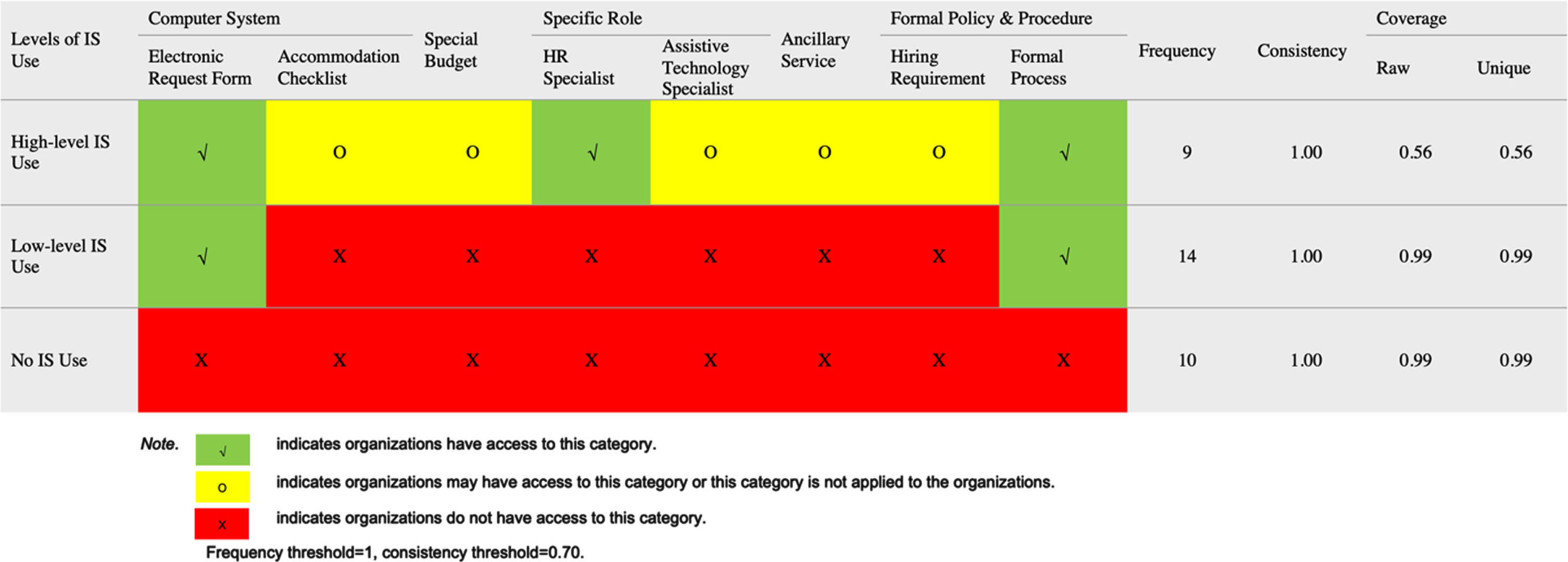
In this section, the results about the high-level IS use and the low-level IS use in the accommodation process are presented by analyzing the empirical data. How different levels of IS use affect accommodation performance including both IS effects and emotional tolls is also examined.
Classification of different levels of IS use and high-level IS use
Since the high-level IS use may cover all the IS components that emerge from the interview data, for the sake of readability, first, a typical accommodation process with the high-level IS use is illustrated, and then, different levels of IS use based on the interaction effects of these IS components are explained. From the interview data, in a typical accommodation process with the high-level IS use (see Fig. 1), as the first step, an employee accesses an established accommodation checklist on an organization’s website, fills out an electronic request form, and sends the form to an HR specialized team that is in charge of all accommodations for the organization. Then, an assigned HR specialist in the team examines the request and discusses with the employee if needed. If the employee does not know what accommodations they need, a needs evaluation (ancillary service) can be provided by an assistive technology (AT) specialist. After the request is approved by the HR specialist, the HR specialist purchases/implements the requested accommodation(s) paid by a special budget. If the accommodation(s) are technology-related, IT staff help install them. If the expertise of AT is needed for the implementation, AT specialists can be engaged. There are hiring requirements and formal organizational policies that are in place to support the whole process. The interview data were used to develop these IS components, as shown in the interview excerpts below.

High-level IS Use in the Accommodation Process.
Electronic request form:
Tiffany 3 : It was an online form . . . the computer people would fill it out and send it up to the centralized source . . .
Accommodation checklist:
Isabella: On that website, a lot of what they have is like a catalog so they have it broken up into different things, vision, whether you have a hearing impairment, that kind of thing. Once you click on the specific category of things that you’re looking for, it will give you a list of all of the things that they offer and what they do and their basic details.
Special budget:
Tiffany: That program is a centralized source of accommodations... If you need adaptive equipment, my office did not have to pay out of the office budget for any accommodations that I got from [the centralized program].
HR specialist:
Isabella: It [the accommodation process] is usually pretty smooth because they [HR specialists] basically send all the information to who they need to send it to and then they contact you to see when is a good time for us to set it up and they tell you hey, this is when it’s gonna going to be shipped. Here’s your tracking number so you can see when it’s going to come in.
AT specialist:
Jack: The vocational counselor . . . put in a request for the AT [Assistive Technology] specialist to install the [accommodation] . . .
Ancillary service:
Judy: [A case manager] developed a service plan and that’s what I went to be evaluated and that’s when it all began, and then they contacted the technical guy. [The case manager] referred me to him, and then I would get in contact with him and we had work things out.
Hiring requirement:
Isabella: There’s some kind of something that says the federal government has to have a certain percentage of employees that are disabled.
Formal process:
Grace: . . . by the time you apply you actually submit an application and then you get a phone call from a navigator who will ask you some more questions and really clarify. Then they will schedule a workplace assessment of a needs assessment. After that they will have to source out like the different options which I would have to review. Then of course, they have their conversation with the employers or they’re negotiating. After all those pieces have been done, then they will actually go ahead and order the equipment. After that they have to schedule a time to come in and install everything or put together whatever that looks like. So the entire process is about I would say approximately three months.
In Table 3, different levels of IS use in the accommodation process are classified using fsQCA. There are nine high-level IS use cases. The cases classified as high-level IS use cases have access to electronic request form, HR specialist, and formal process and may have access to accommodation checklist, special budget, AT specialist, and hiring requirement. The consistency score is 1, therefore, how these IS components are combined is a necessary combination leading to high-level IS use. The coverage score of 0.56 indicates that how these IS components are combined explains 56 percent of high-level IS use in this sample. There are 14 low-level IS use cases. The cases classified as low-level IS use cases only have access to electronic request form and formal process and do not have access to other IS components. The consistency score is 1, therefore, how these IS components are combined is a necessary combination leading to low-level IS use. The coverage score of 0.99 indicates that how these IS components are combined explains 99 percent of low-level IS use in this sample. There are 10 no IS use cases. The cases classified as no IS use cases do not have access to any IS component in the accommodation process. The consistency score is 1, therefore, how these IS components are combined is a necessary combination leading to no IS use. The coverage score of 0.99 indicates that how these IS components are combined explains 99 percent of no IS use in this sample. Since the present study focuses on IS use in the accommodation process, the cases in the no IS use scenario will not be analyzed.
In an accommodation process with the low-level IS use (see Fig. 2), the accommodation tasks still need to proceed following the order of request, negotiation, approval, and implementation. In the low-level IS use scenario, organizations do not have HR specialists as a central point of the accommodation process. A disabled employee often needs to submit their accommodation request to their supervisors or HR staff. Then there may be a lot of back-and-forth negotiations and different levels of approvals among these stakeholders. For example, Daisy shared that,

Low-level IS Use in the Accommodation Process.
Daisy: You had to write to, if I’m remembering this correctly, to human resources and submit a copy to the [boss’ title] . . . who then sent it to the [boss’ boss’ title] when they in turn with human resources and then they would approve or deny the accommodation.
After the supervisors or HR staff approve the request, without resources such as HR specialists, AT specialists, or ancillary services, the employee needs to talk with the procurement department or IT staff to implement the request. For example, Chloe stated that,
Chloe: We [with another employee with disabilities] had to go through the computer people making recommendations...
If stakeholders have a good understanding of disability and accommodation, disabled employees will have successful accommodation experiences; otherwise, the accommodation process may not be as smooth because of bureaucracy, as shown in the participants’ experiences.
Hebe: The person that I was dealing with for disability support was leaving. But before she left, she made sure that this request got processed. She was very diligent about it . . .
Chloe: As far as [the job title], when I first met her, I think she was a little bit hesitant, a little bit nervous, but once I get used to her, she was good. So when I asked for the accommodations later on, she was totally on board.
Christine: Whereas in the second [organization] there was a whole hierarchy. It had to be approved. It had to go up this chain of command and things were promised but got lost in the shuffle.
For the low-level IS use, since there is a lack of IS components, participants often did not directly speak in terms of system use but talked about their suggestions on IS use. They found an accommodation checklist, an information website, a special budget, and a single point of contact would be helpful.
Ivan: A checklist or a guidance list would be really good and one of the examples I’ve mentioned . . . I had no idea that there was a specific set . . . because it was kind of hidden. I had no idea of that until somebody told me.
Sophia: I think HR could be more educated about the accommodation process because even just looking at their websites, there’s not much information on it . . .
Matt: I would magically increase our budget so that we had more to spend for everybody.
Matt: . . . Let’s give the people that are doing this [accommodation process] authority to do what they need to do and have less approvals and fewer steps to make it more efficient.
IS Effects of High-level IS Use
In the high-level IS use scenario (see Table 4), in terms of IS effects, disabled employees easily find accommodation-related information and follow through the process. They have sufficient economic, social, and cultural resources to support their process. Thereby employees usually get approved for whatever accommodations requested. They are also able to reach out to accommodation specialists at any time when needed. If employees are not sure about what they need for accommodations, the accommodation team can provide a needs evaluation. Moreover, specialists and employees are familiar with accommodations and processes to provide them. Considering the interview excerpts below:
Positive and Negative IS Effects and Low Emotional Tolls of High-level IS Use in the Accommodation Process
Positive and Negative IS Effects and Low Emotional Tolls of High-level IS Use in the Accommodation Process
Isabella: It [the accommodation process] is usually pretty smooth because they [HR specialists] basically send all the information to who they need to send it to and then they contact you to see when is a good time for us to set it up and they tell you hey, this is when it’s going to be shipped. Here’s your tracking number so you can see when it’s going to come in.
Isabella: They [The organization] have their own budget for it [accommodation] because I saw the purchase order when they ordered my stuff and they didn’t mean to send it to me, but they did. And it was like sixteen thousand dollars worth of equipment. I was like is this going to come out of my paycheck, and they were like no, we didn’t actually mean to send that to you, but it’s a separate budget just for all of that stuff.
Benjamin: I feel like a lot of most of the time all the time in my experience when something is requested, it’s approved.
Isabella: I think the benefits are that you can really reach out to someone at any time that you need them.
Tiffany: One of the other things that [program] did is that if you wanted them to, they would do a needs assessment. They would talk to you about what your job is, what you have to do on the job, and they would help you find the right accommodations for the job.
Benjamin: We all work with [disabled] people. They are aware of what is needed and how to request for accommodation. They’re not opposed to it, some people more vocal about it as opposed to others, but the [disabled] staff knows what they have to do, too . . .
However, high-level IS use can make the process less flexible, including an inflexible accommodation checklist and budget timeline. Additionally, some organizations may manage their accommodation information websites in a too general way rather than according to disability categories. The participants discussed these specific issues during the interviews:
Isabella: I think what would be helpful is if they had a process for requesting software or a thing to use from outside of the approved vendors list. Like hey, I want to get [add] this software on the approved vendors list. How do I do that? We have no idea as employees how we could do that so that would be nice to have my say.
Tiffany: Sometimes with [the program] we had to wait a while . . . If you would request something in [a particular month] or maybe when [the program] started running out of money or if there was a continuing resolution . . . Sometimes [the program] would not spend money if they were under one of those continuing resolutions . . . So I would say that bonds should be handled in such a way that you don’t run out of money at the end of the year . . . so that everybody who requests accommodations has an equal opportunity to get those and get those timely.
Benjamin: I would probably break [the website] down by disability category so that it would be easy for someone to say okay, I have this disability, this is where I can go, this is the information that I can use for my own disability as opposed to have been generalized.
Regarding emotional tolls, employees experience low emotional tolls and feel much more comfortable requesting accommodations because stakeholders make few judgments about what employees request for, as Isabella said, “you’re generally not afraid to ask for something, to ask for what you need”. Occasionally the insufficient communication between specialists and employees could happen, however, since supervisors do not pay for accommodations out of their departments, have formal requirements to accommodate employees, and “wouldn’t have any reason to” object to providing accommodations, they often discuss with specialists and make sure that employees still get requested accommodations.
IS Effects of Low-level IS Use
In the low-level IS use scenario (see Table 5), regarding IS effects, it is more flexible to choose accommodations compared to an established accommodation checklist. The benefit of this is for some accommodations, disabled employees “couldn’t have guessed” what accommodations they need “until they got there”. The negative IS effect is that without an HR specialist who is in charge of the whole process, employees go through many stakeholders to get the accommodation process going. A participant talked about his experience with an accommodation process without a single point of contact:
Positive and Negative IS Effects and Higher Emotional Tolls of Low-level IS Use in the Accommodation Process
Positive and Negative IS Effects and Higher Emotional Tolls of Low-level IS Use in the Accommodation Process
Ivan:...I went through of having to talk to six different people. With one person in charge of everything, it was a fairly smooth process. And you didn’t have to deal with the accommodations person saying, yes, you need to do this and somebody else saying, no, you don’t need that and then you get into a struggle like I had back in [a state] with [an accommodation].
In the low-level IS use scenario, without enough support of economic, social, and cultural resources, and since a lack of knowledge of disability and accommodation by stakeholders is common, employees have less effective and satisfying accommodation experiences. Employees experience higher emotional tolls and may need to fight hard to justify their needs.
Emily: My boss theoretically knew that who is supposed to provide accommodations but didn’t know the how or the what or even the steps to do it. And that was true down the line from my boss to HR to IT. They are all talking to each other being like we know we need to provide this accommodation, but how to actually do it we don’t know. They never had to do it before.
Emily: This is one of the things that’s so frustrating is like my boss doesn’t know [how to get the accommodations]. I’m brand-new employee. I don’t know what to do.
Daisy: [When asking for an accommodation] I would actually have it written out and schedule a meeting and just explained the particular accommodation that I needed, why was needed and . . . how long do you need it for, kind of things.
Chloe: I remember that when we [with another disabled employee] wanted to update [an accommodation], we had to go to human resources and explain, what was the purpose for it? What would it result in? What would be the advantages of updating? And then we had to kind of write a proposal for a while, how it would be a good idea to update the software, because it would work better with programs and it would really ultimately help me to work more efficiently.
Moreover, some participants pointed out that they experienced mental health issues due to the stresses within the accommodation process.
Sophia: I think it’s stressful. I think some of the cost is like confidence type thing or like anxiety kind of. I know when I was disclosing my disability and asking for the [accommodation], I was really anxious about that just because of my past experience. I also think there’s a lot of internal guilt involved. I think especially in [the state] asking for an accommodation made me feel bad. It made me feel guilty and made me feel worse about my disability or what I needed.
Sophia: I initially felt guilty because I was gonna miss the work, but then as I realized I needed it and with my [boss’ title] reaction, it made that worse. I just hated it. I was afraid to ask for the [accommodation] because of her reaction.
To address the issues, employees may form a personal informal coping system, which positively mediates emotional tolls and helps improve accommodation performance. The personal informal coping system may include creating a tool kit of needed accommodations, requesting things that are low-cost, training others how to accommodate, choosing jobs carefully, and arriving at work earlier (see Table 6).
Personal Informal Coping System
Personal Informal Coping System
Furthermore, I recognize that positive career items positively mediate emotional tolls. Some participants have worked at job positions and organizations that support disabled people, which positively mediate the effects of low-level IS use on employees.
Henry: Good communication [with stakeholders] because everybody knew me as [a job title].
Matt: You are responsible for knowing your stuff. You have to be able to present and demonstrate why you should get a certain thing and people generally trust that, especially in my role that I know what I’m talking about.
Daisy: They [stakeholders] have experiences with people who are [disabled] . . . It’s like you fit the same everything that they perceive and had experience with it.
Conversely, negative personal characteristics negatively mediate emotional tolls. For example, some participants may be afraid of requesting accommodations due to the worry about potential backlash.
Daisy: I think in hindsight I didn’t ask for certain accommodations because I was in a challenging situation, if you ask for too many accommodations, it appears that you’re not capable of doing the job. And so my whole focus was to do the job and show that I was capable and efficient as my peers that I can do the job . . .
Based on the above analysis, the high-level IS use often results in a better accommodation performance than the low-level IS use. Nevertheless, several IS design limitations exist in the high-level IS use. First, IS design in the accommodation process with the high-level IS use often uses a specific, inflexible template. This practice mainly focuses on standardization and efficiency, serves the average users, and often ignores a spectrum of user needs [13, 29]. A specific, inflexible template in the accommodation process contradicts the characteristic of accommodations as individualized services. The empirical findings confirm that such design including an inflexible accommodation checklist and budget timeline and too general accommodation information on organizations’ websites negatively affect disabled employees’ accommodation experiences and ability to acquire the necessary accommodations to make them effective at their work. Second, the standardized IS design often disregards human elements in IS design and does not address the fundamental social issues in the current accommodation process. A major challenge in social inclusion practices (particularly, disability inclusion in the present study) is the awareness issue [3, 31]. The empirical findings show that employers and organizational stakeholders are often not aware of disability and accommodation. A long-term and more effective solution should consider human elements to better fit with the social characteristics of the accommodation process.
The critical disability theory is a helpful lens to inform such IS design. First, the critical disability theory helps raise awareness of disability and accommodation by challenging the rationalism of ableism and addressing diverse opinions [32–36]. As discussed earlier, in the accommodation context, the current IS design does not pay attention to stakeholders’ awareness and knowledge of disability. The empirical findings confirm that stakeholders do not always understand disability and accommodation and make little effort to proactively offer an effective accommodation process to employees. In addition, several study participants because of their personal characteristics such as personality and background were afraid of requesting accommodations due to internal guilty and the worry about potential backlash. Therefore, the critical disability theory informs an IS design that should provide intervention process support to increase disability and accommodation awareness. Intervention process support could be achieved in the forms of training, survey, and action plan [37]. Specifically, for relevant stakeholders, I suggest that IS such as intranets, which allow for the easy storage and quick dissemination of training materials (via videos and guides) as well as feedback mechanisms (surveys and certifications) provide an easy means of educating and engaging supervisors, HR, and coworkers on accommodation norms. Such materials provided by IS also help create and reinforce norms, procedures, and resources of the accommodation process. These materials can focus on how to create a more inclusive work environment, how to properly address disclosure and request, and how to develop a fair and equitable accommodation process that empowers disabled employees.
Second, the critical disability theory helps pay attention to individual needs of disabled employees [34]. Accommodation is essentially an individualized service because different people have various needs [38, 39]. To accommodate different employees’ needs and improve accommodation performance, an IS should provide individualized and flexible arrangements. For example, IS designers can organize accommodation process information according to disability categories. Furthermore, in the accommodation request forms, IS designers can build and provide accommodation checklists and also an open form for filling out special accommodations that are not on the checklists.
Third, the critical disability theory uncovers various human effects and emphasizes social interactions in the accommodation process [40]. Communication among stakeholders is a critical component in the accommodation process [41]. To emphasize immediate and adequate communications among individuals, an IS should provide communication support. One of the main reasons why the accommodation process involves extensive communications is that disabled employees and their supervisors and coworkers as well as the whole organization may have conflicting interests in accommodation decisions [42]. To address these social issues, an IS needs to have a feature of communication support, which includes aspects of an IS that support immediate, sufficient, and iterative communication as well as address varying perspectives among stakeholders when exploring accommodation options [43].
Fourth, the critical disability theory focuses on the broader social, economic, and political context as well as addresses structural inequality [33, 44]. In the accommodation context, we need to consider unequal distributions of resources for providing accommodations inherent across different types of organizations so that we can ensure that the resources empower disabled employees. The empirical findings confirm that the organizations (typically government organizations from the empirical data) that have economic, social, and cultural resources to support accommodation processes and other organizations that do not have different forms of resources result in the inconsistency of IS use in accommodation processes. The unequal distribution of resources inherent across different types of organizations is reinforced over time and thus the structural inequality is widened [34], which limits disabled employees’ job opportunities to certain types of organizations. It is crucial for disabled people to have equal access to all opportunities of employment that are available to their non-disabled counterparts. Therefore, an IS should promote resources share to build an emancipatory environment and empower disabled employees. The IS design should be extended to various organizations and society as a whole. The accommodation efforts are not only organizations’ responsibility but also society’s duty. I encourage organizations to share resources through a network in order to successfully accommodate employees. Additionally, accommodation services offered by some government agencies have been helpful. I suggest more efforts to be invested in those services, aiming at a whole range of disabilities and different types of accommodations. Thus, disabled employees have a variety of choices to acquire the resources they need for supporting their accommodation requests from different channels.
Conclusion
This research examined different levels of IS use in the workplace accommodation process and their effects on accommodation performance. The high-level IS use often results in a better accommodation performance than the low-level IS use, including high efficiency, high effectiveness, and low emotional tolls. Nevertheless, the high-level IS use often uses a specific, inflexible template as well as disregards human elements in the accommodation process. This work, as a critical first step, provides implications that future IS design in the accommodation process should raise awareness of disability and accommodation, account for individual differences, involve multiple stakeholder inputs, as well as address the fundamental social issues in the accommodation process.
Ethical approval
The Worcester Polytechnic Institute Institutional Review Board approved this research on July 28, 2020 (Approval number: FWA #00015204 – HHS #00007374).
Informed consent
Written informed consent was obtained from all participants.
Conflict of interest
The author has no conflict of interest to report.
Footnotes
Acknowledgments
The author would like to thank the Reviewers, Editor-in-Chief, and Editor’s team of Work for their helpful comments.
Funding
The author has no funding to report.
The appendices are available from https://dx.doi.org/10.3233/WOR-220716 " href="#fn4" id="a-88">
4
.
" href="#fn4" id="a-88">
4
.
I recognize that there is still a debate in the disability community regarding identity-first versus person-first language []. There are valid arguments on both sides. In this paper, I use identity first language, which is more in line with the social inclusion aspect and the critical lens I apply, and will continue to learn from research and seek more guidance from self-advocates to inform our work and the language I use.
All the participants except two were from the United States. Those two participants were from Canada. The requirements for accommodations in the Canadians with Disabilities Act are similar to the requirements in the Americans with Disabilities Act.
All participant names have been changed to pseudonyms.