




Abstract
BACKGROUND:
Sickness absence due to depression has indirect and direct costs for employers. Whilst employers play a key role in establishing supportive work environments and providing work adjustments, there is a lack of knowledge on employers’ attitudes to support employees with depression.
OBJECTIVE:
To investigate employers’ attitudes to manage employees’ depression, focusing on the employers’ opportunities and challenges to support employees with depression.
METHODS:
Individual interviews were conducted with five employers. Interview transcripts were analysed using qualitative content analysis.
RESULTS:
Four categories emerged from the interviews: Attitude to and understanding of depression affect supportive practices; Dilemma between supporting employees with depression and accommodating workplace needs; The employer-employee relationship influences supportive practices; and Work accommodations target the employee’s ability to work.
CONCLUSION:
Employers may need a wider understanding of depression and the importance of the work environment influencing work disability due to depression. Studies should investigate how knowledge of work disability due to depression can be transferred to workplaces.
Conflicting agendas of the vocational rehabilitation stakeholders poison opportunities to support, and initiatives may aim to promote employers’ understanding of the benefits of collaborating with other stakeholders. The involvement of decision-makers to provide initiatives that support employers in managing employees with depression to promote their work participation is recommended.
Introduction
In 2011, the estimated number of Europeans suffering from major depression was 30.3 million, and in one year 6.9% will suffer from a major depression [1]. In Europe, 10% of employees have taken time off from work because of depression, with a mean time off work of 35.9 days for the last episode of depression [2].
Sickness absence due to depression has indirect and direct costs for employers, as it may lead to lower productivity and work quality, higher employee turnover and reduced job satisfaction among co-workers due to added workload. Thus, depression imposes an economic burden on the workplace; hence, employers have an incentive to support employees with depression to promote their work participation (WP) [3, 4].
Since an episode of depression lasts for a mean of six months, and as periods of symptom relapse and chronicity are common features, depression usually results in recurring time off work [5–7]. Thus, return to work (RTW) may not occur at the end of symptom recovery, but through a continuous process, where health is gradually rebuilt through work activities [8]. This makes depression an important issue for the workplace, and calls for the involvement of employers, as they have an understanding of workplace issues, awareness of job requirements and usually the authority to implement work adjustments [9].
Work disability is a complex phenomenon that often involves a range of social actors with competing interests, which is illustrated in the case-management ecological model [10]. The model gives attention to the stakeholders involved in vocational rehabilitation represented by four systems; the personal system, e.g., family and relatives; the workplace system, e.g., employer; the health care system, e.g. clinicians; and the compensation system, e.g., social workers. Social workers usually administer worker’s compensations according to current regulations, while employers play a key role in the workplace activities [11, 12]. Researchers stress the key role of employers to conquer the burden of work disability, as workplace interventions may decrease sickness absence [13–15].
An unsupportive employer has been highlighted as a major barrier for WP of employees with depression affecting the employee’s decision to go on sick leave and RTW [9, 16]. Yet, employers’ opportunities to support employees with depression are limited, as the employee often avoids disclosure due to the depressive symptoms, e.g. low self-confidence, guilt and self-blame, affecting emotions, cognition and behaviour as well as stigma attached to depression [17, 18].
From the employers’ perspective, factors influencing WP of employees with depression can be related to the person, e.g. stressors in personal life, resuming work too soon, and the workplace, e.g. prejudices related to mental disorders, lack of knowledge on mental disorders and scepticism regarding the truthfulness of the diagnosis [19–21]. A case study has shown that some employers do not find the employee’s diagnosis important, but focus on work ability and job performance [21]. Employers’ activities, when accommodating employees with depression, are usually focused on the individual and comprise regular contact with the employee prior to RTW; replacement; changes in job content; emotional support; and clarity regarding job tasks and expectations [20, 23].
Employer policies and practices to prevent work disability have gained attention from researchers and policymakers [24–27], and guidelines are available for employers on how to support employees with depression, recommending for example open communication between employer and employee, policies and procedures for the roles and responsibilities of stakeholders involved [28, 29]. Nevertheless, depression remains a workplace issue, and employers have a key role in establishing a supportive work environment and providing relevant work adjustments to promote WP and prevent recurring sickness absence [12, 25]. There is a lack of knowledge on employers’ attitudes to support employees with depression. To provide knowledge that can support employers in managing employees with depression to promote their WP, there is a need for clarifying the employer perspective. Therefore, the purpose of this study was to investigate employers’ attitudes to manage employees’ depression, focusing on the employers’ opportunities and challenges to support employees with depression.
Methods
Setting
The study was carried out in five organisations in Denmark: in one private psychological care clinic and in four public sector organisations of which two were in the educational sector, one in the health care sector, and one in the social sector. Two of the organisations were small (<50 employees) and three were medium-sized (50–250 employees). The main job tasks of the organisations studied were teaching, provision of mental health service, day care for children and psychological consultations.
Participants
Five employers were included using purposive sampling, i.e., employers with knowledge on or experience with employees with depression were selected [36]. Inclusion criteria were: 1) holding a management position in a Danish organisation and 2) having knowledge of or experience with employees with depression.
Data collection
Individual interviews [37] were conducted with the five employers by the first author (CNT). Each interview took place at their workplace on their request (at the employer’s office or in a meeting room) and lasted from 30–60 minutes. Interviews were conducted in November 2017. The semi-structured interview guide comprised six themes: background information about the employer (e.g. age, employment, experience with depression); information about the organisation (e.g. size, workplace organisation); employer’s opportunities and challenges related to interacting with employees with depression; employer’s opportunities and challenges related to the workplace culture; employer’s opportunities and challenges related to the activities supporting employees with depression; and employer’s opportunities and challenges related to the collaboration with internal and external actors when supporting employees with depression. To strengthen the internal validity, the interview guide was framed based on assumptions that derived from the background literature on depression and WP as exemplified in Table 1. During the interviews, the themes in the interview guide were covered, and based on the employers’ responses, other themes emerging in the interviews, describing the employers’ attitudes, opportunities and challenges when supporting employees with depression, were followed.
Framing the interview guide
Framing the interview guide
All interviews were digitally recorded. The interview process was concurrently discussed with the last author (MB) ensuring reliability.
All interviews were transcribed verbatim, including pauses, laughter and changes in breathing, vocal pitch or tone of voice.
The analysis followed inductive content analysis methodology [38–42], and was conducted in four steps. Firstly, CNT read the transcripts to obtain an overall impression of the interviews. Secondly, meaning units, i.e., the constellation of words or statements that relate to the same central meaning [43], relevant to the aim were identified using two analytical questions: a) what are employers’ opportunities to support employees with depression in relation to WP? and b) what are employers’ challenges to support employees with depression in relation to WP? Thirdly, the derived meaning units were analysed focusing on similarities in meaning and comprised into four categories. Fourthly, the categorised meaning units were compared to identify meaningful patterns and one explanatory theme emerged. The analytical process was conducted in a constant dialogue between CNT and MB to strengthen the validity and reliability of findings, categories and themes [38, 42].
To evaluate the validity and reliability of the categories, CNT introduced co-author (SJH) to the main content of the four categories. SJH did have experience in the methodology of content analysis, but did not possess specific knowledge on this study or the subject. CNT and SJH independently identified meaning units in one of the interviews, and the percentage of agreement was calculated, i.e., the percentage of all coding decisions in relation to each category on which SJH and CNT agree [44]. CNT and SJH discussed their categorisations addressing the disagreements and the implications for the validity and reliability of the analyses.
Ethics
The study was registered with the Danish Data Protection Agency (no. 2014-41-3574). The employers were informed in writing and orally about the aim of the study, participation and ethical formalities, e.g. voluntary participation and confidentiality, after which they gave written consent. No participants withdrew from the study.
Results
Four categories describing employers’ attitudes to manage employees’ depression were identified: ‘Attitude to and understanding of depression affect supportive practices’; ‘Dilemma between supporting employees with depression and accommodating workplace needs’; ‘The employer-employee relationship influences supportive practices’ and ‘Work accommodations target the employee’s ability to work’. Figure 1 presents an example of the analytical process including the use of analytical questions to identify relevant meaning units in relation to one category.
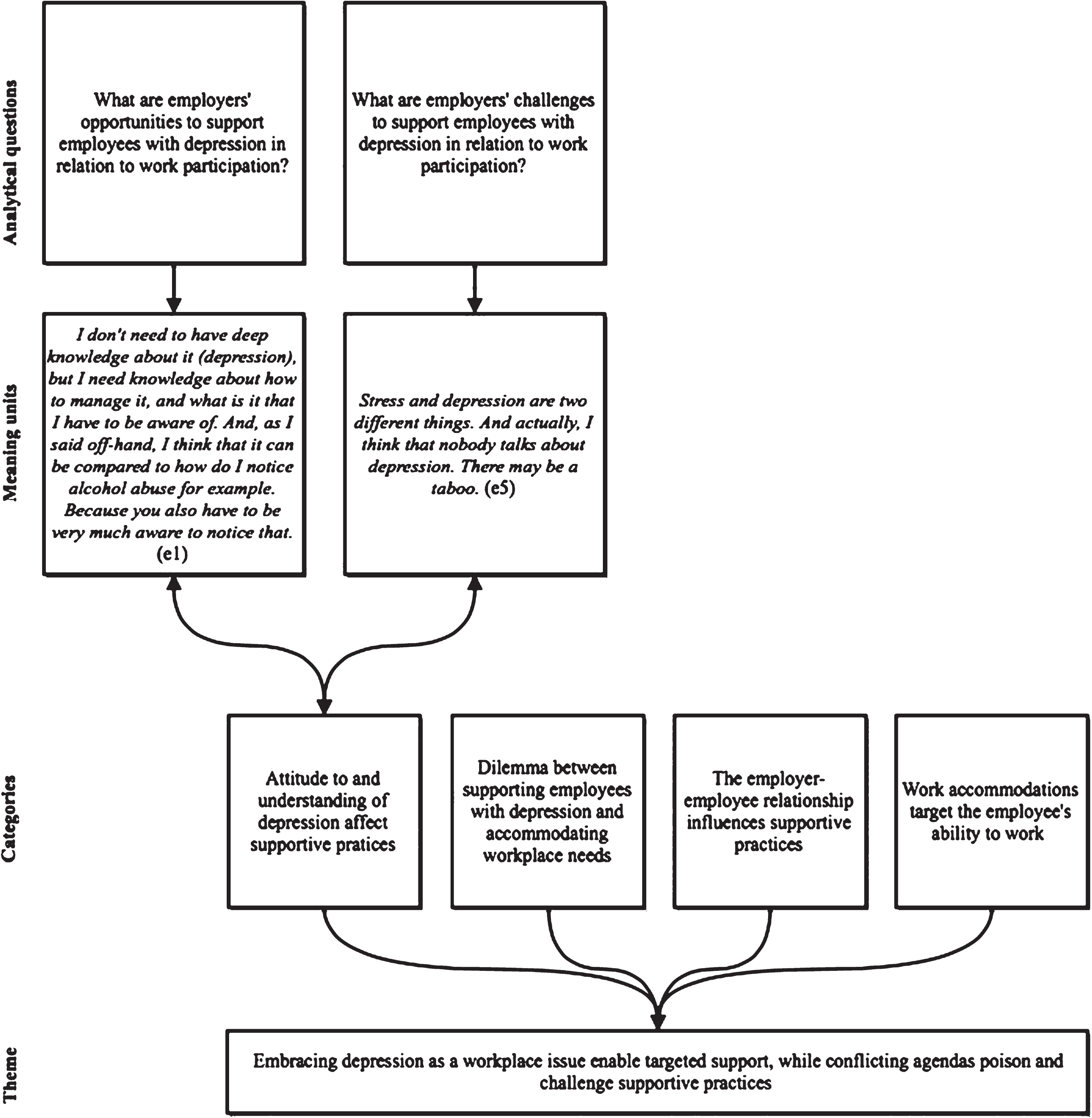
The analytical process.
The inter-coder percent agreement was 88% [44]. The content of disagreements mainly concerned ambiguity in the interpretation of meaning units and the choice of category in which meaning units was placed; however, none of the categories were found unreliable. Also, some of the disagreement concerned meaning units regarding employees with other conditions, as SJH had also identified meaning units that did not specifically concerned employees with depression, but employees with other health conditions or general issues. The disagreements were discussed, and it was considered important that the employers also focused on employees with other conditions, e.g. stress, when being asked specifically about employees with depression. Yet, the meaning units identified by CNT addressing employees with depression did capture this important subject, as they revealed important matters regarding the employers’ attitudes towards employees with depression emphasized in two categories: ‘Attitude to and understanding of depression affect supportive practices’ and ‘The employer-employee relationship influences supportive practices’.
Opportunities to support employees with depression are influenced by whether depression is understood as a private matter that should be managed in the private sphere or embraced as a workplace issue that involves the responsibility of the employer.
Assuming that depression mainly originates from private factors, depression is understood as an illness that is not work-related, implying that depression belongs to and should be managed in the private sphere. The specific health condition of the employee is not important, merely whether the health condition is work-related or not: “It is not that you (the employee) have to tell me what you suffer from, but it is to see, if the reason is something work-related” (employer (e)2).
Employers express that work-related stress may lead to depression depending on the person; yet, work-related stress is taken more seriously in the local work environment: “My experience is that stress can lead to a depression, if you are predisposed for it. And in this case, we try to take the part that is stress-related very, very seriously.” (e1). Thus, employers feel more responsible for employees with work-related disorders because of the direct link between the disorder and the work environment. Depression is understood as a private matter that is caused by personal factors, and therefore depression is not the employers’ responsibility.
Employers neglect the existence and seriousness of depression at work, as the term has become a part of the daily jargon expressing normal mood variations: “I have respect for those who actually have stress, and likewise those with depression. But you can easily hear yourself say that: oh, now I get totally depressed by so and so. And that is also bad communication” (e1).
Furthermore, depression is tabooed, and nobody talks about depression: “Stress and depression are two different things. And actually, I think that nobody talks about depression. There may be a taboo.” (e5). In turn, employees may disclose their depression as stress or something else and consequently employers are challenged to provide targeted support. Thus, employers’ supportive practices depend on willingness from both the employer and the employee to overcome the taboo and engage in the vocational rehabilitation process. Furthermore, employees’ open-mindedness regarding their condition and work ability are important because of the invisible and diffuse nature of depression that makes it difficult for employers to assess employee’s work ability and thus plan RTW: “When it is visible it is easier to manage in the real world. It is more difficult with depression and anxiety and such that you cannot see” (e3).
Knowledge of depression provides opportunities to take depressive symptoms into account in the communication with employees with depression. Accurate oral and written information is applied to meet depressive symptoms that make it difficult to remember and concentrate: “When you have a depression, it is difficult to remember things and take in a lot of information ( ... ) So you have to be very precise about what we are talking about.” (e3). Thus, knowledge of depression and an attitude towards depression among employees that embodies the responsibility of the employer provide opportunities to support.
Dilemma between supporting employees with depression and accommodating workplace needs
Employers are challenged to support employees with depression, as the employee’s needs often conflict with the needs of the workplace, e.g. considering co-workers’ job satisfaction and using the scarce economic resources cost-effectively.
Specific challenges relate to the employer’s often conflicting considerations attempting to meet the needs of both the employee with depression and the workplace. It is difficult to balance the support of employees on sick leave or in a long RTW process and co-workers who have to work harder in the absence of a colleague: ”It is that balance between getting the employee back, maybe through a loooong return to work process, and then the others who have to work harder, right.” (e2). Thereby, employers are challenged to establish initiatives that support employees with depression without compromising the needs of the workplace.
Acute and indefinite sick leave of employees with depression is a challenge, as it makes it difficult to arrange how the employee’s job tasks can be covered. The co-workers have to carry out the most urgent job tasks, and as sick leave due to depression is often prolonged, the co-workers become discontent with the management: “The return to work process prolongs at the workplace, right, while there is a lack of resources, and the others (co-workers) think: hello, how long will this take?“ (e2). Moreover, employers’ opportunities to support employees with depression are limited due to scarce economic resources. Employers are compelled to dismiss or pressure employees to RTW, although they are concerned that returning to work too early imposes a higher risk of repeated sick leave.
Others in the management or union representatives are supportive in handling this dilemma. These internal actors have similar interests in the workplace as the employer, they know the employer and the workplace issues, and are therefore consulted for advice and assistance: “It is very important for me to have a peer ( ... ) We have worked together for many years. He knows me and my leadership style” (e4).
The involvement of social workers is a challenge, as they have their own agenda and interests: “I do not have good experiences with the social workers ( ... ) You just get the feeling that they have some boxes and that there are some rules, some deadlines that everything has to fit into.” (e5). Thus, from an employer perspective, social workers inappropriately intensify the pressure on employees to RTW, and are therefore perceived as unsupportive. Nevertheless, social workers can be supportive in providing opportunities to support employees with depression and accommodate workplace needs when a relation is well-established: “we assume that 1 sick day costs DKK 2000, and a coaching course that we can get via a social worker that we have contact to in the municipality costs DKK 4000, maybe 5000 for three sessions. Then you see, if we can save 3 sick days it is money well spent” (e3). Thus, employer’s attitude to and knowledge of the possibilities in collaborating with other stakeholders provides opportunities to support employees with depression.
The employer-employee relationship influences supportive practices
Employers’ opportunities to support employees with depression are restrained by the balance of power between employer-employee that challenges the establishment of trust in the relation. Thus, employers highly rely on intermediaries to be responsible for employee communication and consultation.
The established roles and responsibilities at the workplace influence employers’ opportunities to support employees with depression. The balance of power between employer and employee makes it difficult to establish trust in the relationship. To overcome challenges caused by the balance of power, the employer relies on others such as general practitioners, co-workers or union representatives, for the employee to consult in relation to their depression: “The union representative is in another position to talk with a teacher, and some things can be easier ( ... ) because the union representation cannot fire and hire.” (e5).
Workplace policies are supportive to overcome employees’ insecurities regarding the consequences of depression and sick leave. Workplace policies are used to clarify how depression is managed at the workplace, and to ensure the individual employee that there is nothing special about how he or she is accommodated at work:” ... it (workplace policies) is a support as I can say to the employee: You know what, it is nothing special about you ( ... ) and then we can say: experiences show that it is a good idea. And that can also demystify it.” (e5).
Employers’ understanding of their role and responsibilities in relation to employees with depression influence their opportunities and willingness to support. The hierarchal distribution of the roles of the workplace actors is emphasised, and the regular employee contact regarding issues such as depression is considered to be the responsibility of others, e.g. union representatives: “I have to be aware that I have an employer role and the employees have an employee role and it exists, regardless of whether I try to soften it and be open. We can screen by putting in an intermediary so that the employee who is challenged by something does not have to address me directly ( ... ) or I can approach the employee and say that I have heard that the employee is highly stressed doing their work tasks” (e1). Thus, employers’ communication with employees focus mainly on challenges related to work and entering the employee’s private sphere is avoided.
Work accommodations target the employee’s ability to work
Employers’ opportunities to provide work accommodations are influenced by attitudes to and knowledge of relevant work accommodations. When accommodating employees with depression, focus is on the single employee and the employee’s ability to work, and includes changes in job tasks and schedule.
Employers’ attitudes to and knowledge of relevant work accommodations to support employees with depression influence the supportive practices. When accommodating employees with depression, employers are focused on making changes in the employee’s job tasks and schedule, while the need for making changes which relate to the work environment are not considered. This is in opposition to accommodating employees with physical disorders, where focus is on adjusting the physical surroundings to meet the employee’s work ability: “you would think more in working hours and when to meet in at work in relation to those with mental health problems, then with those with physical disorders, it is the physical surroundings” (e2).
Sick leave or reduced working hours are considered a necessity in accommodating employees with depression, and gradual RTW with a limited amount of work tasks is considered valuable, as it enables the employee to regain trust in own abilities: “most of them, are satisfied with returning gradually, because then they experience that some of the loss they have felt, losing faith in their own abilities, can be rebuilt” (e2).
Employers’ opportunities to make changes in job schedule are restricted by the work organisation, but the changes provided depend on employers’ attitude to relevant work accommodations. At workplaces lacking possibility to make changes in employee’s job schedule, employers’ practices span from being supportive and inclusive to being exclusive and unsupportive. Attempts to support employees in their WP and accommodate employees’ needs include longer sick-leave and changes in work schedule, while exclusive strategies include dismissal, if employees are not able to fulfil their work function: “They have to be able to fulfil their work function. When they are at work, they are at work. And if they start to fall behind and I think that I can’t accommodate them better with hours and flexibility and so, then it can end up with ... And I know it sounds a bit ugly, but it is very, very difficult to fire employees in the public sector” (e2). In this way, the employer’s attitude to and knowledge of relevant work accommodations shape the supportive practices.
Discussion
Through the transversal analysis [39] of the four categories one theme emerged: ‘Embracing depression as a workplace issue enable targeted support, while conflicting agendas poison and challenge supportive practices’. The theme explains how employers’ supportive practices are challenged by the different agendas of the vocational rehabilitation stakeholders poisoning the opportunities to provide support. Meanwhile, knowledge of depression and of work environmental factors influencing work disability may contribute to a change in employers’ attitude towards employee’s depression and enable targeted support that considers both the employee and the work environment.
The present study emphasised that attitude to and understanding of depression influence considerations regarding employees’ depression as a workplace issue involving the responsibility of the employer. Depression is understood as an illness that is non-work-related and thus should be managed in the private sphere. Hauck et al. [21] showed that employers found it to be a part of their role to monitor and address depression among employees; yet, these employers had either personal experience with depression or knew someone with depression. Thus, knowledge of depression may influence employers’ attitudes. Additionally, Loisel et al. [10] argue for the implementation of the work disability paradigm implying that health at work should not be separated from general health and life. According to the Danish Working Environment Act [12], the employer is responsible for ensuring safe working conditions and has an economic incentive to prevent work-related disorders. Thus, based on our findings, it can be stated that there may be a need for initiatives providing an employer incentive to engage in the vocational rehabilitation process regardless of whether the employee’s health condition is acknowledged as work-related or non-work-related.
Our findings showed that employers neglect the existence and seriousness of employees’ depression, and that the depressive disorder is poorly understood. Stress is taken more seriously at work, thus to change employers’ attitude towards depression, stress may be useful as a way to inform employers about depression highlighting work stress as a risk factor for the development of depression [45]. Additionally, OECD points to the importance of workplace strategies in preventing mental disorders [24]; yet, to successfully prevent and promote work disability due to depression, employers may need a wider understanding of depression and the importance of the work environment influencing work disability.
The present study found that depression is a taboo at work. Interestingly, Martin et al. [46] showed that negative norms about disclosure at work were associated with employers’ stigma towards employees with depression; additionally, two in five employers found that depression was not an appropriate topic for discussion at work. To overcome taboo and stigma attached to depression, initiatives may focus on the establishment of appropriate disclosure norms at work distinguishing between normal mood variations and depressive symptoms.
Our findings showed that willingness from both the employer and employee to engage in and commit to the vocational rehabilitation process is essential. Employers are challenged to assess employees’ work ability and plan RTW due to the invisible and diffuse nature of depression, and their opportunities to support relies on employees’ open-mindedness regarding their condition and work ability. Accordingly, Ladderud et al. [28] emphasised that the unpredictability of depression on employee performance and attendance demands employers’ constant assessment and reassessment to accommodate employees’ work ability.
Our study showed that employers’ considerations regarding the needs of the workplace influence their opportunities to provide support. In concordance, Seing et al. [47] found that employers were challenged to take social responsibility in the RTW process, as economic considerations took precedence over legal and ethical considerations. Thus, it is suggested that policies and legislation carefully integrate an employer incentive to actively engage in the vocational rehabilitation process.
The present study found that employers are challenged due to the agendas and interests of social workers, as it conflicts with their own interests in supporting the employee and accommodating the workplace needs. Thus, it appears that the different agendas of the vocational rehabilitation stakeholders poison the opportunities to provide support. Seing et al. [47] showed that employers’ role and activities in the RTW process were dominated by economic considerations, including needs for and interests in employers’ businesses. A meta-synthesis [48] found that the RTW process of people with psychiatric disorders was obstructed due to conflicting interests and goals of the multiple stakeholders involved. Hence, initiatives may aim to promote employers’ understanding of the benefits of collaborating with other vocational rehabilitation stakeholders and may be supplemented with tools to enhance mutual understanding and goal-setting among the vocational rehabilitation stakeholders.
Our study showed that employers’ attitude to and knowledge of relevant work accommodations shape the supportive practices and include changes in job tasks and schedule. Consistently, a review found that the most commonly reported work accommodations were flexible scheduling/reduced hours, modified training and supervision, and modified job duties/descriptions [49]. These focus on the single employee, which highlights the necessity of the employers to be engaged at an individual level including the importance of communication between the employer and employee. In addition, a mental health programme for employers, combining mental health knowledge and communication training, has been found to reduce work-related sickness absence, but calls for further evidence on the impact of such programs [50]. Interestingly, there is limited research on the effects of work accommodations on depression and WP outcomes [28, 30]; however, there is a body of research on clinical interventions focusing on reducing depressive symptoms and sickness absence [51, 52]. These interventions address the person, and do not accentuate the influence of the work environment. Nevertheless, the work disability paradigm captures that individual or workplace psychosocial factors and societal factors have a greater impact on the development of disability than the health condition itself [53]. In addition, the expanded International Classification of Functioning (ICF) scheme clarifies that individual health and work disability is affected by complex interactions between personal and work-related factors [54]. This implies that work environment factors, e.g. social dynamics at work and workplace support, should be considered when accommodating employees with depression. A study stated that employers have experience with no- or low-cost communication/interaction-based management strategies when dealing with employees with mental disorders, but lack experience in structural changes within the work environment and organisation [55]. Thus, employers appear to need knowledge of relevant work accommodations beneficial in promoting WP among employees with depression.
Methodological considerations
Strengthening the internal validity of the study, the interview guide was developed based on predefined assumptions. During the interview, the employers were given the opportunity to clarify their perspectives through the use of direct questions, e.g. “Are there some tools you need to support employees?”; specifying questions, e.g. “Do you think that you have better opportunities to support employees who are open about their disorder?”; interpreting questions, e.g. “So, there are also these economic considerations?”; follow-up questions, e.g. “What do you mean when you say ‘scared of the boss’?; and probing questions, e.g. “Why bad consciousness? Why do you think that is?” [56].
Regarding the external validity of the study, the age of the employers ranged from 45 to 72 years, and all had more than five years of leadership experience. Thus, based on their life and leadership experience, they might have more confidence in their own skills in managing employees with depression than younger employers with a lack of leadership experience. Furthermore, four of the five employers were female, and four were in the public sector, which should be taken into account, as being a female employer and being in the public sector have been found to be associated with a more positive attitude towards employees with mental disorders [57]. The workplaces were small and medium-sized organisations, and the results may be transferred to employers with similar characteristics.
Limitations
Employers with experience in or knowledge of employees with depression were recruited; yet, according to Danish legislation, employees are not obligated to disclose their diagnosis, nevertheless, the employer is usually aware of the condition because of employee’s work functioning and disability.
When transferring the results, contextual factors, such as legalisation regarding sickness benefits, insurance systems and labour market characteristics, should be considered, as the societal context, including politics and culture, may influence employers’ opportunities and challenges when supporting employees with depression.
Implications for practice
Employers should be provided with knowledge of depression, and stress may be used as an entry to inform about depression and its relation to stress, encouraging employers to establish initiatives to overcome taboos at work and to engage at an individual level accommodating the employee’s need for support. Additionally, specific knowledge of the importance of work environmental factors influencing work disability due to depression focusing on relevant work accommodations and how to apply them cost-effectively at the workplace could be relevant to support employers.
The findings of this study contribute to support employers in managing employees with depression. Nevertheless, the findings contain knowledge of general aspects from the employer perspective that may be useful regardless of the employee’s health condition. We recommend the involvement of decision-makers to provide initiatives supporting employers in manging employees with depression to promote their WP.
Implications for research
There is a need for research investigating how stakeholders can benefit from each other in the vocational rehabilitation process to defeat counteractive practices poisoning the opportunities to promote WP among employees with a work disability.
Furthermore, studies should aim to clarify how knowledge of work disability due to depression can effectively be transferred to workplaces.
Conclusions
The findings of this study contribute with an enhanced understanding of employers’ attitudes, opportunities and challenges when supporting employees with depression, as enabled by the use of semi-structured individual interviews in compliance with the methodology of qualitative content analysis.
Our results showed that employers may need a wider understanding of depression and the importance of the work environment influencing work disability to successfully prevent work disability due to depression and promote WP among employees with depression. To change employers’ attitude towards depression, stress can be useful as a way to inform employers; meanwhile, studies should investigate how knowledge of work disability due to depression can effectively be transferred to workplaces.
Our results suggest that the conflicting agendas of the vocational rehabilitation stakeholders poison the opportunities to provide support, and that initiatives may aim to promote employers’ understanding of the benefits of collaborating with other vocational rehabilitation stakeholders. The involvement of decision-makers to provide initiatives that support employers in managing employees with depression to promote their WP is recommended.
This new knowledge is beneficial to support employers in managing employees with depression to promote WP, nevertheless, the results contain knowledge of general aspects from the employer perspective that may be useful regardless of the employee’s health condition.
Conflict of interest
None to report.
Footnotes
Acknowledgments
This work was supported by the Department of Public Health at Aarhus University; the Jascha Foundation; and the Oticon Foundation. The authors would like to thank those who helped with recruiting relevant employers. Furthermore, a special thanks to the employers for their willingness to participate and sharing their perspective.