



Abstract
BACKGROUND:
Malaysian traffic policemen are constantly exposed to unhealthy air in the outdoor environment, which results in various health problems. This study investigates the relationship of the personal exposure level to PM2.5 and lung functions in traffic policemen in Kuala Lumpur and Johor Bahru.
METHODS:
A pulmonary function test using a spirometer was carried out to measure the lung function of the traffic policemen. The personal exposure level to PM2.5 was measured using a pump with a PVC filter and 5.0μm pore size. A questionnaire requesting the background data, such as age, height, and weight, was also used for testing lung function abnormalities.
RESULTS:
The PM2.5 personal exposure level was found to be significantly related to lung function (predicted FEV1 and predicted FVC) at p-value < 0.05.
CONCLUSIONS:
Traffic policemen are mainly exposed to physical hazards from traffic pollutants emitted by vehicles, such as fine particles and particulate matter. The findings of this study indicate that there is a trend of lung function deterioration among traffic policemen. These baseline data can serve as a reference for the top management of traffic police to aid in the development of occupational safety and health guidelines for police officers, as the traffic police are not covered by the Occupational Safety and Health Act (OSHA, Act 514 1994).
Introduction
As stated by the United States Environmental Protection Agency (US EPA) [1], particles with a diameter of less than 2.5 micrometres are referred to as ‘fine particulates’ and are believed to pose the greatest health risk. Due to their small size, fine particles can penetrate deep into the lungs, and, hence, fall into the respirable particulate mass category.
These airborne particulates refer to particles or droplets of differing size and chemical composition, and with a variety of physical characteristics, are studied in relation to their ability to cause respiratory harm [2]. Magari et al. [3] state that as there is evidence linking PM2.5 and respiratory defects, more attention is required to assess the impact on health arising from exposure thereto. The US EPA [4] modified its National Ambient Air Quality Standards (NAAQS), as shown in Table 1, in which the 24-h and annual average concentration limits for ambient PM2.5 were 65 and 15μg/m3, respectively.
USEPA NAAQS standards 1997 (Source: USEPA, 2001)
USEPA NAAQS standards 1997 (Source: USEPA, 2001)
These particulates come from various sources including traffic, industry, commerce and domestic heating and cooking. According to Xianglu and Luke [2], traffic-related particulates have been receiving considerable attention for two reasons. Firstly, since the particles are generated from combustion processes, the adverse health effects are more potent than those from non-combustion sources. Secondly, traffic-generated emissions are said to comprise of more than 50% of the total emissions of particulate matter in urban areas, especially in highly industrialized countries [5, 6].
Environmental pollution exposure especially to these particulates is one of the major etiologies of chronic respiratory diseases, with the most severe effects being asthma exacerbation and chronic obstructive pulmonary disease (COPD) [7].
Globally, a number of studies have been conducted regarding occupational exposure to particulates. Occupational exposure to harmful dust is among the main causes of pulmonary diseases like asthma and bronchitis; as reported by Vermeulen et al. [8]. A study by Beckett [9] suggests that one of the potential risk factors for chronic pulmonary disease is exposure to respirable particles in the work environment, and, hence, the workers may develop various respiratory disorders as a result of long-term exposure to respirable mineral and organic dust in an occupational environment.
Table 2 shows a summary of the traffic-related exposure studies based on airborne particulate matter, which provides a review of the various studies on PM2.5 since it is closely related to traffic emissions rather than total suspended particles or PM10.
Traffic-related exposure studies based on airborne particulate matter
The size of particles is crucial in determining their potential for causing health problems. Small particles (known as PM2.5 or fine particulate matter) pose the greatest threat because they are able to penetrate deep into the lungs and even the bloodstream. Exposure to such particles can affect both the lungs and the heart [10]. Respiratory diseases in men (11–19%) and women (4–5%) were found as the effects of occupational exposure to these particles [11]. Also, occupational exposure causes chronic obstructive pulmonary disease in 15–20% of cases studied [12]. Occupational lung disease known as non-transmissible chronic disease may cause job limitations, loss in quality of life and leisure activities, that affect both the families as well as the society [13].
However, there have been limited studies in Malaysia regarding the parameters of pulmonary functions in traffic policeman. Specifically, no systematic study has been conducted in traffic policeman in Kuala Lumpur (KL) or Johor Bahru (JB). In response to this problem, this study investigates the relationship of the personal exposure level to PM2.5 and pulmonary functions in traffic policemen who work in heavy traffic areas in KL and JB.
This cross-sectional study is designed to determine the relationship between PM2.5 and the pulmonary function among traffic policemen. Before the research is carried out, the permission was sought from the management of the respective Traffic Police Stations and ethical clearance was obtained from the Ethical Committee of University Putra Malaysia. Informed consent was acquired from each subject in the study. The respondents were given an explanation of the process of measurement and evaluation in this research. All the information and identities used in this study remain confidential. The sampling unit met the inclusion criterion, which is healthy traffic policemen in the age group of 20–56 years who have worked at traffic junctions for more than one year so that they were adapted to their nature of work for consistency of data. A total of 134 respondents were involved in this study.
Instrumentation
In order to obtain accurate data on body weight and height, SECA products (SECA Body Meter and SECA Body Weighting) were used. Spirolab III was used to measure the pulmonary function status of the respondents as it measures the volume of air in the lung and the volume breathed out in one second. The instrument is frequently used to test for pulmonary abnormalities. Since it is very convenient for use among mobile and busy working respondents, such as traffic police, it was used in the present study. Hence, the standard procedures for the pulmonary function test, which were adapted from the ATS/ERS Standardisation of Spirometry [14] were used in this study. The predicted value was obtained using the reference equation for Malaysians [15] which studied spirometry between 13 and 69 years of age. The reference equation for males aged 20–69 years old, is:

The PM2.5 was measured using a pump with a PVC filter with 5.0μm pore size as shown in Fig. 1. The method for collecting the air sample was based on the National Institute of Occupational Safety and Health (NIOSH) Manual of Analytical Methods (NMAM), Fourth Edition (Method 0600).
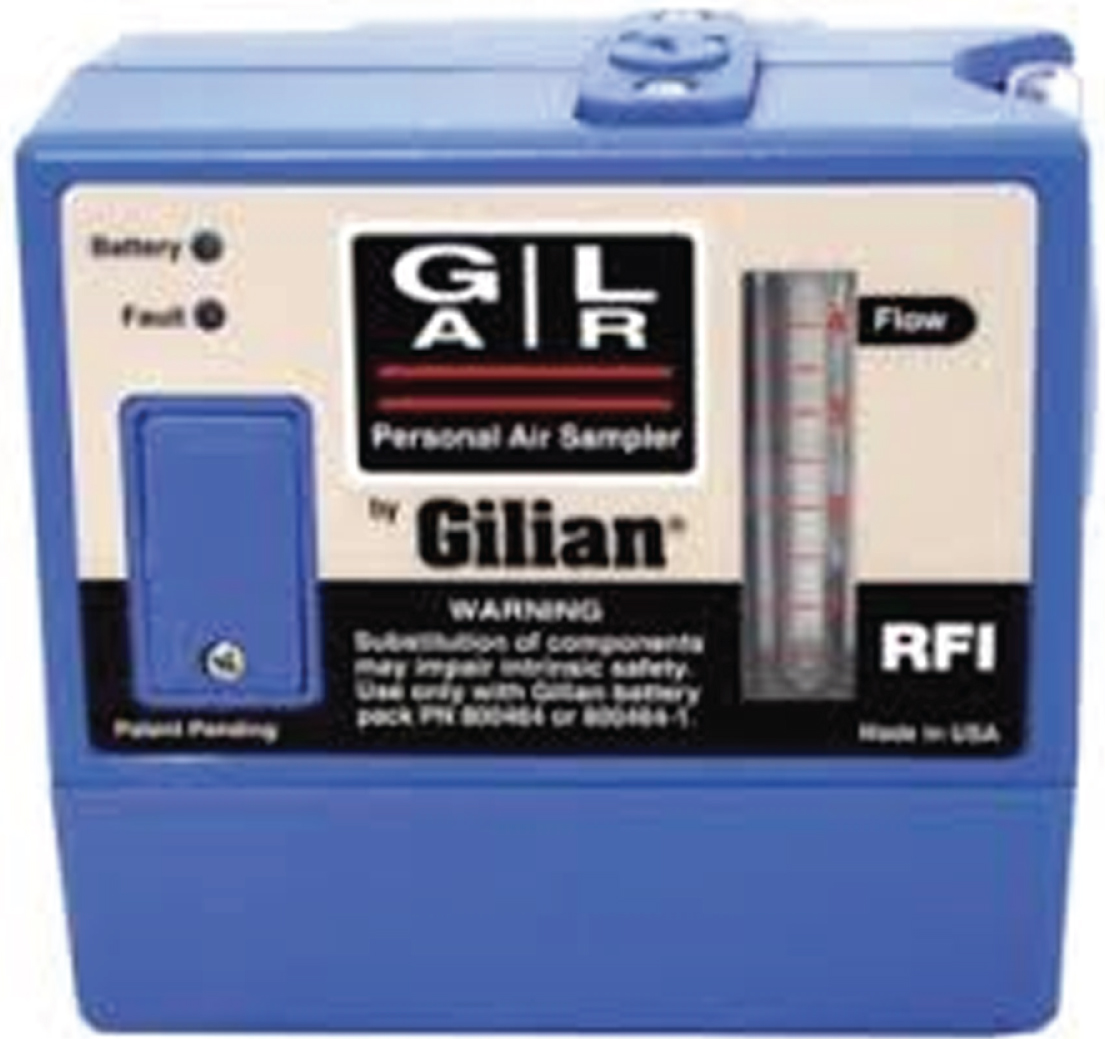
Personal Air Sampling pump used to measure personal level of PM2.5.
In addition, a questionnaire was used to determine the personal background information of the respondents participating in the study. Background information, such as age, race, height, and weight, were asked in the questionnaire.
The study found the respondents have a high PM2.5 concentration which is from 12.4μg/m3 to 55.3μg/m3 in 8 working hours. According to study location, the mean of PM2.5 concentration reported by respondents in KL and JB police station were 27.2μg/m3 and 30.4μg/m3 respectively. The PM2.5 concentration level ranged from 12.43–55.31μg/m3. Spearman rho’s test were carried out to identify the relationship between the concentration of PM2.5 and lung function which is shown in Table 3. A study states that knowledge of fundamental pathophysiology can regularly be picked up by comparing the measured values for pulmonary function tests obtained on a patient at any particular point with normative values derived from population studies. The severity of the abnormality is determined by the percentage of predicted normal [16].
Relationship between concentration of PM2.5 and lung function among traffic policemen (N = 134)
Relationship between concentration of PM2.5 and lung function among traffic policemen (N = 134)
By looking at the measured FEV1, the measured FVC and % Ratio FEV1/FVC variables, there was no significant relationship with the concentration of PM2.5. However, the relationship between the concentration of PM2.5 with the predicted FEV1 and predicted FVC was found to be statistically significant with a p-value < 0.05. This shows that their lung function has increased in abnormality with exposure to a high concentration of PM2.5. This was agreed by a study conducted in Hong Kong among bus drivers [17], suggests that there is a significant relationship between lung function and the concentration of PM2.5.
According to a 2005 study [18] exposure to dust is associated with both respiratory symptoms and lung function status. This is obvious because the respondents are exposed directly to the pollutants in the air as they work outside and are stationed at highly congested roads to direct traffic. Unlike this study, a similar previous study among traffic police and general police in KL in 2012 [19] have not found any significant relationship between PM2.5 concentration and lung function due to small sample size and environmental factors. Hence, the outcome of this present study is important verdict that the traffic policemen are affected with exposure to PM2.5. Findings from this study will contribute to the strong evidence that adverse health effects in other working populations are the outcomes of poor working environments and unsafe practices [20].
Future research may consider for the inclusion of all traffic police stations in Malaysia for bigger data and generalizability of the results. Due to the lack of time, the study is done at a specific point of time. A longitudinal study would be suggested in order to observe the patterns and have a high level of validity. In addition, a potential intervention study would be useful in identifying effective measures for minimizing exposure and preventing occupational lung diseases.
From this study, the PM2.5 personal exposure level (p < 0.05) is significantly related to the pulmonary function among traffic police. To conclude, traffic policemen are exposed to physical hazards from the traffic pollutants emitted by vehicles, such as fine particles. Therefore, recognition of the hazards associated with occupational lung disease and the prevention of exposure must be a high priority. It is recommended that a physician, such as an occupational health doctor, should be involved in the study so that it is easier to detect the respiratory problems. In addition, a long-term follow-up study would be beneficial to determine how personal exposure to PM2.5 affects the pulmonary function and respiratory problems faced by traffic police.
Conflict of interest
The authors declare that there is no conflict of interest.
Footnotes
Acknowledgements
Acknowledgement is given to the Officer in Charge of the Kuala Lumpur Traffic Police Station, ACP Mohd Nazri Hussain, and the Officer in Charge of the Johor Bahru Traffic Police Station ASP, Wan Zul Fikri Wan Othman, who granted permission to conduct the research in their respective police stations. The authors are also grateful to all the traffic policemen, especially those who participated in this research. The research was funded by the Ministry of Education Malaysia (MOE) Fundamental Research Grant Scheme (FRGS), Vote No: 5524770.