



Abstract
BACKGROUND:
Previously, a stretching regimen was designed for manual material handling (MMH) of gas cylinders as a potential ergonomic solution for reducing occupational injury. No studies have made use of objective process measures, such as muscle activation levels, for evaluation of effects of stretching programs.
OBJECTIVE:
Examine acute effects of stretching on muscle activation levels and driver perceived level of exertion in gas cylinder handling during simulated delivery operations.
METHODS:
A within-subject experiment was conducted with eight male participants being subjected randomly to two conditions over a two-day period: stretching before delivery trials and no stretching. Surface electromyography and the Borg CR-10 scale for perceived exertion were used.
RESULTS:
Generally, results were variable among muscle responses. The extensor muscle bundle in the forearm was found to show a significant decrease (p = 0.0464) in activation level because of stretching. The anterior deltoid and trapezius significantly increased (p < .0001) the EMG activation level with stretching. Also counter to expectations, participants rated perceived exertion significantly higher (p = 0.0423) for trials preceded by stretching.
CONCLUSIONS:
This research indicates a muscle stretching regimen in advance of MMH activities has mixed effects on activation levels across muscles. It is possible that effects are attributable to body posture positions, or manner of muscle use, during actual work activities. Findings indicate that stretching prior to work activity does have an impact on specific muscle activation.
Introduction
Industrial workers in the field of gas products delivery are exposed to a high risk of musculoskeletal injury and illness. While the gas cylinder industry has made many improvements in tools and personal protective equipment for workers, there are certain operations that are inherently demanding on the musculoskeletal system.
In a previous study, a gas products company responsible for cylinder distribution, requested the development of a stretching regimen for delivery drivers [1]. The goal of this regimen was to potentially reduce the risk of work-related musculoskeletal disorders (MSDs); specifically, those caused by overexertion. Overexertion injuries occur when muscles, tendons, or ligaments are stretched beyond their limits, or the stress of a load is beyond what a muscle can endure [2]. Everett [3] proposed that primary risk factors in overexertion injuries include posture stresses, forceful exertions, repetitive exertions, localized mechanical stresses, low temperature, and vibration exposure. Proper lifting techniques, mechanical support tools, job rotation, personal protective equipment, and many other controls are regularly implemented in workplaces to reduce the potential for worker risk of overexertion injuries. However, these injuries still occur at high rates and cost companies billions of dollars a year. Furthermore, documented use of stretching programs as an injury control measure has been limited.
In their report citing data from 2014, the Liberty Mutual Research Institute states “overexertion involving outside sources” as the mostly costly non-fatal work-related injury [4]. According to data from 2015, the Bureau of Labor Statistics found that overexertion injuries had the highest incidence rate per 10,000 full- time workers compared with all other injury categories [5]. These injuries amount to nearly $14B per year in workers compensation claims.
Morejon [1] identified muscles in gas cylinder delivery operators that were most negatively impacted by the occupational risk factor identified by Everett [3]. This outcome was based on delivery operator body segments with the highest injury rates. Among at-risk muscles, the research also identified those that were eccentrically contracted during high risk delivery tasks, including: the trapezius, medial deltoid, anterior deltoid, biceps, triceps, and the extensor and flexor bundles of the forearm. On this basis, a stretching regimen was designed to target these muscles with the expectation of moderating activation levels and potential fatigue during work task performance, which could lead to overexertion situations and potential injury.
In general, stretching has been found to reduce stress on ligaments and joints, lengthen muscles, and increase range of motion [6]. Furthermore, stretching allows muscles to relax, which increases blood flow to the muscle, allows for greater sensory awareness, and reduces fatigue, aches, and pain [6]. Intuitively, risks of overexertion injury due to a muscle being stretched beyond limits [2] may be mitigated through muscle lengthening and increasing range of motion in advance of task performance. Increasing the length of the muscle can reduce the number of posture positions that pose a threat for overexertion injury. This intuition is supported by research focused on implementation of workplace stretch and exercise programs. Several studies have reported findings of reduced MSD injury rate [7–10] and severity [9, 11–14] during periods of program implementation. In addition, several other studies have reported significant decreases in employee perceptions of musculoskeletal pain [15–17]. Increased strength [18] and worker commitment to safe work practices [12, 19] have also been cited as benefits of stretching programs.
Many different metrics have been used to assess outcomes of workplace stretching programs. However, no studies have made use of objective process response measures, such as muscle activation levels, for evaluation of program effectiveness. Such validation is needed as a basis for making recommendations for implementation of a stretching program for a workforce.
Regarding process measures of physical performance, electromyography (EMG) is a commonly used tool in manual material handling (MMH) research to assess muscle activity (voltage levels) during work tasks [20, 21]. Non-invasive EMG techniques are typically used in industrial settings for muscle loading and fatigue analysis due to common requirements for worker ballistic movements and varied posture positions.
EMG has also been used to assess the effects of stretching on muscle activation in non-industrial settings with mixed findings. Studies reporting long static stretch periods prior to strength activities have found that maximum muscle force is depressed [22, 23] and EMG amplitude is reduced [24]. Static stretch regimens of shorter duration have also been found to reduce muscle strength [25] and EMG amplitude up to 2 hours post- stretch [26]. However, other studies have failed to identify significant shifts in EMG amplitude measures or muscle output due to stretching [25, 28].
In general, it was expected that EMG may have the potential for revealing stretching program impact on muscle use and injury potential in MMH performance. With this in mind, the objective of this study was to assess the effectiveness of Morejon’s [1] stretching regimen on gas cylinder delivery operator muscle activation levels using EMG and their perceived level of exertion during typical work activities either following or not following the stretching regimen.
Methods
Participants
Eight male gas cylinder delivery drivers and/or delivery driver managers participated in this study with sample demographics being representative of delivery drivers throughout the sponsoring company. The sample size was limited due to required expertise of participants and company regular production demands. The average age of participants was 48.4 years (±9.5 years) with an average height and weight of 177.8 cm±6.1 cm and 102.0 kg±13.5 kg, respectively. None of the participants had a history of arm, shoulder, or back injuries or disorders. Every participant was right handed due to the EMG apparatus only having 8 channels and an experimental choice to collect more muscles on one-side of the body. All participants had received previous training in safety and handling procedures for cylinder delivery operations. Data on one driver was removed from analysis due to unrelated and unforeseen interruptions in experimental trials. Six of the eight participants were once employed as delivery operators with average experience of 7.6 years±6.4 years. The two other participants regularly performed delivery operations as part of their job duties. The experiment took place at a company facility in Raleigh, NC. The company flew-in employees meeting the inclusion criteria from multiple locations across the United States. Each participant arrived at least 12 hours before their first experiment and had one night’s sleep between the flight and the first experiment. Participants received their typical salary for the experiment and were not additionally compensated for participation.
Facility and cylinders
The experiment was conducted at a retail products and operations facility with equipment used in actual delivery operations. The company provided 10 small oxygen cylinders (height: 64.8 cm, diameter: 10.9 cm, weight: 3.6 kg; Fig. 1 (left)), 10 large helium cylinders (height: 139.7 cm, diameter: 23.6 cm, weight: 66.3 kg.; Fig. 1 (center)), 2 liquid nitrogen dewars on wheels (height: 134.6 cm, diameter: 66.0 cm, weight: 301.2 kg; Fig. 1 (right)), and a small cylinder hand cart; Fig. 1 (left)).

Oxygen gas small cylinder being placed in a small cylinder hand cart (left), large helium cylinders (center), and liquid nitrogen dewars (right) used in the experiment.
The equipment layout for the experiment is shown in Fig. 2. The three types of cylinders were distributed in a large warehouse space of approximately 15.24 m x 9.14 m.
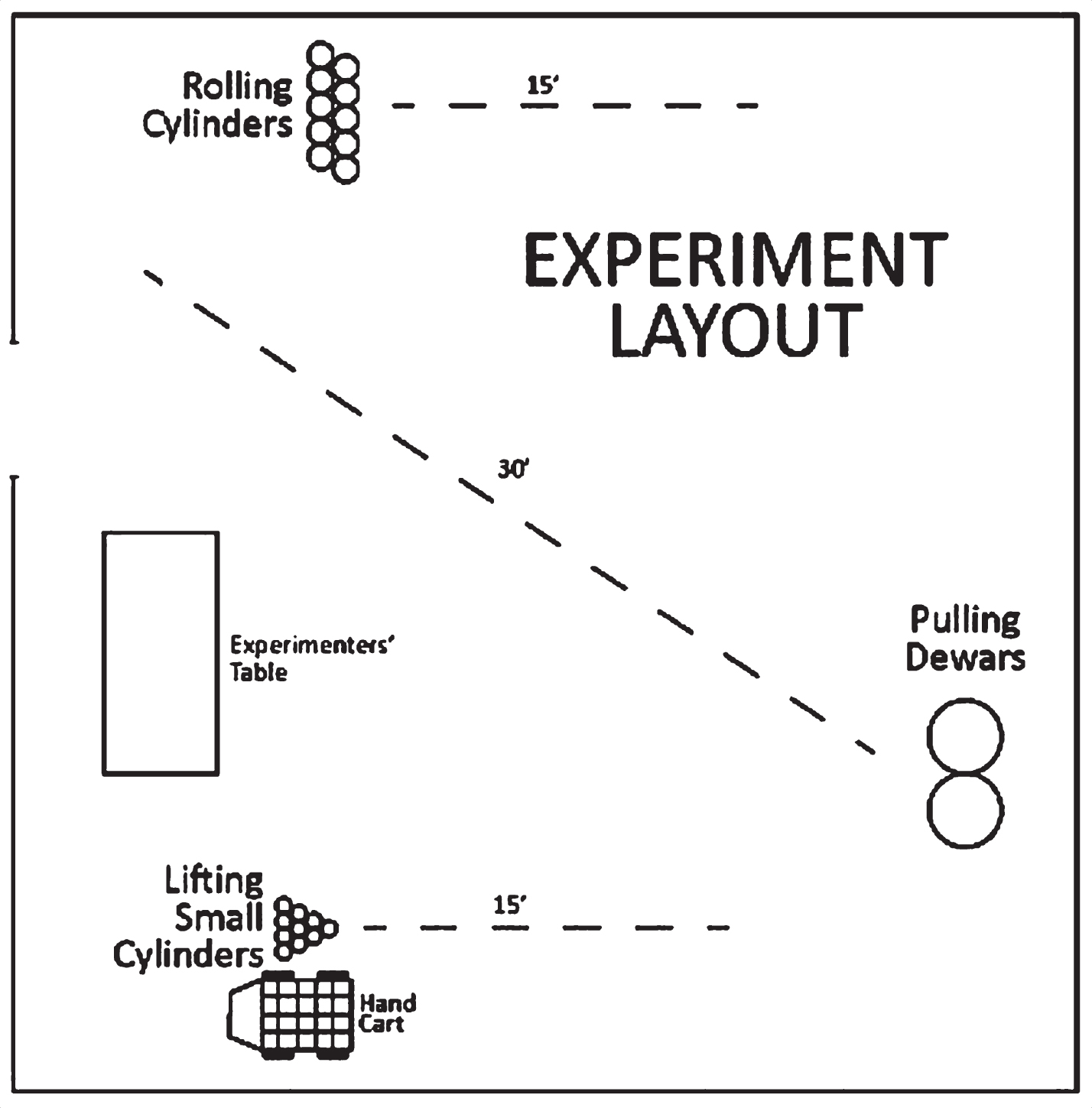
Experiment layout.
Based on the ergonomic risk assessment (ERA) of common gas product delivery tasks, as conducted by Morejon [1], three moderate to high risk tasks were selected for testing muscle activation levels. The tasks included lifting small cylinders, rolling cylinders, and pulling dewars with all designs being in compliance with standard operating and safety procedures for the company. In an attempt to mimic a mock delivery, a trial was defined as a combination of all three tasks presented in random order. Participants were instructed to complete trials without breaks between tasks. Each participant completed three trials per experiment condition.
Lifting small cylinders
Ten small oxygen cylinders were placed on the ground next to the wheeled handcart prior to the start of the experiment. Using their right hand, participants lifted five cylinders, one at a time, and placed them into the handcart. When complete, participants pushed the cart 15’ to a marked ending location and unloaded the cylinders one at a time, using their right hand. This cycle was repeated a total of four times per trial.
Rolling cylinders
Ten helium cylinders were placed on a pallet prior to the start of the experiment. Participants removed one cylinder using their right hand and rolled the cylinder 15’ before placing it on another pallet. Participants used their left hand only to support the cylinder. The standard operating procedure for rolling a cylinder is as follows: (1) Tilt a cylinder until it is resting on a bottom edge and hold the cylinder at the top with the right hand. (2) Use a foot to kick the cylinder forward while simultaneously twisting the cylinder in the forward direction with the right hand. (3) Finally, place the cylinder upright in the desired location and stabilize. During the experiment, this cycle was repeated ten times in each trial.
Pulling dewars
Two liquid nitrogen dewars on wheels were situated at marked starting locations prior to the experiment. Participants placed one hand on the upper handle of the dewar and one hand on a side handle, and then walked backwards while pulling the dewar for 30’. The dewar was then placed at a marked ending location. This cycle was repeated a total of four times during a single mock delivery trial.
Independent variables and experiment design
Given the goal of the study, we manipulated one independent variable, specifically participant stretching or no stretching prior to performance of the mock delivery trials. The stretching developed by Morejon [1] for targeting at-risk muscles that are eccentrically contracted during the three identified gas products delivery tasks was employed. The body segments targeted for stretching were those containing the most commonly injured muscles, as evidenced by Morejon’s [1] analysis of company OSHA 300 logs from January 2013 to September 2015. A total of eight stretches were included in the regimen. Illustrations of each stretch, including identification of target muscles, are presented in Fig. 3. These illustrations were provided to participants during the experiment. It was stated that each stretch had to be completed for each side of the body with three repetitions of 20 seconds each.

Description of the eight stretches and corresponding muscles.
The experiment followed a within-subject design with each participant experiencing both experimental conditions: stretching and no-stretching. Half of the participants performed tasks following stretching on the first day of the study with the other half experiencing no stretching. On the second day of the experiment, the two groups performed under opposite stretching conditions.
There was a 24-hr. rest period between the two test days. The order of the muscle stretches (1-8) was randomized before each trial under the stretching condition. As previously mentioned, task exposure was randomized within each trial within each stretching condition. The order of tasks in any one trial was not repeated in any other trial under the same stretching condition.
Two response measures were collected during the experiment, including the physiological measure of surface EMG maximum amplitude and the perceptual measure of perceived exertion using the Borg CR-10 scale [29].
Physiological measure
Bipolar electrodes (DelSys, Inc) were placed on participant skin over the bellies of seven muscles and used to monitor activity levels during the mock-delivery operations. The muscles included the upper trapezius, medial deltoid, extensor bundle of the forearm, flexor bundle of the forearm, bicep, triceps, and anterior deltoid. To limit the likelihood of EMG equipment and wires interfering with participant movements, all electrodes were only placed on the right side of a participant’s body.
EMG signal capture began at the start of each task repetition and ended with task completion. Researchers made any necessary equipment adjustments between repetitions and no repeat task performances were required of any participant due to equipment issues. Muscle activation responses were collected at a sampling rate of 1000 Hz.
Perceptual measure
Participants were also asked to rate their perceived level of exertion at the end of every experiment trial (mock-delivery). The Borg CR-10 (continuous rating, 10-point) Scale [29] was administered. This scale has previously been validated and used in many MMH studies to gauge participant perception of physical exertion. Ratings ranged from 0 to 10 with zero representing no effort and ten representing the highest exertion a participant has experienced.
Procedure
This experiment was approved by the Internal Review Board of North Carolina State University. Upon signing the consent form, participants completed the demographic/anthropometric survey with questions regarding work history and daily work operations. Body weight was self-reported and other measures, including height and upper-body segment lengths, were taken by researchers.
Each participant underwent an orientation for the multi-day experiment, including instructions on the stretching routine and tasks to be completed during the experiment. Due to participants prior training in proper cylinder handling and safety techniques, the tasks did not need to be demonstrated by researchers. A practice session was also provided for each participant, but all declined, based on their prior work experience. The illustrations and directions of all eight stretches were printed on a 48” by 36” poster board. Researchers instructed participants to examine the poster carefully and attempt the stretches to their best ability. Researchers critiqued stretching postures as needed to ensure stretches were performed correctly.
On the first day of the experiment for each participant, researchers located the seven previously specified muscles and marked electrode placement locations according to Criswell [30]. All electrode sites were shaved, wiped with rubbing alcohol and an abrasive scrub to reduce impedance levels. Electrodes were secured with medical tape and participant range of motion and signal integrity were verified.
Before the experiment test trials, participants were instructed to lie down on the facility floor and remain completely still in order to capture resting muscle activation levels (3 repetitions x 3 seconds). Participants then completed the first test trial followed by a 10-minute break. The break was to allow for muscle recovery and researchers asked participants to identify their perceived level of exertion in completing tasks by using the Borg scale. After the final test trial, participants completed Maximum Voluntary muscle Contractions (MVCs) to provide an additional baseline response for normalizing the test EMG data. MVCs were conducted post-trial to avoid carry-over effect in the experiment and integration of potential stretch effect. MVCs were performed with the seven muscles monitored by the wireless EMG system A standardized MVC procedure was used including 3 seconds of maximal muscle exertion [31, 32] with three replications to ensure accuracy [31, 33]. Subsequently, researchers carefully removed all electrodes from participants.
The stretching day followed the same order activities as the control day. However, immediately prior to every trial participants performed the 17 minute stretching regimen. The 10 minute breaks began at the end of each trial and ended with the start of the next stretching regimen.
Hypotheses
Although there has been limited research assessing the effects of stretching on muscle activity, two prior studies found significant decreases in EMG maximum amplitude following static stretching or a trend of reduction in muscle activity [24, 28]. A decrease in EMG maximum amplitude would indicate a reduction in the amount of work a muscle is performing, potentially reducing the likelihood of muscle fatigue and overexertion. Based on the prior studies, two hypotheses (H) were made: H1: It was expected that maximum EMG amplitude would be lower during delivery task performance preceded by stretching. H2: Based on the expectation for reduced EMG amplitude with stretching, indicating reduced muscular contraction, it was also expected that perceived level of exertion, according to the Borg CR10 scale, would be lower following trials that were preceded by stretching.
Data analysis
The EMG data was processed prior to submitting the data to an analysis of variance test (ANOVA). The raw EMG data was rectified (the absolute value was taken) and then passed through a linear envelope, which consisted of a low-pass filter with a cut-off frequency of around 2.5 Hz. Subsequently, the data was passed through a 4th order butterworth bandpass filter (20 Hz 450 Hz) and a 4th order notch butterworth filter (bandstop set as 58 62 Hz). The filtered data was then rectified and smoothed with a 50 ms moving average window. This filtering procedure is standard according to the Department of Health and Human Services [35].
The average EMG responses in this experiment were influenced by observations from periods of rest as well as intense work and were, therefore, not considered to be accurate indicators of muscle output for task performance. Consequently, the maximum EMG values for each muscle in each test trial (occurring during work) were used as bases for the muscular activity analysis. To be able to compare EMG activity in the same muscle on different days or in different individuals or to compare EMG activity between muscles, the EMG must be normalized [30, 36]. The common consensus is that a “good” reference value to which to normalize EMG signals should have high repeatability, especially in the same subject in the same session, and be meaningful. While MVC values were collected in order to be used as a reference point for normalization, they were often found to be inaccurate as the maximum EMG over the trial was often a greater value than the MVC. This could be attributed to the fact that many of the tasks performed in the study are isotonic tasks with some loading taking place. The changes in muscle length and the loading may increase the recorded EMG signals.
As a result, all test trial responses were normalized using an alternate acceptable normalization reference point [36] which is participant’s absolute maximum EMG (i.e., the maximum value observed during the entire experiment) and resting EMG responses (Equation 1)
The normalized EMG responses represent the levels of muscle activation during testing trials relative to the participant’s maximum potential.
Results
Physiological (EMG) responses
Diagnostic tests revealed EMG response violations of parametric (analysis of variance (ANOVA)) test assumptions, including normality and homoscedasticity. Appropriate transformations to the responses were attempted but they failed to resolve the violations. Therefore, a rank averaged transform was applied to the responses in order to perform a non-parametric analysis.
Table 1 presents the mean and standard deviations (SD) of the proportion of maximum muscle activation amplitude by stretching condition for each muscle across participants. Two of the seven monitored muscles showed a decrease in muscle activation level during stretching trials. However, there was also a trend for an increase in muscle activation during stretching trials for five of the seven monitored muscles, as compared to the no stretching condition.
Mean ratio of EMG signal [SD] of normalized EMG responses by stretching condition
Mean ratio of EMG signal [SD] of normalized EMG responses by stretching condition
Statistically speaking, among all tested muscles, the trapezius, extensor, and anterior deltoid were found to be significantly different in response among the stretching and control conditions. The effect details are presented in Table 2 and Fig. 4. The extensor showed lower muscle activation level following the stretching regimen. However, both the trapezius and the anterior deltoid showed opposite trends.
Stretch effects details for the Muscles demonstrating statistical significance
Stretch effects details for the Muscles demonstrating statistical significance

Stretch Effect on Normalized Trial Max EMG.
The effect of task type on muscle activation level was also analyzed. In general, all muscles responses appeared to be significantly influenced by the task manipulation. Tukey’s honest significant difference (HSD) tests were conducted on each muscle response to determine task type trends. Table 3 and Fig. 5 summarize the comparative intensity of the work tasks, including lifting small cylinders (L), rolling cylinders (R) and pulling dewars (P). The table reveals that lifting was consistently the most demanding task across all muscles, while pulling dewars elicited the least amount of muscular effort.
Task type effect and post hoc analysis results (lifting cylinders (L); rolling cylinders (R); pulling dewars (P))
Task type effect and post hoc analysis results (lifting cylinders (L); rolling cylinders (R); pulling dewars (P))

Task Type effect on muscle amplitude proportion.
The order of experiment trials was also found to be significant for the trapezius, medial deltoid, extensor, and flexor muscles. Post- hoc analyses were conducted on each muscle response in order to identify differences among condition settings. Table 4 summarizes the ANOVA and Tukey’s test results. Results revealed that muscle activation levels were greatest in the first mock delivery operation across days of the study.
Trial effects and post hoc analysis results with the trial number on a given day appearing in the last column
Trial effects and post hoc analysis results with the trial number on a given day appearing in the last column
Since Borg ratings were only collected at the close of each mock delivery, it was not possible to assess a task type effect for this particular response. Participants rated their perceived level of exertion after each experimental trial. Therefore, there were three observations per condition per participant, resulting in 42 total Borg CR-10 observations. Descriptive statistics were generated on these observations for each stretching condition. An ANOVA was conducted to determine the effect of stretching on participants’ perceived exertion during the experimental trials. Results showed that Borg ratings were significantly higher following stretching trials, as compared to control trials (F(1, 30) = 4.4969, p = .0423). Figure 6 shows the differences between conditions in terms of mean Borg ratings. The discussion provides some explanation for these results along with the EMG responses.

Stretch Effect on Borg Scale Rating.
The first hypothesis (H1) postulated that maximum EMG amplitude for major upper-extremity muscles would decrease during trials following the stretching condition. This hypothesis was based on some findings in the previous literature. In this study, results varied among the monitored muscles with the extensor being the only muscle showing a significant decrease in maximum amplitude in trials after the stretching condition. Contrary to hypothesis, the trapezius and anterior deltoid showed significant increases in maximum activation, while the remaining four muscles showed no significant differences between the stretching and control trials.
In a few studies on the effects of stretching on athletic performance, it has been found that stretching led to increased EMG signals, which were shown to correlate with increases in muscle strength and force output [24]. These outcomes were considered beneficial to task performance. On the contrary, the increase in EMG maximum amplitude observed in this experiment for the trapezius and anterior deltoid could indicate a quicker path to fatigue in gas delivery operations.
Haab et al. [38] did not notice a change in the EMG signal between pre-test and post-test measurements after implementing a 10-week stretching regimen. Serefoglu et al. [39] found the EMG activities of the agonist muscles exhibited no significant alterations following both stretching exercises of the antagonist muscles. These studies and the results of the present study lead to the belief that there likely will not be a significant difference in the EMG signal as a result of the stretching regimen over a longer period.
In general, the intent of the present investigation was to test the efficacy of a driver exercise program [1] that could be implemented before work at every delivery site during the course of a work day. The regimen developed by Morejon [1] targeted all “at-risk”, eccentrically contracted and frequently used muscles. Given the duration of each stretch and the number of repetitions, the regimen was approximately 17 minutes in length. Over the course of the experiment, participants (employees of the sponsoring company) expressed interest in implementing a stretching routine as part of their work shift, believing it would be beneficial for job safety; however, they also expressed concern with the practicality of performing the 17-minute stretching regimen before every delivery. The expert delivery operators did believe they could perform the routine at least once a day. Another alternate solution to reducing the amount of time devoted to stretching, would be to perform a subset of the identified stretches at each delivery site, with stretches being selected based on the major tasks to be performed. For example, if a specific delivery required numerous small cylinders to be delivered, then the employee could perform the stretches that specifically target the trapezius and extensor, which are highly activated during this particular task.
Some literature suggests that acute static stretching can cause performance deficits [40, 41], whereas other studies have shown that long term consistent stretching improves athletic performance [42] and muscle strength [18]. Some specific benefits of stretching that may reduce the possibility of overexertion injuries include improved range of motion, muscle lengthening, and reduced stress on ligaments and joints [6]. Continuous long- term implementation of the stretching regimen investigated in this study could have beneficial effects for muscles used in gas delivery operations. Ryan, et al. [25] reported an immediate increase in ROM after just 2 minutes of stretching of the plantar flexor muscles, but effects wore off within 10 minutes of the stretch.
The stretching regimen investigated in this study was created to target individual body parts for approximately 1.5 minutes as part of the total routine. Based on Ryan et al. [25] finding, it is possible that the effects of stretches performed at the beginning of the routine wore off prior to the start of the experimental trials. In this case, consistent application of the stretching regimen might be necessary in order to observe at work effects over time.
The order of experiment trials was also found to be significant for the trapezius, medial deltoid, extensor, and flexor muscles. Results revealed that muscle activation levels were greatest in the first mock delivery operation across days of the study. That is to say, workers may have become more efficient in muscle use across the experiment trials with task performance being consistent (e.g., no cylinder mishandling, no drops, and no loss of control).
Regarding H2, it was expected that participants would perceive lower levels of exertion in terms of the Borg CR-10 scale when completing the stretching regimen before trials. Our results were contrary to the hypothesis. In general, participant perceived exertion was significantly greater in trials following the stretching regimen. Participants commented on the length of the stretching regimen. This likely influenced their opinion of the perceived exertion as it resulted in longer trials compared to the trials not following the stretching regimen. Data was not collected on the regular exercise routines of participants outside of work; however, based on the anthropometric data collected, participants were generally identified as “obese” based on calculated Body Mass Index and Federal criteria. A prior study found higher maximal voluntary isometric contraction associated with overweight male and female during exercise, but relatively lower root mean squared values from MVIC procedures. Gender and BMI could potentially impact sEMG [43]. However, ratings of perceived exertion are likely not purely a measure of physical exertion, but likely also reveal an affective component [44]. In their study of the effect of unknown exercise duration and an unexpected increase in exercise duration on ratings of perceived exertion, Baden et al. [44] found that the unexpected increase in duration led to higher perceived exertion ratings than overall longer trials despite treadmill speed remaining consistent. This finding suggests that there is likely an anticipatory factor that contributes to the ratings of perceived exertion.
Morejon [1] conducted an ergonomic risk analysis (ERA) on gas cylinder operations focusing specifically on rolling cylinders, lifting small cylinders, and pulling dewars. Figure 7 depicts the average risk exposure ratings by body part for the three tasks revealing that upper-body muscles are at greatest risk for injury in delivery operations, as compared to other muscle groups. Related to these results, the findings of the present study on the EMG effects of the task type manipulation revealed a similar trend for the muscles/body segments observed in this study. Across studies, pulling dewars was consistently lower in terms of both muscle activation levels and the results of the ERA.
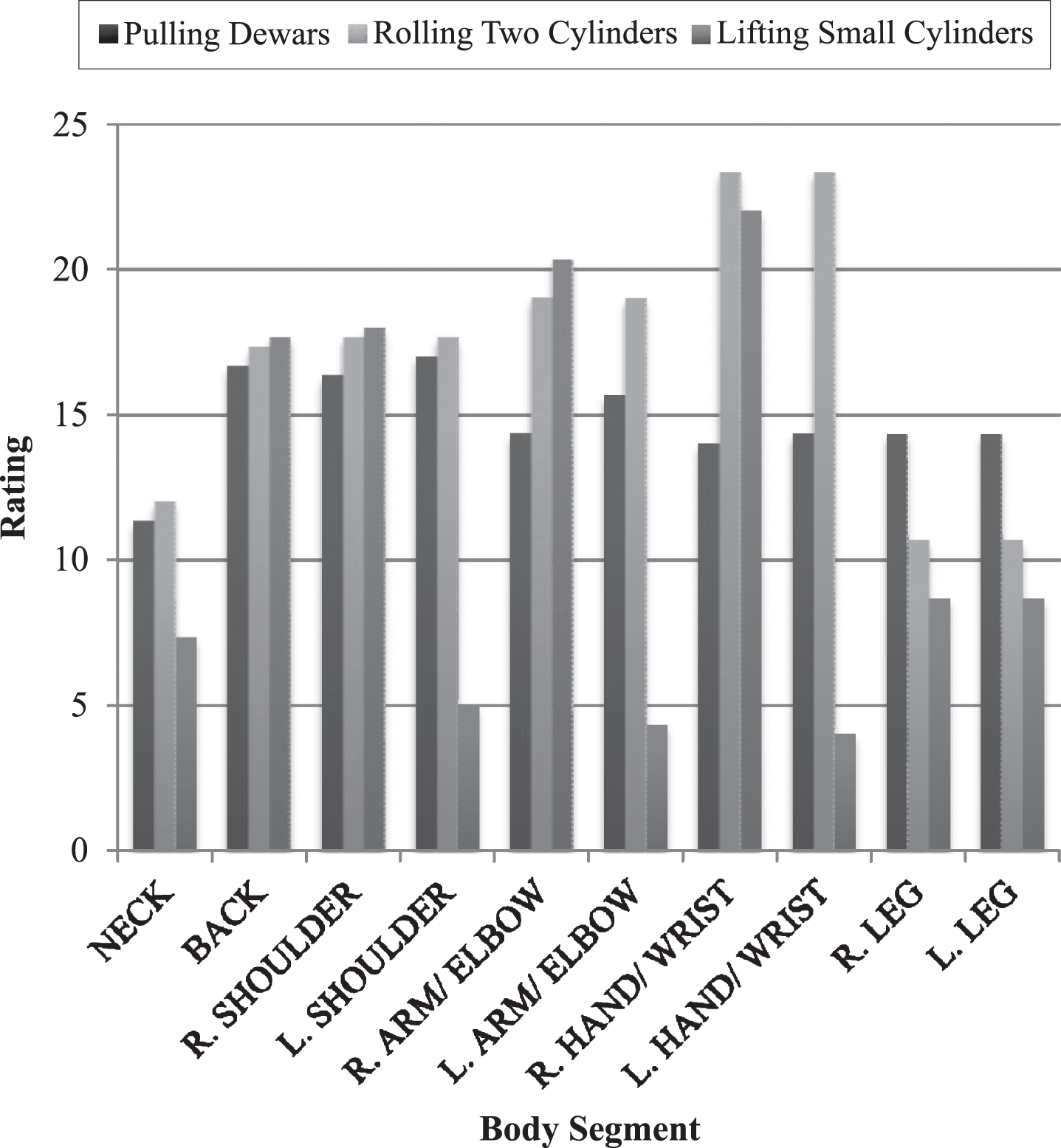
ERA ratings by body segment and task type [1].
Based on the ERA results from Morejon [1], it was assumed that dewars would pose a higher force requirement for movement; however, the highest average percentage of EMG maximum amplitude achieved by participants in the dewar task was approximately 25%. Here, it is important to note that the dewars are mounted on wheels, and despite weighing upwards of 650 lbs., the containers moved relatively easily across a smooth, concrete floor to the destination mark once the dewar was set in motion. This study did, however, examine the simplest task for moving dewars. Often the drivers have to move dewars up a ramp, which would likely result in ratings similar to that of the ERA with much higher muscle activation at the arms, back, and legs.
The present study investigated the effectiveness of a targeted stretching regimen on reducing gas delivery operator muscle activation during follow-on work tasks, the potential for muscle fatigue, and the likelihood for overexertion injuries. Analysis of EMG maximum muscle activation responses indicated that a stretching regimen in advance of manual handling activities has mixed effects on muscle activation across major muscles used in gas cylinder handling. The forearm extensor bundle of muscles showed a significant decrease in maximum EMG amplitude, while the anterior deltoid and the trapezius showed an increase in maximum amplitude. It was expected that reduced muscle activation would be indicative of reduced potential for fatigue and risk for overexertion. It is likely that the nature of the stretching exercises performed in this study had a substantial influence on the relevance of stretching to muscle activation levels during the work tasks. The literature provides clear evidence of long-term benefits of stretching, including increased ROM at joints, muscle lengthening, and stress reduction on ligaments and joints. All of these benefits may aid in the prevention of overexertion injuries. The implementation of the stretching regimen investigated in this study over an extended period of time may serve to reduce overexertion injuries. Based on the findings of the present study and current literature, it was recommended to the sponsoring company that workers perform the entire stretch routine once daily and that a small subset of stretches be performed for specific muscles most commonly used during tasks at specific delivery sites.
One of the main limitations of this study was the small sample size (n = 7). All participants were experienced with gas delivery operations, but the specific tasks completed during the study were not necessarily part of every participant’s regular routine. A larger sample size with more consistent demographics and a variety of lifestyles may have yielded different results. Another limitation of the study was the length of the stretching regimen. It is possible that the immediate, short-term effects of stretches completed at the beginning of the routine may have worn- off before participants performed the first test task. Completing the stretching routine once per shift would be a feasible and potentially cost-effective alternative for drivers to realize long-term benefits of stretching and reduce the likelihood and severity of injury, while not substantially compromising delivery operation productivity.
Future work should investigate the implementation of the stretching regimen in actual operations and analyze changes in worker injury rates and severity following implementation. In addition, future work could examine how to best incorporate a stretching regimen in the daily activities of drivers. Lastly, a longitudinal study investigating potential changes in muscle activation, as observed in the present study, and responses occurring over time with consistent worker adherence to the stretching regimen, would be provide additional useful evidence on the potential utility of stretching programs.
Conflict of interest
None to report.
Footnotes
Acknowledgments
The work of all of the authors was completed while affiliated with North Carolina State University and supported by the Edward P. Fitts Department of Industrial and Systems Engineering. The authors would like to thank all the expert operators and safety officers of the sponsoring company for their participation in the experimental study as well as input on the design of the experiment and data analysis.