



Abstract
BACKGROUND:
Various parameters can affect the performance of firefighters. Thermal stress in firefighters is one of the most important harmful factors, which causes impaired performance and subsequent occupational accidents. Therefore, this study aimed to evaluate the effect of personal protective equipment (PPE) on thermal stress in firefighters.
MATERIALS AND METHODS:
This descriptive-analytical cross-sectional study was performed on 30 firefighters. Heart rate, metabolism and temperature parameters were measured with and without using PPE in a simulated standard chamber. Then, the two indices of predicted mean vote (PMV) and predicted percentage dissatisfied (PPD) were calculated. Data analysis was performed using SPSS version 22.0.
RESULTS:
The results showed that PPE-induced weight directly increased heart rate and indirectly led to an increase in metabolism and temperature as well as significant changes in PMV and PPD indices (p < 0.001). In addition, our results showed that the effect of thermal resistance of clothing (Clo) on PMV and PPD indices was very high (p < 0.001).
CONCLUSION:
The findings of the study indicated that heat stress in firefighters is influenced by PPE weight and thermal resistance of clothing. Therefore, cooling vests can be used to reduce the thermal stress induced by temperature rise resulted from metabolism, PPE weight and thermal resistance of clothing. Reduced thermal stress will lead to the cooling of body temperature to acceptable levels of PMV and PPD.
Keywords
Introduction
Several harmful factors threaten the health of firefighters. Lack of proper control of these factors may result in irreparable human and financial losses [1]. When firefighting, firefighters are prone to heat stress, increased heart rate and elevated body temperature. These can cause a variety of short and long term complications [2–4]. Heat stress, which can result in heat strain, is one of the most important harmful factors that most firefighters face in their occupational environment. Heat stress will be exacerbated if firefighters use personal protective equipment [1, 5]. In addition to creating health problems, heat stress affects the performance of firefighters and increases the probability of occurrence of all types of accidents and injuries [6]. In addition, one of the reasons for resistance of employees to use PPE is its thermal stress [3, 7].
Firefighting operation is a physiologically exhausting occupation due to exposure to extreme external heat and extra physical-thermal load from thermal protective clothing. Moreover, hot environments affect the thermal balance of the body and lead to heat stress [8, 9]. However, thermal protective clothing provides significant protection against the external environment during fire.
Personal protective equipment is highly effective in reducing the risk of exposure to a variety of hazards [7, 11]. Although PPE is considered as the last layer of protection in the occupational safety and health domain [12, 13], but also it is considered one of the most effective safety and protective items in firefighting activities [3].
Thermal protective clothing can limit heat exchange between human body and the environment and causes thermal stress, physical and mental disorders as well as reduced efficiency and productivity [14]. According to official statistics from the U.S. National Fire Protection Association (NFPA), thermal stress accounted for 4.2% of injuries in U.S. firefighters in 2014 [15]. Also, evidence suggests that exposure to heat stress in many occupational environments has a negative impact on different aspects of human performance [16].
Therefore, environmental conditions and personal protective equipment are important factors that can lead to heat strain among firefighters. Since thermal stress caused by personal protective equipment can affect the performance of firefighters, this study aimed to evaluate the effect of personal protective equipment on heat stress indices in firefighters.
Materials and methods
This descriptive-analytical cross-sectional study was conducted in 2017-2018. The sample consisted of 30 operational firefighters selected by taking a census. The implementation steps are presented in Fig. 1.
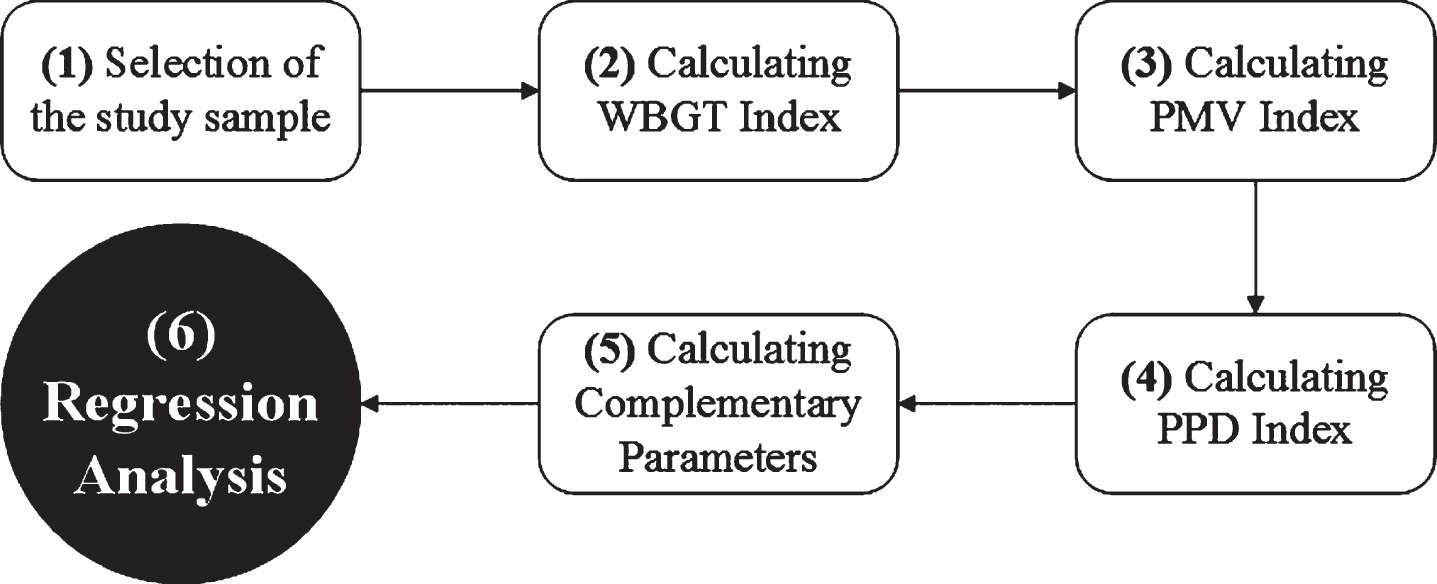
The study algorithm.
The selection criterion of the firefighters included physical and mental health. The data were collected in a standard chamber that was simulated based on real-world conditions (Fig. 2).

The study chamber.
The wet-bulb globe temperature (WBGT) index was used to measure heat exposure. The WBGT index, which easily and accurately specifies heat exposure in industrial environments, was used to standardize the environment of the chamber [17]. The WBGT index was measured by the WBGT meter TES1369B model. Also, PPD and PMV were used to evaluate thermal stress among firefighters. Thermal comfort was estimated by calculating: Predicted Mean Vote (PMV), activity level and thermal resistance of clothing as well as measuring atmospheric parameters such as air temperature, mean radiant temperature, air velocity and relative humidity. According to the American Society of Heating, Refrigerating and Air-Conditioning Engineers (ASHRAE), PMV index predicts the mean response of a large group of people [18, 19]. Moreover, Predicted Percentage Dissatisfied (PPD) index provides information on thermal discomfort or dissatisfaction. The percentage of people who feel too hot or too cold can be predicted using PPD index. PPD index can also be calculated through the predicted mean vote (PMV) index [16, 20]. Furthermore, the prevailing feeling of thermal comfort was measured in ranges of hot, warm, slightly warm, natural or neutral, slightly cool, cool and cold.
Metabolism is a biomechanical process defined as a comprehensive chemical process for converting food and oxygen to mechanical functions (internal and external). Food is converted into Adenosine Tri-Phosphate (ATP), energy-carrying molecules, which release energy during muscular effort and chemical reactions. Since most of the chemical energy we get from our food turns into thermal energy and very little is changed into mechanical energy (useful work), we can only calculate thermal energy to measure metabolism (and ignore mechanical energy) [21].
Clothing acts as insulators for human body. Thermal Resistance of Clothing (Clo) or ‘clothing insulation’, a dimensionless quantity, was used as a measure of thermal insulation against heat transfer from skin to the outer layer of clothing [22].
Since the activity level of firefighters is assumed to be moderate, the metabolism rate and workload is around 5.1 Kcal/min or approximately 300 Kcal/h. This workload is equivalent to walking on a treadmill with zero-percent incline at a speed of 3.5–5.5 Km/h. Given this activity level and workload, the occupational exposure limit (OEL) of heat stress is 30°C for each firefighter who participates in firefighting operations for 25–50% of an 8-hour shift [23, 24]. It should be noted that the threshold temperature was not considered in this study due to the assumed adaptability of firefighters to their workplace. Also, the temperature was calculated to be 30°C, given the effect of firefighters’ clothing (Clo) on an increase of 4°C in OEL and corrected WBGT, to allow firefighters to operate in an appropriate environment. It should be noted that the variables of the study were evaluated in two situations: not using PPE and using PPE.
In the first test, the firefighters were studied without using firefighting equipment;the combined thermal resistance of daily-use clothing was assumed to be Clo = 0.5 (including shorts, T-shirt, thin pants, thin socks and shoes) according to national standards. A standard chamber with constant specifications includingrelative humidity = 22%, air velocity =0.8 m/s and WBGT = 26°C was prepared. The firefighters were asked to walk on a treadmill at a speed of 3.5–5.5 Km/h for 10 minutes so that their activity level and work load reached the desired level of 300 km/h. Then, their heart rates and metabolism rates were measured in the first 20 seconds of the rest time. PMV and PPD indices entered the calculations and the range of thermal comfort was analyzed. A checklist was used for recording the data including age and weight.
In the second test, firefighters participated in the study with firefighting equipment. They were asked not to wear firefighting clothing; instead they took the clothing in their hands since WBGT, corrected with Clo, was compensated by the increase in WBGT within the standard chamber. The thermal resistance of clothing (including short sleeve underwear, underwear blouse, trousers and jackets, shoes and socks) was 1.4. Thus, OEL of the first test was increased by 4°C so that WBGT reached 30°C. Therefore, the only factor that changed within the standard chamber, as compared with the first test, was WBGT. As a result of PPE weight, the heart rate and consequently the metabolism rate would change and affect PMV and PPD.
It should be noted that in the standard chamber of the second test, the relative humidity and air velocity as well as the speed of walking on treadmill were fixed, as in the first test. In this test, the checklist was used for recording the data. Therefore, the effect of PPE on PMV and PPD changes was evaluated based on the results of the two tests. Data analysis was performed using IBM SPSS version 22.0. Paired t-test was used to assess the relationship between the heat loads (from firefighter PPE and metabolism) and PMV and PPD. Additionally, regression analysis was used to investigate the effect of temperature rise resulted from Clo, metabolism and PPE weight on PMV and PPD.
Mean age and work experience of the participants were 28.73±2.43 and 3.07±2.06 years, respectively. Their mean body mass index (BMI) was 20.19±1.06 kg/m2 (Table 1).
Demographic characteristics of the participants
Demographic characteristics of the participants
In the first test, PMV and PPD were calculated for each firefighter without firefighting equipment at a temperature of 26°C. In the second test, PMV and PPD were calculated for each firefighter with firefighting equipment at a temperature of 30°C. As can be seen in Table 2, the results showed that in the second test, mean heart rate, mean metabolism rate, mean weight, mean PMV and mean PPD (increased by13.86 beats per minute) was 2%, 15.67 kg, 1.44 and 54.14, respectively. Also, thermal sensation changed from a state of thermal neutrality or comfort in the first test to a warm state in the second test. All changes in the second test show that firefighting equipment can increase heat stress, independent of weather conditions. In addition, thermal sensation approached the warm and slightly warm state. This amount of change in thermal stress indices resulted from firefighter clothing Clo, metabolism, and PPE weight.
The results of the two tests
The results of paired t-test showed that at the confidence level of 95% and the significance level of 0.05, there was a significant correlation between temperature rise (resulted from firefighter clothing Clo, metabolism, and PPE weight) and PMV and PPD indices (p < 0.001). A regression analysis-based modeling was used to determine how much of the change was due to each of these factors. Analytical results indicated that the effects of metabolism (β= 0.220 and p < 0.001) and temperature (β= 0.950 and p < 0.001) on PMV were significant (Table 3):
Results of regression analysis of PMV (dependent variable) fit
In addition, the simultaneous effects of metabolism (β= 0.028, P < 0.001) and temperature (β= 0.940 and p < 0.001) on PPD changes were significant (Table 4).
Results of regression analysis of PPD (dependent variable) fit
The chain relations of weight-heart rate-metabolism and PMV and PPD indices are presented in models 1 and 2 and Table 5.
Coefficients of the path related to the research model
The results of the regression model showed a significant relationship between heart rate and weight (β= 0.76, P < 0.05), between heart rate and metabolism rate (β= 0.34, P < 0.05), between metabolism rate and PMV (β= 0.32, P < 0.05) and between metabolism rate and PPD (β= 0.31, P < 0.05). Also, the results showed that the effect of weight on PMV and PPD was 8.4% and 8.1%, respectively. This means that 8.4% PMV dispersion and 8.1% PPD dispersion can be described by weight index.


The findings of this study showed the effects of different parameters such as temperature, heart rate and metabolism rate on PMV and PPD indices. Awbi (2003) stated that activity level (metabolic rate), thermal resistance of clothing and environmental parameters including air temperature, mean radiant temperature, relative air velocity and the partial vapor pressure of water are required in PMV equation [25]. Moreover, ISO7730 (1984) and some other studies have stressed the determination of PPD index based on the calculation of PMV index [16, 26].
It is worth noting that according to ANSI/ASHRAE-SS-1981, thermal comfort refers to the condition of mind that expresses satisfaction with the thermal environment [27]. The findings of this study showed that in the first test, heart rate was between 102 and 111 beats per minute, metabolism rate was between 2.1 and 2.9 (MET), weight range was between 55 and 65 kg without personal protective equipment, temperature was 26°C, PMV values were 0.04–0.49 and PPD values ranged from 5% to 10%. On the basis of these results and according to ASHRAE standard 55, the thermal comfort at this stage was normal and within the acceptable limits [28].
In the second test, heart rate ranged from 114 to 125 beats per minute, metabolism rate was between 2.141 and 2.959 (MET) and weight range was from 70 to 80 kg due to the use of firefighting PPE. The temperature in this test was 30 C. WBGT was increased by 4 C due to the effect of firefighter clothing (thermal resistance coefficient). An increase of 1.30–2.10 in PMV and an increase of 40% –77% in PPD were observed due to the effective factors such as temperature rise resulted from firefighter clothing Clo, metabolism, and PPE weight on thermal stress. Therefore, based on these findings and according to ASHRAE standard 55 (2010) and given the values of the thermal stress indices, feeling of thermal comfort in this stage of the test was within the range of slightly warm and warm [29]. Also, according to ISO7730 (1984), temperature rise resulted from firefighter clothing Clo, metabolism, and PPE weight affect PMV and PPD [26].
The effects of standard regression coefficient (β) of each variable on PMV and PPD were compared in order to investigate the effects of temperature and metabolism. The standardized regression coefficient was used to determine the contribution of each independent variable in order to justify changes of the dependent variable. That is, the higher the beta coefficient of a variable, the more its role is in predicting changes of the dependent variable. The results indicated that the effect of temperature on PMV and PPD was significantly higher than the effect of metabolism.
Considering beta value of temperature rise resulted from firefighter clothing Clo and metabolism in thermal comfort indices (PMV and PPD) obtained in the model as well as the regression analysis of PPE weight, we can say that the temperature rise resulted from firefighting personal protective equipment was mostly effective on PMV and PPD indices since the larger the beta coefficient of a variable, the more its role is in predicting the changes in the dependent variable.
Although some important innovations have been achieved in this study, one of the most important limitations of this study is the small sample size. Sampling from a larger population could improve the results of this study.
Conclusion
Based on the findings of this study, firefighting equipment can affect thermal stress. This means that the increased weight caused by PPE results in an increase of 1–2% in metabolism rate due to changes in heart rate. This increase in metabolism rate and temperature will lead to significant changes in PMV and PPD indices. According to sports experts, body weight gain leads to sweating. Cooling vests can be used to reduce heat stress using equations 1 and 2 (in this study) since environmental conditions and personal protective equipment lead to heat stress in firefighters and PPE-induced heat stress can be controlled.
Conflict of interest
There is no conflict of interest in this work.
Footnotes
Acknowledgments
The authors are very grateful to the firefighters whose participation made this study possible.