



Abstract
BACKGROUND:
Marching band activities consist of both physically and cognitively demanding tasks. The demands that this activity has on players has largely been unstudied.
OBJECTIVE:
The goal of this study was to investigate the effects of players’ experience level, role, and gender on the workload of marching band players via a field study.
METHODS:
Surveys were issued during one game day to the Oregon State University Marching Band (OSUMB) in the fall of 2017. Increments of discomfort ratings and workload ratings were gathered. The three independent variables were experience level (novice or experienced), role (leader or non-leader), and gender.
RESULTS:
Novice players had a higher discomfort for their left hand and a higher level of cognitive demand as opposed to experienced players. Leaders had a higher increment of discomfort in their neck and upper back, and higher workload ratings in their performance workload and overall weighted workload than the non-leaders. Gender had no effect on increment of discomfort and workload, but some trends were noted.
CONCLUSIONS:
This study indicates that players’ role and experience, but not gender, can influence their workloads and discomfort.
Introduction
Playing an instrument has been found to be associated with the development of musculoskeletal disorders (MSDs). Many factors in various band activities can contribute to the risk of MSDs among players [1]. Previous studies found that either prolonged playing across years or intensive playing over the course of a week can lead to musculoskeletal discomfort, joint flexibility issues, a decline in playing abilities, or a combination of all three [2–6]. Specifically, marching band players’ physical stress has been proven to be high due to marching activities [7, 8]. Moreover, players’ stress and anxiety levels has been proven to be higher when preforming in front of an audience as compared to playing alone [9–11].
Developing an MSD can largely impact a person’s life. One study showed that people who had a long term MSD reported a lower quality of life for their physical, social, and mental health [12]. Having an MSD can effect someone negatively by having pain in those areas. For example, musicians were found to be restricted participation at work [6]. Socially, an MSD might prevent someone from participating in social events and activities. Both of these aspects can have a negative impact on someone’s mental health as well. Developing an MSD is not just a worry for a few selected individuals, it can impact anyone. MSDs can develop through repetitive actions, limited breaks, and poor posture [13]. Any task that requires the same movement again and again is at risk of being the cause for an MSD. Poor posture can be a factor as well. In some tasks, changing posture can be a simple task. However, there are many areas where a designated bad posture is required for the job.
The risk of developing MSDs among marching band players in college settings is large due to the high physical and mental stress experienced by the players. They are asked to participate in long practice times, nine-hour game days, all while being able to stay on top of their schoolwork. Moreover, they need to carry a wide range of instruments in terms of shapes, sizes, weights, and playing positions. Furthermore, experience level, role, and gender have been found to influence the risk of MSDs among workers which have barely been investigated among players [14, 15]. In summary, there is a lack of understanding for factors which contribute to the development of MSDs among college players. Previous studies either focus on musicians who play alone or focus on effects of factors from a single source, physical demands or cognitive demands. Additionally, the risk of MSDs among adolescent players has been overlooked in previous studies [16].
The goal of this study was to investigate the effects of players’ experience level, role, and gender on the workload of marching band players via a field study.
Methodologies
Participants and variables
70 participants from the 2017 Oregon State University Marching Band (OSUMB) were recruited for this field study. These students were in their undergraduate years in a university setting. Institutional Review Board (IRB) permission was granted for this study.
The independent variables are players’ experience level, role, and gender (Table 1). There are two levels of “Experience Level”, novice vs. experienced. It was determined by how many years a student has participated in the OSUMB. If it was their first year in the OSUMB, they were labeled as novice. Otherwise, they were labeled as experienced. There are two levels of “Role”, leader vs. non-leader. It was determined by if the student held a leadership position. Gender was determined by the student’s self-identification. Dependent variables are the increments of discomfort ratings of twenty-four body parts from neck to feet and self-reported workload ratings.
Number of participants in each test situation
Number of participants in each test situation
The field study was conducted on September 9th, 2017 on the day of an Oregon State University (OSU) football game day. The nine-hour day for the marching band consisted of a rehearsal time, parading through the campus, performing at standstill, preforming while marching, performing two separate 10 minute shows, and performing short songs that are frequently played during the game. The players were only given one 40-minute rest for food in the middle of the day. The temperatures for the day had a high of 79°F and a low of 49°F.
The participants were asked to fill out four surveys: 1) Demographics Survey with general questions, 2) Nordic Questionnaire that determined any pre-existing injuries, 3) Pre-Game Survey which was filled out the morning of September 9th before any OSUMB activities had begun to determine current discomfort (scale of 1 to 10), and 4) Post-game Survey which was completed immediately after the entire game day which determined the discomfort ratings and workload ratings the players had for that day. The BORG-CR10 was used to collect body discomfort ratings for the selected twenty four body parts [17]. Once the pre and post-game discomfort ratings were collected, the increments of body discomfort ratings were calculated by subtracting the post-game ratings by the pre-game ratings. The NASA Task Load Index was used to collect workload ratings [18].
Data analysis
The MATLAB program (The MathWorks Inc., version 2016b, 2016) was used to perform the statistical analysis. A p-value of 0.10 was set to define a statistically significant result. Paired t-tests were run to test the effects of individual independent variables on the increment of discomfort ratings and workload ratings. In addition, since all leaders were experienced players, their ratings were compared to experienced non-leaders to reduce the effect of experience.
Results
Increment of discomfort
Experience
The only statistically significant difference found between the two experience levels was the left hand with a p-value of 0.090 (Fig. 1). Novice players had significantly more discomfort than experienced players within this body part, with an average increment of 1.366 while experienced players had an average increment of 0.681. All other body parts did not show a statistically significant difference. For both groups, higher discomfort in their neck, shoulders, back, and feet were found.

Means of the increments of body discomfort ratings of the experienced and non-experienced groups.
The average numbers of years in OSUMB for the non-leader group was 3.21 years, and for the leader groups was 4 years. A significant difference was found for the neck and upper back discomfort with p-values of 0.020 and 0.012, respectively (Fig. 2). Leaders had a higher neck discomfort and a higher upper back discomfort than the non-leaders, with an average rating of 2.584 and 3.420, respectively. Non-leaders had an average rating of 1.290 and 1.601 for the two body parts, respectively. No other statistically significant differences were found for the other body parts. Higher leader increments of discomfort trends were noted in their upper body. Interestingly, the hands and fingers trends toward the non-leaders having a higher increment of discomfort.
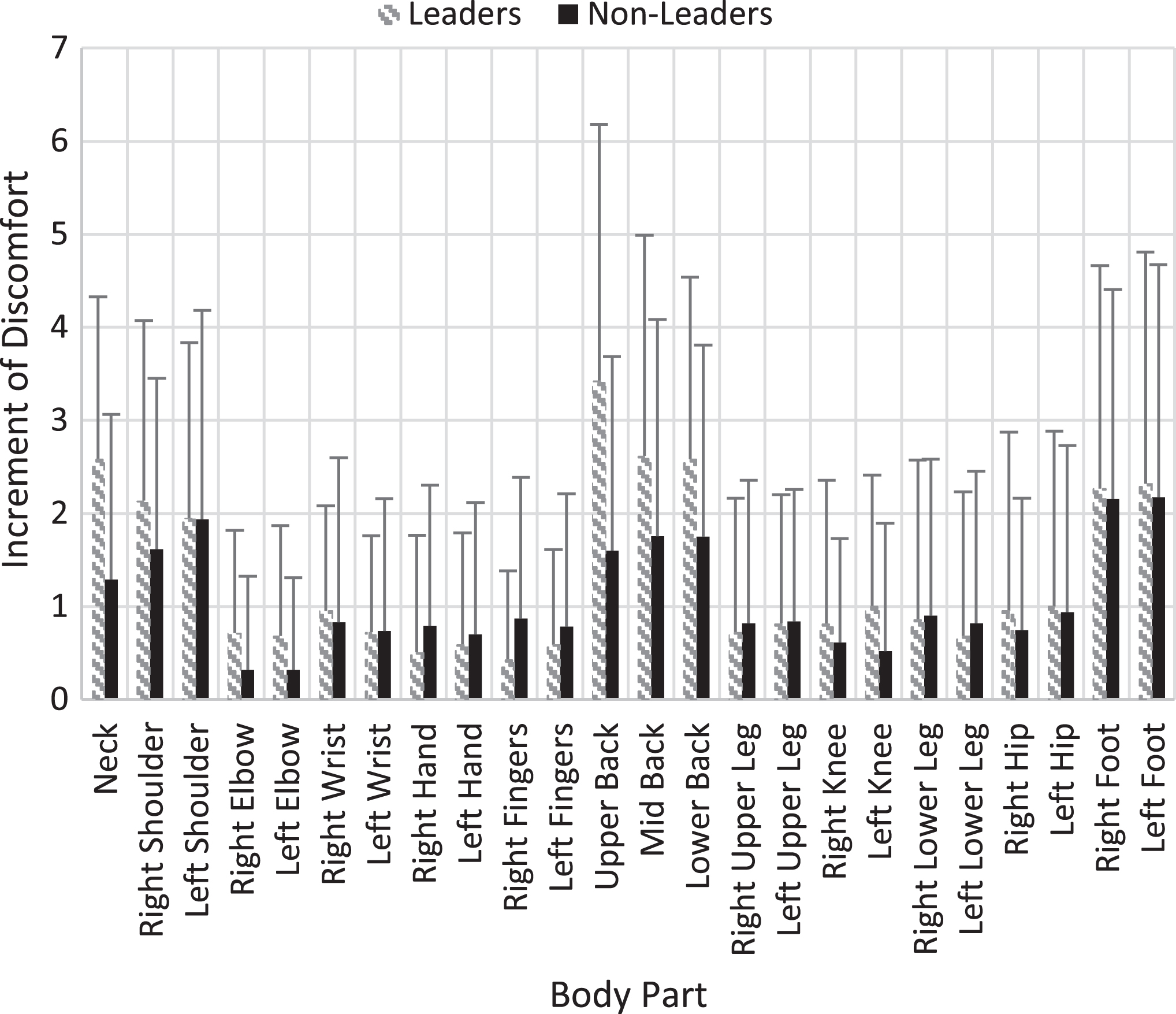
Means of the increments of body discomfort ratings of the leader and non-leader groups.
There were no statistically significant differences for gender. A trend was noted for females, they had rated their discomfort higher than males in all areas except the fingers, knees, lower legs, and feet. The results for this test are shown in Fig. 3.
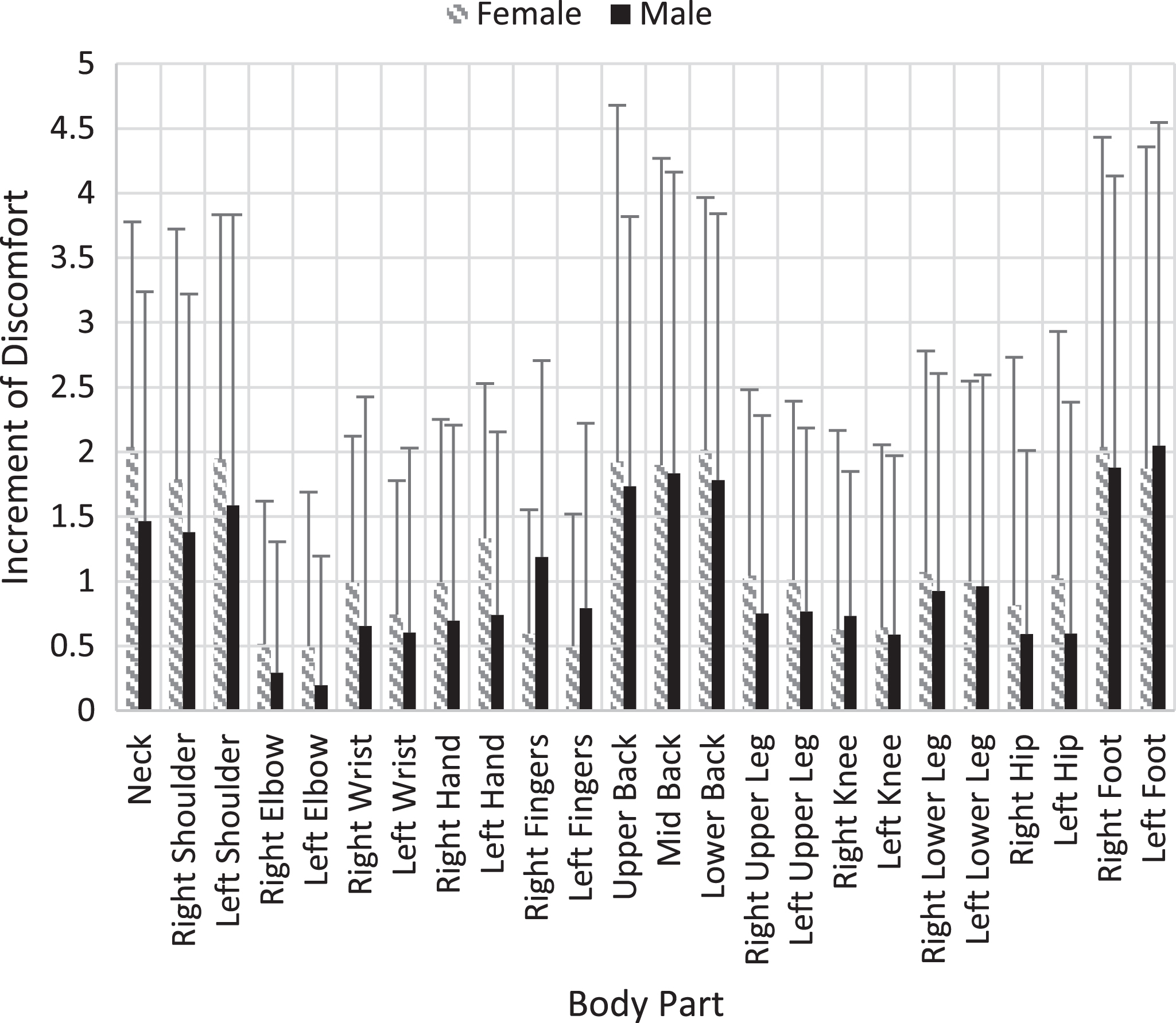
Means of the increments of body discomfort ratings of the male and female groups.
Experience
There was a statistically significant difference for the mental demand between the experienced and novice players with a p-value of 0.0633 (Fig. 4). The novice players had more mental demand than the experienced players, with an average rating of 68.75 while the experienced players had an average rating of 61.316. No other difference was statistically significant.
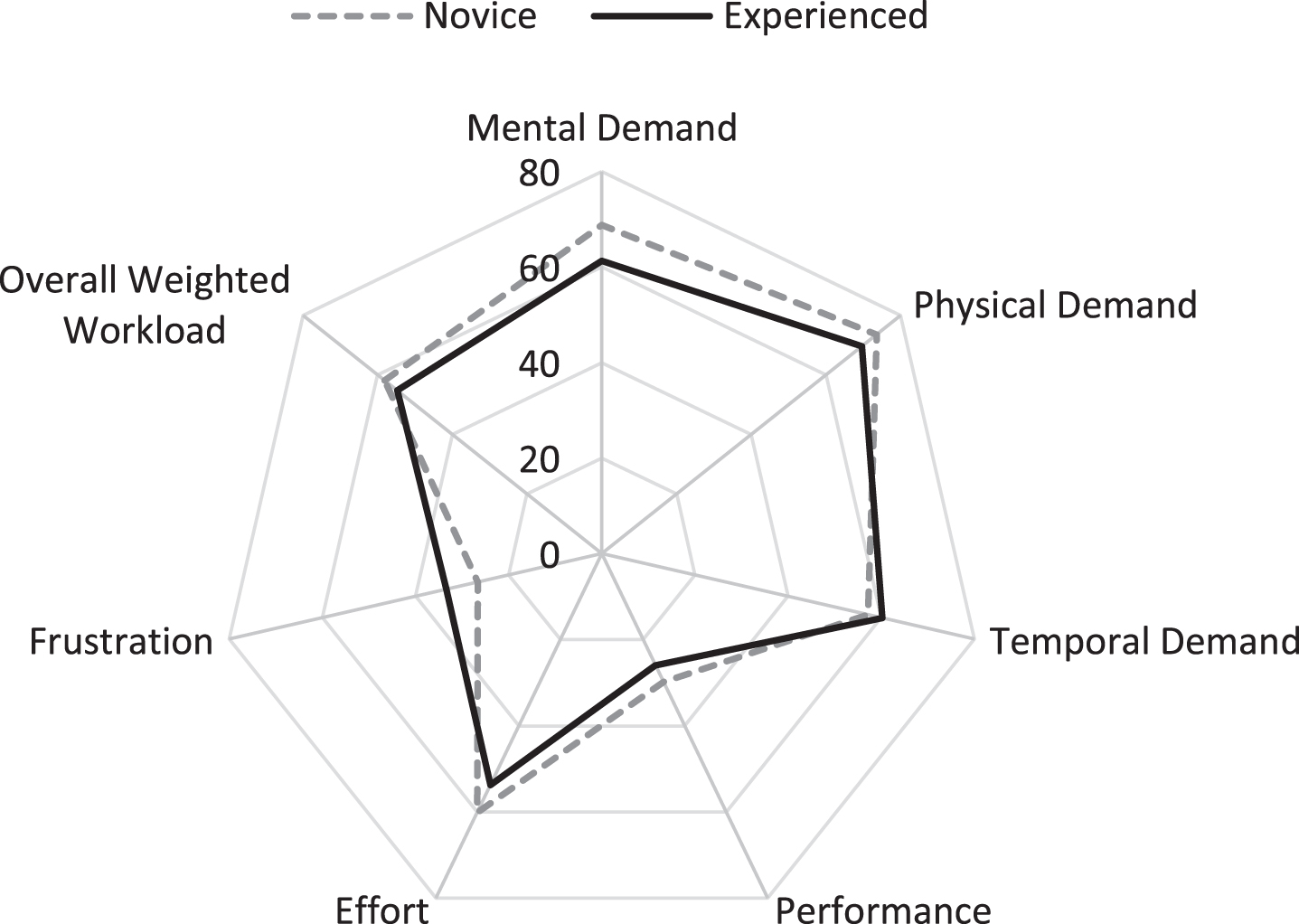
Means of the workload ratings of the experienced and non-experienced groups.
A significant difference was determined for performance between experienced leaders and experienced non-leaders with a p-value of 0.055, shown in Fig. 5. Leaders had a higher performance workload than non-leaders, with an average rating of 43.0 as opposed to the non-leaders average rating of 25.5. While there were no other workloads that were significantly different for this independent variable, the overall workload was significantly different with a p-value of 0.043. The leaders’ mean overall workload was higher than non-leaders with an average rating of 63.6. Non-leaders had an average rating of 53.7. The workload ratings trend towards the leaders having a higher workload in all areas.

Means of the workload ratings of the leaders and non-leaders groups.
Figure 6 shows the results of the effect of gender on players’ workload. There was no statistically significant difference found between the two genders. Females noted a higher workload than males in all areas except frustration and temporal demand.
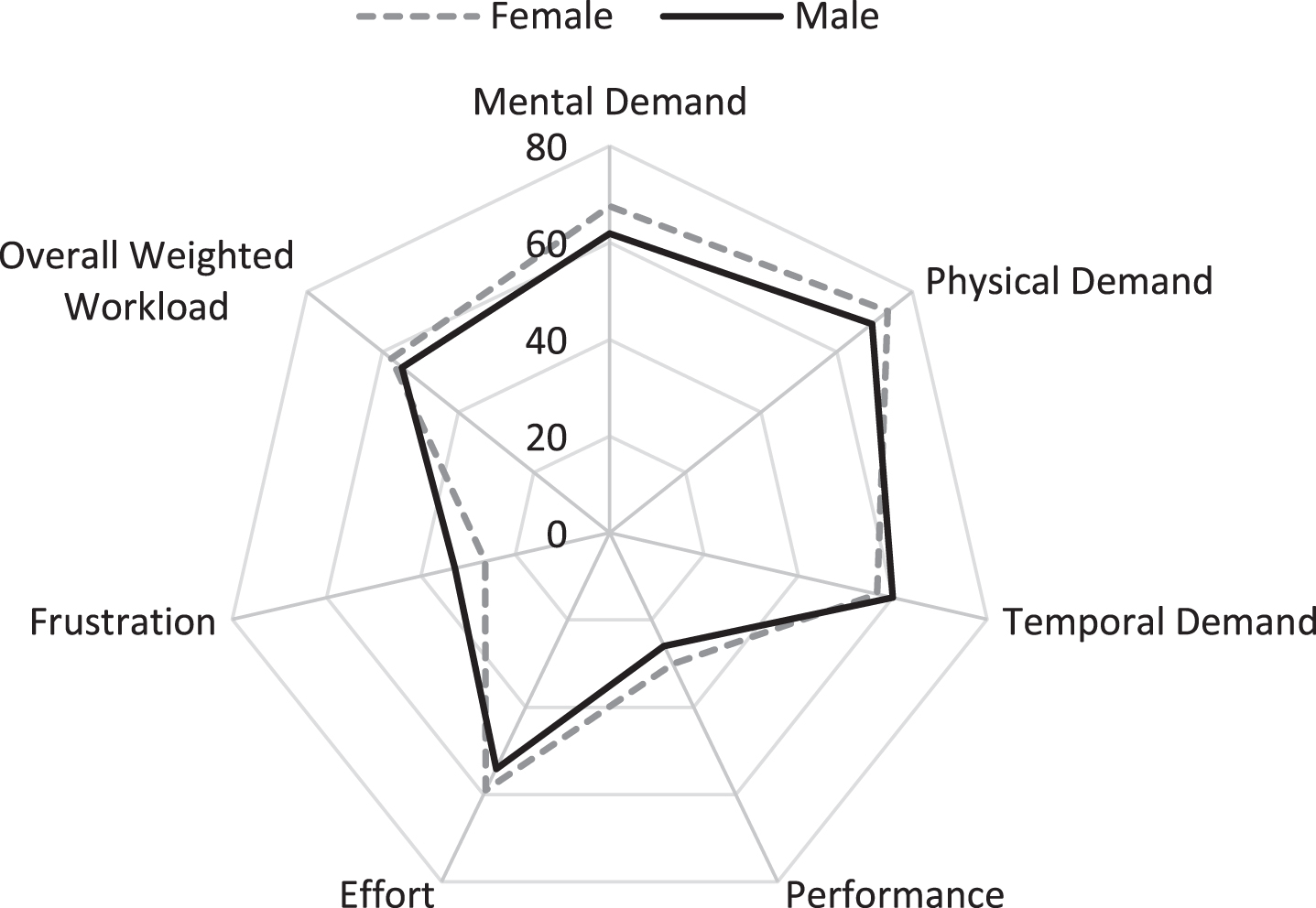
Means of the workload ratings of the male and female groups.
In this study, a mixture of results was found. Experience was found to have significant effect only on the discomfort at the left-hand (p-value = 0.090) and mental demand (p-value = 0.063) with novice players having a higher average values in both. Results also show statistically significant differences in the neck discomfort (p-value = 0.020), upper back discomfort (p-value = 0.012), performance (p-value = 0.055) and overall workload (p-value = 0.043) between two role groups. For gender, there was no statistically significant difference with any of the independent variables. Meanwhile, some interesting trends were found in the results even though these are not statistically significant and these trends might be found to be significant while repeating the experiment with a larger sample size.
Novice players had more discomfort in their left hands. This could be due to a variety of factors. Right and left hands are tasked with different items. For instance, left hands are used to hold up more of the weight for some instruments. One possible explanation is that the novice players are not used to holding the instruments for an entire day, since most high school marching bands do not play for that length of time.
The leaders’ neck and upper back discomfort were statistically worse than the non-leaders. This could be due to the leaders’ exposure to preforming the task more times than the non-leaders. Leaders in the marching band are typically older than the non-leaders. Having more time to experience the strains of the instrument’s weight and potentially awkward posture could lead to a higher discomfort in the neck and upper back. The neck and upper back could also possibly correspond to the use of a neck strap for tenor saxes and alto saxes, sousaphone placement on the neck, drum harnesses, and other possibly awkward postures that most players endure. Some trends were found for leaders having a higher discomfort in the elbows and mid to lower back, however the data was not significant. More testing with a larger sample size needs to be done to see if these trends are accurate.
Novice players had a higher mental demand than experienced players. Novice players have a lot more to learn than the experienced players. There are many songs and traditions that are the same year after year. Due to this, these songs and traditions only need to be learned one time: the very first year. These novice players need to learn the school songs, commonly played songs, instrument movements to go along with those songs, as well as how a game day operates. This would lead to a higher mental demand for the novice players.
Leaders had a higher performance workload. This could be due to multiple factors. Leaders are responsible for their section, and are in charge of teaching them the songs, visual movements, and help them learn their drill. Due to this, leaders are more likely to be aware of other player’s mistakes. Their rating of performance would be worse since they are trained to see what needs to be improved. Leaders also had a higher overall workload. As stated before, leaders are responsible for their sections entire actions and improvement. Due to this, their workload in all areas is higher than a non-leader workload.
These collective results were similar to previous studies in the case that there was some discomfort for players. Potentially, this could lead to the development of MSDs [5, 19]. Marching band players need to be warned about the potential of small discomforts leading to MSDs and how to prevent these from occurring. Moreover, designers and manufacturers of instrument accessories (i.e. harnesses, neck straps, etc.) need to improve their products or come up with new ways to prevent MSDs. The current instrument accessories apply a lot of stress on the neck and upper back as shown in the results of this study. New methods need to be created, and better methods that are out there currently need to be implemented and encouraged within the band environment.
This study can also be related to industry workers due to similar MSD situations. Industry workers also work long hours with awkward postures while carrying and picking up heavy weights. Similar precautions need to be created and implemented for industry workers to better protect against MSDs. By studying marching band players, industry workers can also be helped. Industry workers undergo physical discomfort while balancing mentally demanding tasks. Through this study and studies like this one, new designs can be developed in the future to help prevent MSDs. On top of this, more preventative measures can be taken to protect marching band players and industry workers.
This study has a few limitations. While the potential sample pool was 269 candidates, only 70 returned completed surveys. If the study were to be repeated with more candidates or across more than just one marching band, a larger sample size could be collected. This study was also limited to a subjective self-evaluation survey. The participants filled out how they thought their workload and discomfort was. Also, this study was looking at marching band as a whole and not taking into account the different instrument types. A future study could be done comparing the workload and discomfort of different instruments. This study did not have enough subjects to analyze the differences of each instrument type. A future study is being planned where two instruments, one lightweight and one heavy, will be recorded while playing two songs, one easy and one difficult. This study will monitor their muscle activity, posture, and discomfort.
Conclusion
This study indicates that players’ role and experience, but not gender, can influence their workloads and discomfort. More research needs to be completed to confirm trends in the data as well as provide more factors to compare such as instrument type. Marching band players need to be educated of the risks and prevention methods for MSDs. This research can extend to industry workers as well, providing further evidence that industry workers must also be educated of the risks and prevention methods of MSDs.
Conflict of interest
None to report.
Footnotes
Acknowledgments
This study would not be possible without the support and help of the Oregon State University Director of Athletic Bands, Olin Hannum, for letting us use valuable rehearsal time, as well as being friendly and accommodating to the project. We would also like to thank the Oregon State Drumline Instructor, Justin Preece, for being available and willing to answer questions. Additionally, we would like to thank the entire 2017 Oregon State University Marching Band for being willing to participate.