



Abstract
BACKGROUND:
Many agricultural activities excessively need human power and are associated with musculoskeletal disorders (MSDs). Leafy vegetable cultivation (LVC) is one of these.
OBJECTIVE:
The postural workload, body discomfort, and explainable linkage between these among Iranian wintry LVC workers were investigated.
METHODS:
Postures and body discomfort were evaluated using Ovako working posture analyzing system (OWAS) and a body map, respectively. The explainable body discomforts by working postures for each body region were descriptively discussed using some of the literature.
RESULTS:
Considering the maximum MSD risk value of 400%, irrigation and manual harvesting had the highest MSD risks with index risks of 313% and 305% respectively. Low back discomfort was the most common body discomfort in LVC which was reported for the operations of moldboard plowing, disking, manure application, chemical broadcasting, spraying, and manual harvesting. LVC operations seemed to rely heavily on the use of low back and shoulders. Bent and/or twist postures were the most common postures for the back.
CONCLUSIONS:
Almost all the body discomforts were explained by awkward postures shown by postural workload analysis. Therefore, the working posture analysis results may be reliable and utilized in future decisions around ergonomic interventions. Future studies may be conducted to investigate the simple and inexpensive ergonomic interventions to mitigate MSD risks.
Keywords
Introduction
Despite the development of agricultural mechani-zation which has caused the improvement of system performance [1], several farm activities are labor-intensive and expose to occupational risk factors. Working with manual hoe has been demonstrated as a critical activity concerning physiological strains in the vegetable cultivation [2]. Subsequently, occupational disorders and illnesses may appear. Musculoskeletal disorders (MSDs) as the common and well-known occupational risks are prevalent among farmworkers [3–7]. Studies among developing countries showed that workers suffer from MSDs in the back, knee, neck, hand, wrist, and shoulder areas longtime poor postures, repetitive movements, and magnitude of the physical load [8, 9]. This is a problem even in developed countries [10].
Vegetable cultivation as one of the labor-intensive agricultural activities is associated with drudgery and occupational problems especially MSDs. The highest prevalence of knee problems among agricultural workers belonged to vegetable workers [11]. Prolonged, iterative inappropriate postures and lifting loads caused that body regions such as arm, wrist, hand, and low back had the most common MSD complaints among vegetable workers [12]. Growing greenhouse vegetables such as tomato and pepper expose workers to an increased risk of developing work-related MSDs. Repetitive movements associated with inappropriate postures, especially in the limbs, trunk, wrist, and neck were reported when trellising tomato [13]. Workers’ exposure to peak and cumulative loads and moments at the trunk and shoulder were still considerable in growing greenhouse pepper [14].
In a developing country like Iran, wintry leafy vegetable cultivation (LVC) is a major farm activity, especially in the southwest region, where this study was conducted. Despite the important economic role of vegetable production in this country [15], many of the operations suffer from a low level of mechanization and labor-intensive work tasks. Whereas some manually-operated tools were introduced for vegetable cultivation [16], Iranian farm tools are partly different from other regions. To amend and design ergonomically safe, efficient, and friendly tools that improve the farming system productivity, operation analysis is required which is not usually undertaken in the Iranian agricultural systems. Therefore, the evaluation of work tasks of LVC regarding MSDs’ priority in this region is needed. In this way, we can understand the urgency of them whether the interventions are necessary or not. After the evaluation of working postures and body discomforts, the explainable body discomforts by working postures for each body region were discussed.
Material and methods
Studied operations
This study was undertaken on the operations of LVC in the southwest of Iran. Some of these leafy vegetables were parsley (Apium petroselinum L.), coriander (Coriandrum sativum L.), fenugreek (Trigonella foenum-graecum L.), chard (Beta vulgaris var cicla L.), dill (Anethum gravealens L.) and spinach (Spinacia oleracea L.). The vegetable cultivation season was from September to March in this region. LVC consisted of nine operations: moldboard plowing (primary tillage), disking (secondary tillage), seedbed preparation, manure application, chemical broadcasting, seed broadcasting, irrigation, spraying, and manual harvesting (Fig. 1).
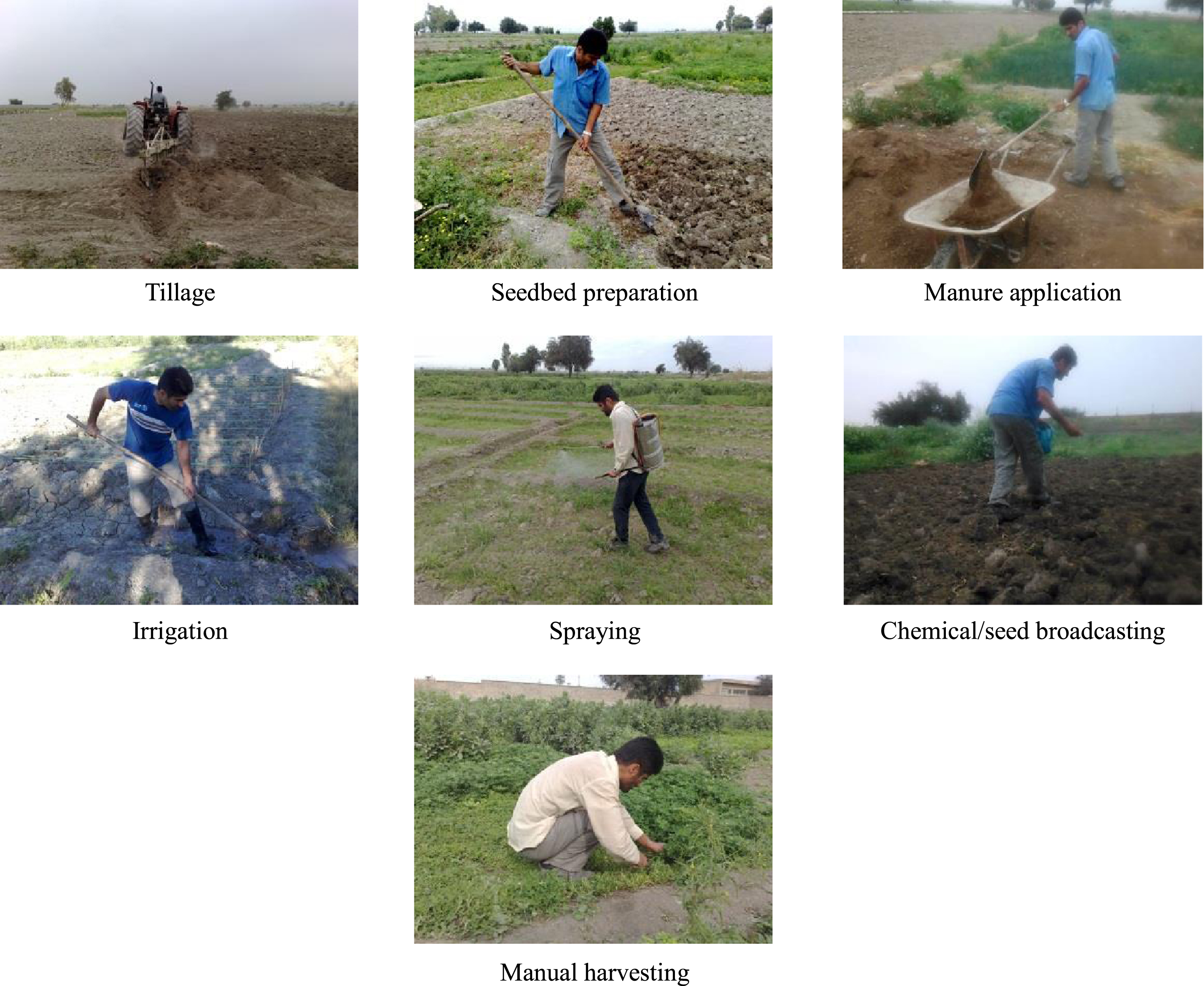
Operations related to wintry leafy vegetable cultivation (the face of the participant shown in the images was not covered with his agreement).
Moldboard plowing and disking (tillage operations) were carried out using a 1.42-meter four-body moldboard plow and a 1.8-meter offset disk harrow respectively. They were attached to an 82-KW two-wheel-drive tractor. These two operations were carried out once per season. At these operations, the tractor driver sat on the tractor seat. After primary and secondary tillage, the worker prepared the seedbed (plot surface) using a manual hoe to better pulverize the soil up to about 15 cm depth with a standing position. Average soil strength using cone index was 1.7 MPa for 0–15 cm soil depth of the study region. To improve soil nutrients, the worker distributed the manure on the plot surface. Worker loaded two wheelbarrows full of manure for each plot (approximately 40 m2) and strewed them throughout the plot surface using a manual hoe with a standing position. Before seed broadcasting, a little chemical (urea) should be added to the soil surface. The operations of chemical and seed broadcasting were performed in a similar way in which the worker manually carried a bag or bucket full of seed or chemical and distributed them on the plot surface while walked throughout the plot. Chemical broadcasting recurred two times within the cultivation season to supply the vegetable nutrition. Averagely ten irrigations occurred through one LVC season. The worker performed irrigation with opening and closing the low weirs using a manual hoe to direct the flow of water in gullies. At the operation of spraying, the worker removed the weeds using herbicide one time within the LVC season. The worker carried a manual-lever-operated knapsack sprayer and sprayed the herbicide solution while walking throughout the immature vegetables. At vegetable maturity, the worker harvested the vegetables using a sickle, with crouching in a squatting posture. Manual harvesting was performed eight times for a plot through one season. The routine time taken to treat a known area for each operation was measured using a stopwatch and converted to hour per hectare (Table 1).
Average time taken for each operation of wintry leafy vegetable cultivation
Thirty-one male workers took part in this study. Nine of them, as the tractor drivers, were in mean age, weight, and height of 47 years (SD =±4 years), 63 kg (SD =±8 kg), and 168 cm (SD =±8 cm) respectively. Twenty-two of them, as manual operators, were in mean age, weight, and height of 25 years (SD =±5 years), 70 kg (SD =±6 years), and 177 cm (SD =±12 cm) respectively. According to body mass index (BMI), all participants were in normal range classification (18.5–24.9 kg/m2) [17]. Each participant had at least ten years of work experience in his occupation. They were right-handed, healthy, and typically skilled workforces for LVC. They were instructed to perform their relevant operation as normal routine work.
Working posture analysis
Operations were recorded by a camera to videotape the working postures. A skilled observer analyzed the videos. Ovako Working posture Analyzing System (OWAS) was employed to analyze the working postures. It was required that postures and loads/forces were assessed simultaneously. OWAS method was able to do it by time sampling for body postures and force. This method identifies four work postures for back, three for arms and seven for legs, and also estimates three phases for force used or load carried. Then this method detects the urgencies for ergonomic measures to correct the working postures based on posture and load/force combinations [18]. The urgencies are shown in four action categories (1: no corrective measures; 2: corrective measures in the near future; 3: corrective measures as soon as possible; 4: corrective measures immediately). Concerning to percentage of four action categories, index risk for each operation was calculated with the following equation: I = [(P1×1) + (P2×2) + (P3×3) + (P4×4)] ×100, where I is the index risk, P1, P2, P3 and P4 are the percentages of action categories 1, 2, 3 and 4 respectively. The index risk is ranged between 100% (lowest MSD risk) to 400% (highest MSD risk) [19]. One-way ANOVA and Duncan’s multiple range tests were used to compare these index risks among the operations by IBM SPSS Statistics 24 (IBM Corporation, US). Statistical comparisons were not undertaken about the proportion of various postures among operations, but they were used in descriptive discussion around the linkage between them and body discomforts.
Body discomfort assessment
A body map was used to detect the location of the body discomforts [20]. Immediately after each operation, the body map was shown to the participants. They were asked to express their feelings about discomforts created in their body segments using a visual analog scale (VAS). Participants marked a point in a 10 centimeters bar with two anchors zero (No discomfort) and 10 (Severe discomfort). The rate of each discomfort was achieved by measuring the distance between zero and the marked point [21].
Procedure
Data collection was performed at temperatures varied between 16°C and 39°C in the morning. There were three repetitions for each operation performed by each worker. Therefore, we had 27 (9×3) videotaped samples and 27 body discomfort complaints about each of moldboard plowing and disking operations, and 66 (22×3) videotaped samples and 66 body discomfort complaints about each of the rest operations. Finally, average values were presented in this study.
After discovering values related to body postures and discomforts, investigate the linkages between these began. We were not able to use the regression to discover the relationship between body postures and body discomforts. It was because the causes of discomfort in a certain body region may not be restricted to an awkward posture in that body region and may depend on a complex of the postures taken by several related body regions. According to it, the explainable body discomforts by working postures for each body region were descriptively discussed using some of the literature to rely on the working posture analysis outcomes to utilize in future decisions around ergonomic interventions. Finally, some ergonomic interventions to reduce MSD risks were recommended.
Ethics approval
Informed consent from the participants was obtained for the study. Privacy was considered about their personal information. This study was performed under the ethical standards of the Declaration of Helsinki.
Results
Results of working postures
Based on OWAS classification, working postures for the operation of moldboard plowing were similar to disking and for chemical broadcasting were similar to seed broadcasting. Therefore these four operations are presented in two columns (Table 2). Workers were often observed in the twisted back (67.1%) and sitting (99.1%) postures at tillage operations, and in the bent back (91.3%) and walking legs (85.4%) postures at the operations of chemical/seed broadcasting. Bending back and walking had also the high proportions when worker sprayed the vegetables with 95.6% and 73.2% respectively. In this operation, exposure to loads over 10 kg was excessive. Standing and squatting with bending both legs were often found for the operations of irrigation (59.5%) and manual harvesting (97.8%) respectively. However, forces used to irrigate were over 10 kg in 58.7% (51% + 7.7%) of the total time cycle, whilst, it was only 3.8% in the manual harvesting. Working with a manual hoe in the bed preparation led the workers to stand with one straight leg (49.4%) and to have a back posture with bending (59.6%). Workers used frequently the forces over 20 kg at the operations of bed preparation, irrigation, and spraying.
Proportions of postures (%) and index risk (%) in the operations of wintry leafy vegetable cultivation
Proportions of postures (%) and index risk (%) in the operations of wintry leafy vegetable cultivation
[a]1: Moldboard plowing, 2: Disking, 3: Bed preparation, 4: Manure application, 5: Chemical broadcasting, 6: Seed broadcasting, 7: Irrigation, 8: Spraying, and 9: Manual harvesting. [b]Same letters refer to statistically equal values at significance level of 0.05.
Table 2 showed that the need for immediate cor-rective measures was not negligible for bed preparation, manure application, irrigation, and manual harvesting. Concerning this value, moldboard plowing, disking, and chemical/seed broadcasting had a better situation. Irrigation and manual harvesting had the highest MSD risks with index risks of 313% and 305% respectively, while the lowest index risk belonged to the moldboard plowing and disking (100%).
Results of body discomfort assessments showed that shoulder discomforts were found at the operations of spraying (front and back of the shoulders), manure application (back of the shoulders), and chemical/seed broadcasting (front of the right shoulder). Low back discomforts were reported for tillage operations, manure application, chemical broadcasting, spraying, and manual harvesting. Left calf discomfort was expressed for the operations of bed preparation and irrigation (Table 3).
Mean rate of body discomfort among wintry leafy vegetable growers
Mean rate of body discomfort among wintry leafy vegetable growers
[a]1: Moldboard plowing, 2: Disking, 3: Bed preparation, 4: Manure application, 5: Chemical broadcasting, 6: Seed broadcasting, 7: Irrigation, 8: Spraying, and 9: Manual harvesting. [b]Only the body segments with a felt discomfort were shown in the table.
General discussion
Boring loads or use of forces over 10 kg or even over 20 kg was frequently observed in LVC. Studies revealed more than half of farmers in rice, flower, and vegetable cultivation, lift, push, and pull materials over 20 kg [11]. The mentioned study reported above three-fourth of these farmers had to take stooping or squatting postures which were highly experienced by the participants of the present study. Another study revealed that during melon picking, they are picked with the help of cutting tools or shears with a bent back in 75.14% of the time cycle [22]. It supported the same back posture with 87.6% during harvesting in the present study with a different-melon was picked in a stooping posture.
Vegetable production was considered in the present study up to the harvesting stage. Required soon and immediate corrective measurements were in most of the operations. In another study about MSDs in melon cultivation, the results of OWAS analysis showed that 37.64%, 47.57%, 14.32%, and 0.47% of the participants belonged to action categories 1 to 4, respectively [22]. In LVC, four operations consisting of seedbed preparation, manure application, irrigation, and manual harvesting have the remarkable corrective measurement urgencies at the levels of as soon as possible and immediately. Moreover, two of them (i.e. irrigation and manual harvesting) repeated ten and eight times in the LVC season that could affect the whole LVC’s urgency of corrective measurements.
Descriptive discussion around linkage between working postures and body discomforts
Back and neck of tractor drivers were frequently in twisted or bent postures. They looked frequently backward to monitor and evaluate [10] the suitable tillage depth and enough overlap between new and old tilled strips. Extensive tractor driving associated with twisted postures may increase MSD risks in low back and neck at tillage operations and explain discomfort in these body regions due to long periods of muscle strain and flexion [23].
In the operation of bed preparation, the worker cut the slice of the soil using a manual hoe, lifted, and transferred it to another place. For cutting a slice of the soil, the worker pressed the bowl of hoe to insert it in the soil with the application of the force with the left leg. Frequent heavy force, in this case, is a common MSD risk factor in farm works, especially among farmers who work with hoe [24]. It could explain the self-reports of the workers about the presence of the discomfort in the left calf since the studies revealed that excessive use of force causes muscle pain in a particular body region [25].
During manure application, four work tasks were observed; filling the wheelbarrow with the manure of heaped pile using a hoe, moving the wheelbarrow full of manure toward the plots, distributing the manures throughout the plots (unloading the wheelbarrow), and returning to the location of the heaped pile. The present study revealed that discomforts in the low back, front of the shoulders and front of the upper legs could be explained as follows: the prolonged awkward low back postures including twisting and/or bending (for low back discomfort) [25] while filling and unloading the wheelbarrow; heavy lifting as an occupational risk in farm works (for low back discomfort) [26], discomforts in front of the shoulders and front of the upper legs while moving the wheelbarrow full of manure [26]; excessive walking (for discomfort in front of the upper legs) as a potential of leg MSD in farm works [26]. When the wheelbarrow is fully loaded, the worker needs to exert upper and lower body strength in balance to maintain stability to prevent tripping and spilling. At a poorly maintained plantation, greater exertion may be required to push the wheelbarrow along the uneven landscape or through the overgrowth of surface vegetation [27].
At the operation of chemical broadcasting, the worker was frequently in bowing posture to better monitor the chemical broadcast uniformity associated with carrying the bag full of chemicals. Therefore this posture was a cause for self-reported low back discomforts and was a reason for an increase in the low back MSD risks. It was because other studies reported that prolonged load carriage and longtime sustained awkward postures for back such as trunk flexion were introduced as the risk factors for low back MSD and discomfort [23, 26]. Prolonged movements of the right arm for strewing the chemical on the plot surface caused the discomfort in the right shoulder region due to excessive activity of this region [25]. As has been aforementioned, the operations of chemical and seed broadcasting were performed similarly. Right shoulder discomfort had been reported during seed broadcasting based on the reasons expressed for chemical broadcasting. However, growers’ low back bore a lighter load in comparison with those of chemical broadcasting because the weight of seed was lighter than the chemical. Therefore low back discomfort was not reported by growers.
The operations of irrigation bed preparation were performed similarly regarding the method of working with the manual hoe. Therefore, discomfort in the left calf could be explained by excessive use of force [25] on the bowl of hoe with the left leg for cutting the soil. This discomfort was reported in a lower severity at irrigation than that of bed preparation because the grower expended a lower percentage of time cycle for cutting the slice of the soil in comparison with bed preparation.
At the operation of spraying, the worker carried the sprayer on his shoulders by two ropes and partly distributed the weight of sprayer (loads over 10 kg) between his shoulders and back with a bowing posture to have a better balance when carrying the sprayer. Although it is assumed that this forward trunk flexion results from a need to move the mass of the backpack closer to the body’s center of gravity to ensure stability in walking, it may lead to increased loading and consequent discomfort in the shoulder and back regions [28].
During manual harvesting, the worker crouched in a squatting posture (97.8%) for harvesting vegetables because the height of vegetables was below the knee level. High knee stress occurred when flexing the knee during long static squatting posture for harvesting the vegetables, which could increase the MSD risk of the knees [11]. Discomforts in low back and knees were explainable by prolonged squatting and knee flexed postures [29].
The postural workload analysis method was able to introduce the magnitude of the workloads and was not able to show the domain of repetitions of them. However, almost all the self-reported body discomforts were explained by the postural workload analysis. There was one exception. Perhaps, repetitive shoulder movement in the operations of chemical and seed broadcasting was the cause of shoulder discomfort, but this movement was presented in the posture analysis method as a posture with a high proportion of the time cycle. In this case, the OWAS method had presented a relationship between prolonged posture and body discomfort instead of the repetitive movement and body discomfort.
Limitation
As a limitation of this study it could be noted that among LVC’s operations, manual harvesting is performed by both female and male workers in Iran. This study considered only men. Female workers could not take part in this study due to culture-related factors.
Recommendation
This study was performed in a developing country. About 80 percent of the world’s extreme poor live in rural areas and depend largely on farming to make a living [30] which may include LVC particularly in Iran. In this situation that increasing prices are a barrier to utilize the motorized equipment in the agricultural farms, the application of some simple and inexpensive interventions to improve health and safety at work is an acceptable strategy [31]. Rest-work schedule [32] and education of workers to perform tasks with the modified postures [12] may be investigated to develop the interventions to alleviate LVC workload pressures. Studying tools/machines to discover their weaknesses (e.g. tractor [33]) and amend them (e.g. hoe or sickle [34]) to make more suitable for farm workers could also be considered when studies are designed to improve safety and health climate in LVC.
Several studies have been conducted in which comparison of the observational posture/load assessment methods regarding to accuracy or validation was the goal [35, 36]. These outcomes may be different in different occupations. However, in the present study, explainable relationship between postures evaluated by OWAS and body discomforts in a LVC was aimed. It is a potential to address other observational posture/load assessment methods in relation with body discomforts in LVC and compare them with OWAS. Therefore further studies may be conducted to address this concern.
Conclusion
LVC operations seemed to rely heavily on the use of low back and shoulders. Bent and/or twist postures were the most common postures for the back. Almost all the body discomforts were explained by awkward postures shown by postural workload analysis. Therefore, working posture analysis results may be reliable and utilized in future decisions around ergonomic interventions. Studies may be conducted to investigate the possible simple and inexpensive ergonomic interventions for mitigation of MSD risks.
Footnotes
Acknowledgments
The authors hereby thank the volunteer workers who participated in the study for their cooperation. This study is based on Abdollah Hayati’s doctoral seminar work at the Agricultural Sciences and Natural Resources University of Khuzestan.
Conflict of interest
None to report.