




Abstract
BACKGROUND:
Distinctly, shift work is burdensome for nurses and may lead to health problems.
OBJECTIVE:
The purpose of the study was to examine the nursing shift system genres and to analyze the potentially debilitating effects upon sleep quality and the subjective state of physical and mental health when considering varying shift schedules.
METHODS:
The first cross-sectional study (n = 639) was performed at the Clinical Center at the University of Pécs, and throughout various hospitals in the South-Danubian Region. The Hungarian version of the Bergen Shift Work Sleep Questionnaire, the Berlin Questionnaire and the 13-item Sense of Coherence Scale were implemented. In the longitudinal survey (n = 52), the quality of sleep was determined by the ActiGraph GT1M type of activity meter supplemented with a sleep diary.
RESULTS:
Interestingly, most respondents weight gained among the irregular schedule group (p = 0.004). The nurses working a flexible schedule reportedly slept better (p = 0.003), had a higher sense of coherence (p = 0.013) and exhibited better subjective health status (p = 0.017) than when compared with nurses working irregular shifts. The frequency of psychosomatic complaints aligned with the length of rest periods proved influential (p = 0.013).
CONCLUSION:
Admittedly, the irregularity of work schedules is stressful for nurses. Due to the health status of nurses, it is a worthy consideration to establish the least exhausting work schedules.
Introduction
Biological rhythms maintain basic life functions and ensure body balance (such as sleep-wake rhythm) also have an important role in the adaptation of changing circumstances. The human circadian rhythm is determined by the internal biological clock in the suprachiasmatic nucleus, various Zeitgebers, and the internal status of the body [1, 2].
The beginning of “shifting” dates back to the late 19th century, when, due to the carbon fiber bulb, in-vented by Thomas Edison at the time of the Industrial Revolution, night shifts were introduced throughout an increase in factories, thus, heated boiler heat was not wasted [3]. Today nearly 20%of the population in developed countries are routinely working different shifts [4]. Due to the continuous provision of health care, several health care professionals and physicians are required to report to work even at night. Among nurses, there are substantial varieties of work schedules, and to cite an example, these shifts include regular, irregular and flexible, 8- and 12-hour schedules [5]. Griffiths and colleagues found in the case of a 12-hour (or longer) shift, patient safety and quality of care declines [6]. Only 15%of the 31,627 nurses who willfully participated in the survey throughout two European countries work in ≥12-hour shifts.
In our 2015 survey head nurses reported the work schedules of 8697 nurses, of which 51.89%of these nurses were working flexible shifts. This means that nurses work irregularly in 8 and/or 12-hour shifts (06:00–14:00, 06:00–18:00, 18:00-06:00) and this is adapted to their needs. In the case of irregular shifts nurses work irregularly in 8 and/or 12-hour shifts (06:00–14:00, 06:00–18:00, 18:00-06:00) and this is not adapted to their needs (7.66%). The regular work schedule was reported amongst 22.35%, and the majority of these nurses were assigned the following schedule: a 12-hour day shift (06:00–18:00) followed by a night shift consisting of 12 hours (18:00-06:00), and then two days of rest. In case there was no regular shift, the most frequent causes were personnel and staffing shortages and the general needs of nurses [7].
Several studies examine the difficulties of work schedule planning, such as, Legrain and colleagues, who analyzed the various problems and proposed two software applications effective in the facilitation of the creation of schedules [8].
Biological rhythms are disturbed among shift workers, and temporary internal desynchronization develops until the internal body clock does not ad-just to the changed external circumstances, which requires nearly one week [9, 10]. Most often sleep and mood disturbance occurs [11–18], including the circadian rhythm disorder, which may lead to the appearance of additional psychosomatic disorders over the short and long term [19–22]. Several reports have documented the formation of cardiovascular- and gastrointestinal system disorders [23–25], and cancer [20, 26]. Due to the negative impact of night work schedules upon health and patient safety professionals, the mandate of the European Parliament and Council (2003/88/EK Guideline includes the following; “Certain aspects of the organization of working time) specifies that EU countries must provide employees that in case of night work, the number of normal working hours should not exceed an average of eight hours in any 24 hours [27].”
Our research aimed to analyze the quality of sleep using an actigraph and specially prepared questionnaires.
Other goals were to test the sense of coherence which is a valid indicator of health and to analyze the psychosomatic complaints and subjective health status of nurses.
We would know the nurses’ opinions about different working shifts. The practical aim of our research is the detection of the least stressful type of work schedule and to recommend the ideal working shift.
Method
Sample
Quantitative and descriptive studies were performed. The survey consisted of two elements, and a total of 691 nurses volunteered to participate in the research.
Sample of study one
In the first cross-sectional study, a simple non-random sampling was conducted throughout the foll-owing institutions: University of Pécs - Clinical Center, Pediatric Clinic - Mohács Hospital, St. Luk-ács Hospital - Dombóvár, Komló Health Center and the Nagyatád Hospital. Additionally, during intervals of professional training, organized by the University of Pécs, Faculty of Health Sciences Directorate of Professional and Postgraduate Training, nurses responded to our questionnaires.
In consideration of a total of 639 individuals from 1000 invited nurses (so the response rate was 63.9%), 471 nurses (73.7%) currently work varying forms of shifts, 157 individuals (24.6%) report during a daytime shift and 11 individuals report during (1.7%) a night shift (Table 1). 96.9%of the respondents were women (n = 619), the average age was 43.1 years of age (21–66 years,±9.44), and the average years of serving as a nurse were 20 years (±11.46).
Nursing work schedules in study one (n = 639)
Nursing work schedules in study one (n = 639)
Inclusion criteria: Minimum one year of employment in nursing at an inpatient institution. In the case of sleep apnoea and restless legs syndrome (RLS) diagnosis respondents were excluded from the analysis of the factors affecting sleep quality because these diseases affect sleep and this distort the results regarding the influence of other factors.
The longitudinal study was conducted among nurses (n = 52) employed at inpatient wards at the University of Pécs, Clinical Center, Department of Pediatrics from 15 May through 15 July 2016.
Exclusion criteria were: diagnosed restless legs syndrome, diagnosed sleep apnoea, sleep disorders associated with the diagnosed disease, consumption of pharmaceuticals, and medications due to sleep disorders and pregnancy.
Altogether, 55 individuals participated in the study over seven days, three measurements were declared invalid, therefore 52 individuals were represented in the study (95%). The average age among the participants was 40.23 years (±10.54) and 94%were women (n = 49).
Measurement tools
Questionnaires in study one
In the first study, the Hungarian version of the Bergen Shift Work Sleep Questionnaire (BSWSQ-H) was applied [28, 29].
The Berlin Sleep Apnoea Questionnaire (Cronbach’s alpha 0.75) and the Hungarian version of the 13-item Coherence Sense Questionnaire (SOC13) (Cronbach’s alpha 0.83) were applied [30–33]. Additionally, questions regarding employment, shift policy, health behavior, and health status were asked.
At first we have translated Bergen Shift Work Sleep Questionnaire to English, and the linguistic validation was completed, psychometric characteristics were analyzed. Cronbach’s alpha was 0.95, which is very good. Based on the correlations between responses to the questions of the questionnaire the latent structure can be examined with factor analysis (Kaiser-Meyer-Olkin measure 0.90; Bartlett’s test results: p < 0.001). The cumulative score of the Athens Insomnia Scale [34] used generally in the assessment of sleep quality and the BSWSQ-H total score shows a significant correlation (p < 0.001; r = 0.61). The correlation between the total score of the BSWSQ-H and the total score of the Perceived Stress Scale is significant (p < 0.001, r = 0.55) [35, 36]. The temporal stability of the questionnaire was examined with convenient sampling on a smaller sample (n = 22; average age 39,59 years, standard deviation 10,22 years; 1 male, 21 females; 6 nurses working in daytime shift and 16 n night shift). Between the two fill, 2 weeks elapsed, the Pearson correlation coefficient was 0,999 (p < 0,001). Based on the psychometric characteristics of the questionnaire, testing of sleep disorders associated with shift work on a Hungarian sample is adequate.
Actigraph study two
In the actigraph survey, the quality of sleep was determined by the implementation of the ActiGraph GT1M (Pensacola, FL, USA), an activity meter supplemented with a sleep diary. In the operational use of the actigraph, the length of the rest period and the number and time of movements during the rest period can be observed. The amount of sleep (total sleep time; TST), waking time after falling asleep (sleep onset after waking; WASO) and the number of awakenings only can be estimated by the actigraph. Precise and exact values can be determined by polysomnography (PSG).
Statistical analysis
The statistical analysis was performed using SPSS 20.0 and Microsoft Excel software, implementing the following statistical methods: descriptive statistics (absolute and relative frequency, mean and standard deviation), χ2-test, ANOVA, paired sample t-test, two-tailed t-test, linear regression, Mann-Whitney and Kruskal-Wallis test. We used the Kolmogorov-Smirnov test to assess normality and Cronbach-alpha to assess reliability. The results of the statistical tests were considered significant with a 95%probability level (p < 0.05).
Results
Mental health, psychosomatic complaints and nutritional status among nurses working varying shifts (study one)
In the first study, the average age of the respondents was 43.1 years (21–66 years±9.44). Most participants possessed high school degrees (n = 467, 73.1%). The participants were employed, on average for 20 years, (±11.46) in the health care profession and reported, on average, 12.36 years (±10.06) in their current shift. 471 nurses (73.7%) were working varying shifts (regular, flexible and irregular), 157 of all respondents (24.6%) only assigned a daytime shift, and 11 nurses (1.7%) assigned only or nearly always the night shift (Table 1).
The “regular”, “flexible” and “irregular” groups worked night shift over a period of one month an average 5.96 shifts (n = 471, 1–17 shifts,±2.19). 250 respondents (39.1%) reportedly enjoyed the night shift, largely due to the increased pay incentive, 119 nurses (18.6%) preferred the peace and tranquility generally associated with night shifts, 57 individuals (8.9%) explained the night shift afforded a unique opportunity of education not regularly associated with the day shift, while 31 nurses (4.9%) described themselves as “night owl” chronotypes, and reportedly, admittedly, were fond of night shifts. 148 individuals (23%) were part-time employees and 54 nurses (8.5%) were studying for degrees regarding higher learning and/or licensing.
We checked that the part-time job would have affected sleep quality, psychosomatic complaints and sense of coherence. The number of nurses aligned to part-time employment is similar when compared with different groups (p = 0.138), and differences were not found in the work shifts with different regularities (p = 0.619). No significant difference was found in the event of the occurrence of psychosomatic complaints in between those employed part-time, and those who were not part-time employees (p = 0.57). There were no differences between the two groups when analyzing the quality of sleep (BSWSQ p = 0.87) and the sense of coherence (SOC p = 0.92). We checked that leaving out the part-time employees (n = 148) the results did not change (p > 0.05). Based on these results, part-time employees were not excluded from the research.
Interestingly, 9.7%of the nurses (n = 62) believed they enjoyed healthy diets, and 33.5%(n = 214) believed they enjoyed partially healthy menus. Strikingly, 61.6%of shift employees do not eat healthily, while in comparison to daytime employees, this ratio is 41.7%(p < 0.001), however, the regularity of work order was not related to the quality of diet (p = 0.29). Regarding the purpose of rest and recreation, 175 individuals (27.4%) carried out activities involving regular physical activity (increased heart rate, resulting in perspiring and sweating). Most of the respondents rarely performed sports (n = 331, 51.8%), and 123 (19.2%) admitted to never perform sporting activities. In the event of work order types, the following results were obtained: 35.8%(n = 54) of the daytime group and 25.2%of shift workers regularly performed sports, and there were more among the mixed shifts group who never participated in sports (21.6%), of which, the difference is significant (p = 0.013).
The subjective health status was classified by nurses into four categories: excellent (n = 34, 5.3%), good (n = 250, 39.1%), adequate (n = 314, 49.1%) and poor (n = 39; 6.1%). The worst health status was assessed by the night shift employees, while daytime shift employees considered their health status among the finest (p = 0.044). The work order regularity also correlated with the answers, the best scores for health were given by the group consisting of the flexible work schedule, while the worst appeared in the irregular group (p = 0.017). Chronic disease was rep-orted in 48.4%of the sample (n = 309) mostly hypertension was mentioned (n = 127, 19.9%) (Table 2). In the case of sleep apnoea and RLS, diagnosis respondents were excluded from the analysis regarding the factors affecting sleep quality. The nutritional status among the respondents were determined by the body mass index: 25.96 kg/m2 (min = 15, max =48,±4.60). The BMI of night shift employees or nurses from chronic wards was higher (p = 0.013 and p = 0.010). We asked questions regarding the changes in body weight, about the beginning of the night shift, astoundingly, the answers exhibit 233 individuals (49.5 %from mixed shifts) gained weight. The regularity of work order is related to weight gain, most respondents gain weight in the irregular schedule group (p = 0.004), while in the case of athletic and nutritionally conscientious employees, a significant difference was not found among the groups (Fig. 1).
Health behavior and health status
Health behavior and health status

Weight gain experienced since the start of shift work in the case of different regularity regarding work schedules (n = 233).
The subjective health status was compared to the scales used and BMI results. We found significant results for each case, in which nurses with poor sub-jective health status reported more psychosomatic complaints (p < 0.001), more sleep problems (p <0.001), possess a diminished sense of coherence (p < 0.001) and a higher body mass index (p < 0.001) (Table 3).
Connection of health status parameters (n = 637)
We measured how many times they had psychosomatic complaints in the past month: back pain, low back pain, sleep problem, exhaustion, rapid or irr-egular heartbeat, heartburn, stomach pain, diarrhea (not due to infection). The most common compla-ints are back and lower back pain (mean: 6.94 times/month±2.07), second is fatigue (mean: 5.23 times/month±4.04) and third is sleep problem (mean: 5.06 times/month±5.01) (Fig. 2). We analyzed the average incidence of all psychosomatic complaints in the case of socio-demographic and work-related variables. Since the sleep problems are also included within psychosomatic complaints, we implemented a constricted database, in which the respondents with sleep apnoea and RLS were excluded (n = 80). Thus, a total of 559 nursing files were analyzed, in which psychosomatic complaints were reported, on average 23.59 occasions (±24.12). The occurrence of psychosomatic complaints was not influenced by age (p = 0.53), gender (p = 0.79); and marital status (p = 0.11). The ward type affected the incidence of complaints: Employees from an active ward (n = 403) reported an average of 21.31 complaints, while chronic ward employees (n = 103) reported 34.70 complaints during the previous month (p < 0.001). Daytime employees (n = 141) indicated less comp-laints (average 19.14/month±14.02) than when compared with shift workers (n = 408, mean = 25.14/ month±18.43, p = 0.012). The regularity of work schedules and work schedule types were not re-lated to the frequency of psychosomatic complaints. The healthy eaters group (n = 249) reported less complaints (average: 17.88/month,±11.23), when compared to unhealthy eaters (n = 307, mean = 28.37/month,±15.43, p < 0.001). Regular exercise is not related (p = 0.25), however, bodyweight change is related to psychosomatic complaints since those individuals who lost or gained weight, observed more symptoms (p = 0.006).

Psychosomatic complaints (n = 639).
The sleep quality in 77.8%of the irregular sch-edule employees and 62%of flexible schedule em-ployees deteriorated since the beginning of the shift work (p = 0.013). Astonishingly 39.7%(n = 254) of the nurses who participated in the study regularly ingest some form of sleep aids, mostly sleeping pills, which is not related to the type of work schedule. Sleep quality measured by the Bergen Shift Work Sleep questionnaire following a 12-hour daytime shift (maximum score: 24) showed a significant difference, since the nurses working assigned to irregular schedules sleep far worse (BSWSG-H daytime work average 10 points) than when compared with employees assigned to the flexible working order (average 8.39 points±3.72, F = 4.49, p = 0.012, Post Hoc: p = 0.003) (Fig. 3).
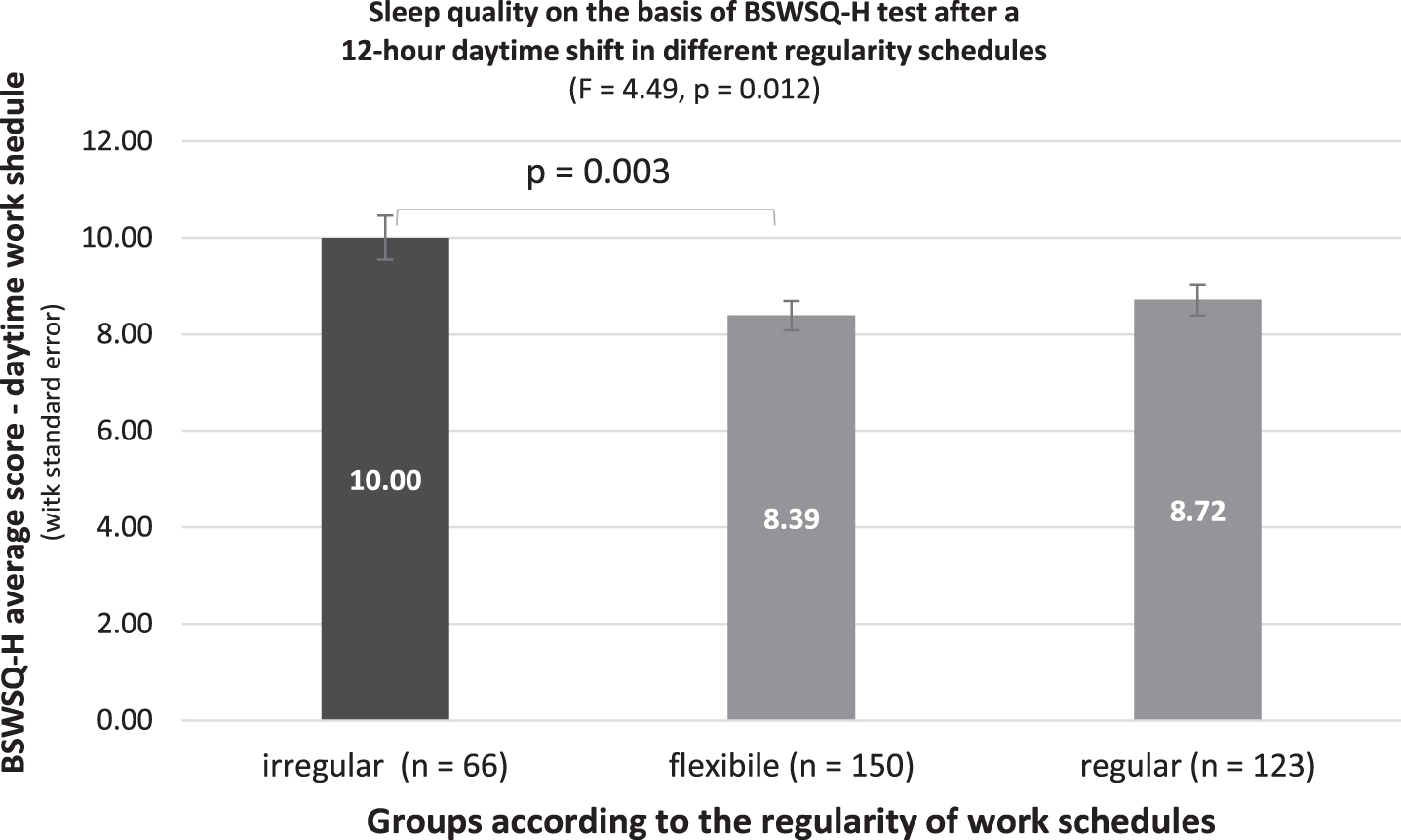
Sleep quality among different regularity schedules (n = 339).
Nurses assigned the daytime shift showed a bet-ter sense of coherence than when compared with employees in mixed or night work order (p < 0.001). The coherence sense of those working in an irreg-ular order was lower (SOC13 average 57.8 points±11.01) than when compared with nurses working a flexible work schedule (SOC13 average 61.2 points±10.92, F = 3,29, p = 0.038, Post Hoc: p =0.0132 (Fig. 4).

Sense of coherence and the regularity of work schedules (n = 472).
Sense of coherence and psychosomatic complaints correlated, and those individuals who reported a better sense of coherence offered fewer complaints (r = –0,21, p < 0.001). In regards to the question of who was the most exhausted, the answer was attr-ibuted to employees assigned irregular work schedules (irregular vs. flexible: p = 0.02, irregular vs. normal: p = 0.02). According to our results, individuals were less exhausted among those having a strong sense of coherence and in the event of the same strain (irregular work schedules) (p = 0.03).
Daytime shift employees (n = 7) reportedly were resting for 6.41 hours (±1.25), and 5.88 hours (±0.91) among regular shift workers (n = 12), while irregular shift workers (n = 16) commit to 5.75 hours (±1.49) with rest (p = 0.52). The movement activity during rest period of nurses assigned daytime shifts represents an average of 14.71 occasions (±3.55), in regular shift employees 17.17 (±7.94), and in the case of irregular shift employees, it is 15.50 occasions (±6.41, p = 0.70). Following the daytime shift, an average of 8.75 hours (±1.63), whereas, after the night shift, it averages 4.70 hours (±1.09) spent resting (p < 0.001).
The length of rest periods was influenced by the frequency of psychosomatic complaints (r = –0,42, p = 0,013). The number of night shifts affected psychosomatic complaints (r = 0,36, p = 0,016).
Discussion
The present study draws attention to the role of health-protective behaviors. Among the higher educated individuals, a higher rate focused on a he-althy diet, and daytime employees also showed better results compared with shift workers. 27.4%regularly participated in some form physical activity, 51.8%rarely participated in sports and 19.2%had never performed sports activities. Higher education and the daytime shift demonstrated a positive effect on our research. A proper diet and regular exercise were related in the examined sample, and nutritional status can be positively influenced by proper health be-havior since the BMI of those performing exercises regularly and healthy eaters were lower than when compared with other respondents. Educational level correlated with health perception, and the worst perception was found among those individuals in the lower educated group.
Health status was considered worst among the group of night-shift employees and the best among those employees assigned to day time shifts. The work order regularity also correlated with the ans-wers, the health status was described as best in the flexible workgroup, while the worst in the irregular group. The nutritional status was described by BMI: 25. 96 kg/m2 (SD: 4.6). The average value of BMI was higher among the older age group and the group of night-shift employees. The work order regularity is related to weight gain, and the highest weight gain occurred among those in the group of an irregular work schedule, while in the case of sports and nutrition, no discernible difference was found among the groups. Daytime employees reported fewer psycho-somatic complaints when compared with shift emp-loyees. The regularity of work schedules and their characteristic genres are not related to the frequency of psychosomatic complaints. The healthy eaters’ group reported fewer complaints when compared with unhealthy eaters. Interestingly, regular exercise was not related to psychosomatic complaints, however, bodyweight change was related, and those ind-ividuals who lost or gained weight encountered an increase in symptoms. Individuals who reported better coherence had fewer psychosomatic complaints. In separately examining the complaints, we found SOC is associated with cephalic pain, sleep problems, fatigue, and a rapid heartbeat. Examining these issues including the correlation of one another, the most impacting complaint proved to be “exhaustion”. In regards to the question of among those who were the most exhausted, the answer referred to those employees assigned irregular work schedules. Our results demonstrated within the group aligned with a strong sense of coherence, there are less exhausted nurses under the same strain, namely, and they were more resistant to load. In the case of shift employees, the psychosomatic complaints are less among those with a strong sense of coherence. In the survey of Varga et al., attention was drawn to one of the reasons for nurse attrition is the weaker sense of coherence [33]. Therefore, the aim is to strengthen the sense of coherence among students during their period of education. One approach includes education regarding a healthier lifestyle, in particular, one which is resplendent with athletics and sporting activities.
According to respondents, following the day shift, individuals sleep an average of 7.08 hours, while those assigned the night shift to sleep an average of 4.54 hours, and here, the difference proved significant. The quality of sleep deteriorated in 77.3%of the irregular, 62.8%of the flexible and 58.9%of the regular work schedule group. 39.7%of the individuals included nurses who regularly ingested some form of a sleeping aid, generally, sleeping pills, and, as age progresses, the number of those individuals consuming sleeping pills increases.
In our previous study in which representatives of a plethora of professions participated, the ratio of those ingesting sedatives was only 11.5%[37]. Since the frequency of sleep problems may be related to age and gender, including irregularity regarding the work schedule, their impact had to be filtered out of the study. With an increase in biological age, generally speaking, sleep disturbances become more frequent. Interestingly, gender generally did not affect the frequency of sleep disorders and no significant results were obtained in the case of irregular work schedules, however, coherence-sense strongly related to sleep disturbance controlling the effect of the above was described. In the case of sleep quality examined by the use of the Bergen Shift Work-Sleep Questionnaire proved significant differences since the irregular schedule employees sleep worse than when compared to those individuals working a regular and flexible schedule. Those individuals working daytime shifts and the flexible work schedule employees also showed better results.
Subjective health status was compared with the applied scales and BMI results. Significant results were found in each case, namely, those nurses associated with poor subjective health status reported an increase in psychosomatic complaints and more sleep problems, possess a lower sense of coherence and higher body mass index. Our results suggest health parameters measured in our study generally correlate with age, health behavior, level of education, type (daytime vs. mixed) and the irregularity of an assigned work schedule.
Fifty-two nurses employed throughout inpatient wards participated in the actigraph study at the University of Pécs, Clinical Center, Pediatric Clinic. Ten nurses (19.2%) are assigned the daytime order, Monday through Friday (06:00–14:00). 18 individuals (34.6%) from those assigned more shifts work in regular shifts, and nurses working an irregular work schedule are included in the third group (n = 24; 46.2%). In reviewing the international literature reg-arding actigraph surveys, the number of nurses and their age is synonymous with our sample, however, the actigraphs were worn over a longer period (on average, 14–28 days) than when compared with our study (7 days) [38–41].
Daytime employees spend an average of 6.41 hours resting, in a regular mixed shift average of 5.88 hours while in the case of irregular shift work 5.75 hours, of which, the difference was not significant (p = 0.52); while significant differences were found in the research of Niu [39]. In a national survey conducted in 2006, in the case of graduate nurses and female physicians, an average of 6.5 hours is spent with sleeping on weekdays and nearly 8 hours during the weekends (rest days). 15.2%of the respondents rarely wake up feeling refreshed and only 12.5%revealed they wake up rested [42]. In our survey, conducted in 2015, we measured the average daily sleep among nurses (mean 6.38 hours) compared to representatives of other professions. Our results show clerical and administrative employees, teachers and other medical staff sleep more than when compared with nurses. The quality of sleep was in relation to the amount of sleep, and those who were assigned a worse value regarding the Athens Insomnia Scale were sleeping less [37].
Following the day shift, including a rest day, an average of 8.75 hours was spent upon rest, while following the night shift, including a day of rest, on average, 4.70 hours were committed to a rest period by the nurses, of which, the difference is significant (p < 0.001). This result coincides with the research of Hirsch in which respondents slept, on average 8.93 hours following the day shift, and rested for 4.84 hours on average following the night shift [41]. The length of the rest period (p = 0.013) and the average time of movements during rest periods (p < 0.001) correlated with the frequency of psychosomatic complaints.
The potential limitation of the studies implies the samples are not representative and the actigraph study was shorter than originally planned.
Conclusions
Our results suggest that flexible work schedules are the least burdensome among nurses, which takes into account the needs of nurses. We recommend that senior leadership calls the attention of employees aligned to several shifts to the following: The shift work may result in potential sleep disorder, including psychological, psychosomatic and somatic complaints due to the disturbed circadian rhythm; the knowledge and the application of sleep hygiene rules is important and regular exercise and good nutrition has proven beneficial. In the event staff encounter problems regarding night shifts, the individual is encouraged to notify their supervisor and/or seek the treatment of a neurologist, somnologist or psychiatrist in the case of debilitating sleep disorders.
Conflict of interest
None to report.