




Abstract
BACKGROUND:
Despite considerable differences in national work-family (WF) policies offered in countries around the world, research concerning the implications of such policies for employee reactions to work-family and family-work conflict (WFC/FWC) is limited.
OBJECTIVE:
The current study examines the contextual role of country-level national WF policies as a moderator of the relationships between individual-level WFC/FWC and job stress, job satisfaction, turnover intentions, organizational commitment, and general health.
METHODS:
Using archival data sources, the ISSP Work Orientations Survey (2015) and the WORLD Policy Analysis Center Adults Labor Database (2014), multilevel analyses tested the predicted cross-level interaction effect in a sample of 49,637 individuals (54% female; Mage = 48 years) nested across 36 countries.
RESULTS:
Results were largely counter to expectations: while more supportive national WF policies attenuated the positive relationship between FWC and job stress, it exacerbated the negative relationships between WFC and organizational commitment, WFC and job stress, and FWC and general health.
CONCLUSIONS:
Our study responds to calls to consider phenomena functioning at multiple levels of analysis. While reactions were more negative in countries with more robust national-level policies, it suggests an unexpected dark side of such policies. That is, it may not be enough to legislate the availability of national-level policies; it may also be needed to ensure that such policies are meeting employees’ needs.
Keywords
Introduction
Although the COVID-19 pandemic has brought into sharp focus the difficulties faced by workers juggling work and life demands, researchers have long understood workers have struggled to balance their work and non-work roles. Such workload escalation and long working hours often result in a permeable boundary, and subsequent conflict, between work and non-work roles [1]. Over the past several decades, scholars have described role incongruences in work and family as ‘work-to-family conflict’ (WFC) and ‘family-to-work conflict’ (FWC; [2]). Defined as the process whereby one domain depletes personal resources and impede accomplishments in the other, WFC/FWC (hereafter, together referred to as “work/family conflict”) has been exacerbated due to trends in family demographics, such as the growing number of working mothers with children, a rise in elder care demands, and a surge in father’s involvement in family caregiving responsibilities [3, 4]. Although stereotypically attributed to a phenomenon affecting parents, work/family conflict is a problem directly and indirectly affecting much of the world’s population. Single individuals and those without children also report experiencing conflict, as all may be sons, daughters, sisters, brothers, or may live with friends who function as family [5]. WFC may also be attributed to rapid advancements in technology (e.g., personal devices connecting individuals to work 24/7 [6]). Further, such escalation is exceedingly pertinent amidst the COVID-19 pandemic crisis, where workers must adapt to working arrangements (e.g., working from home, increased childcare demands, reliance upon virtual means) atypical to normal circumstances.
While scholars have made considerable progress in investigating the effects of organizational-level WFC and FWC interventions, the literature has largely not considered an interactionist perspective reflecting the environment within which organizations function. Working experiences occur in complex systems that operate under multiple environmental forces both internal (i.e., organizational size, industry, technology, stage of development) and external (i.e., political, educational, legal, institutional, and sociocultural) [7]. Therefore, the purpose of our study is to examine how country-level differences in governmental work-family (WF) policies (conceptualized as macro-level resources available to employees [8]) may impact employee work and well-being reactions to perceived work/family conflict. In doing so, we pursue two ends. First, we respond to Aycan’s (2000) call for future research to adopt an interactionist and multidisciplinary perspective that better reflects the complex environment in which organizations, and the individuals working within, function. Second, we aim to provide evidence for empirically-informed policy change conversations. As legislators continue to reconsider work/family-related policies, such scientific grounding can provide a critical role in considering the potential pros, cons, and challenges associated with such legislation.
Figure 1 presents the overarching conceptual model in which we test the direct effects of national WF policies and resources on outcomes of work/family conflict, as well as moderating effects on the relationships between work/family conflict and its established outcomes. The following sections review the extant literature on work/family conflict, propose a multilevel framework for investigating both individual- and country-level processes, and lastly, develop a theoretical foundation for the proposed moderating role of country-level WF policies.
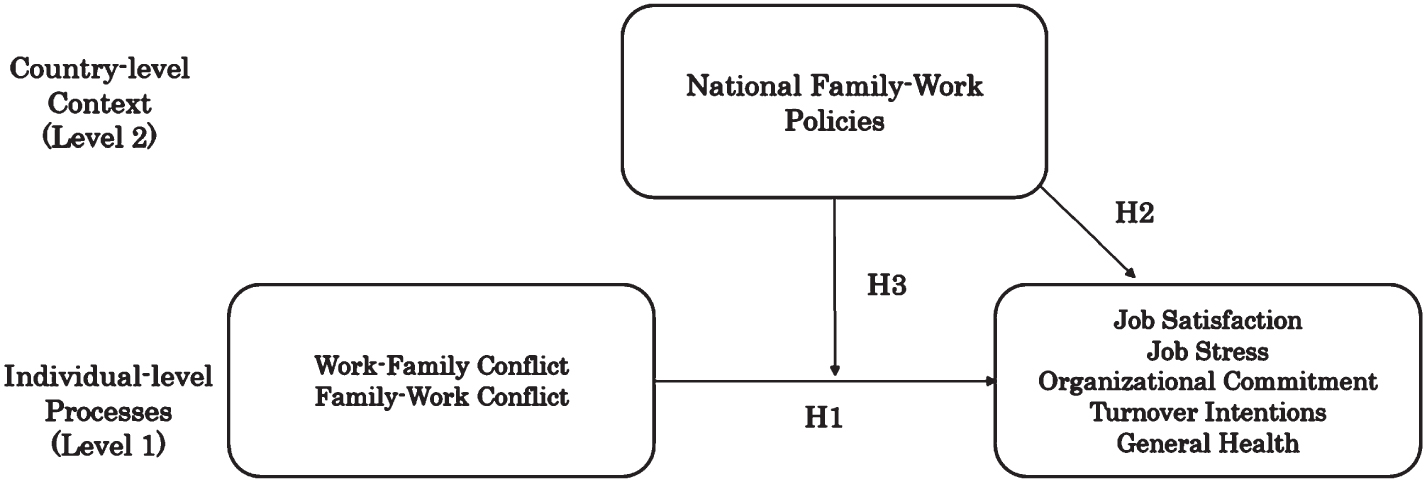
A multilevel conceptual framework linking WFC and FWC and national WF policies to job satisfaction, job stress, organizational commitment, turnover intentions, and general health.
WFC and FWC represent distinct, yet related, forms of inter-role conflict [9, 10]. Whereas WFC reflects the impact of work responsibilities on one’s family, FWC concerns the impact of family responsibilities upon work [11]. Meta-analyses have confirmed numerous adverse work-related outcomes stemming from work/family conflict, such as decreased satisfaction with one’s job, reduced performance and organizational citizenship behaviors, and increased turnover intentions, stress, and absenteeism [12]. The literature has also presented a multitude of harmful health-related outcomes, such as decreased well-being, and increased general and family-related stress. Meta-analysis additionally suggests an association between WFC and satisfaction with life [13]. General life dissatisfaction has been related to psychological health [14, 15], including depression, tension, frustration, and anxiety [9, 16].
Although there are several different theoretical frameworks that could be applied to work/family conflict, they contain a commonality in the notion an individual’s resources (e.g., time, energy) are finite. When such resources are insufficient to meet competing demands for these resources, strain occurs. In particular, Conservation of Resources (COR; [17, 18]) theory posits individuals are driven to maintain, foster, and protect resources (e.g., energies, personal characteristics, conditions, objects). COR predicts individuals will experience stress when (1) individuals are threatened with resources loss; (2) individuals lose resources; or, (3) individuals fail to gain resources after investing resources [18–20].
Individuals with multiple roles and striving for balance might not have access to the resources needed to do so. Thus, they would theoretically struggle to maintain balance, causing psychological stress and, as the empirical literature has revealed, numerous negative outcomes. Although reactions to WFC/FWC are well-established in the literature, we extend the work-family literature by exploring these relationships using a large, cross-nationally representative sample. Thus, based on this theoretical foundation and the empirical literature, we proposed the replication hypothesis:
Hypothesis 1 (H1). WFC and FWC will be negatively related to job satisfaction, organizational commitment, and general health, and positively related to job stress and turnover intentions.
Work-Family Conflict: A Multilevel Perspective
While much of the work/family research has focused upon individual-level variables (e.g., employee perceptions of WFC and FWC; work- and health-related outcomes), it is equally important to consider contextual factors that contribute to phenomena affecting employees [7, 21]. Johns (2006) operationalizes context as “situational opportunities and constraints that affect the occurrence and meaning of organizational behavior as well as functional relationships between variables” (p. 386, emphasis added) and contends that many areas within organizational psychology have failed to adequately account for situational factors affecting organizational behavior. Instead, research erroneously overemphasizes dispositional causes of behavior at the expense of situationalcauses [22].
Within the work-family domain, researchers have begun to examine contextual variables at the organizational-level that may serve as resources for employees (e.g., family-friendly benefits, benefit usage, daycare facilities, job sharing, flexible working hours, and perceived family support from supervisors; [23, 24]). Such resources have been shown to mitigate the effects of work/family conflict, increase levels of family and job satisfaction [25], and play a key role employee work-family experiences [23]. Researchers have additionally argued supportive practices have direct, positive effects in higher levels of organizational commitment [26], self-reported productivity [27], and lessened turnover intentions [28]. Together the academic research points to organizational-provided interventions and resources as important functions in experiences across numerous work outcomes.
While the literature has examined organizational contextual variables, there has been a dearth of attention paid to higher-level contextual factors beyond the organization. Yet, employees are nested within multiple intersecting layers (e.g., organizations, industries, communities, states, countries), and variables within each of these different levels of context may directly influence employee outcomes as well as how they are able to cope with work/family conflict [8]. Below, we specifically consider national WF policies as a relevant contextual variable.
National Work-Family Policies: Parental Paid Leave, Family Leave, and Personal Leave Arrangements
National WF policies provide an overarching backdrop against which employees experience and react to work/family conflict. Yet, our field’s near exclusive focus [29] on individual and organizational-level factors may fail to account for variance attributed to higher level variables at the country-level. Examining context may lead to a more nuanced understanding of the way in which individuals respond to the effects of work/family conflict across national borders. Specifically, national WF policies might directly influence employee work and health-related outcomes, as well as their reactions to experiences of work/familyconflict.
National WF policies are social or economic programs enacted at the national (or federal) level designed to promote and enhance non-work or family-related experiences, such as marriage, reproduction, and rearing of children. Such policies shape the work-life interface via: labor laws, which define work hours and leaves (e.g., sick leave, paid vacations, parental leave, and time off for elder care); benefits (e.g., child(ren)’s allowances) and services, such as subsidized daycare centers [30, 31]; and, policies addressing personal health needs, such as the ability to take sick leave, paid annual leave, and a guaranteed day of rest [32].
National WF policies are distinct from organizationally-provided benefits. Although policies at the organizational-level, as well as work-family culture or climate and family-supportive supervision [33], offer relevant, empirically-supported perspectives, national policies are independent from organizational-policies in that they are formed through country legislation and create a uniform baseline of required support to be offered by a company operating within a given country. Indeed, an organization may choose to provide supportive policies beyond those mandated or may be required to abide by intersecting layers of legislation (e.g., laws at the state or provincial levels); however, such consideration is beyond the scope and purpose of the current study.
Parental Leave
Although WF policies initially focused on providing paid maternity leave, over time this has expanded to include paid paternity leave, family leave to care for post-infant children, leave for care of other family members (i.e., elder members), and the provision of flexible work arrangements [34]. For example, Australia introduced its first universal paid maternity leave in 2010, and paid paternity leave legislation followed closely behind in 2013 [35]. After finding that fathers were leery to take leave due to unsupportive workplace or cultural practices and norms, Germany introduced a paternal leave system that incorporated paternal incentives and subsequently saw a tripling in the proportion of fathers taking leave [36]. Development and implementation of these policies continues to evolve over time in response to cultural and political agendas, as well as global processes (e.g., emerging child well-being norms, flexible labor markets, and work intensification) [37–39].
Despite promising changes in family leave policies being implemented across the globe, some countries are left trailing, such as the United States, which remains one of the only industrialized countries to not guarantee paid leave for new parents [40]. In fact, U.S. policies concerning both parental leave, sick leave, days of rest, and vacation days are often in sharp contrast to that of other developed and developing nations. Countries lacking supportive WF policies, such as the U.S., tend to argue such policies would harm the nation’s ability to compete economically on a global basis [40]. Despite supportive WF policies existing in economically competitive and thriving countries with low unemployment rates (e.g., Austria, Canada, the United Kingdom, Singapore, Australia, Finland, and Germany), unsupportive-policy countries have not been able to make major alterations amidst stiff political opposition [41].
Policies aimed at supporting elder care
WF policies have also evolved to consider elder care responsibilities given that the number of workers with adult and/or elder care responsibilities has increased. In the U.S. alone, an estimated 65.7 million unpaid family caregivers provide care to an ill, disabled, or aged member [42], and on average, caregivers spend 24.4 hours per week providing care, with nearly one quarter providing care 41 or more hours per week [43]. Similarly, estimates from Europe suggest 20 percent of the EU population has elder caretaking responsibilities [44]. Despite significant (and increasing) numbers of adult/elder caregivers, the extant work-family literature on national policies/social support has nearly exclusively included policies surrounding parenthood (e.g., maternal leave, paternal leave) rather than policies aimed at caregivers for adult or family members.
Personal leave policies
Finally, national WF policies also include those that allow for personal leave needed to address the effects of illness or respite and recovery from the demands of work (e.g., work stress, burnout) through vacation and/or personal time-off. Moreover, regardless of family structure, many workers maintain home care responsibilities and can be assumed to make tradeoffs between work and leisure time [45]. Whereas parental leave can only be taken advantage of in a limited set of circumstances (e.g., following the birth of a child), paid sick leave and/or vacation leave can be utilized intermittently as needed, as it encompasses various situations that can occur continually across the lifespan. Therefore, the consideration of policies outside of parental-related experiences merit empirical inclusion.
Outcomes of national work-family policies
As forms of inter-role conflict, WFC reflects aspects of one’s work that interfere with an employee’s ability to effectively carry out their family role, whereas FWC reflects aspects of an employee’s family life that can interfere with the completion of their work role. While many national policies could arguably work to alleviate interference in both directions, some could potentially differentially ease the direction of this cross-domain interference. For example, provision of child income support (e.g., financial assistance for families with preschool children) might primarily act to alleviate the extent to which family obligations interfere with one’s work role (e.g., by having reliable access to child care during working hours). However, such financial support would not likely affect the extent to which one’s work obligations interfere with one’s family life (e.g., needing to work late to finish a project). Conversely, other policies might alleviate to a greater degree the extent to which work interferes with one’s family life. For example, paid maternity leave allows a woman to spend dedicated time with her new child without work responsibilities. Thus, this minimizes the extent to which work interferes with family (although one could argue it maximizes the extent to which family obligations consequently interfere with one’s work role at least temporarily).
Despite the frequent assumption that more supportive WF policies should lead to less competition between work and family [46], findings have largely (and surprisingly) been in contradiction to such notion. For example, Notten and colleagues (2017) found family-leave policies had no impact upon employed parents’ WFC [11]. Similarly, studies using European Union datasets suggest public policies alone had little to no influence upon WFC [31, 47–50]. Meta-analysis examining the impact of macro-environmental influences (i.e., public policies, laws, and regulations) has revealed inconsistent effects [51]. Thus, the literature suggests there may be a disconnect between national-level policies and daily experiences of individuals [31, 52].
While one implication from these findings may be that national policies have little effect, we argue the form of the effect may differ from that posited in earlier research. As noted above, prior studies have typically predicted a main effect of national WF policies onto the level of work/family conflict experienced. We propose the impact of national WF policies may instead be evident when considering their impact on employee reactions to work/family conflict. Specifically, while a policy may not reduce the amount of work/family conflict perceived by an employee, it may alleviate the negative effects associated with such experiences. Moreover, the existence of such policies may have direct beneficial impacts on employee job- and health-related outcomes.
While there is only limited research on such outcomes as a function of national WF policies, Aitken and colleagues (2015) studied participants across seven countries with paid versus unpaid maternity leave and found positive health benefits, including better mental health and wellbeing, general health, and physical wellbeing in countries offering paid-leave compared to employees in countries with unpaid leave. Although these results varied based on the length of leave, such findings imply positive benefits of robust national WF policies for public health [53]. Outside of maternal leave, countries offering supportive “fringe benefits” (i.e., paid family leave and sick days) at the national level can additionally support employees’ abilities to adapt to negative work-related (e.g., intentions to quit, lessened commitment to the company, job-related stress) and general health outcomes that might result following conflict between domains. Conversely, individuals in unsupportive countries are more likely to face tradeoffs in taking time off while forgoing wages, going to work ill, or facing the additional expense of a family caretaker, and in turn, increased levels of strain and stress [54].
Based on this preliminary empirical research, as well as COR theory, we expect the resources afforded by such policies (e.g., paid parental leave, paid sick leave) would have beneficial direct effects on employee health and well-being [55]. Thus, we predicted:
Hypothesis 2 (H2). Individuals living within countries with more supportive WF policies will experience fewer negative work and health-related outcomes compared to individuals in countries with less supportive WF policies.
Country-Level Policies: Moderating Employee Reactions to WFC and FWC
Consistent with COR theory, having access to resources not only leads to lower experienced strain (i.e., a main effect), but can also enable one to better cope when other resources are potentially threatened [18, 20]. However, COR theory “stands out in that it recognizes and emphasizes means for positive adaptation under circumstances of loss.” [56]. Further, one’s ability to obtain and preserve resources is “both a means and an end— a means for achieving success and ends that include adaptation, coping, and well-being” [56]. Macro-level resources provided by supportive national WF policies may provide an “ends,” where although one might perceive he or she is experiencing work/family conflict, the resource of WF policies might alleviate their negative reactions (i.e., in general health, intention to change jobs, less commitment to or satisfaction with work, and/or job stress).
Indeed, extant research has found that national-level policies can influence employee reactions to job stressors. For example, Debus et al. (2012) found employees in countries with a more robust social safety net (e.g., generous provision of unemployment benefits, labor market regulations, employee protections) experienced fewer negative job-related outcomes in response to job insecurity [57]. Similarly, Jiang and Probst (2017) suggested income inequality at the country and state-level can serve as environmental stressors intensifying an employee’s burnout reactions to job insecurity [20]. National WF policies (or lack thereof) may likewise serve a similar contextual source of resources (or added stressor).
Further, literature has explored the effect of national WF policies using a direct effect on work/family conflict [32, 49]. We provide a unique contribution to the WF policy literature and posit here an alternative conceptual approach, whereby national WF policies may influence the relationship between conflicts in the work/family interface and work and health reactions. We expect the sociocultural backdrop of supportive WF policies will not only be directly related to more positive employee health- and work-related outcomes, but such policies will additionally assist employees in coping with work/family conflict stressors. As such, WF policies at the national level might attenuate the effects of WFC/FWC for individuals living within these supportive countries whereas individuals living within non-supportive countries will not experience such mitigation of WFC/FWC effects [8]. Therefore, we hypothesized the following moderation effect:
Hypothesis 3 (H3). National WF policies at the country level will moderate the relationships between WFC/FWC and work and health-related outcomes, such that these relationships will be weaker within the context of supportive national WF policies.
Method
Participants and research design
Due to the multilevel nature of the research design with variables conceptualized at the individual-level and country-level, data were drawn from two primary sources of archival data 1 . Individual-level variables related to WFC, FWC, and their outcomes came from the International Social Survey Program (ISSP), an ongoing, annual cross-national collaboration composing of 43 countries. Each year, the survey is topic-specific, and the data used for the present study were derived from a subset of the 2015 Work Orientation survey [58].
Country-level data regarding national WF policies were obtained from the WORLD Policy Analysis Center Adults Labor Database (2014), a continuing global research database that collects and analyzes rights, laws, and policy information from legal sources (e.g., legislation, constitutional texts) and other existing databases (e.g., International Labor Organization’s NATLEX database) in all 193 UN member states in the multiple areas, such as education, child labor, health, disability, constitutional rights, and working conditions. The WORLD database uses a standardized coding scheme that identifies and evaluates the essential features of each right, law, or policy (based upon research evidence, global agreements, and inherent characteristics). Thus, our measure of the national work-family policies is a formative (rather than reflective) measure comprised of a variety of indicators that encompass the various policies available to employees within each of the countries in our sample. More detailed information regarding the WORLD database methodology used can be found at https://www.worldpolicycenter.org/methodology.
Combining these two datasets led to 49,637 individuals nested within the following 36 countries (due to the general health item being omitted from the ISSP survey in 7 countries): Australia, Austria, Belgium, Chile, China, Croatia, Cyprus, Czech Republic, Denmark, Estonia, Finland, France, Germany, Great Britain, Hungary, Iceland, India, Israel, Japan, Latvia, Lithuania, Mexico, New Zealand, Norway, the Philippines, Poland, Russia, Slovakia, Slovenia, South Africa, Spain, Suriname, Sweden, Switzerland, the United States, and Venezuela. The majority of participants were female (54.3%) and married/in a civil partnership (50.44%). The mean age and years of education was 48.11 years (SD = 17.48) and 12.38 (SD = 4.88), respectively. Slightly more than one-third of participants (35.14%) had children between school age and 17 years, with the plurality of those with children reporting one child (16.00%) or two children (9.20%).
Individual-level measures
Seven variables in total embodied Level 1 (L1; see Table 1). Of these, six (i.e., WFC, FWC, job satisfaction, job stress, turnover intentions, general health) were single-item measures, whereas organizational commitment was represented using three items (α= 0.69). All measures were in Likert-scale response format. For the present study’s purpose, we reverse-coded all items to ensure higher numbers reflected greater levels of the construct. For example, FWC’s item, “How often do you feel that the demands of your family life interfere with your job?” (1 = always to 5 = never) was reverse-coded, such that higher values reflected a higher levelof FWC.
Summary of items capturing all individual-level (L1) variables of interest (ISSP 2015 Work Orientations Survey)
Summary of items capturing all individual-level (L1) variables of interest (ISSP 2015 Work Orientations Survey)
Note: All items were reverse coded, such that higher numbers reflected greater levels of the construct.
As the individual-level (largely, single-item) measures were not operationalized with commonly used and validated measures, we make note of psychometric soundness of measures. Single-item measures similar to that used in the ISSP of WFC (“In the past month my work life frequently interfered with my personal/family life”) and FWC (“In the past month my personal/family life frequently interfered with my work life” [59]) have demonstrated (1) an acceptable range of test-retest reliability coefficients (for WFC, 54–0.79; for FWC, 52–0.75; [60]), and (2) high convergent correlations between single-item and multi-item measures (for WFC, r = 0.83; for FWC, r = 0.80).
Studies which have employed the same ISSP items as we do here have reported consistently acceptable reliability and validity coefficients for our level-one constructs of interest [57, 62]. For example, conducting a validation study where they compared validated multi-item measures of organizational commitment [63] and job satisfaction [64] to their respective items in the ISSP, Debus et al. (2012) found acceptable correlations (r = 0.73 (r, partially disattenuated = 0.83) and r = 0.62 (r, partially disattenuated = 0.65), respectively). Similar single-item, self-reported general health measures have demonstrated good reliability, reproducibility, and strong concurrent and discriminant scale performance with an established health status measure [65]. As such, it appears that the measures used in this study are valid indicators of their respective constructs.
Four facets of national WF policy support (see Table 2) were considered: 1) Personal Health Leave Support (i.e., paid annual leave, guaranteed weekly day of rest, sick leave), 2) Infant Care Support (i.e., maternal and paternal paid leave, maternal and paternal leave wage replacement, maternal breastfeeding, infant income support), 3) Child Care Support (i.e., maternal and paternal leave for child’s health, maternal and paternal leave for child’s education, maternal and paternal leave for child’s health and educational needs, child income support), and 4) Adult and Elder Care Support (i.e., leave to care for adult family member needs, guaranteed leave to care for their family health needs).
Summary of items capturing all national-level (L2) policies of interest (WORLD Policy Analysis Center 2014 Adults Labor Database)
Summary of items capturing all national-level (L2) policies of interest (WORLD Policy Analysis Center 2014 Adults Labor Database)
3 Both parents denote there is at least four weeks of paid leave available for either parent to take, whether it is through maternity or paternity leave specifically for mothers and fathers, gender-neutral parental leave that can be used by either parent, or a combination of these types of leave. 4 Leave length or payment bonus for fathers sharing leave signifies there are incentives for parents to share their parental leave. Parents may receive additional leave if both parents use parental leave or a higher payment while they are on leave. These measures encourage fathers to take parental leave and are therefore viewed as a better option for fathers taking leave compared to time simply guaranteed. 5 Flat rate means all mothers (or fathers) taking leave receive the same amount while taking leave, regardless of previous salary. One country, China, uses an adjusted flat rate, where the rate is set at the level of the average wage of the country. For women taking maternity leave, the International Labour Organization standards state women should be guaranteed at least two-thirds of their previous earnings during paid leave to ensure a suitable standard of leaving. No such protection currently exists for fathers taking paternity leave (World of Work Report, 2011). 6 The World Health Organization recommends at least six months of breastfeeding facilitated by paid leave (World of Work Report, 2011). 7 PPP, or purchasing power parity, is a figure used by economists in cross-national monetary comparisons. Rather than using a simple exchange rate to compare currencies, it is an estimate of the amount of money required to purchase the same bundle of goods and services across countries. 8 Means-tested benefits is financial assistance only available to families with incomes below a certain level. Benefits available without a means test is financial assistance available to families without consideration of their income.
Because each of these indices was measured on a different scale, we followed the process used in previous research (78) and standardized each before aggregating to form a country-level composite [66]. Specifically, responses to each item above were placed on a common metric by first converting them to z-scores. Following this, all items within a particular sub-area (e.g., the three sick leave items) were averaged together to create a single sub-area composite reflecting support for sick leave. Next, area composite variables (e.g., “Personal Health Leave Support”) were created by averaging the z-scores within each sub-area (e.g., annual leave, weekly day of rest, and sick leave). Finally, an overall measure of country-level support was calculated by equally weighting all areas within the final policy composite (i.e., averaging the composite z-scores for Personal Health Leave Support, Infant Care Support, Child Care Support, and Adult and Elder Care Support). In this way, the final country-level composite variable equally weights each support area despite the differential number of items operationalizing each domain (and sub-area). This final index was subsequently used to reflect the overall robustness of the country’s WFpolicies.∥As noted earlier, our measure of macro-level national WF policies is a formative measure comprised of the array of indicators encompassing the various policies available to employees within each of the countries within our sample. In such a formative model (where causality flows from the indicators to the construct), latent constructs are created and determined by its indicators [67]. As a result, empirically, whereas inter-item correlations should be positive and high in a reflective measure, this is not necessarily the case with formative measures, nor are traditional psychometric approaches to evaluating the measure appropriate (e.g., EFA, CFA, Cronbach’s alpha).∥
The ISSP Work Orientation survey provided all individual-level controls and each selected based upon prior study linking them to WFC and FWC. These included sex (dummy coded, 0 = male, 1 = female), age, and education. In addition, we used the marital status item to create an ordinal proxy variable reflecting least to most potential level of support received from a partner (i.e., 1 = widowed, civil partner died/never married or in civil partnership, 2 = Separated/Divorced from spouse/civil partner, and 3 = Married/Civil partnership).
We acknowledge a number of country-level variables could also account for observed differences in our outcomes of interest (see, e.g., [68–73]). We considered the following: economic status (GDP), the human development index (HDI), level of available protections against workplace discrimination, equal pay rights, access to healthcare, women’s rights (e.g., suffrage, hold legislative office, equal pay, discrimination in workplace), the number of women in the workforce, average number of hours worked per week, and Hofstede’s six cultural dimensions [74, 75]. The actual selection, and use within final analyses, were based in part on whether they exhibited significant relationships with the dependent variables. Otherwise, we risked using “impotent” control variables that reduce statistical power [76]. Further, some may not be controls, but instead, antecedents explaining the differing robustness of national WF policies. By including them as controls, we risked taking up meaningful variance and losing significant effects of policies (for a more extended discussion on the use/misuse of control variables, see [76–78] However, inclusion of these control variables did not alter any of the substantive relationships. Therefore, for simplicity of presentation, we present only the primary analyses testing our hypotheses of interest. 2
Results
Descriptive statistics and correlations
The means, correlations, and zero-order correlations for the datasets are displayed in Tables 3 and 4 for both individual- and country-level data. According to Table 2, at the individual-level, WFC was significantly and positively associated with job stress (r = 0.38, p < 0.01) and turnover intentions (r = 0.13, p < 0.01), and negatively linked to health (r = –0.06, p < 0.01), organizational commitment (r = –0.05, p < 0.01), and job satisfaction (r = –0.19, p < 0.01). This indicates that employees with higher WFC also had higher mean levels of job stress and turnover intentions and lower mean levels of health, organizational commitment, and job satisfaction. A similar pattern of results was found with FWC, as it demonstrated significant and positive relationships to job stress (r = 0.23, p < 0.01) and turnover intentions (r = 0.11, p < 0.01), and negative associations with health (r = –0.02, p < 0.01) and job satisfaction (r = –0.09, p < 0.01). However, unlike WFC, FWC was positively related to organizational commitment (r = 0.04, p < 0.01). Therefore, employees with higher FWC also exhibited higher mean levels of job stress, turnover intentions, organizational commitment, and lower mean levels of health and job satisfaction.
Descriptive Statistics
Descriptive Statistics
Note: Listwise deletion Level-1 N2015 = 14,004 listwise deletion; Level-2 N2014 = 36.
At the aggregated country-level, interestingly, more positive WF policies were not significantly correlated with either country-level WFC (r = –0.01, ns) or FWC (r = –0.29, ns), and countries with higher levels of WFC tended to have greater FWC, r = 0.84, p < 0.01. WFC and FWC at the country-level were also significantly related to some outcomes of interest. Specifically, countries with higher WFC were positively associated with job stress (r = 0.69, p < 0.01), and greater FWC was positively linked to organizational commitment (r = 0.41, p < 0.05), job stress (r = 0.42, p < 0.05), and turnover intentions (r = 0.43, p < 0.01). Although there were some sub-dimension differences at the country-level using distinct policy classification (e.g., personal health, infant care, child care, and adult/elder care support), associations with the outcomes of interest were generally in the same direction but with varying strength of relationships. These findings supported the decision to create a single aggregated work-family (WF) policy composite.
Zero-Order Correlations of L1 and L2 Variables of Interest
Note. Correlations below the diagonal are individual-level correlations. Correlations above the diagonal are country-level correlations, with individual-level measures aggregated to the country level. *p < 0.05; **p < 0.01.
Because meta-analyses have suggested that WFC and FWC are distinct constructs with differing nomological networks, we first evaluated whether WFC and FWC display differing relationships with the outcomes in the ISSP dataset. To test this, we ran correlations to determine whether results differed using a work/family conflict composite (i.e., a mean of the WFC and FWC items) versus retaining the WFC and FWC items as separate distinct constructs. Inspection of the correlation matrix in Table 2 indicates WFC and FWC exhibited differing relationships with the outcomes of interest. Specifically, higher levels in the WF policy composite correlated with less FWC (r = –0.29) but to a lesser extent, WFC (r = –0.01) at the country level. A similar pattern was also found using at the individual-level. For example, regarding organizational commitment, WFC was weakly and negatively related to organizational commitment (r = –0.05), whereas FWC was positively related (r = 0.04). Further, the correlation between WFC and FWC was only moderately strong (r = 0.57). Based upon these findings, and hence corresponding with majority of the work/family literature, all subsequent analyses are presented with WFC and FWC entered as separate variables.
In the present study, individual respondents were clustered within countries identified by a two- to three-digit code assigned by ISSP researchers and manually transferred to the L2 WORLD Policy Analysis Center. Each individual’s responses on the ISSP Work Orientations 2015 could be subsequently linked to data provided for their respective country in the WORLD Policy Analysis Center dataset by corresponding the numerical ISSP code to the respective code within the WORLD Policy Analysis Center dataset. Because the data represented two levels (L1— individuals; L2— country), hierarchical linear modeling (HLM) was utilized to analyze the data [79]. Individual-level variables (excluding the dummy-coded control variables) were group-centered and the country-level variables, grand-mean centered. Analyses were conducted separately for each variable of interest (i.e., job satisfaction, job stress, turnover intentions, general health, and organizational commitment). Parameters were estimated using full maximum likelihood estimation with robust standard errors [80].
Multilevel Modeling Results Predicting Organizational Commitment
Multilevel Modeling Results Predicting Organizational Commitment
Notes: Standard errors are in parentheses; *p < 0.05 **p < 0.01 ***p < 0.001. For all models, Level-1 N = 49,542; Level-2 N = 36. a95% Confidence Interval [–0.05, –0.01]. b95% Confidence Interval [–0.01, 0.03].
Multilevel Modeling Results Predicting Job Satisfaction
Note: Standard errors are in parentheses; *p < 0.05 **p < 0.01 ***p < 0.001. For all models, Level-1 N = 49,542; Level-2 N = 36. a95% Confidence Interval [–0.06, 0.003]. b95% Confidence Interval [–0.08, 0.03].
Multilevel Modeling Results Predicting Job Stress
Note: Standard errors are in parentheses; *p < 0.05 **p < 0.01 ***p < 0.001. For all models, Level-1 N = 49,550; Level-2 N = 36. a95% Confidence Interval [0.04, 0.08]. b95% Confidence Interval [–0.08, –0.03].
Multilevel Modeling Results Predicting Turnover Intentions
Note: Standard errors are in parentheses; *p < 0.05 **p < 0.01 ***p < 0.001. For all models, Level-1 N = 49,542; Level-2 N = 36. a95% Confidence Interval [–01, 0.03]. b95% Confidence Interval [–0.01, 0.04].
Multilevel Modeling Results Predicting General Health
Note: Standard errors are in parentheses; *p < 0.05 **p < 0.01 ***p < 0.001. For all models, Level-1 N = 49,543; Level-2 N = 36. a95% Confidence Interval [–0.04, 0.03]. b95% Confidence Interval [–0.11, –0.04].
To assess whether the between-country differences account for a significant proportion of the overall variance of the employee health- and work-related outcomes, we initially constructed a null model. The ICC for organizational commitment was 7%, t(35) = 85.84, p < 0.001 and 6% for job satisfaction, t(35) = 111.24, p < 0.001. The ICC was 4% (t(35) = 90.41, p < 0.001), 5% (t(35) = 52.49, p < 0.001), 13%, (t(20) = 35.64, p < 0.001) for job stress, turnover intentions, and general health, respectively. This indicated that there was sufficient between-country variance in individual’s dependent variables to analyze the data usingHLM [79].
Following null model analyses, we compared a set of four nested models using HLM 6.08 software [81]: Model 1 included the individual-level control variables, Model 2 added the individual-level WFC and FWC, and Model 3 added the country WF policies composite to examine the main effect of national work-family policy context. Lastly, Model 4 contained the WFC, FWC, and work-family policy composite cross-level interaction terms (WFC×work-family policy composite; FWC×work-family policy composite). The entire set of results, together with the tests of significance of the change in -2 log likelihood (e.g., deviance) and variance components, is displayed in Tables 5–9.
Hypothesis 1 predicted WFC and FWC to be negatively related to job satisfaction, organizational commitment, and general health and positively associated with job stress and turnover intentions. The tests of Model 2 predominantly supported this hypothesis. As anticipated, WFC was significantly and negatively related to job satisfaction (t(24326) = –15.107, p < 0.001), organizational commitment (t(23905) = –9.500, p < 0.001), and general health (t(15121) = –9.868, p < 0.001) and positively associated with job stress (t(24297) = 24.536, p < 0.001) and turnover intentions (t(23089) = 10.550, p < 0.001). Similarly, FWC held significant and positive relationships with job stress (t(24297) = 2.513, p = 0.01) and turnover intentions (t(23089) = 2.102, p = 0.035); however, contrary to expectations, FWC was significantly and positively associated with organizational commitment, t(23905) = 4.910, p < 0.001. Together, the level-one predictors of WFC and FWC explained 5% of the variance in job satisfaction, 1% in organizational commitment, 10% in general health, 12% in job stress, and 2% in turnover intentions (comparing Model 2 with Model 1). This was beyond the individual-level controls variables, which explained 2%, 2%, 20%, 0.3%, and 8%, respectively (comparing Model 1 with the null model).
In accordance with Hypothesis 2, individuals living in countries with more supportive WF policies were expected to report fewer negative work- and health-related outcomes. Significant relationships, however, were only found concerning the two work-related outcomes, organizational commitment and turnover intentions. Contrary to H2, individuals living within countries with more supportive WF policies had significantly lower levels of organizational commitment, t(33) = –4.599, p < 0.001. However, individuals within countries with more supportive WF policies also had lower turnover intentions, t(33) = –3.560, p = 0.001. This relationship matched initial expectations; thus, H2 was partially supported. Country-level WF policies explained 0.43% and 0.37% of the between-measures variance in organizational commitment and turnover intentions, respectively (comparing Models 2 and 3).
Using a χ2 distribution [80, 82], the deviance test comparing models with and without random slopes was significant for job satisfaction (χ2(5) = 95.954, p < 0.001), organizational commitment (χ2(5) = 56.206, p < 0.001), general health (χ2(5) = 76.347, p < 0.001), job stress (χ2(5) = 72.838, p < 0.001), and turnover intentions (χ2(5) = 38.383, p < 0.001). Thus, we tested Model 4 to determine the extent to which country WF policies moderated the relationship between WFC/FWC and work/health-related outcomes.
For the final Hypothesis 3, we anticipated a moderating effect of national WF policies on the relationships between WFC/FWC and work- and health-related outcomes, such that the level-one relationships would be weaker within the context of supportive national WF policies. Support for H3 was found only for the relationship between FWC and job stress, where the significant interaction indicated its positive relationship was weaker among individuals in countries with more supportive WF policies, t(33) = –2.760, p = 01. The interaction explained 50% of the variance in the slope of FWC and job stress.
The remaining significant interaction effects were largely counter to our initial hypothesis. In the context of WFC and organizational commitment, national WF policies significantly moderated the negative relationship; however, counter to expectations, it appeared more robust policies strengthened the relationship, t(33) = –2.582, p = 0.02. That is, WFC was associated with less organizational commitment, and this relationship was exacerbated for individuals living in a country with more generous WF policies compared to countries with fewer or weaker policies. A similar interaction was observed for the relationship between WFC and job stress, where the positive relationship was stronger for employees in more supportive countries, t(33) = 3.040, p < 0.01. WF policies also significantly moderated the relationship between FWC and health, such that it was stronger among employees living in countries with more supportive policies, t(19) = –2.971, p < 0.01. Together, the moderating interaction of national-level WF policies explained 30%, 31%, and 45% in the slopes of relationships between WFC and organizational commitment, WFC and job stress, and FWC and general health, respectively.
To determine if the form of the interactions matched the expected pattern of results, we used the procedure for plotting interactions recommended by Aiken and West (1991) [83]. Specifically, simple slopes of the relationships between WFC and FWC with the relevant dependent variables were plotted at±1 SD from their respective means (i.e., at high and low levels of WFC, FWC, and national work-family support policies). As can be seen, the pattern of the interaction for WFC was contrary to hypotheses, such that the negative relationship between WFC and organizational commitment (Fig. 2) and job stress (Fig. 3) was stronger for individuals living in countries that had more supportive work-family national policies. The same interaction held using FWC and general health, where again, the moderating effect of more supportive WF policies at the country-level exacerbated the negative relationship between FWC and general health (Fig. 4). In contrast, the interaction pattern for FWC and job stress was consistent with COR theory; FWC had a stronger positive relationship with job stress for individuals who lived in more supportive countries (Fig. 5).
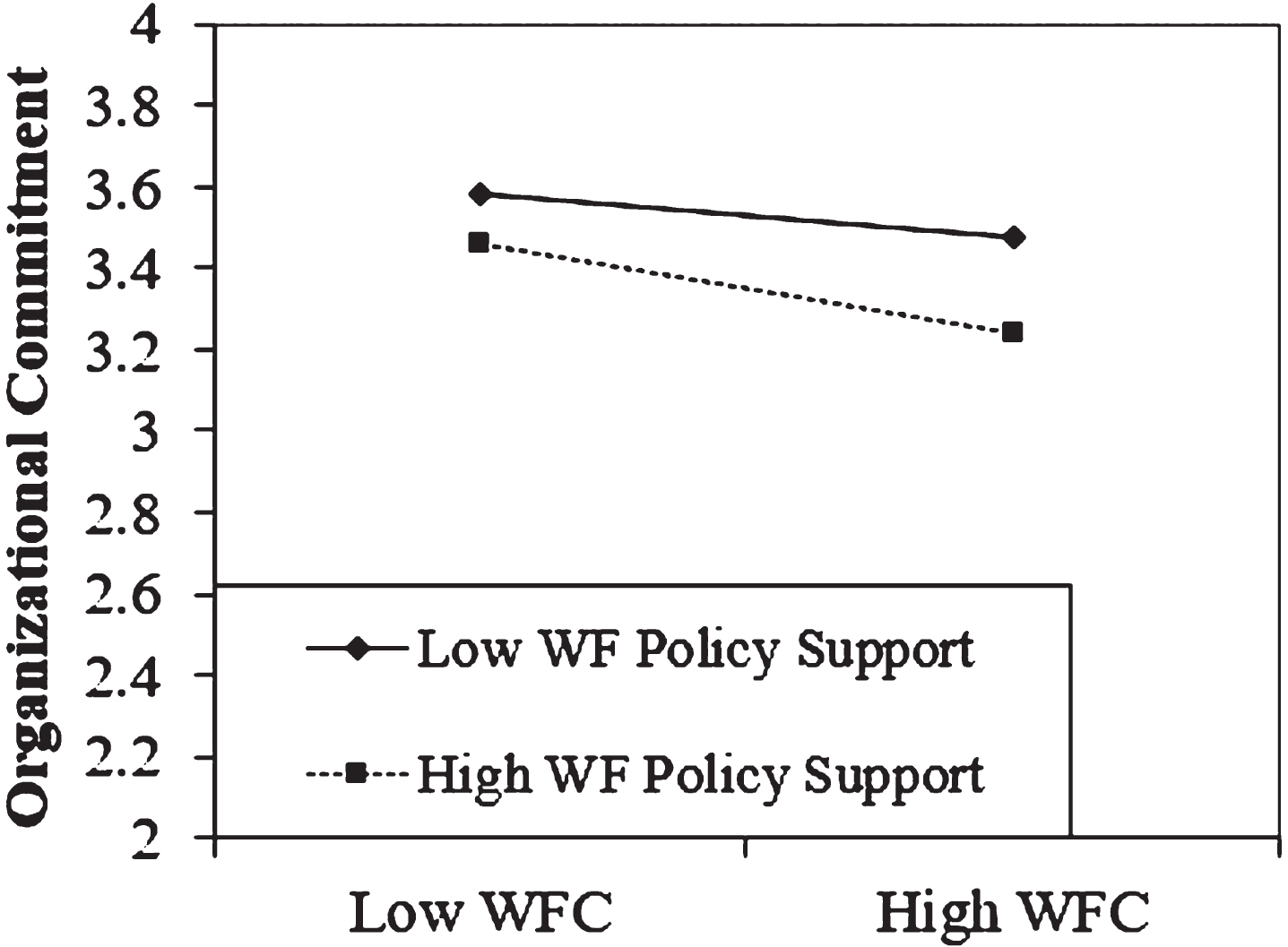
National WF policies as a moderator of the relationship between WFC and organizational commitment.
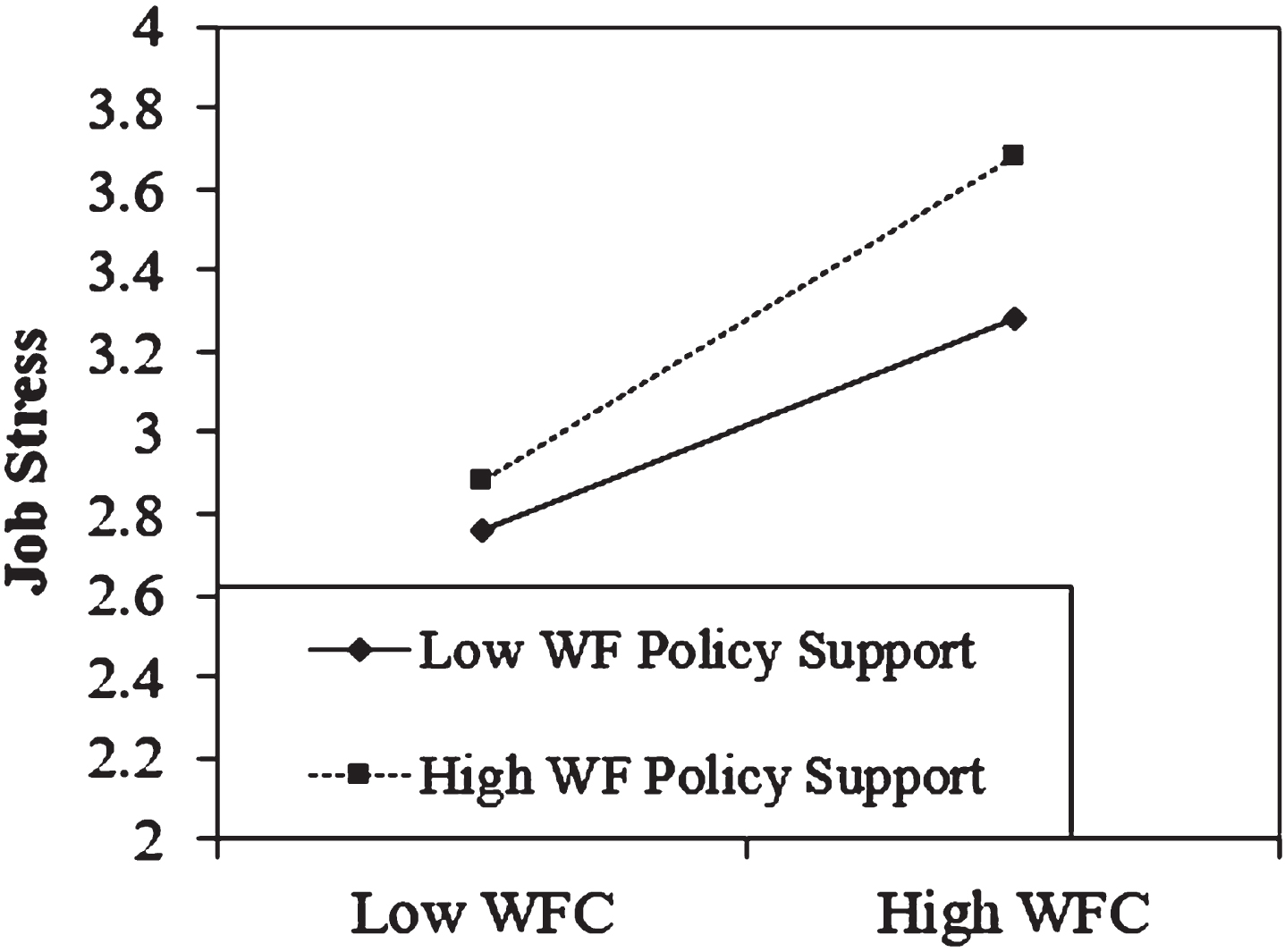
National WF policies as a moderator of the relationship between WFC and job stress.

National WF policies as a moderator of the relationship between FWC and general health.
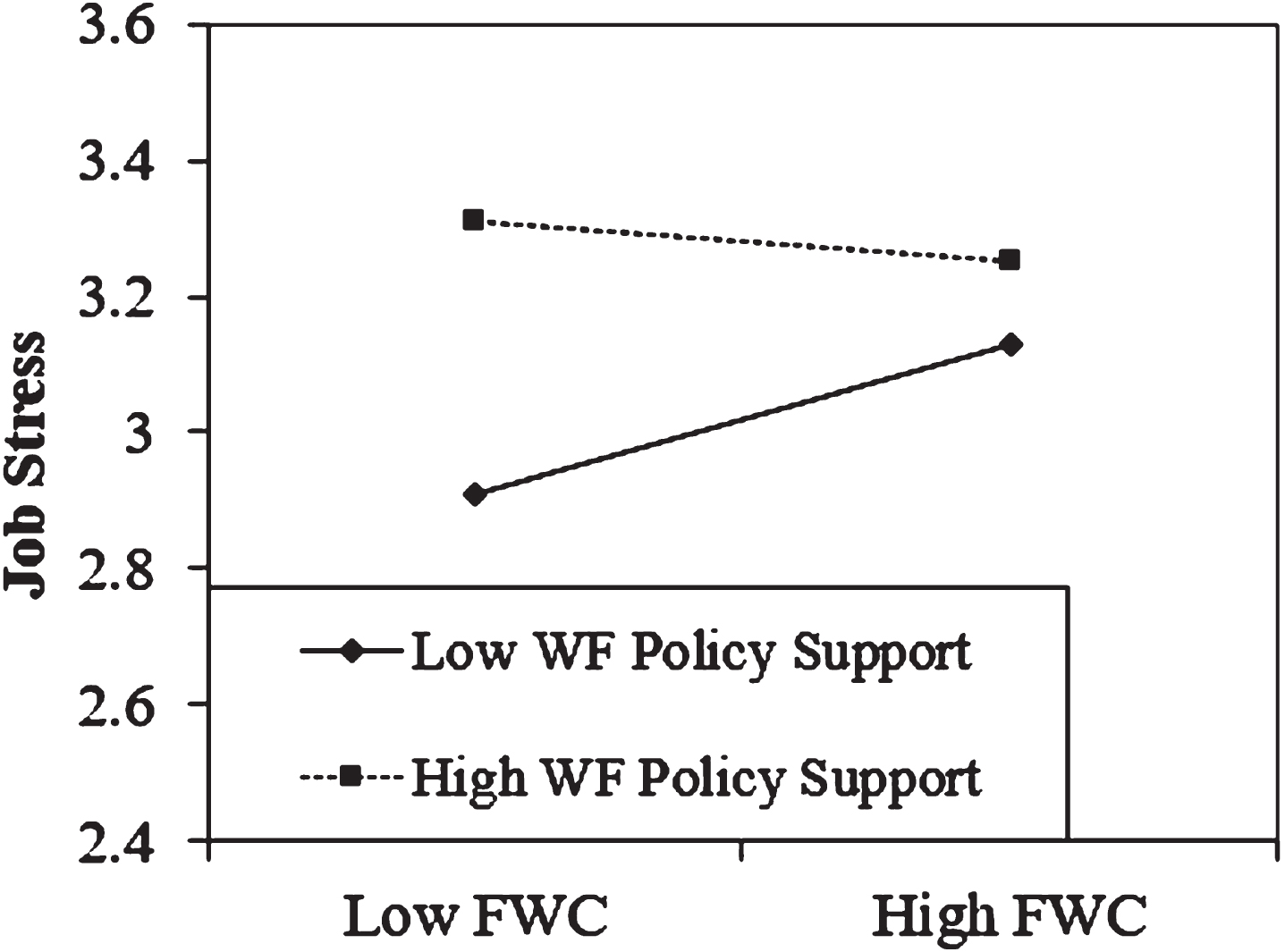
National WF policies as a moderator of the relationship between FWC and job stress.
Theoretical implications
The purpose of the current study was to examine how work- and health-related outcomes of work/family conflict vary as a function of national WF policies. Using internationally representative survey data from nearly 50,000 participants nested in 36 countries we found that work/family conflict was associated with organizational commitment, job satisfaction, job stress, turnover intentions, and general health after adjusting for several demographic control variables. With the exception of the relationship between FWC and organizational commitment, these main effects were largely consistent with the extant literature [84]. Further, we found that country-level WF policies were predictive of commitment and turnover intentions. Specifically, more supportive policies were associated with fewer employee turnover intentions; interestingly, however, more generous WF policies were unexpectedly also linked to reduced organizational commitment. An explanation for this may partly lie in the “safety net” that is available to workers in countries with supportive policies. In such countries, employees know that work-family support is available at the national-level and need not reciprocate loyalty in exchange for WF benefits. Importantly, these results underscore a tenet of the COR perspective, namely, the country in which one lives is an important source of resources for individuals. Employees residing in countries lacking WF supports appear to be more likely to seek alternative job opportunities that may provide them with such support.
Of perhaps greatest theoretical interest, the significant and consistent cross-level interactions offer insights into how the national WF context may impact employee reactions to the experience of conflict between the work and family domains. Drawing upon limited literature demonstrating the importance of country-level policies in examining the work/family interface [37, 39], we had hypothesized stronger, more supportive WF policies would mitigate the adverse relationships between WFC/FWC and work and health outcomes. Remarkably, support for this proposition was only found for the relationship between FWC and job stress. That is, in countries with more support, individuals experiencing FWC were associated with lower levels of job stress. Consistent with COR theory, it appears having the resource of more supportive WF policies helps to attenuate the effect of FWC and potentially enable an individual experiencing FWC to better cope with the resulting stress [18]. However, the remaining significant interactions were in the opposite direction from our original expectations. Specifically, living in a country with supportive policies was associated with more negative reactions to WFC in the form of greater job stress and reduced organizational commitment, as well as more adverse consequences of FWC in the form of worse self-reported health.
This raises the question of why individuals living in countries with more supportive policies generally appeared to exhibit intensified negative reactions to work/family conflict. Part of the answer may lie with the frog-pond effect and the notion of relative deprivation. This effect is grounded in the nature of social comparison [90] and the understanding that one’s self-evaluation and self-knowledge might be influenced by the context in which assessments are made. Although most relative deprivation research has used student samples within educational sites [91, 92], a recent exception to this includes Jiang, Probst, and Benson (2014). When examining employee stress during a period of university budget cuts, they found that academic staff who were personally affected by the budget situation but were located within departmental units less affected overall by these cuts (i.e., a negative personal experience within a context of “plenty”) reported more negative stress reactions than equally impacted employees in more severely affected departments [93]. In a similar fashion, individuals residing in countries with more supportive policies may assess their experiences of work/family conflict more harshly due to the “Why me?” effect [93]. In other words, affected individuals living in more overall supportive countries may feel that in that context, they should not be experiencing such high levels of conflict. Unlike individuals in poorly supportive countries, who may feel a sense of unity (i.e., “we’re in this together” [93]), those in more supportive contexts may feel particularly isolated and subsequently experience greater adverse effects when experiencing work/family conflict. Thus, regardless of a country’s level of supportive WF policies, governmental policy makers should be specifically attuned to these potentially counterintuitive comparative processes, especially among groups of employees who may not personally reap the benefit of generous national WF policies.
Yet another explanation for these seemingly counterintuitive effects may be explained by the concept of psychological contract breach [94]. Psychological contracts consist of employees’ beliefs of the implicit reciprocal obligations between them and their organization [95]. When the organization breaks a perceived obligation, violations, or breach of contract, result. Violations can be both cognitive and relational, with the latter comprising socioemotional elements such as loyalty and support. Central to the experience of violation includes a sense of betrayal or mistreatment; as such, an employee can experience feelings of indignation, resentment, bitterness, and even, outrage [96]. Although psychological contracts have traditionally been studied between employee and organization, individuals may similarly feel a violation of contract on a larger, national-level. Individuals in countries with more support may have heightened expectations they should not encounter conflict between work and home domains. Therefore, when they inevitably do, they experience a sense of betrayal and have subsequently intensified adverse responses. These findings contribute further support for the intensifying effect of violations in psychological contract and to the authors’ knowledge, present one of its first extensions to the work/family domain.
Resiliency research might also help elucidate the unexpected findings. Researchers have acknowledged a “silver lining” to experiencing adverse life circumstances [97]. That is, facing difficulties can promote benefits in the form of greater propensity of resilience and coping when experiencing stressful situations. For example, growing stress-inoculation literature suggests exposure to moderate (vs. low or high) levels of stress in early life is associated with reduced behavioral and physiological anxiety responses. In the current context, individuals within countries with fewer blanket WF policy supports may have developed better coping mechanisms and are less vulnerable to the ill-effects of WFC and FWC. Contrarily, individuals who are in more supportive environments characterized by better WF policies (e.g., Scandinavian countries, where most policies have been in place for an extended period of time [98]) may not have as high a propensity to cope with conflict between the two domains once it occurs and subsequently experience more pronounced adverse work- and health-related outcomes.
Practical implications
Considering these findings, policy officials may at first glance be discouraged from implementing more supportive legislation and even find justification for the argument that such policies would harm the ability to compete economically on a global basis [40]. However, it is important to note that the current study could not take into account the length of time such supportive policies had been in effect. In Spain, for example, new legislation in 2017 entitled fathers to four weeks of paternity leave during or after maternity leave on a part- or full-time basis. The country subsequently saw the number of fathers (196,873) taking leave nearly reach the number of mothers doing so that year (200,618). Similarly, in 2018, Slovenia lengthened paternal leave to 30 days outside of already allowing parents each 130 days of parental leave [99]. Contrast these recent changes with Scandinavian countries, such as Sweden, where incredibly supportive WF policies have existed for almost four decades [98]. More time may be simply needed to more accurately observe relationships and potential positive effects. Unfortunately, the current study was unable to control for the length of time policies had been implemented, as such information was not available in the relevant databases.
One might also consider the way in which policies were implemented. Some countries, such as Germany, adopted drastic changes, including an earnings-related parental leave system (2007) and childcare rights (2013), a move many argued a part of a paradigm shift that weakened the male breadwinner family [100]. Contrarily, France has slowly altered its approach, whereby gradual transitioning over the past two decades has occurred through increased promotion of work-family reconciliation policies paired with an increase the provision of childcare services [101]. Directions in future empirical work might compare countries with long-standing supportive WF policies (i.e., Norway, Sweden, or Denmark) with that of countries with more recently amended policies (e.g., Spain, Slovenia, Czech Republic, Canada), as well as those countries never exhibiting supportive work-family legislation (e.g., the United States, New Guinea) [102]. Additionally, exploration of changes in perceptions, such as gender working roles (like that in Germany), as policies develop merit further investigation.
While our study did not examine the role of organizational-level WF policies (but instead focused on national policies), companies and private sector lobbyists have often expressed severe reservations regarding mandated policies such as paid family leave, particularly with respect to the perceived high costs in covering work for those on leave and potential abuse [106]. Yet, in an analysis of businesses in California six years following the implementation of that state’s “first in the nation” paid family leave law, researchers found that employers largely viewed it as a “non-event” [105]. Indeed, an overwhelming majority of employers either reported no effects or positive effects on employee morale, productivity, business profitability/performance, and (comporting with our results) lower employee turnover intentions. Such results were found to be even more favorable among small businesses (fewer than 50 employees) [105, 107].
In summary, while the beneficial effects of national WF supports are encouraging from a practical standpoint, the somewhat counterintuitive moderating effects require countries and organizations to carefully navigate the implementation of these WF policies, particularly among employees that may still be experiencing higher levels of domain conflict despite the policies on paper. Avoiding frog-pond effects and perceived relative deprivation (in which pockets of employees continue to perceive high levels of work/family conflict despite the instituted policies) may be key to successfully implementing such policies. In other words, our findings do not suggest WF policies are unimportant in mitigating employee reactions to work/family conflict. To the contrary, they are evidence that such policies play an important contextual role and should be examined in conjunction with other national contextual variables such as societal norms regarding workloads and working hours.
Limitations and directions in future research
There are, of course, limitations that are important to acknowledge. First, although the current study has the benefit of drawing upon a large internationally representative individual-level dataset, the survey data were self-reported and gathered cross-sectionally. As such, social desirability effects or common method bias could have potentially influenced our results; however, researchers suggest these concerns may be overstated in empirical work [108]. Perhaps a more critical concern is the cross-sectional nature of the design, as it eliminates strong causal inferences among variables and fails to rule out alternative causal directions. For example, some of the outcomes examined in this study (e.g., general health) might be posed as predictors of WFC and FWC. This could be supplemented by antecedents known to predict WFC and FWC, such as number of children and family stressors/involvement, respectively [103]. Incorporating again the country-level WF policies, one could explore whether these risk factors result in, or are associated with, less WFC and/or FWC in countries with supportive policies. Such multilevel moderated mediation analyses could potentially better explicate the interactions presentlyfound.
Another potential problem arises from the single-item nature of the measures used. Extant research has, however, demonstrated single-item measure validity. Researchers have developed abbreviated one-item measures of WFC and FWC [109], as well as a single-item measure of job satisfaction— whose correlation with multidimensional measures reached a Pearson coefficient of 0.67 [110]. While empirical support reinforces the present sample’s validity, future research could benefit from operationalizing the constructs of interest using more robust and valid measures.
The varying levels of legislation may have influenced results. In the United States, the Family and Medical Leave Act (FMLA) of 1993 is the long-standing federal work-family policy in place. However, an increasing number of states, including Oregon (2015), Vermont (2016), New York (2018) and Washington (2019) have joined states, such as California, Connecticut, New Jersey, and Rhode Island, in expanding family and personal sick leave polices. Other countries may also have lower-level legislation (i.e., state, province) or even organizationally-enacted policies, which alter the levels of support beyond national-level policies. Germany, for example, has historically left its family policies to corporations [111]. It is clearly difficult to encapsulate the intricacies of national WF policies; nonetheless, we provide a widespread examination of country-level influences. Future research might consider these factors while providing an updated analysis reflecting recent changes in policylegislation.
Beyond addressing these specific limitations, there are numerous additional directions for future research. Results using national WF policies emphasize the need to attend to country-level factors [37]. While organizational-level resources (i.e., flexible work arrangements, daycare facilities, job sharing) [25, 112] are important, they offer a situational view of personal resources within an employee’s grasp. We suggest a more refined multilevel model that accounts for national-level policies and the policies of the organization in which the employee is embedded. Likewise, it might be of future interest to examine if national-level policy effects were mitigated by organizational resources, such that an individual may reside within a country with poor support; however, these effects might be attenuated, or eliminated entirely, if their place of employment offers supportive work-family resources. Thus, a central issue for future research entails the investigation of alternate levels of analysis for testing effects operating in multiple levels of analysis (e.g., individual, organizational, state, and/or national).
Finally, implications extend to today’s pandemic crisis. Organizations, and their leaders, must acknowledge the radical shifting of their employees’ personal priorities from work to concerns of family health, accommodating prolonged school closures, and absorbing the human angst of life-threatening uncertainty [113, 114]. Employees particularly vulnerable to current times of crisis, such as parents, caretakers of aging family members, and those affected by sickness and mental health illness present a dire need for resources in adjusting to pandemic-driven changes in work (e.g., working from home, increased childcare responsibility). Findings here highlight one such resource may lie within national-level provisions of support. In countries with nonmandatory family/sick leave and unaffordable child care [115], such as the U.S., workers may experience exacerbated reactions to now amplified spillover between work and family roles. As such, future research explicating the way in which workers adjust during (and after) pandemic working circumstances are pertinent.
Conclusion
The results of our study emphasize the need to use a multilevel framework to consider the work-family experiences of individual employees within the broader context of the national work-family policies in effect within their country. While we expected that employees living in countries with more robust work-family policies would report fewer negative reactions to these interrole conflicts, we largely found that reactions (particularly to WFC) were instead more negative in countries with more policies at the national level. This may point to an unexpected dark side of such policies. If workers continue to experience interrole conflict despite the availability of such policies, then they may be even more aggrieved with their employer resulting in even less organizational commitment and more job stress. Thus, it may not be enough to legislate the availability of such work-family policies, but also to ensure that such policies are meeting the needs of employees who continue to juggle multiple life roles.
Ethical approval
Not applicable.
Informed consent
Not applicable.
Conflict of interest
The authors have no conflicts of interest to report.
Footnotes
Acknowledgments
I thank my Ph.D. advisor and second author, Dr. Tahira M. Probst, for her expertise and unending support in developing what was an unsuspecting research question and ultimately, Master’s thesis, into the published work this study is today.
Funding
None to report.
Given their archival nature, both datasets have been used in prior descriptive research by other authors on topics unrelated to the purpose of the present study. Please visit https://www-tandfonline-com-s.web.bisu.edu.cn/doi/full/10.1080/00207659.2018.1446115?scroll=top&needAccess=true for more information and for references using the ISSP Work Orientation 2015 dataset and  for more information regarding the WORLD Policy Analysis Center data.
A complete set of results including all country-level control variables is available upon request from the first author.