



Abstract
BACKGROUND:
Preserving and protecting the human resources is considered as the most important capital in any economic section by industrial development.
OBJECTIVE:
The aim of this study was to evaluate the health, safety and environment (HSE) climate and its effects on occupational accidents in a petrochemical industry.
METHOD:
This cross-sectional study was performed on 354 male workers in a petrochemical industry (10 different categories of site operators). Data was collected through a questionnaire, which its validity and reliability were standardized with Cronbach’s alpha at 0.85. In this questionnaire the safety condition, workplace environment, disease symptoms were investigated in five, four and three dimensions, respectively. Data was analyzed by SPSS version 23 and LISREL version 8.8.
RESULTS:
According to the model values, there were significant correlation between safety condition and workplace environment r = 0.66, also between work safety condition and disease symptoms. The three hidden variables of work safety condition, work mental environment and physical workplace had significant effects on disease symptoms. Therefore, safety condition was the most effective variable on disease symptoms. Two significant predictors were work safety condition and physical workplace for work mental environment with coefficients γ= 2.29, β= –0.1, respectively.
CONCLUSION:
HSE condition indicators, working environment and disease symptoms reflect workers’ views on HSE issues in the workplace. It can be beneficial in rooting the factors affecting occupational accidents and performance evaluation in the organization HSE management system.
Introduction
With the industrialization and rapid growth in an evolving world, environmental factors are needed to facilitate national economic growth and human resource efficiency, to choose appropriate approaches, strategies and methods and their implementation so that the resulted devastating environmental, economic and human resources damage, could be healed [1]. According to International Labor Organization (ILO), mortality rates caused by occupational accidents and diseases are approximately 2.34 million per year and include amounting up to 4% of global gross domestic product [2]. Iran as a developing country has followed the development and industrialization route and thus the significant need for health, safety and environment (HSE) climate/culture improvement has increased [1]. In the lack of proper coordination between individual and job characteristics, job activities can cause physical and mental discomfort and eventually lead to diseases and accidents [3, 4]. These events have potentially catastrophic consequences, not only for those who have been directly involved in it, but also on a larger scale for industry, society and environment. There are two views on industrial accidents, one is the traditional view that states that accidents are caused by technological and human failures. And the second view, which according to previous studies has stated that industrial accidents are due to the dynamic interaction between social and physical environmental factors, for example the characteristics of the individual and the organization as well as technical forces [5, 6]. So the focus has shifted to promoting a healthy work organization. A healthy work organization is defined as an organization in which culture, climate, and practices create an environment that promotes the well-being, health, and safety of workers in the workplace and encourages the effectiveness of the organization [7]. Therefore, the role of HSE management system to identify HSE risks, health and environmental aspects, adopting approaches and planning in order to improve the conditions is more important. If a healthy environment is created in terms of health, safety and environmental health, it will be efficient to achieve the goals of sustainable development. As Konshovich believes that HSE is fundamental, so recognition of its culture and understanding workers’ tendencies are more essential [8]. HSE climate is the perception of its importance by employees of an organization [9]. Stressful factors in the workplace, such as work speed and high working pressure have been associated with an increase in occupational accidents [10, 11]. Bjerkan stated that the importance of health, environment and safety, and in general the health, safety and culture of the environment or climate (HSE climate /culture) in the Norwegian oil industry is well-known. Therefore, any company operating on the Norwegian area is responsible for creating a healthy HSE culture and climate [7].
Thus, the HSE climate is a complex set of policies, approaches, and rewards related to HSE problems perceived by employees. HSE climate is a special type of organizational space that describes personal perceptions of the value of safety in the workplace. These factors are as follows: management values, managerial actions, relationships and employee interventions in workplace safety [12]. Organizational atmosphere is the general understanding between the staff. A diverse range of factors including value management (such as management concerns for workers, their well-being), management and organizational behavior (e.g., training, providing personal protective equipment, HSE quality assurance systems), workers’ participation in the workplace [13]. There is a close relationship between growth in organizational HSE climate and decrease of accidents in the organization. Therefore, attention to the development of HSE policies in the organizations and reinforce of HSE climate can be fruitful in improvement of HSE status and a decrease in the occurrence of near misses, accidents and losses [14]. Workers perception of HSE climate can act as a mediator amongst a HSE management system and decreases the frequency of accidents and promotes the level of organizational HSE [15]. Also, when workers have positive perceptions of HSE status of their own workplace there are fewer registered accidents. Thus, a good HSE culture will increase productivity and decreases the financial charges in the long run [7, 16]. Identifying the root causes of the events in the industry have passed through several phases from the past to the present day. These root causes can be technical stage (tools and technologies), human error, social engineering and organizational steps. The HSE climate needs to be evaluated so that it becomes an effective tool in the identification of the weaknesses present in organizational environmental, health and safety plans which aim at reducing occupational accidents and work-related injuries. Therefore, the aim of this study was to assess HSE climate and its effects on occupational accidents in one of the petrochemical industries in southwest of Iran.
Materials and methods
This cross-sectional study was performed on 354 male workers of a petrochemical complex in 2020 (from 2 May to 13 November 2019) who were from 10 job categories (e.g., site operator, control room operator, electricity and instrumentation mechanics, repair operator, welders, insulation or central workshop, warehousing and packaging, laboratory staff, service staff, technical inspection). The sampling method was to enrolling all voluntary staff with regard to the inclusion criteria. The inclusion criteria were that each participant should have at least 2 years of experience in the industry. Moreover, the accidents statistic of the recent 3 consecutive years were used as the data for this time period: the data was available and it helped to gain a better understanding of accidents’ occurrence trend. The major type of accidents included burns, fall from height, slips, bone fractures (arm and leg) and, etc. The frequency of total accidents, minor accidents and disabling accidents were 19, 15 and 4, respectively in 2016. And 15, 14 and 1, respectively in 2018. And also, 9, 8 and 1, respectively in 2019. Accident frequency rate (AFR) in 2016, 2017 and 2018 was 8.24, 6.19 and 4.41, respectively. Accident severity rate (ASR) in 2016, 2017 and 2018 was 50.94, 39.6 and 19.74, respectively.
Questionnaire and measures
A questionnaire (adapted from PSA [17] and Bjerkan [7]) was used in the study [7, 17]. The validity and reliability of questionnaire was assessed and Cronbach’s alpha was used to estimate the internal consistency of the extracted dimensions. The questionnaire was tested on a population of 35 workers with time interval of 14 days. The calculated Cronbach’s alpha values for the items of the dimensions, eigenvalue and variance explained after rotation. Cronbach’s alpha coefficient was 0.85. The questionnaire included 72 questions that have three indicators of disease symptoms, HSE condition and working environment. These three indicators have twelve dimensions: safety condition, work environment and disease symptoms with five, four and three dimensions, respectively. Questions related to perception of safety at work included statements such as: ‘I sometimes violate safety rules to get the job done’, ‘I have the necessary competence to conduct my work in a safe manner’ and ‘My worksite is often untidy’. The respondents were asked to evaluate the questions on five-point scales of the Likert type, ranging from ‘completely agree’ to ‘completely disagree’ (scoring 1–5). Perceived risk at work was measured on the basis of nine items, including e.g. the risk of experiencing events such as fire, serious work accidents and exposure to toxic wastes or chemicals. The respondents were asked to indicate to what degree they felt that each of the described events constituted a threat to them whilst at work, on six-point scales ranging from ‘very little danger’ to ‘grave danger’. Items measuring employee perception of the work environment: ‘How do you evaluate your working capacity related to the physical/psychosocial demands posed by work?’ Scale used: (1) very good, (2) good, (3) moderate, (4) poor, and (5) very poor.
Statistical analyses
Data was analyzed using SPSS (version 23) and LISREL (version 8.8) and descriptive statistics, Comparative Fit Index (CFI), Root Mean Square Error of Approximation (RMSEA), Non-Normed Fit Index (NNFI), and Chi-square test were used.
Chi-square index is one of the general indicators for calculating free parameters in calculating fit indices which is calculated from the simple division of Chi-square by the degree of freedom of the model. If this value is less than 3, it is desirable, and if it is less than 5, it is acceptable with negligence. For RMSEA index if the value of this index is less than 0.05, the suitability of the model is good, and if it is between 0.05 and 0.08, the suitability of the model is average. The NNFI index must be greater than 0.9. Also, the CFI index is acceptable for values above 0.9 and is a sign of model fit.
Results
Table 1 presents the demographic characteristics of the study population. The accident frequency in the three work groups include welders, site operators and repair operators was higher than other groups (Table 1). To analyze the differences between employees in understanding different subscales for the group that had and did not have an accident, t-test was performed for independent samples. The results show that in the physical work environment there is a significant difference between employees who have a history of accidents and those who have not. And workers who have experienced an accident have a lower average (15.14) than workers who have not experienced accidents (18.43) (Table 2). Also, between two groups in the risk perception part a significant difference was observed. In management’s commitment to workers with accidents and workers without accidents, a probable difference was obtained (Table 2). Multivariate analysis of variance (MANOVA) has been used to determine whether there is a significant difference between different workgroups in understanding general health status, physical work environment, psychosocial work environment, work safety condition and accidents. The sub-indices of health, physical and mental work environment and work safety condition along with the accident experience are used as dependent variables. And the working group is considered as a fixed factor. The value of Wilk’s lambda for the occupational grouping factor was calculated to be 0.376 (P < 0.001). As a result, the linear composition of the dependent variables for different occupational groups is significantly different. The results show a significant difference between general health status, physical work environment and accidents for different occupational groups with the value of F (353,10) : 2.208, 11.193 and 2.154, P < 0.05, respectively (Table 3). The results of Table 4 indicate that Non-Normed Fit Index (NNFI) and Comparative Fit Index (CFI) have a good fit of the model as they are in the acceptable range (0-1), the more they are closed to one, the better fit the model achieves. Also, Root Mean Square Error of Approximation (RMSEA) is obtained lower than 0.05 which shows a well fit model. In this study several factors were used to measure each part of HSE concept in structural equation model. The factors of workplace index were as physical work environment, supportive work environment, perceived controls, and positive challenges at work. The factors of safety condition included management commitment, safety system, risk level, competency, and work pressure, as well as musculoskeletal pain, allergic reactions, and hearing injuries were the factors of disease symptoms. The correlation between health, safety and workplace indicators was estimated using LISREL version 8.80 (Fig. 1). Figures 1 and 2 graphically show the correlations between factors of symptoms, safety condition and work environment. According to Fig. 1, to determine the correlation between indicators of safety condition, workplace and disease symptoms at the first step fit factor analysis for the three indicators was calculated. Model fitting is significant when the amount of probability was lower than 0.001 and less than significant level (0.05). With respect to the model values, correlation is significant between working safety condition and workplace (r = 0.66), also between safety condition and disease symptoms (r = 0.41). After fitting of confirmatory factor analysis and correlation between indicators of safety condition, workplace and disease symptoms to determine the appropriate dimensions, a t-test was performed. The results showed that the correlations between the three separate parts of the HSE concept were positive and significantly related. The results of the analysis showed that the workers understanding the state of their health has been the most appropriate factor in measuring health in this area. Allergic reactions and hearing loss were directly related to primary health. The results also showed that many indicators measuring the work safety environment, strongly correlate with the main factor of the work safety condition. The ability to meet work-related physical and psychological social demands was the most descriptive factor of the work environment. Positive challenges in the workplace showed a relatively weak correlation with the overall structure of the workplace. To evaluate the effect of perceived work safety in the participants, the model presented in Fig. 2 was tested. Perception of work safety environment and perception of physical and mental work environment were used as group level variables in this analysis, the symptoms experienced by the workers, employees’ perception of their general health status and workers’ accidents are interpreted as indicators of individual level in the analysis. However, it was assumed that all aspects of the HSE concept directly affect the number of experienced accidents. Therefore, a direct relationship between perceived general health status and the number of accidents experienced over the past year was assumed in Fig. 2. Structural equation model depicting the hypothetical relationship between work safety condition, perceived work environment and health status. In Fig. 2 the variances of different variables are presented. Figure 2 shows the results of all dimensions of safety condition indicators are significantly correlated. All dimensions are also significantly correlated with disease symptom indicator and except for the physical environment, other indicators of the workplace have significant relation with it. The structural model of aspects of HSE is presented in Fig. 3 and t-test results of the structural model is calculated for effects in Fig. 4. If the effect absolute value is larger than 1.96, then the effect is significant at the level of 95%. The results showed that safety condition, physical work environment and psychological work environment transmit a small percentage of incident variance (R2 = 7.3%); while the amount of R2 = 31% in the disease symptoms transmit its variance by the variables of equation. For work psychological environment R2 = 47% and for physical work environment R2 = 1%, and variance has been transferred by its relevant variables. If the physical work environment is to be a predictor of incident β= 0.02. Then the work safety condition and work psychological environment has not been observed to have significant effects on the accident experience. A significant effect has been observed on disease symptoms of hidden variables, work safety condition, work psychological environment and physical work environment and values of coefficients of them are estimated as γ= 1.54, β= –0.27 and β= 0.07, respectively. Therefore, safety conditions are the most effective variable on disease symptoms and the effect of work psychological condition is more than the effect of the physical work conditions. These variables with R2 = 31% are transferred variance of disease symptoms. Working safety conditions and physical work environment are two significant predictors of work psychological environment with values of coefficients γ= 2.29, β= –0.1 respectively, so that transferred R2 = 47% of variablevariance.
Demographic characteristics of participants
Demographic characteristics of participants
Results of independent t-test in the two groups (with and without accident experience)
*significantly difference level; P≤0.05.
MANOVA analysis of the effect of work group on the study variables
*significant difference level; P≤0.05.
Confirmatory factor analysis of indicators of safety condition, environment and health
Note; X2: Chi-square, RMSEA: Root Mean Square Error of Approximation, NNFI: Non-Normed Fit Index, CFI: Comparative Fit Index.
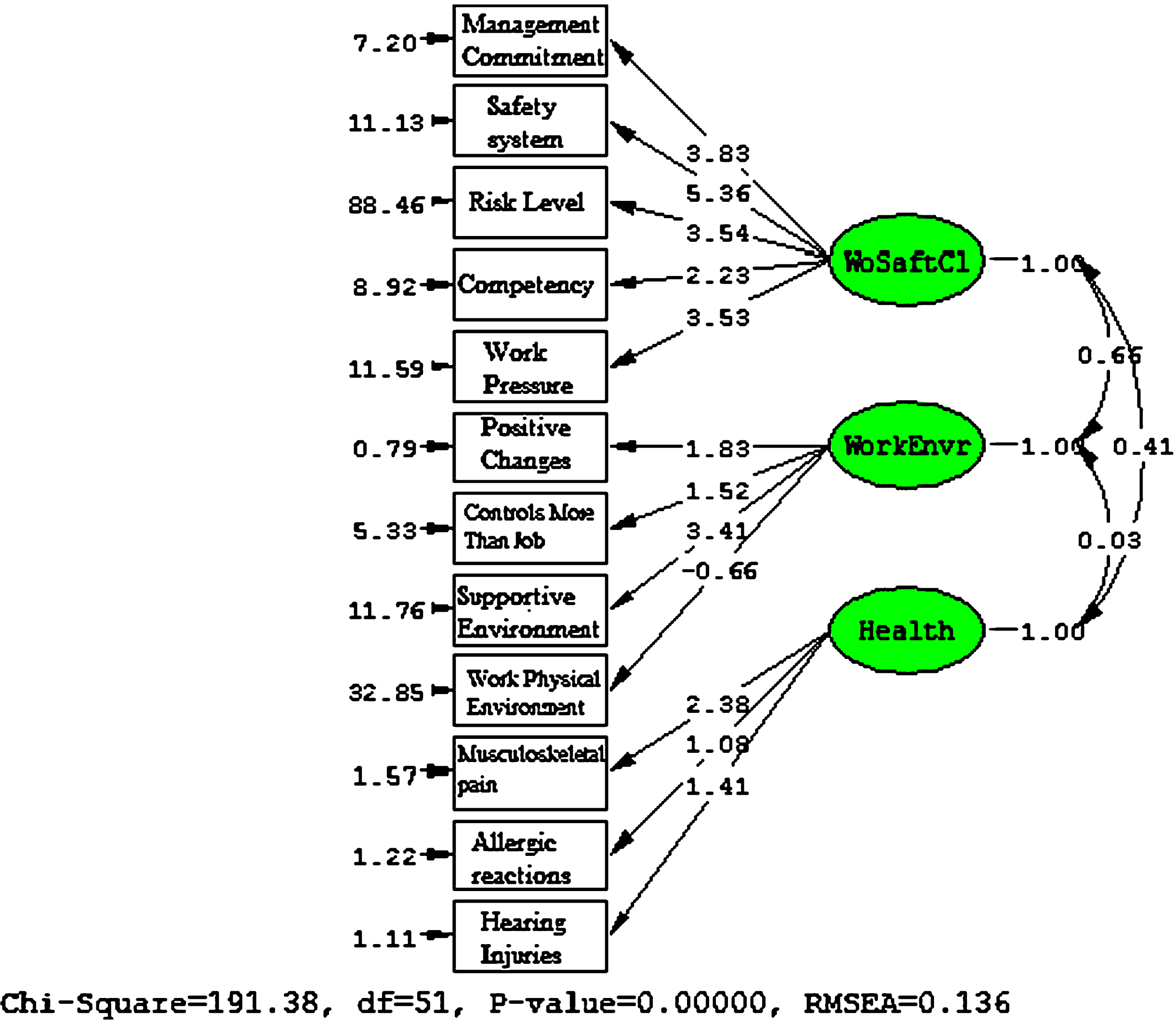
The correlation between indicators of safety condition, workplace and disease symptoms (Note: Work Safety Culture: WoSaftCl; Work Environment: WorkEnvr).
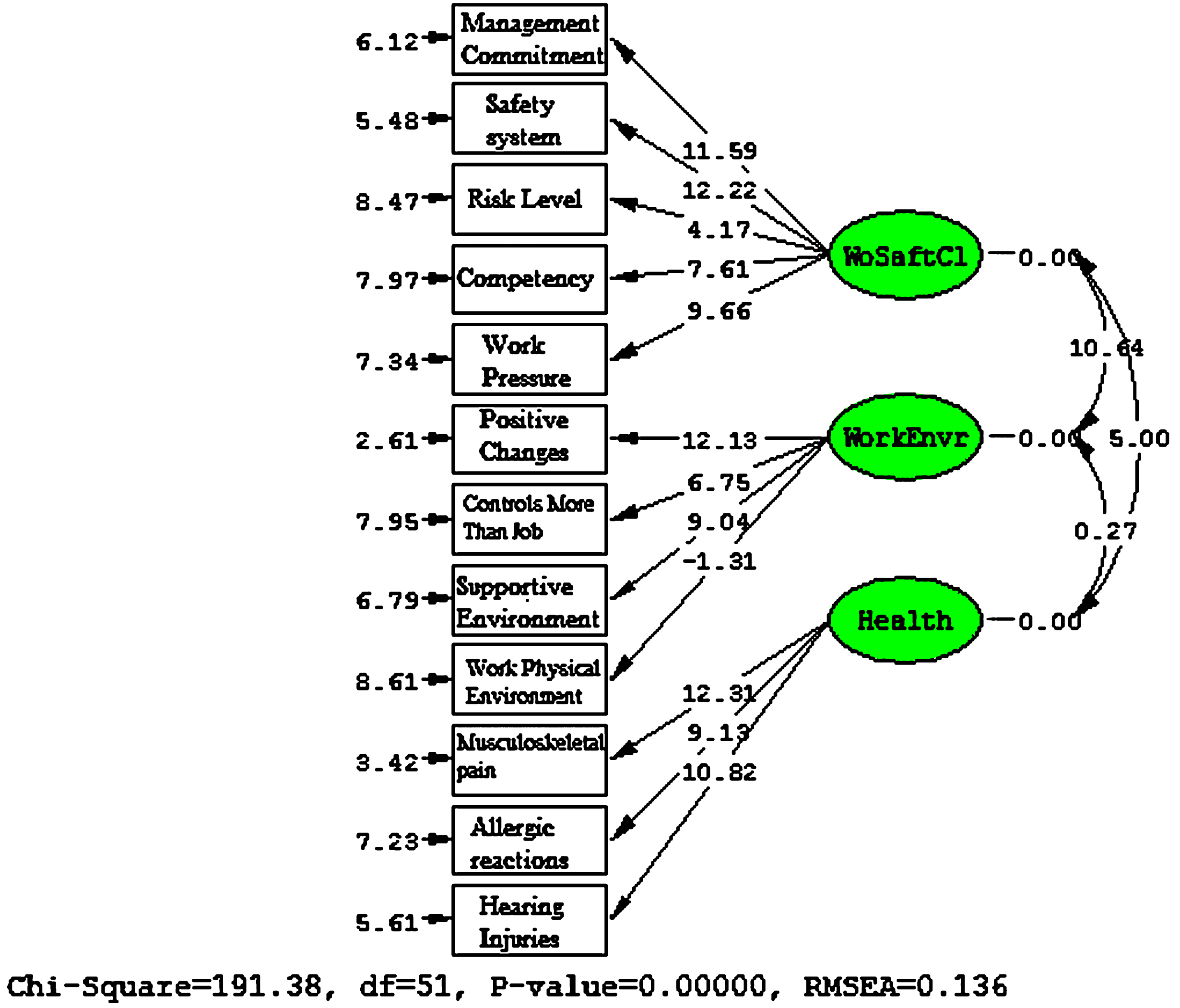
The confirmatory factor analysis between indicators of safety condition, workplace and disease symptoms (Note: Work Safety Culture: WoSaftCl; Work Environment: WorkEnvr).
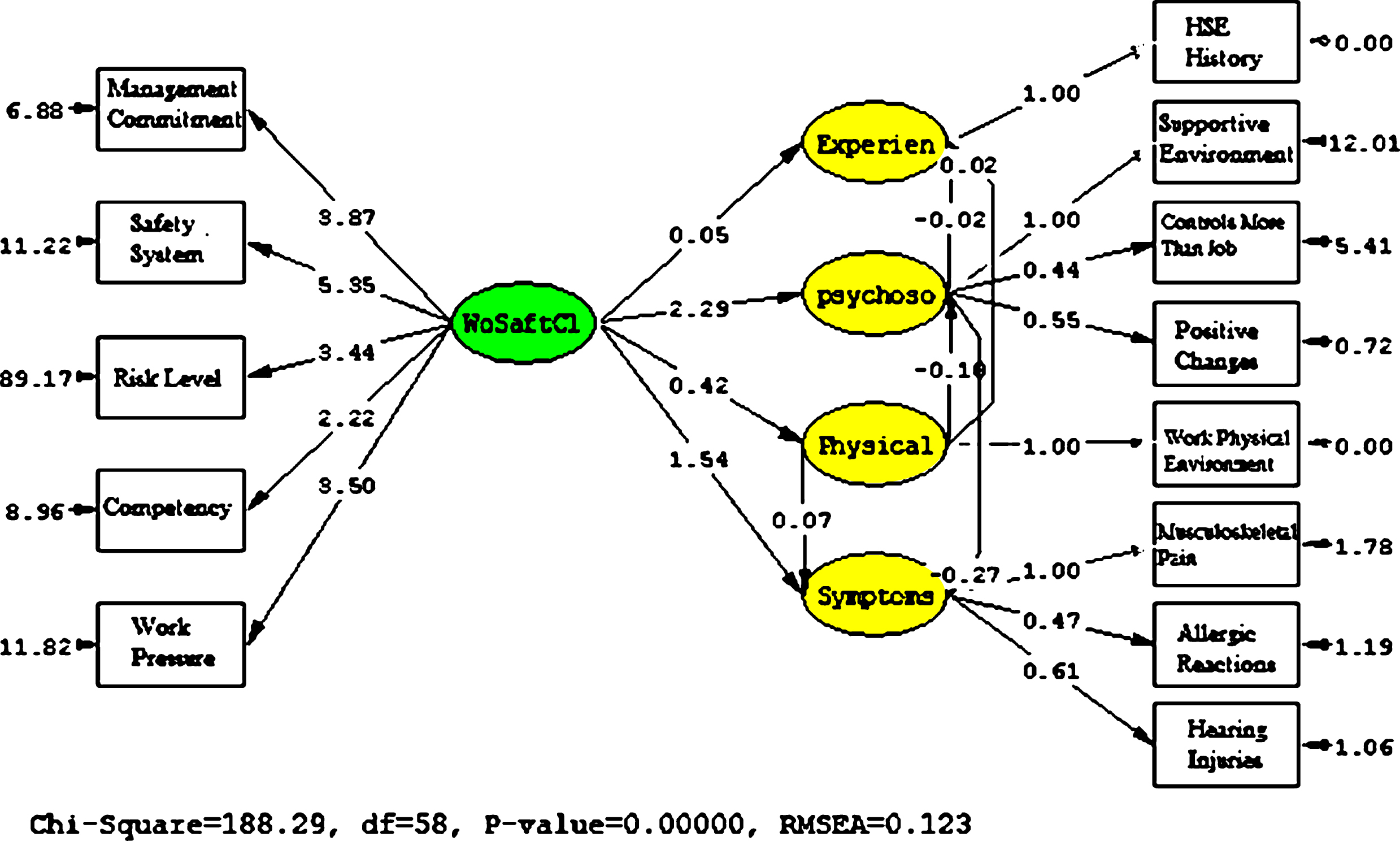
The structural model of aspects of HSE.

T-test results of the structural model of aspects of HSE.
Safety is a top priority for companies operating in the petrochemical industry. Occupational accidents have potentially catastrophic consequences, not only for workers directly involved, but also for the industry and society as a whole. For these reasons, researchers are increasingly concerned with the safety culture / condition concept. For example, previous studies have shown that employees’ perceptions of the workplace safety conditions are a strong predictor of occupational accidents [18, 20]. Such studies suggest that organizations with a stronger safety climate also report less harm in the workplace than organizations with a weak safety climate [7, 19]. This study was aimed to assess HSE climate and its effects on occupational accidents in a petrochemical industry. Based on the results, significant correlations were found between indicator of work HSE condition and indicators of workplace and disease symptoms. Dimensions of these three indicators have shown significant relationships. Indices of workplace environment, disease symptoms and HSE conditions are very effective to gain a better understanding and rooting the occurrence of occupational accidents. As it is well documented, the perception of physical work conditions of workers who have experienced an accident, was more negative than those who have not experienced an accident [20]. The impact of HSE condition was not found to be significantly effective on the occurrence of accidents. This result was similarly found by Høivik [19] but is not supported by other studies which found a significant relationship between safety conditions and accidents [21–24]. Some studies have shown that employees’ perception of safety condition is a strong predictive tool for occupational accidents [25, 26]. However, a large number of studies have shown that the perception of work safety condition is positively related to safe behavior and both factors are inversely associated with the occurrence of the accident at workplace [27, 28]. In this study, the results showed there is a significant relationship between safety condition and management commitment, as this finding is supported by Mosly and Makki [29]. The work psychological environment has not been observed to exert significant effects on occurrence of accidents. Bjerkan stated a strong relation between workplace psychological conditions and accidents experience [7]. HSE condition has significant effects on disease symptoms. Clearly, those who suffer from occupational diseases have a more negative attitude towards HSE conditions prevailing in their organization. Experience of accidents and occupational diseases may influence work safety condition and consequently, have a negative effect on work and organizational commitment, similar findings are reported by other studies [30–34]. Furthermore, the findings of the present study showed that physical work environment has a significant effect on symptoms of disease. Also, it is shown that the perception of different aspects of work and workplace environment can exert a significant effect on employees’ health and well-being.
Limitations
This study has some limitations that can be considered and followed up in future research. The study focused on a petrochemical complex in southwest in Iran and the permission of access to accident documents of industry was limited to 3 years, so the results may not be generalizable. As the study focused on site operators, only male workers participated in the study.
Conclusion
Unsuitable environments, mental conditions and harmful factors at workplace can exert a severe impact on increasing the risk of occupational accidents and diseases. The results showed a feasible approach towards the importance of reducing accidents and occupational diseases. A proper management system and use of employees’ involvement in creating a safe environment is very effective in reducing the probability and severity of accidents. HSE condition indicators, working environment and disease symptoms reflect workers’ views on HSE issues in the workplace that can be beneficial in rooting out the factors affecting occupational accidents and performance evaluation of the organization’s HSE management system.
Footnotes
Acknowledgments
The authors gratefully acknowledge the workers and petrochemical management for their kind cooperation in the study.
Ethics statement
The study was approved by Ahvaz Branch, Islamic Azad University (Code: 10650508951002).
Conflict of interest
The authors declare that there is no conflict of interest regarding the publication of this manuscript.