



Abstract
Background
The metal equipment manufacturing industry is inherently high-risk, particularly in welding operations. Effective training is critical to ensure welders’ safety and health. Systematic identification and prioritization of educational needs are essential for creating impactful training programs tailored to these high-risk environments.
Objective
This study aims to identify and prioritize essential training topics for welders using the Fuzzy Delphi Method (FDM) and Fuzzy Analytical Hierarchy Process (FAHP) to enhance safety, health, and productivity.
Methods
A total of 15 experts participated in this study, including 13 industry professionals (factory inspectors, engineers, and safety directors) and 2 academic experts (professors). Their professional backgrounds encompassed areas such as occupational health and safety, welding safety supervision, and HSE management. Their educational qualifications ranged from BSc to PhD. Expert opinions were collected in two phases. first, the Fuzzy Delphi Method (FDM) was used to refine the training topics, and second, the Fuzzy Analytic Hierarchy Process (FAHP) was employed to prioritize them based on their relative importance.
Results
Of 18 proposed topics, 11 met the 0.7 retention threshold. The highest-ranked topics were Working at Height and Use of Personal Protective Equipment (PPE), both with a normalized weight of 0.149. Other key areas included Welding Safety in Confined Spaces (0.142) and Electrical Hazards in Welding (0.112). Expert agreement across rounds was strong, with final consensus variation under 0.2.
Conclusions
Effective health and safety training is essential for high-risk industries like welding. Accurate identification of training needs ensures that tailored educational content enhances employee safety and organizational productivity.
Introduction
Welding plays a vital role in the metal equipment manufacturing industry, but it is also recognized as one of the most hazardous industrial activities due to its associated occupational risks. These risks stem from exposure to high temperatures, electric currents, hazardous fumes, radiation, and physically demanding work conditions such as working at heights or in confined spaces. The nature of welding makes workers susceptible to a variety of occupational injuries and illnesses, including eye damage (e.g., arc eye), skin burns, respiratory issues, and even long-term musculoskeletal disorders. Therefore, ensuring the safety and health of welders is a significant challenge, particularly in environments where safety awareness and training may be insufficient.1–5
A growing body of research highlights the strong link between effective safety training and the reduction of workplace accidents in high-risk professions such as welding. Unsafe behaviors, often rooted in a lack of awareness and insufficient training, are identified as key contributors to occupational accidents. Studies estimate that human factors account for up to 80% of workplace incidents, underscoring the importance of equipping workers with the knowledge, skills, and mindset to work safely and responsibly.6–8 Safety training is not only essential for compliance with occupational health regulations but also plays a crucial role in shaping workers’ attitudes and behaviors toward risk. Training programs that are tailored to the specific hazards of welding can enhance hazard recognition, improve decision-making in risky situations, and foster a stronger safety culture within organizations.
However, despite the recognized importance of safety training in welding, existing training programs often rely on assumptions, tradition, or managerial preferences rather than systematically identified needs based on expert consensus and empirical evidence. This can result in ineffective training content that overlooks critical hazards or fails to address the actual priorities of welders. Moreover, the integration of innovative technologies such as virtual and augmented reality in training demands a more precise identification and prioritization of educational needs to maximize their impact.9–12 Therefore, considering the complexity of training needs in occupations such as welding, particularly within industries like the Equipment Manufacturing Industry, selecting an appropriate methodological approach for identifying and prioritizing these needs is crucial. The Fuzzy Delphi Method (FDM) and the Fuzzy Analytic Hierarchy Process (FAHP) are especially well-suited for this purpose, as they effectively handle the uncertainty and subjectivity inherent in expert-based evaluations. Accordingly, the aim of this study is to identify and prioritize welders’ training needs in the Equipment Manufacturing Industry by employing a two-phase methodological framework that integrates the Fuzzy Delphi Method and the Fuzzy Analytic Hierarchy Process.
Methods
This study, conducted within the Iranian metal equipment manufacturing industry, focuses on identifying and prioritizing the training needs of welders. It comprises two stages. Figure 1 shows the methodological framework used in the study.

Proposed methodology framework.
Fuzzy Delphi method
The Fuzzy Delphi Method (FDM), originally introduced by Ishikawa et al. (1993), integrates traditional Delphi with fuzzy set theory to enhance flexibility and reduce the number of required iterations in expert consensus processes. This approach minimizes time and cost while managing uncertainty in expert judgments. In this study, trapezoidal fuzzy numbers were used to represent linguistic variables, following prior research demonstrating their effectiveness in group decision-making scenarios.13–16 The steps of the FDM are outlined as follows17–19:
Identification of Experts
The first step was to identify experts with sufficient expertise and experience in the field of the study. A total of 15 experts specializing in welding, safety, and behavioral aspects were selected from both academic and industrial backgrounds. They were contacted via telephone or email. This number was consistent with previous studies, where expert panel sizes typically ranged from 8 to 12 individuals. Participation in the study was entirely voluntary. All selected experts were informed in advance about the study's objectives, methodology, and the intended use of the results. Informed consent was explicitly obtained from all experts, either in written or electronic form.
Preparation and Distribution of Questionnaires on Educational Topics
To simplify the survey process, interviews were conducted with supervisors in the selected industry, statistics on welding incidents recorded in the industry were reviewed, and texts and articles related to safety and behavior in welding were examined in databases such as Scopus, Google Scholar, and Web of Science. Based on these steps, eight educational topics were proposed for training welders. Due to experts’ time constraints, the surveys conducted via email and phone in accordance with the provided instructions.
Extraction of Expert Opinions
Experts rated the importance of each training topic using aseven-level fuzzy linguistic scale, which included “Very Low” (VL), “Low” (L), “Medium Low” (ML), “Medium” (M), “Medium High” (MH), “High” (H), and “Very High” (VH). These levels were represented by trapezoidal fuzzy numbers, Experts could also suggest additional relevant topics. Subsequently, a weighting factor was assigned to each expert based on their role, experience, and education. The highest-scoring expert received a weight of 1, and others were scaled accordingly (Table 1). 21
Criteria for assigning weights to various experts 20 .

Fuzzification
As introduced by Zadeh (1965), fuzzification is an approach for modeling uncertainty using membership functions that assign degrees of belonging between 0 and 1. In this stage, expert judgments were quantitatively transformed into fuzzy numbers. Table 2 was used for this purpose, presenting the numerical representations of each fuzzy linguistic term based on the trapezoidal membership function pattern. 23
Linguistic terms and corresponding trapezoidal fuzzy numbers utilized in the research. 22
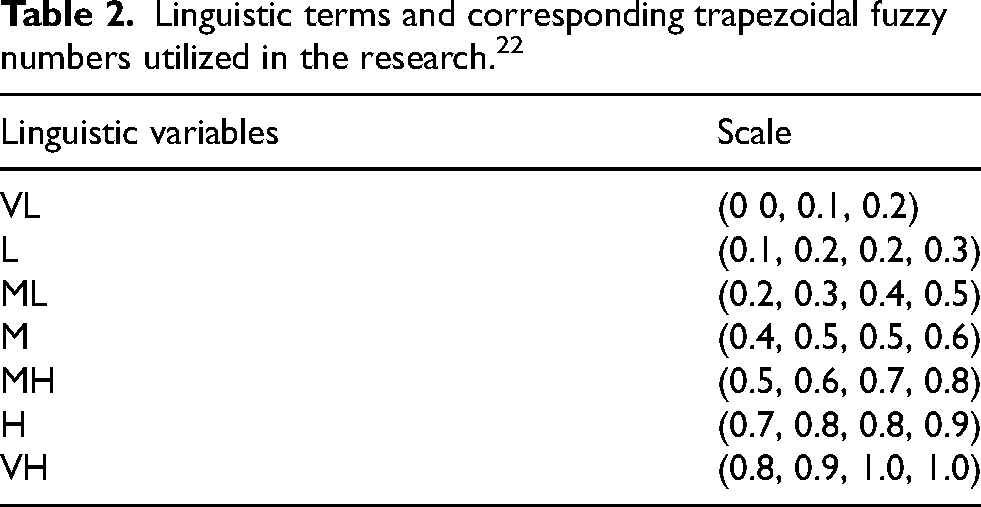
The trapezoidal membership function was chosen over triangular and Gaussian types due to its smoother transitions between linguistic variables and greater computational efficiency. This function more effectively captured the bounded nature of expert opinions in consensus-based decision-making and was particularly appropriate when clarity and interpretability were essential in modeling uncertainty.
This advantage led to its widespread use in decision-making research. For instance, Mirzaei Aliabadi et al. (2021) utilized trapezoidal fuzzy sets to identify and assess maintenance errors during catalyst replacement, aiming to better capture the linguistic uncertainty in expert assessments. 24 Similarly, Torfi et al. (2010) applied trapezoidal fuzzy AHP in personnel selection, emphasizing its ability to realistically reflect human judgment under ambiguous conditions. 25 Keshavarz Ghorabaee et al. (2016) also highlighted that trapezoidal fuzzy numbers improve interpretability and consistency in group decision-making, especially when expert opinions vary in precision. 26
Aggregation and Defuzzification of Expert Opinions
To consolidate expert judgments, the Similarity Aggregation Method (SAM) was employed. This method considered both the degree of consensus and the variability among expert opinions, while also incorporating weighted contributions based on each expert's qualifications and experience.27,28 After aggregation, the resulting fuzzy values were defuzzified using the Centroid of Area (COA) method. Originally proposed by Sugeno (1985), this approach was selected due to its simplicity and effectiveness in capturing the central tendency of fuzzy sets and producing crisp scores for further analysis.
Fuzzy Analytic Hierarchy Process Method
The Fuzzy Analytic Hierarchy Process (FAHP), first introduced by Laarhoven and Pedrycz in 1983, utilized fuzzy numbers and membership functions to capture the inherent uncertainty in human judgment. In this study, we adopted Chang's FAHP method.29–31 Initially, expert opinions were collected through linguistic pairwise comparisons of the training topics and then converted into fuzzy pairwise comparison matrices (Table 3). Subsequently, normalized weight vectors were calculated for each training topic based on the relative importance of each criterion, ensuring that the sum of all weights equaled one. This allowed the results to be interpretable and ready for prioritization. This structured process enabled us to derive a reliable and meaningful prioritization of welding safety training needs, grounded in expert consensus.
The definition of every fuzzy number used in FAHP.

To ensure logical consistency in pairwise comparisons, the consistency ratio (CR) for each expert's comparison matrix was calculated using Saaty's method. Only matrices with CR values less than 0.1 were considered acceptable. If a matrix exceeded this threshold, the corresponding expert was contacted to review and revise their responses. This process ensured the reliability and consistency of the input data used in the FAHP analysis. Furthermore, to enhance the reliability of the final weights, expert comparisons were aggregated using the fuzzy extent analysis method, and the resulting weights were normalized. Consistency of rankings within individual expert inputs was also examined to ensure stability. In addition, the logical alignment of final rankings with expert expectations and domain knowledge served as a qualitative validation of the prioritization outcome. All quantitative analyses related to the Fuzzy Delphi Method (FDM) and FAHP were also performed using SPSS software.
Results
The first phase of our study involved identifying the initial educational needs for welders based on a review of relevant literature. This literature suggested training topics included Principles of ergonomics and working postures in welding, Personal Protective Equipment (PPE), Electrical Hazards in Welding Operations, Welding Fume Exposure, Harmful Rays and Radiation, Hazards from Welding Sprays, Thermal Hazards from Hot Surfaces and Hazards of molten metal in welding.
Subsequently, to comprehensively identify educational topics, the FDM was employed in three rounds. A panel of 15 experts comprising both academic and industrial professionals with years of experience in welding safety and training was assembled. Table 4 presents information about the experts and the weighting coefficients calculated for each based on their professional position, experience, and academic qualifications. All 15 experts were geographically based in Iran. Their fields of expertise were classified into three main categories. Nine experts specialized in occupational health and welding safety, four served as occupational health and safety officers, and three had expertise in HSE supervision in industry.
Expert weighting score.

Based on expert opinions collected through the FDM in the first round, all eight initial training topics were retained, as none had defuzzified values below the 0.7 threshold. We used a threshold value of 0.7 to decide whether to retain or eliminate training topics, consistent with previous studies such as Fatemi et al. (2017), 32 who applied a similar cut-off in a Fuzzy Delphi-based indicator selection framework. A value of 0.7 reflects a moderate to strong level of expert agreement and helps ensure that the retained items are both relevant and significant. The topics that received the highest defuzzified values in the first round were Welding Fume Exposure (0.801), Personal Protective Equipment (0.793), and Harmful Rays and Radiation (0.775), as reported in Table 5. In the second round, the questionnaire was expanded based on expert feedback, leading to the inclusion of 10 additional topics and bringing the total to 18. These topics are listed in Table 6. Among them, 11 exceeded the inclusion threshold of 0.7 and were therefore retained, while 7 topics did not meet the criterion and were excluded.
Verbal opinions of experts on educational topics in the first round.

1. Principles of ergonomics and working postures in welding
2. Personal Protective Equipment (PPE)
3. Electrical Hazards in Welding Operations
4. Welding Fume Exposure
5. Harmful Rays and Radiation
6. Hazards from Welding Sprays
7. Thermal Hazards from Hot Surfaces
8. Molten metal splashes in welding
Educational topics identified based on second round FDM.

Table 7 presents the 11 educational topics retained after the second round of the fuzzy Delphi process. These topics were then included in the third-round questionnaire, and the mean difference between the defuzzified values from rounds two and three was less than 0.2. Since this difference was below the predetermined continuation threshold, the Delphi process was concluded. Table 8 summarizes the verbal expert opinions for each of the 11 selected topics during the final round. These verbal assessments were then converted into crisp values to facilitate quantitative evaluation. Following the completion of the FDM process, the 11 finalized topics were prioritized using the Fuzzy Analytic Hierarchy Process (FAHP). In this phase, each expert conducted pairwise comparisons between all possible pairs of the 11 criteria, resulting in 55 comparisons per expert. With 10 experts participating, a total of 550 pairwise comparisons were carried out. To manage inconsistent or conflicting judgments among experts, triangular fuzzy numbers were used to represent the pairwise comparison values. By performing the necessary FAHP calculations, the normalized weights for each topic were determined based on their ranking. Among the identified educational topics, ‘Working at Height’ and ‘Use of Personal Protective Equipment’ were jointly ranked as the most important topics, each with the highest weight (0.149). Following them, ‘Welding Safety in Confined Spaces’ (0.142) and ‘Electrical Hazards in Welding Operations’ (0.112) ranked second and third, respectively. The topic ‘First aid for welding accidents’ had the lowest weight among the educational topics. The normalized weights of all educational topics are shown in Table 9. Based on this prioritization, training programs can be designed and tailored to focus on the most critical safety needs of welders in the metal equipment manufacturing industry.
Educational topics identified based on FDM.

Experts’ verbal evaluations of educational topics in the final round.

1. Personal Protective Equipment (PPE)
2. Welding-Related Occupational Illnesses and Injuries
3. First aid for welding accidents
4. Principles of ergonomics and working postures in welding
5. Electrical Hazards in Welding Operations
6. Use of Fire Extinguishing Equipment
7. Welding safety in confined spaces
8. Working at Height
9. Welding Fume Exposure
10. Harmful Rays and Radiation
11. Hazards of pressurized cylinders
Results of the FAHP and prioritization of criteria based on final weights.

Discussion
The findings of the present study revealed that the two highest priority training topics were working at Heights and use of Personal Protective Equipment (PPE). These priorities reflect the real and frequent hazards that welders encounter when performing tasks at elevation and while exposed to physical risks. Amani et al. (2017) found that although over 90 percent of welders had experienced occupational injuries, fewer than half reported regular use of PPE, particularly respiratory protection. 33 Similarly, Alexander et al. (2016), in a study of welders in southern India, reported that limited use of PPE was associated with high rates of eye, skin, ear, and respiratory disorders. 34 In another study, Nalugya et al. (2022) showed that although knowledge of PPE was moderate, actual usage remained low due to financial constraints and insufficient regulatory enforcement. 35 In developing countries such as Iran, limited financial and human resources create significant challenges for the implementation of engineering controls. Under these conditions, PPE becomes the most accessible and practical form of protection, and training programs must be designed accordingly. 3
Considering that personal protective equipment and working at height were assigned the highest priority in the training needs assessment of this study, it was recommended that industries utilizing advanced technologies such as virtual reality (VR) for welder training should initially focus on these critical topics. Although immersive simulation technologies like VR provided effective and safe training environments that could lead to high-impact learning outcomes, their implementation faced challenges due to high initial costs, the need for technical infrastructure, and the time required for content development.
Importantly, based on these prioritized training needs, we developed an Android-based training application that is currently available to users. Due to budget constraints, we had to focus on the most critical training topics, and since no prior comprehensive study had identified these topics in Iran, this prioritization was extremely helpful for guiding the development of the training content. This framework is replicable and can guide future research in other industrial sectors or for other occupational hazards, offering a structured methodology to identify high-priority training needs and develop targeted interventions. For the first time in Iran, this app integrates the FDM–FAHP-based training framework with VR/AR simulation modules for immersive welder training.
This is consistent with findings by Alfaro-Viquez and colleagues (2025), who evaluated a VR welding simulator developed using the Unreal Engine. Their assessment revealed a significant reduction in task execution time and error rates, indicating strong learning transfer and increased productivity. However, they also highlighted challenges in scaling such solutions due to development expenses, infrastructure needs, and the effort involved in preparing training content. 36 To enhance cost-effectiveness, the development of VR training content should be guided by the prioritized educational needs. Topics such as personal protective equipment and working at height are particularly well-suited for immersive modules, as they involve hands-on procedures and situational risk awareness, both of which can be effectively simulated in VR environments. Focusing resources on these high-impact areas can improve training outcomes and yield a stronger return on investment.
Falls from height are also among the leading causes of occupational injuries in Iranian industries, which further supports the prioritization of this topic. 37 In a study by Pirvu et al. (2024), fall-related injuries, especially those caused by slipping or loss of balance at the same level, were identified as major risks for welders. 38 This highlights the importance of preventive training and the implementation of effective safety measures. Training related to confined space welding and electrical hazards received the second and third highest rankings respectively. These environments present specific dangers such as inadequate ventilation, restricted mobility, and a high potential for electric shock. 39 In line with this, Kah and Martikainen (2012) recommended structured training for welding in confined spaces. 2
The topics of welding fume exposure and hazards of pressurized cylinders ranked fourth and fifth, respectively, in the training needs assessment. Studies conducted in Iran have clearly highlighted the significance of welding fume exposure. For instance, Taheri fard et al. (2020) examined the respiratory, hepatic, and renal health status of 30 welders in the door and window manufacturing industry in Rafsanjan, reporting a clear link between respiratory problems and insufficient use of protective masks. 40 Similarly, Mohebian et al. (2020) assessed exposure to metal fumes and gases among welders in the shipbuilding sector, noting differences based on welding processes such as SMAW, MIG, and MAG. They recommended regular environmental monitoring and systematic risk assessment. 41 The topic of first aid for welding accidents also received the lowest priority score. This does not imply that the topic is unimportant, but rather reflects its role as a secondary or reactive measure when compared to preventive training strategies aimed at reducing the occurrence of accidents in the first place. A study by LaMontagne et al. (2007) demonstrated that reactive approaches such as post-incident responses and first aid generally have limited long-term impact compared to proactive interventions. Measures that focus on eliminating root causes and reducing exposure to hazards were found to contribute more effectively to lasting improvements in workplace safety. 42 Moreover, the weighted differences between training topics, though numerically modest, hold practical significance when allocating limited training resources. In high-risk industries with constrained budgets, even small variations in priority scores guide decision-makers toward focusing on training topics that experts collectively deem more urgent and impactful. 43
Among the distinguishing features of the present study compared to previous research is its comprehensive approach to identifying and prioritizing welders’ training needs. While earlier studies often focused on only one or two training domains and were primarily based on observational experience and individual judgment, this study employed a structured and integrated methodology. Specifically, the FDM was combined with the FAHP to assess a broad range of safety-related topics within the welding profession. To the best of our knowledge, no prior study in Iran has systematically identified and prioritized the full spectrum of training needs for welders. The structured approach not only provides a comprehensive understanding of welders’ needs in Iran but also establishes a methodological template that researchers in other countries or industries can adopt to systematically prioritize training topics. Considering that welders constitute a significant portion of the workforce across diverse manufacturing sectors in Iran, it was essential to identify their educational needs comprehensively. This approach enabled a more accurate and holistic understanding of training deficiencies in the welding industry. The breadth of the identified needs reflects not only the insights of subject matter experts in occupational health and safety but also the real-world conditions under which welding is typically performed in Iran. As demonstrated by Hsu et al. (2010), such a structured approach can be effectively applied to identify and prioritize key criteria in selecting lubricant regenerative technologies. 44 Similarly, Tsai (2020) highlighted the value of integrating the Fuzzy Delphi Method and FAHP in the field of vocational training, emphasizing that this method provides deeper insights into educational priorities and offers practical guidance for trainers and policymakers. 45
Several studies have confirmed the impact of training on reducing occupational accidents and improving work productivity. For example, Gamboa-Sánchez et al. (2023) reported that following the implementation of structured safety training programs in a mining contractor company, welding-related incidents and accidents were reduced by up to 40%. 46 Similarly, Aisyah et al. (2024) emphasized that a lack of knowledge regarding different welding methods and techniques can significantly reduce workers’ productivity and limit product diversity. 47 From a policy and managerial perspective, these findings may also serve as a practical tool for designing educational interventions. Moreover, regulatory bodies could incorporate the ranked list of training needs into industry-specific training standards for welders, thereby promoting greater regulatory compliance and enhancing overall safety performance. Future studies can use these prioritized training needs as a benchmark to evaluate the effectiveness of new training methods, optimize resource allocation, and measure the impact of immersive technologies on skill acquisition and workplace safety.
This study has several limitations. First, while consistency ratio (CR) checks were performed in the FAHP method to ensure the reliability of expert judgments, no formal sensitivity analysis was conducted. Future research should consider this to evaluate how input changes might influence the final results. Second, the study did not include direct input from welders, who are the primary users of the training programs. Including their perspectives could help identify practical challenges and specific needs that may not be fully captured through expert input alone. Lastly, the study focused on identifying and prioritizing training needs but did not assess the effectiveness or cost-efficiency of implementing these programs using technologies such as virtual reality or augmented reality. These aspects should be explored in future research to support real-world application.
Conclusions
This study systematically assessed the training needs of welders in Iran's equipment manufacturing industry using a combined Fuzzy Delphi and Fuzzy Analytic Hierarchy Process approach. Unlike previous work that often focused on limited topics or relied on subjective judgment, this research evaluated a broad spectrum of training requirements with input from field experts, providing a more complete and evidence-based perspective. Based on the prioritized needs, an Android-based training application was developed and is now accessible to users. Budget constraints required focusing on the most critical topics, and since no prior comprehensive study had identified these areas in Iran, this prioritization guided content development effectively. For the first time in Iran, the training app integrates the FDM–FAHP framework with VR/AR modules to offer immersive and practical learning experiences. The findings extend beyond reaffirming established safety practices by offering a structured approach for identifying and addressing the most impactful training gaps. This allows industry managers and policymakers to allocate resources efficiently and tailor interventions to real-world conditions. Furthermore, the combination of systematic prioritization and innovative delivery tools demonstrates how evidence-based methods can enhance training effectiveness while remaining cost-conscious.
Footnotes
Acknowledgements
The authors would like to thank all experts who freely participated in this study.
Ethical approval
This study received ethical approval from the Isfahan University of Medical Sciences, Isfahan, Iran (Ethical approval number: IR.MUI.REC.1401-063). The research was funded by the Isfahan University of Medical Sciences (Grant number: 3401657).
Informed consent
Informed consent was obtained from all participants.
Funding
The authors disclosed receipt of the following financial support for the research, authorship, and/or publication of this article: This thesis is the work of Ms. Samane Khorshidikia, and the present study was financially supported by Isfahan University of Medical Sciences under grant number 3401657.
Isfahan University of Medical Sciences, (grant number 3401657).
Declaration of conflicting interests
The authors declared no potential conflicts of interest with respect to the research, authorship, and/or publication of this article.